2018 3rd International Conference on Information Technology and Industrial Automation (ICITIA 2018) ISBN: 978-1-60595-607-7
Automatic Control for Fluorite
Floatation Process
Ying Song, Jinhua Wang, Xiangming Hu, Huorong Jin
and Jincheng Zhou
ABSTRACT
According to the conditions of the low level of automation and low laboratory productivity, an automatic control system for flotation process was designed and developed innovator based on the SIEMENS S7 PLC series software and hardware. The structure and function of the control system are introduced carefully. The control strategies of the pulp level the air flow-rate and the flotation reagent feeding are described in detail. The control software and human-machine interface are designed and developed. The actual industrial application results show that the control system operates steadily, safely and reliably, the worker labor intensities are decreased obviously, and the work condition is improved the competitiveness of the enterprise is enhanced. The method can automatically adjust the reagent feeding when the work-condition varies, so that the technical indexes can be controlled within their target ranges. The successful application has shown that the proposed method has practical significance and high potential of being further applied in
optimal control of mineral industry.1
PREFACE
Flotation is a kind of physical and chemical separation technology for the separation of multiple minerals at the interface of gas, liquid and solid. The automatic control of fluorite flotation process requires a variety of on-line instruments and complex mathematical models to measure the characteristics of the
1
Ying Song, Department of Pharmacology, Zhejiang University of Technology, Chao Wang Road 18#, Hangzhou, Zhejiang, China, 310014
flotation process. Flotation automatic control technology has been slow to develop for various reasons. In the actual production process, the operator often adjusts various control parameters according to the visual observation of the characteristic state of the flotation foam, making it difficult to achieve a good state in the flotation process.
Since the 1980 s, the development of computer technology can be regarded as a new technological revolution. The PH value, the level of flotation tank, the flow rate of slurry and its concentration and particle size can be accurately obtained. Recently, the flotation foam image has also been applied. With these technological achievements, the stable control of flotation conditions is becoming more and more mature, and optimal control to improve product grade and reduce consumption is being developed. Process optimization and loop control is developed. The system overcomes the shortcomings of manual adjustment. Through the stable control and optimized control of the flotation process, the energy consumption of flotation production is reduced, the concentrate production and quality are improved, the fluorite recovery rate is increased, and the management of the concentrator is improved.
FLOTATION PROCESS DESCRIPTION
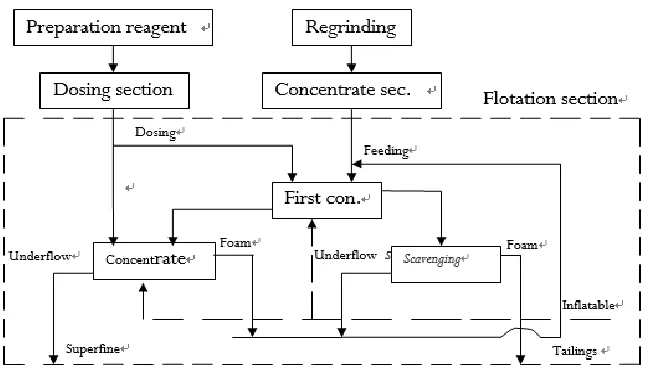
The flotation process consists of several sections, such as regrinding concentration, preparation agents. The regrinding section mainly guarantees the suitable granularity. Flotation requires not only sufficient monomer dissociation, but also suitable particle size. The closed-circuit grinding composed of ball mill and cyclone was used to regrinding the concentrate in the flotation section. The particle size was increased from -200 meshes content 68% to -200 meshes percentage content 94%. The first concentrate section is a dense separation of the slurry transported in the flotation process through featured tank to ensure that the pulp with the appropriate concentration and flow rate can enter into the floatation. The dosing section is mainly to add different kinds and different dosage of reagent in the different separation cell such as first concentrate and scavenging.
through the scavenging. The scavenging foam is discharged into the foam collector as the final tailings, and the underflow and the cleaning foam are fed into the first cell together for re-sorting. The flowchart of the flotation process is shown in fig. 1.
ANALYSIS OF THE RELATIONSHIP OF THE RELATIONSHIP BETWEEN CONTROL OBJECTIVE AND VARIABLES
The concentrate grade, tailing grade and recovery rate are the key process technical indicators for measuring the flotation effect in the flotation process of the whole concentrator. The main factors in the flotation process are: the ore grade, the ore concentration, the ore size, Feeding flux, dosing amount, PH value of the sorting process, aeration flow rate, flotation tank level, etc.
Operating Conditions
[image:3.612.136.460.462.650.2]In the actual production process, due to improper management or negligence of the operator, resulting in unstable production conditions, it will also affect the mineral processing index of fluorite concentrate. Under the conditions of optimized process conditions and reliable automatic control, the fluorite concentrator, such as pretreatment before flotation, removing silt and other substances that are not conducive to flotation, makes the concentration, particle size and flow rate of slurry in flotation remain basically unchanged. Because of the presence of Ca2+ and Mg2+ ions in the pulp, the flotation effect of fluorite and the dosage of reagent will be disturbed. The optimization model assumes that the water added to the ore dressing has softened or keeps the properties of the water unchanged.
The pH of the Pulp
The pH value of pulp has great influence on floatation of fluorite. In the range of 8-9.15, using oleic acid as collector, the floatability of calcite and fluorite is very well. The floatability of calcite in weak acid medium is worse than that of fluorite. Calcite has good floatability under alkaline condition. However, under the condition of weak acidity, the floatability of them is obviously reduced, which can be used to separate them in flotation. Therefore, the pH value in the sweep area should be strictly controlled, and the pH value 6.14 ~ 6.18 should be controlled in the latter tank of the sweep area.
Ore Pulp Temperature
Fluorite of pulp is usually floated with carboxylic acid collector. Because of the high freezing point of carboxylic acid, slurry temperature has a significant effect on flotation process. In a certain temperature range, the solubility of carboxylic acid in pulp increases with the increase of temperature, which is easy to disperse. In actual production, the pulp temperature is regarded as invariant and only affected by the weather.
Grinding Particle Size
Course fluorite has high flotation selectivity, high grade and low recovery, medium grade fluorite floatation has high grade and recovery, fine grade fluorite, flotation concentrate grade and recovery rate are all low.If the grinding fineness increased from-0.074 mm to 70%, the coarse concentrate grade increased from 72.96% to 77.38%, and the effect on the recovery of CaF2 was not obvious. If the grinding fineness was further increased to-0.074 mm, the coarse concentrate grade began to decrease. Therefore, the grinding fineness of-0.074 mm accounted for 70%.
Flotation Agents
Stability Control of Flotation Process
The most important variables that affect the automatic control of flotation are the addition of agent, the amount of aeration, the liquid level of pulp, the thickness of foam layer, the flow rate of pulp and the PH value. PH value controls the effect of mineral on the flotation fruit. In particular, it is very important to select flotation process. For each single loop control, the operator only needs to input a set point to keep the automatic variable on the set value. All the programs of the control loop are executed in a process controller PLC, and the control of the liquid level and the volume of gas in the flotation cell is always a difficult problem. Now, flotation cell level detection has achieved some success around the world. Accurately control the liquid level of flotation cell, the stability of slurry liquid level in flotation cell plays an important role in improving flotation index. It cannot only stabilize flotation operation, but also improve flotation index such as recovery and grade of useful minerals. The floatation process consists of rough, fine and scavenging processes. The liquid level control is mainly used to control the liquid level of the end cell in each flotation stage, especially in the coarse separation and sweep tank. The aeration volume is a flexible and sensitive parameter in the flotation control. The high quality gas Flowmeter and the corresponding regulating valve can accurately adjust the air volume required by flotation. The control of the air volume in the flotation process includes the control of the air volume of the roughing and sweep tank. Traditional PID Control The deviation between the set point and the real time detection value is used as the input of the PID controller, and the output of the controller is the valve opening u. Through the control of valve opening u to adjust the flow rate of inflation, realize the automatic control of the volume of inflation.
Product Grade and Consumption Optimization Control
The optimal control system adopts the optimization technology, used to the grade-recovery curve; the flotation condition is controlled within the economically acceptable range. One of the methods is that a large number of data are recorded in the monitoring system of the concentrator and the better data are extracted from them for training to find the best flotation process parameter combination. The optimal control is to determine the set value of the control variable according to the economic factors, while the supervisory control is in the operation and management of the production process.
guarantee the monitoring data the accuracy and the timeliness, simultaneously solves The problem of real-time data needed for optimal control system is solved. Through the expert system, the optimized computer can infer the set values of each control loop which can improve the grade of fluorite or reduce the material consumption.
Control Strategy for Control Systems
The flotation control system first solves the stability of the single loop control system. Guarantee the boundary conditions of the flotation optimization system application. The flotation liquid level measurement and control still needs to be done with care. The constant amount of inflation adjustment is also an effective control parameter.
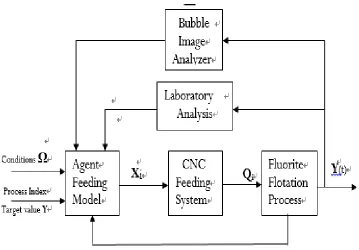
According to the characteristics of dosing in flotation process and the experience of on-site post operation experts, the flotation agent control strategy is proposed, as shown in Figure 2.
[image:6.612.107.466.392.642.2]Laboratory analysis takes a long time, and analytical instrument is expensive and maintenance trouble. The application of foam imager provides a guarantee for obtaining the data of the relation between the object of massive flotation process and the control variable. After large data analysis, you can get optimized operating conditions, real-time optimization control.
IMPLEMENTATION OF THE CONTROL SYSTEM
The control system consists of the Siemens S7-300 and the HMI operation and
optimization station. The single loop control is realized by the I/O module of the S7-300PLC and the man-machine station. Figure 3 is the fluorite flotation operation interface: The thickener exit shows the slurry concentration and particle size prediction value, the rough selection and the fine 2 mixing tank set the PH value control loop, and the flotation tank sets the liquid level control. Apparatus 5001-5003 is a medicament preparation tank that is administered by a numerically controlled drug delivery system.
CONCLUSIONS
REFERENCES
1. Song Ying, Jin Huorong, Hu Xiangming, Zhon Ghong, Cao Zhanfang, Wang Shuai, Xia Liuyin. 2011. “Beneficiation Tests on Suichang Carbonate Fluorite Ore,” Nonferrous Metals, 422(4): 89-93.(in Chinese)
2. Zhang Wang, Zhang Guofan, Chen Wensheng, Feng Qiming. 2014. “Research on the Flotation Process of a Carbonate Type Fluorite Ore,” Nonferrous Metals, 4:48-52. (in Chinese)
3. Hong Long. 2000. “Development status and prospect of mineral processing control,” Nonferrous Metals, 52(4):123-125. (in Chinese)
4. Li Zhenxing, Wen Shuming, Luo Liangfeng. 2008. “A review on automatic detection and automation during mineral processing,” Yunnan Metallurgy, 37(3):20-21. (in Chinese)
5. Amsden, M.P. Chapman, C. and Reading, M.B. 1973. “Computer Control of Flotation at Crystal Concentration,” CIM Bulletin. 18(1): 84-91.
6. Behrend, G.M. 1978. “Mill Instrumentation and Process Control in the Canadian Mining Industry,” Milling Practice in Canada. 10(5):23-44.
7. Ren Chuancheng. 2013. “Research progress of soft measurement technology of concentrate grade in flotation process,” Mining & Processing Equipment, 41(8):8-12. (in Chinese)
8. Zhang Yong, Wang Jiesheng, Wang Wei, Yao Weinan. 2005. “Soft-sensor Modeling for Economy and Technology Indexes in Flotation Process,” Control Engineering of China, 12(4):346-348. (in Chinese)
9. Lv Jian, Xu Sheng, Jiang Xin, Yu Zhuang, Kan Liang. 2015. “Application of flotation foam image analyzer in a copper and molybdenum concentrator,” China mining science and technology, 2015. (in Chinese)