© 2016, IRJET | Impact Factor value: 4.45 | ISO 9001:2008 Certified Journal | Page 2311
M-Toll Using Wi-Fi Technology
Shital Ladkat
1, Bansari Sanghvi
2, Aishwarya Tamne
3, Shrinivas Rathod
4and Prof. Smita Patil
5.
Student, Dept. of I.T, Atharva College of Engineering, Mumbai, India
1,2,3,4Assistant Professor, Dept. of I.T., Atharva College of Engineering, Mumbai, India
5---***---Abstract -
The existing toll collection system all over India isoperated manually. A toll system is the place where toll is paid for passage of a vehicle from the toll plaza. In the existing toll tax system, we observe limitations like mismanagement of time, long queue for the payment. The aim of the project is to implement toll collection system using Wi-Fi technology to overcome demerits of existing toll system. A Mobile Wallet promises a future where users do not need to carry hard cash while travelling. Wi-Fi toll collection stations allow the traffic to flow continuously, and vehicle being stopping and starting again. It reduces fuel consumption and has positive effect on environment. By using M-toll payment system it leads to automatic and easy toll payment. The Android phone need to be included in each vehicle and details of vehicle owner must be stored in the database of toll tax system. Wi-Fi technology will develop the existing payment system used in toll collection.
Key Words: Android Application, Wi-Fi Technology,
M-Toll, Electronic Toll Collection System.
1.INTRODUCTION
The toll collection system all over India is the manual toll collection system. We have proposed an idea of making the toll collection totally electronic with the use of Wi-Fi and Android technology [1]. Electronic toll collection (ETC) is a technology enabling the electronic collection of toll payments. It has been studied by researchers and applied in various highways, bridges, and tunnels requiring such a process. This system is capable of determining if the vehicle is registered or not, and then informing the authorities of toll payment violations, debits, and participating accounts. The most obvious advantage of this technology is the opportunity to eliminate congestion at tollbooths, especially during festive seasons when traffic tends to be heavier than normal. It is also a method by which we can curb complaints from motorists regarding the inconveniences involved in manually making payments at the tollbooths. Other than this
obvious advantage, applying ETC could also benefit the toll operators.
1.1 Manual Toll Collection
Until somewhat recently, the most common approach for collecting tolls was to have the driver stop and pay a toll collector sitting in a tollbooth. The toll collector determines the amount to be paid by each vehicle based upon its characteristics or classification.
1.2 M-Toll
Automatic Vehicle Identification (AVI) technology can accurately identify a specific vehicle at highway speeds, thereby, enabling a wide variety of ETC applications. In its basic form, a vehicle passing through a toll collection point has its identification device read, after which the toll is deducted from the customer’s pre-existing account or the customer is sent an invoice. The driver pays the toll without stopping and tollbooths are not required. ETC also determines whether the vehicles passing are enrolled in the program, and gathers information on the vehicle for further collection or enforcement action [1] [2].
2. RELATED
WORK
© 2016, IRJET | Impact Factor value: 4.45 | ISO 9001:2008 Certified Journal | Page 2312 stable technology. With the elimination of human interaction
in the entire toll collection process, it can also significantly improve the efficiency of toll stations and the traffic abilities of the toll road. In [4] implementation of Bluetooth technology in the application of toll tax system is explained. The Bluetooth is wireless technology was created to replace the cables used on mobile devices with radio frequency waves. The technology encompasses a simple low cost, low-power, global radio system for integration into mobile devices, which can form a quick ad-hoc secure “piconet” and communicate among the connected devices. This technology creates many useful mobile usage models because the connections can occur while mobile devices are being carried in pockets and briefcases. In [5] author explained that Toll tax system in India has most of the highway projects are given on PPP basis, i.e. Public Private Partnership. In this the private organization finances and constructs the facility and recovers the capital from the users in the form of toll tax. This tax is collected for a reasonable period of time after which the facility is surrendered to the public. In [6] the Radio Frequency Identification (RFID) tags has been used in vehicles to automate the toll process on toll roads, bridges, and tunnels in a process called Electronic Toll Collection (ETC). These tags are mounted to the windshield or externally surrounding the license plate on a vehicle and read as the vehicle proceeds without stopping through special lanes at the toll plaza. In [7] author made security system that in the present age Mobile and electronic commerce has been the hot topic of application and research, and the E-cash system is the key technology and backbone of electronic commerce.
3.
IMPLEMENTED
SYSTEM
[image:2.595.307.565.95.279.2]Automatic Vehicle Identification (AVI) technology can accurately identify a specific vehicle at highway speeds, thereby, enabling a wide variety of ETC applications. In its basic form, a vehicle passing through a toll collection point has its identification device read, after which the toll is deducted from the customer’s pre-existing account or the customer is sent an invoice. The driver pays the toll without stopping and tollbooths are not required. ETC also determines whether the vehicles passing are enrolled in the program, and gathers information on the vehicle for further collection or enforcement action.
Figure 1: Architecture Diagram for M-Toll using Wi-Fi Technology
The above architecture diagram describes the working of M-Toll using Wi-Fi Technology. There are different phases for the system. They are described below.
Following are the phases for android applications:
PHASE 1: REGISTER
Each vehicle passing through must have a Smartphone which must be registered with the M-Toll system. The registration can be done at Toll Booth only. The registration process includes verification of personal and vehicle documents. After the verification is done the user will be provided with unique username and password which will be used for login. User can recharge their account after registration.
[image:2.595.312.556.529.687.2]© 2016, IRJET | Impact Factor value: 4.45 | ISO 9001:2008 Certified Journal | Page 2313 PHASE 2: LOGIN
[image:3.595.342.525.165.324.2]The user first needs to scan and connect to the open Wi-Fi on the Toll Booth. This phase includes logging in to the application to pay the toll using Username and password provided at the time of registration. The username and password will be verified in the database. If the user already exists and the input given by user is correct then the login will be successful and user can perform further activities or else the login will be unsuccessful.
Figure 3: Login for M-Toll using Wi-Fi Technology Application
PHASE 3: TOLL PAYMENT
The user can then pay the toll according to his/her vehicle type by just clicking on pay toll button. The balance will be automatically deducted and the balance will be updated to the database. The updated balance will be shown to user after the transaction. The users will automatically logout after the transaction is completed.
Figure 4: Toll Payment for M-Toll using Wi-Fi Technology Application
PHASE 4: E-MAIL RECEIPT
[image:3.595.89.234.239.394.2]Here the user will receive an email for the payment of toll with Transaction Id, Vehicle Type, Vehicle number, Amount Paid and updated balance.
Figure 5: E-mail receipt for Payment of Toll
Following are the phases for website:
PHASE 1: LOGIN
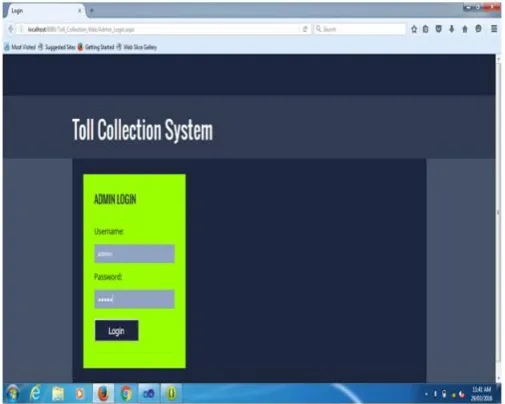
The admin needs to login to the website to access services provided by website. The Admin will have his own username and password so that nobody else can access the website.
[image:3.595.308.561.532.734.2] [image:3.595.100.222.558.727.2]© 2016, IRJET | Impact Factor value: 4.45 | ISO 9001:2008 Certified Journal | Page 2314 PHASE 2: ADD/DELETE/EDIT USER & DETAILS
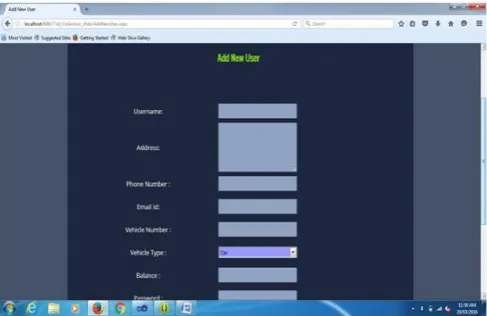
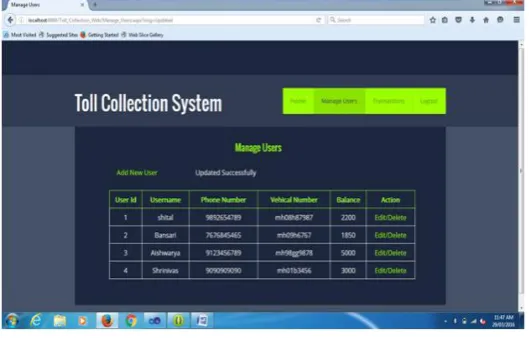
[image:4.595.316.554.71.251.2]The Admin can add, delete or edit the user after verification of user documents. He can update the balance, vehicle type and other user details.
Figure 7: Manage users for Admin
Figure 8: Add/Delete/Edit User for Admin
PHASE 3: TRANSACTIONS
This phase contains the list of all transactions in tabular format along with Transaction Id, User Id, User Name, Charge, Date & Time, etc. The Admin can check for any transaction if required. The following figure gives an overview of this phase:
Figure 9: Transactions of User for Admin
Phase 4: IMAGE PROCESSING (BROWSE & VALIDATE)
[image:4.595.36.301.175.344.2]In this phase the Admin will browse the captured image of user’s vehicle number plate and will validate the image. If the vehicle number in image matches the vehicle number in transaction table then the pop will be displayed on the website & vehicle is allowed to pass Toll Booth.
Figure 10: Image Processing
PHASE 5: LOGOUT
[image:4.595.38.574.385.559.2]© 2016, IRJET | Impact Factor value: 4.45 | ISO 9001:2008 Certified Journal | Page 2315 Figure 11: Logout for Admin
4. CONCLUSION
Wi-Fi toll collection stations allow the traffic to flow continuously and vehicle having been avoided stopping and starting again. This in combination with reduced fuel consumption has positive effect on environment i.e. pollution created will be minimum. Implementing the Wi-Fi technology is also not so costly. Man power and cash risks are also reduced to minimum. Furthermore, only a minimum of traffic disruption is caused during installation. The system also increases safety, as bottlenecks and long queues are avoided. Society and business community also gain from the system as it results in faster transportation. The system is cost-effective, time saving and easy to install which benefits the operator as well as user.
REFERENCES
[1] Mastooreh Salajegheh, “Unleashing The Wild Card for Mobile Payment”, in IEEE International Conference on Pervasive Computing and Communications (PerCom), 2014.
[2] Ganesh K. Andurkar, “Smart Highway Electronic Toll Collection System”, in IJIRCCE, 5th May, 2015. [3] Khadijah kamarulazizi and Dr. Widad Ismail,“Electronic toll collection system using passive RFID technology”, in Journal of Theoretical and Applied Information Technology, 2005-2010. [4] Soni Rani, “Bluetooth Approach For Toll Tax
Application”
http://dspace.thapar.edu:8080/dspace/bitstream/ 123456789/260/1/91889.PDF
[5] Tom Matthew, “Toll operation”, Chapter 46, http://nptel.ac.in/courses/105101008/downloads /cete_46.pdf
[6] F. Don, “Electronic Toll Collection: An Introduction and Brief Look at Potential Vulnerabilities,” in SANS Institute info Sec Reading Room, 1.4b ed. 2004.
[7] Akash Shetty,Yash Chapaneri, Shrikant Parte, Tushar Ghalsasi, Smita Patil, “Elliptical Curve Cryptography in MobiCash”, JCT Volume 3 Issue 4, ISSN: 2278-3814, April 2014.
[8] C. Karlof, N. Sastry, and D. Wagner. Tinysec: link layer security architecture for wireless sensor networks. In SenSys’04, pages 162–175, New York, NY, USA, 2004. ACM.