© 2016, IRJET | Impact Factor value: 4.45 | ISO 9001:2008 Certified Journal
| Page 104
STUDY OF SSSC IN IMPROVEMENT OF POWER SYSTEM
STABILITY WITH SMIB
Nishad Anjum Pathan
1Nishad Anjum Pathan (Research Scholar) Department of Electrical Engineering G. H. Raisoni college of Engineering Nagpur, India.
---***---Abstract -
In this paper, for various faults, the machinesin a stable power system initially oscillate and then settle at the stable equilibrium point where the transient energy is zero. This paper utilizes the rate of dissipation of transient energy as a measure of system oscillation damping. This concept is used to determine the additional damping provided by power system stabilizer and facts device SSSC. This technique is then studied with help of MATLAB Simulink for various condition with help of single machine infinite bus system (SIMB). The result obtained for various condition are then systematically described.
Key Words: power system oscillation, power system
stabilizer, SSSC (Static Series Synchronous Compensator ), SIMB (Single machine infinite bus), MATLAB Simulink
1.1
INTRODUCTION
In last few decades, power demand has increased to a great extent while the expansion of power generation and transmission has been rigorously limited due to limited resources and environmental constraint. As a reason, some transmission lines are heavily loaded and the system stability become a power transfer restricting factor. For overcoming this situation power system become interconnected and complicated, that is why areas of generation are found to be prone to electromechanical oscillation .The repression of electromechanical oscillation is one of the greater concern in electric power system operation .The uncontrolled oscillation leads to total or partial power system suspension or outage.
The key factor of having sustained or growing oscillations is the deficiency of adequate system damping. Power system stabilizer is possibly the first measure that has been used to improve damping. In last few decades flexible ac transmission systems (FACTS) devices have been increasingly used in power systems to improve both the steady state and dynamic performances of the systems.
The first generation thyristor-controlled FACTS devices, such as static var compensator (SVC) and
thyristor-controlled series capacitor (TCSC) have satisfactorily been used in power systems for dynamic reactive compensation. The above FACTS devices require fully rated capacitor or reactor bank to supply or absorb reactive power. However, this requirement can be avoided by employing self-commutated voltage-sourced switching converters to realize static synchronous s voltage sources at fundamental frequency .The FACTS devices that belong to this category synchronous series compensator (SSSC) and unified power flow controller (UPFC) which are second generation facts devices.
Dynamic control of generator output power is the main point in subduing electromechanical oscillation or improving damping of a power system .The damping of a generator can be enhanced by growing its output power when the angle δ increases or speed ω > 0 and reducing the power when the angle decreases or ω < 0. Thus, the speed ω can be reflected as a suitable control signal for improving damping of generator by variable its output power.
Various methods of estimating system damping in the presence of FACTS devices are stated in literature [5-10]. Most of the above methods defined the controller design for damping enhancement. The damping of system is typically studied by model scrutiny of a linearized system model. Other methods of assessing system damping are also stated in the literature [12].
© 2016, IRJET | Impact Factor value: 4.45 | ISO 9001:2008 Certified Journal
| Page 105
1.2
POWER SYSTEM STABILIZER
The reaction of AVR in front of the station voltage oscillate is to force field current changes in generator. This is so called negative damping may be eradicated by presenting additional control loop, known as power system stabilizer .The basic function of PSS is to spread the stability limits by moderating the generator excitation to provide damping for the rotor oscillation of synchronous machines. The PSS can improve the damping of power system, rises the static stability and improve the transmission proficiency .The PSS output is additional to the variance between reference and actual value of the terminal voltage .Normal input signal for the PSS are the rotor speed deviation, the accelerating power, active power output or the system frequency as revealed in fig .1
Kpss
STw STw
1
1
2
1
1
ST
ST
4 1 3 1 ST ST Output voltage Vs Wash out FilterPss Gain Input signal Lead-lag compensator Limiter
Fig 1: Block diagram of PSS
The block diagram is used in portrayed in fig.1. The PSS assembly contain a washout block ), used to decrease the over response of the damping during severe events. Also the washout block, serves as high–pass filter, with constant that permits the signal related with oscillation in rotor speed to pass unaffected, but also does not allow the steady state alteration to adapt the terminal voltages. For native mode operation, a washout time constant TW of 1 s to 2s is acceptable. Since the PSS must create a constituent of electrical torque in phase with speed deviation, phase lead block circuits ate used to recompense for lag between the PSS output and the action control, the electrical torque. The number of lead lag blocks rest on the specific system and the tuning of PSS. The PSS gain KPSS is a significant as the damping provided by the OSS increases in proportion into an increase in the gain up to a definite value, after which the damping begins to decline. In order to limit the value of generator terminal voltage variation during transient condition, limits are forced on the PSS output.
The dynamic compensator is prepared up to two lead lag phases and has the transfer function,
Where, KPSS is the increase of PSS and the time constant T1 to T4 are selected to provide a phase lead for input signal in the range of frequencies that are in the range of the interest (0.1Hz to 0.3Hz).
The torsional in the PSS is basically a band reject or low pass filter to diminish the first torsional mode frequency .The transfer function of the filer can be uttered as,
F
1.3
STATIC
SERIES
SYNCHRONOUS
COMPENSATOR
Static synchronous series compensator(SSSC) is a series FACTS device which injects a controlled voltage into the system in quadrature with line current but controlled independently of the line current, so as to control impedance which is a function of reactive power.The basic diagram of SSSC is shown in figure2.The SSSC is capable of internally generating a controllable compensating voltage over an identical capacitive and inductive range independently of the magnitude of the line current. The series impedance of the line primarily limits AC power transmission over long distances. The SSSC has the inherent ability to interface with an external dc power supply to provide compensation for the line resistance by the injection of the real power, as well as for the line reactance by the injection of reactive power.
Fig.2 Single line diagram with SSSC
The main control objective of the SSSC is to directly contorl the current, and indirectly the power, flowing through the line by controlling the reactive powerexchange between the SSSC and the AC system. The main advantage of this controller over a TCSC is that it does not significantly affect the impedance of the transmission system and, therefore, there is no danger of having resonance problem.
2. MATHEMATICAL
MODELING
A .Generator Modelling:
© 2016, IRJET | Impact Factor value: 4.45 | ISO 9001:2008 Certified Journal
| Page 106
Stator winding equation:vq = −rsiq − xd0id + Eq0
vd = −rsid + xq0iq + Ed0
where, rs is the stator winding resistanc
xd0 is the d−axis transient resistance
xq0 is the q−axis transient resistance
Eq0 is the q−axis transient voltage
Ed0 is the d−axis transient voltage
Rotor winding eqation:
Tdo dEq0 dt + Eq0 = Ef − (xd − xd0) id Tqo0 dE dt + Ed0 = (xq − xq0) iq where
Tdo0 is the d−axis open circuit transient time constant Tqo0 is the q−axis open circuit transient time constant Ef is the field voltage
Torque equation:
Tel = Eq0iq + Ed0id + (xq0 − xd0) id iq
Rotor eqation:
2Hdω dt= Tmech − Tel − Tdamp Tdamp = D∆w
where ,
Tmech is the mechanical torque, which is constant in this model
Tel is the electrical torque Tdamp is the damping torque D is the damping coefficient.
B. SIMB system with PSS:
G Generator
Transformer
Infinite bus
1000 MVA 13.8KV/500 KV
1000 MVA
Vb=1p.u
L1=350 km
L2=350 km
Vt=1 p.u
m
Fig.3 Single line diagram of SIMB system
Consider the simple machine infinite bus (SIMB) as presented in the fig 2. It comprise of a generator attached to an infinite bus through a step–up transformer and a double circuit transmission line. Vt and Vb are magnitude of machine internal voltage and infinite bus a respectively. The system equivalent circuit diagram is given in fig.3.X1 characterizes transformer xt plus machine sub transient
and X2 represent reactance XL1 line 1 in parallel to reactance XL2 of line 2. The magnitude of the machine internal voltagre and infinite bus voltage is characterized by E and V correspondingly.
The dynamics of the machine in conventional model can be characterized by the following differential equation,
(1)
(2)
Here, δ, ω, M, Pm and D are the angle, speed, moment of inertia, input mechanical power and damping co-efficient, correspondingly of the machine. The electrical output power Pe of machine in the fig.3 can be written as,
(3)
Where
The transient energy E of the system can be expressed as,
(4)
Here δs is the machine angle at the post fault stable symmetry point. Note that most of the works on the TEF method are based on the basic machine model . The method may not be very used when very urbane machine model and all associated controls are deliberated2. The first term on the right hand side of (4) depends upon ω and is called the kinetic energy (KE) and the rest of the terms depends on δ is called the potential energy (PE).The time derivative of the energy function is written as ,
(5)
© 2016, IRJET | Impact Factor value: 4.45 | ISO 9001:2008 Certified Journal
| Page 107
(6)
Note that can be considerd as rate of dissipation of transient energy. In the absence of a FACTS device, Pe is govern by (3) and for such case of (6) becomes,
(7)
Thus, without any FACTS device, the rate of dissipation of transient energy rest on the damping coefficient D. The detached of this study is to increase the rate of dissipation of transient energy by appropriately modulating machine output power Pe with the help of FACTS devices and which is defined. The transient energy at the SEP is zero and thus the rate of dissipation of transient energy can be deliberated as an amount of system damping. In this study additional, SSSC and UPFC are to increase the rate of dissipation of transient energy and hence to expand damping. The extra damping delivered by these devices in the simple system of fig.2 is methodically resulting in further work on this area.
C. SIMB system with SSSC:
A SSSC is a VSC-based series facts device that injects a voltage in series with the transmission line voltage. Consider that a SSSC is placed near bus m in the SMIB system as shown in fig.5. The equivalent circuit of the system is shown in ,
G
VSC
Vt m
C
L1
L2
Infinite Bus Vb
Fig.5 Single line diagram of SIMB system with SSSC
the fig.6 where the SSSC is represented by a series
voltage sources.
jX1 jX2
Vb
Vm
E
Is
Fig.6 Equivalent diagram of SIMB system
Note that Vs is always kept in quadrature with the line current so that SSSC can exchange only ractive power with the system. Thus,
(8)
Here, is the angle of line current and is given by,
(9)
With the SSSC,the machine power Pe can be written as,
Where,
(10)
Note that f2(δ) is positive when δ oscillates in between zero and П. It may be mentioned here that Vs in eqaution (9) is positive or negative when SSSC is is operate in capacitive or inductive mode.
Thus, Pe of equation (9) can be modulated by properly controlling the value of Vs. When is used to control signal Vs can be expressed as,
;
(11)
Here, k2 is a positive gain and its depend on the maximum volatge rating ( of the SSSC.using equation (10) and (11), of equation (6) can be written as
,
(12)
3.
SIMULATION
RESULT
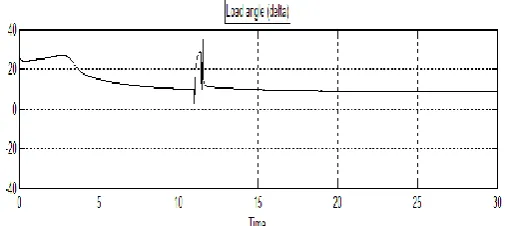
The single line diagram of SMIB which is shown above in fig.2 are modeled and simulate in MATLAB Simulink. The run time for the system is 30 sec . The three phase fault is applied at bus m . The time where the fault is applied is 11sec and it is cleared at time 11.3 sec for analysis of system. The system is studied for tree different and three different parameter cases which are as follow:
A.
Without Fault and with PSS.© 2016, IRJET | Impact Factor value: 4.45 | ISO 9001:2008 Certified Journal
| Page 108
of machine which shows the deviation occurring in speed. [image:5.595.314.557.95.199.2]Fig.8 the rotor speed of machine and fig.9 analyzes rotor angle of the machine.
Fig.7 Rotor speed deviation of machine for run time 30sec
Fig.8 Rotor speed of machine for run time of 30sec
Fig.9 Rotor angle of machine for run time of 30 sec
B.
With fault only. [image:5.595.41.287.154.230.2] [image:5.595.322.575.250.363.2] [image:5.595.38.286.270.355.2]In this case, system is simulating with three phase fault at bus m. PSS is not introduced in the system. Now system is simulate for the run time of 30 sec. thus we get the following result. fig.10 shows rotor speed deviation of machine which shows the deviation occurring in speed. Fig.11 the rotor speed of machine and fig.12 analyses rotor angle of the machine.
Fig. 10 Rotor speed deviation of machine for a three fault at 11 sec at run time of 30sec
Fig.11 Rotor speed of machine for a three fault at 11 sec at run time of 30sec
Fig.12 Rotor angle of machine for a three fault at 11 sec at run time of 30sec
C.
With fault and PSS. [image:5.595.37.288.388.481.2]In this case, system is simulating with three phase fault at bus m. PSS is not introduced in the system. Now system is simulate for the run time of 30 sec. thus we get the following result. fig.10 shows rotor speed deviation of machine which shows the deviation occurring in speed. Fig.11 the rotor speed of machine and fig.13 analyses rotor angle of the machine
[image:5.595.313.567.566.670.2] [image:5.595.47.285.646.730.2]© 2016, IRJET | Impact Factor value: 4.45 | ISO 9001:2008 Certified Journal
| Page 109
Fig.14 Rotor speed of machine for a three fault at 11 secat run time of 30sec
Fig.15 Rotor angle of machine for a three fault at 11 sec run time of 30 sec
D.
With facts device SSSC.In this case, system is simulate without any three phase fault at bus m. Although SSSC is introduced in the system. Now system is simulate for the run time of 1 sec. thus we get the following result. fig.17 shows rotor speed deviation of machine which shows the deviation occurring in speed. Fig.16 the rotor speed of machine and fig.18 analyzes rotor angle of the machine.
Fig.16 Rotor speed of machine with SSSC for sec at run time of 1 sec
Fig.16 Rotor speed deviation of machine with SSSC for sec at run time of 1 sec
Fig.18 Rotor angle of machine with SSSC for run time of 1 sec
3. CONCLUSIONS
The result obtained from simulation shows that electromechanical oscillation are not present in the system when it is not applied to the fault, so system is completely stable without any fault. Further when three phase fault is applied at receiving end there is sustained low frequency oscillation. Now this low frequency oscillation can be eliminated using PSS. Thus, system is than studied for three phase fault using PSS. The result shows that the low frequency oscillation are removed completely and also damping is improved. Also rotor speed is improved using PSS. After the study of system with PSS, system is then studied under the facts device that is SSSC .The system shows some decrease in the rotor speed but load angle seems to be near expected. There is some works need to be done in case of SSSC, which would be done in future.
4. REFERENCES
[1] P.Kundur, “Power System Stability and Control,”McGraw-Hill, New York, 1994.
[2] Alok Kumar Mohanty, Amar Kumar Barik “Power System Stability Improvement Using FACTS Devices” Vol.1, Issue.2, pp-666-672, ISSN: 2249-6645, International Journal of Modern Engineering Research (IJMER).
[3] Saidi Amara and Hadj Abdallah Hsan“Power system stability improvement by FACTS devices: a comparison between STATCOM, SSSC and UPFC”2012 First International Conference on Renewable Energy and Vehicular Technology.
[4] N. G. Hingorani and L. Gyugyi, Understanding FACTS: Concepts and Technology of Flexible AC Transmission System. New York, NY, USA: IEEE Press, 2000.
© 2016, IRJET | Impact Factor value: 4.45 | ISO 9001:2008 Certified Journal
| Page 110
[6] H F Wang. „A Unified Model for the Analysis of FACTSDevices in Damping Power System Oscillations — Part III: Unified Power Flow Controller, IEEE Transactions on Power Delivery, vol 15, no 3, July 2000.
[7] P. Kumkratug, Student Member, IEEE, and M. H. Haque, Senior Member, IEEE “Improvement of Stability Region and Damping of a Power System by Using SSSC” 0-7803-7989-6/03/$17.00 02003 IEEE. [8] Majid Poshtan, Member, IEEE, Brij N. Singh, Member,
IEEE, and Parviz Rastgoufard, Member, IEEE “A Nonlinear Control Method for SSSC to Improve Power System Stability” 0-7803-9772-X/06/$20.00 ©2006 IEEE.
[9] A. Hernandez, P. Eguia, Member, IEEE, E. Torres, and M. A. Rodriguez, Member, IEEE “Dynamic simulation of a SSSC for power flow control during transmission network contingencies” Paper accepted for presentation at the 2011 IEEE Trondheim PowerTech. [10] E.V. Larsen, D.A. Swann. Jones, “Applying power system stabilizers Parts I and II”,IEEE Trans.PAS, vol. 100, pp. 3017–3046. 1981.
[11] M.Noroozian, L.Angquist, M. Ghandari, and G.Anderson, “Use of UPFC for optimal power flow control”, IEEE Trans. on Power Systems, vol. 12, no. 4, pp. 1629–1634. 1997.