© 2016, IRJET ISO 9001:2008 Certified Journal
Page 1907
A Statically Study Of Probable Future Water Demand of KOMPALLY
K. N. Sujatha
Assistant Professor, Dept. of Civil Engineering, Malla Reddy Engineering College,
---****---
Abstract:
Population projections are key elements of many planning and policy studies, the future development of the town mostly depends on water, while the designing the water supply scheme for a town or city, it is necessary to determine the total quantity of water required for various purpose in city and present population for design of water supply project like storage reservoir and other can be conveniently used.This paper discuss about the population forecast for next 3decades based on past data to a small town KOMPALLY in TELANGANA and also estimation of present water requirement in the town based on the census A satisfactory study to measure the probable estimation of water demand in future for KOMPALLY town in TELANGANA .
Key words: population forecasting, water demand, geometric estimation, cumulative demand, mass curve method
1. INTRODUCTION
Water is required for multiple uses such as agricultural, domestic, community or industrial use in our life and for each use quality of water differs. To make water available for various purposes we have to know the requirement then quantity and then the quality. Two main challenges related to water are affecting the sustainability of human urban settlements: the lack of access to safe water and sanitation, and increasing water-related disasters such as floods and droughts. As the water resources are not evenly distributed, across different continents, some countries have surplus water while many other countries are facing scarcity of water. Likewise, there is skewed growth of population in different continents, resulting in a wide miss-match between the existing population and water availability. Among various continents, Asia has 36% of the available fresh water reserves, with over 60% of the world population where water is a scarce commodity.
India is most vulnerable because of the growing demand and in-disciplined lifestyle. This calls for immediate attention by the stakeholders to make sustainable use of the
available when the concentration of the population
increases; it becomes very difficult to locate wells. In addition to the sources of water having good quality of water, are less readily available to the individuals. It also
becomes compulsory to protect the community from the danger of fire, which is not possible through private source of water. These all situations led to the development, of public water supply schemes water resources to ensure better quality of lives.
While designing the water supply schemes for a town or city, it is to determine the total quantity of water required for various purposes by the city. A matter of fact the first duty of the engineer is to be determining the water demand of the town and then to find out the suitable water sources from where the demand can be meet. These results indicated that NWP-based analogs showed promising features for advancing the accuracy of short-term urban water demand forecasts Reference [2]
Population growth has long been a concern of the government, and India has a lengthy history of explicit population policy. The periodic census enumeration obtains data on the size and composition of the population at the time census was taken. But for many purposes, it is important to know the number and characteristics of the people at different dates between the two censuses. With the Government’s commitment to stabilizing the population of India by 2045 as stated in the National.
2. STUDY AREA
KOMPALLY is one of the fastest growing suburbs of Hyderabad, India which is located in the QUTUBULLAPUR Mandal of RANGA REDDY District. The main approach to KOMPALLY is the 250 feet, 6 Lane, NH 7 towards Nagpur and KOMPALLY is just 10 km from Paradise, SECUNDERABAD. There is lot of green everywhere in KOMPALLY making it the best place for a home.
2.1 Colonies in and around Kompally
© 2016, IRJET ISO 9001:2008 Certified Journal
Page 1908
Shanthiniketan, Ashoka-Ala-Maison,Vitis Villa, Aparna Canopy, Sri Sai Krupa Apartments,Tanusha Residency,
Prestige Park, Casa Estebana, Gangasthan, Gurusai Residency, Sree Vensai Projects, canton Park, Devender Colony, ELA Projects, Panchsheel Enclave, Patel's Landmark, Durga Vihar, Diamond Residency, Sriram Residency, Spring Field Colony,Angadi Pet, Anthem Vistas, Anthem Ambience & Neighborhood, Trident Grande,Oorjitha Grand Vie, Srinivas Nagar Colony, Godavari Homes, Gayatri Nagar Colony, Bank Colony & Jayabheri Park. The largest among being Jayabheri Park next to which is Devender Colony followed by Central Park, Bank Colony and SN colony,HI-VISION Residency,ncl north, Jayadarsini Enclave, Siri Sampadha Residency gated community.
3. METHODOLOGY
3.1 Water demand
Whenever an engineer is given the duty to design a water supply scheme for a particular section of community, it becomes imperative upon him,to first of all, evaluate the amount of water available and the amount of water demanded by the public. In fact the first study is to consider the demand, and then the second requirement is to find sources to fulfil the demand. The various types of water demands, which a city may have,may be broken in to the following cases.
Data collection:
The statistically water data of Kompally area collected from the Gramapanchayat and the peoples.
Mass curve method is adopted for the calculations of water demand, Source of water: Area of the Kompally is 2272 acres and the house holders are 7700, others are commercial. The data of Kompally can be collected from the Gramapanchayat they are
1) Bore wells: Bore wells in kompally are 88. In these 50 bore wells are dry up. The remaining 38 are in working condition. In these 21 are seasonal and 17 are in working condition.
2) Sumps: The sumps present in Kompally are 10. In these four are under Gramapanchayat and remaining six under private sector. The daily supply of water from these four sumps is 8 Kl*4
3) Tanks: The tanks present in Kompally are 11. In this five tanks are under Gramapanchayat and remaining six are under private sector.
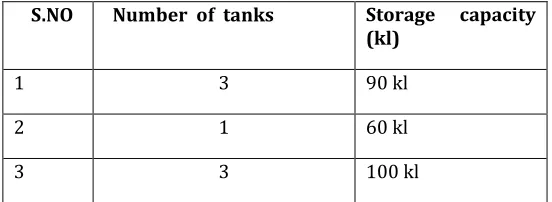
The storage capacity of each tanks are described in below table
TABLE 3: 1 Capacity of water tanks present in Komapally
3.2 Population forecasting:
Data collection:
The statistical population data of Kompally collected from the Gramapanchayat and from the peoples. Geometric Increase method is adopted for the calculation of population, To forecasting the population for next three decades is can be worked out by using geometric method. The collected past population data from the Grampanchayat
[image:2.612.308.584.385.486.2]The collected population data is used to compute the growth rate (%) for an each decade by Geometric Mean Method
TABLE 3:2 last three decade populations
3.3 METHODOLOGY TO ADOPT FOR FORECASTING THE WATER DEMAND:
The forecasting the requirement of water for the future generations is needed to calculate the total storage capacity of distribution reservoir. The total storage capacity of distribution reservoir is the summation of
a) Balancing storage ( or equalizing or operating storage) b) Breakdown storage
c) Fire storage
The main and primary function of distribution reservoir is to meet the fluctuating demand with a constant rate of supply from the treatment plant. The quantity of water required to store in the reservoir for balancing or equalizing this variable demand against the constant supply
S.NO Number of tanks Storage capacity
(kl)
1 3 90 kl
2 1 60 kl
3 3 100 kl
Population year Population (as per census)
1991 6591
2001 8035
© 2016, IRJET ISO 9001:2008 Certified Journal
Page 1909
is known as the balance reserve or the storage capacity of a balancing reservoir. The balancing storage can be worked out by utilizing the hydrographs of inflow or outflow, either by mass curve method or by using an analytical tubular solution.
Mass - curve method:
A mass diagram is the plot of accumulated inflow (i.e. supply) or outflow (i.e. demand) versus time. The mass curve of supply (i.e. supply line) is, therefore, first drawn and is superimposed by the demand curve. The procedure to construct such diagram is as follows: From the past records, determine the hourly demand for all 24 hours for typical days (maximum, average and minimum). Calculate and plot the cumulative demand against time, and thus plot the mass curve of demand. Read the storage required as the sum of the two maximum ordinates between demand and supply line as shown in fig. Repeat the procedure for all the typical days (maximum, average and minimum), and determine the maximum storage required for the worst day.
4. RESULTS AND INTERPRETATION
4.1 Geometric mean method:
Population year
(1)
Population
(2)
Increase in population in each decade (3)
Growth rate (%) Col (3)/(2)x100 (4)
1991 6591 - -
2001 8035 1444 1444/6591x100
=21.90
2011 11193 3158 3158/8035x100
= 39.30
Average =
2301 Average = 30 TABLE: 4.1 forecasting of population for next three decades
The average of increase in population is = 1444 + 3158/2 = 2301
Similarly,
The average or geometric mean of growth rate (r) is = (21.90 % + 39.30 %) /2 = 30.60 %
(30 %)
Now, assuming that the future population increases at this constant rate (30%), we have Pn = PO (1 + r / 100) n
As per census, using n = 1, 2, 3 decades
1. The population after first decade for the year 2021 is
P2021 = 11193 + 30.60/100 x 11193= 14168
2. The population after second decade for the year 2031 is
P2031 = 14168 + 30.60 / 100 x 14168 = 19091
Similarly,
3. The population after third decade for the year 2041 is
P2041 = 19091 + 30.60 / 100 x 19091 = 24932
Therefore the forecasting population for next three decades is 24932.
4.3 Interpretation of water demand by using mass curve method:
As per the present population required water demand for 135 liters/day/head is 15, 11055 liters. But the present supply of water in Kompally is 30 liters/day/head and the deficiency of water is 615615 liters.
Now, as per the forecasted population for next three decades is 24932 , the requirement of water for the next three decades at 135 liters/day/head is
Total daily supply = Rate of supply x Population = 24932 x
135 = 3365820 liter = (33, 66,000
liters)
For the water supply of a small town
( Kompally ) with the daily requirement of 33,66,000 liters , it is proposed to construct a distribution reservoir.
\The pattern of draw off or maximum peak hours are as follows
7:00 A.M – 8:00 A.M 30% of days supply
8:00 A.M - 5:00 P.M 35% of days supply
5:00 P.M – 6: 30 P.M 30% of days supply
6:30 P.M – 7:00 A. 5% of days supply
The pumping is to be done at constant rate of 8 hours per day (8 A.M to 4 P.M)
Then the total daily requirement is = 3365820 liters/ day or
© 2016, IRJET ISO 9001:2008 Certified Journal
Page 1910
An Average water supply/ water demand is required for the
population of Komapally for next decades An Average demand is converted in to cumulative demand as shown in table
TABLE: 4:2 cumulative water demands
The total supply is obtained in 8 hours at rate = 3366x103 / 8 liters/hour
= 420 .750x103 liters /hour
Graph: 1 Mass diagram for during 24 hours pumping
The supply line on the mass diagram will, therefore be a straight line with its slope as 420.750x10³ liters per hour , a s shown by the dotted line . From the graph the two maximum ordinates A and B enclosed between the demand and supply lines are read out from the graph5.1
Maximum ordinate A = 1009.8x103 liters
Maximum ordinate B = 1366 x103 liters
The total storage required is (A + B) = (1009.8x103+ 1366x103) liters = 2375.8 x 103 liters
Hence, Per capita demand = 3366 x103 / 365x24932 = 0.3698 liter/person/hour
As for the above collected data and its calculations, we have concluded that the design for the storage capacity of water reservoir for Kompally is 2375.8 x103 liters.
Thus, the per capita demand is 0.3698 liters /person/hour is recommended for future next three decades.
5. CONCLUSION
The population of Kompally for the next three decades and water demand of Kompally calculated.
For the present population of Kompally the water deficiency is 615615 liters, if there is no proper supply of water, possible of increase of water demand. Hence, it may lead to scarcity of water in this region. In this region content has less ground water resources.
fAs above collected data and its calculations, we have concluded that the design for the storage capacity of water reservoir for Kompally is 2375.8 x103 liters.
Thus, the per capita demand is 0.3698 liters /person/hour is recommended for future next three decades.
REFERENCES
Alvisi, S., Franchini, M., and Marinelli, A. (2007).“A short-term, pattern-based model for water-demand forecasting”.
Journal of Hydroinformatics.
Babel, M.S., and Shinde, V.R. (2011). “Identifying Prominent Explanatory Variables for Water Demand Prediction Using
Period
(1)
Rate of demand
(2)
Demand in liters Col(2)x(3366x103) (3)
Cumulative demand in 103 liters (4)
7:00AM–
8:00AM 30% of total 0.3x (3366x10 3) = 1009.8*103
1009.80
8:00AM-5:00PM 35% of total 3.5x(3366x10 3) = 2187.9x103
2187.9
5:00AM-6:30PM 30% of total 0.3*(3366x10 3) = 3297.7*103
3297.7
6:30PM-7:00AM 5% of total 0.05*(3366x10 3) = 168.30x10³
© 2016, IRJET ISO 9001:2008 Certified Journal
Page 1911
Artificial Neural Networks: A Case Study of Bangkok”. Water
Resources Management.
Bakker, M., Vreeburg, J.H.G., Palmen, L.J., Sperber, V., Bakker, G., and Rietveld, L.C. (2013).“Better water quality and higher energy efficiency by using model predictive flow control at water supply systems”. Journal of Water Supply: Research and Technology.
Bakker, M., Vreeburg, J.H.G., Van Schagen, K.M., and Rietveld, L.C. (2013). (Submitted). “A fully adaptive forecasting model for short-term drinking water demand”. Journal of Environmental Modeling and Software
Box, G.E.P., and Jenkins, G.M. 1976. Time Series Analysis:
Forecasting and Control. 2 nd ed. San Francisco: Holden-Day.
Bunn, S.M., and Reynolds, L. (2009).“The energy-efficiency benefits of pump scheduling optimization for potable water supplies”. IBM Journal of Research and Development.
Caiado, J. (2010). “Performance of combined double seasonal univariate time series models for forecasting water demand”. Journal of Hydrologic Engineering.
Grillenzoni, C. (2000). “Time-varying parameters prediction”. Annals of the Institute of Statistical Mathematics.
House-Peters, L.A., and Chang, H. (2011).“Urban water demand modeling: Review of concepts, methods, and organizing principles”. Water Resources Research.
Jain, A., Varshney, A.K., and Joshi, U.C. (2001). “Short-term water demand forecast modeling at IIT Kanpur using artificial neural networks”. Water Resources Management.
Joo, C.N., Koo, J.Y., and Yu, M.J. (2002).“Application of short-term water demand prediction model to Seoul”. Water
Science and Technology. 46 (6-7): 255-261.
Jowitt, P.W., and Chengchao, X. (1992).“Demand forecasting for water distribution systems”. Civil Engineering Systems.
Lertpalangsunti, N., Chan, C.W., Mason, R., and Tontiwachwuthikul, P. (1999).“Toolset for construction of hybrid intelligent forecasting systems: Application for water demand prediction”. Artificial Intelligence in Engineering.
Odan, F.K., and Reis, L.F.R. (2012).“Hybrid Water Demand Forecasting Model Associating Artificial Neural Network with Fourier Series”. Journal of Water Resources Planning and Management
PWN. (2006).“Automated Water System Control”. Control Engineering.
Worm, G.I.M., van der Helm, A.W.C., Lapikas, T., van Schagen, K.M., and Rietveld, L.C. (2010).“Integration of models, data management, interfaces and training support in a drinking water treatment plant simulator”. Environmental Modelling and Software.
Zhou, S.L., McMahon, T.A., Walton, A., and Lewis, J. (2000).“Forecasting daily urban water demand: A case study of Melbourne”. Journal of Hydrology. 236 (3-4): 153-164.
Zhou, S.L., McMahon, T.A., Walton, A., and Lewis, J. (2002).“Forecasting operational demand for an urban water supply zone”. Journal of Hydrology. 259 (1-4): 189-202.
Arandia, E., Ba, A., Eck, B., and McKenna, S. (2015). "Tailoring Seasonal Time Series Models to Forecast Short-Term Water Demand." Journal of Water Resources Plan
Tian, D., Martinez, C., and Asefa, T. (2016). "Improving Short-Term Urban Water Demand Forecasts with Reforecast Analog Ensembles." Journal of Water Resources Planning and
Management,
Brauman, K., Freyberg, D., and Daily, G. (2014). "Impacts of Land-Use Change on Groundwater Supply: Ecosystem Services Assessment in Kona, Hawaii." Journal of Water
Resources Planning and Management,
Steinschneider, S., McCrary, R., Wi, S., Mulligan, K., Mearns, L., and Brown, C. (2015). "Expanded Decision-Scaling Framework to Select Robust Long-Term Water-System Plans under Hydroclimatic Uncertainties." Journal of Water