comparison of functional genomics,
environmental adaptations, and pathogenic
mechanisms
Stephen F. Porcella, Tom G. Schwan
J Clin Invest.
2001;
107(6)
:651-656.
https://doi.org/10.1172/JCI12484
.
Spirochetes are a diverse group of bacteria found in soil, deep in marine sediments,
commensal in the gut of termites and other arthropods, or obligate parasites of vertebrates.
Two pathogenic spirochetes that are the focus of this perspective are Borrelia burgdorferi
sensu lato, a causative agent of Lyme disease, and Treponema pallidum subspecies
pallidum, the agent of venereal syphilis. Although these organisms are bound together by
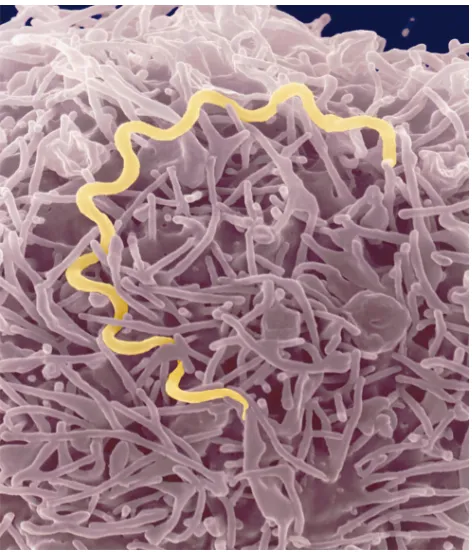
ancient ancestry and similar morphology (Figure 1), as well as by the protean nature of the
infections they cause, many differences exist in their life cycles, environmental adaptations,
and impact on human health and behavior. The specific mechanisms contributing to
multisystem disease and persistent, long-term infections caused by both organisms in spite
of significant immune responses are not yet understood. The Centers for Disease Control
and Prevention reported 16,801 cases of Lyme disease and 37,977 cases of syphilis in the
United States in 1998. Syphilis was first observed just over 500 years ago although the
bacterial cause was not determined until 1905 (1). Lyme disease was described 25 years
ago with its causative agent discovered in late 1981 (2), but progress toward managing
Lyme disease has occurred rapidly, and a vaccine for this disease is now approved for
human use and is available in the United States (3). This critical advance was made
possible […]
Perspective
Spirochetes are a diverse group of bacteria found in soil, deep in marine sediments, commensal in the gut of termites and other arthropods, or obligate parasites of vertebrates. Two pathogenic spirochetes that are the focus of this perspective are Borrelia burgdorferi sensu lato, a causative agent of Lyme disease, and Treponema pallidum subspecies pallidum, the agent of venereal syphilis. Although these organisms are bound togeth-er by ancient ancestry and similar morphology (Figure 1), as well as by the protean nature of the infections they cause, many differences exist in their life cycles, environmental adaptations, and impact on human health and behavior. The specific mechanisms con-tributing to multisystem disease and persistent, long-term infections caused by both organisms in spite of significant immune responses are not yet understood. The Centers for Disease Control and Prevention reported 16,801 cases of Lyme disease and 37,977 cases of syphilis in the United States in 1998. Syphilis was first observed just over 500 years ago although the bac-terial cause was not determined until 1905 (1). Lyme disease was described 25 years ago with its causative agent discovered in late 1981 (2), but progress toward managing Lyme disease has occurred rapidly, and a vac-cine for this disease is now approved for human use and is available in the United States (3). This critical advance was made possible in part by the ability to cul-tivate Lyme disease spirochetes in vitro, due to the prior development of Kelly’s medium (4) for cultivating relapsing fever borreliae. In contrast, T. pallidummust be grown in the testicles of live rabbits to obtain bacte-ria for experimental use (5). While no vaccine is yet available for syphilis, the spirochete’s obligate associa-tion with humans and transmission by sexual contact makes the eradication of this disease at least conceiv-able. Eradication is not an obtainable goal for Lyme disease, becauseB. burgdorferiis widespread in nature and is maintained in zoonotic cycles involving many species of mammals, some birds, and transmission by small, blood-feeding ticks. Recently, the genome sequences for both of these bacteria were published
(6–8). Here, we compare the biology and genomes of these two spirochetal pathogens with reference to their different host associations and modes of transmission.
Genomic structure
A striking difference between B. burgdorferiand T. pal-lidumis their total genomic structure. Although both pathogens have small genomes, compared with many well known bacteria such as Escherichia coliand Mycobac-terium tuberculosis, the genomic structure of B. burgdorferi
Borrelia burgdorferi and Treponema pallidum:
a comparison of functional genomics,
environmental adaptations, and pathogenic mechanisms
Stephen F. Porcella and Tom G. Schwan
Laboratory of Human Bacterial Pathogenesis, Rocky Mountain Laboratories, National Institute of Allergy and Infectious Diseases, NIH, Hamilton, Montana, USA
Address correspondence to: Tom G. Schwan, Rocky Mountain Laboratories, 903 South 4th Street, Hamilton, Montana 59840, USA. Phone: (406) 363-9250; Fax: (406) 363-9445; E-mail: [email protected].
[image:2.612.304.540.413.689.2]Martin J. Blaser and James M. Musser, Series Editors
Figure 1
is one of the most complex known in prokaryotes. This spirochete contains a linear chromosome 910,725 bp in length with an average guanine + cytosine (G+C) content of 28.6% (6). Twenty-one extrachromosomal elements, including 12 linear and 9 circular plasmids, totaling another 610,694 bp have also been identified (8). There is considerable variation in plasmid content among iso-lates. Some of these extrachromosomal elements are lost quickly upon serial propagation.
In contrast, T. pallidumcontains a single circular chro-mosome with 1,138,006 bp, an average G+C content of 52.8%, and no extrachromosomal elements (7), making its total genome approximately 25% smaller than that of
B. burgdorferi. Importantly, none of the 1041 predicted open reading frames (ORFs) of T. pallidumare homolo-gous to any of the 535 intact ORFs or 167 pseudogenes encoded by the B. burgdorferi plasmids (7, 8). Indeed, over 90% of the B. burgdorferiplasmid ORFs are unrelated to any known bacterial sequences (8). The novel genes found on the B. burgdorferiplasmids may therefore con-tribute to the ability of this pathogen to survive and maintain its complex life cycle, alternating between warm-blooded animals and cold-blooded ticks as hosts.
Lipoprotein and pathogen-host interactions
The B. burgdorferi genome contains at least 132 genes encoding putative lipoproteins, but only 22 such genes are present in T. pallidum(7, 8). Lipoprotein genes com-prise 5% of the chromosomal ORFs in B. burgdorferiand 2.1% of those in T. pallidum. The T. pallidum value is clos-er to that of othclos-er types of bactclos-eria such as Helicobacter pylori, in which 1.3% of its genome encodes lipoproteins (7, 8). Interestingly, 14.5 to 17% of the functionally complete ORFs on the B. burgdorferi plasmids encode lipoproteins (7, 8). The reasons for this proportionate-ly greater coding capacity for lipoproteins in B. burgdor-fericompared with many other bacteria are unknown. Lipoproteins are the predominant membrane protein immunogens for both T. pallidumand B. burgdorferi(9, 10). No lipoproteins have been definitively localized to the outer surface of T. pallidum. In contrast, the
majori-ty of surface-exposed proteins made by B. burgdorferiare lipoproteins. Two well-characterized lipoproteins are outer surface protein A (OspA) and OspC. The OspA
gene is phylogenetically conserved and its protein prod-uct is the immunogen in the recently approved human vaccine for Lyme disease (3). Conversely, the OspCgene has considerable sequence heterogeneity among natu-ral isolates at both the DNA and amino acid level. This gene is also differentially expressed at higher tempera-tures and its protein product has been hypothesized to be involved with transmission of spirochetes during tick bite and the early colonization in vertebrates (11).
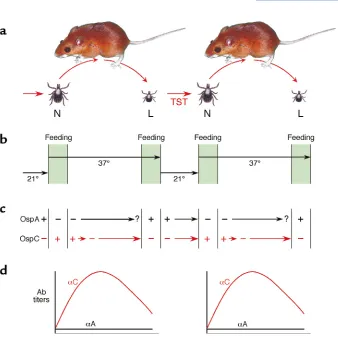
The difference in the number and cellular location of lipoproteins made by the two spirochetes suggests a functional role for the borrelial lipoproteins for survival in diverse hosts and/or transmission by ticks. The syn-thesis of many borrelial lipoproteins increases when the growth temperature is shifted from 23°C to 35°C (11, 12), a change presumed to mimic the warming that occurs when B. burgdorferipasses from ticks to mam-mals. Consistent with this idea, many B. burgdorferi
lipoproteins are recognized by sera from infected ani-mals (9, 12), indicating that the mammal is exposed to these proteins during infection. These observations sug-gest that many of the lipoproteins of B. burgdorferi are involved in host-pathogen interactions, and we assume this to be true as well for T. pallidum.
[image:3.612.126.461.595.684.2]Given the evidence that borrelial and treponemal lipoproteins interact with the mammalian immune system early in infection, numerous studies have explored their potential role in cytokine production and immune-cell activation. B. burgdorferiouter mem-brane lipoproteins activate macrophages, endothelial cells, neutrophils, and B cells (13). Dermal inflamma-tion characterized by infiltrainflamma-tion of neutrophils, het-erophils, and mononuclear cells has been observed in mice and rabbits following injections of lipopeptides of B. burgdorferiand T. pallidum(14). Hence, lipopro-teins may be involved in the initial inflammatory processes that occur in erythema migrans and the pri-mary lesion in syphilis.
Figure 2
The pathogenesis associated with Lyme disease has stimulated research into the role of spirochete lipopro-teins in the disease pathway (15–17). Picomolar amounts of OspA increase CD10 and CD11b, decrease CD62-L, and activate neutrophils (15), suggesting the involve-ment of lipoproteins in tissue-specific arthritic inflam-mation, where neutrophils are known to be the pre-dominant infiltrate. The toll-like receptor 2 has been implicated also in signal transduction for borrelial and treponemal lipopeptides and lipoproteins (18, 19), an integral process potentially involved in the inflammato-ry processes associated with Lyme arthritis. In addition,
B. burgdorferi and T. pallidum spirochetes, as well as lipoproteins and lipopeptides derived from these organ-isms can induce pro- and anti-inflammatory cytokines, including TNF, IL-1β, IL-6, IL-8, IL-10, and IL-12 (16, 18, 19) in monocytes via an initial signaling or binding event with the CD-14 receptor (16, 17). Brown et al. (13) observed that mice deficient in IL-10, an
anti-inflam-matory cytokine, developed a more severe arthritis when infected with B. burgdorferithan did normal mice with the same genetic background. Surprisingly, the numbers of spirochetes in the ankles of the IL-10–deficient mice were tenfold less than in normal mice and their IgG titers to spirochetal antigens were significantly higher. Clearly, the interactions between B. burgdorferiand the host’s cellular and humoral immune responses are com-plex, and their effect on the induction and severity of Lyme arthritis requires further investigation.
The abundance of lipoproteins in B. burgdorferi com-pared to other bacterial pathogens suggests that lipid modification performs an essential role associated with spirochetal framework, activity, or protein function. For example, access of antibody to the exposed loop of the integral outer membrane protein P66 of B. burgdor-feriis blocked by the presence of OspA (20). Neither B. burgdorferi nor T. pallidumproduce true LPS, and analy-ses of their respective genomes indicate that pathways
[image:4.612.122.460.93.433.2]Martin J. Blaser and James M. Musser, Series Editors
Figure 3
containing LPS-like biosynthetic genes do not exist (6, 7). Both spirochetes lack the ability to elongate long-chain fatty acids, so their fatty acid composition reflects that present in the culture medium or host. Lipid moieties of membrane-associated proteins induce immunological stimulation in the mammalian host, similar to LPS in other bacterial pathogens. The lipoprotein-mediated immunostimulatory process can lead to containment and control of inflammatory processes, or in the case of susceptible hosts, Lyme arthritis, with chronicity resulting from low levels of persistent spirochetes.
Variation in outer surface proteins
Both B. burgdorferiand T. pallidumcontain genetic sys-tems with the potential for antigenic variation of sur-face molecules. Borrelia hermsiicontains a variable major protein (Vmp) system, which encodes surface-exposed lipoproteins of two size classes, variable small proteins (Vsp) or variable large proteins (Vlp). The Vmp-like sys-tem (Vls) recently discovered in B. burgdorferiencodes proteins that are most similar to the Vlp family of B. hermsii. B. burgdorferihas 15 silent vlsgenes adjacent to an expression site (vlsE), which is found near the telom-ere of a 28 kb plasmid (21) (Figure 2). Recombination of
vlsgenes occurs early during mammalian infection and involves a gene conversion event in which a silent vls cas-sette replaces a corresponding region in thevlsgene residing in the vlsEexpression site. The vlssystem has the potential to produce millions of antigenic variants during infection of the mammalian host (21), and it has been speculated that Vls variation contributes to per-sistence of the organism in vivo.
Chronic syphilitic infection, seen in untreated indi-viduals where periods of latency are interrupted by episodes of active disease, indicates that these bacteria can evade the host immune system by one or more mechanisms. To date, no antigen has been definitively localized or identified in the outer membrane of T. pal-lidum, a factor contributing to the concept of the spiro-chete being a “stealth pathogen.” In the genome ofT. pallidum, a gene family with 12 members, termed tpr, has been discovered. These proteins are homologous to the major sheath protein (Msp) of Treponema denticola, a molecule reported to be surface-exposed and involved in cell attachment. Although tprgenes lack a consensus lipoprotein sequence, three members (TprF, TprI, and TprK) are predicted to be associated with the outer membrane of T. pallidum (22). The presence of multiple
tprKalleles within the same isolate ofT. pallidumand heterogeneity of thetprKgene among isolates (23) sug-gests that multiple subpopulations or genetic variants exist. The presence of a complex tprgene family with multiple tprKgene alleles also suggests thattprKhas the capacity to undergo recombination with the generation of new alleles or gene variants within an isolate. Because
the tprK genes are not restricted to a single locus with one promoter, the mechanism for generating gene vari-ation must be different from that used in borreliae at the vmpand vlsloci. However this diversity is generated,
tprK gene(s) or other members of the tprgene family apparently helps explain the lack of cross-immunity in animals challenged with nonhomologous strains (23).
Phenotypic response to changes in temperature
Temperature is an important environmental cue that triggers adaptation of pathogenic bacteria to their hosts. The ranges in temperature that B. burgdorferiand
T. pallidumexperience differ significantly. For example, the Lyme disease spirochete experiences considerable change in temperature as it alternates between warm-blooded mammals and cold-warm-blooded ticks. In contrast, temperature for T. pallidumis confined to the narrow range imposed on it by human homeostasis. Tempera-ture-induced differential expression of potential viru-lence determinants has been examined more in B. burgdorferi, because this organism can be grown con-tinuously in a liquid, acellular medium and can be ana-lyzed in ticks kept at various ambient temperatures.
Erps, Mlps, OspE, OspF, and OppAV are also upregulat-ed when spirochetes are grown at higher temperatures (12, 27–29), but the expression profile of these proteins in free-living and feeding ticks remains to be determined. While T. pallidumcan be grown in vitro for a limited number of days through cocultivation with cottontail rabbit epithelial (Sf1Ep) cells, this process must be per-formed at 33°C (30). There is circumstantial evidence that T. pallidumvaries expression of potential virulence determinants at different temperatures. For example, an exacerbation of syphilitic skin lesions occurs in experimentally infected rabbits with shaved backs when the animals are kept in rooms cooled to 16–18°C (5). In addition, the slightly cooler temperature of the human appendages and the occurrence of classic sec-ondary syphilitic skin lesions on the arms and legs sug-gest thatT. pallidumgrows optimally at a few degrees less than 37°C.
With regard to high temperature, both B. burgdorferi
and T. pallidumlack σfactor 32 (6, 7), a primary media-tor of the heat-shock response, although some evidence exists that B. burgdorferi can mount a heat shock response while T. pallidum cannot. In vitro cultivation of B. burgdorferiat various temperatures demonstrates that the spirochete replicates most quickly at 37°C. An increase in temperature to 39°C retards growth signif-icantly, while a 24 hour exposure at 41°C kills all spiro-chetes in the culture. Therefore, the optimal growth temperature of B. burgdorferi is only 4°C below the upper lethal limit. The low tolerance of spirochetes for high temperatures is well known and may explain in part the restricted distribution ofB. burgdorferito tem-perate latitudes and its absence in the tropics, where infected ticks may be exposed to high temperatures detrimental to spirochete survival. Interestingly, the thermal sensitivity of T. pallidumwas exploited in the early 1900s prior to the discovery of penicillin by using fever therapy with malaria or relapsing fever infection to treat patients with general paresis (31).
Closing remarks
Beyond the morphological and phylogenetic similari-ties that exist between T. pallidumand B. burgdorferi, the diseases they cause include multistage protean clinical manifestations that include dermatological and neuro-logical involvement and a chronically infected state in the untreated host. Investigators ofT. pallidum recog-nized early the parallels between the syphilis spirochete and the newly emerging tick-transmitted spirochete and contributed their expertise towards understanding bor-reliae biology and pathogenesis. In fact, the ability to cultivate borreliae in vitro attracted many investigators working on T. pallidumfollowing the discovery of B. burgdorferi. The determination of the complete genomes of bothB. burgdorferiand T. pallidum(6, 7) has already contributed to a greater understanding of
chromoso-mal structure, gene regulation, and specific physiologi-cal needs, such as the observation that iron is not required for survival (32, 33). Comparison of the T. pal-lidumgenome with other bacterial genomes may con-tribute toward the development of an assemblage of essential nutrients for a medium that will provide con-tinuous growth in vitro. In the absence of such an advance, we can anticipate a continued lag in scientific progress with T. pallidum. Because techniques for inacti-vating genes have been successful in B. burgdorferi(34) but not yet in T. pallidum, the information gap is likely to grow, but these approaches may provide a framework for future genetic efforts on the syphilis spirochete.
The 0.61 megabase pairs of DNA unique to the B. burgdorferi plasmids encode numerous lipoprotein genes, several of which are differentially regulated with temperature. The mechanisms for thermal sensing by spirochetes are not yet known but likely share strategies used by other bacteria (35). Based on expression data, many of the differentially regulated lipoproteins may be involved in adaptation to cycling between cold-blooded ticks and warm-cold-blooded vertebrates. Such an extensive repertoire of proteins may be unnecessary for
T. pallidum, which does not require an arthropod vector. One striking difference between these organisms is the ability of T. pallidumto cross the human placenta, resulting in the potentially devastating consequences of congenital syphilis. Transplacental transmission of
B. burgdorferihas not been demonstrated in animal studies, and is rare or nonexistent in humans, but transplacental transmission is well documented in the case ofB. hermsii and other spirochetes that cause relapsing fever. Determination of the genomic sequences of these other pathogens may provide insights into mechanisms responsible for transplacen-tal transmission.
Acknowledgments
We apologize to colleagues for not citing many perti-nent works due to space limitations. We thank Dave Dorward for scanning electron microscopy and Gary Hettrick for graphic art work.
1. Quetel, C. 1990. History of syphilis. The Johns Hopkins University Press. Baltimore, Maryland, USA. 342 pp.
2. Burgdorfer, W., et al. 1982. Lyme disease: a tick-borne spirochetosis? Sci-ence. 216:1317–1319.
3. Steere, A.C., et al. 1998. Vaccination against Lyme disease with recombi-nant Borrelia burgdorferiouter-surface lipoprotein A with adjuvant. N. Engl. J. Med.339:209–215.
4. Kelly, R. 1971. Cultivation of Borrelia hermsi. Science. 173:443–444. 5. Turner, T.B., and Hollander, D.H. 1957. Biology of the treponematoses.
Monogr. Ser. World Health Organ.35:9–278.
6. Fraser, C.M., et al. 1997. Genomic sequence of a Lyme disease spirochaete, Borrelia burgdorferi. Nature. 390:580–586.
7. Fraser, C.M., et al. 1998. Complete genome sequence of Treponema pal-lidum, the syphilis spirochete. Science. 281:375–378, 387–388. 8. Casjens, S., et al. 2000. A bacterial genome in flux: the twelve linear and
nine circular extrachromosomal DNAs in an infectious isolate of the Lyme disease spirochete Borrelia burgdorferi. Mol. Microbiol.35:490–516. Martin J. Blaser and James M. Musser,
9. Brandt, M.E., Riley, B.S., Radolf, J.D., and Norgard, M.V. 1990. Immuno-genic integral membrane proteins of Borrelia burgdorferiare lipoproteins.
Infect. Immun.58:983–991.
10. Chamberlain, N.R., Brandt, M.E., Erwin, A.L., Radolf, J.D., and Norgard, M.V. 1989. Major integral membrane protein immunogens of Trepone-ma pallidumare proteolipids. Infect. Immun.57:2872–2877.
11. Schwan, T.G., Piesman, J., Golde, W.T., Dolan, M.C., and Rosa, P.A. 1995. Induction of an outer surface protein on Borrelia burgdorferiduring tick feeding. Proc. Natl. Acad. Sci. USA. 92:2909–2913.
12. Stevenson, B., Schwan, T.G., and Rosa, P.A. 1995. Temperature-related differential expression of antigens in the Lyme disease spirochete, Bor-relia burgdorferi. Infect. Immun.63:4535–4539.
13. Brown, J.P., Zachary, J.F., Teuscher, C., Weis, J.J., and Wooten, R.M. 1999. Dual role of interleukin-10 in murine Lyme disease: regulation of arthri-tis severity and host defense. Infect. Immun.67:5142–5150.
14. Norgard, M.V., Riley, B.S., Richardson, J.A., and Radolf, J.D. 1995. Der-mal inflammation elicited by synthetic analogs of Treponema pallidum
and Borrelia burgdorferilipoproteins. Infect. Immun.63:1507–1515. 15. Morrison, T.B., Weis, J.H., and Weis, J.J. 1997. Borrelia burgdorferiouter
surface protein A (OspA) activates and primes human neutrophils. J. Immunol.158:4838–4845.
16. Sellati, T.J., et al. 1999. Activation of human monocytic cells by Borrelia burgdorferiand Treponema pallidumis facilitated by CD14 and correlates with surface exposure of spirochetal lipoproteins. J. Immunol. 163:2049–2056.
17. Wooten, R.M., et al. 1998. The role of CD14 in signaling mediated by outer membrane lipoproteins of Borrelia burgdorferi. J. Immunol. 160:5485–5492.
18. Hirschfeld, M., et al. 1999. Cutting edge: inflammatory signaling by Bor-relia burgdorferilipoproteins is mediated by Toll-like receptor 2. J. Immunol.163:2382–2386.
19. Lien, E., et al. 1999. Toll-like receptor 2 functions as a pattern recognition receptor for diverse bacterial products. J. Biol. Chem.274:33419–33425. 20. Bunikis, J., and Barbour, A.G. 1999. Access of antibody or trypsin to an integral outer membrane protein (P66) of Borrelia burgdorferiis hindered by Osp lipoproteins. Infect. Immun.67:2874–2883.
21. Zhang, J.-R., Hardham, J.M., Barbour, A.G., and Norris, S.J. 1997. Anti-genic variation in Lyme disease borreliae by promiscuous recombination of VMP-like sequence cassettes. Cell. 89:275–285.
22. Centurion-Lara, A., et al. 1999. Treponema pallidummajor sheath protein
homologue TprK is a target of opsonic antibody and the protective immune response. J. Exp. Med.189:647–656.
23. Centurion-Lara, A., Godornes, C., Castro, C., Van Voorhis, W.C., and Lukehart, S.A. 2000. The tprKgene is heterologous among Treponema pal-lidumstrains and has multiple alleles. Infect. Immun.68:824–831. 24. de Silva, A.M., Telford, S.R., III, Brunet, L.R., Barthold, S.W., and Fikrig,
E. 1996. Borrelia burgdorferiOspA is an arthropod-specific transmission-blocking Lyme disease vaccine. J. Exp. Med.183:271–275.
25. Schwan, T.G., and Piesman, J. 2000. Temporal changes in outer surface proteins A and C of the Lyme disease-associated spirochete, Borrelia burgdorferi, during the chain of infection in ticks and mice. J. Clin. Micro-biol.38:383–388.
26. Obonyo, M., Munderloh, U.G., Fingerle, V., Wilske, B., and Kurtti, T.J. 1999. Borrelia burgdorferiin tick cell culture modulates expression of outer surface proteins A and C in response to temperature. J. Clin. Micro-biol.37:2137–2141.
27. Porcella. S.F., Fitzpatrick, C.A., and Bono, J.L. 2000. Expression and immunological analysis of the plasmid-encoded mlpgenes of Borrelia burgdorferi strain B31.Infect. Immun. 68:4992–5001.
28. Bono, J.L., Tilly, K., Stevenson, B., Hogan, D., and Rosa, P. 1998. Oligopeptide permease in Borrelia burgdorferi: putative peptide-binding components encoded by both chromosomal and plasmid loci. Microbi-ology.144:1033–1044.
29. Stevenson, B., Bono, J.L., Schwan, T.G., and Rosa, P. 1998. Borrelia burgdorferiErp proteins are immunogenic in mammals infected by tick bite, and their synthesis is inducible in cultured bacteria. Infect. Immun. 66:2648–2654.
30. Fieldsteel, A.H., Cox, D.L., and Moeckli, R.A. 1981. Cultivation of viru-lent Treponema pallidumin tissue culture. Infect. Immun.32:908–915. 31. Solomon, H.C., and Kopp, I. 1937. Fever therapy. N. Engl. J. Med.
217:805–814.
32. Posey, J.E., Hardham, J.M., Norris, S.J., and Gherardini, F.C. 1999. Char-acterization of a monganese-dependent regulatory protein, TroR, from
Treponema pallidum. Proc. Natl. Acad Sci. USA. 96:10887–10892. 33. Posey, J.E., and Gherardini, F.C. 2000. Lack of a role for iron in the Lyme
disease pathogen. Science. 288:1651–1653.
34. Bono, J.L., et al. 2000. Efficient targeted mutagenesis in Borrelia burgdor-feri. J. Bacteriol.182:2445–2452.