© 2015, IRJET ISO 9001:2008 Certified Journal Page 936
AN EFFECTIVE INTRUDER DETECTION WITH BACKUP TIME SERIES
TECHNIQUES IN WIRELESS NETWORK
Dr.D.Devakumari
1, K.Gayathri
21 Assistant Professor, PG and Research Department of Computer Science,
Government Arts College(Autonomous), Coimbatore, Tamil Nadu, India
2 Research Scholar ,Department of Computer Science , L.R.G Government Arts College For
Women , Tirupur, Tamil Nadu, India
---***---Abstract -
In wireless network, every node accesses the network in a cooperative manner and randomly delays transmissions to avoid collisions by following a common backoff rule [1]. However, in such a distributed environment without a centralized controller, a malicious node may deliberately choose a smaller backoff timer and selfishly gain an unfair share of the network throughput at the expenses of other normal nodes’ channel access opportunities. The distributed nature of the CSMA/CA-based wireless protocols allows malicious nodes to deliberately manipulate their backoff parameters and, thus, unfairly gain a large share of the network throughput. While most of the existing schemes for selfish misbehavior detection depend on heuristic parameter configuration and experimental performance evaluation, the projects develop a Markov chain-based analytical model to systematically study the performance of the FS detector in real-time backoff misbehavior detection. Key Words:Denial of service, security, routing, ad hoc networks, sensor networks, wireless networks1. Introduction
AD hoc wireless sensor networks (WSNs) promise existing new applications in the near future, such as ubiquitous on-demand computing power, continuous connectivity, and instantly deployable communication for military and first responders. Such networks already monitor environmental conditions, factory performance, and troop deployment, to name a few applications. As WSNs become more and more crucial to the everyday functioning of people and organizations, availability faults become less tolerable—
© 2015, IRJET ISO 9001:2008 Certified Journal Page 937
beacon routing. Neither do these attacks rely on flooding the network with large amounts of data, but rather try to transmit as little data as possible to achieve the largest energy drain, preventing a rate limiting solution. Since Vampires use protocol-compliant messages, these attacks are very difficult to detect and prevent.
2.Related Work
The problem of detecting backoff misbehavior over the 802.11-based medium access control (MAC) protocol has been widely studied in the literature. In [8], [9], a modification to the 802.11 protocol is proposed to facilitate the misbehavior detection, where the receiver assigns a backoff timer for the sender. If the number of idle slots between consecutive transmissions from the sender does not comply with the assigned backoff timer, the receiver may label the sender as a selfish node. Modification to the 802.11 protocol and reliance on a trustworthy receiver are the main limitations of the work. Another approach to deal with the backoff misbehavior is to develop protocols based on the game-theoretic techniques [14], [15], [16]. The goal is to encourage all the nodes to reach a Nash equilibrium. As a result, a malicious node is not able to gain an unfair share compared to wellbehaved nodes and, thus, discouraged from the misbehavior. However, this category of approaches assumes that all the nodes are willing to deviate from the protocol when necessary, and the standard protocol needs to be modified. A heuristic sequence of conditions is proposed in [17], [18] to test multiple misbehavior options over the 802.11 MAC based on simple numerical comparisons. This approach, named DOMINO, preserves its advantage of simplicity and easiness of implementation, and still demonstrates its efficiency when dealing with a wide range of 802.11 MAC misbehavior. However, the heuristic nature of the approach limits its applications to specific scenarios. The sequential probability ratio test (SPRT) method is used in [5], [6], [7] to detect the 802.11 backoff misbehavior. The detection decision is made when a random walk of the likelihood ratio of observations (given two hypotheses) rises to be larger than an upper threshold. The main advantage of SPRT is that it can reach decision very fast, given the complete knowledge of both normal behavior and backoff misbehavior strategy [20]. However, in a realistic setting, the strategy
of malicious nodes is hard to know in advance. Further, the existing work normally assumes that the backoff timer of each node is observable, which is again hard to achieve in practice because thetransmission attempts involved in a collision are impossible to be distinguished. In our design, we monitor the successful transmission of the tagged node as the observation measurement.
© 2015, IRJET ISO 9001:2008 Certified Journal Page 938
A common research issue among most of the existing schemes for misbehavior detection is their dependency on heuristic parameter configuration and experimental performance evaluation, which largely limits the flexibility and robustness of the schemes. To address this issue, in [19], we propose a Markov chain-based analytical model to theoretically analyze the detection performance and quantitatively configure the system parameters. In this paper, we develop the analytical model according to the newly proposed FS detector. Our analysis demonstrates performance improvement of the FS detector in real-time misbehavior detection over the original detector in [19]. Also, we demonstrate the robustness of the FS detector under varying network size, against the short-term unfairness, and in the situation when both UDP and TCP traffic exists.
3.Methods
3.1 Misbehave Action Occurrence and Finding the Action
In this module, the node sends the data repeatedly even the receiver is not able to receive quickly. To find the action, a real-time back-off misbehavior detector, termed as the fair share detector (FS detector), which exploits the nonparametric cumulative sum (CUSUM) test to quickly find a selfish malicious node without any a priori knowledge of the statistics of the selfish misbehavior is applied. The
observation measure is based on the following.
Consider a tagged node v. In the detection system, the observation measure is an indicator of whether a successful transmission over the network belongs to the tagged node v, denoted as Iv
We take the popular modeling technique that each node independently accesses an idle channel for transmission with a probability determined by its contention window size. If we use qv s to denote the probability that a successful transmission over the network is from node v, the probability distribution of Iv
is given by
In a normal situation that every node follows the 802.11 DCF standard, it can be seen that qvs = 1/N due to fair channel sharing, given N nodes in the network. If node v is a malicious node taking a smaller contention window size, it will achieve a qvs larger than 1/N and, thus, a larger portion of the network throughput.
The Fair Share Detector is based on the following.
Let {In, n = 0, 1, ...} be the sequence of sample values of Iv, observed each time a successful transmission appears on the channel. Here, we drop the superscript v for easier presentation considering the clear context. There are N nodes and one access point (AP) in the network. Suppose that the initial value of the detector is X0 = 0. If a successful transmission upon the nth observation is from the tagged node, i.e., In = 1, the detector Xn increases by N – 1, otherwise, In = 0, and Xn decreases by 1 until it reaches 0.
The intuition of this design is as follows: In the normal situation, each node roughly takes turn to transmit; the increase of Xn caused by one successful transmission from the tagged node can then be equally offset by the successful transmissions from other N - 1 nontagged nodes. Thus, the detector Xn will fluctuate around a low value close to zero in the normal situation.
On the other hand, when the tagged node turns to misbehave and obtain more chances to transmit, it is not difficult to see that Xn is going to quickly accumulate to a large positive value. The behavior of the FS detector can be mathematically described as
where (x)+ = x if x >= 0 or 0 otherwise. We can see that the above equation is actually in the form of a nonparametric CUSUM detector. Let h be the detection threshold. The decision rule of the detector in step n is
© 2015, IRJET ISO 9001:2008 Certified Journal Page 939
will be reset back to 0 as soon as it exceeds the threshold and the detection procedure starts over again.
To implement the above concept, the receiver node checks for the sender‘s request continuously. If request is repeated with in the back off timer value, then it is found that the sender node is misbehaving and disturbing the receiver node. A threshold is set so that the request count (each request is sent before the backoff timer), is found to be above the threshold value, then the node is found to be misbehaving and alerted in receiver node.
3.2. Fixed Window Protocol Module
In monitoring-based intrusion detection, each node monitors the forwarding behavior of its neighboring nodes in fixed window mechanism. The node listens the next-hop node with the packets sent at regular intervals. If say ten packets (window frame size) are sent and listen for monitoring, then the packets dropped at the starting side of the window frame and the packets dropped at the ending side of the window frame are calculated. In addition, the nth frame‘s ending side added with n+1th frame‘s starting side is added up.
If the value is above the given threshold value, then suspect count value is added with one. If the total suspect count is crossed the given suspect threshold value, then the node is suspected that it is dropping the packets suspiciously. Unlike the existing system, the node not only monitors the source node‘s windows frames but also monitors of the neighbor node which
passes the packets to the suspected node.
3.3. Sliding Window Protocol Module
In monitoring-based intrusion detection, each node monitors the forwarding behavior of its neighboring nodes in sliding window mechanism. The node listens the next-hop node with the packets sent at regular intervals. If say ten packets (window frame size) are sent and listen for monitoring, the windows is calculated as 1st frame to nth frame, then 2nd frame to nth packet in first window and 1st packet in second window and so on.
Then the packets dropped at the starting side of the window frame and the packets dropped at the ending side of the window frame are calculated. In addition, the nth frame‘s ending side added with n+1th frame‘s starting side is added up.
If the value is above the given threshold value, then suspect count value is added with one. If the total suspect count is crossed the given suspect threshold value, then the node is suspected that it is dropping the packets suspiciously. Unlike the existing system, the node not only monitors the source node‘s windows frames but also monitors of the neighbor node which passes the packets to the suspected node.
4. EXPERIMENTAL RESULT
4.1 Comparison of Packet Drop between hope and multi hope protocols
The Packet drop count of existing hope base fixed and sliding window protocol is compared with the proposed Marko chain model for Multi-Hop Wireless Networks. The Packet drop count of existing protocol is drop count threshold 88 (ex: single hope). The packet drop count for the proposed protocol is 31(ex: multi hope). The comparison of packet drop count in FWP-SFP and MFWP-MSWP
Table 4.1 Comparison of Packet Drop count of FWP-
PAC KETS
FWP-SWP OF PACKET DROP
COUNT
MFWP-MSWP OF PACKET DROP
COUNT
25 13 7
50 23 19
75 33 29
© 2015, IRJET ISO 9001:2008 Certified Journal Page 940
SFP and MFWP-MSWP
The Packet drop count of existing hope base fixed and sliding window protocol is compared with the proposed Marko chain model for Multi-Hop Wireless Networks.
Comparison of Packet Drop count of FWP-SFP and MFWP-MSWP
0 10 20 30 40 50
1 2 3 4
Number of Node [N]
[image:5.595.42.283.195.352.2]N u m b e r D ro p P a c k e t [N ] FWP-SWP OF PACKET DROP COUNT MFWP-MSWP OF PACKET DROP COUNT
Fig 5.1 Comparison between Packet Drop counts
5.2.2. Performance analysis for existing system Cluster base Revocation Certification
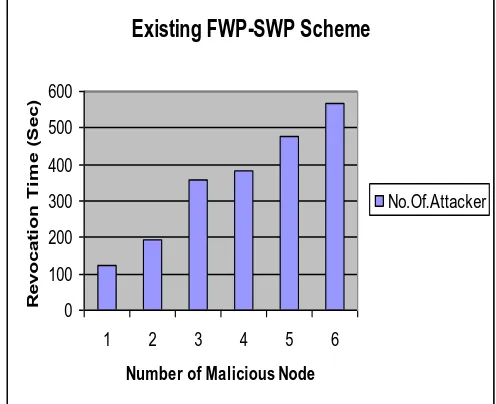
The Table 4.2 represents experimental result for existing system. The finding malicious node and revocation node process within second details and Mines details as followed.
S.N O
REVOCATIO N TIME (SEC)
NO.OF ATTACKE R NODES AVERAGE OF ATTACKE R PER MINS (Throughput ) (%)
1 100 125 3.68
2 200 195 10.67
3 300 356 25.38
4 400 384 38.22
5 500 475 60.41
6 600 566 90.63
Table 4.2 Experimental Result for number of node and average of attacker node finding in
Existing System
The Figure 4.2 represents experimental result for existing system. The finding malicious node and revocation node process within Minis details as followed.
Existing FWP-SWP Scheme
0 100 200 300 400 500 600
1 2 3 4 5 6
Number of Malicious Node
[image:5.595.308.556.225.427.2]R e v o c a ti o n T im e ( S e c ) No.Of.Attacker
Fig 4.2 Existing FWP-SWP- Number of Attacker
The Figure 4.3 represents experimental result for proposed system. The finding malicious node and revocation node process within Minis details as followed.
Proposed MFWP-MSWP Scheme
0 100 200 300 400 500 600 700
1 2 3 4 5 6
Number of Malicious Node
[image:5.595.48.577.517.775.2]R e v oc a ti on Ti m e ( S e c ) No.of.Attacker
© 2015, IRJET ISO 9001:2008 Certified Journal Page 941
5. CONCLUSION
The new system eliminates the difficulties in the existing system. It is developed in a user-friendly manner. In this project, major issues to ensure secure communications for mobile ad hoc networks, namely, certificate revocation of attacker nodes are solved. In contrast to existing algorithms, we propose a cluster-based certificate revocation with vindication capability scheme combined with the merits of both voting-based and non-voting based mechanisms to revoke malicious certificate and solve the problem of false accusation.
A new incentive method to release and restore the legitimate nodes and to improve the number of available normal nodes in the network has been proposed. This software is very particular in finding malicious applications. Any node with .Net framework installed can execute the application.
6. FUTURE ENHANCEMENT
The process of preparing plans had been a new experience, which was found use full in later phases of the project is completed. Efforts had been taken to make the system user friendly and as simple as possible. However at some points some features may have been missed out which might be considered for further modification of the application. The new system become useful if the below enhancements are made in future.
Any attack should be identified as soon as possible.
To mitigate malicious attacks on the network.
In future, the system is more effective and efficient in revoking certificates of malicious attacker nodes, reducing revocation time, and improving the accuracy and reliability of certificate revocation.
REFERENCES
[1] H. Yang, H. Luo, F. Ye, S. Lu, and L. Zhang, ―Security in Mobile Ad Hoc Networks: Challenges and Solutions,‖ IEEE Wireless Comm., vol. 11, no. 1, pp. 38-47, Feb. 2004.
[2] P. Sakari ndr and N. Ansari , ―Security Services in Group Communications Over Wireless Infrastructure,
Mobile Ad Hoc, and Wireless Sensor Networks,‖ IEEE Wireless Comm., vol. 14, no. 5, pp. 8-20, Oct. 2007. [3]A.M. Hegland, E. Winjum, C. Rong, and P. Spilling, ―A Survey of Key Management in Ad Hoc Networks,‖ IEEE Comm. Surveys and Tutorials, vol. 8, no. 3, pp. 48-66, Third Quarter 2006.
[4]L. Zhou and Z.J. Haas, ―Securing Ad Hoc Networks,‖ IEEE Network Magazine, vol. 13, no. 6, pp. 24-30, Nov./Dec. 1999.
[5] L. Zhou, B. Cchneider, and R. Van Renesse, ―COCA: A Secure Distributed Online Certification Authority,‖ ACM Trans. Computer Systems, vol. 20, no. 4, pp. 329-368, Nov. 2002.
[6] C. Gentry, ―Certificate-Based Encryption and the Certificate Revocation Problem,‖ EUROC RYPT: Proc. 22nd Int ‘l Conf. Theory and Applications of Cryptographic Techniques, pp. 272-293, 2003.
[7] H. Yang, J. Shu, X. Meng, and S. Lu, ―SCAN: Self-Organized Network-Layer Security in Mobile Ad Hoc Networks,‖ IEEE J. Selected Areas in Comm., vol. 24, no. 2, pp. 261-273, Feb. 2006.
[8]J. Newsome, E. Shi, D. Song, and A. Perrig, ―The Sybil Attack in Sensor Network: Analysis & Defenses,‖ Proc. Third Int‘l Symp. Information Processing in Sensor Networks, pp. 259-268, 2004.
[9] W. Liu, H. Nishiyama, N. Ansari, and N. Kato, ―A Study on Certificate Revocation in Mobile Ad Hoc Network,‖ Proc. IEEE Int‘l Conf. Comm. (ICC), June 2011.
[10] P. Yi, Z. Dai, Y. Zhong, and S. Zhang, ―Resisting Flooding Attacks in Ad Hoc Networks,‖ Proc. Int‘l Conf. Information Technology: Coding and Computing, 2005.
[11] Kong, X. Hong, Y. Yi, J.-S. Park, J. Liu, and M. Gerla, ―A Secure Ad-Hoc Routing Approach Using Localized Self-Healing Com-munities,‖ Proc. Sixth ACM Int‘l Symp. Mobile Ad hoc Networking and Computing , pp. 254-265. 2005.
© 2015, IRJET ISO 9001:2008 Certified Journal Page 942
[13] M. Sanchez and P. Manzoni. Anejos: A java based simulator for ad-hoc networks. Future Generation Computer Systems, 17(5):573–583, 2001.
[14] V. Davies. Evaluating mobility models within an ad hoc network. Master‘s thesis, Colorado School of Mines, 2000.
[15]E. W. Weisstein. The CRC Concise Encyclopedia of Mathematics. CRC Press, 1998.
[16] M. Zonoozi and P. Dassanayake. User mobility modeling and characterization of mobility pattern. IEEE Journal on Selected Areas in Communications, 15(7):1239–1252, 1997.
[17] I. Rubin and C. Choi. Impact of the location area structure on the performance of signaling channels in wireless cellular networks. IEEE Communications Magazine, pages 108–115, 1997.
[18] IEEE-SA Standards Board, ―IEEE Std. 802.11i,‖ IEEE, 2004. [2] ZigBee Alliance, ―ZigBee Standard, version 1,‖ ZigBee Alliance,2004.
[19] IEEE-SA Standards Board, ―IEEE Std. 802.15.4,‖ IEEE, 2003.
[20] Bluetooth SIG, ―Bluetooth Core Specification Version 2.0 + Enhanced Data Rate,‖ Bluetooth SIG, 2004.
[21]A. Shamir, ―Identity-Based Cryptosystems and Signature Schemes,‖ Proc. CRYPTO ‗84, 1984, pp. 47– 53. and Computing, pp. 254-265. 2005,
[22]Scalable Network Technologies: Qualnet, http://www.scalable-networks.com, 2012.
[23]C. Bettstetter, G. Resta, and P. Santi, ―The Node Distribution of the Random Waypoint M obility Model for Wireless Ad Hoc Net-works,‖ IEEE Trans. Mobile Computing, vol. 2, no. 3, pp. 257-269, July-Sept. 2003. [24]J. Clulow and T. Moore, ―Suicide for the Common Good: A New Strategy for Credential Revocation in Self-organizing Systems,‖ ACMSIGOPS Operating Systems Rev., vol. 40, no. 3, pp. 18-21, July 2006. [25]K. Park, H. Nishiyama, N. Ansari, and N. Kato, ―Certificate Revocation to Cope with False Accusations
in Mobile Ad Hoc Networks,‖ Proc. IEEE 71st Vehicular Technology Conf. (VTC ‘10), May 16-19, 2010.
[26]E. Ayanoglu, C .- L. I, R. D. Gitlin, and J. E. Mazo. Diversity c o ding for transparent se lf-healing and fault-tolerant communication networks. IEEE Transactions on Communications , 41(11):1677–1686, Nove mb e r 1993.
[27]M. Castro and B. Liskov. Practical Byzantine fault tolerance. In Proceedings of the 3rd USE NIX
Symposium on Operating System Design and Implementation (OSDI‘99) , pages 173–186, New
Orleans, LA USA, February 22–25, 1999. USENIX Association, IEEE TCOS, and ACM SIGOPS.
© 2015, IRJET ISO 9001:2008 Certified Journal Page 943 Dr. D. Devakumari has received M. Phil degree from Manonmaniam Sundaranar University in 2003 and Ph.D from Mother Teresa Womens’ University in 2013. Currently she is working as Assistant Professor in the PG and Research Department of Computer Science, Government Arts College (Autonomous), Coimbatore, India. Her research papers have been published in International journals including Inderscience, Springer etc. She has presented papers in National and International Conferences. Her research interests include Data Pre-processing and Pattern Recognition.