The Effect of Social Science Learning Using Group
Investigation Model On Critical Thinking Ability of
Students at SMPN 13 Malang
Siti Dina Safrianti*, Harmanto**, M. Jacky ***
*Postgraduate Student in Elementary Program, State University of Surabaya, Indonesia **Lecturers of Elementary Program, State University of Surabaya, Indonesia ***Lecturers of Elementary Program, State University of Surabaya, Indonesia
DOI: 10.29322/IJSRP.9.07.2019.p91119
http://dx.doi.org/10.29322/IJSRP.9.07.2019.p91119
Abstract- This study aims to analyze the differences in critical thinking skills of students who follow the group investigation learning model with direct learning models. This is done to find the influence of group investigation learning model on students' critical thinking abilities. This study uses a quasi-experimental design. The study population was all students of class VII of SMP 13 Malang City 2018/2019 school year as many as 240 students. The research sample was students of class VII-H and VII-I (59 students). Research instruments are essay questions to measure students' critical thinking skills. The data analysis technique applied was the t-test on the SPSS 21 program. The results showed that the average critical thinking ability of students in the post-test in the control group was 79.88, while the experimental group was 85.97. In addition, the significance value obtained was 0.000 (<0.05) so that the research hypothesis was accepted. Thus, it can be concluded that there is a significant increase in critical thinking skills in students who follow the group investigation learning model with a direct learning model.
Index Terms- Group Investigation Learning Model, Critical Thinking Ability
I. INTRODUCTION
ocial science (IPS) is a compulsory education which has an important role in improving the quality of education. In accordance with its sociological foundation, IPS education provides a system of fundamental ideas to determine the ideals, needs, interests, strengths, aspirations, and patterns of future life through social interactions experienced by students (Sapriya 2015). In this case, the consequence is that the social studies learning process must be able to help students build competence as an important provision in social life.
The process of social studies learning in schools so far is still dominated by memorization methods, which causes students to get bored with what they learn. In addition, the teacher still dominates learning by the lecture method rather than the skills to process and understand the material independently. Social studies learning consists of concepts and theories that examine the relationship between humans to develop responsibility in a democratic country, so that it requires critical thinking in analyzing it (Nasution, 2011). This means that the implementation
of social studies must be able to help students develop their potential and competencies, both cognitive, affective, or psychomotor potential. Thus, they will be able to face the environment in which they live today until later in the future. One of the fundamental challenges in social studies learning at this time is to look for learning models that can motivate students to participate in learning, and develop their thinking skills (Sapriya, 2015). This is considered important to provide space for students to learn independently and develop their abilities. Based on Law No.20 of 2003, education is a conscious and planned effort to develop the abilities and potential of students to become human beings who believe and fear God Almighty, have a noble character, are healthy, knowledgeable, capable, creative, independent, and become a democratic and responsible citizen. This can be interpreted that in teaching and learning activities, children are the subject and object of teaching activities. The core of the teaching process is nothing but the learning activities of students in achieving one teaching goal. The purpose of teaching, of course, will be achieved if students play an active role with the help of teachers who are creative in creating a pleasant learning atmosphere.
students to search for topics through various problems that exist in society. The purpose of the group investigation learning model is to develop student participation in a democratic social process by combining attention to abilities between personal (group) and academic curiosity in the learning process. In the group investigation model, it is assumed that the atmosphere of a class is an analogy of the life of a society in which it has an order, order, and culture. Here students strive to maintain a developing order in the classroom, namely the standard of living and hope that grows in the class.
The investigation group learning model can be used by teachers to develop critical thinking skills and student learning motivation in groups to solve problems. Cooperative learning models are designed to help the distribution of responsibilities when students follow learning oriented towards the formation of social humans (Manufen, as cited in Rusman, 2012). In this case, the GI cooperative learning model was deemed by the researcher in accordance with the conditions of the problems experienced by Malang City Middle School 13 students. If examined, the study of social studies learning has a close relationship with the problems that occur in society. So, it is expected that the use of the experimental group learning model can make students more active in the learning process. As a result, in addressing a problem, students can make wise decisions now until later in the future. Cognitive learning theory implies that different processes regarding learning can be explained by analyzing mental processes first. This suggests that with effective cognitive processes, learning becomes easier and new information can be stored in memory for a long time. On the other hand, ineffective cognitive processes result in learning difficulties that will be seen during a person's lifetime (Asri, 2012). The essence of cognitive learning theory is learning does not have to be teacher-centered, but students must be more active. Therefore, students must be guided so they actively find something they have learned. Consequently, the material studied must attract students' interest in learning and challenge it so that they are absorbed and involved in the learning process. This is in accordance with the group investigation learning model This study aims to describe the differences in critical thinking skills of students who take social studies with group investigation models with direct learning.
II. METHOD
This study uses a quantitative approach with a quasi-experimental method. The quasi-quasi-experimental method is a typical research method in education that examines the practical conditions in which it is impossible to control all relevant variables. The aim is to overcome difficulties in determining the control group used in the study (Sugiyono, 2010: 77).
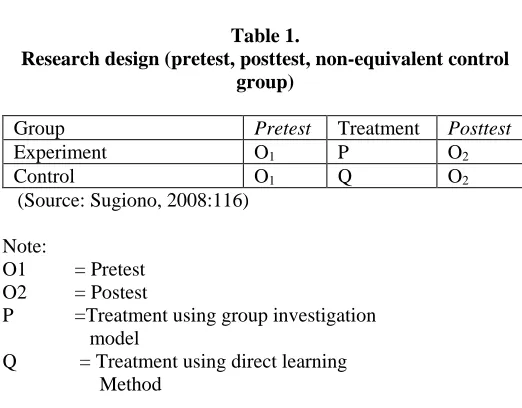
[image:2.612.312.573.69.273.2]In its implementation, this research will be divided into two groups, namely the experimental class and the control class. The experimental class group was a group of students who received treatment using the investigation group learning model while the control group was a group of students who received treatment using the direct learning model. The design of this study can be illustrated in Table 1.
Table 1.
Research design (pretest, posttest, non-equivalent control group)
Group Pretest Treatment Posttest
Experiment O1 P O2
Control O1 Q O2
(Source: Sugiono, 2008:116)
Note:
O1 = Pretest
O2 = Postest
P =Treatment using group investigation
model
Q = Treatment using direct learning
Method
This research was conducted at Malang State Junior High School 13 which is located at Jl. Sunan Ampel 2, RT.9 / RW.2, Dinoyo, Kec. Lowokwaru, Malang City from February to March 2019.
The population in this study were all students of class VII of SMP 13 Malang City in the 2018/2019 school year which amounted to 240 students. The technique used in collecting samples is cluster random sampling because the selected groups represent the population and involve all individuals in the group as subjects. The samples in this study were students of class VII-I (30 students) as an experimental class and students of class VII-H (29 students) as a control class.
The data collection instruments used are observation and test sheets. The observation sheet was used as an observation guideline to measure the learning implementation of the group investigation learning model for the experimental class and the direct learning model for the control class. In addition, the test used in the form of a written test in the form of description to measure students' critical thinking skills at the time of the pretest and posttest. These test questions are based on indicators that are in accordance with the learning material.
Analysis of the data used is the t-test. Before the t-test is carried out, a prerequisite test is first performed, namely the test for normality and homogeneity. If both classes have normal and homogeneous data distribution, then the t-test is carried out with the SPSS 21 program. Testing criteria are, (1) If tstatistics is smaller than ttable (tstatistics < ttable) then the alternative hypothesis
(Ha) is rejected. (2) If tstatistics is greater than ttable (tstatistics > ttable),
the alternative hypothesis (Ha) is accepted.
III. RESULTANDDISCUSSION
Data on students' critical thinking skills taken from tests of critical thinking skills that have been validated and tested are then applied to class VII students of SMP N 13 Malang City. This research is an experimental study involving two classes, namely the experimental class that uses the group investigation learning
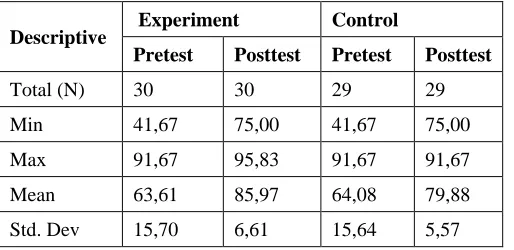
Data calculation or processing is carried out with SPSS 21 program. The data presented in this study are data from the results of tests of students' critical thinking skills with group investigation and direct learning model learning. The description of the data presented is in the form of a mean, standard deviation, minimum value and maximum value which includes the results of tests of students' critical thinking skills; pre-test results (control class), post-test results (control class), pre-test (experimental class), and post-test (experimental class). The results of the descriptive analysis are shown in table 2.
Table 2.
Descriptive analysis of students' critical thinking abilities
Descriptive Experiment Control
Pretest Posttest Pretest Posttest
Total (N) 30 30 29 29
Min 41,67 75,00 41,67 75,00
Max 91,67 95,83 91,67 91,67
Mean 63,61 85,97 64,08 79,88
Std. Dev 15,70 6,61 15,64 5,57
In the experimental class using the investigation group model, the average pre-test critical thinking ability was obtained by 63.61 with a standard deviation of 15.70. The minimum value on the pre-test critical thinking ability is 41.67 with a maximum value reaching 91.67. Critical thinking ability has increased after giving treatment (post-test) to reach an average of 85.97 with a standard deviation of 6.61. The minimum value of this post-test critical thinking ability is 75.00 with a maximum value reaching 95.83.
In the control class using the direct learning model, the average pre-test critical thinking ability was obtained by 64.08 with a standard deviation of 15.64. The minimum value on the pre-test critical thinking skills is 41.67 with a maximum value reaching 91.67. Critical thinking ability has increased after giving treatment (post-test) to reach an average of 79.88 with a standard deviation of 5.27. The minimum value of post-test critical thinking skills is 75.00 with a maximum value reaching 91.67.
Before the two mean similarity tests were carried out, first a test was conducted on the distribution of research data, namely the normality test using the Kolmogorov-Smirnov method. If the research data is normally distributed, then the data testing is done using parametric methods. Conversely, if the data is not normally distributed, then testing the research data using non-parametric methods.
The basis for decision making from the Kolmogorov-Smirnov test is to use a significance value (p-value) compared to the 0.05 significance level. If the significance value is < 0.05, then the data distribution is not normal. If the significance value is > 0.05, then the data distribution is normal. The results of the normality test of students' critical thinking skills are as follows:
Tabel 3
Normality test on the data of critical thinking ability
Group Data Kolmogrov
- Smirnov
Sig. Interpretatio n
Control Pretest 1,107 0,17
2
Normal distribution
Posttes t
1,203 0,11
1
Normal distribution
Experimen t
Pretest 1,056 0,21
5
Normal distribution
Posttes t
0,866 0,44
2
Normal distribution
Based on the results of the normality test, obtained a significance value (p-value) greater than 0.05 in both the pre-test (0.215) and post-test (0.442) in the experimental group (group investigation learning model). In addition, the pre-test data in the control group (direct learning model) is 0.172, and in the post-test is 0.111. So that it can be concluded that the data of Critical Thinking Ability students have a normal distribution.
After the normality test is carried out, the homogeneity test is then carried out using the Levene test method to find out the variety of research data in each group that will be compared. The basis of decision making is using a significance value (p-value) with a real level of 0.05. If the significance value is < 0.05, then the two data are not homogeneous. If the significance value is > 0.05, then the data of the two groups are declared homogeneous. The homogeneity test results are presented as follows:
Tabel 4
Homogeneity test on the data of critical thinking ability
Variabel Levene Statistics
Sig. Interpretation
Pretest 0,02 0,968 Homogenous
Posttest 1,160 0,232 Homogenous
Based on the results of the homogeneity test, get a significance value (p-value) on the comparison of pre-test critical thinking skills, namely 0.968, and post-test 0.232 (> 0.05), so it can be concluded that the research data has a variety of homogeneous values.
[image:3.612.42.299.218.343.2]Independent Sample t-Test. The basis for decision making is to look at the t-count and the significance value (p-value). The tstatistics greater than the t table or the significance value (p-value) smaller than alpha of 0.05 indicates that there is a significant difference between the experimental class and the control class. Testing the hypothesis of students 'critical thinking skills is done to know whether there are differences in students' critical thinking skills between the experimental class using the investigation group learning model and the control class using the direct learning model. The t-Test results are explained in table 5.
Tabel 5
The result of t-Test on students' critical thinking ability
Variabel Kelompok N Mean thitung Db Sig
Critical thinking ability (pretest)
Control 29 64,08 0,115 57 0,909
Experiment 30 63,61 57
Critical thinking ability (posttest)
Control 29 79,88 3,818 57 0,000
Experiment 30 85,97 57
Note: ttable (5%; 57) = 2,002
Table 5 shows the results of the comparison of students' critical thinking skills in the control group using the direct learning model, and the experimental group using the group investigation learning model. Obtained a tstatistics of 0.115 (< ttable) with a
significance value of 0.909 (> 0.05), so that it can be stated that there is no significant difference in students' critical thinking skills at the pre-test between the control group using the direct learning model and the experimental group with the group investigation learning model.
On the comparison of the post test critical thinking skills between the control class using the direct learning model and the experimental class using the investigation group learning model,
the tstatistics was 3,818 with a significance value of 0.000. It is
known that the value of tstatistics > ttable or significance value is
smaller than the real level of 5%, it is concluded that there is a significant difference in post test critical thinking skills between the control class using direct learning models and experimental classes that use group investigation learning models.
Based on the constructivism theory revealed by Vigotsky, students have Zone of Proximal Development, which means that students will be much more developed if they interact with other people. Students will never develop formal operational thinking without the help of others or find out for themselves. The investigation group learning model places more emphasis on actual development which encourages students to think critically. Actual development emphasizes how a student can do something without the help of a teacher. In other words, the teacher is only a facilitator and students themselves are looking for solutions to the problems faced. In this principle, several indicators of critical thinking ability can be seen in the group investigation model. In indicators analyzing arguments, students can express their arguments with relevance, coherent (logical) lines of thought, to
be able to analyze cases of Entrepreneurship Roles in Building Indonesian Economy based on their opinions (based on what they understand). This shows that in analyzing arguments, students have been able to express their own opinions. In addition, on indicators solving problems on the topic of "falling milk prices and decreasing apple prices in Malang", students have been able to express the ways of problems solving through various references and provide solutions by discussing with group members. This shows that actual development is very visible, where students have been able to provide solutions to the problems discussed.
Unlike the group investigation learning model, the direct learning model is more directed at potential development. In this case, a student will be able to do something or solve a problem with the teacher's instructions. In the indicator analyzing the argument, students express their arguments relevantly in analyzing the case of the Entrepreneurship Role in Building the Indonesian Economy with the help of a textbook. In indicators of problem-solving, students have been able to express the ways of solving the topic of discussion "Falling milk prices and decreasing apple prices in Malang" according to his opinion, each with a textbook guide and asking the teacher. Thus, it can be concluded that the learning model directly leads to potential development. This can be seen from the way students solve problems, where students have been able to express the ways of solving based on textbook guidelines and ask the teacher.
IV. CONCLUSION
Based on the description of the results of the study, data analysis, and hypothesis testing, it can be concluded that there are significant differences in the critical thinking skills of students who follow the group investigation learning model with the direct learning model. This is evidenced by the value of tstatistics > t table or significance value < 5% real level. The acquisition of tstatistics on critical thinking skills is 3.818 with a significance value of 0.000. In the matter of critical thinking skills, there are several indicators developed to measure the level of students' critical thinking skills, namely arguing, analyzing arguments, solving problems, analyzing problems, and concluding. This is in accordance with the opinion of Vigotsky, that students must build their own knowledge in their minds. Students should learn through interaction with adults or peers who are more capable. These interactions will help form new ideas and improve children's intellectuality.
REFERENCES
[1] Amri, Sofan. 2013. Pengembangan Dan Model Pembelajaran Dalam Kurikulum 2013. Jakarta : Prestasi Karya.
[2] Asyari. (2015). Improving Critical Thinking Skills Through The Integration Of Problem Based Learning And Group Investigation. Journal Of Education And Research. Vol. 5, No 3
[3] Dahar, R.W. 2011. Teori-Teori Belajar & Pembelajaran. Jakarta: Erlangga [4] Ivy Geok Chin Tan. (2013). Group Investigation Effects on Achievement,
Motivation, and Perceptions of Students in Singapore.. Vol 100,142-154 [5] Karafkan. (2015). Investigating the Effects of Group Investigation (GI) and
Cooperative Integrated
[7] Mushoddik. (2016 ). Investigation Learning Model Influence on Critical Thinking Skills. Journal of Education and Research. Vol. 5, No.2
[8] Nasution. 2011. Kajian Pembelajaran IPS di Sekolah. Surabaya : Unesa University Press
[9] Nilufer & Kemal (2012). The Effects Of Group Investigation And Cooperative Learning Techniques Applied In Teaching Force And Motion Subjects On Students’ Academic Achievements. Journal of Education and Research . Vol 2 No. 3
[10] Sapriya. 2015. Pendidikan IPS. Bandung : PT. Remaja Rosdakarya [11] Sugiyono.2010. Metode Penelitian. Kuantitatif, Kualitatif dan R&D.
Bandung: Alfabeta
[12] Supardan, dadang. 2015. Pembelajaran Ilmu Pengetahuan Sosial Perspektif Filosofi dan Kurikulum. Bandung : Bumi Aksara.
[13] Suprijono, Agus. 2016. Model-Model Pembelajran Emansipatoris. Yogyakarta: Pustaka Pelajar
[14] Sutikno Sobri. 2014. Metode Dan Model-Model Pembelajaran Menjadikan Proses Pembelajaran Lebih Variative, Aktif, Inovatif, Efektif, Dan Menyenangkan. Lombok : Holistica
[15] Syahbana, Ali. (2012). Peningkatan Kemampuan Berpikir Kritis Matematika Siswa SMP Pendekatan Contexstual Teaching And Learning. , Jurnal edumatica Volume 2 No.1
AUTHORS
First Author – Siti Dina Safrianti, Postgraduate Student in Elementary Program, State University of Surabaya, Indonesia, Email: [email protected]
Second Author – Harmanto, Lecturers of Elementary Program, State University of Surabaya, Indonesia