Isolation and Molecular Characterization of acne causing
Propionibacterium acnes
Roselin Polugari1, Shailaja Raj Marla1, Shailaja. D2
1
St. Francis College for Women, Begumpet, Hyderabad, Telangana
2
Gokaraju Rangaraju Institute of Technology, JNTUH, Telangana
Abstract- Propionibacterium acnes is the most common member of the Anaerobic or microaerophilic coryneform organisms found on the skin. The present study focused on the isolation of
Propionibacterium acnes, the causative organism of acne and its characterization based on the cultural characteristics, biochemical tests, GC FAME (Gas Chromatography- Fatty acid methyl esters) analysis and 16 S r RNA sequencing. The results were compared with the standard organisms procured from IMTECH, Chandigarh, India. The FAME analysis report of the organism correlates with that of the genotyping of the isolate and the organism is identified as Propionibacterium acnes.
Index Terms- Propionibacterium acnes, Biochemical tests, FAME analysis, 16 S r RNA gene sequencing
I. INTRODUCTION
cne is a chronic inflammatory disease of the pilosebaceous unit resulting from androgen induced increased sebum production, altered keratinization, inflammation and bacterial colonization of hair follicles on the face, neck, chest and back by
Propionibacterium acnes. Facial scarring due to acne affects up to 20% of the teenagers. Acne can persist into adulthood, with detrimental effects on self-esteem.1
Propionibacterium acnes is relatively slow growing, aero tolerant anaerobic, Gram-positive skin microbe that colonizes sebaceous glands and pilosebaceous follicles.2 This organism is considered to play a principal role in the development of acne vulgaris.2 Acne has many different symptoms including comedones, papules, pustules, nodules, cysts and pilosebaceous inflammation. Among these, inflammatory lesions of acne are of the greatest concern to patients because they may lead to acne scarring, thereby inducing adverse psychological effects.3 It can also cause chronic blepharitis and endophthalmitis, the latter particularly following intraocular surgery4. The bacterium is largely commensal and part of skin flora present on most healthy adult human skin5. It lives primarily on, among other things, fatty acids in sebum secreted by sebaceous glands in the follicles. It may also be found throughout the gastrointestinal tract in humans. 6 It accounts for approximately half of the total skin microbiota7, with an estimated density of 102 to 105 or 106 organisms per cm2 . 8, 9
P. acnes bacteria live deep within follicles and pores, away from the surface of the skin. In these follicles, P. acnes bacteria use sebum, cellular debris and metabolic byproducts from the surrounding skin tissue as their primary sources of energy and nutrients. Elevated production of sebum by hyperactive
sebaceous glands or blockage of the follicle can cause P. acnes
bacteria to grow and multiply. 10
P. acnes bacteria secrete many proteins, including several digestive enzymes. 11 These enzymes are involved in the digestion of sebum and the acquisition of other nutrients. They can also destabilize the layers of cells that form the walls of the follicle. The cellular damage, metabolic byproducts and bacterial debris produced by the rapid growth of P. acnes in follicles can trigger inflammation.12 This inflammation can lead to the symptoms associated with some common skin disorders, such as folliculitis and acne vulgaris. 13, 14 The aim of this study is to isolate P. acnes and identify it based on its characteristics. There are many different ways of identifying bacteria. Rapid and accurate identification of bacterial pathogens is a fundamental goal of clinical microbiology, but one that is difficult or impossible for many slow-growing and fastidious organisms.15 New and exciting molecular methods, using the 16S small sub-unit ribosomal nucleic acid molecules have added much to our knowledge of microbial diversity 16. For many years, sequencing of the 16S ribosomal RNA (r RNA) gene has shown that sequence identification is useful for slow-growing, unusual, and fastidious bacteria as well as for bacteria that are poorly differentiated by conventional methods. The technical resources necessary for sequence identification are significant. Despite the availability of resources, sequence-based identification is still relatively expensive. 17 Although it is generally regarded that routine identification of very common species using conventional methodologies are highly accurate, we now have a more convenient and precise mechanism for checking these identifications on a molecular basis. Such studies need to be performed and published18.
Recent advances in the biochemistry of microorganisms revealed that analysis of cell components, such as proteins and fatty acids, can be effectively applied to bacterial identification, providing the basis for chemotaxonomy19. Fatty acids are one of the most important building blocks of cellular materials. In bacterial cells, fatty acids occur mainly in the cell membranes as the acyl constituents of phospholipids. These fatty acids are synthesized in certain bacteria from iso, anteiso, or cyclic primer and Malonyl-CoA with or without a subsequent modification20. The occurrence of branched-chain fatty acids as major constituents in bacteria was first reported for Bacillus subtilis21.
These days, fatty acids in bacterial lipids are routinely analyzed by gas-liquid chromatography. The unique pattern of fatty acids in bacteria is the basis of identification in FAME analysis. The MIDI (Microbial Identification Incorporation) Sherlock FAME analysis is a laboratory-based system that can be used on a routine basis to identify commonly isolated bacteria from clinical
ISSN 2250-3153
and environmental source22. More than 300 fatty acids and related compounds have been found in bacteria are analyzed in the MIDI Research and Development Laboratory. Whole cell fatty acids are converted to methyl esters and analyzed by gas chromatography. The fatty acid composition of the unknown is compared to a library of known organisms in order to find the closest match. The peaks are automatically named and quantitated by the system. Branched chain acids predominate in some Gram positive bacteria, while short chain hydroxy acids often characterize the lipopolysaccharides of the Gram negative bacteria23. The MIS, as the first automated CFA (Cellular fatty acid) identification system, is an accurate, efficient, and relatively rapid method for the identification of microorganisms
24
The present study focuses on the isolation, characterization of P. acnes based on its cultural characteristics, biochemical tests, FAME and 16S r RNA typing.
II. MATERIALS AND METHODS
2.1 Isolation of Propionibacterium acnes
P. acnes is isolated from acne. About 50 samples were collected from students aged between 18-21 years. The samples were collected using sterile swabs and then were inoculated into Brain Heart Infusion broth and Thioglycollate broth. A 1 cm2 area of the facial skin of about 50 volunteers aged between 17-21 years was cleansed with a sterile swab, and the swab was placed in a test tube containing 10ml of Thioglycollate broth. The broth was incubated for 4days in Anaero Gas Pak. After incubation, the culture was then streaked onto BHI and Clostridia agar and incubated for 4 days at 37 o C. The colony morphology was observed and stained by gram staining. The isolated colonies were sub cultured anaerobically into BHI broth and were preserved on BHI agar slants and also inoculated by stab culture onto BHI agar tubes.
2.2 Characterization of the organisms: 2.2.3. Biochemical Characterization
The Biochemical characteristics of the strains of anaerobes isolated from the persons suffering with acnes were analyzed by looking for production of Indole, sugar fermentation tests, nitrate reduction and Gelatin hydrolysis 25
Hemolysis:
The organisms were plated onto the Blood Agar plates containing 10% defibrinolysed sheep blood to test for Hemolysis. The plates were incubated anaerobically for 4 days.
2.2.4 .FAME Analysis:
FAME analysis was carried out using Agilent 6850 Series II. To perform this analysis, a bacterial culture was taken and the fatty acids were extracted and used to form methyl esters. The volatile derivatives are then introduced into a gas chromatograph and the patterns of the peaks helped identify the organism. Anaerobic library BHI was referred for the analysis. This is widely used in characterizing new species of bacteria and is useful for identifying the pathogenic strains.
2.2.5. 16S r RNA typing:
The 16S r RNA gene is used as the standard for classification and identification of microbes, because it is present in most microbes and shows proper changes. Type strains of 16S r RNA gene sequences for most bacteria and archaea are available on public databases. In the present study, the Ez Taxon database (a web-based tool for the identification of prokaryotes
based on 16S ribosomal RNA gene sequences) was used. Ez Taxon is an open access database that is produced and maintained by Chun Lab, Inc. The Ez Taxon database contains sequences of type strains of prokaryotic species with validly published names, mainly used for the routine identification of prokaryotic isolates.
III. RESULTS AND DISCUSSION
Isolation and Characterization of P. acnes
1. Pa1 Round, slimy, opaque, small colonies Gram positive cocci
2. Pa2 Small, circular, raised, creamy mucoid colonies.
Gram positive bacilli
3. Pa3 Circular, opaque, irregular and creamy colonies.
Gram positive bacilli
4. Pa4 Small, Round, cream coloured pin head colonies
Gram positive bacilli
5. Pa5 Slimy, round, cream colored colonies. Gram positive bacilli
6. Pa6 Small, round, opaque, mucoid colonies Gram positive cocci
7. Pa7 Big, round, elevated, creamy colonies Gram positive bacilli
8. 1951 Round, opaque, raised, creamy pinhead colonies
Gram positive bacilli
9. 3297 Small, round, opaque, regular, creamy colonies.
Gram positive bacilli
a b
[image:3.612.84.525.63.471.2]Figure 1: a) Colony morphology of 1951, Pa3 b) Microscopic observation of Pa 3
Figure 2: P.acnes showing Hemolysis on Blood Agar plate
Identification Glucose Maltose Sucrose Esculin* Adonitole Indole NO3^ Gelatin Catalase
Pa2 - - - - - + + + +
Pa3 + - - - + + + + +
Pa4 + - - - + + + - +
Pa5 - - - - - + - - +
Pa7 + + + - - - + + -
MTCC1951 + - - - + + + + +
MTCC3297 + - - - + + + + +
Table 2: Typical reaction patterns of the isolates
*in the case of Esculin + indicates a positive ferric citrate test. The pH in these tubes did not change significantly
Fermentation of Carbohydrates in question is indicated by + + indicates production of Indole, reduction of nitrate to nitrite and liquefaction of Gelatin respectively in the last three columns
[image:3.612.103.513.70.237.2]Out of the samples analyzed 5 samples showed colony morphology and Microscopic observation similar to that of the standard culture. These cultures were subjected to further analysis. The colonies were round, opaque, raised, creamy colonies and on gram staining, gram positive bacilli were observed (Table 1, Fig.1). Cultures Pa1, Pa6 were Gram positive cocci in clusters, hence could be Staphylococcus aureus. Pa3, Pa4 showed hemolysis on the blood agar plates as shown in Fig.2. From Table 2 we can infer that Pa3 and Pa4 showed sugar fermentation, Nitrate reductase, catalase test results similar to
that of the standard cultures – P. acnes MTCC 1951, P. acnes
[image:3.612.257.381.275.403.2]ISSN 2250-3153
FAME Analysis and 16S r RNA:
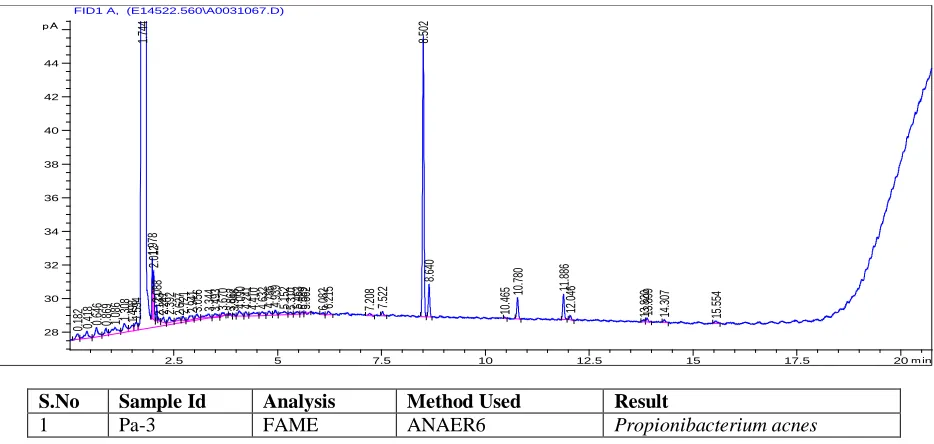
The microbial culture Pa3 and Pa4 obtained from acne was analyzed using FAME and sequencing approaches. On comparing FAME results of Pa3 with that of sequencing, it was found that both the methods correlate to each other in confirmation of identity. Fig. 3. shows results corresponding to the fatty acids identified through FAME analysis of bacterial sample. The MIDI Sherlock microbial identification system using ANAER6 method identified the organism to be
Propionibacterium acnes with 0.446 Similarity Index (SI). The SI is a numerical value, which expresses how closely the fatty acid composition of an unknown compares with the mean fatty acid composition of the strains used to create the library entry listed as its match. The SI is not a “probability” or percentage, but an expression of the relative distance of the unknown sample from the population mean. Samples with an SI of 0.500 or higher and with a separation of 0.100 between the first and second choice are considered good library comparisons. If the SI is between 0.300 and 0.500 and well separated from the second choice (>0.100 separation), it may be a good match, but an atypical strain (it would fall very far away from the mean on the normal distribution curve).27 The sequence analysis also showed similar results (Table 3). After the completion of BLAST analysis the organism was identified to be Propionibacterium acnes with 100% identity match with Propionibacterium acnes strain: DSM 1897(T) , Accession number AWZZ01000008 (EZ TAXON database). Pa4 did not find any matching chromatogram pattern in Anaerobic (BHIBLA) library.
The present study focused on the isolation, culturing and characterization of Propionibacterium acnes from acne. Identification was done based on the colony morphology, gram staining, biochemical tests, FAME analysis and sequencing. Identification of bacteria by conventional methods usually requires ≥48 h after a colony has been isolated. The identification of slow-growing fastidious microbes to the species level is difficult and time-consuming by conventional methods. 16S r RNA gene sequences frequently provide phylogenetically useful information. Signature nucleotides allow classification even if a particular sequence has no match in the database, since otherwise-unrecognizable isolates can be assigned to a phylogenetic branch at the class, family, genus, or subgenus level. Cost is a critical issue in the evaluation of 16S rDNA sequence analysis as a diagnostic tool. However, sequencing costs will probably continue their rapid trend downward, bringing this technology within the reach of many microbiology laboratories 15, 28.
IV. CONCLUSION
Propionibacterium acnes was isolated from acne and the characterization and confirmation of the same was carried out by conventional methods (Cultural characteristics and biochemical tests), FAME analysis and 16 S r RNA gene sequencing. FAME analysis and sequencing were useful in characterizing the organism up to species level.
m in
2.5 5 7.5 10 12.5 15 17.5 20
pA 28 30 32 34 36 38 40 42 44
FID1 A, (E14522.560\A0031067.D)
0.
182
0.
418 0.646
0.
869
1.
086 1.308 1.498 1.594
1. 744 1. 978 2. 012 2. 088 2. 133 2. 247 2. 392 2. 627 2. 721 2. 941 3. 056 3. 344 3. 493 3. 670 3. 862 3. 948 4. 090 4. 241 4. 410 4. 632 4. 786 4. 939 5. 152 5. 310 5. 463 5. 589 5. 662 6. 082 6. 215 7. 208 7. 522 8. 502 8. 640 10.
465 10.
780 11. 886 12. 046 13. 820 13. 899 14. 307 15. 554
S.No Sample Id Analysis Method Used Result
[image:4.612.74.541.393.615.2]1 Pa-3 FAME ANAER6 Propionibacterium acnes
m in
2.5 5 7.5 10 12.5 15 17.5 20
pA
28 30 32 34 36 38 40 42 44
FID1 A, (E14522.560\A0051069.D)
0.
066
0.
305 0.542 0.765
0.
913
0.
989 1.211 1.507 1.604
1.
745
1.
978
2.
011
2.
088
2.
160
2.
252
2.
315
2.
653
2.
729 2.815 2.983 3.280 3.428 3.614 3.797 3.882 4.016 4.174
4.
394
4.
578
4.
731
4.
940
5.
265
5.
390
5.
541
5.
754
5.
862
6.
184
6.
367
6.
644
6.
759
6.
905 7.518 8.
500
8.
644
9.
091
10.
472
10.
533
10.
783
11.
888
12.
337
13.
999
14.
312
15.
904
17.
150
Sample Id Analysis Method Used Result
[image:5.612.76.539.57.284.2]Pa-4 FAME ANAER6 No Match
Figure 4: Chromatogram of bacterial sample Pa4 showing the fatty acid peaks through Agilent GC 6850
Accession Description Pairwise
similarity (%)
Different/ Total
Completeness (%)
AWZZ01000008 Propionibacterium acnes strain: DSM 1897(T)
100 0/1398 100
AFAM01000003 Propionibacterium humerusii strain: P08(T)
98.26 24/1397 100
AGBA01000019 Propionibacterium avidum strain: ATCC 25577(T)
96.44 49/1385 100
JQ283460 Propionibacterium olivae strain: IGBL1 (T)
94.4 76/1358 94.73
JQ283461 Propionibacterium damnosum strain: IGBL13(T)
94.36 77/1365 95.7
AOSS01000369 Propionibacterium granulosum strain: DSM 20700(T)
94.32 78/1374 100
AJ704569 Propionibacterium acidopropionici strain: NCFB 563 (T)
94.24 79/1372 98.85
AF234623 Propionibacterium microaerophilum strain: M5(T)
93.74 86/1373 100
AUDD01000055 Propionibacterium jensenii strain: DSM 20535(T)
93.74 86/1373 100
AJ704572 Propionibacterium thoenii strain : NCFB 568 (T)
92.79 99/1373 99.46
Table. 3: Blast Similarity Search Results for Pa3 by 16S r RNA sequencing
ACKNOWLEDGEMENTS
The authors thank UGC for financial assistance and Management of St. Francis College.
REFERENCES
[1] Hywel C Williams, Robert P Dellavalle, Sarah Garner. Acne Vulgaris. The Lancet . Science Direct. (2012) vol.379 (9813)361-372
[2] Bojar RA, Holland KT. Acne and Propionibacterium acnes. Clin Dermatol.2004;22:357–379
[image:5.612.72.541.317.602.2]ISSN 2250-3153
Potential for Inflammatory Acne Vulgaris. Journal of Investigative Dermatology (2009), Volume 129, 2480–2488
[4] Dali.P, Giugliano. E.R, Vellozi. E.M, Smith. M.A Susceptibilities of Propionibacterium acnes ophthalmic isolates to Moxifloxacin. Antimicrobial Agents and Chemotherapy (2001) 45(10): 2969-70
[5] Bruggeman .H, Henne. A, Hoster .F, Hujer. S, Durre. P, Gottschalk G. The Complete genome sequence of Propionibacterium acnes, a commensal of Human skin. Science (2004) 305 (5684): 671-73
[6] Perry, Alexandra, Lambert, Peter. Propionibacterium acnes: infection beyond the skin. Expert Review of Anti- infective therapy (2011) 9 (12):1149-56
[7] Tancrede, C.. Role of human microbiota in health and disease. Eur. J. Clin. Microbiol. Infect. Dis. 1992. 11:1012–1015
[8] Leyden, J. J., K. J. McGinley, and B. Vowels. Propionibacterium acnes colonization in acne and non-acne. Dermatology (1998)196:55–58. [9] McGinley, K. J., G. F. Webster, and J. J. Leyden. Regional variations of
cutaneous Propionibacterium. Appl. Environ. Microbiol. (1978) 35:62–66. [10] Makrantonaki; et al. An update on the role of the sebaceous gland in the
pathogenesis of acne. Dermatoendocrinology (2011) 22(5):360-6
[11] Holland, Carsten et al., Proteomic identification of secreted proteins of P. acnes. BMC Microbiology (2010) 10: 230.
[12] Kim, Christos C. Review of the innate immune response in acne vulgaris: activation of Toll-like receptor 2 in acne triggers inflammatory cytokine responses. Dermatology (2005) 211 (3): 191-2
[13] Zouboulis, Christos C. Acne and sebaceous gland function Clinical Dermatology (2004) 22 (5):360-6
[14] Understanding acne- News in Health, January 2010. Newsinhealth.nih.gov. [15] TangY W , Ellis N M, Hopkins M K, Smith, DH, Dodge D E , Persing D H.
Comparison of Phenotypic and Genotypic Techniques for Identification of Unusual Aerobic Pathogenic Gram- Negative Bacilli; Clin Microbiol. 1998. 36(12): 3674–3679
[16] Macrae A. The Use Of 16s rDNA Methods In Soil Microbial Ecology .Brazilian Journal Of Microbiology (2000) 31:77-82
[17] Patel J B. 16S rRNA gene sequencing for bacterial pathogen identification in the clinical laboratory. Mol Diagn. ( 2001) 6(4):313-21
[18] Janda J M , Abbott S L. 16S rRNA Gene Sequencing for Bacterial Identification in the Diagnostic Laboratory: Pluses, Perils, and Pitfalls. J Clin Microbiol. 2007 September; 45(9): 2761–2764.
[19] Goodfellow, M., and D. E. Minnikin. Introduction to chemosystematics, pIn, Chemical methods in bacterial systematics. Academic Press Ltd., London. (1985). 1– 16.
[20] Kaneda, T. Fatty acids in the genus Bacillus: an example of branched-chain preference. Bacteriol. Rev. (1977). 41:391-418.
[21] Saito, K. Chromatographic Studies on Bacterial Fatty Acids. J. Biochem. (1960). 47:699-709.
[22] Leonard R. B., J. Mayer, M. Sasser, M.L. Woods, B. R. Mooney, B G Brinton, P. L. Newcomb-Gayman, And K C Carroll. Comparison of Midi Sherlock System And Pulsed-Field Gel electrophoresis In Characterizing
Strains of Methicillin-Resistant Staphylococcus aureus From A Recent Hospital Outbreak. J Clin microbiol. (1995).33: 10 .
[23] Sasser M . Identification of Bacteria by Gas Chromatography of Cellular Fatty Acids. (2001).MIDI Technical Note # 101
[24] Osterhout G J, Shull V H, Dick J D. Identification Of Clinical Isolates Of Gram-Negative Non fermentative Bacteria By An Automated Cellular Fatty Acid Identification System. J Clin Microbiol.(1991). ;29:1822– 1830 [25] Laboratory Exercises in Microbiology. Harley Prescott. Mc Graw Hill
2002. Pg 133-193.
[26] C.S Cummins. Identification of Propionibacterium acnes and related organisms by precipitin tests with Trichloroacetic acid extracts. Journal of Clinical Microbiology, (1975)p.104-110
[27] Craig Kunitsky, Gerard Osterhout, and Myron Sasser Newark, DE, USA Identification of Microorganisms Using Fatty Acid Methyl Ester (Fame) Analysis And The Midi Sherlock Microbial Identification System, MIDI, Inc. Newark, DE, USA, Encyclopedia of Rapid Microbiological Methods. www.pda.org/bookstore
[28] Surve V V, Patil M U, Dharmadhikari S M. FAME and 16 S r DNA sequence analysis of halophilic bacteria from solar salterns of Goa: A comparative study. International Journal of Scientific and Research Publications (2012) 2(8)
AUTHORS
First Author- Roselin Polugari, M.Sc., M.Phil.,(Ph.D), APSET, St.Francis College for Women, Begumpet, Hyderabad, Telangana, India
Email address: [email protected]
Second Author – Dr. M. Shailaja Raj, M.Sc., Ph.D., NET. St. Francis College for Women, Begumpet, Hyderabad, Telangana, India
Email address: [email protected]
Third Author –Dr. D. Sailaja, M.Sc., Ph.D., Gokaraju
Rangaraju Institute of Technology, Bachupally, Telangana, India Email address: [email protected]
Correspondence Author – Roselin Polugari, M.Sc., M.Phil., (Ph.D), APSET ; St.Francis College for Women, Begumpet, Hyderabad, Telangana, India