Evaluation of Bio-efficacy, Weed Control Efficiency in
Herbicide Resistant Transgenic Stacked and
Conventional Corn Hybrids (NK603 x TC 1507) for Crop
Productivity
Sivagamy Kannan
*, Chinnusamy Chinnagounder
***
Department of Agronomy, Adhiparasakthi Agricultural &Horticultural college and Research Institute, Kalavai- 632 506, Tamil Nadu, India **
Professor & PI,DWSRC, Department of Agronomy, Tamil Nadu Agricultural University, Coimbatore, Tamil Nadu - 641003, India.
Abstract- Corn (Zea mays L.) is a versatile crop, allowing it to grow across a range of agro-ecological zone popularly called ―Queen of Cereals‖. Weeds constituent one of the major
economic important problem for maize growers because they can reduce yield up to 86 per cent. A field experiment were conducted for two years at Tamil Nadu Agricultural University, Coimbatore during kharif seaons of 2010 and 2011 to evaluate the weed management options for transgenic stacked (TC 1507 & NK 603) and conventional maize hybrids. The experiments were conducted with the following objective to evaluate the weed control efficiency and crop productivity with K salt of glyphosate formulations under field conditions. Treatments consisted of two transgenic stacked hybrids named 30V92 and 30B11 applied with glyphosate as early post emergence at 900 and 1800 g a.e ha-1 during kharif,2010 and conventional maize hybrids named 30V92 and 30B11 applied with glyphosate by controlled droplet application method at 900 ,1350 and 1800 g a.e ha-1 during kharif,2011 ,these were compared with non transgenic counterpart maize hybrids applied with pre emergence atrazine at 0.5 kg ha-1 followed by one hand weeding on 40 DAS with and without insect management. Based on the two years field experimentation , it was found that early post emergence application of glyphosate at 1800 g a.e ha-1 gave significantly lower weed density, weed dry weight and higher weed control efficiency at all the intervals . Higher grain yield was registered with post emergence application of glyphosate at 1800 g a.e ha-1 in transgenic and conventional maize hybrid of 30V92(12.21 t ha-1 and 11.23 t ha-1 ) during both the seasons of study.
Index Terms- Transgenic maize,Weed density,Weed dry weight, Yield attributes ,Grain yield
I. INTRODUCTION
erbicidal weed control seems to be a competitive and promising way to control weeds at initial stages of crop growth. Selection of proper herbicides is essential for successful weed management in all crop production systems [1]. Maize was an ideal crop due to availability of the plant to acclimate to many soil and climate conditions. It is an important cereal crop s cultivated worldwide ,it is not only important human nutrient source, but also a basic element of animal feed and raw material for manufacture of many industrial products.The major yield
reducing factors for maize cultivation in india are weeds and insects. Weeds cause considerable yield loss due to competition of resources with maize crop [2].
Post emergence herbicides have been achieved adequate weed control programmes, due to its broad spectrum of activity, excellent crop safety, convenience and flexibility [3]. This necessitates the development and testing of selective early post emergence herbicides for weed control in maize. Glyphosate is a foliar applied ,broad spectrum , post emergence herbicide capable of controlling annual, perennial grasses and dicotyledonous weeds. The introduction of glyphosate resistant crops has created new oppurtunities for the use of effective , non selective herbicides like glyphosate as selective weed control in crop production. Prior to the introduction of glyphosates resistant crops , glyphosate is being applied to control existing vegetation prior to sowing the crops. Now, it can be used as post emergence herbicide in glyphosatre resistant crops [4] Herbicide resistant corn plants confer tolerance to glyphosate by production of the glyphosate –resistant CP4 5-enolpyruvyl shikimate – 3 phosphate synthase (CP4 EPSPS) proteins. Transgenic stacked hybrid maize (TC1507 X NK 603) was developed for preventing yield losses for maize crop due to pests and weeds and to improve productivity. Post emergence application of glyphosate at 1800 g a.e ha-1 gave significantly lower weed index , weed dry weight and high weed control efficiency at all the intervals. Post emergence application of glyphosate at 1800 g a.e ha-1 in transgenic maize and post emergence control droplet application method of glyphosate at 1800 g a.e ha-1 in conventional maize hybrid (30V92) recorded high productivity and profitability. In view of the above facts, an experiment on ―Evaluation of weed management options for transgenic stacked and non transgenic maize hybrids’was formulated with the following objectives. With these in view, evaluation of weed control efficiency and yield of glyphosate resistant maize hybrids has been taken up during kharif season of 2010 and 2011 with the objectives of, to assess the effect of glyphosate on the weed control efficacy in transgenic and conventional maize hybrid and to find out the influence of glyphosate on grain yield of herbicide tolerant and conventional maize hybrids .
II. MATERIALSANDMETHODS
ISSN 2250-3153
www.ijsrp.org
Field experiments were laid out during kharif seasons of 2010 & 2011 in Eastern block farm of Tamil Nadu Agricultural University , located at Coimbatore,India.The geographical location of the experimental site is situated in western agro climatic zone of Tamil Nadu at 11ºN longitude and 77 ºE latitude with an altitude of 426.7 m above MSL and the farm receives the total annual rainfall of 674 mm in 45.8 rainy days. The soil of the experimental site was sandy clay loam in texture (32.48 % clay, 18.50 % silt and 28.96 % coarse sand) with low available nitrogen,medium in available phosphorous and high in available potassium.The soil analysed 260,11.90 and 490 Kg ha-1 of KMnO4- N,Olsen –P and NH4 OAC- K, respectively with EC of 0.16 dSm-1 ,Ph of 8.11 and organic carbon of 0.31%.
2.2 Experimental Design , Selection of cultivar and Sowing
The experiment was laid out in randomized complete block design (RBD) with sixteen treatments and replicated thrice. The gross plot size adopted was (5mx3.6m) 18 Sq meter.The adopted spacing between the rows and plants were 60 cm and 25 cm respectively. Herbicide tolerant transgenic maize test hybrids namely 30V92, 30B11 and conventional hybrids of 30V92,30B11 ,BIO 9681 and COHM5 during kharif,2010. Conventional maize hybrids 30V92 , 30B11 , BIO 9681 and COHM5 were raised during kharif, 2011. After sowing the seed, immediate light irrigation was given to the crop for uniform germination.
2.3 Treatment details
The experiment I during kharif, 2010 comprises two transgenic stacked hybrids 30V92 and 30B11 with post emergence of glyphosate at 900 and 1800 g a.e ha-1 and conventional maize hybrids of 30V92 with pre emergence atrazine at 0.5 kg ha-1 on 3 DAS fb HW 40 DAS and insect control, 30V92 no weeding and insect control, 30V92 no weeding and no insect control, conventional maize hybrid of 30B11 with pre emergence atrazine at 0.5 kg ha-1 on 3 DAS fb
HW 40 DAS and insect control, 30B11 no weeding and insect control, 30B11 no weeding and no insect control , conventional maize hybrids of BIO 9681 with pre emergence atrazine at 0.5 kg ha-1 on 3 DAS fb HW 40 DAS and insect control, BIO 9681 no weeding and insect control, BIO 9681 no weeding and no insect control and COHM5 with pre emergence atrazine at 0.5 kg ha-1 on 3 DAS fb HW 40 DAS and insect control, COHM5 no weeding and insect control, COHM5 no weeding and no insect control.
The experiment II during kharif, 2011 comprises of conventional maize hybrid of 30V92 with post emergence controlled droplet application of glyphosate at 900,1350 and 1800 g a.e ha-1, 30B11 hybrid with post emergence glyphosate at 900,1350 and 1800 g a.e ha-1 ,30V92 with pre emergence atrazine at 0.5 kg ha-1 on 3 DAS fb HW 40 DAS and insect control, 30V92 no weeding and insect control, 30V92 no weeding and no insect control,30B11 with pre emergence atrazine at 0.5 kg ha-1 on 3 DAS fb HW 40 DAS and insect control , 30B11 no weeding and insect control,30B11 no weeding and no insect control , BIO 9681 with pre emergence atrazine at 0.5 kg ha-1 on 3 DAS fb HW 40 DAS and insect control,BIO 9681 no weeding and no insect control and COHM5 with pre emergence atrazine at 0.5 kg ha-1 on 3 DAS fb
HW 40 DAS and insect control, COHM5 no weeding and no insect control.
The herbicides as per the treatments schedule were applied as pre emergence at third day after sowing, glyphosate application at 2-4 leaf stage of weeds (20-25 DAS of maize). Hand operated knapsack sprayer fitted with a flat fan type nozzle (WFN 40) was used for spraying the herbicides adopting a spray volume of 250 litres ha-1. The recommended dose of 150:75:75 Kg of NPK ha-1 in the form of urea,single super phosphate and muriate of potash.
2.4 Observation on weeds 2.4.1. Weed density
The weed count was recorded species wise using 0.5m x0.5 m quadrated four randomly fixed places in each plot and the weeds falling within the frames of the quadrat were counted, recorded and the mean values were expressed in number m-2.The density of grasses, sedges and broadleaved weeds and the total weeds were recorded at 20,40,60 and 80 days after sowing and expressed in number m-2.
2.4.2. Weed Dry Weight
The weeds falling within the frames of the quadrant were collected, categorized into grasses, sedge and broadleaved weeds ,shade dried and later dried in hot air oven at 80ºC for 72 hrs. the dry weight of grasses , sedge and broadleaved weeds were recorded separately at 20,40 and 60 days after sowing and expressed in Kg ha-1.
2.4.3 Weed Control Efficiency
Weed control efficiency was calculated as per the procedure [5]
100
x
WD
WD
-WDc
WCE%
c t
Where ,WCE – Weed control efficiency (per cent) ; WDc - Weed biomass (g.m-2) in control plot;
WDt - Weed biomass (g.m-2) in treated plot;
2.5 Statistical Analysis
The data were statistically analysed following the procedure given by Gomez and Gomez (2010) for randomised block design .The data pertaining to weeds and germination were transformed to square root scale of
(X
2
)
and analysed as suggested by [6] .Whenever significant difference existed, critical difference was constructed at five per cent probability level.
III. RESULTSANDDISCUSSION 3.1. Effect on weeds
were Setaria verticillata and Cyanodon dactylon. Cyperus rotundus was the only sedgepresent in the experimental field.
3.2 Weed Density
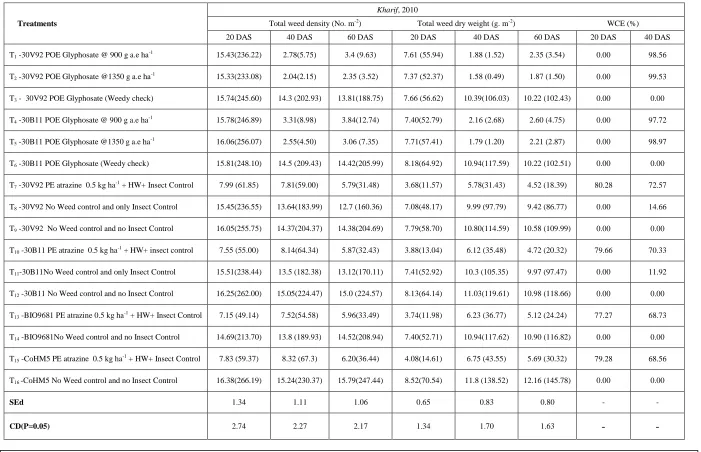
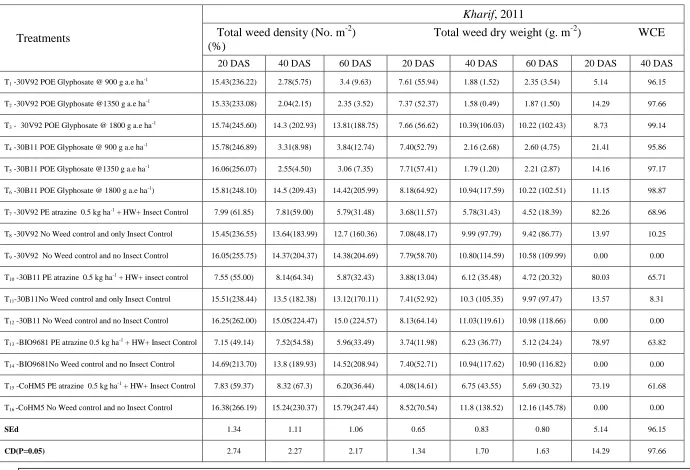
During kharif, 2010 season,lower weed density was achieved under non transgenic maize hybrid BIO 9681 and 30B11 with pre emergence application of atrazine at 0.5 Kg ha-1 followed by hand weeding at 20 DAS. Relatively, a higher density was observed under unweeded checks and transgenic maize before imposing post emergence application of glyphosate. At 40 DAS and 60 DAS ,lower weed density observed under transgenic maize hybrid 30V92 with post emergence application of glyphosate at 1800 g a.e ha-1 resulted in effective control of broad leaved weeds ,grasses and sedges due to its broad spectrum action [7]. This may due to more impressive control of broadleaved weeds like Trainthema portulacastrum ,Datura stramonium ,Cleome gynandra and Physallis minima . Foliar application of glyphosate was readily and rapidly translocated throughout the actively growing aerial and under ground portions at active growing stage of broadleaved weeds might have blocked the 5-Enulpyruvate shikimate -3- phosphate synthase enzyme and arrest the amino acid synthesis which led to complete control [8] (Table 1). During kharif, 2011 season, post emergence controlled droplet application of glyphosate at conventional maize hybrid of 30V92 at 1800 g a.e ha-1 (1.84 Nos m-2) observed lesser total weed density at 40 DAS .Thus glyphosate effectively controlled a broad spectrum of annual and perennial grasses , sedges and broadleaved weeds[9] could be due to increased translocation of glyphosate inside the plant tissues [10] (Table 2).
3.3 Weed dry weight
Weed dry weight is the most important parameter to assess the weed competitiveness for the crop growth and productivity.Considerable reduction in weed dry weight was recorded with the application of glyphosate at 1800 g a.e ha-1 in transgenic 30V92 and post emergence controlled application of glyphosate at 1800 g a.e ha-1 in conventional maize hybrid of 30V92 (1.58 and 1.82 g m-2) at 40 DAS during kharif , 2010 and
kharif, 2011(Table 1&2).This might be weed control as achieved by glyphosate [11] this findings were in accordance with earlier reports that post emergence application followed by pre emergence herbicide reduced total weed dry weight by at least 97 per cent when compared to without glyphosate applied plots [12].
3.4 Weed control efficiency
Weed control efficiency which indicates the comparative magnitude of reduction in weed dry matter, was highly influenced by different weed control treatments. Pre emergence application of atrazine at 0.5 Kg ha-1 followed by hand weeding recorded higher weed control efficiency of 80.28 percent in non transgenic maize hybrid 30V92 at 20 DAS. Whereas at 40 DAS after spraying of herbicide,higher weed control efficiency of 99.53 per cent was recorded in glyphosate at 1800 g a.e ha-1 followed by 30B11was observed 98.97 per cent during
kharif,2010 (Table 1). whereas during kharif,2011 higher weed control efficiency was observed with glyphosate at 1800 g a.e ha
-1in conventional maize hybrid of 30V92 registered maximum
weed control efficiency of 99.14 per cent owing to the fact that registered lesser weed density and weed dry weight (Table 2).
3.4Effect on crop yield attributes and yield
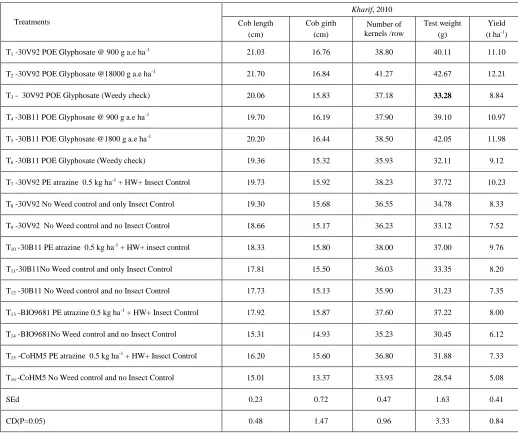
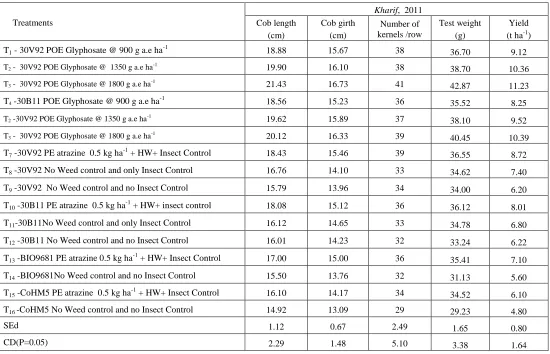
During both the years of study, among the weed control treatments, post emergence application of glyphosate at 1800 g a.e ha-1 in transgenic corn hybrid recorded higher grain yield of 12.21 t ha-1 .this was 36.64 percent higher than the unweeded check plot of transgenic 30V92 during kharif , 2010, whereas , during kharif, 2011post emergence controlled droplet application of glyphosate at 1800 g a.e ha-1 in conventional maize hybrid of 30V92 resulted in higher grain yield of 11.23 t ha-1 (Table 3&4). This was 44.79 percent higher than the unweeded check plot of conventional maize hybrid. This could be achieved control of weeds with non selective ,translocated herbicide, provided the favourable crop growth environment at the establishment stage of the crop itself by minimizing the perennial and annual weeds and increased the seed and stalk yields . This might be due to the fact that the perennial weeds like Cyperus rotundus, Cyanodon dactylon, troublesome broadleaved weeds like Trianthema portulacastrum weeds were effectively controlled and might increase the maize yield may be due to better light utilization of narrow row zone and faster canopy closure .
Higher yield attributes of increased cob length, cob girth and number of grains per cob and test weight were recorded with post emergence application of glyphosate at 1800 g a.e ha-1 in both the transgenic and conventional maize hybrids of 30V92 and 30B11 respectively. This might due to better control of weeds at critical stages and shifted the balance in favour of crop in the utilization of nutrients,moisture,light and space and creates the favourable environment for recording higher growth of maize leading to enhanced yield attributes [13]. Among the weed control treatments methods, lower weed index was recorded with 9.09 and 10.15 per cent in transgenic 30V92(T1)
and 30B11(T5) whereas at conventional maize hybrids observed
glyphosate at 1350 g a.e ha-1 recorded lower weed index of 7.75 and 15.23 per cent in non transgenic maize hybrids of 30V92 (T2) and 30B11(T5). Unweeded check plots resulted in higher
weed index and performed poorly during both the years of study.
IV. CONCLUSION
From the results of the field experiments, it could be concluded that post emergence spraying of potassium salt of glyphosate at 1800 g a.e ha−1 in transgenic and conventional maize hybrid of 30V92 enhanced complete control of broad spectrum weeds can keep the weed density,dry weight reasonable at lower level and enhance higher productvity and profitability with higher grain yield during both the kharif seasons.
REFERENCES
[1] Ghodralollah, F. 2005. Integrated weed management in corn (Zea mays L.). Crop Research.2005, 29: 40-46.
ISSN 2250-3153
www.ijsrp.org [3] Ferrell, J.A and Witt, W.W. Comparison of glyphosate with other
herbicides for weed control in corn (Zea mays): Efficacy and economics. Weed Technology, 2002,16:701-706.
[4] Norsworthy,J.K., Burgos, N.R and Oliver, L.R. Differences in weed tolerance to glyphosate involve different mechanism. Weed Technology,
2001, 15:725-731.
[5] Main, C. L., Michael A. J, and E. C. Murdock. Weed Response and Tolerance of Enhanced Glyphosate-Resis-tant Cotton to Glyphosate. Journal of Cotton Science, 2007, 11: 104-109.
[6] Snedecor, G.W and Cochran, W.G. Statistical Methods, Oxford and IBH Publ. Co.,New Delhi1,1967,593.
[7] Koger, C. H. and Reddy, R. N. Glyphosate Efficacy, Ab- sorption and Translocation in Pitted Moringglory (Ipo- moea lacunose) .Weed Science,
2005,53: 277-283. doi:10.1614/WS-04-098R
[8] Summons, R.D.,Grugs, K.J., Andersen, K.S., Johnson , K.A. and J.A. Sikors . Re-evaluating glyphosate as a transition-state inhibitor of EPSP synthase: Identification of an EPSP synthase-EPSP glyphosate ternary complex,Biochemistry, 1995,34: 6433-6440
[9] J. W. Wilcut, H. D. Coble, A. C. York and D. W. Monks, ―The Niche for Herbicide-Resistant Crops in US Agri- culture,‖ In: S. O. Duke, Ed., Herbicide-Resistant Crops: Agricultural, Environmental, Economic, Regulatory, and Technical Aspects, CRC Press, Boca Raton, 1996, 213-230.
[10] Suwunnamek, U and Parker,C .Control of Cyperus rotundus with glyphosate, ―The influence of ammonium sulfate and other additives, Weed Research,1975,15: 13-19.
[11] Hafeezullah. 2000. ―Effect of different sowing and weed control methods on performance of sunflower. M.Sc., Thesis, Dept. of. Agronomy, Agric. Univ. Peshwar.
[12] Kumar, A and Thakur, K.S. Influence of intercropping and weed control measures on weeds and productivity of rainfed maize (Zea mays).Indian Journal of Weed Science,2005, 37: 65-67
[13] Grichar, W. J., Besler,B.A., Brewer, K. D and Minton ,B. W. Using Soil-Applied Herbicides in Combination with Glyphosate in a Glyphosate-Resistant Cotton Herbi- cide Program. Crop Protection, 2004, 23: 1007-1010. doi:10.1016/j.cropro.2004.03.004
AUTHORS
First Author – SivagamyKannan, Assistant Professor,
Adhiparasakthi Agricultural &Horticultural college and Research Institute, Kalavai- 632 506, Tamil Nadu,India. Email address: [email protected]
Second Author – Professor and Principal Investigator
(DWSRC), Department of Agronomy, Tamil Nadu Agricultural University, Coimbatore, Tamil Nadu - 641003, India. Email address: [email protected]
Correspondence Author – Sivagamy Kannan , email address:
www.ijsrp.org Table 1. Effect of glyphosate application on total weed density and total weed dry weight in herbicide tolerant transgenic maize- kharif, 2010
Treatments
Kharif, 2010
Total weed density (No. m-2) Total weed dry weight (g. m-2) WCE (%)
20 DAS 40 DAS 60 DAS 20 DAS 40 DAS 60 DAS 20 DAS 40 DAS
T1 -30V92 POE Glyphosate @ 900 g a.e ha-1 15.43(236.22) 2.78(5.75) 3.4 (9.63) 7.61 (55.94) 1.88 (1.52) 2.35 (3.54) 0.00 98.56
T2 -30V92 POE Glyphosate @1350 g a.e ha-1 15.33(233.08) 2.04(2.15) 2.35 (3.52) 7.37 (52.37) 1.58 (0.49) 1.87 (1.50) 0.00 99.53
T3 - 30V92 POE Glyphosate (Weedy check) 15.74(245.60) 14.3 (202.93) 13.81(188.75) 7.66 (56.62) 10.39(106.03) 10.22 (102.43) 0.00 0.00
T4 -30B11 POE Glyphosate @ 900 g a.e ha-1 15.78(246.89) 3.31(8.98) 3.84(12.74) 7.40(52.79) 2.16 (2.68) 2.60 (4.75) 0.00 97.72
T5 -30B11 POE Glyphosate @1350 g a.e ha-1 16.06(256.07) 2.55(4.50) 3.06 (7.35) 7.71(57.41) 1.79 (1.20) 2.21 (2.87) 0.00 98.97
T6 -30B11 POE Glyphosate (Weedy check) 15.81(248.10) 14.5 (209.43) 14.42(205.99) 8.18(64.92) 10.94(117.59) 10.22 (102.51) 0.00 0.00
T7 -30V92 PE atrazine 0.5 kg ha-1 + HW+ Insect Control 7.99 (61.85) 7.81(59.00) 5.79(31.48) 3.68(11.57) 5.78(31.43) 4.52 (18.39) 80.28 72.57
T8 -30V92 No Weed control and only Insect Control 15.45(236.55) 13.64(183.99) 12.7 (160.36) 7.08(48.17) 9.99 (97.79) 9.42 (86.77) 0.00 14.66
T9 -30V92 No Weed control and no Insect Control 16.05(255.75) 14.37(204.37) 14.38(204.69) 7.79(58.70) 10.80(114.59) 10.58 (109.99) 0.00 0.00
T10 -30B11 PE atrazine 0.5 kg ha-1 + HW+ insect control 7.55 (55.00) 8.14(64.34) 5.87(32.43) 3.88(13.04) 6.12 (35.48) 4.72 (20.32) 79.66 70.33
T11-30B11No Weed control and only Insect Control 15.51(238.44) 13.5 (182.38) 13.12(170.11) 7.41(52.92) 10.3 (105.35) 9.97 (97.47) 0.00 11.92
T12 -30B11 No Weed control and no Insect Control 16.25(262.00) 15.05(224.47) 15.0 (224.57) 8.13(64.14) 11.03(119.61) 10.98 (118.66) 0.00 0.00
T13 -BIO9681 PE atrazine 0.5 kg ha-1 + HW+ Insect Control 7.15 (49.14) 7.52(54.58) 5.96(33.49) 3.74(11.98) 6.23 (36.77) 5.12 (24.24) 77.27 68.73
T14 -BIO9681No Weed control and no Insect Control 14.69(213.70) 13.8 (189.93) 14.52(208.94) 7.40(52.71) 10.94(117.62) 10.90 (116.82) 0.00 0.00
T15 -CoHM5 PE atrazine 0.5 kg ha-1 + HW+ Insect Control 7.83 (59.37) 8.32 (67.3) 6.20(36.44) 4.08(14.61) 6.75 (43.55) 5.69 (30.32) 79.28 68.56
T16 -CoHM5 No Weed control and no Insect Control 16.38(266.19) 15.24(230.37) 15.79(247.44) 8.52(70.54) 11.8 (138.52) 12.16 (145.78) 0.00 0.00
SEd 1.34 1.11 1.06 0.65 0.83 0.80 - -
CD(P=0.05) 2.74 2.27 2.17 1.34 1.70 1.63
-
-
Figures in parenthesis are original values must need for differentiating the original and transformed values;, DAS—Days After sowing , POE—Post-emergence, PE- Pre emergence, WCE-
ISSN 2250-3153
[image:6.792.46.736.69.539.2]www.ijsrp.org Table 2.Effect of glyphosate application on total weed density, total weed dry weight and weed control efficiency in conventional maize hybrids
Treatments
Kharif
, 2011
Total weed density (No. m
-2) Total weed dry weight (g. m
-2) WCE
(%)
20 DAS 40 DAS 60 DAS 20 DAS 40 DAS 60 DAS 20 DAS 40 DAS
T1 -30V92 POE Glyphosate @ 900 g a.e ha-1 15.43(236.22) 2.78(5.75) 3.4 (9.63) 7.61 (55.94) 1.88 (1.52) 2.35 (3.54) 5.14 96.15
T2 -30V92 POE Glyphosate @1350 g a.e ha-1 15.33(233.08) 2.04(2.15) 2.35 (3.52) 7.37 (52.37) 1.58 (0.49) 1.87 (1.50) 14.29 97.66
T3 - 30V92 POE Glyphosate @ 1800 g a.e ha-1 15.74(245.60) 14.3 (202.93) 13.81(188.75) 7.66 (56.62) 10.39(106.03) 10.22 (102.43) 8.73 99.14
T4 -30B11 POE Glyphosate @ 900 g a.e ha-1 15.78(246.89) 3.31(8.98) 3.84(12.74) 7.40(52.79) 2.16 (2.68) 2.60 (4.75) 21.41 95.86
T5 -30B11 POE Glyphosate @1350 g a.e ha-1 16.06(256.07) 2.55(4.50) 3.06 (7.35) 7.71(57.41) 1.79 (1.20) 2.21 (2.87) 14.16 97.17
T6 -30B11 POE Glyphosate @ 1800 g a.e ha-1) 15.81(248.10) 14.5 (209.43) 14.42(205.99) 8.18(64.92) 10.94(117.59) 10.22 (102.51) 11.15 98.87
T7 -30V92 PE atrazine 0.5 kg ha-1 + HW+ Insect Control 7.99 (61.85) 7.81(59.00) 5.79(31.48) 3.68(11.57) 5.78(31.43) 4.52 (18.39) 82.26 68.96
T8 -30V92 No Weed control and only Insect Control 15.45(236.55) 13.64(183.99) 12.7 (160.36) 7.08(48.17) 9.99 (97.79) 9.42 (86.77) 13.97 10.25
T9 -30V92 No Weed control and no Insect Control 16.05(255.75) 14.37(204.37) 14.38(204.69) 7.79(58.70) 10.80(114.59) 10.58 (109.99) 0.00 0.00
T10 -30B11 PE atrazine 0.5 kg ha-1 + HW+ insect control 7.55 (55.00) 8.14(64.34) 5.87(32.43) 3.88(13.04) 6.12 (35.48) 4.72 (20.32) 80.03 65.71
T11-30B11No Weed control and only Insect Control 15.51(238.44) 13.5 (182.38) 13.12(170.11) 7.41(52.92) 10.3 (105.35) 9.97 (97.47) 13.57 8.31
T12 -30B11 No Weed control and no Insect Control 16.25(262.00) 15.05(224.47) 15.0 (224.57) 8.13(64.14) 11.03(119.61) 10.98 (118.66) 0.00 0.00
T13 -BIO9681 PE atrazine 0.5 kg ha-1 + HW+ Insect Control 7.15 (49.14) 7.52(54.58) 5.96(33.49) 3.74(11.98) 6.23 (36.77) 5.12 (24.24) 78.97 63.82
T14 -BIO9681No Weed control and no Insect Control 14.69(213.70) 13.8 (189.93) 14.52(208.94) 7.40(52.71) 10.94(117.62) 10.90 (116.82) 0.00 0.00
T15 -CoHM5 PE atrazine 0.5 kg ha-1 + HW+ Insect Control 7.83 (59.37) 8.32 (67.3) 6.20(36.44) 4.08(14.61) 6.75 (43.55) 5.69 (30.32) 73.19 61.68
T16 -CoHM5 No Weed control and no Insect Control 16.38(266.19) 15.24(230.37) 15.79(247.44) 8.52(70.54) 11.8 (138.52) 12.16 (145.78) 0.00 0.00
SEd 1.34 1.11 1.06 0.65 0.83 0.80 5.14 96.15
CD(P=0.05) 2.74 2.27 2.17 1.34 1.70 1.63 14.29 97.66
Figures in parenthesis are original values must need for differentiating the original and transformed values;, DAS—Days After sowing , POE—Post-emergence, PE- Pre emergence, WCE-
www.ijsrp.org Table 3. Effect of weed control methods on yield attributes and grain yield in herbicide tolerant transgenic maize hybrid
Treatments
Kharif, 2010 Cob length
(cm)
Cob girth (cm)
Number of kernels /row
Test weight (g)
Yield (t ha-1)
T1 -30V92 POE Glyphosate @ 900 g a.e ha-1 21.03 16.76 38.80 40.11 11.10
T2 -30V92 POE Glyphosate @18000 g a.e ha-1 21.70 16.84 41.27 42.67 12.21
T3 - 30V92 POE Glyphosate (Weedy check) 20.06 15.83 37.18 33.28 8.84
T4 -30B11 POE Glyphosate @ 900 g a.e ha-1 19.70 16.19 37.90 39.10 10.97
T5 -30B11 POE Glyphosate @1800 g a.e ha-1 20.20 16.44 38.50 42.05 11.98
T6 -30B11 POE Glyphosate (Weedy check) 19.36 15.32 35.93 32.11 9.12
T7 -30V92 PE atrazine 0.5 kg ha-1 + HW+ Insect Control 19.73 15.92 38.23 37.72 10.23
T8 -30V92 No Weed control and only Insect Control 19.30 15.68 36.55 34.78 8.33
T9 -30V92 No Weed control and no Insect Control 18.66 15.17 36.23 33.12 7.52
T10 -30B11 PE atrazine 0.5 kg ha-1 + HW+ insect control 18.33 15.80 38.00 37.00 9.76
T11-30B11No Weed control and only Insect Control 17.81 15.50 36.03 33.35 8.20
T12 -30B11 No Weed control and no Insect Control 17.73 15.13 35.90 31.23 7.35
T13 -BIO9681 PE atrazine 0.5 kg ha-1 + HW+ Insect Control 17.92 15.87 37.60 37.22 8.00
T14 -BIO9681No Weed control and no Insect Control 15.31 14.93 35.23 30.45 6.12
T15 -CoHM5 PE atrazine 0.5 kg ha-1 + HW+ Insect Control 16.20 15.60 36.80 31.88 7.33
T16 -CoHM5 No Weed control and no Insect Control 15.01 13.37 33.93 28.54 5.08
SEd 0.23 0.72 0.47 1.63 0.41
ISSN 2250-3153
[image:8.792.123.673.90.444.2]www.ijsrp.org Table 4. Effect of weed control methods on yield attributes and grain yield in conventional maize hybrids
Treatments
Kharif, 2011 Cob length
(cm)
Cob girth (cm)
Number of kernels /row
Test weight (g)
Yield (t ha-1)
T1 - 30V92 POE Glyphosate @ 900 g a.e ha
-1
18.88 15.67 38 36.70 9.12
T2 - 30V92 POE Glyphosate @ 1350 g a.e ha-1 19.90 16.10 38 38.70 10.36
T3 - 30V92 POE Glyphosate @ 1800 g a.e ha-1 21.43 16.73 41 42.87 11.23
T4 -30B11 POE Glyphosate @ 900 g a.e ha-1 18.56 15.23 36 35.52 8.25
T2 -30V92 POE Glyphosate @ 1350 g a.e ha-1 19.62 15.89 37 38.10 9.52
T3 - 30V92 POE Glyphosate @ 1800 g a.e ha-1 20.12 16.33 39 40.45 10.39
T7 -30V92 PE atrazine 0.5 kg ha -1
+ HW+ Insect Control 18.43 15.46 39 36.55 8.72
T8 -30V92 No Weed control and only Insect Control 16.76 14.10 33 34.62 7.40
T9 -30V92 No Weed control and no Insect Control 15.79 13.96 34 34.00 6.20
T10 -30B11 PE atrazine 0.5 kg ha-1 + HW+ insect control 18.08 15.12 36 36.12 8.01
T11-30B11No Weed control and only Insect Control 16.12 14.65 33 34.78 6.80
T12 -30B11 No Weed control and no Insect Control 16.01 14.23 32 33.24 6.22
T13 -BIO9681 PE atrazine 0.5 kg ha-1 + HW+ Insect Control 17.00 15.00 36 35.41 7.10
T14 -BIO9681No Weed control and no Insect Control 15.50 13.76 32 31.13 5.60
T15 -CoHM5 PE atrazine 0.5 kg ha-1 + HW+ Insect Control 16.10 14.17 34 34.52 6.10
T16 -CoHM5 No Weed control and no Insect Control 14.92 13.09 29 29.23 4.80
SEd 1.12 0.67 2.49 1.65 0.80