http://dx.doi.org/10.4236/jmp.2015.611172
How to cite this paper: Velázquez, G.L. and Cabrera, G.M. (2015) Study of Decoherence of Entangled States Made up of Two Basic States in a Linear Chain of Three Qubits. Journal of Modern Physics, 6, 1701-1710.
http://dx.doi.org/10.4236/jmp.2015.611172
Study of Decoherence of Entangled States
Made up of Two Basic States in a Linear
Chain of Three Qubits
Gustavo López Velázquez
*, Gustavo Montes Cabrera
Departamento de Física, Universidad de Guadalajara, Blvd. Marcelino García Barragan y Calzada Olímpica, Guadalajara, Mexico
Email: *[email protected]
Received 27 May 2015; accepted 26 September 2015; published 29 September 2015
Copyright © 2015 by authors and Scientific Research Publishing Inc.
This work is licensed under the Creative Commons Attribution International License (CC BY).
http://creativecommons.org/licenses/by/4.0/
Abstract
Using Lindblad approach to study decoherence of quantum systems, we study the decoherence and decay of entangled states, formed by two basic states of a chain of thee qubits. We look on these states for a possible regular dependence on their decay as a function of their energy separa-tion between the basic states under different types of environments. We didn’t find regular or sig-nificant dependence on this energy separation for the type of environment considered.
Keywords
Decoherence, Entangled States, Three Quits, Linear Chain
1. Introduction
In the real world (quantum or classical) the interaction of the system with the environment is unavoidable. In principle, one could study the unitary evolution of the whole system, quantum plus environment plus quantum- environment interaction, but this represents a many-bodies problem which is unsolvable within any picture of the quantum mechanics. The most used approach to study this phenomenon is to use the matrix density approach for the whole system and to make the trace over the environment variables [1]-[5]. The resulting density matrix is called “reduced density matrix”, and its associated non-unitary evolution equation is called “master equation”. This equation is phenomenological where dissipative and diffusion parameters are defined, and they are respon-sible of the decay behavior of the non diagonal elements of the reduced density matrix. This phenomenon is
called “decoherence” because it is related with the disappearance of the interference in terms of the product of the quantum wave function [6] [7] and many think that this decoherence effect is closely related with the ap-pearance of the classical world [7]-[9]. In most of the approaches, the positiveness and trace equal to one are kept as principal condition for the reduced density matrix. The best known mathematical approach which kept these conditions was given by Lindblad [10], which gave an abstract general non unitary evolution equation for the reduced density matrix. The master equation is different when dealing with continuous systems (quantum Browning motion, for example) [1] [2] or discrete quantum systems (spin system) [11]. One of the used ap-proaches for quantum discrete system is described in [12], and we will use this approach for our study of deco-herence of entangled states built up with two states of three qubits in a quantum computer model of a linear chain of three paramagnetic atoms with nuclear spin one half [13]. In this work, we are interested in determining the decoherence of several entangled states formed by two states of three qubits, and we will use the above men-tioned Markovian-Lindblad master type of equation [4] [12]. On the other hand, even this model for solid state quantum computer has not been built; it has been very useful for theoretical studies about implementation of quantum gates and quantum algorithms [13]-[16] which can be extrapolated to other solid state quantum com-puters. The main idea is to explore the possible sensitivity of the decay of an entangled state with respect to the energy-difference of its two states involved; we establish four cases to be considered with the quantum-environ- ment system: independent environment interaction, pure dephasing interaction, correlated dissipation interaction, and dephasing correlated interaction. The analytical dynamical systems of the reduced density matrix elements are obtained for these cases, and the results of the analytical and numerical simulations are presented.
2. Hamiltonian of the Chain of Nuclear Spins
Following Lloyd’s idea [17], consider a linear chain of nuclear spin one half, separated by some distance and in-side a magnetic in a direction z, B
( )
z =(
0, 0,B z0( )
)
, and making and angleθ
with respect this linear chain. Choosing this angle such that cosθ =1 3, the dipole-dipole interaction is canceled, the Larmore’s frequency for each spin is different, ωk =γB0( )
zk withγ
the gyromagnetic ratio. The magnetic moment of the nucleusk
µ is related with its spin through the relation µk =γSk, and the interaction energy between the magnetic field and magnetic moments is
H
int= −
∑
kµ
k⋅
B z
( )
k= −
∑
kω
kS
kz. If in addition, one has first and second neighbor Ising interaction, the Hamiltonian of the system is just [13]1 2
1 2
1 1 1
2 2
,
N N N
z z z z z
s k k k k k k
k k k
J J
H ω S S S S S
− −
+ +
= = =
′
= −
∑
−∑
−∑
(1)
where N is the number of nuclear spins in the chain (or qubits), J and J' are the coupling constant of the nucleus at first and second neighbor. Using the basis of the register of N-qubits,
{
, , 1}
N
ξ ξ with ξ =k 0,1, one has
that z
( )
1 k 2k k k
S
ξ
= − ξ ξ
. Therefore, the Hamiltonian is diagonal on this basis, and its eigenvalues are( )
( )
1( )
21 2
1 1 1
1 1 1 .
2 2 2
k k k k k
N N N
k
k k k
J J
Eξ ξ ω ξ ξ+ ξ ξ+
− + − +
= = =
′
= −
∑
− − ∑
− − ∑
− (2)3. Interaction with the Environment
Consider now that the environment is characterized by a Hamiltonian He and its interacting with the quantum system with Hamiltonian Hs. Thus, the total Hamiltonian would be H=Hs+He+Hse, where Hse is the part of the Hamiltonian which takes into account the interaction system-environment, and the equation one would need to solve, in terms of the density matrix, is [18] [19]
[
,]
,t
t
i H
t
ρ
ρ
∂ = ∂
(3)
where ρt =ρt
( )
s e, is the density matrix which depends on the system and environment coordinates. The evo-lution of the system is unitary, but it is not possible to solve this equation. Therefore, under some approxima-tions and tracing over the environment coordinates [5] [20], it is possible to arrive to a Lindblad type of equation[
]
† † † 1 1 1 , 2 2 Is i i i i i i
i
i H V V V V V V
t
ρ ρ ρ ρ ρ
=
∂ = + − −
∂
∑
(4)
where Vi are called Kraus’ operators. This equation is not unitary and Markovian (without memory of the dy-namical process). This equation can be written in the interaction picture, through the transformation ρ=U Uρ †
with U=eiH ts , as
( )
, i tρ
ρ
∂ = ∂ (5)
where
( )
ρ
is the Lindblad operator( )
† † †1
1 1
2 2
I
i i i i i i
i
V V V V V V
ρ ρ ρ ρ
= = − −
∑
(6)
with V=UVU†. The explicit form of Lindblad operator is determined by the type of environment to consider
[12] at zero temperature. In this work we consider dissipation effects and dephasing. So, the operators can be
i i
V =S− (for dissipation), z
i i
V =S (for dephasing), and γi i is the coupling constant with the environment. In this way, one considers the following cases:
1) Independent: In this case, each qubit of the chain acts independently with the environment, and one has local decoherence of the system. The Lindblad operator is
( )
1(
)
2 2
N
k k k k k k k
k
S S S S S S
i
ρ =
∑
γ −ρ +− + −ρ ρ− + −
(7)
where Sk+ and Sk− are the ascend and descend operators such that
ˆ
†
e
i kt,
k k k
S
±=
US U
±=
S
± ± Ω (8)where ˆΩk has been defined as
(
1 1) (
2 2)
ˆ z z z z .
k k k k k k
J J
w S + S − S + S −
′
Ω = + + + +
(9)
2) Correlated independent: Each qubit interact with the environment but its effect is felt by the other qubits, that is, the type of interaction is nonlocal with a collective interction between qubits and environment. The Lindblad operator is
( )
(
)
, 1 2 2 N jkk j j k j k
j k
S S S S S S
i
γ
ρ =
∑
−ρ +− + −ρ ρ− + −
(10)
where γjk are the coupling constant between qubits and environment, with γjk =γkj and γii =γi.
3) Dephasing: There is not interchange of energy between qubits and environment, only decoherence is pre-sented where the non diagonal elements of the reduced density matrix go to zero. The Lindblad operator is
( )
1(
)
2 N
z z z z z z
k k k k k k k
k
S S S S S S
i
ρ =
∑
Γ ρ − ρ ρ−
(11)
where Γk is the parameter of the kth-qubit which take into account the dephasing of the qubit with the envi-ronment (the tilde operators do not appear due to commutation of this operators with the evolution operator U). 4) Correlated dephasing: Here, one takes into account the collective effect of the environment to the qubits. Lindblad’s operator is of the form
( )
(
)
,
1
2 ,
N
z z z z z z
jk k j j k j k
j k
S S S S S S
i
ρ =
∑
Γ ρ − ρ ρ−
(12)
4. Entanglement and GME-Concurrence
Our 3-qubits Hilbert space H is generated by the basis
{
1 2 3}
0,1
j ξ
ξ ξ ξ
= . Labeling the qubit of the 3-qubits chain [image:4.595.170.457.203.566.2]as ABC, we understand an entanglement of the form AB when the qubits
{ }
1, 2 are entangled, and we under-stand an entanglement of the form ABC when the 3-qubits{
1, 2, 3 are entangled. The entangled state under our}
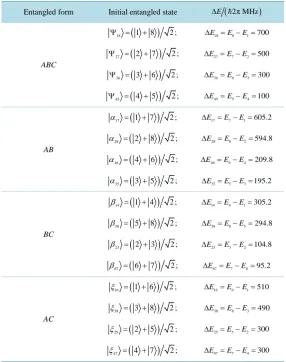
consideration are listed onTable 1. We chose these state since they are mostly used on experiments of quantum computation or quantum information.Table 1. Entangled states (ordered according their energy separation).
Entangled form Initial entangled state ∆E(2π MHz)
ABC
(
)
18 1 8 2 ;
Ψ = + ∆E18=E8−E1=700
(
)
27 2 7 2 ;
Ψ = + ∆E27=E7−E2=500
(
)
36 3 6 2 ;
Ψ = + ∆E36=E6−E3=300
(
)
45 4 5 2 ;
Ψ = + ∆E45=E5−E4=100
AB
(
)
17 1 7 2 ;
α = + ∆E17=E7−E1=605.2
(
)
28 2 8 2 ;
α = + ∆E28=E8−E2=594.8
(
)
46 4 6 2 ;
α = + ∆E46=E6−E4=209.8
(
)
35 3 5 2 ;
α = + ∆E35=E5−E3=195.2
BC
(
)
14 1 4 2 ;
β = + ∆E14=E4−E1=305.2
(
)
58 5 8 2 ;
β = + ∆E58=E8−E5=294.8
(
)
23 2 3 2 ;
β = + ∆E23=E3−E2=104.8
(
)
67 6 7 2 ;
β = + ∆E67=E7−E6=95.2
AC
(
)
16 1 6 2 ;
ξ = + ∆E16=E6−E1=510
(
)
38 3 8 2 ;
ξ = + ∆E38=E8−E3=490
(
)
25 2 5 2 ;
ξ = + ∆E25=E5−E2=300
(
)
47 4 7 2 ;
ξ = + ∆E47=E7−E4=300
In order to quantify the entanglement of a state formed by three qubits basis-states, we will use the criteria given on [22]-[24] where the lower bound of the concurrence is
( )
2 { } 2GME 2 1, ,N
C β β
β
ρ⊗ ρ⊗
Φ ≥ Φ Π Φ − Φ Π Π Φ
∑
(13)where Φ is a separable state of the two copies of the Hilbert space, ⊗ . Π{ }α is the permutation oper-ator acting on the double copies of the Hilbert space, ⊗ , interchanging elements of one space into the oth-er, for example Π{ }1
(
φ φ1 2 ⊗ψ ψ1 2)
=ψ φ1 2 ⊗φψ1 2 . ifζ
1={
l m n,}
, Π{l m n,} acting on Ψrs means that the qubit label by “l” is fixed and the qubits label “m” and “n” are interchanged (Π{ }1|2,3 18 = 45 ,{1,2,3} 18 81
Table 2. Entanglement form: ABC.
State Φ GME-concurrence
18
Ψ 18 2ρ18−2 ρ ρ44 55−2 ρ ρ33 66−2 ρ ρ22 77
27
Ψ 27 2ρ27−2 ρ ρ11 88−2 ρ ρ33 66−2 ρ ρ44 55
36
Ψ 36 2ρ36−2 ρ ρ11 88−2 ρ ρ22 77−2 ρ ρ44 55
45
Ψ 45 2ρ45−2 ρ ρ11 88−2 ρ ρ22 77−2 ρ ρ33 66
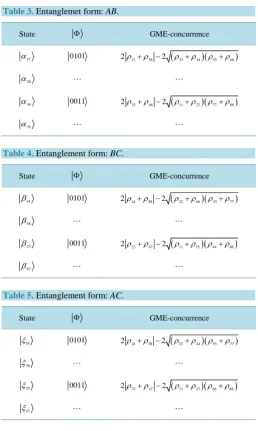
For the case when entangled state is of the form AB, BC or AC, one makes the trace on the missing letter qubit, and it follows that
(
Φ = ijkl)
(Tables 3-5)GME
2 AB AB AB
C
il
ρ
kj ijρ
ij klρ
kl [image:5.595.184.443.297.729.2]= − (14)
Table 3. Entanglemet form: AB.
State Φ GME-concurrence
17
α 0101 2ρ17+ρ28−2 (ρ33+ρ44)(ρ55+ρ66)
28
α
46
α 0011 2ρ35+ρ46−2 (ρ11+ρ22)(ρ77+ρ88)
35
α
Table 4. Entanglement form: BC.
State Φ GME-concurrence
14
β 0101 2ρ14+ρ58−2 (ρ22+ρ66)(ρ33+ρ77)
58
β
23
β 0011 2ρ23+ρ67−2 (ρ11+ρ55)(ρ44+ρ88)
67
β
Table 5. Entanglement form: AC.
State Φ GME-concurrence
16
ξ 0101 2ρ16+ρ38−2 (ρ22+ρ44)(ρ55+ρ77)
38
ξ
25
ξ 0011 2ρ23+ρ47−2 (ρ11+ρ33)(ρ66+ρ88)
47
5. Results
In our case, we have three qubits space
{
2 2 1}
=0,1
i ξ
ξ ξ ξ , and our parameter in units 2π MHz are
1 2 3
1 2 3 1 2 3
12 23 13 12 23 13
400; 200; 100; 10; 0.4
0.05; 0.05; 0.05; 0.05; 0.05; 0.05
0.05; 0.025 0.0125; 0.05; 0.025; 0.0125
J J
ω ω ω
γ γ γ
γ γ γ
′
= = = = =
= = = Γ = Γ = Γ =
= = = Γ = Γ = Γ =
the time is normalized by the same factor of 2π MHz. To determine the departure of the pure state entangled state, we use the purity parameter, P Tr=
( )
ρ
2 [25].Figure 1(a) shows the behavior of this parameter for the entangled state Ψ18 as a function of time, where one can see that correlations does not affect much the inde-pendent model of the environment, which can be seen only for much bigger dissipation parameters,Figure 1(b). Dephasing models finish with the mix state on the system at the end, instead of a pure state of the independent model. As seen onFigure 2, independent model ends with a pure state in the system due to the system ends on the ground state after sharing energy with the environment.Let us see now how the GME-concurrence and Purity behave for different entangled state and different envi-ronments.
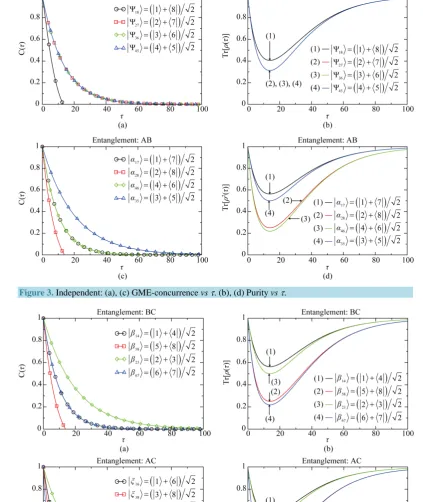
Independent Model: For the entangled states listed onTable 1, Figure 3(a),Figure 3(c),Figure 4(a), and
Figure 4(c)show GME-concurrence, and Figure 3(b),Figure 3(d),Figure 4(b), andFigure 4(d) show their
(a) (b)
Figure 1. Independent model: (a) Purity behavior with 4-models environments; (b) Indepent model with big dissipation.
Figure 3. Independent: (a), (c) GME-concurrence vsτ. (b), (d) Purity vsτ.
associated Purity parameter behavior. The system always finish on the pure ground states
(
1 = 000)
, the lowest bound of the GME-concurrence fall down (although this parameter can not tell us whether or not the en-tanglement has been completely destroyed). Except for the entangled state Ψ18 (maximum entergy difference between their entangled qubits), there is not clear difference how this entanglement decay is developed. For example, the entangled states Ψ27 , Ψ36 , Ψ45 have the same GME-concurrence decay behavior, but these states have different energy-difference on their associated qubits. The entangled states α17 and α46 the GME-concurrence decay is the same, although their energy-difference is quite big. [image:8.595.116.513.216.327.2]Dephasing model: In this case, the GME-concurrence and purity parameters can be expressed explicitly in a simple form as shown inTable 6:
Table 6. Exact solution for dephasing model.
Entanglement CGME:ij ( ) τ
ϒ Pij ( )
τ
ϒ
(ABC) 2ρij( )0 exp(−Γτ), ( ) ( ) ( ) ( )
2 2 2
0 0 2 0 exp
ii jj ij
ρ +ρ + ρ −Γτ
(AB) 2ρij( )0 exp− Γ + Γ( 1 2)τ, ( ) ( ) ( ) ( )
2 2 2
1 2
0 0 2 0 exp
ii jj ij
ρ +ρ + ρ − Γ + Γ τ
(BC) 2ρij( )0 exp− Γ + Γ( 2 3)τ , ( ) ( ) ( ) ( )
2 2 2
2 3 0 0 2 0 exp
ii jj ij
ρ +ρ + ρ − Γ + Γ τ
(AC) 2ρij( )0 exp− Γ + Γ( 1 3)τ, ( ) ( ) ( ) ( )
2 2 2
1 3 0 0 2 0 exp
ii jj ij
ρ +ρ + ρ − Γ + Γ τ
[image:8.595.113.515.386.707.2]where Γ = Γ + Γ + Γ1 2 3, and ϒ = Ψij
{
ij ,αij , βij ,ξij}
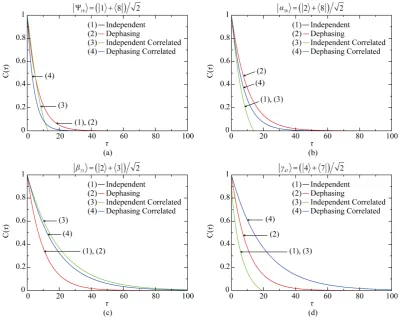
, for the entangled cases ABC, AB, BC and AC respectively. This expressions show that the decay behavior is the same for each family of entangled states, that is, entangled states in the same family have the same decay behavior.Independent correlated: FromFigure 1, we saw that correlations have no effect on the purity. In addition,
Figure 5shows entangled states in different environments where we see that the behavior of the GME-concur- rence is the same for the independent and independent correlated models.
6. Conclusion
We have studied the decay behavior of entangled states, formed by two basic states of three qubits registers, un-der four different environments and using Lindblad type of equation to see whether or not this decay has a regu-lar dependence with respect to the energy-difference (difference of energy of the two basic states of three qubits which made up the entangled state) associated to the entangled state. We did not find this regular dependence, but rather a complicated situation which depends also on the type of environment.
References
[1] Caldeira, A.O. and Legget, A.T. (1983) Physica A, 121, 587-616. http://dx.doi.org/10.1016/0378-4371(83)90013-4
[2] Hu, B.L., Paz, J.P. and Zhang,Y. (1992) Physical Review D, 45, 2843. http://dx.doi.org/10.1103/PhysRevD.45.2843
[3] Venugopalan, A. (1997) Physical Review A, 56, 4307. http://dx.doi.org/10.1103/PhysRevA.56.4307
[4] Breuer, H.-P. and Petruccione, F. (2007) The Theory of Open Quantum Systems. Oxford University Press, London.
http://dx.doi.org/10.1093/acprof:oso/9780199213900.001.0001
[5] Haroche, S. and Raymond, J.M. (2006) Exploring the Quantum. Oxford University Press, London.
http://dx.doi.org/10.1093/acprof:oso/9780198509141.001.0001
[6] Zurek, W.H. (1991) Physics Today, 44, 36. http://dx.doi.org/10.1063/1.881293
[7] Zurek, W.H. (2003) Reviews of Modern Physics, 75, 715. http://dx.doi.org/10.1103/RevModPhys.75.715
[8] Zeh, H.D. (1973) Foundation of Physics, 3, 109-116. http://dx.doi.org/10.1007/BF00708603
[9] Zurek, W.H. (2002) Los Alamos Science, 27.
[10] Lindblad, G. (1976) Communications in Mathematical Physics, 48, 119-130. http://dx.doi.org/10.1007/BF01608499
[11] Allard, P., Helgstrand, M. and Häre, T. (1998) Journal of Magnetic Resonance, 134, 7-16.
http://dx.doi.org/10.1006/jmre.1998.1509
[12] Sumanta, D. and Agarwal, G.S. (2009) Journal of Physics B: Atomic, Molecular and Optical Physics, 42, Article ID: 229801.
[13] Berman, G.P., Doolen, D.D., Kamenev, D.I., López, G.V. and Tsifrinovich, V.I. (2002) Contemporary Mathematics, 305, 13-41. http://dx.doi.org/10.1090/conm/305/05213
[14] López, G.V., Quezada, J., Berman, G.P., Doolen, D.D. and Tsifrinovich, V.I. (2003) Journal of Optics B: Quantum and Semiclassical Optics, 5, 184-189. http://dx.doi.org/10.1088/1464-4266/5/2/311
[15] López, G.V., Gorin, T. and Lara, L. (2008) Journal of Physics B: Atomic, Molecular and Optical Physics, 41, Article ID: 055504. http://dx.doi.org/10.1088/0953-4075/41/5/055504
[16] López, G.V. and López, P. (2012) Journal of Modern Physics, 3, 85-101. http://dx.doi.org/10.4236/jmp.2012.31013
[17] Lloyd, S. (1993) Science, 261, 1569-1571. http://dx.doi.org/10.1126/science.261.5128.1569
[18] Fano, U. (1957) Reviews of Modern Physics, 29, 74. http://dx.doi.org/10.1103/RevModPhys.29.74
[19] von Neumann, J. (1927) Göttinger Nachrichten, 1, 245-272.
[20] Davies, E.B. (1976) Quantum Theory of Open Systems. Academic Press, San Diego.
[21] Alicki, R. and Lendi, K. (2007) Quantum Dynamical Semigroups and Applications. Lecture Notes in Physics, Vol. 717, Springer, Berlin.
[22] Huber, M. and Mintert, F. (2010) Physical Review Letters, 104, Article ID: 210501.
http://dx.doi.org/10.1103/PhysRevLett.104.210501
[23] Seevinck, M. and Uffink, J. (2008) Physical Review A, 78, Article ID: 032101.
http://dx.doi.org/10.1103/PhysRevA.78.032101
[24] Ma, Z.-H.,Chen, Z.-H., Chen, J.-L., Spengler, C., Gabriel, A. and Huber, M. (2011) Physical Review A, 83, Article ID: 062325. http://dx.doi.org/10.1103/PhysRevA.83.062325
Appendix
We consider a linear chain of three nuclear spin system. Then, our basis is
{
3 2 1}
0,1
i ξ
ξ ξ ξ = , and the equations for the reduced matrix elements are obtained by making the bracket with these elements of the basis of the equation (5).
1) Independent:
( )
( )
( )2 , 2
e 2
mn
N k N k i k t
k
mn mn mn k mn m n
k k
k k
t
γ
ρ δ ρ γ δ ∆Ω ρ + − + −
∂ + =
∂
∑
∑
(15)where we have made the following definitions
( )
,1 2 ,1 2,0 ,0
m m N k n n N k
k k k k
mn k α α α α
δ =δ δ − − +δ δ − − (16)
( )
m,0 n,0k k
mn k α α
δ =δ δ (17)
( )
, 2N k , 2N k.mn k k n+ − k m+ −
∆Ω = Ω − Ω (18)
2) Correlated independent:
( )
( )
( )( )
( )( )
( ),
2 , 2
,
, ,
2 2 , , 2 2
2 , e
2
, e , e
mn
N k N k
mn mn
N l N k N l N k
i k l t kl
mn mn m n
k l
i k l t i k l t
m m n n m n
t N k l
t
k l k l
γ
ρ δ ρ
δ ρ δ ρ
− − − − − − ∆Ω + + ′ ′′ ∆Ω ∆Ω − + − + ∂ = ∂ − −
∑
(19)where the following definitions have been made
( )
, m,0 n,0( )
, , 2N k , 2N kl k
mn k l α α mn k l k n l m
δ =δ δ ∆Ω = Ω + − − Ω + − (20)
( )
, lm,1 m2N l,0( )
, , 2N l 2N k , 2N lk
m k l α α mn k l k m l m
δ =δ δ − − ∆Ω′ = Ω − −+ − − Ω − − (21)
( )
, ln,1 n2N l,0( )
, , 2N l 2N k , 2N l.k
n k l α α mn k l k n l n
δ =δ δ − − ∆Ω′′ = Ω − −+ − − Ω − − (22)
3) Dephasing:
( )
( )
1 1( )
m n k k N
mn k mn
k
t t
t
α α
ρ + ρ
∂ = Γ − −
∂
∑
(23)which has the following analytical solution
( )
( )
0 exp 1( )
1 .m n k k N
mn mn k
k
t α α t
ρ ρ +
= − Γ − −
∑
(24)4) Correlated depahsing:
( )
( )
( )
( )
( )
,
2 1 1 1
4
m n m m n n
l k l k l k
N kl mn mn k l t t t
α α α α α α
ρ Γ + + + ρ
∂ = − − − − −
∂
∑
(25)which has the explicit solution
( )
( )
( )
( )
( )
,
0 exp 1 1 2 1 .
4
m m n n m n
l k l k l k
N kl
mn mn
k l
t α α α α α α t
ρ =ρ − Γ − + + − + − − +