Munich Personal RePEc Archive
Modeling purchasing power parity using
co-integration: evidence from Turkey
Levent, Korap
Istanbul University Institute of Social Sciences, Besim Ömer Paşa
Cd. Kaptan-ı Derya Sk. 34452 Beyazıt /ISTANBUL
September 2007
Online at
https://mpra.ub.uni-muenchen.de/19584/
1
Modeling Purchasing Power Parity Using Co-integration:
Evidence from Turkey
Cem Saatcioglu, Ph.D., Istanbul University, Istanbul, Turkey
H. Levent Korap, Marmara University, Istanbul, Turkey
Ara G. Volkan, Ph.D., Florida Gulf Coast University, Fort Myers, FL
ABSTRACT
In this study, we consruct a co-integration model of the Turkish economy using high
frequency data to examine the validity of the purchasing power parity (PPP) theory. The
ex-post estimation results derived from the analysis of monthly observations for the January
1987 – December 2004 period generally support the use of the PPP theory in predicting the
movement of currency values in the Turkish economy.The methodology developed in this
study can be used in other countries to ensure the success of economic policies that depend on
the existence of PPP relationship.
INTRODUCTION
During the 1990s, the Turkish economy endured a highly unstable growth
performance with chronic double-digit inflation that impacted the course of many domestic
macroeconomic aggregates (Ertuğrul and Selçuk, 2002: 13-40; Korap, 2006; and Saatçioğlu
and Korap, 2006). Figure 1 below indicates that, beginning in 1989 when capital account
liberalization was completed, to 1999, large differences between the domestic and foreign
inflation rates existed, along with parallel movements between currency depreciation rates
and domestic inflation. Given the observed behavior of the data in Figure 1 for
DEPRECIATION (the annualized depreciation rate of nominal exchange rate of Turkish Lira
(TL) / US$) versus the DOMESTICINF (the annualized inflation rate based on consumer
price index (CPI)) and WORLDINF (the representative annualized CPI-based world
inflation), an argument can be made for the existence of PPP relationships in the Turkish
2
The data for domestic variables originate from the electronic data delivery system of
the Central Bank of the Republic of Turkey (CBRT) and the sources for world price level and
inflation are the IMF-IFS CD-ROM data base.
PURPOSE
Given the behavior of the variables in Figure 1, it is warranted to examine whether
PPP relationships hold in the Turkish economy. To empirically analyze this proposition, we
apply contemporaneous estimation techniques. If the results of our analyses are positive,
policy makers can be confident of the success of economic programs they devise to manage
domestic currency values and domestic inflation. In the following sections, an economic
model is developed and used to empirically reveal the existence of PPP relationships in the
Turkish economy. Finally, we present our conclusions and discuss future research
opportunities.
A MODEL FOR TESTING THE EXISTENCE OF THE PPP HYPOTHESIS
We start by relating the PPP relationships to the law of one price. Froot and Rogoff
(1994) express that for any good i,
3
where ptd is the log of the domestic currency price of good i, ptf is the analogous
foreign-currency price, and et is the log of the domestic currency price of foreign exchange, ensuring
identical prices of unfettered trade in goods. Letting equation (1) hold for every individual
good would lead to the assumption that it must hold for any identical basket of goods. Even if
the law of one price fails for individual goods, it is possible that the deviations cancel out
when averaged across a basket of goods (Froot and Rogoff, 1994). Moreover, adopting an
international perspective generally allows the use of price indices from different countries
with varying weights and mixes of goods across these countries, rather than using identical
baskets, as hypothesized in the PPP theory. Finally, international price indices for identical
baskets of goods can still be constructed for this purpose.
Relaxing the PPP Assumptions
Instead of using the absolute form of the PPP relationships in equation (1), we can
develop a weak form of the PPP theory. Following Salvatore (1998: 466), the absolute PPP
theory would give the exchange rate that equilibrates trade in goods and services while
completely disregarding the capital account. A nation experiencing capital outflows would
have a deficit in its balance of payments, while a nation receiving capital inflows would have
a surplus if the exchange rate was the one that equilibrated international trade in goods and
services. A second objection to the absolute PPP theorem comes from the assumption that this
version of the PPP would not give the exchange rate that equilibrates trade in goods and
services because of the existence of many non-traded goods and services whose prices in part
depend on relative productivity levels (Jonsson, 2001: 247). Considering these deficiencies,
the relative or weak form of PPP can be suggested to analyze the theory where the change in
the exchange rate over a period of time would be proportional to the relative changes in the
price levels in different countries over the same time period. In this sense, Taylor and Taylor
(2004) express that the relative PPP would hold if the absolute PPP holds, but the absolute
PPP does not necessarily hold when the relative PPP holds, since it is possible that common
changes in nominal exchange rates may be happening at different levels of purchasing power
of the currencies examined.
In addition, we can consider the pricing to market theory of Dornbusch (1985) and
Krugman (1986) that examines why the import prices fail to fall in proportion to the exchange
rate appreciation. The pricing to market theory emphasizes that, due to the imperfect
4
constant elasticity of demand, producers who are monopolists or oligopolists working under
imperfect competition conditions may charge different prices in different countries, while
exchange rate changes would not cause fluctuations in relative prices charged (Obstfeld and
Rogoff, 2000). This is possible because there are many industries that can supply separate
licences for the sale of their goods at home and abroad (Sarno and Taylor, 2002: 70).
Empirical Flwas in Prior Studies
Taylor (2000) considers methodological problems in prior studies such as employing
low frequency data and linear model specification. As a result, such studies do not empirically
support the PPP theory since such specification problems can lead to bias towards findings of
slow convergence of real exchange rates to the long run equilibrium.
Thus, the existence of a long run equilibrium relationship between the domestic price
level, nominal (spot price of) exchange rate, and the foreign price level, all expressed in
logarithms and with statistically significant a priori signs, would give support to the absolute
PPP theory. Froot and Rogoff (1994) and Taylor (1996) emphasize that an obvious problem
with equation (1) above is that exchange rates and prices might reasonably be considered
endogenous and are simultaneously determined, and so there is no compelling reason to put
exchange rates on the left hand side, rather than vice-versa. In this sense, single equation
results may be seriously misleading due to a simultaneity bias and / or invalid conditioning
(Gökcan and Özmen, 2001). The other requires that contemporaneous time series estimation
techniques be employed to test the PPP hypothesis, considering the integration properties of
the relevant variables to search for a valid long run relationship constructed by means of
economic theory.
Two Methods to Test for the PPP Relationships
If there is a co-integrating relationship such as equation (1) in which all the variables
are integrated at order 1, their combinations constructing real exchange rate (ret) in equation
(2) below should not follow a random walk process. Instead, the relationship should be
stationary or has a mean-reverting process that is equal to a constant. Otherwise, the presence
of unit roots in the real effective exchange rate series leads us to reject the validity of the PPP
theory and determine that price stabilization programs will be ineffective at the
5
Alternatively, following Cashin and McDermott (2003: 323-324) and Civcir (2002),
we can use the half-life of real exchange rate shocks to test the validity of the PPP theory.
Thus, rather than using conventional analyses testing whether the real exchange rate shocks
are mean-reveting or not, we now focus on measuring the duration of the shocks to the real
exchange rate and characterize the extent of parity reversion in terms of estimates of half-life
of deviations from the PPP, where the half-life is defined as the time required for half the
magnitude of a unit shock to the level of a series to dissipate. If the real exchange rate shock
dissipates with more than a 5-year half-life, this would indicate a lack of PPP relationships
and a low convergence speed in real exchange rates (Chen and Engel, 2004).
Thus, concentrating on the contemporaneous co-integration analysis of testing the PPP
theory using these two estimation methods, unitary coefficients resulting from the likelihood
ratio (LR) tests would lead us to accept the evidence in favor of the strong form of the PPP
relationships to hold in the long run. To compare the results of these two tests, we follow
Froot and Rogoff (1994) and assume that the unit root testing procedure for the PPP
relationships determines whether the real exchange rate in equation 2 below is stationary,
ret≡et – ptd + ptf (2)
while the co-integration approach asks whether et – µ*ptd + µ*ptf is stationary for any constant µ and µ*. Thus, for the latter approach we relax the symmetry and proportionality restrictions
that µ = µ* = 1. Alternatively, these special cases can be tested in a co-integration analysis
with appropriate restrictions using LR tests (Metin, 1994; Telatar and Kazdağlı, 1998: 51-53;
Gökcan and Özmen, 2001; Civcir, 2002; Yazgan, 2003: 143-147; Erlat, 2003: 70-97;
Yıldırım, 2003: 3-14; and Özdemir, 2004: 243-265).
EXAMINING THE EXISTENCE OF THE PPP RELATIONSHIPS IN TURKEY
We now contruct an empirical model for the Turkish economy to examine the
existence of the PPP theory using monthly data for the period of January 1987 – December
2004. We use a variaty of econometric procedures available in the program EViews 5.1. The
data we use are taken form the electronic data delivery system of the CBRT for domestic
6
Following Johansen and Juselius (1992: 211-244), we indicate seasonally unadjusted values
in natural logarithms.
For the domestic price variable, the Turkish consumer price (pd) index data with the
base year 1987: 100 are used. In theory, the choice of benchmark country for foreign price
level (pf) should be immaterial for the PPP relationship. However, the choice matters in
practice due to, for instance, unusual swings of the currency considered for this variable
during the model estimation period. The solution is to set the benchmark in relation to a
world-average basket of currencies (Taylor, 1996). For this purpose, we employ the wholesale
world CPI based price index taken from IMF-IFS CD ROM database using series code
00164...ZF... The spot exchange rate of TL / US$ is taken into account for the exchange rate
variable. We also add eleven centered seasonal dummies which sum to zero over a year as an
exogenous variable. Thus, the linear term from the dummies disappears and is taken over
completely by the constant term, and only the seasonally varying means remain (Johansen,
1995: 84).
Time Series Properties of the Variables Used
The next step in our econometric analysis is to investigate the time series properties of
the variables. Granger and Newbold (1974: 111-120) indicate the occurrence of the spurious
regression problem when using non-stationary time series causing unreliable correlations
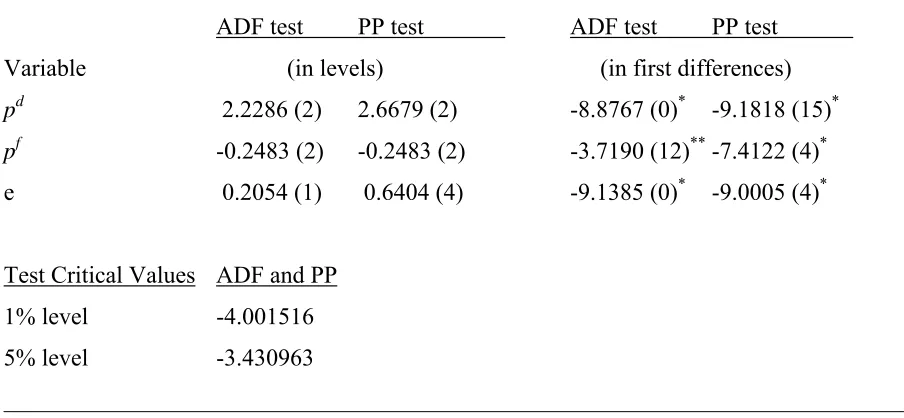
within the regression analysis. First, by using the augmented Dickey-Fuller (ADF) and
Phillips-Perron (PP) unit root tests, we compare the ADF and PP statistics obtained with the
MacKinnon (1996: 601-618) critical values available in EViews 5.1. For the case of
stationarity, we expect that these statistics are larger than the MacKinnon critical values in
absolute value and that they have a minus sign. Although differencing eliminates the trend,
we report the results of the unit root tests for the first differences of the variables with a linear
time trend in the test regression in Table 1 below. For the MacKinnon critical values, we
consider 1% and 5% level critical values for the null hypothesis of the existence of a unit root.
The numbers in parentheses are the lags used for the ADF stationary tests and augmented up
to a maximum of 12 lags using monthly observations, and we add a number of lags sufficient
to remove serial correlation in the results, while the Newey-West bandwidths are used for the
PP test. The choice of the optimum lag for the ADF test is decided on the basis of minimizing
the Schwarz Information Criterion (SC). The symbols ‘*’ and ‘**’ indicate the rejection of a
7
Table 1: Unit Root Tests (assuming constant & trend)
___________________________________________________________________________
ADF test PP test ADF test PP test
Variable (in levels) (in first differences)
pd 2.2286 (2) 2.6679 (2) -8.8767 (0)* -9.1818 (15)*
pf -0.2483 (2) -0.2483 (2) -3.7190 (12)** -7.4122 (4)*
e 0.2054 (1) 0.6404 (4) -9.1385 (0)* -9.0005 (4)*
Test Critical Values ADF and PP
1% level -4.001516
5% level -3.430963
___________________________________________________________________________
Examining the results of the unit root tests, we see that the null hypothesis that there is
a unit root cannot be rejected for all the variables using constant & trend terms in the test
equation in the level form. Inversely, for the first differences of all variables the null
hypothesis of a unit root is strongly rejected. So we accept that all the variables contain a unit
root, that is, they are non-stationary in their level forms, but stationary in their first
differenced forms, thus enabling us to test for co-integration.
Determining Co-integration
As a third step, we examine whether the variables used are co-integrated with each
other. Engle and Granger (1987: 251-276) indicate that even though economic time series
may be non-stationary in their level forms, there may exist some linear combination of these
variables that converge to a long run relationship over time. If the series are individually
stationary only after differencing, a linear combination of their levels may still be stationary
demonstrating that the series are co-integrated. That is, they cannot move too far away from
each other in a theoretical sense (Dickey, et al, 1991: 58). For this purpose, we estimate a
VAR-based co-integration relationship using the methodology developed in Johansen (1995)
in order to specify the long run relationships between the variables considered making use of
EViews 5 User’s Guide by QMS (2004: 735-748). Let us assume a vector autoregression
(VAR) of order p,
8
where yt is a k-vector of non-stationary I(1) variables, xt is a d-vector of deterministic
variables such as constant term, linear trend, seasonal dummies, and crisis variables and εt is a
vector of innovations, i.e. independent Gaussian variables with mean zero and variance Ω.
Such exogenous variables are often included to take account of short run shocks to the
system, such as policy interventions and shocks or crises which have an important effect on
macroeconomic conditions. It is worth noting that including any other dummy or dumy-type
variable will affect the underlying distribution of test statistics, so that the critical values for
these tests are different depending on the number of dummies included (Haris, 1995: 81). We
can write this VAR as,
1 1
1
p
t t i t i t t
i
y y y Bx ε
−
− −
=
∆ = Π +
∑
Γ ∆ + + (4)where:
1
p
i=
Π = Σ Ai – I Γi =
-1
p
j i
∑
= +Aj (5)
Granger represetation theorem asserts that if the coefficient matrix Π has a reduced
rank r < k, then there exist kxr matrices α and β each with rank r such that Π = αβ´ and β´yt is
I(0). The rank r is the number of co-integrating relations and each column of β is the
co-integrating vector. The elements of α are known as the adjustment parameters in the vector
error correction (VEC) model and measure the speed of adjustment of particular variables
with respect to a disturbance in the equilibrium relationship. Johansen’s method is to estimate
the Π matrix from an unrestricted VAR and to test whether we can reject the restrictions
implied by the reduced rank of Π.
This method performs better than other estimation methods even when the errors are
non-normal distributed, the dynamics are unknown, and the model is over-parameterized by
including additional lags in the error correction model (Gonzalo, 1994: 225). Also the model
does not suffer from the problems of normalization. Thus, we first determine the lag length of
our unrestricted VAR model for which the maximum lag number selected is 12 based on the
9
Sims’ small sample modification. This approach compares the modified LR statistics to the
5% critical values starting from the maximum lag, and decreases the lag one at a time until the
first rejection is obtained (QMS, 2004: 709). In our case, reduction of the system to 11 lags is
accepted with an LR statistic of 2.952014, but reduction to 10 lags is first rejected with an LR
statistic of 17.58262.
Determining Long-Run Co-integration Relationships
Fourth step is to estimate the long run co-integrating relationship between the
variables by using two likelihood test statistics offered by Johansen and Juselius (1990:
169-210). These procedures determine the maximum eigenvalue for the null hypothesis of r versus
the alternative of r+1 co-integrating relationships and trace for the null hypothesis of r
co-integrating relations against the alternative of k co-integrating relations, for r = 0, 1, ... , k-1
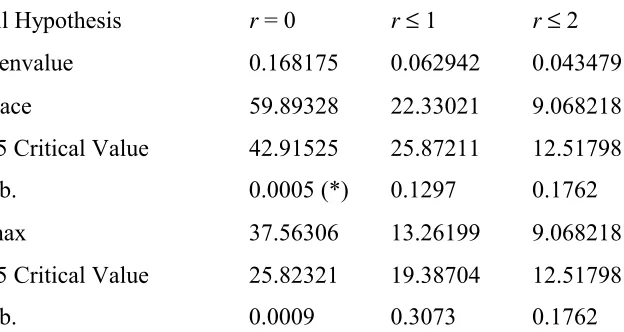
where k is the number of endogenous variables. Table 2 reports the results of Johansen
Co-integration Test using max-eigen (λ max) and trace (λ trace) tests based on the critical values
taken from Osterwald-Lenum (1992: 461-472) and on more recent p-values from MacKinnon,
et al (1999: 563-577), also available from the VAR and COINT procedures in EViews 5.1.
For the co-integration test, we restrict the intercept and trend factors into our long run
variable space, assuming that the trend factor can include the effects of other factors which
are not considered in our co-integrating analysis. At this point we follow Pantula (1989:
256-271) principle also used by Johansen (1992: 383-397) and Harris (chapter 5) who suggest the
need to test the joint hypothesis of both the rank order and the deterministic components, and
the former tries to demonstrate how to use the tables in Johansen and Juselius (1990: 169-210)
for conducting inference about the co-integration rank. After normalizing the co-integrating
vector using the domestic price level to give the variables economic meaning, both the trace
and max-eigen statistics in Table 2 jointly indicate one co-integrating vector in the long-run
variable space.
Equation (6) below describes the normalized co-integrating vector relationship
between the domestic and foreign price level and the exchange rate (standard errors in ( ) & t
10
pd = -7.418175 + 1.022819 e + 1.900940 pf – 0.021264@TREND(87M1) (6) (0.14411) (0.28155) (0.00747)
[7.09728] [6.75172] [2.84553]
All the signs match a priori expectations and have statistical significance. A
one-to-one relationship exists between the domestic price level and the spot price of the nominal
exchange rate. Such a finding is also verified when we apply a -1 homogeneity restriction
between these variables and obtain a χ2(1) = 0.0130119, with a probability of 0.909158, a
result which cannot reject the null of homogeneity.
Thus, estimation results in our paper give support to the use of the PPP theory in
managing the Turkish economy. In addition, the significant adjustment coefficients given in
Table 2 below verify the co-integrating relationship between these variables such that the
deviations from equilibrium can be corrected by constructing vector error correction models
transferring the long-run knowledge from the co-integrating space to these variables. Finally,
system diagnostic tests in Table 3 below reveal that the use of high frequency data ensures
that no serial correlation problem occurs for the 12th degree estimates and non-normality for
residuals creates no problem in our model (Gonzalo, 1994: 203-233).
Concluding Comments and Suggestions for Future Research
This study investigates whether the PPP relationships are valid for the Turkish
economy. Considering high frequency data for the period of Januay 198 – December 2004
and applying a contemporaneous co-integration estimation methodology reveal that there
exists a significant, one-to-one relationship between the domestic price level and the spot
value of nominal exchange rate. However, the same relationship between the domestic price
level and the foreign price level is rejected using homogeneity restrictions, although the
predicted relationship equation has the correct a priori signs. Thus, we give support to the
proposition that the PPP theory is valid for the Turkish economy.
The CBRT can be confident that its economic stabilization programs will be
successful, especially when focused on lowering the domestic inflation rate through the
management of the foreign exchange rates. Future studies may examine the time series
characeristics of the real exchange rate indices used by the CBRT. A finding that the series
11
Table 2: Rank Test Assuming Linear Deterministic Trend Restricted in Co-integrating
Space
Null Hypothesis r = 0 r≤ 1 r≤ 2
Eigenvalue 0.168175 0.062942 0.043479
λtrace 59.89328 22.33021 9.068218 0.05 Critical Value 42.91525 25.87211 12.51798
Prob. 0.0005 (*) 0.1297 0.1762
λmax 37.56306 13.26199 9.068218 0.05 Critical Value 25.82321 19.38704 12.51798
Prob. 0.0009 0.3073 0.1762
Both Trace and max-eigenvalue tests indicate 1 co-integrating equation at the 0.05 level
(*)
denotes rejection of the hypothesis at the 0.05 level
Unrestricted co-integrating coefficients
pd e pf @TREND(87M02)
7.036131 -7.196689 -13.3526 0.149615
2.063689 1.734807 2.231040 -0.163111
14.77402 -11.91691 -3.799435 -0.120539
Unrestricted adjustment coefficients (alpha)
D(pd) -0.006128 0.000647 -0.000218
D(pf) -0.010018 0.001949 0.006416
D(e) -0.000627 -0.000727 -7.92E-05
One co-integrating equation(s) (standard error in parentheses)
pd e pf @TREND(87M02)
1.000000 -1.022819 -1.900940 0.021264
(0.14411) (0.28155) (0.00747)
Adjustment coefficients (standard error in parentheses)
D(pd) -0.043114 (0.00779)
D(e) -0.070489 (0.02170)
D(pf) -0.004413 (0.00181)
Multivariate statistics for testing stationarity
Variable pd e pf
χ2
(2) 28.53248 22.68232 8.950347
12
Table 3: Vector Diagnostic Tests
VEC Residual Serial Correlation LM Test (probabilities: chi-square tests with 9 d.o.f.)
H0: no serial correlation at lag order h
Lags LM-Stat Prob.
12 12.41122 0.1905
VEC Residual Normality Test
H0: residuals are multivariate normal
Skewness χ2(3) = 178.2255 Prob. 0.0000
Kurtosis χ2(3) = 1646.123 Prob. 0.0000
Jarque-Bera χ2(6) = 1824.349 Prob. 0.0000
REFERENCES
Anderson, R.G., Hoffman, D. and Rasche R.H. (1998). A Vector Error Correction Forecasting
Model of the U.S. Economy, The FRB of St. Louis Working Paper, 98-008a, May.
Cashin, P. and McDermott, C.J. (2003). An Unbiased Appraisal of Purchasing Power Parity,
IMF Staff Papers, 50/3, 321-351.
Chen, S.S. and Engel, C. (2004). Does ‘Aggregation Bias’ Explain the PPP Puzzle?, NBER
Working Paper, No. 10304.
Civcir, İ. (2002). Before the Fall was the Turkish Lira Overvalued?, ERF Working Paper, No.
200220.
Dickey, D.A., Jansen, D.W. and Thornton, D.L. (1991). A Primer on Co-integration with an
Application to Money and Income, Federal Reserve Bank of St. Louis Review, March/
April, 58-78.
Dornbusch, R. (1985). Purchasing Power Parity, NBER Working Paper, No. 1591.
Engle, R.F. and Granger, C.W.J. (1987). Co-integration and Error Correction: Representation,
Estimation, and Testing, Econometrica, 55, 251-276.
Erlat, H. (2003). The Nature of Persistence in Turkish Real Exchange Rates, Emerging
Markets Finance and Trade, March/April, 39/2, 70-97.
Ertuğrul, A. and Selçuk, F. (2002). Turkish Economy. In: A. Kibritçioğlu, L. Rittenberg and
13
Froot, K.A. and Rogoff, K. (1994). Perspectives on PPP and Long-Run Real Exchange Rates,
NBER Working Paper, No. 4952.
Gonzalo, J. (1994). Five Alternative Methods of Estimating Long-Run Equilibrium
Relationships, Journal of Econometrics, 60, 203-233.
Gökcan, A. and Özmen, E. (2001). Do PPP and UIP Need Each Other in a Financially Open
Economy? The Turkish Evidence, ERC Working Papers in Economics, 01/01.
Granger, C.W.J. and Newbold, P. (1974). Spurious Regressions in Economics, Journal of
Econometrics, 2/2, 111-120.
Harris, R.I.D. (1995). Using Co-integration Analysis in Econometric Modelling, Prentice
Hall.
Johansen, S. (1992). Determination of Co-integration Rank in the Presence of a Linear Trend,
Oxford Bulletin of Economics and Statistics, 54/3, 383-397.
Johansen, S. (1995). Likelihood-based Inference in Co-integrated Vector Autoregressive
Models, Oxford University Press.
Johansen, S. and Juselius, K. (1990). Maximum Likelihood Estimation and Inference on
Co-integration – with applications to the demand for money, Oxford Bulletin of
Economics and Statistics, 52, 169-210.
Johansen, S. and Juselius, K. (1992). Testing Structural Hypothesis in a Multivariate
Co-integration Analysis of the PPP and UIP for UK, Journal of Econometrics, 53,
244.
Jonsson, G. (2001). Inflation, Money Demand, and Purchasing Power Parity in South Africa,
IMF Staff Papers, 48/2, 243-265.
Juselius, K. (1995). Do Purchasing Power Parity and Uncovred Interest Parity Hold in the
Long Run? An Example of Likelihood Inference in a Multivariate Time-Series Model,
Journal of Econometrics, 69, 211-240.
Korap, L. (2006). An Analysis of Central Bank Interventions on FOREX Market for the
post-Crisis Period, Turkish Economic Association Discussion Paper, 2006/4.
Krugman, P. (1986). Pricing to Market When the Exchange Rate Changes, NBER Working
Paper, No. 1926.
MacKinnon, J. (1996). Numerical Disribution Functions for Unit Root and Co-integration
Tests, Journal of Applied Econometrics, 11, 601-618.
Metin, K. (1994). A Test of Long-Run Purchasing Power Parity and Uncovered Interest
14
Obstfeld, M. and Rogoff, K. (2000). The Six Major Puzzles in International Maroeconomics:
Is There a Common Cause?, NBER Working Paper, No. 7777.
Osterwald-Lenum, M. (1992). A note with Quantiles of the Asymptotic Distribution of the
Maximum Likelihood Cointegration Rank Test Statistics, Oxford Bulletin of
Economics and Statistics, 54, 461-472.
Özdemir, Z.A. (2004). Mean Reversion in Real Exchange Rate: Empirical Evidence from
Turkey, 1980-1999, METU Studies in Development, 31, December, 243-265.
Pantula, S.G. (1989). Testing for Unit Rootsin Time Series Data, Econometric Theory, 5,
271.
QMS (2004). EViews 5 User’s Guide, April.
Saatçioğlu, C. and Korap. L. (2006). Determinants of Turkish Inflation, Turkish Economic
Association Discussion Paper, 2006/7.
Sarno, L. and Taylor, M.P. (2002). Purchasing Power Parity and the Real Exchange Rate,
IMF Staff Papers, 49/1, 65-105.
Salvatore, D. (1998). International Economics, International Edition, Prentice-Hall, Inc.
Taylor, A.M. (1996). International Capital Mobility in History: Purchasing-Power Parity in
the Long Run, NBER Working Paper, No. 5742.
Taylor, A.M. (2000). Potential Pitfalls for the Purchasing-Power-Parity Puzzle? Sampling and
Specification Biases in Mean Reversion Tests of the Law of One Price, NBER
Working Paper, No. 7577.
Taylor, A.M. and Taylor, M.P. (2004). The Purchasing Power Parity Debate, NBER Working
Paper, No. 10607.
Telatar, E. and Kazdağlı, H. (1998). Re-examining the Long-Run Purchasing Power Parity
Hypothesis for a High Inflation Country: The Case of Turkey, Applied Economics
Letters, 5, 51-53.
Yazgan, M.E. (2003). The Purchasing Power Parity Hypothesis for a High Inflation Country:
A Re-examination of the Case of the Turkey, Applied Economics Letters, 5, 51-53.
Yıldırım, O. (2003). Döviz Kurları Çerçevesinde Satınalma Gücü Paritesinin Zaman Serisi
Analizi ve Türkiye Uygulaması, Bankacılar Dergisi, 4, 3-14.