Performance Study of Several Methods and Selected
Wavelets for Image Compression
Md. Mustafizur
Rahman
State Key Laboratory of Bioelectronics, School of Biological Science and Medical
Engineering, Southeast University,
Nanjing210096,
Wang Fang
State Key Laboratory of Bioelectronics, School of Biological Science and Medical
Engineering, Southeast University,
Nanjing 210096, China
Mursheda Akter
School of Communication and
Information Engineering, Post
and
Telecommunication Engineering
University, Chongqing 400065,
China
Shahina Haque
Assistant Professor, Department of Electronics and Telecommunication Engineering, Daffodil
International University, Dhaka,
Bangladesh
ABSTRACT
Image compression is an application of data compression on digital images, which is in high demand as it reduces the computational time and consequently the cost in image storage and transmission. The basis for image compression is to remove redundant and unimportant data while to keep the compressed image quality in an acceptable range. In this work, Fast Fourier Transform (FFT), Discrete Cosine Transform (DCT), Discrete Wavelet Transform (DWT) methods are used to process a test image is measured and compared in terms of parameters such as compression ratio, L2-norm error, mean squared error (MSE), peak signal- to-noise ratio (PSNR) and visual quality. The performance of several wavelets using DWT is also measured and compared in terms of the parameters mentioned above.
General Terms
Entropy encoding, Quantize, Mat lab, Visio
Keywords
Fourier Transform(FT), Fast Fourier transform(FFT), Discrete Cosine Transform(DCT), Wavelet Transform(WT), Peak Signal-to-Noise Ratio(PSNR), Mean Square Error(MSE), Compression Ratio(CR).
1.
INTRODUCTION
The origin of the image analysis is significant information from images, mainly from digital image processing techniques. The main task of image analysis is identifying a person face as well as it can be as plain as reading bar coded tags or as obscured. The vital role for the computers are the analysis of hefty amounts of data, have need of elaborate working out or the amputation of quantitative information. On the other hand, the excellent image analysis apparatus is the human visual cortex. This tools specially for extorting higher-level in sequence, furthermore for many functions for instance medicine, security, moreover remote sensing, human analysts
at a halt cannot be restored by computers. Thus edge detectors in addition to neural networks are instigated by human visual perception models [1, 2]. The early 20th century the expansion of wavelets are initiating with Haar’s work . The meaning of Wavelet is “small wave”. The compactness implies to a gap function of fixed length (closely supported). Wavelets are used in symbolizing data otherwise other tasks as well as it is a function that satisfies certain mathematical requirements and wavelet has an average value of zero. Oscillatory is the condition of this function. Wavelets can analyze a confined region of a superior signal. Wavelet is capable of informative facets of data that other signal analysis methods miss portions like inclinations, disintegrate points, discontinuities in higher derivatives, as well as self-similarity [2, 8,10].
This paper will mainly focus on to understanding the general operations and compressing two-dimensional gray-scale images in addition to to enlarge an function that consent to the compression as well as recast to be done on the images. The function promoted goal to attain:
Minimum alteration
High compression ratio
Fast computation time
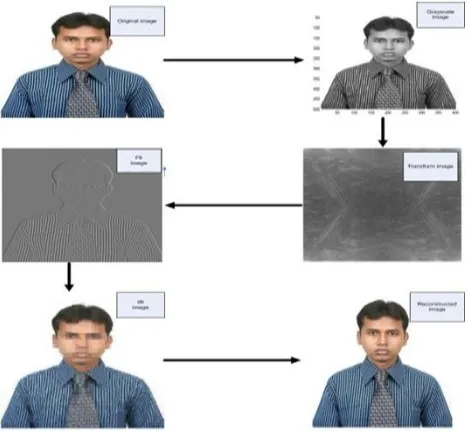
Fig1: Image compression overview
In the past years some of the people have been work on the Image Compression Using, FT, DCT, and Wavelet Transform. Some name and information about their works are given bellow. In 1989, G. Demoment who did the work on” image reconstruction moreover restoration: Synopsis of familiar assessment formations furthermore hitch”. In 1998, R.M. Rao as well as A.S Bopardikar they did the work on” Wavelet Transforms: Prologue to Theory with Applications”. In 19th October 2001 Choo Li Tan did the work on “Still Image Compression Using Wavelet Transform”. Resent in year of 2005, Mr. Song did the work on” Wavelet image compression”.
2.
IMPORTANCE OF IMAGE
ANALYSIS AND COMPRESSION
[image:2.595.330.509.234.366.2]Image analysis as a procedure for the quantification of unit size and form in order has retreated for many years.By the introduction of digital image analysis plain dealings such as Feret’s and Martin’s calliper diameters were used to organize atom size, and easy ratios of such measures could be used to explain atom figure. [6]
Figure 2: Two-dimensional Discrete Wavelet Transform: a) Original image, b) One level decomposition, c) Two
levels decomposition, d) Three levels Decomposition.
2.1
Fourier Transform
The Fourier transforms of states a signal at the same time as a sinusoidal function. The development of the computer for the duration of the mid 20th century there came to require for a rapid scheme of formative the discrete Fourier transform of a signal. Firstly these schemes were extremely workstation as well as remembrance concentrated [4]. The workstation tools
of the mid 20th century, this intended very outsized computer as well as lots of time (24 hrs for a 128 x 128 image). Decreasing the moment it took to procedure these discrete transforms many adaptations of the Fast Fourier Transform (FFT) were generated. The generally broadly used algorithm was expanded in 1965 by J.W. Cooley as well as John Tukey call the Cooley-Tukey algorithm. This algorithm lessened the FFT working out point to On log(n)) from a O(n2). The adaptation of the FFT realized in MATLAB is mainly bottomed on the Cooley-Tukey algorithm with additional optimizations. The highest power of two as well as as fast for spans that have merely diminutive key issues along with more than a few times slower for distance end to ends that are chiefs or which have hefty most important aspects [4,5].
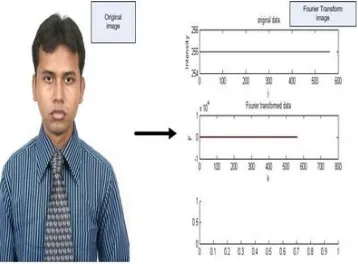
Fig 3(a): Overview of Fouriertransform
Fig 3(b): Fourier Transform Spatial Frequency: 0.48 cycles/pixel 37
[image:2.595.315.551.398.745.2] [image:2.595.58.288.491.651.2]Discreate Fourier transform (DFT) absorbs a shape of the renovate to work with the Fourier transform on a computer. Input along with output values are discrete sections moreover make it opportune for computer operation is known as Discreate Fourier transform (DFT). Here, two prime basis for using this figure of the transform:
We know DFT has input along with output values as well as both are discrete that’s why DFT make convenient for computer manipulations. Normally DFT can be known as the Fast Fourier Transform while it is using fast algorithm for computing. DFT can be defined the discrete function f(m,n) specifically nonzero merely over the finite section 0≤ m ≤M -1 in addition to 0≤ n ≤N--1. M-by-N DFT as well as inverse M-by- N DFT are the two dimensional relations are presented by
(p, q)=
Where p = 0,1…………..,M-1 ; q = 0,1,…………..,N-1
(p, q) =
Where
m= 0,1,…………..,M-1; n= 0,1,…………..,N-1 The values F(p,q) are the DFT coefficients of F(m, n). DC component mostly known as zero-frequency coefficient, (0,0) and it mainly work for direct current. (Remark that MATLAB constantly initiate at 1 rather than 0; for that reason, the matrix elements (1,1) and (1,1) keep up a correspondence to the mathematical quantities (0,0) and (0,0) respectively). We know that fft, fft2, and fftn are the MATLAB functions are implementing the fast Fourier transform algorithm for calculating the one-dimensional DFT, two-dimensional DFT, moreover N-dimensional DFT, in several esteems. The tasks ifft, ifft2, furthermore ifftn are calculating the inverse DFT [1,4,5]
2.2 Discrete Cosine Transform
The discrete cosine transform (DCT) is using only real numbers and DCT is a Fourier-correlated transform equivalent to the discrete Fourier transform (DFT). DCT is correspondent to a DFT of in the region of twice the extent, to work on real data with even equilibrium (while real as well as even function is real in addition to even of the Fourier transform), where the input moreover output data are altered by half a section. (we observe eight typical variants, four are familiar).Type-II DCT is the most familiar variant, which is frequently called basically "the DCT"; its inverse, the type-III DCT, is in the same way regularly called merely "the inverse DCT" or "the IDCT". Discrete sine transform (DST) is called two related transforms, corresponding to a DFT of real and odd functions and the customized discrete cosine transform (MDCT), generally based on a DCT of overlapping data [8]. The inverse discrete cosine transform recreates a order from its discrete cosine transform (DCT) coefficients. The function of idct is the innverse of the dct function .x = idct(y) revisits the innverse discrete cosine transform of y
X(n)= n=1,2,…….N
Where
w(k)=
[image:3.595.319.543.191.398.2]
and N = length(x), which is the same as length(y).The series is indexed from n = 1 and k = 1 instead of the usual n = 0 and k = 0 because MATLAB vectors run from 1 to N instead of from 0 to N-1.x = idct ( y, n ) appends zeros or truncates the vector y to length n before transforming. If y is a matrix, idct transforms its columns. [1,8,10]
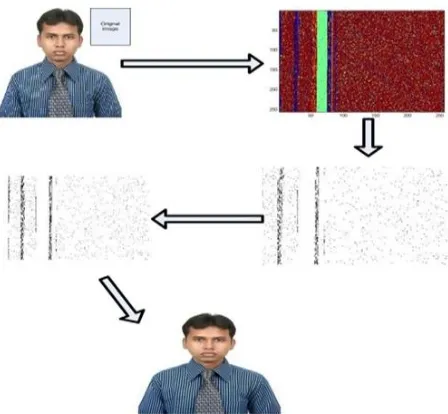
Fig 4: DiscreteCosine Transform P.S.N.R=1.489, M.S.E=1.534e+004, CR=0.04%
2.3 Wavelet Transform
Fig 5: Wavelet Transform P.S.N.R=3.477, M.S.E=2.92e+004, CR=0.04%
3.
COMPARISON BETWEEN FOURIER
AND WAVELET TRANSFORMS
3.1
Resemblance between Fourier and
Wavelet Transforms
Linear functions that engender a data formation that include in
sections of a range of lengths, generally satisfying as well as metamorphosing it into a unusual data vector of span both of the fast Fourier transform (FFT) in addition to the discrete wavelet transform (DWT) . Matrices mathematical properties are the drawn in the transforms are related as well. The FFT and the DWT both are the inverse transform matrix and the rearrange of the original. Accordingly, both transforms are viewed while a alternation in task space to a unusual domain. Sine and cosines are the origin functions of FFT. Wavelets, analyzing wavelets, or mother wavelets are more complicated origin functions for the wavelet transform. Another relationship has found between this two transform. The crucial functions are confined to a small area in frequency, formulating mathematical tools for example power spectra [4,5].
3.2 Discordance between Fourier and
Wavelet Transforms
Being wavelet functions are confined to a small area in space is the main dissimilarities of both transform. Localizing aspect, beside with wavelets confined to a small area in frequency, creates numerous functions and operators can be used wavelets "sparse" while altered interested in the wavelet field. This strangeness, in succession, outcome in a figure of functional appliances for example data compression, unrolling shapes in images, and withdrawing noise from the time series [16]. In one direction to perceive the time-frequency motion differences between the Fourier transform in addition to the wavelet transform is to take a observe the root function veil of the time-frequency plane. We observe that Fourier transform, where the slit is plainly a square wave. The square wave gap decollates the sine or cosine task to robust a gap of a fussy size. Since a solo gap can be used for all frequencies in the WFT, the assessment of the investigation is the same at all space in the time-frequency plane. [4,5,9]
3.3 Metrics for image compression
Measuring the superiority of the reformed image, two mathematical metrics are used. One of them is MSE, which calculates the cumulative square error linking the unique as well as the compressed image [2]. The additional is the peak signal-to-reconstructed image compute known as PSNR. The rule for MSE is giving as
MSE = (1/MN) I( x, y) - I(x, y)]2
The rule for PSNR is given as PSNR = 20 * log 10(255/sqrt(MSE))
Though these two measurements may not be the best loom to compute an image, they do offer a show to the eminence of the renovated image .In common, a superior reformed image is one with low MSE in addition to high PSNR. That indicates that the image has low error in addition to high image devotion.
Compression ratio = uncompressed file size / compressed file size
By measuring the image eminence, we also assess the compression ratio along with Compression time. Compression ratio is the ratio of the unique file extent to the compressed file size. In broad, the upper the compression ratio, the diminutive is the dimension of the compressed file. Compression momentum, conversely, is the sum of time involved to compress with decompress the image. This rate depends on a amount of factors, for example the intricacy of the algorithm, the competent of the implementation along with the momentum of the processor [2,6,10].
4. RESULTS AND DISCUSSION
4.1 Performance analysis
[image:4.595.317.542.511.748.2]The wavelet transform presents the improved compression ratio in our imitations. Though, the quantize attains high compression ratio at the outlay of low MSE as exposed in Table-1. The Wavelet offers the uppermost compression ratio and the quantize provides the shortest compression time.
Table 1. Comparison of linear transform
Linear Transform
P.S.N.R M.S.E C.R
Fourier Transform
0.985 -.06564e+004 .01% Cosine
Transform
1.489 1.534e+004 .04% Wavelet
Transform
3.477 2.92e+004 .07%
The wavelet presents a enhanced image eminence as well as has a lower MSE with higher PSNR than FFT. Though, in expressions of the compression ratio, the recital of DCT does not convene to the anticipation of a higher compression ratio. The outcomes acquired illustrates that FT creates lower compression ratios while compared to DCT. One of the potential motives is as a result of the clumsy way of handling the special decomposition levels for diverse FT in this system. Therefore, this has resulted in pitiable compression ratio. The implementation for this DFT, thus, requires to be altered in the future.
The recital of the encoders that exploit the quantize has attained the best effects in expressions of compression ratio in addition to time. Mainly for the Entropy encoding, the encoder is capable to attain higher compression ratio here than in FT(as shown in Figure-3,4 and 5). The enlarge in this feat is mainly down to the thresholding of irrelevant wavelet coefficients to attain large extent of zeros. Then, these coefficients are further used by the encoder. Through the high compression ratio, the compressed image using this pattern preserves the high image eminence.
The quantizer is capable to sustain the image eminence at large image assortment. Though, the feat of the FT that does not make good outcomes in terms of compression ratio in addition to compression time. More attempt is required to inspect the potential cause.
4.2 Comparison several wavelet methods
with still image
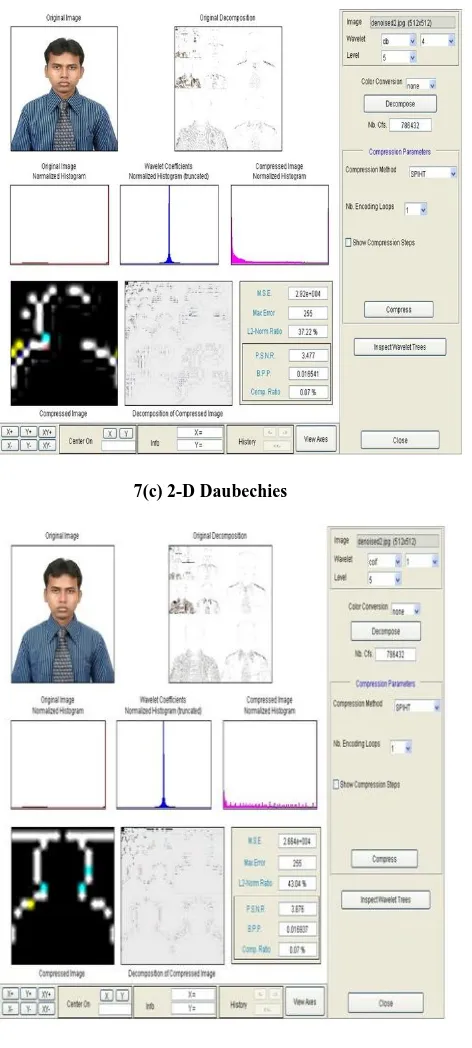
Wavelets analyze the original still image in Figure-7. The wavelet transform is capable to deliberate most of the in sequence in relation to the image to a few coefficients. Figure-7 shows the output of the compress image after applying the wavelet families. From the figure-7, we see that retained energy is higher percentage of Coif1 than Haar that is 98.96%and 99.37% respectively. But the Global Threshold is also lowest the Haar wavelet that is 158.8.Table 2, shows that Haar contains the higher elements than all other wavelets. It is not good for better compression. Coif1 contains higher retained energy and lowest Standard Deviation than the Haar wavelet. On the other hand, db4 and sym2 are the 18.2 and 18.26 Standard Deviation which are also higher than Coif1.Table 3, shows that Coif1 contains higher PSNR than all other wavelets. On the other hand, Haar contains lowest PSNR than other wavelets. So we said that
7(a) 2-D Symlets
7(c) 2-D Daubechies
7(d) 2-D Coiflets
Fig 7(a,b,c and d): overall true compression of wavelet methods
[image:6.595.57.551.65.629.2]Coif1 give the better compression image. Table 3 shows that wavelets contain the higher PSNR and CR than the DCT and FT respectively. PSNR is nearly same the DCT and FT. On the other hand, wavelets contain the lowest MSE than the DCT and FT respectively. So we can say that wavelets give the better image compression performance than DCT and FT respectively.
Table 2. Wavelet 2-D image data
Table-3: Wavelet true compression data
5. CONCLUSION
The eminence of a compressed image depends on a amount of factors. From the arguments, we have congregated that the sort of transformation, quantization as well as entropy encoding are several of the more vital factors. Wavelet transformation presents a method where an image can be de-correlated devoid of introducing any relics or alterations. In doing so, the more significant in sequence about the image is focused in fewer coefficients while the fewer significant in sequence about the image is extend over many coefficients. Quantization can be used to eliminate the spatial redundancies current in these coefficients. Higher compression ratios can be attained at the outlay of the eminence of the image by quantizing the image clumsily otherwise by using a more sophisticated entropy encoder for example Huffman encoder. Mutually FT as well as DCT does not create good results in terms of compression ratio in addition to compression.
6. ACKNOWLEDGEMENT
We feel pleasure to express our immense and heartfelt gratitude to teachers and friends for their help, impressive comments, constructive criticism and encouraging attitude.
7. REFERENCES
[1] Demoment, G. 1986. Image reconstruction and restoration: Overview of common estimation structures and problems, IEEE Trans. Acoust., Speech, Signal Process. 37:2024-36.
[2] Baluram, N., FarukhHasmi, M.H.D and Pradeep, D. 2011.Comparative Analysis of Fast Wavelet Transform for Image Compression for optimal Image Quality and
Wavelet Mean Mode Max Min Range SD Mean
abs. dev. Max norm Haar
0.1077 2.05 187 -224 411 20.07 10.86 224 db4
0.6325 1.12 158 -138 296 18.2 10.58 158 Sym2
0.4682 1.95 153 -132 285 18.26 10.48 153 Coif1
0.5032 -1.37 145 -142 287 18.43 10.61 145
wave let
L e v e l
MSE Max
Error L2-norm Ratio
PS NR
BPP Comp
Ratio
Sym5 5 2.901
e+00 4
255 39.08 %
3.50 6
0.015 625
0.07%
Haar 5 3.888
e+00 4
255 0.00% 2.23 3
0.002 0142
0.01%
db4 5 2.92e +004
255 37.22 %
3.47 7
0.016 541
0.07%
coif1 5 2.664
e+00 4
255 43.04 %
3.87 6
0.016 937
[image:6.595.57.293.68.592.2]Higher Compression Ratio, International Journal of Engineering Science and Technology. 3( 5): 4014-4019. [3] Karthik, K. Michael, W.M., Ali, B., Mariappan, S., and
Nadar. 2006. Efficient Transmission of Compressed Data for Remote Volume Visualization”, IEEE transactions on medical imaging 25(9): 1189-1199.
[4] Mridul, K.M. and Gunjan.2012. Image Compression using DFT through Fast Fourier Transform Technique, International Journal of Emerging Trends & Technology in Computer Science (IJETTCS). 1(2): 129-133. Ramkumar, M. and Anand, G.V., 1997. An FFT-based technique for fast fractal image compression Signal Processing.63: 263–268.
[5] Maneesha, G.and Amit, K.G. 2012. Analysis Of Image Compression Algorithm Using DCT, International Journal of Engineering Research and Applications (IJERA). 2(1): 515-521.
[6] Adrian M, Jan C, Paul C, “Wavelet-Based Lossless Compression of Coronary Angiographic Images”, IEEE transactions on medical imaging 1999; (18, 3): 272-281. [7] Subhasis, S. 2000 Image Compression from DCT to
Wavelets: A Review, Crossroads Homepage archive. 6(3): 12-21.
[8] Sergio, D.S., Ramchandran, K. and Orchard, M.T. 1999. “Image Coding Based on a Morphological Representation of Wavelet Data,” IEEE Transaction on Image Processing. 8(9): 1161-1174.