Choosing DBSCAN Parameters Automatically using
Differential Evolution
Amin Karami
Computer Architecture Department (DAC) Universitat Polit´ecnica de Catalunya (UPC) Jordi Girona 1-3, Campus Nord, Barcelona, Spain
Ronnie Johansson
Informatics Research Center (IRC)University of Sk¨ovde
P.O. Box 408, SE-541 28 Sk¨ovde, Sweden
ABSTRACT
Over the last several years, DBSCAN (Density-Based Spatial Clus-tering of Applications with Noise) has been widely applied in many areas of science due to its simplicity, robustness against noise (outlier) and ability to discover clusters of arbitrary shapes. However, DBSCAN algorithm requires two initial input param-eters, namely Eps (the radius of the cluster) and MinPts (the minimum data objects required inside the cluster) which both have a significant influence on the clustering results. Hence, DB-SCAN is sensitive to its input parameters and it is hard to de-termine them a priori. This paper presents an efficient and ef-fective hybrid clustering method, named BDE-DBSCAN, that combines Binary Differential Evolution and DBSCAN algorithm to simultaneously quickly and automatically specify appropriate parameter values for Eps and MinPts. Since the Eps parame-ter can largely degrades the efficiency of the DBSCAN algo-rithm, the combination of an analytical way for estimating Eps and Tournament Selection (TS) method is also employed. Exper-imental results indicate the proposed method is precise in de-termining appropriate input parameters of DBSCAN algorithm.
General Terms:
Artificial Intelligence, Metaheuristics
Keywords:
Clustering Analysis, DBSCAN, Differential Evolution, Tourna-ment Selection
1. INTRODUCTION
Clustering is a fundamental and popular data analysis technique. It can be considered as an unsupervised classification to find a num-ber of groups of similar data in a data set. Clustering techniques are applied in many fields such as image processing, pattern recogni-tion, machine learning, information retrieval and so on [1]. There are a large number of clustering algorithms in the literature. They can usually be classified into the four categories: partitioning, hier-archical, density-based and grid-based methods [2].
DBSCAN (Density-Based Spatial Clustering of Applications with Noise), introduced by Ester et al. [3], is a density-based clustering. Initially, the DBSCAN clustering algorithm was proposed for clus-tering spatial data. But it has been popular rapidly and applied in
different fields of science [4, 5, 6, 7, 8]. DBSCAN clusters data ob-jects based on the density. Clusters are regarded as regions in which the objects are dense, and which are separated by regions of low ob-ject density or noise. It can discover clusters of arbitrary shape as well as to distinguish noise [9]. DBSCAN requires two input pa-rameters, Eps (the radius of the cluster) and MinPts (the minimum data objects required inside the cluster). In spite of its advantages, the original DBSCAN algorithm suffers by some drawbacks: (1) it is not easy to determine proper values for Eps and MinPts, (2) the computational complexity without special structure isO(n2), but if a spatial index is used, the complexity can be reduced toO(nlogn) [10], and (3) it fails when the border objects of two clusters are rel-atively close [11], or when there are multi-density and connected clusters.
There have been many efforts to mitigate the drawbacks of DB-SCAN clustering algorithm. Jiang et al. [12] present a new hybrid method based on partitioning-based DBSCAN and ant clustering to improve memory usage in DBSCAN. The GMDBSCAN algorithm [13] based on spatial index and grid technique has been proposed to improve clustering in multi-density data sets. Xue-yong et al. [14] propose a density-based algorithm for intrusion detection using a method for calculating the distance and the merging process. Shah [10] gives a new detection method to discover clusters that exist within a cluster. Tepwankul and Maneewongwattana [15] present a metric which specifically measures the density quality of DBSCAN clustering in order to give better clustering quality. Edla and Jana [16] resolve the quadratic computational complexity drawback of DBSCAN by using the prototypes produced from a squared error clustering method such as K-means. Tran et al. [11] present a mod-ified version of the DBSCAN algorithm to solve instability of DB-SCAN when detecting border objects of adjacent clusters. There are also some research to solve difficulties in finding appro-priate input parameters. Darong and Peng [17] combine the grid partition technique and DBSCAN to automatically generate input parameters. The efficiency of this method has not been evaluated against noise and various data sets with different densities. This method also requires input parameters for grid partitioning. Smiti and Elouedi [18] combine Gaussian-Means (GM) and DBSCAN algorithm to determine the input parameters in DBSCAN. How-ever, GM provides circular cluster shape not density-based clus-ters, and it is not strong against noise (outlier). It still needs input parameter for the Gaussian distribution. These existing algorithms and techniques have their own drawbacks and limitations which leads to a bad clustering.
Recently, many research have combined clustering algorithms with optimization and meta-heuristic algorithms to improve the re-sults of clustering. For instance, Simulated Annealing [19], Par-ticle Swarm Optimization [20, 21, 22, 23], Tabu Search [24, 25], Harmony Search [26, 27, 28], Bees algorithm [29, 30, 31], and Ant Colony Optimization [32, 33]. However, there is no research to solve the problem of automatically choosing input parameters in DBSCAN algorithm. In this paper, we propose a new hybrid DBSCAN algorithm combining with an optimization algorithm as Binary Differential Evolution (BDE) to choose efficiency very well suited DBSCAN input parameters (BDE-DBSCAN). Since a slightly different setting (changing MinPts and Eps values) in DB-SCAN may lead to total different clusters of a data set [34], an optimization procedure would fit the requirements (finding the op-timal combination of MinPts and Eps) for a good clustering. Be-cause an optimization algorithm is related to an optimal choice of process decisions that satisfy definite constraints and make an op-timization criterion (performance or cost index) maximize or min-imize [35, 36]. Since the Eps parameter can largely degrades the efficiency of the DBSCAN algorithm [37], the combination of an analytical way for estimating Eps and Tournament Selection (TS) method is employed. The TS [38] method can create more diverse Eps values until an appropriate combination of MinPts and Eps val-ues be selected.
The rest of the paper is organized as follows. Section 2 describes the DBSCAN clustering algorithm and its characteristics. In Section 3, Differential Evolution algorithm is described. Section 4 presents the proposed hybrid clustering algorithm BDE-DBSCAN in detail. Experimental results and discussions are explained in Section 5. Finally, Section 6 draws conclusions.
2. DBSCAN: A DENSITY-BASED CLUSTERING
Density-based clustering discovers clusters as regions where the objects of the regions are dense. The clusters are separated from each other by low-density regions [2]. Density-based algorithms have considerable advantages over partitional and hierarchical clus-tering algorithms. It can define clusters of arbitrary shapes as well as effectively identify noise points. DBSCAN [3] is a density based algorithm which discovers clusters with arbitrary shape. However, it requires the specification of two input parameters which are hard to guess [18]. The input parameters are the radius of the cluster (Eps) and minimum required points inside the cluster (MinPts). The time complexity of DBSCAN algorithm isO(n2), but it can be reduced toO(n·logn)by building some special data structures. The basic idea in DBSCAN algorithm is as follows [3]:
Definition 1 (neighborhood of an object): The Eps-neighborhood of an objectp, denoted byEps(p)in a set of objects D, is defined by
Eps(p) ={q∈D|distance(p, q)≤Eps}
Definition 2(Directly density-reachable): An objectpis directly density-reachable from an objectqwrt. Eps and MinPts, in the set of objectsD, if two conditions are satisfied:
(1) p∈Eps(q)
(2) |Eps(q)| ≥M inP ts
Definition 3(Core object & border object): An object is core object if it satisfies condition 2 of Definition 2, and a border object is not a core object itself but is density-reachable from another core object (see Definition 4).
Definition 4(Density-reachable): An objectpis density reachable from an objectqwrt. Eps and MinPts if there is a chain of objects
p1, ..., pn, p1 = q, pn = psuch thatpi+ 1is directly density-reachable frompi.
Definition 5(Density-connected): An objectpis density-connected to an objectq, if there is an objecto∈Dsuch that both,pandq are density-reachable fromo.
Definition 6(Cluster): LetDbe a data set of objects. A cluster Cwrt. Eps and MinPts is a non-empty subset ofDsatisfying the following conditions:
(1) ∀p, q, ifp∈Candqis density-reachable frompwrt. Eps and MinPts, thenq∈C(Maximality).
(2) ∀p, q ∈ C,pis density-connected toqwrt. Eps and MinPts (Connectivity).
Definition 7(Noise): LetC1, ..., Ck be clusters of the data setD wrt. Eps and MinPts. Then the noise is the set of objects in the data setDnot belonging to any clusterCi, i.e. noise={p∈D|∀i:p /∈ Ci}, i= 1,2, .., k.
The steps of DBSCAN clustering algorithm is summarized as fol-lows [6, 7]:
FunctionDBSCAN(Dataset D, Eps, MinPts) 1: Select an arbitrary objectP inD;
2: Retrieve all objectsdensity-reachablefromP by arbitrary/random Eps and MinPts values;
3:ifPis a core objectthena cluster is formed;
4:ifPis a border objectthenno objects are density reachable fromPand DBSCAN visit the next object of the data set; 5:elseassignPtonoiseobject;
6: Continue the process (from step 1) until all of the objects have been processed.
end
Algorithm 1:Pseudo-code of the DBSCAN
3. DIFFERENTIAL EVOLUTION ALGORITHM
Differential Evolution (DE) Algorithm is a new evolutionary com-putational method for global optimization over continuous spaces proposed by Storn in 1997 [39]. Differential Evolution is similar to the overall structure of the genetic algorithm [40, 41]. DE consists of three basic operators: mutation, crossover and selection. Muta-tion is the most important operator in the performance of the DE algorithm because it generates new elements for the population, which may contain the optimum solution of the objective func-tion [42, 43]. The DE algorithm can be summarized as follows [44]:
(1) Initialization: This step creates arbitrary initial population inn dimension space as follows:
xi(j) =xlj+rand(0,1)·x u
j (1)
Wherexi(j)denotes thejth variable of theith individual, and xl
jandxujare the lower and upper constraints.rand(0,1) rep-resents a uniformly distributed random value within [0 1]. (2) Mutation: DE randomly selects two population vectors
xp2, xp3(p26=p3)which must be different from each other, then uses the difference between the individualsxp2, xp3 by scaling factorη(usually set the value within [0.5 1] [42]) to mutatexp1by equation:
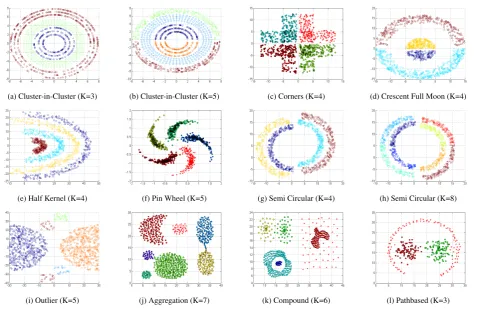
(a) Cluster-in-Cluster (K=3) (b) Cluster-in-Cluster (K=5) (c) Corners (K=4) (d) Crescent Full Moon (K=4)
(e) Half Kernel (K=4) (f) Pin Wheel (K=5) (g) Semi Circular (K=4) (h) Semi Circular (K=8)
[image:3.595.69.548.66.377.2](i) Outlier (K=5) (j) Aggregation (K=7) (k) Compound (K=6) (l) Pathbased (K=3)
Fig. 1. The twelve applied data sets
(3) Crossover: The new individual is generated by recombiningxi andhias represented below:
Ui(j) =
hi(j), if rand(0,1)≤CR or j=jrand xi(j), otherwise
(3)
Whererand(0,1)is a random number within [0 1],jrandis a randomly chosen index to ensure that the train vectorUidoes not duplicatexi, and the CR is crossover rate.
(4) Selection: Greedy algorithm is used to select the better one between the trial individualUiand the parent vectorxifor the next generation using a fitness/cost functionf:
xi=
Ui, if f(Ui)≥f(xi) xi, otherwise
(4)
The algorithm of DE in pseudo-code is shown in algorithm 2.
4. BDE-DBSCAN: BINARY DIFFERENTIAL
EVOLUTION-BASED DBSCAN ALGORITHM
BDE-DBSCAN adopts the binary coding scheme and each individ-ual (MinPts parameter) is represented by a bit string. In summary, the procedure of BDE-DBSCAN can be stated as follows: Step 1:Set control parameters and initialize the binary-coded pop-ulations randomly;
Step 2:Calculate the best fitness function value in terms of the pu-rity metric (see section 5.2) for each individual and keep the maxi-mum purity as Best Solution;
FunctionDE
Initialize the populationPby Eq. 1;
1 repeat
fori←1tonPopoverP(i)do Execute Mutation operator by Eq. 2; Execute Crossover operator by Eq. 3; Execute Selection operator by Eq. 4 using a fitness/cost function;
end until
2 stopping condition; end
Algorithm 2:Pseudo-code of the DE
Step 3:Generate the mutant individuals according to Eq. 2; Step 4:Generate the new trial individual by using the crossover op-erator in Eq. 3;
Step 5:Apply limit over real-coded individuals by Eq. 6;
Step 6:Evaluate the target individual and the corresponding trial individual, and choose the better one based on the maximum purity (fitness function) to survive into the next generation. Also, keep the best one into the Best Solution;
Step 7:If the terminal conditions are met, terminate the iteration; otherwise go to step 2.
Generally, the evolution process terminates if the maximum genera-tion is reached or the minimum/maximum fitness value is satisfied. The detailed process of BDE-DBSCAN is described in the algo-rithm 3. There are some definitions over the proposed algoalgo-rithm as
FunctionBDE-DBSCAN(data set: input Matrix) ;/Declare DE parameters
MaxIt←Maximum iteration of DE algorithm; nPop←Number of individuals;
nVar←The number of decision variables;
Population←[P op1P op2...P opnP op], e.g., ifM inP tsi= 26andnVar= 8thenP opi= [00011010];
;/Define an array for storing global information
BestSol←Store the best solution (MinPts, Eps, Purity, nCluster (number of clusters), Class) in each iteration based on the maximum fitness (purity) value (Eq. 8). Initially,BestSol=null;
;/Define the population structure
Population(i).Position←The position/point of each individual in the search space,i= 1,2,3, ..., nP op; Population(i).Cost←The purity value of each individual;
Population(i).Sol←Store the solution of each individual including MinPts, Eps, Purity, nCluster and Class; fori←1tonPopdo
Population(i).Position =randi([0 1], nVar); generate the random initial position value (called MinPts) by a binary coding (0 or 1) based on the number of nVar;
[Population(i).CostPopulation(i).Sol] =Fitness Function(Population(i).Position); end
;/DE Main Loop forit←1toMaxItdo
fori←1tonPopdo
Execute Mutation operator (Eq. 2) by an uniform distribution of scaling factor in Eq. 7; Execute Crossover operator (Eq. 3);
Apply position limits overPopulation(i) by Eq. 6.;
Execute Selection operator (Eq. 4) byFitness Function(Population(i).Position); ;/Update Best Solution of each population i
ifPopulation(i).Cost>BestSol.Costthen BestSol=Population(i);
else if(Population(i).Cost==BestSol.Cost) AND (Population(i).Sol.nCluster<BestSol.Sol.nCluster)then BestSol=Population(i);
end
ifBestSol.Cost(it)==1thenExit from algorithm; /* purity==100% */ end
end
FunctionFitness Function(MinPts)
Calculate an analytical formula of estimating neighborhood radius (Eps) for DBSCAN by Eq. 5;
Run Tournament Selection (TS) method to select an Eps value by high probability (purity value) among storedEps; Run standalone DBSCAN (M inP ts, Eps) algorithm;
Run purity function over DBSCAN results by Eq. 8; returnMinPts, Eps, Purity and nCluster;
end
Algorithm 3:Pseudo-code of the BDE-DBSCAN algorithm
follows:
Definition 8(Eps Parameter):
Since the Eps parameter can largely degrades the efficiency of the DBSCAN algorithm [37], the combination of an analytical way for estimating Eps and Tournament Selection (TS) method is employed. The TS [38] method based on its specifications cre-ates more diverse Eps values until an appropriate combination of MinPts and Eps values be selected. The Eps parameter can be cal-culated by an analytical way as [45]:
Eps= ((
Qmax(x)−min(x)
i=1 i)∗k∗γ(0.5∗n+ 1)
m∗√πn )
1/n (5)
Wherexis data matrix by m-objects and n-variables,kis the num-ber of objects in a neighborhood of an object, andγinterpolates
the factorial function. In each iteration, the Eps parameter is calcu-lated and compared to the stored Eps values from previous itera-tions through tournament selection method. At first, this initial Eps value has high probability by default in order to be selected in the tournament among others. It might be a very well suited selection of Eps and MinPts.
Definition 9(Tournament Selection):
TS [38] is widely used selection strategy in evolutionary algo-rithms. It employs to select the Eps value from a population of stored Eps values based on the fitness function (purity). The bet-ter fitness value of each Eps gets more chance to be selected. The winner of each tournament is selected for running the DBSCAN algorithm by the generated population (MinPts).
Definition 10(Apply limit over real-coded vectors):
strings, a simple control is proposed to values get either0or 1:
Binary−coded=min(max(Real−coded,0),1) (6) Definition 11(Uniform Distributions of Scaling Factor):
For scaling factor in mutation operator, a random number with the size ofnV arbit strings is generated from the continuous uniform distributions with lower and upper bound specified byβmin and βmax, respectively:
η=unif rnd(βmin, βmax, nV ar) (7)
4.1 Time Complexity
[image:5.595.331.545.75.786.2]The time complexity of the BDE-DBSCAN is O((Iteration· P opulation)·(n·logn)), whereIterationis the number of Dif-ferential Evolution iterations,P opulationis the number of indi-viduals,n·lognis the time complexity of the DBSCAN algorithm, andnis the number of data objects in the data set.
Table 1. Characteristics of data sets considered
Data set classes Size
Cluster-in-Cluster 3 1006 (250,256,500) Cluster-in-Cluster 5 1056 (230,256,220,230,220)
Corners 4 1000 (250,250,250,250)
Crescent Full Moon 4 1200 (150,450,300,300) Half Kernel 4 1000 (250,250,200,200) Pin Wheel 5 1000 (200,200,200,200,200) Semi Circular 4 1000 (250,250,250,250)
Semi Circular 8 1000 (130,120,118,132,115,135,124,126)
Outlier 5 1020 (460,20,40,460,40)
Aggregation 7 788 (45,170,102,273,34,130,34) Compound 6 399 (50,92,38,45,158,16)
Pathbased 3 300 (110,97,93)
5. EXPERIMENTAL RESULTS AND DISCUSSIONS
5.1 Data sets
The nine 2D artificial data sets asCluster-inside-Cluster (K=3 and 5), Corners, Crescent Full Moon, Half Kernel, Pinwheel, Semi Cir-cular (K=4 and 8), Outlier, as well as Aggregation [46], Compound [47], and Pathbased [48] data sets are applied. Applied data sets consist of different unified densities such as, clusters inside clus-ters, multi-density, connected clusclus-ters, and well-separated densi-ties. It allows to evaluate the effectiveness and efficiency of the BDE-DBSCAN algorithm over different shapes of data sets. These data sets are summarized in Table 1 and depicted in Fig. 1. All the experiments were performed on Intel Pentium (R) CPU 2.13 GHz with 3 GB RAM on the platform Microsoft Windows 7. We have implemented BDE-DBSCAN algorithm and artificial data sets us-ing MATLAB software.
5.2 Performance Metric
[image:5.595.48.302.278.411.2]Clustering (unsupervised classification) is usually more difficult to evaluate than a supervised approach (e.g., counting the number of errors or true detection) [49]. We evaluate effectiveness and accu-racy of BDE-DBSCAN on applied data sets (Table 1) usingPurity criterion. The purity metric measures the goodness of formed clus-ters. It is also fitness function in the proposed algorithm. The purity
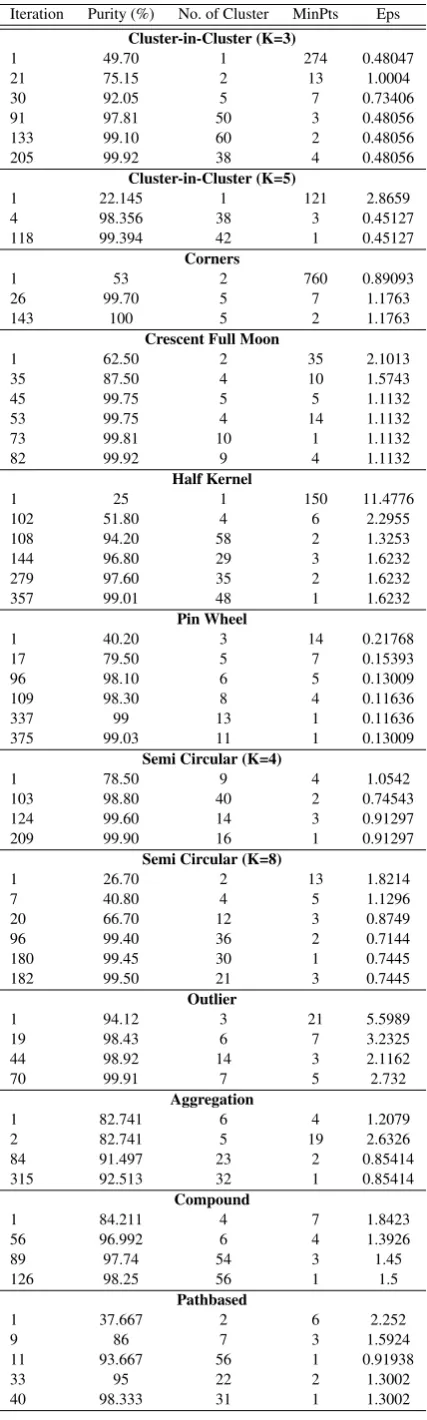
Table 2. BDE-DBSCAN with Tournament Selection Iteration Purity (%) No. of Cluster MinPts Eps
Cluster-in-Cluster (K=3)
1 49.70 1 274 0.48047
21 75.15 2 13 1.0004
30 92.05 5 7 0.73406
91 97.81 50 3 0.48056
133 99.10 60 2 0.48056
205 99.92 38 4 0.48056
Cluster-in-Cluster (K=5)
1 22.145 1 121 2.8659
4 98.356 38 3 0.45127
118 99.394 42 1 0.45127
Corners
1 53 2 760 0.89093
26 99.70 5 7 1.1763
143 100 5 2 1.1763
Crescent Full Moon
1 62.50 2 35 2.1013
35 87.50 4 10 1.5743
45 99.75 5 5 1.1132
53 99.75 4 14 1.1132
73 99.81 10 1 1.1132
82 99.92 9 4 1.1132
Half Kernel
1 25 1 150 11.4776
102 51.80 4 6 2.2955
108 94.20 58 2 1.3253
144 96.80 29 3 1.6232
279 97.60 35 2 1.6232
357 99.01 48 1 1.6232
Pin Wheel
1 40.20 3 14 0.21768
17 79.50 5 7 0.15393
96 98.10 6 5 0.13009
109 98.30 8 4 0.11636
337 99 13 1 0.11636
375 99.03 11 1 0.13009
Semi Circular (K=4)
1 78.50 9 4 1.0542
103 98.80 40 2 0.74543
124 99.60 14 3 0.91297
209 99.90 16 1 0.91297
Semi Circular (K=8)
1 26.70 2 13 1.8214
7 40.80 4 5 1.1296
20 66.70 12 3 0.8749
96 99.40 36 2 0.7144
180 99.45 30 1 0.7445
182 99.50 21 3 0.7445
Outlier
1 94.12 3 21 5.5989
19 98.43 6 7 3.2325
44 98.92 14 3 2.1162
70 99.91 7 5 2.732
Aggregation
1 82.741 6 4 1.2079
2 82.741 5 19 2.6326
84 91.497 23 2 0.85414
315 92.513 32 1 0.85414
Compound
1 84.211 4 7 1.8423
56 96.992 6 4 1.3926
89 97.74 54 3 1.45
126 98.25 56 1 1.5
Pathbased
1 37.667 2 6 2.252
9 86 7 3 1.5924
11 93.667 56 1 0.91938
33 95 22 2 1.3002
40 98.333 31 1 1.3002
determines the frequency of the most common category/class into each cluster:
P urity= 1 n
k
X
q=1 max 1≤j≤ln
j
q (8)
Where,nis the total number of samples;lis the number of cat-egories,nj
qis the number of samples in clusterqthat belongs to the original classj(1≤ j≤l). A large purity (close to 100%) is desired for a good clustering.
5.3 Analysis
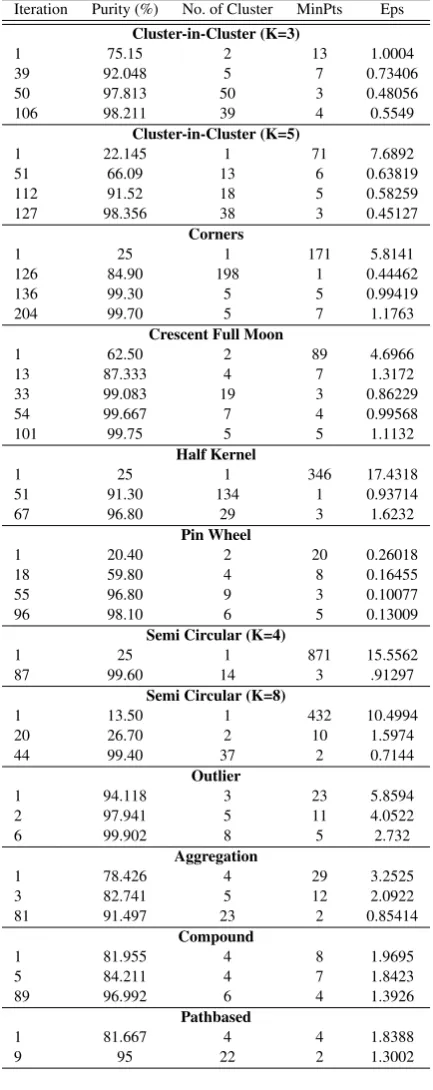
[image:6.595.329.546.117.663.2]The experiments on each data sets were repeated 10 times indepen-dently to find the optimal results. Table 2 summarizes the results of BDE-DBSCAN algorithm over twelve data sets based on any im-provement in the purity and in the number of clusters. Some data sets such as Cluster-inside-Cluster (K=5), Half Kernel, Semi Cir-cular (K=8), and Pathbased have initialized with a low purity. After several iterations they reached to the optimal results. In contrast, some data sets such as Semi Circular (K=4), Outlier, Aggregation and Compound have initialized with high purity, then reached to the optimal results. In the most data sets, a same Eps value with differ-ent MinPts values lead to the optimal accuracy (maximum purity). For instance, in cluster-in-cluster (k=3) Eps=0.48056 by MinPts=3, 2 and 4 satisfy accuracy criterion by 97.81%, 99.1% and 99.9%, re-spectively. In corners, Eps=1.1763 by MinPts=7 and 2 satisfy the accuracy by 99.7% and 100%. Also, crescent full moon data set by Eps=1.1132 and MinPts=5, 14, 1 and 4, half kernel by Eps=1.6232 and MinPts=3, 2 and 1, pin wheel by Eps=0.13009 and MinPts=5 and 1, semi-circular (k=4) by Eps=0.91297 and MinPts=3 and 1, and semi-circular (k=8) by Eps=0.7445 and MinPts=1 and 3 per-form optimal accuracy results. Table 3 shows BDE-DBSCAN with-out TS. The experimental results demonstrate that BDE-DBSCAN with TS performs better than without TS. It can be concluded that the combination of an analytical way for estimating Eps and TS method has considerably decreased the MinPts sensitivity to Eps value. Hence, this procedure leads to find the optimal results. In order to compare the quality and performance of BDE-DBSCAN, five binary-encoded optimization algorithms, i.e., Bi-nary Harmony Search (BHS), BiBi-nary Genetic Algorithm with Tournament Selection (BGA-TS), Binary Genetic Algorithm with Roulette Wheel (BGA-RW), Binary Bees Algorithm (BBees), and Binary Particle Swarm Optimization (BPSO) with the recom-mended parameter values were applied. The experiments on each algorithm were repeated 10 times independently to find the optimal parameter values. Table 4 lists the best final parameter settings of all the algorithms. The notation of control parameters in each al-gorithms is as follows. In Binary Harmony Search (BHS),HM S is harmony memory size,nN ewis number of the new harmonies, HM CRis harmony memory consideration rate,P ARis pitch ad-justment rate,F Wis fret width (bandwidth), andF Wdampis fret width damp ratio. In Genetic Algorithm with Tournament Selection (GA-TS),pcis crossover percentage,ncis number of Offsprings (Parents),pmdenotes mutation percentage, nmdenotes number of mutants,mudenotes mutation rate. In Genetic Algorithm with Roulette Wheel (GA-RW),βdenotes selection pressure parameter and other settings are same as GA-TS. In Binary Bees (BBees) al-gorithm,nScoutBeeis number of scout bees,nBee0is recruited bees scale,ris neighborhood radius, andrdampis neighborhood radius damp rate. In Binary Particle Swarm Optimization (BPSO), φ denotes correlation coefficient,w denotes inertia weight, and wdampdenotes inertia weight damping ratio.
Table 3. BDE-DBSCAN without Tournament Selection Iteration Purity (%) No. of Cluster MinPts Eps
Cluster-in-Cluster (K=3)
1 75.15 2 13 1.0004
39 92.048 5 7 0.73406
50 97.813 50 3 0.48056
106 98.211 39 4 0.5549
Cluster-in-Cluster (K=5)
1 22.145 1 71 7.6892
51 66.09 13 6 0.63819
112 91.52 18 5 0.58259
127 98.356 38 3 0.45127
Corners
1 25 1 171 5.8141
126 84.90 198 1 0.44462
136 99.30 5 5 0.99419
204 99.70 5 7 1.1763
Crescent Full Moon
1 62.50 2 89 4.6966
13 87.333 4 7 1.3172
33 99.083 19 3 0.86229
54 99.667 7 4 0.99568
101 99.75 5 5 1.1132
Half Kernel
1 25 1 346 17.4318
51 91.30 134 1 0.93714
67 96.80 29 3 1.6232
Pin Wheel
1 20.40 2 20 0.26018
18 59.80 4 8 0.16455
55 96.80 9 3 0.10077
96 98.10 6 5 0.13009
Semi Circular (K=4)
1 25 1 871 15.5562
87 99.60 14 3 .91297
Semi Circular (K=8)
1 13.50 1 432 10.4994
20 26.70 2 10 1.5974
44 99.40 37 2 0.7144
Outlier
1 94.118 3 23 5.8594
2 97.941 5 11 4.0522
6 99.902 8 5 2.732
Aggregation
1 78.426 4 29 3.2525
3 82.741 5 12 2.0922
81 91.497 23 2 0.85414
Compound
1 81.955 4 8 1.9695
5 84.211 4 7 1.8423
89 96.992 6 4 1.3926
Pathbased
1 81.667 4 4 1.8388
Table 4. Parameter settings of applied algorithms Algorithm Control Parameters
BDE-DBSCAN nV ar=10,M axIt=500,nP op=25,βmin=0.2,βmax=0.8,pCR=0.25 BHS HM S=20,HM CR=0.5,P AR=0.1,F W=0.02,F Wdamp=0.995
GA-TS nV ar=10,M axIt=500,nP op=25,pc=0.7,nc= 2∗round(pc∗nP op/2),pm=0.2,nm=round(pm∗nP op),mu=0.02 GA-RW nV ar=10,M axIt=500,nP op=25,pc=0.8,nc= 2∗round(pc∗nP op/2),pm=0.25,nm=round(pm∗nP op),mu=0.025,β=8 BBees nV ar=6,M axIt=500,nScoutBee=20,nBee0=round(0.3*nScoutBee),r=0.2,rdamp=0.98
BPSO nV ar=8,M axIt=600,nP op=20,φ=4.1,w=0.73,wdamp=1 and it is linearly decreased byw∗wdampin each iteration
In order to validate the BDE-DBSCAN performance, we use some measures including purity (Eq. 8), entropy (Eq. 10), Davies-Bouldin Index (DBI) (Eq. 11) and Dunn index (Eq. 12). Entropy [50, 51, 52] is the degree to which each cluster consists of objects of a single class. For each cluster, the class distribution of the data is calculated bypij =
mij
mi, wheremiis the number of objects in
clusteri,mijis the number of objects of classjin clusteri, andpij denotes the probability of a member of clusteribelongs the class j. The entropy of each clusteriis calculated using the standard formula:
ei=− L
X
j=1
pij·log2pij (9)
WhereLis the number of classes. The total entropy for a set of clusters is calculated by:
e=− K
X
j=1 mi
m ·ei (10)
WhereKis the number of clusters andmis the total number of data points. The DBI [53] calculates the similarities between each clusterCand other clusters, and the highest value is assigned toC as its cluster similarity. Then DBI measures the average of similar-ity between each cluster. As the clusters should be compacted and separated, the lower DB means better clustering result.
1 N C
X
i
maxj,j6=i [1
ni P
xCid(x, ci) + 1 nj
P
xCjd(x, cj)]
d(ci, cj)
(11) Where,c: center of data set; NC: number of clusters;Ci: the i-th cluster;ni: number of objects inCi;ci: center ofCi;d(x, y): dis-tance between x and y.
Dunn index [54] is based on the minimum pairwise distance be-tween objects in different clusters as the inter-cluster separation and the maximum diameter among all clusters as the intra-cluster compactness. The larger value of Dunn means better cluster con-figuration.
mini{minj(
minxCi,yCjd(x, y)
maxk{maxx,yCkd(x, y)}
)} (12)
Where,Ci: the i-th cluster;ni: number of objects inCi;d(x, y): distance between x and y.
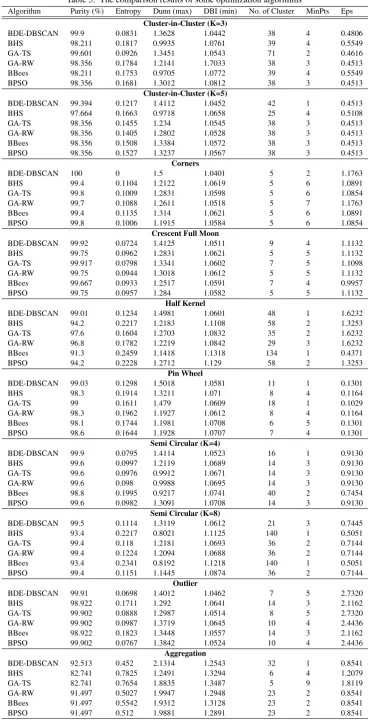
Table 5 shows the comparison results over applied methods. As shown, BDE-DBSCAN outperforms BHS, BGA-TS, BGA-RW, BBees, and BPSO on almost all the tests in terms of the purity, entropy, DBI and Dunn criteria.
For the time complexity measurement, we should take into con-sideration two different complexities includingO(n·logn) and O(Iteration·P opulation). It implies thatO(n·logn)comes from DBSCAN algorithm andO(Iteration·P opulation)comes
from BDE-DBSCAN. Based on the obtained results, the optimal accuracy will be reached by the number of population between 20 and 30 and the number of iteration between 200 and 500. Hence, the most influential parameter is given byn(number of the data points in considered data sets). It demonstrates that the added ex-tra time complexity to DBSCAN algorithm can be reasonable for finding very well suited MinPts and Eps values at the same time.
5.4 Accuracy Improvement
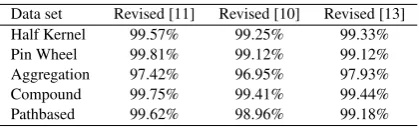
As seen in Table 2, BDE-DBSCAN shows uniformly high accuracy ranging around 99.4%-100% for all data sets except half kernel curacy=99.01%), pin wheel (accuracy=99.03%), aggregation (ac-curacy=92.513%), compound (accuracy=98.25%), and pathbased (accuracy=98.333%). Since these data sets consist of border data objects with absolutely close clusters and connected clusters, we should apply a modified DBSCAN algorithm to tackle successfully with these types of data sets. The assumption for optimal accuracy is the purity with more than 99.3%. By applying any modified ver-sion of DBSCAN, the accuracy can be considerably improved. We applied the three revised versions of DBSCAN algorithm from pa-pers [11], [10] and [13] inFitness Functionsection of algorithm 3. According to Table 6, applied modified DBSCAN algorithms out-perform almost all the standalone DBSCAN algorithms in terms of the optimal accuracy. It shows that BDE-DBSCAN algorithm by integration of any revised DBSCAN which can tackle with multi-density data sets and close connected clusters, can provide better combination of Eps and MinPts parameters in the same time.
5.5 Discussion
This paper presented a new hybrid approach combining Binary Differential Evolution (BDE) and DBSCAN clustering algorithm called BDE-DBSCAN. This is a meta-heuristic population-based algorithm to find the optimal initial parameters (Eps and MinPts) of the DBSCAN algorithm. BDE-DBSCAN tries to find the very well suited Eps value for each individual (MinPts) in DE. To do so, a combination of an analytical way of estimating Eps and tour-nament selection method is employed. Tables 2 and 3 confirm that tournament selection can provide optimal results in side of an ana-lytical way. We also applied standalone DBSCAN version for clus-tering purposes. However, for relatively closed clusters and densi-ties, we applied three revised version of DBSCAN from literature to improve BDE-DBSCAN accuracy reasonable. The time complex-ity of BDE-DBSCAN consists of two phases:O(n·logn) from DBSCAN algorithm andO(Iteration·P opulation)from DE. Experimental results imply that the added time complexity to DB-SCAN algorithm is reasonable for accuracy improvement. Convergence of BDE-DBSCAN is studied for finding the optimal accuracy (maximum purity) over twelve data sets with variety of shapes and densities. The performance measurement results show that the BDE-DBSCAN algorithm performs well with optimal ac-curacy over different data sets. Tables 2 and 6 show results for
Table 5. The comparison results of some optimization algorithms
Algorithm Purity (%) Entropy Dunn (max) DBI (min) No. of Cluster MinPts Eps
Cluster-in-Cluster (K=3)
BDE-DBSCAN 99.9 0.0831 1.3628 1.0442 38 4 0.4806
BHS 98.211 0.1817 0.9935 1.0761 39 4 0.5549
GA-TS 99.601 0.0926 1.3451 1.0543 71 2 0.4616
GA-RW 98.356 0.1784 1.2141 1.7033 38 3 0.4513
BBees 98.211 0.1753 0.9705 1.0772 39 4 0.5549
BPSO 98.356 0.1681 1.3012 1.0812 38 3 0.4513
Cluster-in-Cluster (K=5)
BDE-DBSCAN 99.394 0.1217 1.4112 1.0452 42 1 0.4513
BHS 97.664 0.1663 0.9718 1.0658 25 4 0.5108
GA-TS 98.356 0.1455 1.234 1.0545 38 3 0.4513
GA-RW 98.356 0.1405 1.2802 1.0528 38 3 0.4513
BBees 98.356 0.1508 1.3384 1.0572 38 3 0.4513
BPSO 98.356 0.1527 1.3237 1.0567 38 3 0.4513
Corners
BDE-DBSCAN 100 0 1.5 1.0401 5 2 1.1763
BHS 99.4 0.1104 1.2122 1.0619 5 6 1.0891
GA-TS 99.8 0.1009 1.2831 1.0598 5 6 1.0854
GA-RW 99.7 0.1088 1.2611 1.0518 5 7 1.1763
BBees 99.4 0.1135 1.314 1.0621 5 6 1.0891
BPSO 99.8 0.1006 1.1915 1.0584 5 6 1.0854
Crescent Full Moon
BDE-DBSCAN 99.92 0.0724 1.4125 1.0511 9 4 1.1132
BHS 99.75 0.0962 1.2831 1.0621 5 5 1.1132
GA-TS 99.917 0.0798 1.3341 1.0602 7 5 1.1098
GA-RW 99.75 0.0944 1.3018 1.0612 5 5 1.1132
BBees 99.667 0.0933 1.2517 1.0591 7 4 0.9957
BPSO 99.75 0.0957 1.284 1.0582 5 5 1.1132
Half Kernel
BDE-DBSCAN 99.01 0.1234 1.4981 1.0601 48 1 1.6232
BHS 94.2 0.2217 1.2183 1.1108 58 2 1.3253
GA-TS 97.6 0.1604 1.2703 1.0832 35 2 1.6232
GA-RW 96.8 0.1782 1.2219 1.0842 29 3 1.6232
BBees 91.3 0.2459 1.1418 1.1318 134 1 0.4371
BPSO 94.2 0.2228 1.2712 1.129 58 2 1.3253
Pin Wheel
BDE-DBSCAN 99.03 0.1298 1.5018 1.0581 11 1 0.1301
BHS 98.3 0.1914 1.3211 1.071 8 4 0.1164
GA-TS 99 0.1611 1.479 1.0609 18 1 0.1029
GA-RW 98.3 0.1962 1.1927 1.0612 8 4 0.1164
BBees 98.1 0.1744 1.1981 1.0708 6 5 0.1301
BPSO 98.6 0.1644 1.1928 1.0707 7 4 0.1301
Semi Circular (K=4)
BDE-DBSCAN 99.9 0.0795 1.4114 1.0523 16 1 0.9130
BHS 99.6 0.0997 1.2119 1.0689 14 3 0.9130
GA-TS 99.6 0.0976 0.9912 1.0671 14 3 0.9130
GA-RW 99.6 0.098 0.9988 1.0695 14 3 0.9130
BBees 98.8 0.1995 0.9217 1.0741 40 2 0.7454
BPSO 99.6 0.0982 1.3091 1.0708 14 3 0.9130
Semi Circular (K=8)
BDE-DBSCAN 99.5 0.1114 1.3119 1.0612 21 3 0.7445
BHS 93.4 0.2217 0.8021 1.1125 140 1 0.5051
GA-TS 99.4 0.118 1.2181 1.0693 36 2 0.7144
GA-RW 99.4 0.1224 1.2094 1.0688 36 2 0.7144
BBees 93.4 0.2341 0.8192 1.1218 140 1 0.5051
BPSO 99.4 0.1151 1.1445 1.0874 36 2 0.7144
Outlier
BDE-DBSCAN 99.91 0.0698 1.4012 1.0462 7 5 2.7320
BHS 98.922 0.1711 1.292 1.0641 14 3 2.1162
GA-TS 99.902 0.0888 1.2987 1.0514 8 5 2.7320
GA-RW 99.902 0.0987 1.3719 1.0645 10 4 2.4436
it comes from the previous page ...
Algorithm Purity (%) Entropy Dunn (max) DBI (min) No. of Cluster MinPts Eps
Compound
BDE-DBSCAN 98.25 0.1761 1.4012 1.0792 56 1 1.5 BHS 96.992 0.1945 0.9871 1.0924 6 4 1.3926 GA-TS 96.992 0.1978 0.9745 1.0931 6 4 1.3926 GA-RW 96.992 0.1986 0.9712 1.0944 6 4 1.3926 BBees 92.732 0.2242 0.7731 1.1391 6 3 1.206 BPSO 97.74 0.1814 1.1044 1.0819 54 3 1.45
Pathbased
BDE-DBSCAN 98.333 0.1746 1.2517 1.0714 31 1 1.3002 BHS 93.667 0.2167 0.8618 1.0911 56 1 0.9194 GA-TS 95 0.1876 0.9984 1.0814 22 2 1.3002 GA-RW 95 0.1894 1.1012 1.0845 22 2 1.3002 BBees 95 0.1903 1.1191 1.0823 22 2 1.3002 BPSO 95 0.1901 1.1018 1.0812 22 2 1.3002
ing the optimal accuracy by very well suited Eps and MinPts, where BDE-DBSCAN performs well.
The feasibility and efficiency of BDE-DBSCAN for optimization of different examples are compared to five different algorithms. Ta-ble 5 depicts the final results, using Binary Harmony Search (BHS), Genetic Algorithm with Tournament Selection (GA-TS), Genetic Algorithm with Roulette Wheel (GA-RW), Binary Bees (BBees) algorithm, and Binary Particle Swarm Optimization (BPSO). BDE-DBSCAN provides better accuracy based on the purity, entropy, Davies-Bouldin Index (DBI) and Dunn index among others. More-over, BDE-DBSCAN and other applied algorithms use different parameter settings to find the global results; therefore, the effect of tuning parameters on performance of the algorithms are studied. Results show BDE-DBSCAN is capable for finding globally opti-mal accuracy in a relatively sopti-mall number of generations.
[image:9.595.70.280.441.505.2]Some improvements are needed in future works. First, utilization of various cluster validity measures; second, hybridization of other metaheuristics techniques with DBSCAN, and third, evaluation of the proposed method with multi-dimensional data sets.
Table 6. The purity of revised versions of DBSCAN Data set Revised [11] Revised [10] Revised [13]
Half Kernel 99.57% 99.25% 99.33%
Pin Wheel 99.81% 99.12% 99.12%
Aggregation 97.42% 96.95% 97.93%
Compound 99.75% 99.41% 99.44%
Pathbased 99.62% 98.96% 99.18%
6. CONCLUSION
This paper proposes a novel hybrid approach consisting Binary Differential Evolution (BDE) and DBSCAN clustering algorithm as BDE-DBSCAN to choose quickly and automatically very well suited Eps and MinPts parameters for DBSCAN algorithm. BDE-DBSCAN performance is evaluated using various data sets with different densities and shapes. Moreover, BDE-DBSCAN outper-forms other algorithms such as Binary Harmony Search (BHS), Bi-nary Bees (BBees) algorithm, BiBi-nary Genetic Algorithm with Tour-nament Selection (GA-TS) and with Roulette Wheel (GA-RW), and Binary Particle Swarm Optimization (BPSO) in terms of the purity, entropy, Davies-Bouldin and Dunn indices. As illustrated results over applied data sets, the proposed algorithm provides op-timal accuracy by the purity ranging around 99.4% and 100%.
7. REFERENCES
[1] Krista Rizman ˇZalik. An efficient ´k-means clustering algo-rithm.Pattern Recognitoin Letters, 29(9):1385–1391, 2008. [2] Tran Manh Thang and Juntae Kim. The anomaly detection by
using dbscan clustering with multiple parameters. In Interna-tional Conference on Information Science and Applications (ICISA), pages 1–5, 2011.
[3] M. Ester, H. P. Kriegel, J. Sander, and X. Xu. A density-based algorithm for discovering clusters in large spatial databases with noise. InProceeding of 2nd International Conference on Knowledge Discovery and Data Mining, pages 226–231, 1996.
[4] T. Ali, S. Asghar, and N.A. Sajid. Critical analysis of dbscan variations. InInternational Conference on Information and Emerging Technologies (ICIET), pages 1–6, 2010.
[5] Wu Ying, Yang Kai, and Zhang Jianzhong. Using dbscan clustering algorithm in spam identifying. In 2nd Interna-tional Conference on Education Technology and Computer (ICETC), volume 1, pages V1–398–V1–402, 2010.
[6] Derya Birant and Alp Kut. St-dbscan: An algorithm for clus-tering spatialtemporal data.Data & Knowledge Engineering, 60(1):208–221, 2007.
[7] P. Viswanath and V. Suresh Babu. Rough-dbscan: A fast hy-brid density based clustering method for large data sets. Pat-tern Recognition Letters, 30(16):1477–1488, 2009.
[8] Amin Karami. Data clustering for anomaly detection in content-centric networks.International Journal of Computer Applications, 81(7):1–8, November 2013. Published by Foun-dation of Computer Science, New York, USA.
[9] Guilherme Andrade, Gabriel Ramos, Daniel Madeira, Rafael Sachetto, Renato Ferreira, and Leonardo Rocha. G-dbscan: A gpu accelerated algorithm for density-based clustering. Pro-cedia Computer Science, 18:369–378, 2013.
[10] G.H. Shah. An improved dbscan, a density based cluster-ing algorithm with parameter selection for high dimensional data sets. In Nirma University International Engineering (NUiCONE), pages 1–6, 2012.
[11] Thanh N. Tran, Klaudia Drab, and Michal Daszykowski. Re-vised dbscan algorithm to cluster data with dense adjacent clusters. Chemometrics and Intelligent Laboratory Systems, 120:92–96, 2013.
[12] Hua Jiang, Jing Li, Shenghe Yi, Xiangyang Wang, and Xin Hu. A new hybrid method based on partitioning-based dbscan and ant clustering. Expert Systems with Applications, 38(8), 2011.
[13] Chen Xiaoyun, Min Yufang, Zhao Yan, and Wang Ping. Gmdbscan: Multi-density dbscan cluster based on grid. In IEEE International Conference on e-Business Engineering (ICEBE ’08), pages 780–783, 2008.
[14] Li Xue-yong, Gao Guo-hong, and Sun Jia-xia. A new in-trusion detection method based on improved dbscan. In In-ternational Conference on Information Engineering (ICIE), volume 2, pages 117–120, 2010.
[15] A. Tepwankul and S. Maneewongwattana. U-dbscan : A density-based clustering algorithm for uncertain objects. In 26th IEEE International Conference on Data Engineering Workshops (ICDEW), pages 136–143, 2010.
[16] Damodar Reddy Edla and Prasanta K. Jana. A prototype-based modified dbscan for gene clustering. Procedia Tech-nology, 6:485–492, 2012.
[17] Huang Darong and Wang Peng. Grid-based dbscan algo-rithm with referential parameters. Physics Procedia, 24, Part B:1166–1170, 2012.
[18] A. Smiti and Z. Elouedi. Dbscan-gm: An improved cluster-ing method based on gaussian means and dbscan techniques. In16th International Conference on Intelligent Engineering Systems (INES), pages 573–578, 2012.
[19] G. P. Babu and M. N. Murty. Simulated annealing for se-lecting optimal initial seeds in the k-means algorithm. In-dian Journal of Pure and Applied Mathematics, 25(1-2):85– 94, 1994.
[20] Amin Karami and Manel Guerrero-Zapata. A fuzzy anomaly detection system based on hybrid pso-kmeans algorithm in content-centric networks.Neurocomputing, 2014.
[21] George E. Tsekouras. A simple and effective algorithm for implementing particle swarm optimization in rbf network’s design using input-output fuzzy clustering.Neurocomputing, 108:36–44, 2013.
[22] Junyan Chen. Hybrid clustering algorithm based on pso with the multidimensional asynchronism and stochastic dis-turbance method. Journal of Theoretical and Applied Infor-mation Technology, 46(1):434–440, 2012.
[23] Zhenkui Pei, Xia Hua, and Jinfeng Han. The clustering al-gorithm based on particle swarm optimization alal-gorithm. In Proceedings of the 2008 International Conference on Intelli-gent Computation Technology and Automation - Volume 01, ICICTA ’08, pages 148–151, Washington, DC, USA, 2008. IEEE Computer Society.
[24] Li Lin and Liu Suhua. Wheat cultivar classifications based on tabu search and fuzzy c-means clustering algorithm. In4th International Conference on Computational and Information Sciences (ICCIS), pages 493–496, 2012.
[25] Hong bing Xu, Hou jun Wang, and Chun-Guang Li. Fuzzy tabu search method for the clustering problem. In Proceed-ings International Conference on Machine Learning and Cy-bernetics, volume 2, pages 876–880, 2002.
[26] Yangyang Li, Jing Chen, Ruochen Liu, and Jianshe Wu. A spectral clustering-based adaptive hybrid multi-objective har-mony search algorithm for community detection. InIEEE Congress on Evolutionary Computation (CEC), pages 1–8, 2012.
[27] C. Cobos, J. Andrade, W. Constain, M. Mendoza, and E. Le´on. Web document clustering based on global-best har-mony search, k-means, frequent term sets and bayesian
infor-mation criterion. InIEEE Congress on Evolutionary Compu-tation (CEC), pages 1–8, 2010.
[28] Liang Li, Shi bao Lu, Xue song Chu, and Guang ming Yu. A combinatorial search method based on harmony search algo-rithm and particle swarm optimization in slope stability anal-ysis. InInternational Conference on Computational Intelli-gence and Software Engineering (CiSE), pages 1–4, 2009. [29] E. Hancer, C. Ozturk, and D. Karaboga. Artificial bee colony
based image clustering method. InIEEE Congress on Evolu-tionary Computation (CEC), pages 1–5, 2012.
[30] D. Karaboga, S. Okdem, and C. Ozturk. Cluster based wire-less sensor network routings using artificial bee colony algo-rithm. InInternational Conference on Autonomous and Intel-ligent Systems (AIS), pages 1–5, 2010.
[31] Y. Marinakis, M. Marinaki, and N. Matsatsinis. A hybrid dis-crete artificial bee colony - grasp algorithm for clustering. In International Conference on Computers Industrial Engineer-ing (CIE), pages 548–553, 2009.
[32] Bo Zhao, Zhongxiang Zhu, Enrong Mao, and Zhenghe Song. Image segmentation based on ant colony optimization and k-means clustering. InIEEE International Conference on Au-tomation and Logistics, pages 459–463, 2007.
[33] Yanfang Han and Pengfei Shi. An improved ant colony algo-rithm for fuzzy clustering in image segmentation. Neurocom-puting, 70(46):665–671, 2007.
[34] J. W. Han and M. Kamber.Data Mining Concepts and Tech-niques, second edition. Morgan Kaufmann Publishers, 2006. [35] Stanisaw Sieniutycz and Jacek Jeowski. 1 - brief review of
static optimization methods. InEnergy Optimization in Pro-cess Systems and Fuel Cells (Second Edition), pages 1–43. Elsevier, Amsterdam, second edition edition, 2013.
[36] Yang Sun, Lingbo Zhang, and Xingsheng Gu. A hybrid co-evolutionary cultural algorithm based on particle swarm op-timization for solving global opop-timization problems. Neuro-computing, 98(3):76–89, 2012.
[37] Hongfang Zhou, Peng Wang, and Hongyan Li. Research on adaptive parameters determination in dbscan algorithm. Journal of Information & Computational Science, 9(7):1967– 1973, 2012.
[38] Mohammed Azmi Al-Betar, Ahamad Tajudin Khader, Zong Woo Geem, Iyad Abu Doush, and Mohammed A. Awadallah. An analysis of selection methods in memory consideration for harmony search. Applied Mathematics and Computation, 219(22):10753–10767, 2013.
[39] R. Storn and K. Price. Differential evolution - a simple and efficient heuristic for global optimization over continuous spaces. Journal of Global Optimization, 11:341–359, 1997. [40] Dexuan Zou, Jianhua Wu, Liqun Gao, and Steven Li. A
mod-ified differential evolution algorithm for unconstrained opti-mization problems.Neurocomputing, 120:469–481, 2013. [41] Marco Locatelli, Mirko Maischberger, and Fabio Schoen.
Differential evolution methods based on local searches. Com-puters & Operations Research, 43:169–180, 2014.
[42] Yang Lou, Junli Li, and Yongsheng Wang. A binary-differential evolution algorithm based on ordering of individ-uals. In6th International Conference on Natural Computa-tion (ICNC), pages 2207–2211, 2010.
[44] Ling Wang, Xiping Fu, Yunfei Mao, Muhammad Ilyas Men-has, and Minrui Fei. A novel modified binary differential evolution algorithm and its applications. Neurocomputing, 98:55–75, 2012.
[45] M. Daszykowski, B. Walczak, and D. L. Massart. Looking for natural patterns in data: Part 1. density-based approach. Chemometrics and Intelligent Laboratory Systems, 56:83–92, 2001.
[46] A. Gionis, H. Mannila, and P. Tsaparas. Clustering aggrega-tion. ACM Transactions on Knowledge Discovery from Data (TKDD), 1(1):1–30, 2007.
[47] C. T. Zahn. Graph-theoretical methods for detecting and de-scribing gestalt clusters. IEEE Transactions on Computers, 100(1):68–86, 1971.
[48] H. Chang and D.Y. Yeung. Robust path-based spectral clus-tering.Pattern Recognition, 41(1):191–203, 2008.
[49] Sameh A. Salem and A.K. Nandi. New assessment criteria for clustering algorithms. InIEEE Workshop on Machine Learn-ing for Signal ProcessLearn-ing, pages 285–290, 2005.
[50] Anil K. Jain and Richard C. Dubes.Algorithms for clustering data. Prentice-Hall, Inc., Upper Saddle River, NJ, USA, 1988. [51] Amin Karami. Utilization and comparison of multi attribute decision making techniques to rank bayesian network options. master thesis, University of Sk¨ovde, Sk¨ovde, Sweden, 2011. [52] Amin Karami and Ronnie Johansson. Utilization of multi
at-tribute decision making techniques to integrate automatic and manual ranking of options. Journal of Information Science and Engineering, 30(2):519–534, 2014.
[53] David L. Davies and Donald W. Bouldin. A cluster sepa-ration measure. IEEE Transactions on Pattern Analysis and Machine Intelligence, PAMI-1(2):224–227, 1979.
[54] J.C. Dunn. Well separated clusters and optimal fuzzy parti-tions.Cybernetics, 4:95–104, 1974.