FFT Factorization Technique for OFDM System
Tanvi Chawla
Haryana College of Technology & Management, Kaithal, Haryana, India
ABSTRACT
For OFDM communication systems, the frequency offsets in mobile radio channels deteriorate the orthogonality between subcarriers resulting in Inter Carrier Interference (ICI). ICI causes power leakage among subcarriers thus degrading the system performance. A well-known problem of OFDM is its sensitivity to frequency offset between the transmitted and received carrier frequencies. This research work investigates three bandwidth efficient methods for combating the effects of ICI: DFT-OFDM algorithm, two path algorithm (TPA) and these three methods are compared in terms of bit error rate performance with Proposed FFT Factorization Technique. Through simulations, it is shown that proposed Technique is much effective in mitigating ICI at high frequency offset. Keywords: Self-cancellation,ICI,BER,CIR
1. INTRODUCTION
Orthogonal frequency division multiplexing has gained considerable attention due to its high speed data applications. It is emerging as most preferred digital modulation technique due to its high bandwidth efficiency and strength to handle multipath interference. OFDM is a multicarrier transmission system in which transmission bandwidth is divided into many narrowband sub channels which are transmitted into parallel. As a result the symbol duration is increased and inter-symbol interference is mitigated. OFDM systems require precise frequency synchronization otherwise inter-carrier interference (ICI) occurs [1]. ICI has a negative impact on data throughput. In literature there are several methods to reduce ICI. The first approach is frequency-domain equalization in [2], in which, weighting coefficients of equalizer need be chosen by channel state information (CSI) estimation. The second one is time-domain windowing in [3]. The third is ICI self-cancellation in [4], which maps the transmitted data onto a group of adjacent subcarriers with a group of weighting coefficient rather than onto single subcarrier, and then the ICI can be reduced by linearly combining the received signals. This method is very simple and significantly provides CIR improvement, however bandwidth efficiency of OFDM system gets reduced.
This paper is focused on ICI-self-cancellation technique. There are various self-cancellation techniques with different ICI cancelling modulation methods and the corresponding demodulation methods, proposed to reduce the ICI caused by carrier frequency offset (CFO). These methods include the adjacent conversion method [5], the symmetric data-conversion method [6], the adjacent data-conjugate method, and the symmetric data-conjugate method [7].The aforementioned methods can suppress the ICI effectively, but the spectral efficiency will obviously be reduced as data is replicated on two or more subcarriers.
To increase bandwidth efficiency various schemes has been proposed in literature. Bing Han et al. proposed DFT based bandwidth efficient method for ICI cancellation [8].In this scheme at the transmitter side, before modulated onto a groupof adjacent subcarriers, the parallel data symbols are divided into two groups, each discrete Fourier transformed. In this scheme with additional signal processing the IC1 can be counteracted to some extent. However, this scheme outperforms only for small frequency offset values (Є<0.2).
In this direction another scheme based on two path algorithm (TPA) was proposed in [9]. The first path sends a specially modulated data symbols which results from weighted subtraction of an even numbered modulated symbol and its consecutive symbol. The second path uses the conjugate of a similar type of specially modulated data symbols which results from weighted addition of an even numbered modulated symbol and its consecutive symbol.With additional signal processing bandwidth efficiency of system can be achieved.
In this paper, a new bandwidth efficient scheme is proposed in which parallel Fast Fourier Transform (FFT) factorization is performed using Radix -2 DIF FFT algorithms derived from the well known Cooley-turkey factorization using butterfly algorithm. The decimation in frequency (DIF) radix-2 FFT partitions the DFT computations into even indexed and odd indexed outputs, which can be computed by shorter length DFT’s of different combinations of input samples. Recursive application of this decomposition to the shorter length DFT results in the full radix DIF-FFT. Paper concentrate on ICI analysis of proposed scheme and also a theoretical CIR expression is derived. The paper is organized as: In section II system model of proposed scheme is presented. Section III, discusses simulation results of proposed scheme and compared with previous bandwidth efficient schemes. Finally, the overall findings of the study are summarized in Section IV.
2. PROPOSED MODEL
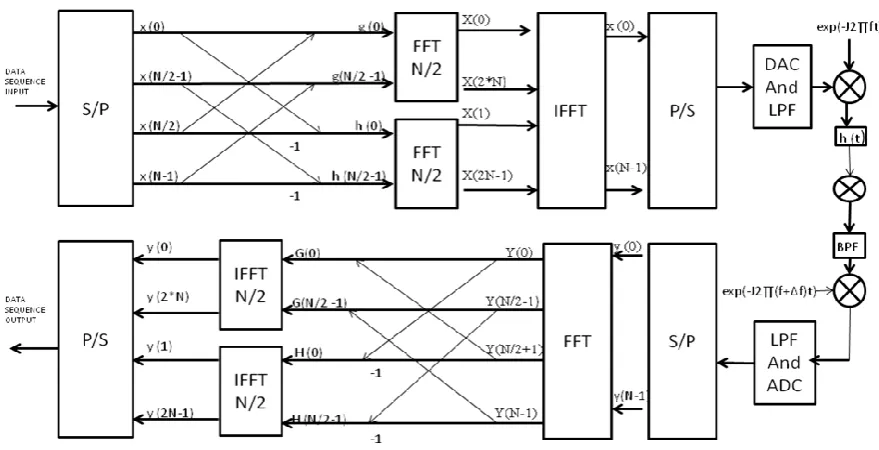
Fig 1: Block diagram of FFT Factorization based ICI self-cancellation technique
Mathematical Description
In proposed model, N/2 factorization is shown for the decimation in frequency (DIF) FFT. The sequence of N complex data symbols [ (time domain) are transformed into data sequence as[ by two N/2 FFT (Fast Fourier Transform) blocks as shown in figure 1. The data sequence of N points is divided into two equal halves.
The sequence x (n) which is in time domain after mapping to the subcarrier is taken, then apply an operation of Radix-2 FFT factorization on it
X(2k)=∑ ( )
(1a)
X(2k+1)=∑ ( ) (1b)
X (2k) and X (2k+1) denote the subsequences of those
elements of X (k) that have even or odd indices and then follow
the same operation as standard OFDM. IFFT of
X (k) is
x(n)= ∑ ] (2)
ICI Mechanism
In the presence of additive white Gaussian noise (AWGN) and
carrier frequency offset (Є), the received signal on subcarrier
can be written as
y (n)= ∑
(3)
On right hand side of (3) is desired sequence, is ICI
and is AWGN noise introduced in the channel. is
transmitted symbol for the subcarrier and the sequence
S(l-k) is defined as the ICI co-efficient between and kth sub
carrier which is expressed as
(4)
where Є or ep is frequency offset
.
ICI Cancelling Demodulation
Let us continue the derivation for ICI co-efficient only
y (l)=∑ (5a)
At receiver, FFT of it is as
Y(k)=∑ (5b)
Then IFFT
y (2l)= ∑ ( )
= ∑ ∑
= ∑ ∑ (
By applying symmetric property WN-lk=WN(lk+N/2) and
periodicity property results in, For even values of l, y (2l) =0
and for odd S (l-k)/N. Similarly for another IFFT N/2
y(2l+1)= ∑ ∑ (
) (5d)
For even values of l, y (2l+1) =S (l-k)/N and for odd
y(2l+1)=0.So nearly half of ICI coefficients are zero.
The first term in the right-hand side of (3) represents the
desired signal. Without frequency error takes its maximum
value. The ICI components results from ICI cancelling
demodulation mechanism as
The comparison of ICI coefficients of standard model in (4)
and of proposed model is in figure 2 under logarithmic scale at
Є=0.2 and N=64. For
Fig.2: Comparison of S(l-k) of standard and S’(l-k)
for N=64
most S(l-k) values
Figure 3 gives an example of the S’ (l-k) which is combined
effect of odd and even indices when l=0and N=16.The frequency offset values are Є=0.2and Є=0.4. It is evident that
as becomes larger, the desired part decreases and the undesired
part increase.
Fig3:- An example of the S’ (l-k) when l=0and N=16 with
amplitude, real part and Imaginary part of S’ (l-k)
The system ICI power level can be evaluated by using the CIR.
While deriving the theoretical CIR expression, the additive
noise is omitted .CIR is calculated for even and odd separately
as per desired or undesired ICI coefficients by equation
CIReven= | | ∑ ( )
[image:3.595.53.192.285.345.2] [image:3.595.62.266.409.571.2] [image:3.595.317.539.515.661.2]
CIRodd=
| | ∑ ( )
(7)
CIRtot=CIReven+CIRodd.
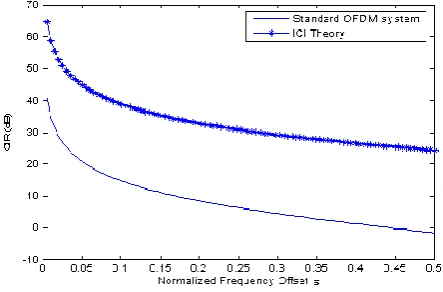
Figure 4 shows the comparison of CIRtot(in dB) and CIR of
standard OFDM as a function of normalized frequency Є,
where N=128.CIR improvement can be found about 30dB.
Fig 4:- Comparison of CIR v/s Є of standard and proposed
model
Performance of proposed sheme can be analyzed by BER.BER
decreases as signal to noise ratio increases . Part of simulation
0 10 20 30 40 50 60
-70 -60 -50 -40 -30 -20 -10 0
Subcarrier index k
dB
Comparrison of standard and proposed model for = 0.2 and N = 64 standard proposed model
0 5 10 15
0 0.02 0.04 0.06
Subcarrier index k
|S
(l
-k
)|
0 5 10 15
0 0.02 0.04
Subcarrier index k
R
e
a
l(
S
(l
-k
))
0 5 10 15
-0.02 0 0.02 0.04
Subcarrier index k
Im
a
g
(S
(l
-k
Transmitted, ep =[0.1 0.2 0.3] carrier frequency offset,
[image:4.595.66.270.119.315.2]Eb/N0=1:2:20 SNR (signal to Noise Ratio)
Fig 5 :- BER V/S Eb/No at ep=0.1,0.2 &0.3
In figure 5 ,it is observed that for frequency offset 0.1,at
SNR=6db ,BER is less than 10-2 .For ep=0.2,BER is slightly
less than 10-3 and for ep=0.3 ,BER is greater then 10-4.So the
proposed scheme shows very good performance Performance
can also be judged when signal is affected by both AWGN and
rician fading as below
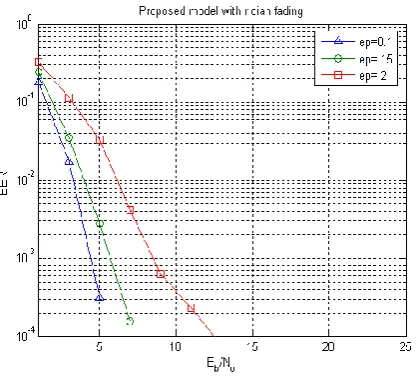
Fig 6:- BER V/S Eb/No at ep=0.1,0.15 &0.2
In figure 6 ,it is observed that for frequency offset 0.1,at
SNR=5db ,BER is less than 10-3 .For ep=0.15,BER is greater
than 10-3 and for ep=0.2 ,BER is greater then 10-2.So the
proposed scheme shows very good performance even in recian
fading channel.
AN IMPROVED PROPOSED MODEL
The system performance of proposed model can also be
improved by adding an extra block of convolution encoder and
interleaving for forward error correction at transmitter side. At
receiver, inverse of it that is convolution decoder and
de-interleave is applied. Thus single or burst errors can be detected
and corrected which results in more reduced BER. This can be
clearer by the comparison of proposed model with convolution
and without convolution. Design parameters are: FFT /IFFT for
128 points, QAM Modulation,½ rate Convolution coding, N/4
Length of Guard Period, AWGN Channel ,Ns= 50 Number
of OFDM symbols Transmitted e p =[0.2] carrier frequency
[image:4.595.321.523.279.443.2]offset, Eb/N0=1:2:20 SNR (signal to Noise Ratio)
Fig 7:-Comparison B/w Proposed scheme with or without convolution
Comparison shows that convolution improves the system
performance .For example, for frequency offset of 0.2,at
SNR=10db,BER of improved model is greater then 10-4 and of
proposed model is 10-3
3. COMPARISON WITH PREVIOUS
MODELS
The simulations have been conducted for performance
comparison of various bandwidth efficient techniques used for
ICI cancellation in OFDM system. We have performed
simulations using MATLAB for BPSK/OFDM with 128
subcarriers. The normalized frequency offset is set to be Є=0.3
respectively. The performance of various schemes of ICI
cancellation is compared on basis of bit error rate (BER). We
have assumed ideal reception of OFDM symbols for all
schemes. BER of standard OFDM, DFT-OFDM, TPA
algorithm and proposed (Radix2) algorithm is plotted in figure
8. . In figure 8, it can be observed DFT-OFDM and Radix2
algorithm has significant improvement in performance than
5 10 15 20 25
10-4 10-3 10-2 10-1 100
EbNo
BER
ep=0.2
[image:4.595.61.270.447.636.2]other schemes at =0.3. The SNR gain of 10dB, 5dB, 13dB is
achieved at 10-2 for DFT-OFDM, TPA algorithm and Radix2
algorithm over standard OFDM performance. The proposed
scheme outperforms than other band efficient algorithms at all
frequency offsets. The spectral efficiency of proposed scheme
is maintained without much increase in system complexity.
Fig8:- BER performance with Bandwidth ICI cancellation Schemes at Є =0.3
4. CONCLUSION
This paper basically studied the effect of ICI on OFDM system. The Proposed scheme provides significant improvement of CIR which has been studied theoretically and by simulation. The scheme works well in rician fading also. In addition, at high frequency offset it has been verified that proposed scheme is better then previous bandwidth efficient schemes like: DFT-OFDM, TPA scheme without sacrificing system bandwidth efficiency.
5. REFERENCES
[1] Pollet T, Van Bladel M, Moeneciaey M., “BER sensitivity of OFDM system to carrier frequency offset and Wiener phase noise”, IEEE Trans Commun, Vol 43,pp 191-193, 1993.
[2] J. Ahn and H. S. Lee, “Frequency domain equalization of OFDM signal over frequency nonselective Rayleigh fading channels,” Electron. Lett., vol.29, No.16, pp.1476– 1477, Aug. 1993.
[3] C. Muschallik, “Improving an OFDM reception using an adaptive Nyquist windowing,” IEEE Trans. Consumer Electron., vol.42, pp. 259- 269, Aug. 1996.
[4] Y. Zhao, J.-D. Leclercq, and S.-G. Häggman, “Intercarrier interference compression in OFDM communication systems by using correlative coding,” IEEE Commun. Lett., vol. 2, pp. 214–216, Aug. 1998.
[5] Y. Zhao and S-G. Haggman, “Intercarrier Interference Self-cancellation Scheme for OFDM mobile communication systems,” IEEE Trans. Commun., vol.49, No.7, pp.1185-1191, July 2001.
[6] K. Sathananthan and C. Tellambura, “Probability of error calculation of OFDM systems with frequency offset,” IEEE Trans. Commun., vol. 49, no. 11, pp. 1884–1888, Nov. 2001.
[7] K. Sathananthan, C. R. N. Athaudage, and B. Qiu, “A novel ICI cancellation scheme to reduce both frequency offset and IQ imbalance effects in OFDM,” in Proc. IEEE 9th International Symposium on Computers and Communications, pp. 708–713, July 2004.
[8] Bing Han, Xiqi Gao et al., “A DFT-based ICI Self-cancellation Scheme for OFDM Systems,” Commun. Technology Proc., ICCT, vol. 2, pp. 1359-1362, April 2003.
[9] Heung-GyoonRyu, Member, IEEE, Yingshan Li, and Jin-Soo Park, Member, IEEE “An Improved ICI Reduction Method in OFDM Communication System” IEEE TRANSACTIONS ON BROADCASTING, VOL. 51, NO. 3, SEPTEMBER 2005
[10]Arvind Kumar, and Rajoo Pandey,” A bandwidth-efficient method for cancellation of ICI in OFDM systems,” Int. J. Electron.Communication. , volume 63, pp 569–575, 2009
[11]Akhil Kamboj, Abhinav Keshari, Vivek K. Dwivedi1, and G. Singh, “Bandwidth Efficient Intercarrier Interference Cancellation Technique for OFDM Digital Communication Systems”, PIERS Proceedings, Vol 5, pp 1244-1248, August 2009.
[12]Qiang Shi, Yong Fang and Min Wang, “A Novel ICI Self Cancellation Scheme for OFDM Systems”, 5th
International Conference on Wireless Communications
Networking and Mobile Computing, pp. 1-4. October 2009.
[13]Fan JunLe, Hu YongJiang, Chen ZiLi “A New ICI Self Cancellation Method with Double Bandwidth Efficiency in OFDM Systems” 2010 International Conference on Communications and Mobile Computing.
5 10 15 20 25
10-4 10-3 10-2 10-1 100
EbNo
BER
ep=0.3