http://dx.doi.org/10.4236/ce.2015.68074
The Design and Application of Primary and
Secondary Teacher Training Oriented
Micro-Course
Yi Wei, Yimeng Yang, Xueqing Zeng, Liang Yu
Department of Computer and Information Science, Southwest University, Chongqing, China Email: [email protected]
Received 7 April 2015; accepted 16 May 2015; published 19 May 2015
Copyright © 2015 by authors and Scientific Research Publishing Inc.
This work is licensed under the Creative Commons Attribution International License (CC BY). http://creativecommons.org/licenses/by/4.0/
Abstract
With the “Micro-era” coming, micro-course becomes a new popular course form because it is short, small, refined, and efficient with various teaching methods and wide fields. Using micro-course in teacher training can adapt to teachers’ learning features and meet their development demands. The quality of micro-course design decides the effectiveness of training. This paper presents the learning features and requirements of primary and secondary teachers as well as the superiorities of micro-course application, builds primary and secondary teacher training oriented micro-course design mode, and uses a series of micro-courses “Tutoring Teaching in the Multimedia Environ-ment” of “National Training Program (2014)”—rural primary and secondary teacher distance training program in Guizhou province as an example to verify the mode.
Keywords
Teacher Training, Micro-Course, Micro-Course Design
1. Introduction
feasibility and effectiveness of the mode, and hope that the micro-course can be applied to teacher training bet-ter.
2. The Characteristics and Demands of Primary and Secondary Teacher Training
2.1. The Characteristics of Primary and Secondary Teacher Training
Teacher training is carried out in full swing every year. With the development of information technology and the popularity of mobile terminals, teacher training is advancing with the times, changing greatly and reflecting new features of this era.
2.1.1. Lifelong Learning
Since the mid-1960s, under the strong advocacy, promotion and popularity of UNESCO and other relevant in-ternational organizations, “The First World Conference on Lifelong Learning” was held in Rome in 1994, and then lifelong learning became a consensus in the world. Knowledge updates extremely fast for the rapid devel-opment of science and technology today. As basic education practitioners, primary and secondary teachers shoulder heavy responsibilities of teaching children and teenagers, so it’s more necessary for them to hold the belief of lifelong learning. In order to maintain their own progressiveness and impart the most forefront know-ledge of this era, teachers need to keep learning.
2.1.2. Fragmented Learning
Fragmented learning which can be carried out anytime and anywhere has always been here, especially in adult learning (Shan & Wang, 2013). Schoolteachers are busy with daily work and there are many things to disperse their energy. They spend little time participating in training whose time and location is comparatively fixed. They need to make use of fragmentary time to learn related knowledge (Yan, Liu, & Liang, 2014). Long time module training is becoming increasingly unrealistic, and it’s difficult to achieve the expected results. Many findings show that the “Attention Mode” of Internet age is just 10 minutes, that is to say learners’ attention can be fully focused only within 10 minutes. Therefore, fragmented learning will become a new mode for teacher training. Teachers take advantage of fragmentary time to learn to enhance the professional technology.
2.1.3. Self-Learning
Malcolm Knowles, the famous American adult educator, puts forward five characteristics of adult learning, and he emphasized learner independence, existing life experience, serving the demands and problems as the center, learning motivation more coming from inside (Fang, 2012). As adults, teachers have a more clear perspective of the content and importance of learning through work practice. Teachers’ self-discipline is strong. They can resist various interference in the network and the external environment consciously, control their own behavior ration-ally, and carry out study initiatively.
2.2. The Demands of Primary and Secondary Teacher Training
With humans entering the Internet age, the learning style of teachers in primary and secondary schools trans-formed gradually, and the traditional teacher training can no longer adapt to teachers’ study habits today due to its own limitations. The rapid development of information technology, the diversification of teachers’ learning style, as well as the accelerating pace of modern society all raised new requirement to teacher training.
2.2.1. Free Time and Space
2.2.2. Individual Curriculum
Adults attach great importance to the practicability of knowledge, and their motivation of learning is more di-versified. Their study is timely and useful oriented, and to solve the problem is the core. Adult learning is main-ly to meet the needs of the society and life. They know well about their training requirements and goals, and those clear objectives make adult learning definitely targeted (Zhou, 2013). If we adopt a uniform training con-tent and steps, it is unavoidable that the enthusiasm of some teachers will be weakened and teachers’ spare time will be wasted because the discipline backgrounds, teaching experience, education level, and learning prefe-rences of each teacher are different. We should pay more attention to the content and process personalization of teacher training courses, meet teachers’ various learning needs, make them choose what to learn and arrange the pace freely according to their own requirements so that they can make the best of spare time effectively to con-duct self-learning.
2.2.3. Effective Support
In order to encourage the majority of teachers to learn actively and strive to forge ahead, the government as well as relevant departments ought to issue the corresponding policy and invest money in a planned way. Besides, primary and secondary schools should establish partnerships with universities so that universities will open the extensive library resources and literature database to schoolteachers and provide sufficient teacher force to sup-port the teacher training. Each teacher has the right and obligation to improve capabilities constantly. Notifica-tions of related training programs on teacher professional development should be published online openly and transparently to ensure that every teacher have a fair opportunity to learn.
3. The Advantages of Micro-Course in Primary and Secondary School Teacher
Training
Micro-course, also named as micro-lecture, is a new kind of online web video course which is scene-oriented and able to support multiple learning styles. It is designed and developed for a certain subject knowledge point (such as emphasis, difficulties, doubts and exam points, etc.) or teaching link (such as learning activities, themes, experiments, assignments, etc.) and focuses on micro teaching video for the main carrier (Hu, Huang, & Li, 2013).
Micro video serves as the core of micro-course, which is short, generally 5 to 8 minutes, but no more than 10 minutes. There are teaching courseware, class exercises, feedback evaluation and interactive Q & A, and many other supporting resources. The capacity of micro-course is small. The video format is usually streaming media (such as rm, wmv, flv, etc.) (Hu, 2013) which supports network online play. In general, the total capacity of mi-cro video and the complete set of auxiliary resources is about tens of megabytes. Mimi-cro-course has the focused emphasis and clear theme to explain one knowledge point or record a teaching link. Meanwhile, micro-course is also semi-structured, dynamically generated and easy to expand. Applying micro-course to teacher training has the following advantages:
3.1. Breaking through the Restrictions of Time, Space and Personnel
Compared with the traditional teacher training, micro-course which is an online training mode can meet teachers’ needs of arranging learning time and place flexibly. Teachers can browse the online courses and gain new knowledge within 10 minutes in their spare time. Traditional training can only accommodate a small number of teachers due to the limited classroom space. However, online training can absorb in more trainees so that teach-ers have more opportunities to undergo further training. Integrating micro learning into teachteach-ers’ daily life makes study more humanizing, which is conducive to arouse teachers’ learning enthusiasm, avoid burnout emo-tion and enhance the sense of professional happiness.
3.2. Accurate and Reusable Knowledge
resources together. Both teachers who are at the school and prospective teachers who will be recruited for a cer-tain period to come can use these resources. It realizes the reuse of resources and reduces the cost of primary and secondary teacher training.
3.3. Abundant Resources and Diverse Methods
Although micro-course is “micro”, it has multiple resource types and self-sufficiency. Micro-course is based on micro video, and provides courseware, relevant materials or links for expanding learning, platform for discus-sion, practice and other resources to teachers, which offers strong support for their self-learning. The teaching methods of micro-course are flexible and varied. For different teaching content, it can be made by different software and tools, and presented through appropriate forms, such as pictures, PPT, Flash, movie clips synthesis, operating demonstrations and so on, which transforms the abstracts into visualizations to help teachers under-stand the training content. They can choose apposite resources and develop a learning pace according to the ac-tual situation and their own needs, which avoids lots of problems, such as learning repetition, learning difficul-ties, shallow content, and achieves the personalized development.
3.4. Extensive Communication and Timely Feedback
Adopting micro-course in primary and secondary teacher training is able to provide online communication and discussion support for teachers. On the network platform, teachers can raise questions, express their own opi-nions, discuss with other teachers, share the learning outcomes with each other, and draw on teaching methods and experience from others. Teaching experts can grasp the effect of the training by analyzing the feedback from teachers. They can carry out the corresponding online Q & A activities according to teachers’ questions and help teachers solve learning problems timely. The interaction among teachers as well as that between teachers and experts is displayed on the platform openly, which is helpful to exert the advantages of collaborative learning, promote the exchange of different ideas, and come up different ideas.
4. Micro-Course Design Mode
Micro-course is not only a job about resource development, but also a complex systematic task including the de-sign, planning, construction, application and research of online course(Hu, Huang, & Li, 2013). The instruc-tional design of tradiinstruc-tional teacher training is an approach based on long-time module, but it’s no longer appli-cable to the design of the micro-course. Teachers’ learning psychology and habits have distinctive group cha-racteristics. The micro-course design of teacher training must meet teachers’ training needs, take full advantage of the micro-course, satisfy teachers’ individual development, and help them upgrade their professional skills. Thus, micro-course design is a very important job which is related to the effectiveness of teacher training.
Early studies on micro-course tends to locate it in the “micro resources composition” and focused on resource construction, especially the micro video development, but the degree of concern for the design of learning activ-ities is relatively low. Actually, learning activactiv-ities plays a crucial role to ensure the final quality of learning
(Huang, Wang, & Li, 2009). Micro-course design should give more consideration to the design of learning process rather than that of content, and support learners’ deep cognition of learning content by designing effec-tive learning activities (Yu, & Chen, 2014). Thus, the micro-course design for primary and secondary teacher training should be based on the teachers’ learning characteristics and demands. It should guide teachers to con-duct self-learning and collaborative learning as well as participate in the evaluation and feedback via problem orientation, activity design, and circumstances creation.
Prophase Analysis
Resources and Activities Design
Micro-course Development
Training Implementation
Effect Evaluation Reflection and
Modification
Learner Analysis Demand Analysis Target Analysis Content Analysis Scenario Analysis
Micro Teaching Plan Design Micro Case Collection Micro Exercise Design Micro Courseware Making Micro Activities Organization
Supporting Resources Making Micro Teaching Activities Implementation
Micro Video Recording
Self-learning Collaborative Learning Process Support and Management
[image:5.595.89.538.80.245.2]Micro Feedback Micro Comment
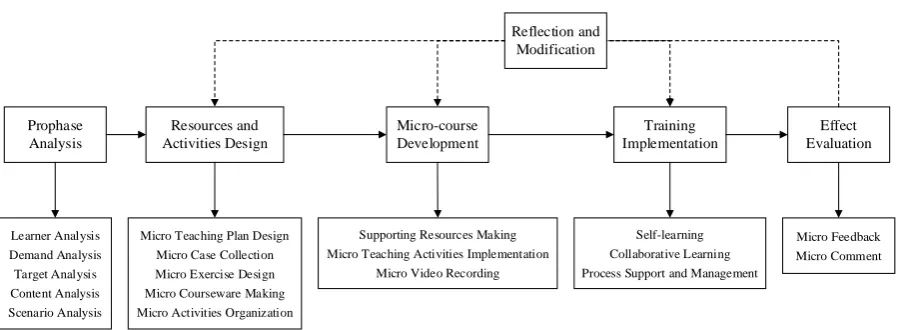
Figure 1. Primary and secondary teacher training oriented micro-course design mode.
4.1. Prophase Analysis
Although micro-course makes learning at anytime and anywhere a reality, this flexible approach to learning puts forward higher requirements for teaching. So we must make a detailed analysis of the entire application process when we design micro-courses. (1) Learner Analysis. At present, learners have become the subject of class. As a group, teachers have their unique learning preferences, and we should master teachers’ learning features com-prehensively by learner analysis. (2) Demand Analysis. Teachers are adults whose learning is demand-centered. We should grasp teachers’ learning requirements in order to ensure the micro-courses that we design can stimu-late their learning motivation and meet the learning needs. (3) Target Analysis. The purpose is to determine the goal that teachers should achieve after learning. (4) Course Content Analysis. The designers should determine the course content according to the learning target. What’s more, they should pay attention to reasonable divid-ing of the content granularity and knowledge point. (5) Scenario Analysis. It includes learndivid-ing environment and performance circumstance. The designers should consider what tools to use, what kind of interference to resist and what problems may appear in the teachers’ learning and knowledge application process to ensure the high efficiency of learning and the practicability of knowledge.
4.2. Resources and Activities Design
main points, clarify the ideas, and emphasize the important and difficult points.
4.3. Micro-Course Development
Micro-course development consists of recording micro-video as well as making related supported and extended ancillary resources. Micro-course development is the process that designers transform the “micro teaching plan” into the “micro script” which has clear objectives and structure and is easy to operate, then make training mate-rials, carry out micro teaching activities, shoot and edit the micro video depending on the micro-course design. There are a variety of methods to make micro video. For instance, “Khan Style”, namely the electronic black-board system combines with screen recording software. “Software Style”, that is to say using some common micro-course production software, such as Photoshop, Flash, PowerPoint, The Geometer’s Sketchpad, Corel Video Studio, Show Me, Edu-Creations, etc. “Recorded Course Style” is using digital video equipment to record real teaching situations, editing the video with corresponding software, and implementing micro treatment on the courseware and exercise. “Blended Style” means making the micro-video via the integrated use of various methods such as augmented reality technology. Micro-video is the key resource of micro-course, so we should attach importance to choosing appropriate media and strategies. There should be attractive introduction, clear hierarchy, suitable questions, and a brief summery. In addition, we must advert the importance of teaching process integrity and never skip any step. The logical relations between steps should be explicit. Colored lines, symbols, graphs and other prompts can be used to mark the emphasis and difficulties. Subtitle and mind map-ping can supplement the content which is not easy to explain clearly. If the chart is complex, the partial content should be amplified to enable teachers to see the details clearly. The picture should be concise and beautiful. The color of text and background should match reasonably. Slides switching cannot be too quickly or too often. The icon, background, and portrait which has nothing to do with the teaching content should be deleted. The en-vironment of video recording must be quiet (Li, 2013).
4.4. Training Implementation
Micro-learning resource package will be uploaded onto the micro-course platform, and it will be applied after audited and published. Teachers login with their account and then they can begin to learn. Teachers are able to arrange the learning pace independently during the training. They can watch the micro video first, then read re-levant cases and expand materials, next take part in the course activities on the platform where they can ex-change learning experiences with others and discuss difficulties with experts to solve those problems in time via collaborative learning. At the same time, micro-course learning system generates study record for teachers and administrators release notifications at regular time to remind teachers to take notice of learning progress and participating in related activities.
4.5. Effect Evaluation
The micro-course needs teachers who join in the training to evaluate the content, design, process and support by micro feedback and micro comment in light of their own situations and experiences to look into whether the training achieves the expected goals, whether the teachers’ study demands are met after learning, whether the teachers adapt to micro-course training mode, and gather their advice and suggestions on the application of micro- course in teacher training.
4.6. Reflection and Modification
According to the questions raised in training, the completion status of exercise, the evaluation of training, as well as the comments from other experts, micro-course designers should reflect every aspect of the micro-course comprehensively, including the resource design, activities organization, process supporting and so on. After-wards, designers adjust the inadequacies of micro-course dynamically to optimize the training constantly.
5. The Example Analysis
example.
With the “Teacher-led, Student-centered” classroom role concept put forward and the development of infor-mation technology in education, primary and secondary school classroom enters the multimedia teaching era. It requires primary and secondary teachers to transform their teaching methods adaptively. The Micro-course “Tutoring Teaching in the Multimedia Environment” is added in this national training program, which contri-butes to guiding the first-line teachers to cope with the change of times correctly and easily, learn about the si-milarities and differences of tutoring teaching under the multimedia environment and traditional teaching, grasp the components and methods of multimedia tutoring teaching design, use multimedia reasonably, as well as pro-vide students with proper guidance and improve teaching quality. In the smooth network environment, teachers login with account and appropriate equipment to enter the learning community and then take the course to learn.
“Tutoring Teaching in the Multimedia Environment” is divided into 16 micro-courses: “Comparing the Two Teaching Plans”, “Tutoring Teaching in the Multimedia Environment”, “Tutoring Teaching Design”, “Teaching Content Analysis”, “Learner Characteristic Analysis”, “Learning Style Analysis”, “Teaching Targets”, “Teach-ing Key and Difficult Points”, “Teach“Teach-ing Method”, “The Choice of Teach“Teach-ing Method”, “Multimedia and Teaching”, “The Basis and Method of Choosing Teaching Media”, “Interactive Electronic Whiteboard and Touch TV Application in Teaching”, “The Flow Chart of Teaching”, “Teaching Reflection”, “Education Evalu-ation”.
The relevant materials involved in the micro video, including “Cases”, “Homework”, “Learning Content Structure”, “Learning tips”, “Teaching Activities”, “Core Concepts”, “Expand Information”, “PPT”, “Reading Materials” and “Teacher Profile” are placed in the “Auxiliary Resources” section, which is to control the capac-ity of micro video and make it convenient for teachers to learn. After logining, teachers enter the learning plat-form, then they can firstly know about the main content of the topic “Tutoring Teaching in the Multimedia En-vironment” and construct the knowledge framework through the “Guidance Directory” combining with the “Theme Introduction”, “Learning Content Structure”, “Learning Tips” and “Core Concepts” under the video window. They can view the “Teacher Profile” to know the instructor. Then, teachers watch the micro video to learn related content. They can take notes while watching according to their own learning habits. If the know-ledge is difficult to understand, they can locate freely and view it again. Teachers can read the teaching plan samples and teaching cases which are claimed in micro video directly or download them to the local computer to read at the “Cases” and “Expand Information” under the video window. PPT used by experts when teaching can also be downloaded to facilitate teachers’ self-learning. At the end of micro video, there are questions and exer-cises about the topic. After watching the video, teachers can download the “Teaching Activities” and “Home-work” at the resource plate, including checking related theory before class, reading extend cases, discussing the subject, reflecting teaching design and so on to consolidate the knowledge through the practice. In addition, teachers can also download extend resources in the “Resource Sharing” plate, including “Discipline Resource” and “Platform Resource”.
To solve the problems that teachers may encounter in the learning process and promote collaborative learning, teachers have their own study groups in the learning platform. They can share learning experience with others in the Course BBS including “Learning Exchange” and “Homework Discussion” to strengthen the interaction among teachers or between teachers and experts. In the learning process, when teachers have their own opinions or questions of the theme, they can post at the “Learning Exchange” in Course BBS to share ideas with others who are in the same period to brainstorm. The problems about homework can be posted at the “Homework Dis-cussion” in Course BBS. Other teachers show their views or answer the questions by replying. Except the inte-raction among teachers, experts organize “Online Q & A” activities of corresponding topics from time to time, which maintain 2 hours every time to assist teacher collaborative learning. Teaching administrators will publish the starting time of the “Online Q & A” at the “Notification and Status” plate in advance. Teachers should check the notice in time, and ask questions on the BBS during the specified period. Experts on duty will give the im-mediate answers. In addition, teachers need to submit their works in the “Teaching Design Reflection” plate with learned knowledge application in reality.
teachers are able to see the learning content clearly and decrease the interference of other superfluous informa-tion. In the micro-course, there is soothing background music when reading teaching plans or cases, and the content switching is at a medium speed. Teachers whose reading speed is slower can pause it, then continue af-ter finishing a paragraph, or download the reading maaf-terials under the video window to read. At the end of the video, there are some questions about the subject. Teachers can download related activities and exercise docu-ments at the “Homework” and “Teaching activities” as well as PPT at the “Teaching PPT” to review and sum-marize. The teaching expert appears to prompt the end of the micro-course. All resources after completed and checked will be uploaded to the training platform, then teachers can log in and study.
In the learning process, the system will record teachers’ learning progress. Teaching administrators will regu-larly publish notifications to warn teachers to pay attention to the learning progress, earned credits and getting online to participate in teaching activities and remind experts to announce practice and Q & A activities of the topic. Meanwhile, they will manage the whole learning process.
Teachers who participate in the training should evaluate after learning. The main ways include posting on the “Course BBS” and submitting “Training Logs”. At the same time, the tutors also reflect and summarize the training through the “Coaching Experience”. Teaching experts make further comprehensive reflection on the de-sign of the micro-course, tune and optimize it according to teachers’ feedback.
6. Conclusion
As a brand new teaching form, micro-course whose design, development and application are unlike that of tradi-tional course has a certain degree of innovation. Combining micro-course with primary and secondary teacher training is a bold attempt of micro-course application. Therefore, we made a relatively deep exploration of the micro-course design for teacher training. We construct the primary and secondary teacher training oriented mi-cro-course design mode, and take a series of mimi-cro-courses “Tutoring Teaching in the Multimedia Environment” in “National Training Program (2014)”—rural primary and secondary teachers distance training program in Guizhou province as an example to verified the feasibility.
Acknowledgements
This work was supported by The National College Students Innovation Training Project (No. 201410635031).
References
Fang, M. J. (2012). Study on Principle and Model to Cultivate Teachers’ Informationalized Teaching Ability Based on Adult Learning Theory. Modern Educational Technology, 10, 33-36.
Hu, T. S. (2011). “Micro-course”: The New Trend of the Area Education Information Resources Development. E-education Research, 10, 61-65.
Hu, T. S., Huang, M. Y., & Li, M. (2013). The Three Stages of Micro-Course Development and Its Enlightenment. Distance Education Journal, 4, 36-41.
Huang, R. H., Wang, X. C., & Li, Y. S. (2009) Towards a Theory of Mobile Learning Activity Design. Distance Education Journal, 1, 3-7.
Li, J. H. (2013). The Implication and Development of Micro-Course. Primary and Secondary Information Technology Edu-cation, 4, 10-12.
Shan, C. K., & Wang, L. (2013). The Development and Application of Micro-Course. Distance Education in China, 12, 74-77.
Wang, K., & Hao, J. (2013). Urgent Issues in Primary and Secondary In-Service Teacher Training. Adult Education, 10, 105- 106.
Yan, P. Z., Liu, Z. P., Liang, Y. C., & Pi, J. Y. (2014). Online Teacher Training Micro Learning Resources Design Research. China Educational Technology, 2, 84-87.
Yu, S. C., & Chen, M. (2014). Design of Micro-Course Based on Learning Cell System. Open Education Research, 1, 100- 110.