
http://dx.doi.org/10.4236/ojce.2014.43021
How to cite this paper: Haghighatpour, P.J. and Moayedfar, R. (2014) Pedestrian Crash Prediction Models and Validation of Effective Factors on Their Safety (Case Study: Tehran Signalized Intersections). Open Journal of Civil Engineering, 4, 240-254. http://dx.doi.org/10.4236/ojce.2014.43021
Pedestrian Crash Prediction Models and
Validation of Effective Factors on Their
Safety (Case Study: Tehran Signalized
Intersections)
Pegah Jafari Haghighatpour
1*, Reza Moayedfar
21Master of Science, Department of Engineering, Islamic Azad University South Tehran Branch, Tehran, Iran 2Department of Engineering, Arak University, Iran
Email: *[email protected], [email protected]
Received 7 July 2014; revised 27 July 2014; accepted 29 August 2014
Copyright © 2014 by authors and Scientific Research Publishing Inc.
This work is licensed under the Creative Commons Attribution International License (CC BY). http://creativecommons.org/licenses/by/4.0/
Abstract
The quantity and severity of traffic accidents have increased with the development of machinery life and traffic growth in cities and roads in the past 50 years. Among the road users, pedestrians are the most vulnerable groups to be exposed to high risks. Vehicle crashes with pedestrian are almost inevitable and cause injury or death to pedestrian. Crash investigation and statistical stu-dies indicate that percentage of pedestrian deaths caused by vehicle accidents are much more than all deaths. A considerable amount of accidents occur at signalized and urban intersections which are the intensive crash places. Therefore in this paper appropriate models that could speci-fy safety indicators have been indicated with existing information by characterized parametric and nonparametric variables for twenty signalized intersections. Categories and correlations of variables also have been investigated. Three models including Regression, Poisson, and Negative binomial with defined variables have been determined. T and chi square tests, calibration and comparison of variables have been done by curve fitting. The role of each parameter was specified in pedestrian crashes. Validating models had the following outcomes: Pedestrian crash prediction models were based on none linear relations at intersections. Predictable variables, developing extended linear models and also pedestrian crash prediction are on the basis of Negative binomial distribution which is used due to more data dispersion. As observed, the Negative binomial re-gression because of its more R2 correlation factor has more validity among other regression mod-els such as linear regression and Poisson. Calibrated modmod-els are put into sensitivity analysis to study the effect of each previously mentioned parameter in overall performance. Hence much better perception of future transportation plans can be achieved by development of safety models at planning levels.
Keywords
Crash Prediction Models, Pedestrian, Sensitivity Analysis, Signalized Intersection, Validation
1. Introduction
Depending on accidents, they may have different causes. Eliminating the risk of each cause requires separate solutions. Intersections safety has always been the main purpose of planning and transportation due to special importance and role of intersections in street network. Important priority of decision is to reduce the number of pedestrian accidents at intersections. Pedestrian crashes and activities depend on demographic, land use, road network, geometric and transit characteristics. An increase in demographic and socio-economic characteristics such as population, household units, and total employment within walking distance of an intersection may crease pedestrian volume and the number of pedestrian crashes at intersection. While an increase in mean in-come level within the same area may result in a decrease (or sometimes increase) in pedestrian volume and the number of pedestrian crashes at the intersection. Pedestrian volume and pedestrian crashes could also depend on land use characteristics within the walking distance of an intersection. People living in apartments may walk more than those living in residential neighborhoods, or vice versa. Likewise, an increase in street width (or the number of lanes); speed limit, traffic volume, and the number of transit stops within the vicinity of an intersec-tion may increase pedestrian exposure to risk and crashes at the intersecintersec-tion. Therefore, data pertaining to these characteristics are required for developing and assessing pedestrian crash estimation models [1].
bus stop or the presence of an alcohol sales establishment is included in a model. The role of demographic cha-racteristics, socio-economic chacha-racteristics, land use chacha-racteristics, road network characteristics and the pres-ence of transit stops on pedestrian crashes was not examined and used in pedestrian crash estimation models for signalized intersections [10]. Those that examined did not consider site specific data or the effect of spatial proximity (or buffer width) to extract demographic characteristics, socio-economic characteristics, and land use characteristics in estimating pedestrian crashes. So considering these variables and examining the effects would help to make better transportation planning and land use decisions. Field of study has been considered as Tehran in this article. Tehran is one of the major and Sixteenth cumulated cities with a density of about eleven thousand square kilometers in the world. Large population and the high volume of vehicle traffic have increased the number of traffic accidents in Tehran. Period studied according to the existing information in police statistics collection system and traffic Studies has been considered from 2012 to 2013 in this paper. During these years according to traffic police statistics, about 17.3 percent of the total 648,615 traffic accident has occurred at the intersection of Tehran. Assuming that the occurred accident at Tehran Intersection is independent and the num-ber of accidents is discrete, non-negative and integer variable and also considering that the information in the traffic police crashes database and traffic studies Company are correct and free of errors, 20 intersections have been investigated by using linear regression, Poisson and negative binomial methods for the period of two years.16 intersections data is used in Statistical models. These intersections include Beheshti-Sohrevardi, Jannat Abad-Iran’s Pars (niayesh), Keshavarz-Jamalzadeh, modiriat (darya)-Saadat Abad, Shaghayegh-Ferdos, Taleg-hani-Bahar, Aboozar-Aemmeye Athar, Africa-Haghani (Jahan koodak), Beheshti-Ghaem Magham, Beheshti- Mirza Shirazi, Emam Khomeini-Khosh, Farahzad-Darya, Farjam-Nirooye Daryaee, Felestin-Keshavarz, Karim Khan-Hafez, Motahari-Ghaem Magham. However, the article introduces 3 intersections of 20 intersections used in the statistical models including Beheshti-Sohrevardi, Taleghani-Shariati, Nabard-Aemmeye Athar. The mod-eling of pedestrian crashes have been done at 16 intersections then curve fitting and statistical tests have vali-dated by using data’s from four intersections comprising Taleghani-Shariati, Motahari-Sohrevardi, sardar E Jangal-Golestan, Nabard-Aemmeye Athar. Moreover impact of each factor on the number of crashes has been investigated. It is considerable that SPSS 18 software is used in the data analysis.
2. Type of Pedestrian Crashes
The pedestrian route is cut off when the vehicle is turning approximately. 32.2% of all pedestrian crashes of this type and over 50% of these accidents occur at intersections. Also 22% of crashes occur when the driver visibility before intersection has been limited. 16% of accidents due to driver violation from right of way. 26.5% of all pedestrian crashes are vehicle accident with a pedestrian crossing the street except through the intersection. 32% of accidents are while the driver has enough visibility and pedestrian quickly ran to the street. 72% of pede-strian’s crash is occurred in the vehicle-pedestrian collisions when the vehicles moving in reverse gear [11].
3. Methodology
characteristics that crash prediction are related to them can be used to assess the relevance of pedestrian crashes and pedestrian crash prediction models developed by the spatial proximity and function level. However, because the collection of this information in the database is very difficult in Tehran and there is no organization to pro-vide such information to us. Or if there is, unfortunately these data are not available to students. Therefore, some of the effective parameters information in crash prediction model that have been obtained by comprehensive studies company be investigated in this paper. The methodology involves the following steps:
1) Identify study intersections. 2) Identify data elements.
3) Identify the number of pedestrian crashes as the predicted variable which dependent to other characteris-tics.
4) Extract incoming vehicles volume on the main and secondary routs.
5) Extract the number of transit stops and schools within the vicinity of intersections.
6) Extract the number of lanes at main and auxiliary road, Area traffic plan, Type of signal, one way streets, Intersection’s angle and pedestrian volume.
7) Examine correlation between the predictor variables. 8) Develop pedestrian crash estimation models.
3.1. Identify Study Intersections and Data Elements
Examining Beheshti-Sohrevardi, Taleghani-Shariati, Nabard-Aemmeye Athar intersections from investigated Tehran 20 intersections in statistical models to develop pedestrian crash prediction models have been selected in this paper. Demographic, socio-economic, land use, road network and transit characteristics in the vicinity of these signalized intersections should represent typical characteristics of an urban area. Pedestrian crashes and activity depends on demographic, socio-economic, land use, road network and transit characteristics. An in-crease in demographic and socio-economic characteristics such as population, household units, and total em-ployment within walking distance of an intersection may increase pedestrian volume and the number of pede-strian crashes at the intersection. It is noteworthy that to calculate and consider these parameters some limits should be specified. This requires geographical surveys, census studies and etc but the possibility of such study does not exist in this paper. Only Several factors in crashes such as incoming vehicles volume on the main and secondary routs, the number of transit stops and schools within the vicinity of intersections, the number of lanes at main and auxiliary road, area traffic plan, type of signal, one way streets, intersection’s angle and pedestrian volume can be addressed. The average number of pedestrian crashes as the dependent variable is used to devel-op pedestrian crash estimation models at intersections. Pedestrian crashes data to extract pedestrian crashes have been covered around the intersection for two-year period.
3.2. Extract Incoming Vehicles Volume on the Main and Secondary Routs
Traffic volume is important variables in occurring crashes at intersections. Research also indicates that with in-creasing incoming vehicle volume, the number of accidents increases at intersection. Pickering knows traffic volume is one of the main parameters in his research [12]. It is notable that for every 10,000 vehicles per day, the number of crashes between 15 to 20 percent increase but in high volume the percentage decreases. The number of crashes depend on incoming traffic volume on the main and secondary routs. This parameter is inde-pendent that the number of pedestrian crashes depends on it.
3.3. Extract the Number of Transit Stops and Schools within the Vicinity of Intersections
People generally walk or use bicycle to achieve the public transportation system (bus) from its location in the vicinity of the intersection. To study these affects, the number of public transportation stations identified from intersections and consider in pedestrian crash estimation model. In addition pedestrians that cross intersections to go to school are effective in the number of crashes. This parameter is also independent of the parameters.3.4. Extract the Number of Lanes at Main and Auxiliary Road, Area Traffic Plan,
Type of Signal, One Way Streets, Intersection’s Angle and Pedestrian Volume
inci-dent point for road users. So intersection entrance ramp should give the possibility to driver that do necessary movement with complete visibility, enough safety and minimal collision with others to cross through intersec-tions. Streets along at intersection should somewhat direct and have less slope. Optimum angle of intersection is 90 degree or near it due to intersections safety and economic issues.Intersection with inclined angle requires a greater level and especially reduces visibility for truck drivers. Also vehicles will require a lot of space for turn-ing left or right. Traffic signals are used to control traffic separation and different traffic flow improvement at the intersections. Drivers increase speeds to cross the intersection on the final green times and suddenly stop when traffic signal is red. Also pedestrian volume has been done in main and secondary routes during the 15- minute study.
4. Statistical Properties of the Intersections
4.1. Sohrevardi-Beheshti Intersection
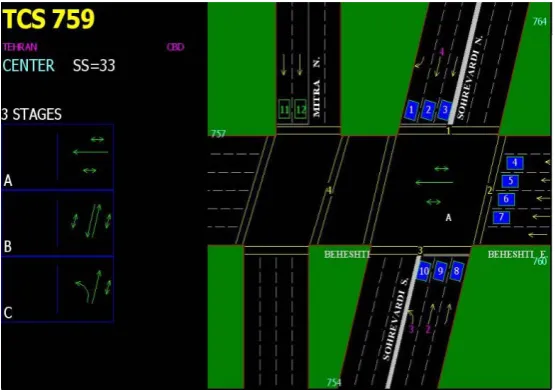
Beheshti Avenue is one-way and has 5 lanes in each direction and Sohrevardi Avenue is bilateral and has 3 lanes in each direction also there is a left turn at Sohrevardi. Figure 1illustrates this intersection. Intersection angle is not 90 degrees and has 3-phase intelligent traffic signal. This intersection has bus stop and special bus way. Schools are around the intersection and there isn’t any area traffic plan. In 2012 the average daily volume of ve-hicles is 24,253,695 in the main rout and 12,861,049 in secondary path and in 2013 the average daily volume of vehicles is 25,369,563 in the main rout and 13,889,933 in the secondary path. In 2012 the volume of pedestrians during the 15-minute study is 342,580 in the main rout and 185,253.00 in the secondary path. The number of pedestrian crashes is 17 persons. In 2013 the volume of pedestrians during the 15-minute study is 369,986 in the main rout and 195,236 in the secondary path. The number of pedestrian crashes is 15 persons.
4.2. Shariati-Taleghani Intersection
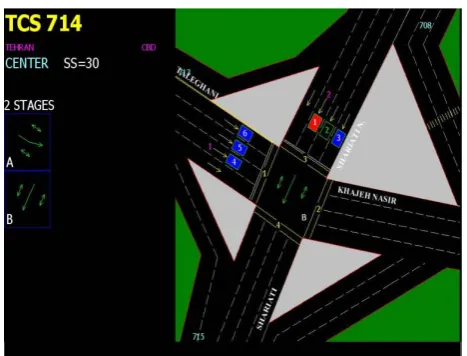
[image:5.595.160.438.507.702.2]Taleghani Avenue is one-way from west to east and has 4 lanes in each direction and Shariati Avenue is one- way from north to south and has 3 lanes in each direction also there is discrete turn on two-sides in this intersec-tion. Figure 2 illustrates this intersection. Intersection’s angle is not 90 degrees and has 2-phase intelligent traf-fic signal. This intersection has bus stop and special bus way. Schools are around the intersection and there is an area traffic plan. In 2012 the average daily volume of vehicles is 2,060,326 in the main rout and 6,160,350 in secondary path and in 2013 the average daily volume of vehicles is 2,282,929 in the main rout and 7,220,330 in the secondary path. In 2012 the volume of pedestrians during the 15-minute study is 226,784 in the main rout and 143,457 in the secondary path. The number of pedestrian crashes is 12 persons. In 2013 the volume of pede-strians during the 15-minute study is 285,365 in the main rout and 162,209 in the secondary path. The number of pedestrian crashes is 11 persons.
Figure 2. Shariati-Taleghani intersection.
4.3. Aemmeye Athar-Nabard Intersection
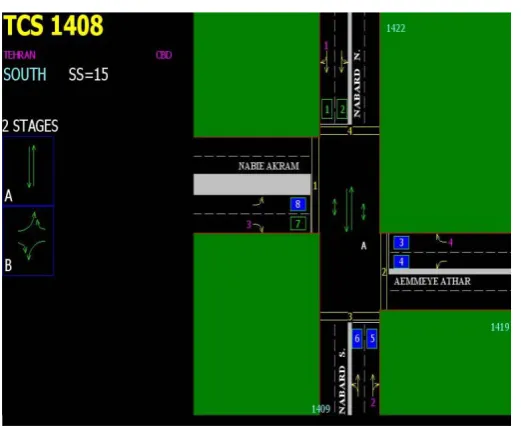
Aemmeye Athar Avenue from west to east has 2 lanes in each direction and Nabard Avenue from north to south has 2 lanes in each direction also there isn’t any discrete turn and area traffic plan.Figure 3 illustrates this in-tersection. Intersection’s angle is 90 degrees and has 2-phase intelligent traffic signal. This intersection has bus stop and special bus way. Schools are around the intersection. In 2012 the average daily volume of vehicles is 14,340,120 in the main rout and 6,298,805 in secondary path and in 2013 the average daily volume of vehicles is 14,108,345 in the main rout and 6,163,025 in the secondary path. In 2012 the volume of pedestrians during the 15-minute study is 248,325 in the main rout and 100,236 in the secondary path. The number of pedestrian crashes is 9 persons. In 2013 the volume of pedestrians during the 15-minute study is 259,664 in the main rout and 112,349 in the secondary path. The number of pedestrian crashes is 12 persons.
5. Development of Pedestrian Crash Prediction Models
Figure 3. Aemmeye Athar-Nabard intersection.
Table 1. Effective variables in crashes.
Encoded Abbreviated Name Variable 3 2 1 0 No code NOA
The average number of crashes per year
No code VP1
Pedestrians volume from Main road to intersection
No code VP2
Pedestrians volume from secondary road to intersection
No code V1
Incoming vehicles volume from main road
No code V2
Incoming vehicles volume from secondary road
No code NL1
Number of lanes on Main road
No code NL2
Number of lanes on auxiliary road
have Not have
TT Area traffic plan
Two-way One-way Not have GM Discrete turn 4-phase 3-phase 2-phase Flashing LS Type of signal
Two-way One-way Not have OW One-way street - Not 90 degrees 90 degrees
AN Angle of intersection
- have Not have S Schools - have Not have BS Bus stop - have Not have BR
Special bus way
6. Pedestrian Crash Prediction Models
The pedestrian crash estimation models have been developed by considering information for intersections .The purpose of statistical model is to identify the relationship between the expected number of crashes at intersec-tions E (Yi) and dependent parameters to intersection Xj, (j = 1, 2, ..., n). So a set of series including q parameter
modeling and are very useful in the crashes analysis [12]. Modeling of quantitative factors is used as numerical. Qualitative factors are used 0, 1 and 2 as coded. NOA Variable (number of crashes per year) has been consi-dered as the dependent variable and the other variables have been consiconsi-dered as independent variables. Inde-pendent variables should not well correlate with each other. Therefore Pearson correlation coefficient was used to calculate data correlation index. Data shows that the number of pedestrian crashes increased by population growth near schools, public transportation stations, and the number of sideway approaches at intersections, pe-destrian volume increases, and the number of discrete turn. However, we can observe fewer pepe-destrian crashes if commercial and residential centers are close to the intersection. Because drivers reduce their speed when faced with such centers.
6.1. Linear Regression
The general form of the model is as follows:
0 1 1 2 2 n n
Y =β +β X +β X +…+β X (1)
where:
Y is dependent variable, Xi’s are independent variables and βi’s are the regression coefficients. The
genera-lized form for predicting crashes at intersections is as follows:
i ij ij
Y =β +
∑
β X (2)where:
Yi: Number of crashes at intersection I; Xj: independent variables;
βj: unknown variable coefficients.
The method of minimum squares and maximum likelihood are used to estimate β. Distribution of βi is not
considered in minimum squares method, but normal distribution with zero mean and constant variance σ2 > σ are considered in the maximum likelihood method. T-test is used to test whether the variables are normally distri-buted and sample mean is equal to population mean. NOA is the number of crashes and dependent variable in this model. The results of the linear regression with studied intersections data have been indicated in Table 2. The results show that the variables are significantly higher than 0.05 and adjusted R2 of the model is 0.538, which indicates a relatively poor fitting of the model and also variables have weak relationship with dependent variable (number of crashes per year).
Linear regression model with Computational coefficient is as follows:
6.559 0.000008774 1 0.000003077 2 0.0000003741 1
0.0000002920 2 1.719 1.630 3.042
NOA VP VP V
V GM AN BS
= + − +
+ − − −
6.2. Poisson Regression
Poisson regression models are discrete models and used when consequence are rare. Considering that crashes statistics are discrete, non-negative, integer variable and the average number of crashes at intersections is low, this method can well modeling crashes at intersection. The general form of the model is as follows:
( )
! ie i Y i i
i
P Y Y
µ
µ −
= (3)
The relationship between the number of crashes at i intersection (i = 1, 2, and 3…, n) and the q parameter (Xil,
Xi2, Xiq) is as follows:
( )
0 1ln µi =β +
∑
qj= Xijβj (4)( )
i ixi E Yi e
β
µ = = (5)
where:
Yi: the independent variable with Poisson distribution and μi mean, Xi: independent variables at intersection i.
Table 2. Results of linear regression model [13].
Variable B Standard Deviation t Sig
Constant 6.559 4.021 1.631 0.116
VP1 8.774E−6 0.000 1.086 0.288
VP2 −3.077E−6 0.000 −0.276 0.785
V1 3.741E−7 0.000 2.794 0.101
V2 2.920E−7 0.000 2.466 0.212
GM −1.719 0.622 −2.766 0.107
AN −1.630 1.450 −1.124 0.272
BS −3.042 1.179 −2.579 0.165
F test 1.828
R 0.793
R Square 0.697
Adjusted R Square 0.538
Sig 0.002
Table 3. Results of Poisson regression model [13].
Parameter B Standard
Deviation
95% Profile Likelihood Confidence Interval Hypothesis Test
Lower Upper Wald Chi-Square df Sig.
(Intercept) 1.316 .4413 .451 2.181 8.898 1 0.003
VP1 7.260E−7 1.0325E−6 −1.298E−6 2.750E−6 0.494 1 0.482
VP2 3.176E−7 1.2879E−6 −2.207E−6 2.842E−6 0.061 1 0.805
V1 2.822E−8 1.9797E−8 −1.058E−8 6.703E−8 2.032 1 0.154
[image:9.595.63.540.318.714.2]V2 1.900E−8 1.5097E−8 −1.059E−8 4.859E−8 1.584 1 0.208
[GM = 0.00] 0 0.1773 −0.011 0.684 3.601 1 0.058
[GM = 1.00] 0.182 0.3160 −0.437 0.802 0.333 1 0.564
[GM = 2.00] 0a . . . . . .
[AN = 0.00] 0.041 0.1946 −0.340 0.423 0.045 1 0.832
[AN = 1.00] 0a . . . . . .
[BS = 0.00] 0.145 0.1375 −0.125 0.414 1.111 1 0.292
[BS = 1.00] 0a . . . . . .
Value df Value/df
Deviance 8.040 23 0.350
Scaled eviance 8.040 23
Pearson Chi-Square 8.090 23 0.352
Scaled Pearson Chi-Square 8.090 23
Log Likelihood −74.649
Akaike’s Information 167.298
Finite Sample Corrected AIC 175.480
Bayesian Information 180.489
Consistent AIC (CAIC) 189.489
Likelihood ratio chi-square 34.387
variables standard deviation is less than 1. So the actual distribution of data is lower than model and model fit-ting would not be appropriate. Poisson regression model with variable computational coefficients are calculated as follows:
(
)
1.316
e 0.0000007260 1 0.0000003176 2 0.00000002822 1
0.00000001900 2 0.182 0.041 0.1452
NOA EXP VP VP V
V GM AN BS
= + +
+ + + +
6.3. Negative Binomial
Negative binomial distribution is discrete distribution and used for high dispersion of crashes data. Also unlike the Poisson distribution, it has two parameters. If Yi is the number of crashes with negative binomial distribution
by α and k parameters at intersection i and predictor variables is Xiq, The number of crashes relationship is
cal-culated as follows:
(
)
(
) (
)
1
1 i 1, 2, 3, , n
1 1 ! i y i k i
i i i
i
y
k k
P Y y k
k y k γ µ µ µ γ + = = + = … + (6) where:
γ : Gamma function.
Mean and variance of crash data’s negative binomial distribution are as follows relationships:
( )
Mean=E Yi =µi
( )
2Variance=Var Yi =µi+kµi
If dispersion parameter (k) is zero, negative binomial distribution will tend to Poisson distribution. And if k is negative (variance is smaller than mean), negative binomial model is not appropriate. Therefore Poisson model should be used.
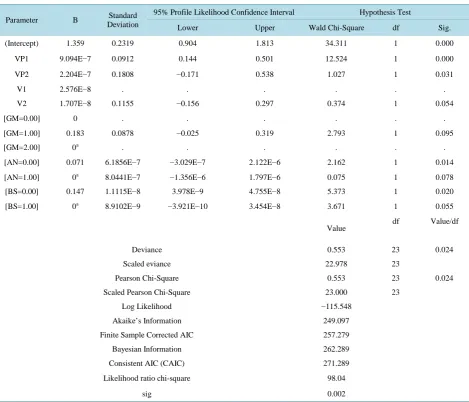
The results of the negative binomial model with studied intersection data are shown in Table 4. The p-value is greater than 0.5 indicates that the model is suitable for variable. Negative binomial regression model with varia-ble computational coefficients are calculated as follows:
(
)
1.359
e EXP 0.0000009094 1 0.00000022046 2 0.000000022576 1
0.00000001707 2 0.183 0.071 0.147
NOA VP VP V
V GM AN BS
= + +
+ + + +
7. Comparison the Output of Linear Regression, Poisson and Negative
Binomial Models
Due to the fact that crashes are accidental, scattered and independent, Poisson model is more appropriate than the linear regression model to investigate crashes. Some researches were used Poisson regression models to es-tablish any relationship between traffic accidents and effective factors in creating them. The limitation of the Poisson model is equality of mean and variance and does not established in crashes. If this assumption is not true, the statistics derived from the model will be incorrect and the standard deviation that usually estimated by maximum likelihood method will be deviated. Some researchers in recent years have concluded that crashes da-ta are significantly too scattered. It means that the variance is much greater than the mean of dada-ta. So this will lead to incorrect estimates of crashes probability. Negative binomial model is more appropriate because the Pearson chi-square value is less than the Poisson model. Indicated summary results show non-linear relationship between predictor variables and pedestrian crashes. Therefore, the best pedestrian crash estimation models is created when classified are based on the level of pedestrian’s activity.
8. Validating Models
Figure 4. Scatter plot between observed and predicted Poisson model at in-tersections.
Table 4. Results of Negative binomial regression model [13].
Parameter B DeviationStandard
95% Profile Likelihood Confidence Interval Hypothesis Test
Lower Upper Wald Chi-Square df Sig.
(Intercept) 1.359 0.2319 0.904 1.813 34.311 1 0.000
VP1 9.094E−7 0.0912 0.144 0.501 12.524 1 0.000
VP2 2.204E−7 0.1808 −0.171 0.538 1.027 1 0.031
V1 2.576E−8 . . . .
[image:11.595.67.537.318.720.2]V2 1.707E−8 0.1155 −0.156 0.297 0.374 1 0.054
[GM=0.00] 0 . . . .
[GM=1.00] 0.183 0.0878 −0.025 0.319 2.793 1 0.095
[GM=2.00] 0a . . . . . .
[AN=0.00] 0.071 6.1856E−7 −3.029E−7 2.122E−6 2.162 1 0.014
[AN=1.00] 0a 8.0441E−7 −1.356E−6 1.797E−6 0.075 1 0.078
[BS=0.00] 0.147 1.1115E−8 3.978E−9 4.755E−8 5.373 1 0.020
[BS=1.00] 0a 8.9102E−9 −3.921E−10 3.454E−8 3.671 1 0.055
Value df Value/df
Deviance 0.553 23 0.024
Scaled eviance 22.978 23
Pearson Chi-Square 0.553 23 0.024
Scaled Pearson Chi-Square 23.000 23
Log Likelihood −115.548
Akaike’s Information 249.097
Finite Sample Corrected AIC 257.279
Bayesian Information 262.289
Consistent AIC (CAIC) 271.289
Likelihood ratio chi-square 98.04
251
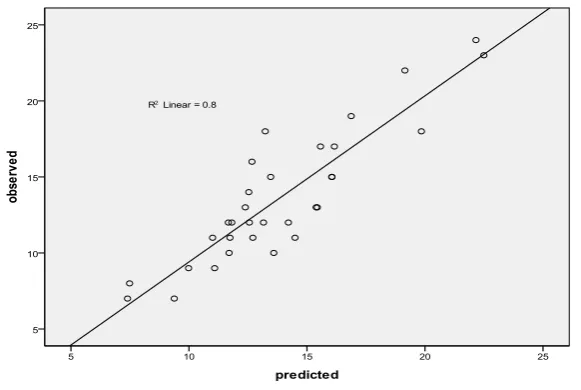
Figure 5. Scatter plot between observed and predicted negative binomial model at intersections.
tion. According to results, it can be observed that the negative binomial regression model due to R2 = 0.8 has better performance than the Poisson model. Also remaining four intersections that were not included in the model can be used for specifying the error rate in observation and model and model validating. That only the first intersection will be mention in this paper. Scatter plots and preliminary statistical tests indicated that the re-lationship between pedestrian crashes and predictor variables are non-linear in nature. Non-linear rere-lationships based on Poisson, negative binomial, and lognormal distributions. Also the incremental model has been tested to identify the best model that could elaborate the relationship between pedestrian crashes and selected predictor variables. By validating (Curve Fitting) each of tests and investigating a variety of tests including chi-square and T-test in connection with each of models, the most appropriate model that has R2 close to 1 will be selected to predict pedestrian crashes in future.
Information about the intersection of Taleghani-shariati is explained in Section 5. Negative binomial model:
1, 2, 1, 11, 1 285365, 2 162209, 1 2282929, 2 7220330
AN= GM = BS= NOA= VP = VP = V = V =
(
)
1.359
e EXP 0.0000009094 1 0.00000022046 2 0.000000022576 1
0.00000001707 2 0.183 0.071 0.147
NOA VP VP V
V GM AN BS
= + +
+ + + +
(
)
(
)
(
(
)
(
)
( )
( )
( )
)
1.359
e EXP 0.0000009094 285365 0.00000022046 162209
0.00000002257 2282929 0.00000001707 7220330 0.183 2 0.071 1 0.147 1
NOA= +
+ + + + +
(
0.25939 0.03568 0.05022 0.12325 0.366 0.071 0.147)
0.9881EXP + + + + + + =
1.359 0.9881
e ⋅e =3.892 2.869⋅ =11.17
(
)
(
)
(
)
(
)
( )
( )
new before 11.17 11
Calibrating 100 100
before 11
1.545%Error ok
NOA NOA NOA NOA
NOA NOA
− −
= × = ×
= →
9. Sensitivity Analysis and Provide Solutions for the Pedestrians
Safety at Intersections
Study the effects of output variables from input variables of statistical model is called sensitivity analysis1. In other words, sensitivity analysis is a method for changing the statistical model inputs to an organized
[image:12.595.154.445.83.278.2]ic), that can be predicted the effects of changes in model’s output. Calibrated models will be under the sensitivi-ty analysis to study the effect of each mentioned factor in overall performance. At first, three intersections pro-file as sample be selected for this method then the number of pedestrian crashes change rate due to change of any parameters will be examined by Excel software. Only one intersection’s sensitivity analysis is investigated in this paper. The results of the sensitivity analysis are shown in Table 5and Table 6. As the rate of change, the parameters that expressed in to percentage are used to calculate the effect of changes rate in performance value. The results of sensitivity analysis for Taleghani-Beheshti intersection show that the maximum sensitivity of pe-destrian crashes is related to bus stop which nears to intersection and increases 17.13% of pepe-destrian crashes. This happens because more pedestrians are crossing stations. Discrete turn reduces 16.72% of pedestrian crashes at intersections. Pedestrian crashes due to driver visibility reduction will be increased when streets angle leading to intersection is other than 90 degrees than when it is 90 degrees. 10% increases in pedestrian volume in main route causes 2.63% increase in crashes rate and 10% decreases in pedestrian volume in main route causes 2.56% decrease in crashes rate. Other results can be observed inTable 5.
These factors are classified based on the type and nature of each factor after determining effective factors on pedestrian crashes at intersections. Many strategies that outlined below can help to reduce pedestrian crashes and improving pedestrian safety and their convenience at intersections and passage. These methods include the following:
• Reduce vehicles speeds.
• Reduce the probability of intersecting streets with pedestrian pathways.
• Create particular lanes which separated from vehicles.
• Increase visibility between vehicles and pedestrians and increase safety warnings.
• Improvement of pedestrians and drivers behavior.
• Construct overpass and underpass bridges for pedestrian or cyclists.
• Reducing the width of streets in intersecting with pedestrian path.
• Emphasis on not doing other activities while pedestrians and cyclists move from pathways (speak, watch shops ,use cell phone, etc.).
• Increased in front of vehicles safety to reduce injuries to vulnerable groups.
[image:13.595.60.537.452.652.2]• Install special pedestrian signals at intersections.
Table 5. 10% increase and decrease of effective parametric variables results in main and secondary routes of intersection [14].
Effective Parameters on the Number of Crashes
The Number of Accidents Resulting
from the Model
The Number of Crashes Caused by10% Increase of
Each Parameters
Percentage Changes from Sensitivity
Analysis
The Number of Crashes Caused by10% Decrease of
Each Parameters
Percentage Changes from Sensitivity
Analysis
The average volume of pedestrian in main
rout( vp1)
11.17 11.46 2.63 10.88 −2.56
The average volume of pedestrian in secondary
rout( vp2)
11.17 11.21 0.36 11.13 −0.36
The average volume of entering vehicles in main
rout( v1)
11.17 11.23 0.52 11.11 −0.51
The average volume of entering vehicles in secondary rout ( v2)
[image:13.595.57.538.649.719.2]11.17 11.31 1.24 11.03 −1.22
Table 6. Presence or absence of effective nonparametric variables results in the main and secondary routes [14].
Parameter Percentage Change The Number of Crashes If the Parameter Is 1 The Number of Crashes If the Parameter Is 0
Discrete turn (GM) −16.72 6.37 7.65
Intersection’s angle (AN) 7.36 11.03 10.28
• Modification of intersections geometric design to enhance the driver’s visibility of pedestrians who cross the street width.
• Apply intelligent traffic systems to identify pedestrians and cyclists and to alert vehicles drivers.
• Provide pedestrian crash prediction models to investigate the effective factors and reduce the number of crashes at intersections.
• Reduction of public places in the vicinity of pedestrian to reduce the pedestrian volume.
• Another important point is pedestrian lanes painting at intersections. Painted surfaces are very slippery and dangerous for pedestrian during rainfall. For this reason, pedestrian lanes painted into two pieces which 2 meters away among them. So pedestrian cross from this created gap.
10. Conclusions and Recommendations for Future Research
Traffic accidents are one of the major public health threat and a national disaster. Thus reducing traffic accidents in developing countries is one of the most important issues because the number of accidents increases in these countries. Most accidents happen in urban traffic networks so the role of intersections is very important. Due to converging traffic flow, more accidents have been observed at intersections. Identifying effective factors on pe-destrian crashes and providing pepe-destrian crash prediction models can help to improve pepe-destrian safety and prevent pedestrian crashes at intersections. Some models were shown to estimate pedestrian crashes at intersec-tions during the research. Incoming vehicles volume on the main and secondary routs, number of transit stops and schools within the vicinity of intersections, number of lanes at main and auxiliary road, area traffic plan, type of signal, one way streets, intersection’s angle and pedestrian volume have been extracted and used in pe-destrian crash estimation models for 20 intersections. After examining the correlations some parameters were excluded in model. Among models including: linear regression, Poisson and negative Binomial to select the best pedestrian crash prediction model from studied models with conducted tests on them that can express characte-ristics of pedestrian crashes in the best way, negative binomial due to less dispersion, more correlation and logi-cal answer between Poisson and linear regression were considered more appropriate.
(
)
1.359
e EXP 0.0000009094 1 0.00000022046 2 0.000000022576 1
0.00000001707 2 0.183 0.071 0.147
NOA VP VP V
V GM AN BS
= + +
+ + + +
While the number of transit stops, shopping malls, area traffic plan cause to reduce the pedestrian crashes rate. Drivers tend to alert and pay more attention to pedestrian’s safety because they typically expect to encounter more pedestrians in these areas. The results of sensitivity analysis show that the maximum sensitivity of pede-strian crashes is related to bus stop which nears to intersection and increases 17.13% of pedepede-strian crashes. This happens because more pedestrians are crossing stations. Discrete turn reduces 16.72% of pedestrian crashes at intersections. Pedestrian crashes due to driver visibility reduction will be increased when streets angle leading to intersection is other than 90 degrees than when it is 90 degrees. 10% increases in pedestrian volume in main route causes 2.63% increase in crashes rate and 10% decreases in pedestrian volume in main route causes 2.56% decrease in crashes rate. Demographic, socio-economic, land use characteristics can be effective on the rela-tionship between pedestrian crashes, vehicles and pedestrian volume. Aspects such as population by age group, automobile ownership and transit ridership (alighting and boarding passengers at each transit stop) and weather condition were not considered due to the lack of available data for the study period. Described methods in the previous section can great help to improve pedestrian safety and reduce pedestrian crashes after determining ef-fective factors and providing pedestrian crash prediction model at intersections.
Recommendations for Future Research
Researchers interested in reducing pedestrian crashes to complete this research can continue their studies in the following subjects at intersections:
254
• Research can also be done on the optimization of traffic signals phase for safe passage of pedestrians.
• Cordon study2 could used to limit public transit stops, commercial centers; schools and etc distance to the intersection and provide accurate data to the location.
References
[1] Pulugurthaa, S.S. and Sambharab, V.R. (2011) Pedestrian Crash Estimation Models for Signalized Intersections. Acci-dent Analysis and Prevention, 43, 439-446. http://dx.doi.org/10.1016/j.aap.2010.09.014
[2] Joksch, H.C. and Kostyniuk, L.P. (1997) Modeling Intersection Crash Counts and Traffic Volume.
http://deepblue.lib.umich.edu/bitstream/2027.42/1213/2/90762.0001.001.pdf
[3] Brude, U. and Larsson, J. (1993) Models for Predicting Accidents at Junctions Where Pedestrians and Cyclists Are In-volved. How Well DO they Fit? Accident Analysis and Prevention Journal, 25, 449-509.
http://dx.doi.org/10.1016/0001-4575(93)90001-D
[4] Huang, H., Chin, H.C. and Haque, M.M. (2008) Bayesian Hierarchical Analysis of Crash Prediction Models. Trans-portation Research Board 87th Annual Meeting Compendium of Papers DVD, Washington, DC.
[5] Lyon, C. and Persaud, B.N. (2002) Pedestrian Collision Prediction Models for Urban Intersections. Transportation Re-search Record # 1818, 102-107. http://dx.doi.org/10.3141/1818-16
[6] Wier, M., Weintraub, J., Humphreys, E.H., Seto, E. and Bhatia, R. (2009) An Area-Level Model of Vehicle-Pedestrian Collisions with Implications for Land Use and Transportation Planning. Accident Analysis & Prevention Journal, 41, 137-145. http://dx.doi.org/10.1016/j.aap.2008.10.001
[7] Torbic, D.J., Harwood, D.W., Bokenkroger, C.D., Srinivasan, R., Carter, D.L., Zegeer, C.V. and Lyon, C. (2010) Pe-destrian Safety Prediction Methodology for Urban Signalized Intersections. Transportation Research Board 89th An-nual Meeting Compendium of Papers DVD, Washington DC.
[8] Lee, C. and Abdel-Aty, M.A. (2005) Comprehensive Analysis of Vehicle-Pedestrian Crashes at Intersections in Florida.
Accident Analysis & Prevention Journal, 37, 775-786. http://dx.doi.org/10.1016/j.aap.2005.03.019
[9] Elvik, R. (2009) The Non-Linearity of Risk and the Promotion of Environmentally Sustainable Transport. Accident Analysis & Prevention Journal, 41, 849-855. http://dx.doi.org/10.1016/j.aap.2009.04.009
[10] Harwood, D.W., Torbic, D.J., Gilmore, D.K., Bokenkroger, C.D., Dunn, J.M., Zegeer, C.V., Srinivasan, R., Carter, D., Raborn, C., Lyon, C. and Persaud, B. (2008) Pedestrian Safety Prediction Methodology. NCHRPWeb-Only Document 129: Phase. III. Transportation Research Board, Washington DC.
[11] FHWA How to Develop a Pedestrian Safety Action Plan Traffic Safety Basic Facts (2005).
[12] Pickering, D., Hall, R.D. and Grimmer, M. (1986) Estimation of Safety at Two-Way STOP-Controlled Intersections on Rural Highways. Transportation Research Record, 1401, 83-89.
[13] PASW. Statistics18 lnk. Statistics Software SPSS 18. [14] Microsoft Office Excel ( 2007). Lnk.
![Table 2. Results of linear regression model [13].](https://thumb-us.123doks.com/thumbv2/123dok_us/8110687.790898/9.595.63.540.318.714/table-results-linear-regression-model.webp)
![Table 5. 10% increase and decrease of effective parametric variables results in main and secondary routes of intersection [14]](https://thumb-us.123doks.com/thumbv2/123dok_us/8110687.790898/13.595.60.537.452.652/increase-decrease-effective-parametric-variables-results-secondary-intersection.webp)
