Comparative Performance Study of Zone Routing
Protocol over AODV and DSR Routing Protocols on
Constant Bit Rate (CBR)
Suresh Kumar Jogendra Kumar
Computer Science & Engineering Department Computer Science & Engineering Department
G.B. Pant Engineering College G.B. Pant Engineering College Pauri Garhwal Uttarakhand, INDIA Pauri Garhwal Uttarakhand, INDIA
ABSTRACT
Ad hoc wireless network is a collection of mobile nodes that can move independently any direction without any infrastructure, access point in a wireless network. In this article showing the performance analysis on the basis of constant bit rate (CBR) in routing protocol ZRP, AODV and DSR in mobile ad hoc network .In this article simulate the performance of routing protocol ZRP, AODV and DSR taken performance metric First Packet sent (s), Last Packet sent (s), Total Bytes sent, Total Packet sent, Throughput client (bits/s), First Packet Received (s), Last Packet Received (s), Total Bytes Received, Throughput Server (bits/s) using Qualnet simulation tools 5.0.2 in mobile ad hoc network (MANET).
Keywords
Ad hoc Network, Routing Protocol Zone Routing Protocol, AODV, DSR, QualNet 5.0.2 etc.
1. INTRODUCTION
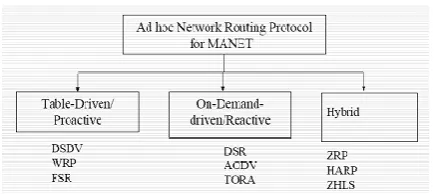
A mobile ad hoc network is a set of wireless nodes that communication directly without needs any access point, infrastructure in a wireless network. Mobile nodes can move randomly through router has a capability to forwarding a packet from source to destination .due to mobility of nodes topology change frequently as compared to other network. Mobile ad hoc network have own capability to control mobility of nodes in wireless network. Mobile ad hoc network routing protocol divided into three category proactive routing, reactive routing and hybrid routing protocol like DSDV [7], FSR [10], AODV [1, 3, 4, 9, 10], DSR[1, 3, 6], ZRP [1, 3, 6, 10] etc. this paper basically discuss three routing protocol performance
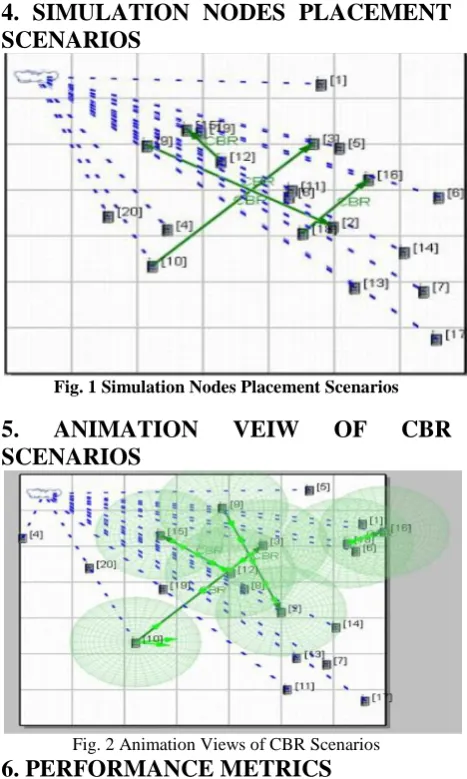
On the basis CBR [2, 6, 10, 11] CBR means constant bit rate which send data from source to destination at fixed rate.CBR apply from source nodes (9,10,12,18) to destination (2,3,15,16) in nodes placement scenarios.
[image:1.595.59.277.658.755.2]Table I. Category of mobile ad hoc network (MANET) routing protocol.
Table 1 for Routing Protocol in MANET
1.1 Proactive Routing Protocol: Proactive routing or table driven routing protocol means which update routing table periodically and maintain routing information up to date .proactive routing protocol like
Destination sequenced Distance vector routing (DSDV) [7]
wireless routing protocol(WRL) [7,8] Fisheye State Routing (FSR) [10]
1.2 Reactive Routing Protocol: In reactive routing protocol paths are searched only when needed. A route discovery operation invokes a route-determination procedure; active routes may be disconnected due to node mobility. Therefore, route maintenance is an important operation of reactive routing protocols ad hoc networks.
The Dynamic Source Routing (DSR) [1, 3, 6] Ad hoc on- demand Distance Vector routing
(AODV) [1, 3, 4, 9, 10]
1.3 Hybrid Routing Protocol: Hybrid routing protocol is a combination of proactive routing and reactive routing protocol like
Zone Routing Protocol (ZRP) [1, 3, 6, 10]
2. ROUTING PROTOCOL OF MANET
2.1 Ad hoc on demand routing protocol (AODV): Ad hoc
on demand routing protocol (AODV)[1, 3, 4, 9, 10]is a Reactive routing or on demand routing protocol that means to maintain the routing information only when needs about the active paths. Routing information is maintained in routing tables at nodes and every mobile node keeps a next-hop routing table, which contains the destinations to which it currently has a route. In case AODV when a source S node wants to send packets to the destination D but no route is available, it initiates a route discovery operation. In the route discovery operation, the source broadcasts route request (RREQ) packets. A RREQ includes addresses of the source S and the destination D, the broadcast ID, which is used as its identifier, the last seen sequence number (Seq. no) of the destination as well as the source node’s sequence number (Seq. no) . Sequence numbers (Seq. no) are used for remove the duplicate rout and provides loop-free, up-to-date routes. Discovery operation reduce the flooding overhead, a node discards RREQ.
routing protocol because this maintain route information only needed. Dynamic source routing network is completely self-organizing and self-configuring requiring no existing network infrastructure or administration. DSR protocol has two main mechanisms
Route discovery: Route discovery is the
mechanism by which source node S wishing to send a packet to a destination node D obtains a source route to destination D. Route discovery is used only when S attempts to send a packet to D and does not already know a route to destination D.
Route maintenance: Route maintenance is the mechanism by which source node S is able to detect .while using a source route to destination D. When route maintenance indicates a source route is broken. Source node S can attempts to use any other route it happens to know to destination node D. route maintenance for this route is used only when source node S is actually sending packets to destination node D.
2.3 Zone Routing Protocol (ZRP): The Zone Routing
Protocol (ZRP) [1, 3, 6, 10] combines both reactive routing and pro-active routing protocols into a hybrid routing protocol. ZRP routing protocol divided into zones.
Intrazone Routing Protocol (IARP): Interazone routing protocol (IARP) [3, 6, 10] to communicate with the interior nodes of within zone with limited radius of the zone. It works fast when topology change, local neighborhood of a node may change rapidly because controlling all information of within zone. Thus node periodically updates the routing information or you can say that this also called table driven routing protocol.
Interzone Routing Protocol (IERP): The global reactive routing or on demand routing component of the ZRP the Interzone Routing Protocol (IERP) [1, 3, 10]. It better works outside the zone. IERP handled route discovery when change the way. When you need to broadcast a route request to the entire node to used Bordercast Resolution Protocol (BRP) [2, 3].
3. SIMULATION PARAMETERS SETUP
[image:2.595.315.549.73.463.2]Simulation setup is done using QualNet5.0.2 [11] simulator tools. We studied the performance of AODV, DSR and ZRP routing protocol for random waypoint node placement models at constant bit rate (CBR)
Table 2 Parameter Values for scenarios
Parameter Values
Area 700m*700m
No of nodes 20
Routing protocol AODV,DSR,ZRP
Mobility model Random waypoint model
Simulation time 120 sec
Traffic source CBR
Channel frequency 2.4 GHz
Data rate 2 Mbps
4. SIMULATION NODES PLACEMENT
SCENARIOS
Fig. 1 Simulation Nodes Placement Scenarios
5.
ANIMATION
VEIW
OF
CBR
SCENARIOS
Fig. 2 Animation Views of CBR Scenarios
6. PERFORMANCE METRICS
[image:2.595.50.275.606.765.2] [image:2.595.316.529.656.723.2]Fig. 4 UDP: packet received from application layer Vs routing protocol
In figure [3,4] (UDP) User Datagram Protocol (UDP) is a connection-less transport protocol that provides best-effort data transmission service in version of IPv4, IPv6 .A transport protocol provides end-to-end data transport services. It serves the Application Layer and allows multiple Application Layer sessions to be multiplexed on the transport services and TCP is a connection-based protocol and provides reliable data transmissions with congestion control and flow control. UDP is a simple, connection-less protocol. QualNet also implements another transport protocol, the Traffic Extension to Resource Reservation Protocol (RSVP-TE), which is a special protocol for distributing the labels for MPLS networks.
6.1 CBR CLIENT PERFORMANCE
METRICS
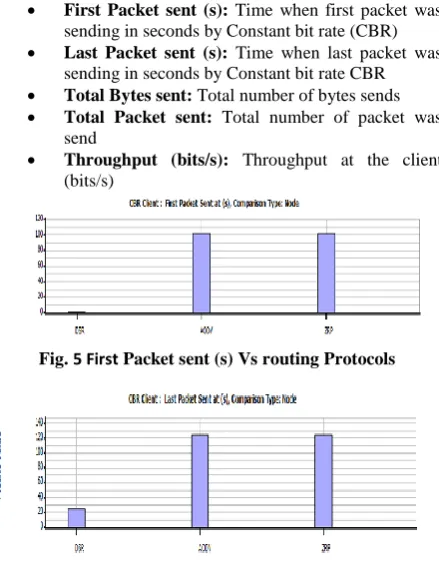
First Packet sent (s): Time when first packet was sending in secondsby Constant bit rate (CBR) Last Packet sent (s): Time when last packet was
sending in seconds by Constant bit rate CBR Total Bytes sent: Total number of bytes sends Total Packet sent: Total number of packet was
send
Throughput (bits/s): Throughput at the client (bits/s)
Fig. 5 First Packet sent (s) Vs routing Protocols
[image:3.595.56.265.81.165.2]Fig.6 Last Packet sent (s) Vs routing Protocols
[image:3.595.315.523.81.372.2]Fig. 7 Total Bytes sent Vs routing Protocols
Fig. 8 Total Packet sent Vs routing Protocols
Fig. 9Throughput (bits/s) Vs routing Protocols
6.2 CBR SERVER PERFORMANCE
METRICS
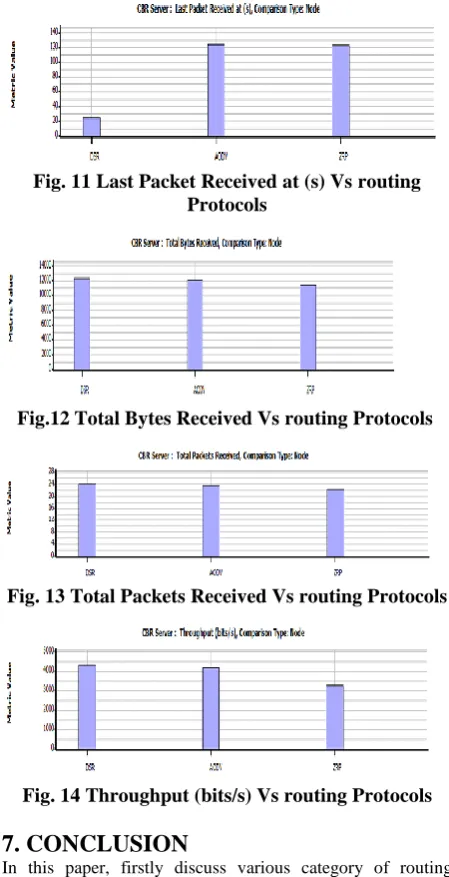
First Packet Received (s): Time when first packet was received in secondsby Constant bit rate CBR
Last Packet Received (s): Time when last packet was received in seconds by Constant bit rate CBR
Total Bytes Received: Total number of bytes received
Total Packet Received: Total number of packet was received
Throughput (bits/s): Throughput at the server (bits/s)
[image:3.595.58.278.391.674.2]Fig. 11 Last Packet Received at (s) Vs routing Protocols
Fig.12Total Bytes Received Vs routing Protocols
[image:4.595.53.278.75.514.2]Fig. 13 Total Packets Received Vs routing Protocols
Fig. 14 Throughput (bits/s) Vs routing Protocols
7. CONCLUSION
In this paper, firstly discuss various category of routing protocol mainly three type routing protocol proactive, reactive, and hybrid routing protocol then we have simulate the performance comparative analysis based on constant bit rate (CBR) of three routing protocol AODV, DSR and ZRP in mobile ad hoc network (MANET). In this used various performance metrics First Packet sent (s), Last Packet sent (s), Total Bytes sent, Total Packet sent, Throughput client (bits/s), First Packet Received (s), Last Packet Received (s), Total Bytes Received, Throughput Server (bits/s) . These performance metrics given the better comparative performance at CBR (constant bit rate) using Qualnet simulation tools 5.0.2 in mobile ad hoc network (MANET).
8. ACKNOWLEDGEMENT
Jogendra Kumar thanks Mr. Sandipvijay Head of the Department (HOD) and Professor of Electronic Communication & Engineering in DIT (Dehradun Institute of Technology) Uttarakhand by recognized UTU (Uttarakhand Technology University) Dehradun, Uttarakhand ,INDIA and also Thanks Mr. S.K Verma HOD CSED G.B. Pant
comparative analysis of routing protocol AODV, DSR and ZRP at Constant Bit Rate in MANET .
9. AUTHOR’S PROFILE
Suresh Kumar is working as an Assistant Professor in Department of Computer Science and Engineering at G.B. Pant Engineering College Pauri Garhwal, Uttarakhand, India. His area of interest includes Sensor network, ad hoc network, image processing and also published various research papers in leading journal & conferences.
Jogendra Kumar received his B.E. degree in Computer Science & Engineering from H.N.B Garhwal University Shrinagar Uttarakhand (India) in 2008 and he is currently doing M.Tech CSE degree from UTU University Dehradun Uttarakhand (India) in G.B. Pant Engineering College Pauri Garhwal, Uttarakhand, (India). His research interest includes mobile ad hoc networks (MANET) and wireless sensor networks systems.
10. REFERENCES
[1] Shaily Mittal, Prabhjot Kaur,” PERFORMANCE COMPARISION OF AODV, DSR and ZRP ROUTING PROTOCOLS IN MANET’S,” International Conference on Advances in Computing, Control, and Telecommunication Technologies , IEEE computer society .pp 165-168,2009.
[2] Dinesh Singh, Ashish K. Maurya, Anil K. Sarje,”Comparative Performance Analysis of
LANMAR, LAR1, DYMO and ZRP Routing Protocols in MANET using Random Waypoint Mobility Model” PP 62-66, 2011 IEEE.
[3] Parma Nand, Dr. S. C. Sharma,” Routing Load Analysis of Broadcast based Reactive Routing Protocols AODV, DSR and DYMO for MANET” International journal of grid and distributed computing vol.4, No.1, PP 81-92, March 2011
[4] SreeRangaRaju, Jitendranath Mungara,” Performance Evaluation of ZRP over AODV and DSR in Mobile Ad hoc Networks Using Qualnet” European Journal of Scientific Research ISSN 1450-216X Vol.45 No.4, pp.658-674, 2010
[5] Alexander Klein,” Performance Comparison and Evaluation of AODV, OLSR, and SBR in Mobile Ad-Hoc Networks” PP 571-575, 2008 IEEE
[6] Sree Ranga Raju , Dr. Jitendranath Mungara ,” ZRP versus AODV and DSR : A Comprehensive Study on ZRP Performance” International Journal of Computer Applications (0975 – 8887) Volume 1 – No. 12,pp 35-40, 2010.
[7] C.Siva Rammurty and B.S. Manoj , ”Ad hoc wireless networks architectures and protocols” ISBN 978-81-317-0688-6, 2011.
Applications (0975 – 8887) Volume 11– No.12, pp 6-9, December 2010.
[10] Ashish K. Maurya , Dinesh Singh,” Simulation based
Performance Comparison of AODV, FSR and ZRP Routing Protocols in MANET , International Journal of
Computer Applications (0975 – 8887) Volume 12– No.2”,pp 23-28, November 2010.
[11] The Qualnet 5.0.2 simulator tools online available