© 2017, IRJET | Impact Factor value: 5.181 | ISO 9001:2008 Certified Journal | Page 2516
EVALUATION OF FACTORS CAUSING CONFLICTS & DISPUTE IN
CONSTRUCTION PROJECTS BY AHP & IMPI METHOD
Sagar Soni
1, Mukesh Pandey
2, Sohit Agrawal
31
PG Scholar, Department of Civil Engineering, ITM University Gwalior, Madhya Pradesh, India
2
Professor & Head, Department of Civil Engineering, ITM University Gwalior, Madhya Pradesh, India
3
Assistant Professor, Department of Civil Engineering, ITM University Gwalior, Madhya Pradesh, India
---***---ABSTRACT –
Construction industry is one of the significantareas that records for an impressive rate of the Gross Domestic Product (GDP) across the various countries. The construction industry is covering a rapid growth across worldwide. As the industry is dynamic in nature; due to this aspect the construction projects are probably going to have a characteristic potential for disputes and conflicts and it depends upon the size of project, time of completion, delay etc. Construction disputes, when not settled in an opportune way, turn out to be exceptionally basic a while later. This paper is aim to analyze the factors which are mostly responsible for conflicts and dispute in construction. In order to do so a literature survey is conducted that gives the desired factors which leads to dispute in construction. The factors which are derived by literature survey are further classified in their appropriate categories. In the end, an investigation is completed by using the process of analytical hierarchy process (AHP) and important index (IMPI) which gives the relative importance of these factors. This paper is expected to believe by helping the stakeholders to follow-up the main causes of conflicts and dispute in construction projects.
Key Words: Conflicts, Disputes, Construction
Projects, Construction Industry, Claim, Delay, Contractor.
1.
INTRODUCTION
The construction industry plays a crucial role in the growth of the country by economically. It also helps in the urbanization of any rural areas. However, due to modernization in the previous working procedure and evolving of new technique to do work the whole environment turning to be more and more complex and clashing of ideas among the participants in industry, this in the end prompts to conflict and dispute in the projects.
Conflicts and disputes consider as the critical factors in every construction project as they can arise in the middle of the project and not only create a fluctuation in the pre-planned schedule and destroy it but also results in increasing the construction cost, completion time, and performance. As it is known that the disputes are the main reason to worry. Thus, it is very important to find the causes of it and remove as soon as possible because they leads to delay which can affect the performance, and loss on money (Fenn, 2007)[1].
Moreover, by the enrollment of disputes in construction results in the failure of anticipate budget, and also lead to the ruining of business relations.
According to Gebken (2006),it has been seen that the disputes have to be resolve out quickly in the first place as it arise to avoid the need of formal claim by the intrusion of the third party, which would minimizing the chance of ruining to relation among the participant involved in the construction work [2]. It also helps in making better relation and save of time. Which results in smooth processing of constructional work, less fight, does not need for lawsuit for claim process, fast & efficient work and good end results Gibbons (2007). In other words, it can be said that disputes are the reason to worry in all construction works [3].
As we studied that the disputes in the construction vary with size, budget & time of the project. Since, the public sector involves a lot of work which have to be got done across the country. However, these kinds of projects are associated with a large amount of conflicts & dispute, complexity due to the size of the covering field.
On a different point of aspect we can also say that if the dispute is already get involved in the project then, it is better to trying to avoid the dispute by finding out the reason behind it rather than trying to resolve it because, the resources which are used to solving these problem can be used in better places to make the construction cost low (Fenn, 2007) [1]. In simple words, by the application of dispute, it only makes the cost of the project more. However, that money can be used in many better constructional environments by just use of better way to do it (Commerce, 2002) [4]. Now, from the above point of view discussed above, it is very clear that disputes will result in creating a devastating holding over each participant who is involve in this industry. Thus, it is wise to avoid disputes rather than resolving them when they have already occurred.
2.
OBJECTIVE
a. To investigate the main causes of conflicts and disputes in construction projects.
b. To distinguish the factors responsible for conflicts and dispute.
© 2017, IRJET | Impact Factor value: 5.181 | ISO 9001:2008 Certified Journal | Page 2517
3.
SOURCES OF CONFLICTS AND DISPUTE
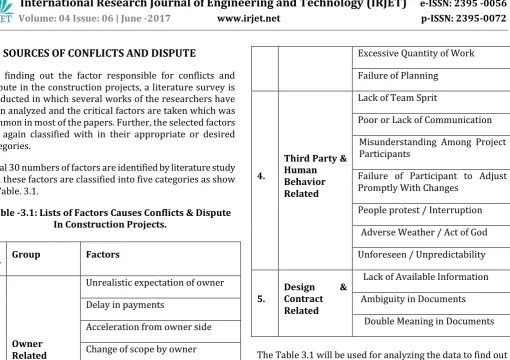
For finding out the factor responsible for conflicts and dispute in the construction projects, a literature survey is conducted in which several works of the researchers have been analyzed and the critical factors are taken which was common in most of the papers. Further, the selected factors are again classified with in their appropriate or desired categories.
[image:2.595.51.562.53.413.2]Total 30 numbers of factors are identified by literature study and these factors are classified into five categories as show in Table. 3.1.
Table -3.1: Lists of Factors Causes Conflicts & Dispute In Construction Projects.
S.
NO. Group Factors
1. Owner Related
Unrealistic expectation of owner
Delay in payments
Acceleration from owner side
Change of scope by owner
Complexity in project from owner side
Failure of owner/respond to issues in a timely
2. Contractor Related
Contractor Financial Failure
Delay in Project
Lack of Quality Control
Lack of Management & Administrative Process
Need of Time Extension
Unfair Distribution of Risk
Contractor Being of Poor Means
3. Consultant Related
Excessive Quantity Variation
Errors in Design & Drawing
Change of Site Condition
Insufficient Specification
Lack of Knowledge
Excessive Quantity of Work
Failure of Planning
4.
Third Party & Human Behavior Related
Lack of Team Sprit
Poor or Lack of Communication
Misunderstanding Among Project Participants
Failure of Participant to Adjust Promptly With Changes
People protest / Interruption
Adverse Weather / Act of God
Unforeseen / Unpredictability
5. Design Contract & Related
Lack of Available Information
Ambiguity in Documents
Double Meaning in Documents
The Table 3.1 will be used for analyzing the data to find out the relative importance of the factors by AHP & IMPI.
4.
RESEARCH METHODOLOGY
For reaching out the goal of this paper two approaches are used; first one is analytical hierarchy process (AHP) which is used to calculate the relative importance of the main groups and the co- factors under each group. While, the other approach used is important index (IMPI) which is used to find out the relative importance of all the factors.
4.1.
Analytical Hierarchy Process (AHP)
© 2017, IRJET | Impact Factor value: 5.181 | ISO 9001:2008 Certified Journal | Page 2518
who have enough experience related to constructiondisputes (Stuart H. Mann 1995) [5].
4.2.
Important Index (IMPI)
The information gathered to decide the most influential factors on project management of the project is done through a survey by explorative questionnaires to the respondent required in daily activities of construction firms in Gwalior region of India. The research methodology for study contains two phases. The first phase included a literature search and interviews. The writing audit was led through books, meeting procedures, articles, web and worldwide project administration diaries. As the result of this stage, 30 causes for conflict and dispute is find out. These causes were sort in 5 fundamental groups. The second stage incorporates arrangement of survey in light of various approach utilized for offering positioning to causes for conflict and dispute in construction projects. In this method Importance Index (IMPI) is figured as a part of frequency and severity.
5.
DATA ANALYSIS
The data is analysis by both of the techniques these are as follows:
5.1.
Data analysis by AHP
[image:3.595.303.565.277.482.2]AHP is used to determine the relative importance of the main group and the co-factors corresponding to particular group.
Table -5.1: Group Comparison & Ranking.
Group Categories Weight Rank
Owner 0.172406679 3
Contractor 0.317404577 1
Consultant 0.088446984 5
Third Party & Human Behavior 0.316769656 2
Design & Contract 0.104972104 4
The relative importance and the ranking of the main group is shown in Table 5.1.
Table -5.2: Ranking of Owner Related Factors.
Owner Related Factors Weight Rank
Unrealistic expectation of owner 0.048334274 6
Delay in payments 0.450606785 1
Acceleration from owner side 0.139908258 3
Change of scope by owner 0.222679281 2
Complexity in project from owner
side 0.08787167 4
Failure of owner/respond to issues
in a timely 0.050599732 5
The relative importance & ranking of the factors comes under the influence of owner is shown in Table 5.2.
Table -5.3: Ranking of Contractor Related Factors.
Contractor Related Factors Weight Rank
Contractor Financial Failure 0.340132896 1
Delay in Project 0.266516803 2
Lack of Quality Control 0.087341886 4
Lack of Management &
Administrative Process 0.156143847 3
Need of Time Extension 0.037531249 6
Unfair Distribution of Risk 0.077110606 5
Contractor Being of Poor Means 0.035222713 7
The relative importance & ranking of the factors comes under the influence of contractor is shown in Table 5.3.
Table -5.4: Ranking of Consultant Related Factors.
Consultant Related Factors Weight Rank
Excessive Quantity Variation 0.0373948 7
Errors in Design & Drawing 0.288174639 1
Change of Site Condition 0.090642204 5
Insufficient Specification 0.280928313 2
Lack of Knowledge 0.069276818 6
Excessive Quantity of Work 0.094804432 4
Failure of Planning 0.280928313 3
© 2017, IRJET | Impact Factor value: 5.181 | ISO 9001:2008 Certified Journal | Page 2519
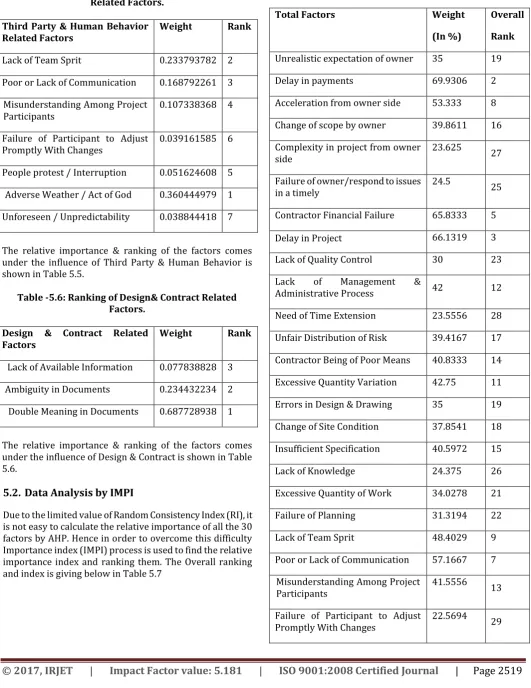
Table -5.5: Ranking of Third Party & Human BehaviorRelated Factors.
Third Party & Human Behavior
Related Factors Weight Rank
Lack of Team Sprit 0.233793782 2
Poor or Lack of Communication 0.168792261 3
Misunderstanding Among Project
Participants 0.107338368 4
Failure of Participant to Adjust
Promptly With Changes 0.039161585 6
People protest / Interruption 0.051624608 5
Adverse Weather / Act of God 0.360444979 1
Unforeseen / Unpredictability 0.038844418 7
The relative importance & ranking of the factors comes under the influence of Third Party & Human Behavior is shown in Table 5.5.
Table -5.6: Ranking of Design& Contract Related Factors.
Design & Contract Related
Factors Weight Rank
Lack of Available Information 0.077838828 3
Ambiguity in Documents 0.234432234 2
Double Meaning in Documents 0.687728938 1
The relative importance & ranking of the factors comes under the influence of Design & Contract is shown in Table 5.6.
5.2.
Data Analysis by IMPI
Due to the limited value of Random Consistency Index (RI), it is not easy to calculate the relative importance of all the 30 factors by AHP. Hence in order to overcome this difficulty Importance index (IMPI) process is used to find the relative importance index and ranking them. The Overall ranking and index is giving below in Table 5.7
Table -5.7: Overall Ranking of the Factors.
Total Factors Weight
(In %)
Overall
Rank
Unrealistic expectation of owner 35 19
Delay in payments 69.9306 2
Acceleration from owner side 53.333 8
Change of scope by owner 39.8611 16
Complexity in project from owner
side 23.625 27
Failure of owner/respond to issues
in a timely 24.5 25
Contractor Financial Failure 65.8333 5
Delay in Project 66.1319 3
Lack of Quality Control 30 23
Lack of Management &
Administrative Process 42 12
Need of Time Extension 23.5556 28
Unfair Distribution of Risk 39.4167 17
Contractor Being of Poor Means 40.8333 14
Excessive Quantity Variation 42.75 11
Errors in Design & Drawing 35 19
Change of Site Condition 37.8541 18
Insufficient Specification 40.5972 15
Lack of Knowledge 24.375 26
Excessive Quantity of Work 34.0278 21
Failure of Planning 31.3194 22
Lack of Team Sprit 48.4029 9
Poor or Lack of Communication 57.1667 7
Misunderstanding Among Project
Participants 41.5556 13
Failure of Participant to Adjust
© 2017, IRJET | Impact Factor value: 5.181 | ISO 9001:2008 Certified Journal | Page 2520
People protest / Interruption 22.0278 30Adverse Weather / Act of God 58.5 6
Unforeseen / Unpredictability 26.625 24
Lack of Available Information 65.9167 4
Ambiguity in Documents 46.2222 10
Double Meaning in Documents 80.8889 1
The Relative importance & overall ranking of all the factors is shown in Table 5.7
6.
CONCLUSION
The important conclusion withdrawn from the data analysis is that the contactor related factors are the key sources for creating conflicts and dispute in construction industry and then followed by third party and human related factors.
Based on the relative importance of the groups; Contractor factors ranked as 1st, followed by Third party & human Behavior factors, Owner related factors, then Design & contract related factors, and last is Consultant related factors.
The top five factors which are concluded by data analysis are: Double meaning in documents (80.8889%), Delay in payment by owner (69.9306%), Delay in projects by contractor (63.1319%), Lack of available information in design (65.9167%), and Contractor financial failure (65.8333%).
Thus, this study conclude that for the completion of construction project as conflicts & dispute free, these above factors have to be managed carefully. This investigation likewise gives a decent direction to administrative & management groups and significant data to the managers which can be used to manage their project in a better and efficient way.
REFERENCES
[1] Fenn, P, (2007) "Predicting Construction Disputes: An Aetiological Approach," Proceedings of the Institution of Civil Engineers - Management, Procurement and Law, Volume 160, Issue 2, pp. 69-73.
[2] Gebken R. J., (2006), Quantification of transactional dispute resolution costs for the US construction industry.
[3] Gibbons M., (2007), Better dispute resolution: A review of employment dispute resolution in Great Britain, London: DTI.
[4] Commerce O. O. G., (2002), Dispute resolution guidance: Norwich.