© 2017, IRJET | Impact Factor value: 5.181 | ISO 9001:2008 Certified Journal | Page 829
PAPR Reduction Based Pilots Assisted Channel Estimation
in OFDM Systems
Abirami A
1, C.Jeya suriya
21
PG Scholar, Communication system, PET Engineering College, Vallioor
2Assistant Professor PET Engineering College, Vallioor
---***---Abstract - Channel estimation plays out an essential part in orthogonal frequency-division multiplexing (OFDM) systems. Insertion of pilot symbols is one of the required techniques for estimation of channel. However, the peak-to-average power ratio (PAPR) suffers the OFDM system. PAPR can be reduced by utilizing various accessible procedures, such as coding, active constellation extension, amplitude clipping, and selective level mapping. The coding approach produces redundant data that significantly reduce the bit rate. The active constellation extension requires higher transmission power. The clipping method and Selective Level mapping (SLM) is the best among the available methods. In this study, we combine the clipping and SLM methods, which is efficient in terms of PAPR reduction value and of spectral efficiency while the channel estimation performance is maintained.
Key Words: PAPR, OFDM, SLM, Clipping, Pilots
1. INTRODUCTION
Orthogonal frequency division multiplexing (OFDM) has turned out to be important in numerous applications amid the most recent decade as a result of its advantages. OFDM can give high information rates and in addition handle multipath channels without requiring confounded equalizers. Given the significance of such a framework, the channel state information(CSI) is assessed to give great quality to the conveyed information. Two important techniques are used to estimate the CSI: blind and non-blind. The visually impaired technique does not send pilots (in any event expressly), though the non-blind sends the embedded pilots to evaluate the CSI. The pilot addition based channel estimation is subdivided into two methodologies: block type channel estimation and comb type channel estimation. The look over sort is the most relevant for multipath channel estimation purposes. Be that as it may, one of the essential issues in the OFDM framework is the peak to average power ratio (PAPR). Various strategies can be utilized to diminish the PAPR values, such as the block-coding technique, active constellation extension, amplitude clipping (AC), and the selected mapping (SLM).In this paper we used AC and the SLM techniques for PAPR reduction. Another issue that emerges when the PAPR decrease strategies are connected is the contortion of the pilot tones before these are sent to the multipath channel. This issue is tended to in this paper utilizing the AC-strategy, wherein the high pinnacles are sliced off to reduce the PAPR. In a typical case, the pilot tones are embedded at high power (high peaks). All information are then subjected to the PAPR reduction to evacuate the high peaks, which brings about the incorrect estimation of CSI by the beneficiary. In the event that the SLM-based PAPR diminishment strategy is utilized rather than the AC approach, a few periods of the embedded pilots would change. Notwithstanding, this change would not influence the CSI estimation at the beneficiary. These marvels are talked about in the consequent segments of the paper.
2. OFDM SYSTEM MODEL
Let A = [A0 A1 ··· AN-1] T be the input symbol vector , where Ak represents the complex data of the kth subcarrier and
N is the number of subcarriers. The OFDM signal is generated by adding all the N modulated subcarriers each of which is separated by 1/NTs in the frequency domain, where Ts is the sampling period. Then, a(t) continuous time baseband OFDM signal is defined as:
s t
NT k j N
k Ke t NT
N t
a( ) 1
1A
2 ;0 0
[1]
where,
© 2017, IRJET | Impact Factor value: 5.181 | ISO 9001:2008 Certified Journal | Page 830
3. PAPR AND CCDF
3.1. Peak average power ratio
The peak to average power ratio of OFDM signals is defined as the ratio between the maximum power and its average power during an OFDM symbol. PAPR is defined as:
[2]
In OFDM system, some information groupings would bring about higher PAPR than others. For instance, an information grouping that requires every single such bearer to transmit their greatest amplitudes would absolutely bring about a high yield PAPR. Along these lines by restricting the conceivable info arrangements to a littlest sub set, it ought to be conceivable to get yield signals with an ensured low yield PAPR.
3.2. Complementary cumulative distribution function
CCDF gives the measure of time ,a signal spends above given power level. In current correspondence, CCDF estimation is considered as one of the valuable instrument offers comprehensive analysis of signal power peaks. For adequate huge number of sub carriers ,the amplitude of multicarrier signal, CCDF expression for OFDM signal can be given as
CCDF=( >𝑧) =1−( ≤𝑧 )
=1−(𝑧)𝑁
=1−(1−𝑒𝑥𝑝 (−𝑧) )𝑁 [3]
where N signal samples are statistically independent uncorrelated.
4. CLIPPING AND SELECTIVE MAPPING
4.1Clipping
In amplitude clipping, IFFT equation generates L times oversampled discrete time signal. (𝐾) with N(L-1) zero padding in frequency domain) is then modulated its carrier frequency to get pass band signal and clipped version of the signal which is given by
( ) { ( )
( ) [4]
clipping ratio is defined as CR= A/σ. Where A is specified clipping level and σ is RMS value of OFDM signal.
4.2. Selective mapping
In the SLM, the information arrangements are duplicated by each of the stage successions to produce elective info image groupings. Each of these option input information groupings is made the IFFT operation, and afterward the one with the most reduced PAPR is chosen for transmission. Ak is the OFDM data block, Bu is the phase vectors and Au is the
modified data vectors in the frequency domain.
( )
√ ∑
𝑒 [5]
Where u=1, 2… U is the number of sub-carriers. Among the adjusted data blocks, the one with the most reduced PAPR is chosen for transmission. The measure of PAPR reduction for SLM relies on upon the quantity of stage groupings U and the plan of the stage arrangements must be known to both transmitter and receiver
5. PROPOSED METHOD
The proposed strategy utilizes dedicated pilots for PAPR decrease issue prompting spectral efficiency loss. In this suggestion, we utilize a portion of the scattered pilots dedicated to channel estimation for both PAPR deduction and channel estimation purposes. The main issue turns out then to discover the pilot symbols at the transmitter which limits the PAPR esteem additionally to discover these pilot symbols at the beneficiary so as to accomplish channel estimation. That is, with a specific end goal to accomplish both operations, that is, PAPR reduction and channel estimation, the set c decided for PAPR decrease needs to experience some specific laws known at the receiver.
© 2017, IRJET | Impact Factor value: 5.181 | ISO 9001:2008 Certified Journal | Page 831 or [6]
Ck = ΩkC0,
where Ω denotes the step between two consecutive pilots and C0 is the first pilot symbol.
Fig-1: General principle of the proposed method.
The choice of Ck and Ω could be either in continuous domain, that is, the pilots could take any consistent incentive in C, or they could take any discrete incentive from a discrete predefined set in discrete domain with a discrete value Ω. Since the estimation of the pilots and Ω at the receiver in continuous domain could yield to a residual estimation error, and after that to slight system execution degradation, we propose to perform research in a discrete subset of C. It is given a dyo}|+ s
C0 = λejφ
Ω = ejΔ,
Ck = λej(φ+kΔ) , [7]
© 2017, IRJET | Impact Factor value: 5.181 | ISO 9001:2008 Certified Journal | Page 832
5.1. Pilot recovery and channel estimation
In order to explain the channel estimation scheme and pilots recovery, frequency non selective weakening per subcarrier and time unchangeableness throughout one OFDM image are assumed. Besides, the absence of inter symbol interference and inter carrier interference is bonded by the utilization of a guard interval longer than the utmost excess delay of the impulse response of the channel. In typical OFDM systems and beneath these assumptions, the received signal at the output of the FFT operation might be written as
R = HS +W [8]
where H denotes the N × N matrix that contains the advanced channel coefficients, and W is that the additive white Gaussian noise vector. In typical OFDM systems, the channel estimation is completed by estimating the pilot channel coefficients hp first and then by filtering the obtained coefficients using some typical filters. In our scheme, the pilot symbols Cp used for PAPR reduction are not best-known a priori at the receiver. Therefore, the pilots recovery and channel estimation procedure is performed in 2 steps. First, we verify the transmitted sequence Cp used for PAPR
reduction. Within the second step, we tend to confirm the particular channel coefficients Hk.
6. SIMULATION RESULT
[image:4.595.39.533.446.623.2]We completed broad simulation using MATLAB to assess the PAPR reduction execution of the proposed approach. OFDM systems with N=256 subcarriers was utilized for the simulation with QPSK modulation
Table -1 Simulation parameters
Modulation QPSK
Number of subcarriers 256
Number of data symbols 1000
Size of the phase sequence 256
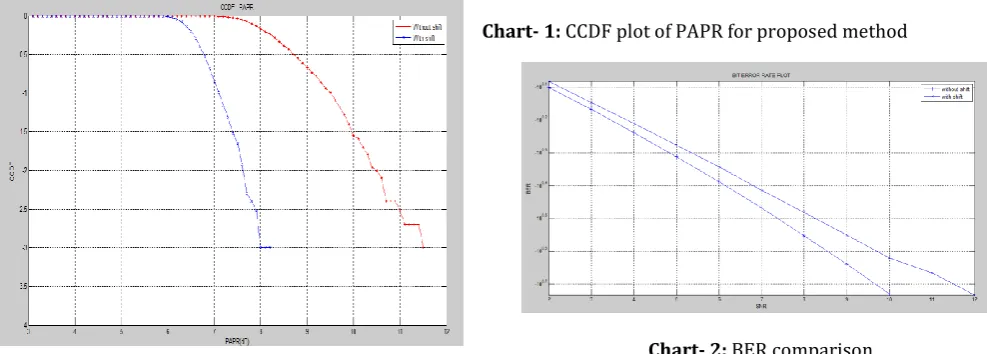
A total of 10000 data blocks were generated to obtain the CCDF plot of PAPR
Chart- 1: CCDF plot of PAPR for proposed method
Chart- 2: BER comparison
Our method achieved about 3 dB in PAPR reduction and by adding the DCT in our algorithm we had a further reduction on the PAPR by about 1 dB less than the initial PAPR of the original OFDM signal with significant reduction on complexities compared.
7. CONCLUSION
© 2017, IRJET | Impact Factor value: 5.181 | ISO 9001:2008 Certified Journal | Page 833
REFERENCES
[1] Xiaodong Li and Cimini, L.J. Jr., "Effects of clipping and filtering on the performance ofOFDM," IEEE Communications
Letters, pp.131- 133, May 1998
[2] Jiang T., Wu Y., “An Overview: Peak-to-average power ratio reduction techniques for OFDM signals”, IEEE Transactions
on Broadcasting, vol. 54, no. 2, pp. 257–268, Jun 2008.
[3] Mohit Chandwani, Arjun Singhal, Naga Vishnukanth, and Vijaykumar Chakka,” A Low Complexity SLM Technique for
PAPR reduction in OFDM using Riemann sequence and Thresholding of power Amplifier”, IEEE communication Letters, submitted on July2009
[4] Bajwa, Haupt, Sayeed, and Nowak, “Compressed channel sensing: A new approach to estimating sparse multipath
channels,”Proc. IEEE, vol. 98, no. 6, pp. 1058–1076, Jun. 2010.
[5] Barbotin and Vetterli, “Fast and robust parametric estimation of jointly sparse channels,” IEEE J. Emerging Sel. Topics Circuits Syst., vol. 2, no. 3, pp. 402–412, Sep. 2012.
[6] Berenguer, Wang, and Krishnamurthy, “Adaptive MIMO antenna selection via discrete stochastic optimization,” IEEE Trans. SignalProcess., vol. 53, no. 11, pp. 4315–4329, Nov. 2005.
[7] Berger, Wang, Huang, and Zhou, “Application of compressive sensing to sparse channel estimation,” IEEE Commmun. Mag.vol. 48, no. 11, pp. 164–174, Nov. 2010.
[8] Cai and Wang, “Orthogonal matching pursuit for sparse signal recovery with noise,” IEEE Trans. Inf. Theory, vol. 57,
no. 7, pp. 4680–4688, Jul. 2011.
[9] Candes and Tao, “Decoding by linear programming,” IEEE Trans.Inf. Theory, vol. 51, no. 12, pp. 4203–4215, Dec. 2005. [10] Chen and Wen, “A novel cognitive radio adaptation for wireless multicarrier systems,” IEEE Commun. Lett., vol. 14, no.
7, pp. 629–631, Jul. 2010.
[11] Chen,Wen, and Ting, “An efficient pilot design scheme for sparse channel estimation in OFDM systems,” IEEE Commmun. Lett.,vol. 17, no. 7, pp. 1352–1355, Jul. 2013.
[12] Cheng et al., “Sparse channel estimation for OFDM transmission over two-way relay networks,” in Proc. IEEE ICC,
Ottawa, ON, Canada, Jun. 2012, pp. 3948–3953.
[13] Donoho and Huo, “Uncertainty principles and ideal atomic decomposition,” IEEE Trans. Inf. Theory, vol. 47, no. 7, pp.
2845–2862,Nov.
[14] Feng et al., “A survey of energy-efficient wireless communications,” IEEE Commun. Surveys Tuts., vol. 15, no. 1, pp. 167–
178, Feb. 2013.
[15] Gesbert et al., “Multi-cell MIMO cooperative networks: A new look at interference,” IEEE J. Sel. Areas Commun., vol. 28,
no. 9, pp. 1380–1408, Dec. 2010.
[16] Gopalakrishnan and Jindal, “An analysis of pilot contamination on multi-user MIMO cellular systems with many
antennas,” in Proc. IEEE 12th Int. Workshop SPAWC, San Francisco, CA, USA, Jun. 2011, pp. 381–385.
[17] He,Song, and Zhu, “Pilot allocation for sparse channel estimation in MIMO-OFDM systems,” IEEE Trans. Circuits Syst. II, ExpBriefs, vol. 60, no. 9, pp. 612–616, Sep. 2013.
[18] Hu, Wang, and He, “A new sparse channel estimation and tracking method for time-varying OFDM systems,” IEEE Trans. Veh. Technol.,vol. 62, no. 9, pp. 4648–4653, Nov. 2013.
[19] Huang et al., “Distributed multicell beamforming with limited intercell coordination,” IEEE Trans. Signal Process., vol.