http://dx.doi.org/10.4236/apm.2015.55029
Index-p Abelianization Data of p-Class
Tower Groups
Daniel C. Mayer
Naglergasse 53, 8010 Graz, Austria
Email: [email protected]
Received 18 February 2015; accepted 11 April 2015; published 20 April 2015 Copyright © 2015 by author and Scientific Research Publishing Inc.
This work is licensed under the Creative Commons Attribution International License (CC BY). http://creativecommons.org/licenses/by/4.0/
Abstract
Given a fixed prime number p, the multiplet of abelian type invariants of the p-class groups of all unramified cyclic degree p extensions of a number field K is called its IPAD (index-p abeliani- zation data). These invariants have proved to be a valuable information for determining the Galois group Gp
2 of the second Hilbert p-class field and the p-capitulation type of K. For
p=3 and a
number field K with elementary p-class group of rank two, all possible IPADs are given in the complete form of several infinite sequences. Iterated IPADs of second order are used to identify the group Gp
∞ of the maximal unramified pro-p extension of K.
Keywords
p-Class Groups, p-Principalization Types, p-Class Field Towers, Quadratic Fields, Second p-Class Groups, p-Class Tower Groups, Coclass Graphs
1. Introduction
After a thorough discussion of the terminology used in this article, such as the logarithmic and power form of abelian type invariants in Section 2, and multilayered transfer target types (TTTs), ordered and accumulated index-p abelianization data (IPADs) up to the third order in Section 3, we state the main results on IPADs of exceptional form in Section 3.1, and on IPADs in parametrized infinite sequences in Section 3.2. These main theorems give all possible IPADs of number fields K with 3-class group Cl3
( )
K of type (3,3) .of proofs which were given in [5].
Iterated IPADs of second order are used in Section 6 for the indirect calculation of TKTs in Section 6.1, and for determining the exact length p
( )
K of the p-class tower of a number field K in Section 6.2. These sophisticated techniques prove 3( )
K =3 for quadratic number fields K =( )
d with{
342664, 957013}
d∈ (the first real quadratic fields) and d= −3896 (the first tough complex quadratic field after the easy d= −9748 ([6], Cor.4.1.1), which resisted all attempts up to now.
Finally, we emphasize that IPADs of infinite p-class towers reveal an unknown wealth of possible fine structure in Section 7 on complex quadratic fields K having a 3-class group Cl3
( )
K of type (3,3,3) .2. Abelian Type Invariants
Let p be a prime number and A be a finite abelian p-group. According to the main theorem on finitely generated abelian groups, there exists a non-negative integer r≥0, the rank of A, and a sequence n1,,nr of positive integers such that n1≤n2 ≤≤nr and
(
n1)
(
nr)
A p ⊕ ⊕ p (1) The powers : ni
i
d =p , 1≤ ≤i r, are known as the elementary divisors of A, since d di i+1 for each
1≤ ≤ −i r 1. It is convenient to collect equal elementary divisors in formal powers with positive exponents
1, , s
r r such that r1+ + = rs r, 0≤ ≤s r, and
1 1 1 2 1 1 1
1 r r 1 r r r rs 1 r rs
n ==n <n + ==n + <<n + + −+ ==n + +
The cumbersome subscripts can be avoided by defining mj:=nr1+ + rj for each 1≤ ≤j s. Then
(
)
1(
)
1 r ms rs
m
A p ⊕ ⊕ p (2) and we can define:
Definition 2.1. The abelian type invariants (ATI) of A are given by the sequence
( )
(
1)
1
ATI : r, , rs
s
A = m m (3) of strictly increasing positive integers m1<<ms with multiplicities r1,,rs written as formal exponents indicating iteration.
Remark 2.1. The integers mj are the p-logarithms of the elementary divisors di.
1) For abelian type invariants of high complexity, the logarithmic form in Definition 2.1 requires considerably less space (e.g. in Section 7, Table 2) than the usual power form
1
1, , 1, , , ,
s
s s
r r
m m
m m
p p p p
(4)
2) For brevity, we can even omit the commas separating the entries of the logarithmic form of abelian type invariants, provided all the mj remain smaller than 10.
3) A further advantage of the brief logarithmic notation is the independence of the prime p, in particular when p-groups with distinct p are being compared.
4) Finally, since our preference is to select generators of finite p-groups with decreasing orders, we agree to write abelian type invariants from the right to the left, in both forms.
Example 2.1. For instance, if p=3, then the abelian type invariants
( )
214 in logarithmic form corre- spond to the power form(
9, 3, 3, 3, 3)
and( )
2 12 2 corresponds to(
9, 9, 3, 3)
.Now let G be an arbitrary finite p-group or infinite topological pro-p group with derived subgroup G′
and finite abelianization Gab:=G G′.
Definition 2.2. The abelian type invariants of the commutator quotient group G G′ are called the abelian quotient invariants (AQI) of G, that is, AQI
( )
G : ATI=( )
Gab .3. Index-
p
Abelianization Data
Let p be a fixed prime number and K be a number field with p-class group Clp
( )
K of order v0
v≥ denotes a non-negative integer.
According to the Artin reciprocity law of class field theory [7], Clp
( )
K is isomorphic to the commutator quotient group G G′ of the Galois group G=Gp∞( )
K : Gal=(
Fp∞( )
K K)
of the maximal unramified pro-p extension Fn( )
K∞
of K. G is called the p-class tower group (briefly p-tower group) of K. The fixed field of the commutator subgroup G′ in Fp
( )
K∞
is the maximal abelian unramified p-extension of K, that is the (first) Hilbert p-class field Fp1
( )
K of K with Galois group( )
(
1)
(
( )
)
(
( ) ( )
1)
Gal Fp K K Gal Fp∞ K K Gal Fp∞ K Fp K =G G′. The derived subgroup G′ is a closed (and open) subgroup of finite index
(
G G: ′ =)
pv in the topological pro-p group G.Definition 3.1. For each integer 0≤ ≤n v, the system
( )
{
1( )
[
]
}
Lyrn K = K≤ ≤L Fp K L K: = pn (5) of intermediate fields K≤ ≤L Fp1
( )
K with relative degree[
:]
n
L K = p is called the n-th layer of abelian un-ramified p-extensions of K. In particular, for n=0, K forms the bottom layer Lyr0
( ) { }
K = K , andfor n=v, Fp1
( )
K forms the top layer( )
{
( )
}
1
Lyrv K = Fp K .
Now let 0≤ ≤n v be a fixed integer and suppose that K ≤ ≤L Fp1
( )
K belongs to the n-th layer. Then the Galois group H =Gal(
Fp∞( )
K L)
is of finite index(
:)
[
:]
nG H = L K = p in the p-tower group G of K and the quotient G H Gal
(
L K)
is abelian, since H contains the commutator subgroup( ) ( )
(
1)
Gal p p
G′ = F∞ K F K of G.
Definition 3.2. For each integer 0≤ ≤n v, the system
( )
{
(
)
}
Lyrn G := G′≤H≤G G H: = pn (6)
of intermediate groups G′ ≤H ≤G with index
(
G H:)
= pn is called the n-th layer of normal subgroups ofG with abelian quotients G H. In particular, for n=0, G forms the top layer Lyr0
( ) { }
G = G , and for n = v, G′ forms the bottom layer Lyrv( ) { }
K = G′ .A further application of Artin’s reciprocity law [7] shows that
( )
(
)
(
( ) ( )
1)
(
(
1( )
)
)
( )
Gal p Gal p p Gal p Clp
H H′ = F∞ K L F∞ K F L F L L L (7)
for every subgroup H∈Lyrn
( )
G and its corresponding extension field L∈Lyrn( )
K , where 0≤ ≤n v is fixed (but arbitrary).Since the abelianization ab
H =H H′ forms the target of the Artin transfer homomorphism TG H, :G→H H′
from G to H [8], we introduced a preliminary instance of the following terminology in ([9], Dfn. 1.1, p. 403). Definition 3.3. For each integer 0≤ ≤n v, the multiplet
( ) (
)
Lyr( )n
n G H H H G
τ = ′ ∈ , where each member
H H′ is interpreted rather as its abelian type invariants, is called the n-th layer of the transfer target type (TTT) of the pro-p group G,
( )
G : 0( )
G ; ; v( )
G , where n( ) (
G H H)
H Lyrn( )G for each 0 n vτ =τ τ τ = ′ ∈ ≤ ≤ (8)
Similarly, the multiplet
( )
(
( )
)
( )Lyr
Cl
n
n K p L L K
τ
∈
= , where each member Clp
( )
L is interpreted rather as itsabelian type invariants, is called the n-th layer of the transfer target type (TTT) of the number field K,
( )
( )
( )
( )
(
( )
)
( )n
0 Lyr
: ; ; v , where n Clp for each 0
L K
K K K K L n v
τ τ τ τ
∈
= = ≤ ≤ (9)
Remark 3.1.
1) If it is necessary to specify the underlying prime number p, then the symbol τ
(
p G,)
, resp. τ(
p K,)
, can be used for the TTT.3) In view of the considerations in Equation (7), it is clear that we have the equality
( )
G( )
Kτ =τ (10)
in the sense of componentwise isomorphisms.
Since it is increasingly difficult to compute the structure of the p-class groups Clp
( )
L of extension fields( )
Lyrn
L∈ K in higher layers with n≥2, it is frequently sufficient to make use of information in the first layer only, that is the layer of subgroups with index p. Therefore, Boston, Bush and Hajir [10] invented the following first order approximation of the TTT, a concept which had been used in earlier work already [11]-[15], without explicit terminology.
Definition 3.4. The restriction
( )
( )
( ) ( )
( )
( )
( ) ( )
1
0 1
1
0 1
: ; , resp.
: ; ,
G G G
K K K
τ τ τ
τ τ τ
=
= (11)
of the TTT τ
( )
G , resp. τ( )
K , to the zeroth and first layer is called the index-p abelianization data (IPAD) of G, resp. K.So, the complete TTT is an extension of the IPAD. However, there also exists another extension of the IPAD which is not covered by the TTT. It has also been used already in previous investigations by Boston, Bush and Nover [12] [14] [15] and is constructed from the usual IPAD τ0
( ) ( )
K ;τ1 K of K, firstly, by observing that( )
(
( )
)
( ) 11 K Clp L L Lyr K
τ
∈
= can be viewed as
( )
(
( )
)
( )1
1 K 0 L L Lyr K
τ = τ ∈ and, secondly, by extending each τ0
( )
L to the IPAD τ0( ) ( )
L ;τ1 L of L.Definition 3.5. The family
( )
( )
( )
(
( ) ( )
)
( ) ( )( )
( )
(
( ) ( )
)
( ) 1
1
2
0 0 1 Lyr
2
0 0 1 Lyr
: ; ; , resp.
: ; ; ,
H G
L K
G G H H
K K L L
τ τ τ τ
τ τ τ τ
∈ ∈
=
=
(12)
is called the iterated IPAD of second order of G, resp. K.
The concept of iterated IPADs as given in Dfn. 3.5 is restricted to the second order and first layers, and thus is open for further generalization (higher orders and higher layers). Since it could be useful for 2-power extensions, whose absolute degrees increase moderately and remain manageable by MAGMA [4] or PARI/GP [1], we briefly indicate how the iterated IPAD of third order could be defined:
( )
( )
( )
( )
(
( ) ( )
)
( )(
)
( )( )
( )
( )
( )
(
( ) ( )
)
( )(
)
( )1
1
1 1
3
0 0 0 1 Lyr
Lyr
3
0 0 0 1 Lyr
Lyr
: ; ; ; , resp.
: ; ; ; .
I H
H G
M L
L K
G G H I I
K K L M M
τ τ τ τ τ
τ τ τ τ τ
∈ ∈
∈ ∈
=
=
(13)
3.1. Sporadic IPADs
In the next two central theorems, we present complete specifications of all possible IPADs of pro-p groups G
for p=3 in the simplest case of an abelianization G G′ of type
( )
3, 3 . We start with pro-3 groups Gwhose metabelianizations G G′′ are vertices on sporadic parts of coclass graphs outside of coclass trees ([9], Section 2, p. 410), ([16] Section 10).
Since the abelian type invariants of the members of TTT layers will depend on the parity of the nilpotency class c or coclass r, a more economic notation, avoiding the tedious distinction of the cases odd or even, is provided by the following definition ([5], Section 3).
Definition 3.6. For an integer n≥2, the nearly homocyclic abelian 3-group A
( )
3,n of order 3nis de- fined by its type invariants
(
q+r q,)
=ˆ(
3q r+ , 3q)
, where the quotient q≥1 and the remainder 0≤ <r 2 are determined uniquely by the Euclidean division n=2q+r. Two degenerate cases are included by putting( ) ( ) ( )
3,1 : 1 ˆ 3A = = the cyclic group C of order 3 3 and A
( ) ( )
3, 0 := 0 =ˆ1 the trivial group of order 1.Theorem 3.1. (First Main Theorem on p=3, G G′
( )
3, 3 , and G G′′ of small class)Let G be a pro-3 group having a transfer target type τ
( )
G = τ0( ) ( ) ( )
G ;τ1 G ;τ2 G with top layer com-ponent τ0
( )
G =12. Let 0≤ ≤k 1 denote the defect of commutativity ([9], 3.1.1, p.412, and 3.3.2, p. 429) ofthe metabelianization G G′′ of G. Then the ordered first layer τ1
( )
G and the bottom layer τ2( )
G aregiven in the following way (exceptional cases in boldface font).
1) If G G′′ is of coclass cc
(
G G′′ =)
1 and nilpotency class c: cl=(
G G′′)
≤3, then( ) ( )
( )
( ) ( )
( )
( )
( )
( ) ( )
( )
(
( )
)
( ) ( )
( )
(
( )
)
( )
( )
( )
(
( )
)
( )
( )
4 1 2 4 2 1 2 2 1 2 3 2 2 1 2 3 2 2 1 21 ; 0 , if 1, 9, 2 ,
1 ; 1 , if 2, 27, 3 ,
1 , ; 1 , if 2, ,
, 1 ; 1 , if 3, ,
21, 1 ; 1 , if 3, 81,8 9 10 .
G G c G
G G c G
G G c G
G G c G
G G c G
τ τ τ τ τ τ τ τ τ τ = = = = = = = = = = = = = = = 3 3
2 27, 4
1 81, 7
(14)
where generally G′′ =1.
2) If G G′′ is of coclass cc
(
G G′′ =)
2 and nilpotency class c: cl=(
G G′′)
=3, then( ) ( )
(
)
( )
( )
( ) ( )
(
( )
)
( )
( )
( )
(
)
( )
( )
( )
(
( )
)
( )
( )
( ) ( )
( )
( )
( )
2 3 3
1 2
2
2 3 3
1 2
3 3 3
1 2
3
1 2
4 3
1 2
21 ,1 , 21 ; 1 , if 243, 5 or 243, 6 ,
21 , 1 ; 1 , if 243, 3 ,
1 , 21,1 , 21 ; 1 , if 243, 7 ,
, 21, ; 1 , if ,
21 ; 1 , if 243,8 9 .
G G G G G
G G G G
G G G
G G G G
G G G G
τ τ τ τ τ τ τ τ τ τ ′′ = = ′′ = = = = ′′ = = ′′ = = 2 3 3
1 1 243, 4
(15)
where G′′ =1 can be warranted for G G′′ 243, 5 7 only. However, if c: cl=
(
G G′′)
=4 with k=1, then( ) ( )
(
( )
)
( )
( )
( ) ( )
(
( )
)
( )
( )
( )
(
( )
)
( )
( )
( ) ( )
( )
( )
( )
2
2 3 2
1 2 2 2 3 1 2 2 1 2 4 1 2
21 , 1 ; 21 , if 729, 37 38 39 ,
21 , 1 ; , if ,
, 21, ; 21 , if ,
21 ; , if .
G G G G
G G G G
G G G G
G G G G
τ τ τ τ τ τ τ τ ′′ = = ′′ = = ′′ = = ′′ = = 4 2 3 3 4
1 729, 34 35 36
1 1 729, 44 45 46 47
1 729, 56 57
(16)
3) If G G′′ is of coclass r: cc=
(
G G′′)
≥3 and nilpotency class c: cl=(
G G′′)
= +r 1, then( )
(
(
)
2( )
3 2)
( )
( ) (
)
1 G A 3,r 1 , 1 ; 2 G A 3,r A 3,r 1 and k 0
τ = + τ = × − = (17)
However, if c= +r 2, then
( )
(
(
) (
)
( )
)
( )
(
) (
)
( )
(
(
)
( )
)
( )
(
) (
)
( )
(
(
)
( )
)
( )
( )
( )
2 3 1 2 2 2 3 1 2 2 2 3 1 23, 2 , 3, 1 , 1 ; 3, 1 3, 1 , if 0
3, 1 , 1 ; 3, 1 3, 1 , if 1, regular case,
3, 1 , 1 ; , if 1, irregular case,
G A r A r G A r A r k
G A r G A r A r k
G A r G k
τ τ
τ τ
τ τ
= + + = + × − =
= + = + × − =
= + =A 3, r ×A 3, r =
(18)
commutativity k=1, and relational parameter ρ= −1 in ([5], Equation (3.6), p. 424) or ([9], Equation (3.3), p. 430).
Proof. Since this proof heavily relies on our earlier paper [5], it should be pointed out that, for a p-group G, the index of nilpotency m= +c 1 is used generally instead of the nilpotency class cl
( )
G = = −c m 1 and the invariant e= +r 1 frequently (but not always) replaces the coclass cc( )
G = = −r e 1 in that paper.1) Using the association between the identifier of G in the SmallGroups Library [17] [18] and the transfer kernel type (TKT) [19], which is visualized in ([5], Figure 3.1, p. 423) and ([16], Figure 3), this claim follows from ([5], Thm. 4.1, p. 427, and Tbl. 4.1, p. 429).
2) For c=3, resp. c=4 with k=1, the statement is a consequence of ([5], Thm. 4.2 and Tbl. 4.3, p. 434), resp. ([5], Thm. 4.3 and Tbl. 4.5, p. 438), when the association between the identifier of G in the SmallGroups database and the TKT is taken into consideration, as visualized in ([5], Figure 4.1, p. 433) and ([16], Figure 4).
3) All the regular cases behave completely similar as the general case in Theorem 3.2, item (3), Equation (22). In the irregular case, only the bottom layer τ2
( )
G , consisting of the abelian quotient invariants G G′ ′′ of thederived subgroup G′, is exceptional and must be taken from ([5], Appendix 8, Thm. 8.8, p.461). □
3.2. Infinite IPAD Sequences
Now we come to the IPADs of pro-p groups G whose metabelianizations G G′′ are members of infinite periodic sequences, inclusively mainlines, of coclass trees.
Theorem 3.2. (Second Main Theorem on p=3, G G′
( )
3, 3 , and G G′′ of large class)Let G be a pro-3 group having a transfer target type τ
( )
G = τ0( ) ( ) ( )
G ;τ1 G ;τ2 G with top layer com-ponent τ0
( )
G =12. Let 0≤ ≤k 1 denote the defect of commutativity ([9], Section 3.1.1, p. 412, and Section3.3.2, p. 429) of the metabelianization G G′′ of G. Then the ordered first layer τ1
( )
G and the bottom layer( )
2 G
τ are given in the following way.
1) If G G′′ is of coclass cc
(
G G′′ =)
1 and nilpotency class c: cl=(
G G′′)
≥4, then( )
(
(
)
( )
)
( )
(
)
3 2 1
2
3, , 1 ;
3, 1 .
G A c k
G A c
τ τ
= −
= −
(19)
2) If G G′′ is of coclass cc
(
G G′′ =)
2 and nilpotency class c: cl=(
G G′′)
≥5, or c = 4 with k=0, then( )
(
(
)
( )
)
( )
(
(
)
)
( )
(
(
) ( )
)
2 3 1
3 1
3 1
3, , 21, 1 or
3, , 21,1 , 21 or
3, , 21 ,
G A c k
G A c k
G A c k
τ
τ
τ
= −
= −
= −
(20)
in dependence on the coclass tree 2
(
)
729,
G G′′∈ i , i∈
{
40, 49, 54}
, but uniformly( )
(
) ( )
2 G A 3,c 1 A 3,1
τ = − × (21)
3) If G G′′ is of coclass r: cc=
(
G G′′)
≥3 and nilpotency class c: cl=(
G G′′)
≥ +r 3, or c= +r 2 with 0k= , then
( )
(
(
) (
)
( )
)
( )
(
) (
)
2 3 1
2
3, , 3, 1 , 1 ;
3, 1 3, 1 .
G A c k A r
G A c A r
τ τ
= − +
= − × −
(22)
The first member H H1 1′ of the ordered first layer τ1
( )
G reveals a uni-polarization (dependence on thenilpotency class c), whereas the other three members H Hi i′, 2≤ ≤i 4, show a stabilization (independence of c) for fixed coclass r.
Proof. Again, we make use of [5], and we point out that, for a p-group G, the index of nilpotency m= +c 1 is used generally instead of the nilpotency class cl
( )
G = = −c m 1 and the invariant e= +r 1 frequently (but not always) replaces the coclass cc( )
G = = −r e 1 in that paper.1) All components of τ1
( )
G are given in ([5], Section 3.1, Thm. 3.1, Equation (3.4)-(3.5), p. 421) whenThere is only a unique coclass tree with 3-groups of coclass 1.
2) The first component of τ1
( )
G is given in ([5], Section 3.2, Thm.3.2, Equation (3.7), p. 424), and the lastthree components of τ1
( )
G are given in ([5], Section 4.5, Thm. 4.4, p. 440) and ([5], Section 4.5, Tbl. 4.7, p. 441), when their ordering is defined by the special selection of generators ([5], Section 3.2, Equation (3.6), p. 424). The invariant ε∈{
0,1, 2}
([5], Section 4, p. 426), which counts IPAD components of rank 3, decides to which of the mentioned three coclass trees the group G belongs ([9], Figure 3.6-3.7, pp. 442-443).3) The first two components of τ1
( )
G are given in ([5], Section 3.2, Thm.3.2, Equation (3.7)-(3.8), p. 424), and the last two components of τ1( )
G are given in ([5], Section 4.6, Thm. 4.5, p. 444), when their ordering isdefined by the special selection of generators ([5], Section 3.2, Equation (3.6), p. 424). For coclass bigger than 2, it is irrelevant to which of the four (in the case of odd coclass r) or six (in the case of even coclass r) coclass trees the group G belongs. The IPAD is independent of this detailed information, provided that c≥ +r 3.
Finally, the bottom layer τ2
( )
G , consisting of the abelian quotient invariants G G′ ′′ of the derived sub-group G′, is generally taken from ([5], Appendix 8, Thm. 8.8, p. 461). □
4. Componentwise Correspondence of IPAD and TKT
Within this section, where generally p=3, we employ some special terminology.
Definition 4.1. We say a class of a base field K remains resistant if it does not capitulate in any unramified cyclic cubic extension L K.
When the 3-class group of K is of type
( )
3, 3 the next layer of unramified abelian extensions is already the top layer consisting of the Hilbert 3-class field F31( )
K , where a resistant class must capitulate, according tothe Hilbert/Artin/Furtwängler principal ideal theorem [8].
Our desire is to show that the components of the ordered IPAD and TKT [9] [19] are in a strict corre- spondence to each other. For this purpose, we exploit details of the proofs given in [5], where generators of metabelian 3-groups G with G G′
( )
3, 3 were selected in a canonical way, particularly adequate for theore- tical aspects ([5], Section 3.2, p. 424), ([9], Section 3.3.2, p. 429).Since we now prefer a more computational aspect, we translate the results into a form which is given by the computational algebra system MAGMA [4].
To be specific, we choose the vertices of two important coclass trees for illustrating these peculiar techniques. The vertices of depth (distance from the mainline) at most 1 of both coclass trees, with roots 243, 6 and 243,8 ([9], Figure 3.6-3.7, pp. 442-443), are metabelian 3-groups G with order G ≥35, nilpotency class
( )
cl 3
c= G ≥ , and fixed coclass cc
( )
G =2.4.1. The Coclass Tree 2
(
)
243, 6
Remark 4.1. The first layers of the TTT and TKT of vertices of depth at most 1 of the coclass tree 2
(
)
243, 6
([9], Figure 3.6, p. 442) consist of four components each, and share the following common properties with respect to Magma’s selection of generators:
1) polarization (dependence on the class c) at the first component of TTT and TKT, 2) Stabilization (independence of the class c) at the last three components,
3) Rank 3 at the second TTT component (ε=1 in [5]).
Using the class c, resp. an asterisk, as wildcard characters, these common properties can be summarized as follows, now including the details of the stabilization:
( )
( ) ( )
3 2( ) (
)
1 G A 3,c ,1 , 21 , and 1 G ,1, 2, 2
τ = = ∗
(23)
However, to assure the general applicability of the theorems and corollaries in this section, we aim at in- dependency of the selection of generators (and thus invariance under permutations).
Theorem 4.1. (in field theoretic terminology)
1) The class associated with the polarization becomes principal in the extension with rank 3.
2) The class associated with rank 3 becomes principal in both extensions of type
( )
21 , in particular, 1( )
Gcannot be a permutation and can have at most one fixed point.
In the sequel, we use designations of special TKTs which were developed in [19]-[21].
first express with respect to Magma’s selection of generators:
1) The TKT is E.6, 1
( ) (
G = 1,1, 2, 2)
, if and only if the polarized extension reveals a fixed point principa-lization.
2) The TKT is E.14, 1
( ) (
G ∈{
3,1, 2, 2 , 4,1, 2, 2) (
)
}
, if and only if one of the classes associated with type( )
21 becomes principal in the polarized extension.3) The TKT is H.4, 1
( ) (
G = 2,1, 2, 2)
, if and only if the class associated with rank 3 becomes principal inthe polarized extension.
4) The TKT is c.18, 1
( ) (
G = 0,1, 2, 2)
, if and only if the polarized extension reveals a total principalization(indicated by 0).
Corollary 4.1. (in field theoretic terminology)
1) For the TKTs E.6 and H.4, both classes associated with type
( )
21 remain resistant, for TKT E.14 only one of them.2) All extensions satisfy Taussky’s condition (B) [22], with the single exception of the polarized extension in the case of TKT E.6 or c.18, which satisfies condition (A).
3) TKT E.6 has a single fixed point, E.14 contains a 3-cycle, and H.4 contains a 2-cycle. Proof. (of Theorem 4.1 and Corollary 4.1)
Observe that in [5], the index of nilpotency m= +c 1 and the invariant e= +r 1 are used rather than the nilpotency class c= −m 1 and the coclass r= −e 1. The claims are a consequence of ([5], 4.5, Tbl. 4.7, p. 441), when we perform a transformation from the first layer TKT and TTT
( ) (
)
( )
( )
31 G = ∗, 3,1, 3 , τ1 G = A 3,c , 21,1 , 21
with respect to the canonical generators, to the corresponding invariants
( ) (
)
( )
( ) ( )
3 21 G = ∗,1, 2, 2 , τ1 G = A 3,c ,1 , 21
with respect to Magma’s generators. □
4.2. The Coclass Tree 2
(
)
243, 8
Remark 4.3. The first layer TTT and TKT of vertices of depth at most 1 of the coclass tree 2
(
243,8)
([9], Figure 3.7,p. 443) consist of four components each, and share the following common properties with respect to Magma’s choice of generators:1) polarization (dependence on the class c) at the second component of TTT and TKT, 2) stabilization (independence of the class c) at the other three components,
3) rank 3 does not occur at any TTT component (ε=0 in [5]).
Using the class c, resp. an asterisk, as wildcard characters, the common properties can be summarized as follows, now including details of the stabilization:
( )
( ) ( )
2( ) (
)
1 G 21,A 3,c , 21 , and 1 G 2, , 3, 4
τ = = ∗
(24)
Again, we have to ensure the general applicability of the following theorem and corollary, which must be in- dependent of the choice of generators (and thus invariant under permutations).
Theorem 4.2. (in field theoretic terminology)
1) Two extensions of type (21) reveal fixed point principalization satisfying condition (A) [22].
2) The remaining extension of type (21) satisfies condition (B), since the class associated with the polarization becomes principal there.
Remark 4.4. Next, we come to variations caused by the polarization, which we now express with respect to Magma’s choice of generators:
1) The TKT is E.8, 1
( ) (
G = 2, 2, 3, 4)
, if and only if the polarized extension reveals a fixed point principa- lization.2) The TKT is E.9, 1
( ) (
G ={
2, 3, 3, 4 , 2, 4, 3, 4) (
)
}
, if and only if one of the classes associated with fixedpoints becomes principal in the polarized extension.
4) The TKT is c.21, 1
( ) (
G = 2, 0, 3, 4)
, if and only if the polarized extension reveals a total principalization(indicated by 0).
Corollary 4.2. (in field theoretic terminology)
1) For the TKTs E.8 and E.9, the class associated with type (21), satisfying condition (B), remains resistant. 2) The polarized extension satisfies condition (B) [22] in the case of TKT E.9 or G.16, and it satisfies con- dition (A) in the case of TKT E.8 or c.21.
3) TKT G.16 is a permutation containing a 2-cycle, and TKT E.8 is the unique TKT possessing three fixed points.
Proof. (of Theorem 4.2 and Corollary 4.2)
In our paper [5], the index of nilpotency m= +c 1 and the invariant e= +r 1 are used rather than the nil- potency class c= −m 1 and the coclass r= −e 1. All claims are a consequence of ([5], 4.5, Tbl. 4.7, p. 441), provided we perform a transformation from the first layer TKT and TTT
( ) (
)
( )
( ) ( )
31 G = ∗, 2, 3,1 , τ1 G = A 3,c , 21
with respect to the canonical generators, to the corresponding invariants
( ) (
)
( )
( ) ( )
21 G = 2, , 3, 4 , ∗ τ1 G = 21,A 3,c , 21
with respect to Magma’s generators. □
5. Applications in Extreme Computing
5.1. Application 1: Sifting Malformed IPADs
Definition 5.1. An IPAD with bottom layer component τ0
( ) ( )
K = 3, 3 is called malformed if it is not covered by Theorems 3.1 and 3.2.To verify predicted asymptotic densities of maximal unramified pro-3 extensions in the article [10] numeri- cally, the IPADs of all complex quadratic fields K=
( )
d with discriminants 810 d 0
− < < and 3-class rank r K3
( )
=2 were computed by Boston, Bush and Hajir with the aid of PARI/GP [1]. In particular, there occurred 276375, resp. 122444, such fields with 3-class group Cl3( )
K of type( )
3, 3 , resp.( )
9, 3 .Example 5.1.
A check of all 276375 IPADs for complex quadratic fields with type
( )
3, 3 in the range 810 d 0
− < < of discriminants, for which Theorem 3.2 states that the 3-class groups of the 4 unramified cyclic cubic extensions can only have 3-rank 2, except for the unique type
(
3, 3, 3)
, revealed that the following 5 IPADs were com- puted erroneously by the used version of PARI/GP [1] in [10]. The successful recomputation was done with MAGMA [4].1) For d = −96174803, the erroneous IPAD τ( )1
( ) ( ) (
K = 3, 3 ; 3, 3, 3 , 9, 3, 3, 3 , 27, 9) (
) (
)
2 contained the mal- formed component(
9, 3, 3, 3)
instead of the correct(
3, 3, 3)
. The transfer kernel type (TKT) [9] [19] [21]turned out to be F.12.
2) For d= −77254244, the erroneous IPAD τ( )1
( ) ( ) (
K = 3, 3 ; 3, 3, 3 , 3, 3, 3, 3 , 9, 3) (
2) ( )
contained the malformed component(
3, 3, 3, 3)
instead of the correct(
3, 3, 3)
. Its TKT is H.4.3) For d = −73847683, the erroneous IPAD τ( )1
( ) ( ) (
K = 3, 3 ; 3, 3, 3 , 9, 3, 3 , 9, 3) (
) ( )
2 contained the mal- formed component(
9, 3, 3)
instead of the correct( )
9, 3 . The TKT is D.10.4) For d= −81412223, the erroneous IPAD τ( )1
( ) ( ) (
K = 3, 3 ; 9, 3, 3 , 9, 3 , 27, 9) ( ) (
2)
contained the mal- formed component(
9, 3, 3)
instead of the correct( )
9, 3 . This could be a TKT E.8 or E.9 or G.16.5) For d= −82300871, the erroneous IPAD τ( )1
( ) ( ) (
K = 3, 3 ; 3, 3, 3 , 9, 3 , 9, 9, 3 , 27, 9) ( ) (
) (
)
contained the malformed component(
9, 9, 3)
instead of the correct( )
9, 3 . This could be a TKT E.6 or E.14 or H.4.For the last two cases, Magma failed to determine the TKT. Nevertheless, none of the discriminants
{
73847683, 77254244, 81412223, 82300871, 96174803}
is particularly spectacular. Example 5.2.
We also checked all 122444 IPADs for complex quadratic fields with type
( )
9, 3 in the range −108< <d 0 of discriminants, Again, we found exactly 5 errors among these IPADs which had been computed by PARI/GP[1] in [10]. For the recomputation we used MAGMA [4]. The study of this extensive material was very helpful for the deeper understanding of 3-groups having abelianization of type
( )
9, 3 . Systematic results in the style of Theorems 3.1 and 3.2 will be given in a forthcoming paper. The abbreviation pTKT means the punctured TKT.1) For d = −94304231, the erroneous IPAD τ( )1
( ) ( ) (
K = 9, 3 ; 9, 3, 3 , 27, 3 , 9, 9, 9 , 27, 9) (
) (
) (
)
contained the malformed component(
27, 9)
instead of the correct(
27, 3)
. This could be a homocyclic pTKT B.2 or C.4 or D.5.2) For d = −79749087, the erroneous IPAD τ( )1
( ) ( ) (
K = 9, 3 ; 9, 3, 3 , 27, 3, 3 , 27, 3) (
2) (
)
contained the mal- formed component(
27, 3, 3)
instead of the correct(
27, 3)
. It is a pTKT D.11, 1( ) (
K = 4, 3, 2;3)
.3) For d= −74771240, the erroneous IPAD τ( )1
( ) ( ) (
K = 9, 3 ; 9, 3, 3 , 27, 3, 3 , 27, 3 , 9, 9, 9) (
) (
) (
)
contained the malformed component(
27, 3, 3)
instead of the correct(
27, 3)
. It could be a homocyclic pTKT B.2 or C.4 or D.5.4) For d= −70204919, the erroneous IPAD τ( )1
( ) ( ) (
K = 9, 3 ; 9, 3, 3 , 27, 3 , 81, 27, 27) (
) (
2)
contained the malformed component(
81, 27, 27)
instead of the correct(
81, 27, 3)
. This could be a pTKT B.2 or C.4 or D.5 in the first excited state.5) For d = −86139199, the erroneous IPAD τ( )1
( ) ( ) (
K = 9, 3 ; 81, 3, 3, 3 , 9, 3, 3 , 27, 3) (
) (
)
2 contained the mal- formed component(
81, 3, 3, 3)
instead of the correct(
9, 3, 3)
. This is clearly a pTKT D.11, 1( ) (
K = 4, 3, 2;3)
.Again, none of the corresponding discriminants
{
70204919, 74771240, 79749087, 86139199, 94304231}
d∈ − − − − −
is particularly spectacular.
We emphasize that, in both Examples 5.1 and 5.2, the errors of PARI/GP [1] occured in the upper limit range of absolute discriminants above 70 millions. This seems to be a critical region of extreme computing where current computational algebra systems become unstable. MAGMA [4] also often fails to compute the TKT in that range.
Fortunately, there appeared a single discriminant only for each of the 5 erroneous IPADs, in both examples. This indicates that the errors are not systematic but rather stochastic.
5.2. Application 2: Completing Partial Capitulation Types
Example 5.3. For the discriminant d= −3849267 of the complex quadratic field K=
( )
d with 3-class group of type( )
3, 3 , we constructed the four unramified cyclic cubic extensions L Ki , 1≤ ≤i 4, and com- puted the IPAD τ( )1( )
K = 1 ; 54, 21,1 , 212(
3)
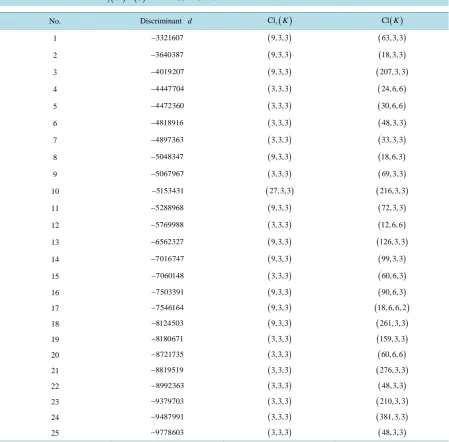
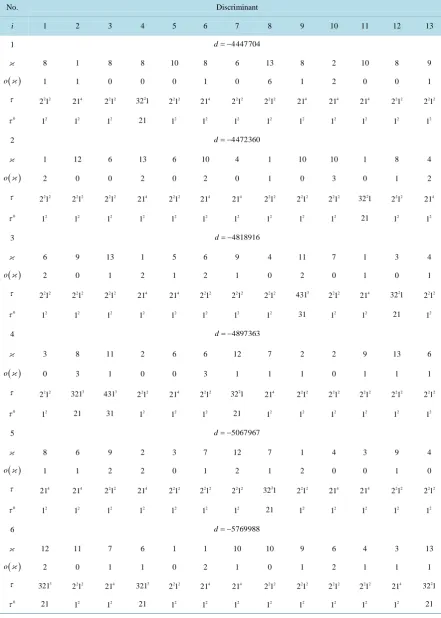
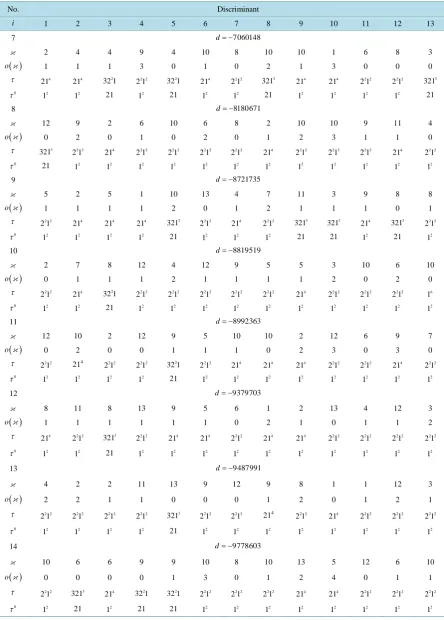
with the aid of MAGMA[4].According to Equation (20) in Theorem 3.2, the second 3-class group G of K must be of coclass cc
( )
G =2, and the polarized component 54 of the IPAD shows that c− = + =k 5 4 9 and thus the nilpotency class( )
clc= G and the defect of commutativity k are given by either c=9, k=0, or c=10, k=1. Further, in view of the rank-3 component 1 of the IPAD, 3 G must be a vertex of the coclass tree 2
(
729, 49)
.When we tried to determine the 3-principalization type :=1
(
3,K)
, Magma succeeded in calculating( )
1 =3 and
( )
2 =3 but unfortunately failed to give ( )
3 and ( )
4 . With respect to the complete IPAD, Theorem 4.1 enforces ( )
3 =1 (item (1)) and ( )
4 =3 (item (2)), and therefore the partial result(
3, 3, ,)
= ∗ ∗
is completed to =
(
3, 3,1, 3)
. According to item (3) of Remark 4.2 or item (3) of Corollary 4.1,K is of TKT H.4. Our experience suggests that this TKT compels the arrangement c=10, k=1, expressed by the weak leaf conjecture ([9], Cnj. 3.1, p. 423).
group of type
( )
3, 3 , we constructed the four unramified cyclic cubic extensions L Ki , 1≤ ≤i 4, and com- puted the IPAD τ( )1( )
K = 1 ; 21, 54, 212(
( )
2)
with the aid of MAGMA [4].According to Equation (20) in Theorem 3.2, the second 3-class group G of K must be of coclass
( )
cc G =2, and the polarized component 54 of the IPAD shows that c− = + =k 5 4 9 and thus the nilpotency class c=cl
( )
G and the defect of commutativity k are given by either c=9, k=0, or c=10, k=1. Further, due to the lack of a rank-3 component 1 in the IPAD, 3 G must be a vertex of the coclass tree(
)
2
729, 54
.
Next, we tried to determine the 3-principalization type :=1
(
3,K)
. Magma succeeded in calculating two fixed points ( )
1 =1 and ( )
2 =2 but unfortunately failed to give ( )
3 and ( )
4 . With respect to the complete IPAD, Theorem 4.2 enforces ( )
3 =3 or ( )
4 =4 (item (1)), and ( )
4 =2 or ( )
3 =2 (item (2)), and therefore the partial result =(
1, 2, ,∗ ∗)
is completed to =(
1, 2, 3, 2)
or =(
1, 2, 2, 4)
. According to item (1) of Remark 4.4 or item (3) of Corollary 4.2, K is of TKT E.8, and this TKT enforces the arrangement c=9, k=0, since k=1 is impossible.Example 5.5. For the discriminant d= −65433643 of the complex quadratic field K=
( )
d with 3- class group of type( )
3, 3 , we constructed the four unramified cyclic cubic extensions L Ki , 1≤ ≤i 4, and computed the IPAD τ( )1( )
K = 1 ; 65,1 , 212(
3( )
2)
with the aid of MAGMA [4].According to Equation (20) in Theorem 3.2, the second 3-class group G of K must be of coclass cc
( )
G =2, and the polarized component 65 of the IPAD shows that c− = + =k 6 5 11 and thus the nilpotency class( )
clc= G and the defect of commutativity k are given by either c=11, k=0, or c=12, k=1. Further, in view of the rank-3 component 1 of the IPAD, 3 G must be a vertex of the coclass tree 2
(
)
729, 49
.
Then we tried to determine the 3-principalization type :=1
(
3,K)
. Magma succeeded in calculating( )
1 =4 and
( )
2 =1 but unfortunately failed to give ( )
3 and ( )
4 . With respect to the complete IPAD, Theorem 4.1 enforces ( )
3 =2 and ( )
4 =2 (item (2)), whereas the claim in item (1) is confirmed, and therefore the partial result =(
4,1, ,∗ ∗)
is completed to =(
4,1, 2, 2)
. According to item (2) of Remark 4.2 or item (3) of Corollary 4.1, K is of TKT E.14, and this TKT enforces the arrangement c=11, k=0, since k=1 is impossible.6. Iterated IPADs of Second Order
In this section, where generally p=3, we apply iterated IPADs of second order for indirectly computing p- capitulation types in Section 6.1 and finding the exact length of p-class towers in Section 6.2.
6.1. p-Capitulation Type
By means of the following theorem, the exact 3-principalization type [9] [19] [21] of real quadratic fields
( )
K = d , d>0, can be determined indirectly with the aid of information on the structure of 3-class groups of number fields of absolute degree 6 3× =18.
Theorem 6.1. (Indirect computation of the p-capitulation type)
Suppose that p=3 and let K be a number field with 3-class group Cl3
( )
K of type( )
3, 3 and 3-towergroup G.
1) If the IPAD of K is given by
( )1
( )
2(
( )
2 3)
1 ; 21, 1
K
τ =
then by Equation (14) in Theorem 3.1,
( )
{
}
1, , cc 1, and 81,8 , 81, 9 , 81,10
G′′= GG G′′ G = G∈
in particular, the length of the 3-class tower of K is given by 3
( )
K =2.2) If the first layer Lyr1
( )
K of abelian unramified extensions of K consists of L1,,L4, then the iterated( )2
( )
( )
(
( ) ( )
)
( )
2 0 ; 0 i ; 1 i 1i 4 , with 0 1K K L L K
τ =τ τ τ ≤ ≤ τ =
admits a sharp decision about the group G and the first layer of the transfer kernel type
( )
K = 0( ) ( )
K ; 1 K ; 2( )
K where trivially 0( )
K =1, 2( )
K =0
( ) ( )
(
( )
)
( ) ( )
(
( )
)
3 2
0 1 1 1
2 2
0 1
; 21; 1 , 2 ,
; 1 ; 1 , , for 2 4,
i i
L L
L L i
τ τ
τ τ
=
= ≤ ≤
2 3
(25)
if and only if G 81,10 , and thus 1
( ) (
K = 1, 0, 0, 0)
.( ) ( )
(
( )
)
( ) ( )
( )
( ) ( )
(
( )
)
3 2
0 1 1 1
4 2 2
0 2 1 2
2 2
0 1
; 2 1; 1 , 2 ,
; 1 ; 1 ,
; 1 ; 1 , , for 3 4,
i i
L L
L L
L L i
τ τ
τ τ
τ τ
=
=
= ≤ ≤
3 2
(26)
if and only if G 81, 8 , and thus 1
( ) (
K = 2, 0, 0, 0)
.( ) ( )
(
( )
)
( ) ( )
( )
3 2
0 1 1 1
4
2 2
0 1
; 21; 1 , 2 ,
; 1 ; 1 , for 2 4,
i i
L L
L L i
τ τ
τ τ
=
= ≤ ≤
(27)
if and only if G 81, 9 , and thus 1
( ) (
K = 0, 0, 0, 0)
.Proof. It suffices to compute the iterated IPADs of the groups G= 81,8 9 10 with the aid of MAGMA [4], simply by investigating their four maximal normal subgroups HiG, 1≤ ≤i 4. □ Example 6.1. A possible future application of Theorem 6.1 could be, for instance, the separation of the capitulation types a.2, 1
( ) (
K = 1, 0, 0, 0)
, and a.3, 1( ) (
K = 2, 0, 0, 0)
, among the 1386 real quadratic fields( )
K = d , 7
0< <d 10 , with 3-class group Cl3
( )
K of type( )
3, 3 and IPAD( )1
( )
(
( )
3)
2 2
1 ; 21, 1
K
τ =
,
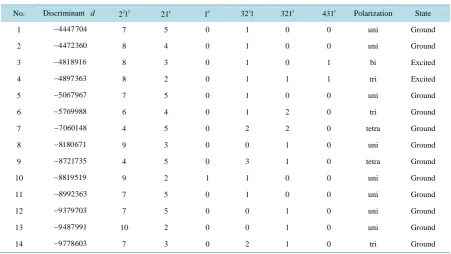
which was outside of our reach in all investigations of ([23], Tbl. 2, p. 496), ([5], Tbl. 6.1, p. 451) and ([9], Figure 3.2, p. 422). The reason why we expect this enterprise to be promising is that our experience with MAGMA [4] shows that computing class groups can become slow but remains sound and stable for huge discriminants d, whereas the calculation of capitulation kernels frequently fails.
6.2. Length of the p-Class Tower
In this section, we use the iterated IPAD of second order ( )
( )
( )
(
( ) ( )
)
( ) 12
0 ; 0 ; 1 L Lyr K
K K L L
τ = τ τ τ ∈
for the
indirect computation of the length p
( )
K of the p-class tower of a number field K with p-tower groupG, where p denotes a fixed prime.
We begin with theorems which permit a decision between finitely many possibilities for the length p
( )
K in Section 6.2.1. These results systematically extend the investigations of complex quadratic fields in [6] to arbitrary base fields K and yield the first examples of real quadratic fields having a p-class tower of exact length three. Then, in Section 6.2.3, we launch the first successful attack against quadratic fields K=( )
dwhose second p-class group G G′′ possesses an infinite cover ([16], Dfn.21.2), and for which the problem of finding the length p
( )
K was completely unsolved up to now [13]. In Section 6.2.2, some prerequisites con- cerning periodic bifurcations are provided.6.2.1. Second p-Class Groups with Finite Cover
In the following theorems, we must use extended identifiers[4] [24] [25] of finite 3-groups with order bigger than 3 , which lie outside of the SmallGroups database 7 [17] [18]. This was explained in ([16], Section 9).
Theorem 6.2. (Length 3
( )
K of the 3-class tower for(
)
2
243, 6
[image:12.595.79.538.83.367.2]Suppose that p=3 and let K be a number field with 3-class group Cl3
( )
K of type( )
3, 3 and 3-towergroup G.
1) If the IPAD of K is given by
( )1
( )
2(
3( )
2)
1 ; 32,1 , 21 K
τ =
and the first layer TKT 1
( )
K neither contains a total principalization nor a 2-cycle, then there are two possi-bilities 3
( ) { }
K ∈ 2, 3 for the length of the 3-class tower of K.2) If the first layer Lyr1
( )
K of abelian unramified extensions of K consists of L1,,L4, then the iteratedIPAD of second order
( )2
( )
( )
(
( ) ( )
)
( )
20 0 1 1 4 0
= ; i ; i , with 1
i
K K L L K
τ τ τ τ ≤ ≤ τ =
admits a sharp decision about the length 3
( )
K .( ) ( )
(
( )
)
( ) ( )
(
( ) ( )
)
( ) ( )
(
( )
)
3
2 2
0 1 1 1
9
3 2 2
0 2 1 2
2
0 1
; 32; 2 1, 31 ,
; 1 ; 2 1, , 1 ,
; 21; 2 1, , for 3 4,
i i
L L
L L
L L i
τ τ
τ τ
τ τ
=
=
= ≤ ≤
3 3
3
1
21
(28)
if and only if G 2187, 288 289 290 , and thus 3
( )
K =2.( ) ( )
(
( )
)
( ) ( )
(
( ) ( )
)
( ) ( )
(
( )
)
3
2 2
0 1 1 1
9
3 2 2
0 2 1 2
2
0 1
; 32; 2 1, 31 ,
; 1 ; 2 1, , 1 ,
; 21; 2 1, , for 3 4,
i i
L L
L L
L L i
τ τ
τ τ
τ τ
=
=
= ≤ ≤
3 2
3
21
31
(29)
if and only if G 729, 49 −#2;4 5 6, and thus 3
( )
K =3.Proof. According to Theorem 3.2, an IPAD of the form τ( )1
( )
K = 1 ; 32,1 , 212(
3( )
2)
indicates that the metabelianization of the group G belongs to the coclass tree 2(
243, 6)
([9], Figure 3.6, p. 442) and has nilpotency class 3 2+ =5, due to the polarization.According to Section 4.1, the lack of a total principalization excludes the TKT c.18 and the absence of a 2-cycle discourages the TKT H.4, whence the group G must be of TKT E.6 or E.14.
By means of the techniques described in ([6], Proof of Thm. 4.1), a search in the complete descendant tree
(
243, 6)
, not restricted to groups of coclass 2, yields exactly six candidates for the group G: three metabe- lian groups 2187,i with i∈
{
288, 289, 290}
, and three groups of derived length 3 and order 3 with gene- 8 ralized identifiers 729, 49 −#2;i(
i∈{
4, 5, 6}
)
. There cannot exist adequate groups of bigger orders ([6], Cor. 3.0.1). The former three groups are charcterized by Equations (28) the latter three groups (see [16], 21.2, Figure 8) by Equations (29).Finally, we have 3
( )
K =dl( )
G . □Theorem 6.3. (Length p
( )
K of the 3-class tower for(
)
2
243,8
G G′′∈ )
Suppose that p=3 and let K be a number field with 3-class group Cl3
( )
K of type( )
3, 3 and 3-towergroup G.
1) If the IPAD of K is given by
( )1
( )
2(
( )
3)
1 ; 32, 21 K
τ =
and the first layer TKT 1
( )
K neither contains a total principalization nor a 2-cycle, then there are two possi-bilities 3
( ) { }
K ∈ 2, 3 for the length of the 3-class tower of K.2) If the first layer Lyr1
( )
K of abelian unramified extensions of K consists of L1,,L4, then the iterated( )2
( )
( )
(
( ) ( )
)
( )
2 0 ; 0 i ; 1 i 1i 4 , with 0 1K K L L K
τ =τ τ τ ≤ ≤ τ =
admits a sharp decision about the length 3
( )
K .( ) ( )
(
( )
)
( ) ( )
(
( )
)
3
2 2
0 1 1 1
2
0 1
; 32; 2 1, 31 ,
; 21; 2 1, , for 2 4,
i i
L L
L L i
τ τ
τ τ
=
= ≤ ≤
21 3
(30)
if and only if G 2187, 302 304 306 , and thus 3
( )
K =2.( ) ( )
(
( )
)
( ) ( )
(
( )
)
3
2 2
0 1 1 1
2
0 1
; 32; 2 1, 31 ,
; 21; 2 1, , for 2 4,
i i
L L
L L i
τ τ
τ τ
=
= ≤ ≤
31 3
(31)
if and only if G 729, 54 −#2; 2 4 6, and thus 3
( )
K =3.Proof. According to Theorem 3.2, an IPAD of the form τ( )1
( )
K = 1 ; 32, 212(
( )
3)
indicates that the metabe- lianization of the group G belongs to the coclass tree 2(
243,8)
([9], Figure 3.7, p. 443) and has nil- potency class 3 2+ =5, due to the polarization.According to Section 4.2, the lack of a total principalization excludes the TKT c.21 and the absence of a 2-cycle discourages the TKT G.16, whence the group G must be of TKT E.8 or E.9.
As we have shown in detail in [6], Proof of Thm. 4.1], a search in the complete descendant tree
(
)
2
243,8
, not restricted to groups of coclass 2, yields exactly six candidates for the group G: three metabelian groups 2187,i with i∈
{
302, 304, 306}
, and three groups of derived length 3 and order 3 with 8 generalized identifiers 729, 54 −#2;i(
i∈{
2, 4, 6}
)
. There cannot exist adequate groups of bigger orders ([6], Cor. 3.0.1). The former three groups are characterized by Equations (30) the latter three groups (see [16], Section 21.2, Figure 9) by Equations (31).Eventually, the 3-tower length of K, 3
( )
K =dl( )
G , coincides with the derived length of G. □Example 6.2. (The first real quadratic field K with 3
( )
K =3.) In June 2006, we discovered the smallestdiscriminant D=342664 of a real quadratic field K=
( )
D with 3-class group of type( )
3, 3 whose 3-tower group G possesses the transfer kernel type E.9, =(
2, 3, 3, 4)
([19], Tbl. 4, p. 498).The complex quadratic analogue k=
(
−9748)
was known since 1934 by the famous paper of Scholz and Taussky [20]. However, it required almost 80 years until M.R. Bush and ourselves ([6], Cor. 4.1.1) succeeded in providing the first faultless proof that k has a 3-class tower of exact length 3( )
k =3 with 3-tower groupG isomorphic to one of the two Schur σ -groups 729, 54 −#2;i
(
i∈{ }
2, 6)
of order 3 . 8For K=
(
342664)
, the methods in [6] do not admit a final decision about the length 3( )
K . They onlyyield four possible 3-tower groups of K, namely either the two unbalanced groups 2187,i with i∈
{
302, 306}
and relation rank r=3 bigger than the generator rank d=2 or the two Schur σ -groups 729, 54 −#2;iwith i∈
{ }
2, 6 and r=2 equal to d=2.In October 2014, we succeeded in proving that three of the unramified cyclic cubic extensions L Ki reveal
the critical IPAD component τ1
( )
Li =(
2 1,2( )
)
3
31 in Equation (31) of Theorem 6.3, item (2), whence also 729, 54 #2; 2 6
G − and 3
( )
K =3. This was done by computing 3-class groups of number fields of ab- solute degree 6 × 3 = 18 with the aid of MAGMA [4].6.2.2. Another Descendant Tree with Periodic Bifurcations
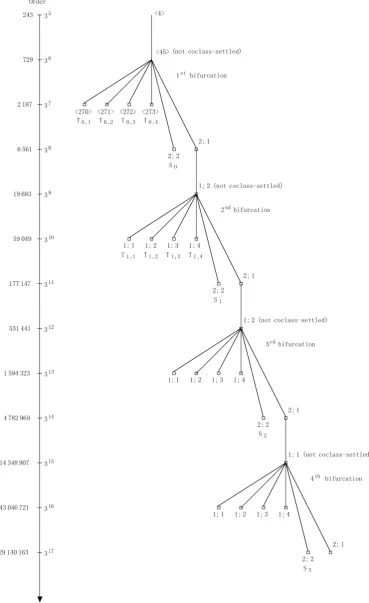
In ([16], Section 21.2), we provided computational evidence of periodic bifurcations in pruned descendant trees with roots 243, 6 8 . Now we want to show that the immediate descendant 729, 45 of another root
![Figure 3.2, pdiscriminants MAGMA . 422). The reason why we expect this enterprise to be promising is that our experience with [4] shows that computing class groups can become slow but remains sound and stable for huge , whereas the calculation of capitula](https://thumb-us.123doks.com/thumbv2/123dok_us/8140468.799395/12.595.79.538.83.367/pdiscriminants-enterprise-promising-experience-computing-remains-calculation-capitula.webp)