© 2016, IRJET | Impact Factor value: 4.45 | ISO 9001:2008 Certified Journal
| Page 1035
A survey of Super resolution Techniques
Krupali Ramavat
1, Prof. Mahasweta Joshi
2, Prof. Prashant B. Swadas
31.
P. G. Student, Dept. of Computer Engineering, Birla Vishwakarma Mahavidyalaya, Gujarat,India
2.Professor, Dept. of Computer Engineering, Birla Vishwakarma Mahavidyalaya, Gujarat, India
3.Professor, Dept. of Computer Engineering, Birla Vishwakarma Mahavidyalaya, Gujarat, India
---***---Abstract -
The image processing field is quite advance nowa days. Many important developments have taken place over the last three or four decades. Super Resolution is really very important subject for Image Processing. Super resolution describes increasing the resolution of an image using various algorithms and construct a high resolution image from one or more low resolution images. This paper reviews various super-resolution technique with their advantages and disadvantages. Finally presented challenge issues and future research directions for super resolution.
Key Words: Image resolution, Super resolution,
Interpolation, Wavelet transform, Learning, Reconstruction.
1. INTRODUCTION
Out of all five senses vision is most advanced, so it is not surprising that images play the single most important role in human perception. Most of all important applications for military and civilian, High Resolution images are required and always desirable [2]. Recent advances in image and video sensing have intensified user expectations on the visual quality of captured data [4]. Due to limitations like camera cost, power, memory size and limited bandwidth, it is not always possible to get high resolution image [3]. Image super-resolution produces a high-super-resolution image using one or more low-resolution images [1]. The subject has become really popular research area due to fact that High Resolution images contained more data which does not directly exist in the LR images. Resolution is determined by the pixel density [2].High Resolution image can be gained using various methods that can be classified into three types [1]:
1.1 Interpolation based:
Image interpolation [1], [2], [3], such as Bilinear and Bicubic is the most popular algorithm for simply resizing images, but it
cannot avoid undesired artifacts such as jagging and blurring[10].
1.2 Reconstruction based:
Reconstruction based techniques [7],[8] uses the pair relationship between Low Resolution image and High Resolution image, through this linear equations are developed and using these equations the pixel values can be connected of HR and LR images [1].
1.3 Learning based techniques:
In these methods [4], [5], [6], [9], [10], the correspondences between LR and HR image patches are first learned from a database of LR and HR image pairs, and then applied to a new LR image to recover its HR version [7].
2. RELATED WORK
Below are the important methods in super resolution and author’s main observations are listed below:
2.1
Wavelet Transform based interpolation
techniques:
© 2016, IRJET | Impact Factor value: 4.45 | ISO 9001:2008 Certified Journal
| Page 1036
rotation by 45 degree and up-sampling is proposed. Upsampling is done by a factor of 2. Up sampling creates space for the missing coefficients in the Curvelet domain and these coefficients are interpolated. A Curvelet transform based interpolation to form a single high resolution image. In [3], SWT and DWT both are applied to LR image. As SWT generates each sub band of the size of image while in DWT each sub band is half the size of image, so before DWT, Bicubic is used but it will not affect the size of image. The output sub-bands of both transform will pass through Gaussian filter which will remove the blurring effect. After IDWT up-sampling will provide the HR image.
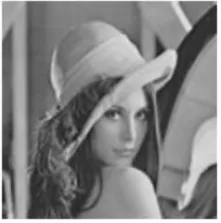
[image:2.595.105.216.272.384.2]Figure 1 Test Image
Table 1 PSNR for various Interpolation
Interpolation PSNR
Bicubic 32.61
Directional Cubic Convolution 27.74
Directional Filtering and Data Fusion
28.60
Iterative Curvature Based Interpolation
31.93
2.1
Restoration:
In [7], authors have established a new method for an edge-directed single-image super-resolution algorithm through using a new adaptive gradient magnitude self-interpolation. The proposed constraint HR with preserve image details or sharp edges, while suppressing the ringing, blocking, and blurring artifacts, especially along salient edges. In [8], Hybrid algorithm which are provided that adds the advantages of the simple Maximum Likelihood estimator and the capability of the Projection on to convex sets to
incorporate this problem. It is noticed that there is a capability of restoration of an image whose resolution is improved, based on several motionless blurred, decimated, and noisy images. This model enabled the direct generalization of classic tools from restoration.
2.2
Learning based:
Recently, example based SR reconstruction methods were introduced, which use direct image examples as a prior for proper regularization. Here, the dictionary is learnt from natural images and used to reconstruct HR image [4]. The approach requires a larger sized dictionary.
In [5] the authors overcome this by introducing a sparse representation method for compact dictionary learning. Consuming time is less and quality is better. This method however does not succeed in suppressing unwanted artifacts.
In [6] authors have trained HR dictionary via kernel PCA instead of linearly related dictionary. In recovering the detail of image these directories are important. A compact solution is proposed for the preparation of KPCA dictionary, and leads to real time SR application.
© 2016, IRJET | Impact Factor value: 4.45 | ISO 9001:2008 Certified Journal
| Page 1037
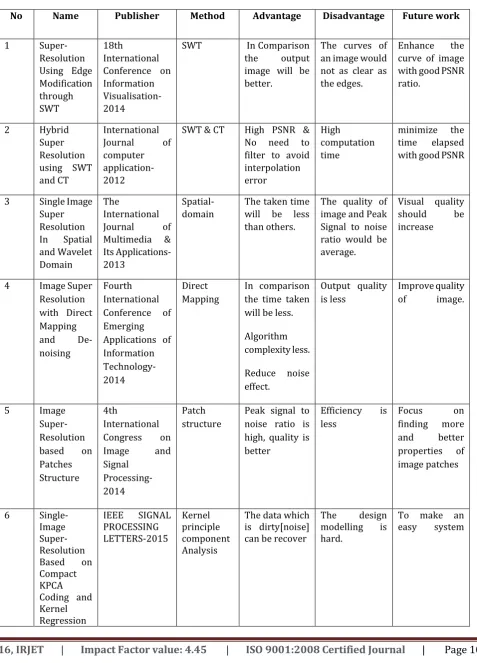
Table 2 Analysis of various methods
No Name Publisher Method Advantage Disadvantage Future work
1
Super-Resolution Using Edge Modification through SWT
18th
International Conference on Information Visualisation-2014
SWT In Comparison the output image will be better.
The curves of an image would not as clear as the edges.
Enhance the curve of image with good PSNR ratio.
2 Hybrid Super Resolution using SWT and CT
International Journal of computer application-2012
SWT & CT High PSNR & No need to filter to avoid interpolation error
High
computation time
minimize the time elapsed with good PSNR
3 Single Image Super Resolution In Spatial and Wavelet Domain
The
International Journal of Multimedia & Its Applications-2013
Spatial-domain
The taken time will be less than others.
The quality of image and Peak Signal to noise ratio would be average.
Visual quality should be increase
4 Image Super Resolution with Direct Mapping and De-noising
Fourth International Conference of Emerging Applications of Information Technology-2014
Direct Mapping
In comparison the time taken will be less.
Algorithm complexity less.
Reduce noise effect.
Output quality is less
Improve quality of image.
5 Image
Super-Resolution based on Patches Structure
4th
International Congress on Image and Signal
Processing-2014
Patch structure
Peak signal to noise ratio is high, quality is better
Efficiency is less
Focus on
finding more and better properties of image patches
6 Single-Image Super-Resolution Based on Compact KPCA Coding and Kernel Regression
IEEE SIGNAL PROCESSING LETTERS-2015 Kernel principle component Analysis
The data which is dirty[noise] can be recover
The design modelling is hard.
© 2016, IRJET | Impact Factor value: 4.45 | ISO 9001:2008 Certified Journal
| Page 1038
7
Edge-Directed Single-Image Super-Resolution via Adaptive Gradient Magnitude Self-Interpolatio n
IEEE
Transactions On Circuits And Systems For Video
Technology-2013
Gradient Sharpening [Adaptive]
The image is gained with shared edge
Computation time would be high
Time complexity should be decrease.
8 Restoration of a Single Super resolution Image from Several Blurred, Noisy, and Under sampled Measured Images
IEEE
TRANSACTIONS
ON IMAGE
PROCESSING-1997
Reconstruct
ion based Effectiveness of method is high as well as it is simple in comparison with others.
Computation time is high so as result the time taken by completing the process would be higher.
Reduce processing time.
9 Learning Multiple Linear Mappings for Efficient Single Image Super-Resolution
IEEE
TRANSACTIONS
ON IMAGE
PROCESSING-2015
Learning
based Noise effect is removed Efficiency of the process is not so good.
To improve system
performance.
10 Multi-Frame Example-Based Super-Resolution Using Locally Directional Self Similarity
IEEE
International Journal on Consumer Electronics-2015
Example
based The caused artifacts by interpolation would be removed.
Peak Signal to noise ratio is low.
To enhance image more time.
3. CONCLUSIONS
In this paper the various techniques for Super resolution is discussed. We have specified various methods for enhancement of resolution of an image. Advantage, Disadvantage and application of various technique is also included. In future by extension or integration of the above method a new method can be derived which can generate more detailed SR image as the result
REFERENCES
© 2016, IRJET | Impact Factor value: 4.45 | ISO 9001:2008 Certified Journal
| Page 1039
SWT and CT”. International Journal of ComputerApplications (0975 – 8887) Volume 59– No.7-2012.
[2] Davis, Deepa K., and Rajesh Cherian Roy. "Hybrid Super Resolution using SWT and CT." International Journal of Computer Applications 59.7 (2012).
[3] Naik, Sapan, and Nikunj Patel. "Single image super resolution in spatial and wavelet domain." arXiv preprint arXiv:1309.2057 (2013).
[4] Bhosale, Gaurav G., Ajinkya S. Deshmukh, and Swarup S. Medasani. "Image Super Resolution with Direct Mapping and De-Noising." Emerging Applications of Information Technology (EAIT), 2014 Fourth International Conference of. IEEE, 2014.
[5] Chen, Huahua, Baolin Jiang, and Weiqiang Chen. "Image super-resolution based on patches structure." Image and Signal Processing (CISP), 2011 4th International Congress on. Vol. 2. IEEE, 2011..
[6] Zhou, Fei, et al. "Single-image super-resolution based on compact KPCA coding and kernel regression." IEEE Signal Processing Letters 22.3 (2015): 336-340.
[7] Wang, Lingfeng, et al. "Edge-directed single-image super-resolution via adaptive gradient magnitude self-interpolation." IEEE Transactions on Circuits and Systems for Video Technology 23.8 (2013): 1289-1299.
[8] Elad, Michael, and Arie Feuer. "Restoration of a single superresolution image from several blurred, noisy, and undersampled measured images." IEEE transactions on image processing 6.12 (1997): 1646-1658.
[9] Zhang, Kaibing, et al. "Learning multiple linear mappings for efficient single image super-resolution." IEEE Transactions on Image Processing 24.3 (2015): 846-861.
[10] Jeong, Seokhwa, Inhye Yoon, and Joonki Paik. "Multi-frame example-based super-resolution using locally directional self-similarity." IEEE Transactions on Consumer Electronics 61.3 (2015): 353-358.