http://dx.doi.org/10.4236/ijoc.2014.44025
How to cite this paper: Lin, Q., Zheng, H.R., Zheng, G.C., Li, X.Z. and Lou, B.Y. (2014) Effects of Yttrium Doping on the Per-formance of Ru-Based Catalysts for Hydrogenation of Fatty Acid Methyl Ester. International Journal of Organic Chemistry, 4, 219-224. http://dx.doi.org/10.4236/ijoc.2014.44025
Effects of Yttrium Doping on the
Performance of Ru-Based Catalysts for
Hydrogenation of Fatty Acid Methyl Ester
Qi Lin
*, Huirong Zheng, Guocai Zheng, Xinzhong Li, Benyong Lou
Department of Chemistry and Chemical Engineering, Minjiang University, Fuzhou, China Email: *[email protected]
Received 8 August 2014; revised 25 September 2014; accepted 10 October 2014
Copyright © 2014 by authors and Scientific Research Publishing Inc.
This work is licensed under the Creative Commons Attribution International License (CC BY).
http://creativecommons.org/licenses/by/4.0/
Abstract
The highly dispersed supported ruthenium-yttrium (Ru-Y) bimetallic catalysts were prepared by impregnation method and their catalytic performance for hydrogenation of ester was fully inves-tigated. The catalyst was characterized by X-ray diffraction and field emission scanning electron microscopy. The results show that the average particle diameter of the bimetallic crystallites was less than 10 nm. The effects of the reaction temperature, the hydrogen pressure, the amount of catalyst and the proportion of yttrium in catalyst on the hydrogenation of ester were studied. The experimental results show that the introduction of yttrium not only changed the chemical and textural properties of ruthenium-based catalyst but also controlled the formation of Ru-Y alloy. The Ru-Y catalyst (Ru-2%Y/TiO2) exhibited high catalytic activity and good selectivity towards the higher alcohols. Under optimal reaction conditions of 240˚C and 5 MPa hydrogen pressure, the conversion of palm oil esters was above 93.4% while the selectivity towards alcohol was above 99.0%.
Keywords
Yttrium-Doped, Ruthenium-Based Catalyst, Fatty Acid Methyl Ester, Hydrogenation
1. Introduction
Fatty alcohols (FAlcs) and their derivatives are widely used as surfactants, lubricants, solvents, synthetic deter-gents, antifoaming adeter-gents, perfumes, cosmetics and pharmaceuticals, and as additives in many industrial prod-ucts [1]. Naturally, derived FAlcs approximately accounts for 65% of the world’s steadily growing fatty alcohol
demand. They are special products obtained from natural fats and oils by the hydrogenation of fatty acids or fat-ty acid methyl esters (FAME) [2]. The best method of converting an acid to the corresponding alcohol is through the esters because esters are less corrosive and can be reduced to alcohols with considerably higher yields, and esters can be obtained from acids in nearly quantitative yields.
Since the last century, the natural-fatty-alcohol-based surfactants have gained growing significance in the de-tergent market due to their excellent washing properties and superior biodegradability. Therefore, the hydroge-nation of FAME to the corresponding FAlcs is of great industrial importance. And the concern of catalyst re-search is raised because catalyst is the key technology for the effective production of FAlcs and the successful utilization of natural FAME. Many efforts have been made to develop high active catalysts [3] [4]. Most of these studies concentrated on the characterization of the catalyst or mechanism of the reaction but as lower catalytic activity or selectivity towards FAlcs.
During the last decade, the development of biodiesel has been emphasized. Biodiesel is defined as a fatty acid methyl ester obtained by the trans-esterification route of renewable biological sources with methanol. It can of-fer abundant feedstock for the hydrogenation to obtain FAlcs. Therefore, the research subject is to focus on im-proving the selectivity and yield of FALcs to the highest possible. It is reported that depositing the amorphous alloys on support [3] [5] [6] and adding promoters such as Au and Ag to the amorphous [7] are useful ways to improve their thermal stability and catalytic activity. In this study, the ruthenium-yttrium (Ru-Y) bimetallic cat-alysts were prepared through impregnation method and their performances of the hydrogenation of methyl pal-mitate to fatty alcohol were investigated. The effects of reaction conditions such as the reaction temperature, the hydrogen pressure, the proportion of yttrium, the amount of catalyst and the solvent on the hydrogenation of methyl palmitate were studied. The conversion of methyl palmitate could reach high at mild reaction conditions.
2. Experiment
2.1. Chemicals
RuCl3 (Sinopharm Chemical Reagent Co., Ltd., >99.6%), Y(NO3)3 (Sinopharm Chemical Reagent Co., Ltd., >99.9%),
Methyl palmitate (Aladdin Reagent Co. Ltd., >99.9%), TiO2 (100 - 160 mero), hydrogen (99.99%) and the other
reagents were used as received.
2.2. Preparation of Catalyst
All the catalysts were prepared by the impregnation method in aqueous suspensions. The metallic precursors (such as ruthenium chloride and yttrium nitrate) were dissolved in deionic water. Then, the titania was impreg-nated with above solution for overnight. And water was employed by evaporation at 333 K for 5 h. Next, the samples were dried at 393 K for 12 h. The solids were subjected to calcination treatment for 4 h at 673 K under air flow and reduced by hydrogen for 3 h at 453 K.
In order to eliminate the surface acidity of the catalyst, the catalyst was treated with barium nitrate and washed with deionic water until the absence of barium cations. The solids were dried for 6 h under vacuum. For the bimetallic catalysts, with moninal concentration of 5 wt% in Ru and 2.5 wt% in Y was employed, designated as 5% Ru - 2.5% Y/TiO2.
2.3. Characterization of the Supported Catalyst
The powder XRD patterns were recorded at room temperature on a Philips X’ Pert Pro MPD X-ray diffraction with Cu-Kαradiation at 50 kV and 35 mA. The 2θ angles were scanned from 15˚ to 75˚ at a rate of 0.1(˚)/s. High-resolution TEM (HRTEM) images were obtained on a Philips TECNAIF-30 FEG instrument at an accele-rating voltage of 300 V. The sample was dispersed with dry ethanol.
2.4. Investigation on the Catalytic Activity
car-ried out under the designed conditions for a desired time. After the reaction, the autoclave was quickly cooled in a water bath and vented. The liquid products were separated from the reaction mixture by decantation and ana-lyzed by GC 4002A (SUPELCOWAXTM10 0.25 mm × 0.25 μm × 30 m), incorporating an FID detector. The solid residue obtained was reused in the next reaction.
3. Results and Discussion
3.1. Characterization of the Supported Catalyst
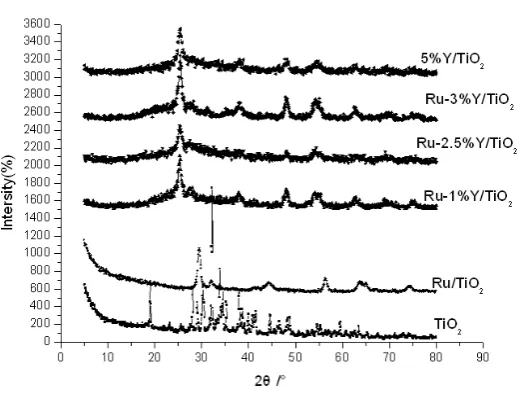
In order to further identify the crystalline phase of Ru in the catalyst, power X-ray diffraction patterns of the six solids with different metal loadings were obtained, as shown in Figure 1. The XRD pattern of titania exhibit the typical reflections of titania at 18˚. The XRD patterns of Ru/TiO2 exhibit the typical reflections at 29˚, 55˚ and
64˚. As the yttrium dopes on the Ru-based catalyst, the typical reflection of yttrium at 38˚ and 48˚ were found. Meanwhile, the characteristic peak of ruthenium (29˚) shifts slightly from 29˚ to 25˚ while the other peaks are still observed. As the yttrium loadings increase from 1wt% to 2.5 wt%, the ruthenium peaks are remarkably weakened and the other low-angle reflection peaks almost disappear. Further increasing the yttrium loadings, the characteristic peaks of ruthenium and yttrium are still observed again. This indicates that Ru and Y species are highly dispersed in the support, which is possible due to the not calcinated catalyst. This is probably caused by yttrium entering into the interspaces of titania and forming the Ru-Y alloy at the surface of the catalyst, which is in agreement with other reports [2]. According to the above analysis, it is assumed that the size distribution of the highly dispersed Ru and Y crystallites is small when w(Y) was 2.5 wt%. The deduction is also confirmed by the TEM images shown in Figure 2.
3.2. Catalytic activity of Ru-Y/TiO
23.2.1. Effect of Y Doping Amounts on the Catalytic Activity
To evaluate the catalytic activity of Ru-Y/TiO2, the hydrogenation of methyl palmitate was chosen as a probing
reaction. In all the runs, the selectivity for 1-hexadecanol in the products was more than 99%, only trace amounts of by-products palmitic acid were detected by GC-MS.
In order to investigate the effect of the amount of Y in catalyst on the hydrogenation, several kinds of cata-lysts with different amount of Y were used in the hydrogenation of methyl palmitate. It is clear fromTable 1 that the amount of Y shows a significant influence on the catalytic activity for hydrogenation of methyl palmi-tate. It is evident that conversion rates increase with Y doping amounts and selectivity is all above 99.9%. When
CH3OH
H2 +
+
CH3(CH2)14COOCH3 CH3(CH2)14CH2OH
[image:3.595.184.446.508.706.2]Scheme1.Hydrogenation of methyl palmitate.
Figure 2.The TEM pictures of Ru-Y/TiO2 catalysts.
Table 1. Effect of the amount of yttrium on the catalytic activity.
The amount of yttrium % 0 0.5 1 1.5 2 5*
Conversion (%) 10.4 29.3 72.5 75.8 93.4 0
Reaction conditions: catalyst 30 mg, methyl palmitate 1.85 mmol, cyclohexane 1 mL, 220˚C, 5 MPa, 10 h. *
The supported catalyst was Y/TiO2.
Y doping amount is 0.5%, the conversion rate is just 29.3%. However, when Y doping amount is 2%, the con-version rate reached up to 93.4%. The doping of rare earth metals is one of the efficient methods to improve the activity of supported metal catalysts. This is probably due to the 4f electrons in Y electronic structure. Its out-ermost electronic structure is 4f1+n5d0-16s2. Most of the earth metals have no 5d electron, so they could easily lose two 6s electrons, one d electron or f electron to form trivalent cations whose outermost electron configura-tion is 4fn5s26p2. From the electronic structure, the 5d orbital is empty, which provides a good electron transfer-ring orbital and could be used as an electron transfertransfer-ring station with catalytic action. With the increasing of Y doping amounts, Y scrambles for electrons to reduce the composite of electron hole pair on TiO2 surface so that
more O2− or O2−OH are generated on the catalyst surface which has higher catalytic activity. Meanwhile, the specific electronic structure and larger radius of earth metals lead to lattice expansion on Ru/TiO2 surface, which
3.2.2. Effect of Temperature on the Catalytic Activity
The effect of temperature on the catalytic activity is shown in Table 2. It is clear from Table 2that the temper-ature also shows a significant influence on the catalytic activity for the hydrogenation of ester. The results indi-cate that the activity increases when the temperature rises from 180˚C to 240˚C. The tendency is similar to that of the hydrogenation of ester catalysed by Ru-based catalyst.
3.2.3. Effect of Hydrogen on the Catalytic Activity
Under the same conditions, the effect of the hydrogen pressure on the hydrogenation reaction of methyl palmi-tate was studied by altering the hydrogen pressure. When using 1.85 mmol methyl palmipalmi-tate, 30 mg catalyst and 1 mL cyclohexane at 220˚C for 10 h, the results are listed inTable 3. It indicates that the activity increases when the pressure rises from 3 MPa to 7 MPa. Higher pressure could increase the concentration of hydrogen in the solution and thereby accelerates the hydrogenation.
3.2.4. Recycling of the Catalyst
To investigate the stability of catalyst, the reaction mixture was separated from the catalyst by decantation after the reaction and analyzed by GC. The catalyst was directly reused for the next run. The results of hydrogenation are shown inTable4. No dramatic fall in the catalytic activity is observed at any point of time during the seven experiments, which further confirms the fact that the active metals are immobilized at the surface of titania. It is noteworthy that the catalytic activity of Ru-Y/TiO2 increases to some extent in the recycling experiments, which
further indicates that there is an induction time to form the catalytical active species. In the successive recycling runs, no induction time is needed for the high catalytic activity.
4. Conclusion
The supported ruthenium-yttrium bimetallic catalysts were prepared by impregnation and their catalytic perfor-mances for hydrogenation of ester were evaluated. The XRD and TEM results reveal that the active metals are highly dispersed and the alloy is formed by Ru with Y. The catalytic results indicate that the catalytic activity of Ru-Y/TiO2 depends on the loading of yttrium. The ruthenium-yttrium catalyst (Ru-2%Y/TiO2) exhibits high
catalytic activity and good selectivity towards the higher alcohols compared with Ru/TiO2 and Y/TiO2.
Fur-thermore, the catalyst can be easily separated from the organic products and reused for seven times without sig-nificant decrease of activity and selectivity.
Acknowledgements
[image:5.595.87.539.504.552.2]This work was supported financially by the Great Science & Technology Research Program from Fujian Province
Table 2. Effect of temperature on the catalytic activity.
Temp. (˚C) 180 200 220 230 240 250
Conversion (%) 3.9 7.5 23.2 29.3 50.3 65.7
Reaction conditions: catalyst 25 mg, methyl palmitate 1.85 mmol, cyclohexane 1 mL, 5 MPa, 10 h.
Table 3. Effect of hydrogen on the catalytic activity.
PH2 (MPa) 3 4 5 6 7
Conversion (%) 38.0 56.2 72.5 74.8 78.2
Reaction conditions: catalyst 25 mg, methyl palmitate 1.85 mmol, cyclohexane 1 mL, 220˚C, 10 h
Table 4. Recycling experiment of the catalyst.
Cycle 1 2 3 4 5 6 7
Conversion (%) 43.1 44.5 47.4 49.3 56.9 52.1 50.6
of China (Project No. 2011H6021), the Nature Science Foundation of Fujian Province of China (Project No. 2013J01053), the Science & Technology Research Program from Education Office of Fujian Province (Project No. JA12268) and the Science & Technology Research Program of Fuzhou Municipal, China (Project No. 2012-G-128).
References
[1] Weissermel, K. and Arpe, H.-J. (1994) Industrielle Organische Chemie. 4th Edition, VCH Verlagsgesellschaft mbH, Deerfield Beach.
[2] Echeverri, D.A., Marín, J., Restrepo, G. and Riso, L. (2009) Characterization and Carbonylic Hydrogenation of Methyl Oleate over Ru-Sn/Al2O3: Effects of Metal Precursor and Chlorine Removal. Applied Catalysis A: General, 366, 342-
347. http://dx.doi.org/10.1016/j.apcata.2009.07.029
[3] Yuan, P., Liu, Z.Y., Sun, H.J. and Liu, S.C. (2010) Influence of Calcination Temperature on the Performance of Cu-Al-Ba Catalyst for Hydrogenation of Esters to Alcohols. Acta Physico-Chimica Sinica, 26, 2235-2241.
http://dx.doi.org/10.3866/PKU.WHXB20100642
[4] Figueiredo, F.C.A., Jordão, E. and Carvalho, W. (2008) Adipic Ester Hydrogenation Catalyzed by Platinum Supported in Alumina, Titania and Pillared Clays. Applied Catalysis A: General, 351,259-266.
http://dx.doi.org/10.1016/j.apcata.2008.09.027
[5] He, L., Li, X., Lin, W., Cheng, H., Yu, Y., Fujita, S., Arai, M. and Zhao, F. (2014) The Selective Hydrogenation of Ethyl Stearate to Stearyl Alcohol over Cu/Fe Bimetallic Catalysts. Journal of Molecular Catalysis A: Chemical, 392,143- 149. http://dx.doi.org/10.1016/j.molcata.2014.05.009
[6] Vigier, K., Pouilloux, Y. and Barrault, J. (2012) High Efficiency CoSn/ZnO Catalysts for the Hydrogenation of Methyl Oleate. Catalysis Today, 195,71-75. http://dx.doi.org/10.1016/j.cattod.2012.04.027
[7] Zheng, J., Lin, H., Wang, Y., Zheng, X., Duan, X. and Yuan, Y. (2013) Efficient Low-Temperature Selective Hydro- genation of Esters on Bimetallic Au-Ag/SBA-15 Catalyst. Journal of Catalysis, 297,110-118.