Use of regression trees in the study
of nonparametric wage structures
by
Ricardo Mora
Thesis submitted for the degree of doctor of Philosophy (PhD) on February, 1998
at
All rights reserved
INFORMATION TO ALL USERS
The quality of this reproduction is dependent upon the quality of the copy submitted.
In the unlikely event that the author did not send a complete manuscript and there are missing pages, these will be noted. Also, if material had to be removed,
a note will indicate the deletion.
Dissertation Publishing
UMI U615554
Published by ProQuest LLC 2014. Copyright in the Dissertation held by the Author. Microform Edition © ProQuest LLC.
All rights reserved. This work is protected against unauthorized copying under Title 17, United States Code.
ProQuest LLC
789 East Eisenhower Parkway P.O. Box 1346
IH£SC
S
F
My foremost thanks are due to Danny Quah for his supervision and encouragement over the last four years. My thanks should also go to Irini Moustaki and Pedro Delicado not only for their advice and helpful comments but also for their kind readiness to help whenever asked. I want to express my thanks to all members of the Economics Department at the London School of Economics where I have found a very friendly and encouraging environment. Financial
support from the Bank of Spain is also greatly acknowledged.
Abstract
This study is concerned with the application of multivariate
nonparametric models known as regression trees to the analysis of the
U.S. wage structure. In Chapter 1, I first review regression trees and
other available multivariate nonparametric techniques, highlighting
their differences and common features. In the second part of Chapter 1,
I look at the literature on the U.S. wage structure in connection with
the issue of functional specification and argue that regression trees
is particularly well suited for analyzing wage structures. In Chapter
2, I implement regression trees on U.S. wages for white male workers to
estimate experience-wage profiles and unveil local sudden breaks in the
profiles at the end of the working life. For 1980, these breaks account
for about 50% of the negative average differential between the last two
experience groups. This effect decreases continuously until 1995. In
Chapter 3 I propose a simple extension of the Oaxaca-type average wage
gap decompositions between any two groups of workers. This procedure
can be carried out without any compromise in the interpretation using
a nonparametric wage structure. I then study wage gap decompositions
for Mexican workers in the U.S. labor market. Finally, in Chapter 4 I
apply regression trees to study both the relative growth performance of
workers' real wages and the sources of wage dispersion and its
evolution in the U.S. from 1980 onwards. On trends, the technique
uncovers a linear structure for the growth experience of white workers
with less than forty years of experience. On dispersion, at least 10%
of the increase in observed variance came from changes in the structure
page
Acknowledgements 2
Abstract 3
Contents 4
List of tables 7
List of figures 9
1 Introduction:
Regression
trees and nonparametric
wage structures
12
1.1 Regression trees and predictive learning 12 1.1.1 Least squares parametric regression 18 1.1.2 Single hidden layer artificial neural
networks 19
1.1.3 Projection pursuit and multiple hidden
layer artificial neural networks 22
1.1.4 Tree structures 23
1.1.5 Universal approximators 25
1.2 Estimation of regression trees 26
1.3 Regression trees in economics 34
1.3.1 A classification algorithm 34
1.3.2 Melon prices 36
1.3.3 Multiple growth regimes 37
1.4 Nonparametric Wage Structures 39
1.4.1 Wage structures 39
Contents
the U.S. wage structure 42
1.5 Outline of the thesis 49
1.5.1 Outline of the thesis 49
1.5.2 Data and programming 51
Appendix A 55
2 Tree estimation of experience-wage profiles
59
2.1 Introduction 59
2.2 The theoretical framework 62
2.2.1 Ben-Porath (1967) 66
2.2.2 Uncertainty and human capital 74 2.2.3 A simple model of uncertainty in the
depreciation of human capital 75
2.3 The econometric model 81
2.4 Empirical results 85
2.5 Conclusions 103
Appendix A 105
Appendix B 112
3 Decomposition of average
wage differentials for
nonparametric wage structures: An application
to Mexican workers in the
U.S.
114
3.1 Introduction 114
3.2.1 The parametric approach 116 3.2.2 Nonparametric decompositions 121
3.3 Empirical findings 124
3.3.1 Parametric and nonparametric average wage gap decompositions for workers of
Mexican origin 124
3.3.2 Average non-Hispanic-Mexican wage
differentials in the border states 137
3.4 Conclusions 141
Appendix A 143
Appendix B 147
Appendix C 154
An application of regression trees to the
analysis of the evolution of the U.S. wage
structure since 1980
155
4.1 Introduction: Relative growth performance
and dispersion changes in wages 155
4.2 Random fields and dynamic wage structures 158
4.2.1 Dynamic wage structures 158
4.2.2 A dynamic index model for dynamic
wage structures 160
4.3 A review of trend estimators 166
4.4 Trends in U.S. real wages 171
Contents
4.4.2 Empirical results 175
4.5 Wage dispersion and nonparametric dynamic
wage structures 181
4.6 Conclusions 190
Appendix A 193
Appendix B 197
Appendix C 199
5
Conclusions
2092.1 Goodness-of-fit results for logwage regressions.
Human capital specification 89
2.2 Experience wage differentials in the nonparametric
surfaces and vintage effects 93
2.3 General breaks in accumulation paths and experience profiles 95 2.4 Parametric specification searches for each type of
worker along the nonparametric surfaces 97 2.5 Tests for sudden losses of human capital 100 2.6 Effects on average wages at each level of experience
of human capital 102
2.7 No. of observations in each cell. 1980 110 2.8 No. of observations in each cell. 1985 110 2.9 No. of observations in each cell. 1990 111 2.10 No. of observations in each cell. 1995 111 3.1 Regression results: Goodness-of-fit measures for
the Mex data set 124
3.2 Average wage decompositions. Mex data. Reference variable: Country of birth. Reference worker: born
in Mexico 133
3.3 Average wage decompositions. Mex data. Reference
variable: Ethnic. Reference worker: Mexicano 136 3.4 Average Wage Decompositions. Texmex data. Reference
variable: Ethnicity. Reference worker: Mexican
Liat of
4.1 Main growth experiences from regression trees. Latent growth indicator. Trends data.1980-1995
4.2 Growth structure for white workers with less than 40 years of experience. Trends data
4.3 Regression trees: Validation results. Dispersion data. 1980-1995
4.4 Wages and tree residuals. Dispersion data. Basic statistics
4.5 The effect of structural change in observed wages dispersion. Dispersion data.1980-1995
4.6 The effect of structural change. Correlation matrix. Dispersion data.1980-1995
4.7 Simulation results
tabl«s
179
181
184
186
187
1.1 2D representation of structure f(x1#x2) 55 1.2 Binary tree representation of structure f(x1/x2) 56 1.3 Binary tree representation of a 4-dimensional tree
structure 57
1.4 2D representation of a general tree structure 58 2.1 Average wages of white, male, nonfarm, full-time
employed workers 105
2.2 Experience-wage profiles. Unweighted averages of
nonparametric projections. 1980 106
2.3 Experience-wage profiles. Unweighted averages of
nonparametric projections. 1985 107
2.4 Experience-wage profiles. Unweighted averages of
nonparametric projections. 1990 108
2.5 Experience-wage profiles. Unweighted averages of
nonparametric projections. 1995 109
3.1 Average residual sum of squares for the sequence of
optimal subtrees .Estimation and Test Samples. Mex data 147
3.2 Tree T21. Mex data 148
3.3 Wage differentials projected by T21 between workers born in the U.S. and workers b o m in Mexico 149 3.4 Wage differentials projected by T21 between
Mexican-Americans and Mexicanos 150
3.5 Residual sum of squares for the sequence of optimal
subtrees. Test Sample. Texmex data 151
List of figurss
3.7 Wage differentials projected by T8 between Mexican and White Nonhispanic
4.1 Latent growth indicator vs average rates. Trends data Estimation sample. 1980-1995
4.2 Latent growth indicators vs average rates. Trends data Test sample.1980-1995
4.3 Histogram for latent growth indicator. Trends data. Estimation sample. 1980-1995
4.4 Histogram for latent growth indicator. Trends data. Test sample. 1980-1995
4.5 Residual sum of squares for the sequence of optimal trees. Trends data. Latent growth estimator
4.6 Tree T182. Trends data
4.7 Histogram for regression tree test sample residuals. Dispersion data. 1980
4.8 Histogram for regression tree test sample residuals. Dispersion data. 1985
4.9 Histogram for regression tree test sample residuals. Dispersion data. 1990
4.10 Histogram for regression tree test sample residuals. Dispersion data. 1995
153
199
200
201
202
203 204
205
206
207
Introduction: Regression trees and nonparametric
wage structures
In the following chapters I will be concerned with the
application of multivariate nonparametric models known as
regression trees to the analysis of the U.S. wage structure. In
this chapter, I first review neural networks, projection pursuit
and regression trees -all of them available multivariate
nonparametric techniques-. Then, I present a brief survey on
empirical results on the wage structure in the U.S. labor
market. The chapter ends with an outline of the rest of the
thesis.
1.1 Regression trees and predictive learning
Mathematics, statistics, engineering, artificial intelligence,
Chapter 1: Introduction
learning. A simple example of a predictive learning problem
involves one set of variables, sometimes called inputs,
sometimes called explanatory variables, and other times called
independent variables, and just one variable called either
output, response, or dependent variable. This variable is
defined over a subset of the real line1.
The problem can consist of designing a system with which
interpolations of the output can be obtained from the inputs.
This is a mathematical problem called function approximation.
If some of the inputs are not observable, the mathematical model
is of a statistical nature. Let the model be
y = f ( x 1 , • • • ,xn) + e = f (x) + e. (1.1)
In (1.1) I assume an additive relation for the two sets of
independent variables. The residual e is the effect of all the
unobserved variables on the dependent variable. A fixed effect
can be thought both as an observed constant effect and as the
effect of a constant unobserved variable. This makes model (1.1)
ambiguous. To solve this ambiguity, the unobserved residual e
can be defined by E[e|x]=0 where E[] is the expectation
operator.
The objective of predictive learning is to obtain a useful
1 In statistics, when the response is categorical, the
approximation to f(x)=E[y|x].
Neural networks use finite learning samples {yi/X^ and learning
algorithms to produce outputs f* in response to inputs x* and
adapt its outputs f* according to residuals { (yi-f*(Xi) ) }iB
Statistics seeks to obtain true approximations of f on the local
area defined by the finite sample {y^x.^. Thus, the stress in
statistics is on validating results while the stress in neural
networks is on learning.
Predictive learning is implemented through an optimization
problem on a finite sample. The objective function could be
An infinite number of functions can yield the minimum value,
zero, for the solution in (1.2). In order to obtain a well
defined problem in finite samples2, further assumptions must be
2 The similar problem for a "sample of infinite size" is
well defined in the sense that only f (•) will be the solution
of the problem. Thus,
f (x) (1 .2 )
f (x)
g
+ e - g (x) ] 2 p (x) dx.
Chapter 1: Introduction
added. Every predictive learning method can be characterized as
a set of constraints on problem (1.2).
There are two general forms of restrictions. The first way to
restrict the problem is to place constraints on the class of
eligible functions g(x). The second alternative consists of
selecting a small number of input variables, so that the
dimension of the variable space is small relative to the finite
sample.
For high dimensional spaces, the second alternative is in many
practical cases not feasible. The reasons are generally known
as the curse of dimensionality. Firstly, there is the problem
of minimum required number of observations to have a densely
packed sample. If 100 observations represents a dense sample for
a single input system, then for xeRN, the required sample would
be 100N. For 10 input variables we would need 1020 observations.
Secondly, all observations are close to an edge of the sample3.
Consider a sample of three observations in a one-dimensional
problem. Two of the observations must be at the edge of the
sample. If you add a new dimension (input) to the problem, all
three observations will be at the edge, making interpolation
impossible.
3 That is, there are no more observations between that
The only way to overcome these problems in a high dimensional
setup is by incorporating outside knowledge -knowledge not
related to the sample- in the way of functional restrictions.
A direct way of doing this is by incorporating a penalty to
criterion (1.2):
The best penalty <p>0 is one that has small values for those g(x)
that are close to f (x) and large values otherwise. The strength
parameter A is inserted so that the penalty effect can be
adjusted independently from its form.
If no restriction is imposed on A, then we might want to solve
the two-step problem:
However, this is not very interesting since (1.4) always yields
The best fit is given by the solution without penalty. This fit,
however, may be very poor for any other independent sample,
i.e., the estimated surface may have very low predictive power.
A common approach to overcome overfitting is to divide the
sample into a learning and a test sample. The learning sample
f (x) (1.3)
(1.4)
Chapter 1: Introduction
pursuit, neural networks, and regression trees5. The objective
is to highlight what is common between these methods and what
characterizes regression trees more neatly.
1.1.1 Least squares parametric regression
Penalty function 0 takes the form
where h(*) is a continuous, doubly differentiable function with
respect to 8 that is completely specified but for a finite
number of unknown parameters in 0.
Problem (1.3) collapses to
The choice of A becomes irrelevant and there is no need for
cross-validation.
5 For an introduction of neural networks, see e.g. Kuan and
White (1994). See Huber (1984) for a review on projection
pursuit. The basic reference for regression trees is Breiman et
alia (1984). These are the most popular predictive learning
models.
<t> [g (x) ] = - if g(x) + h(x | 01,...,8k)
4>
[g
(x) ] = 0 if g (x) = h(x I 0lf . . ., 0k) , (1.6)= argmin 0x e*
Assuming certain statistical properties for the error term, e,
leads to a complete inferential theory.
The function h(*) needs not be linear, as it is the case of the
binary logit probability model, where
h(x | 9) = G (x, 0) = --- ---- -— . (1.8)
1 + exp (-x 6)
This is a multivariate nonlinear model and can be thought of as
a three-layer system. The first layer corresponds to the inputs,
x. The second layer is the linear index of the inputs, x' 0. The
third layer is the output h(*).
The model is flexible in the sense of giving nonlinear responses
because of the nonlinear relation between the second and the
third layer. This fundamental source of flexibility is fully
exploited in artificial neural networks, projection pursuit, and
regression trees.
1.1.2 Single hidden layer artificial neural networks
Penalty function <p now takes the form
<J>[g(x) ] = °° if g(x) f J h T(x | 0) J (19)
<t>Cg(3c)] = p(9)< 00 else
Chapter 1: Introduction
h (x|a,y) = ]fcat ’ s( x V t ) (1.10)
t-i
and s(*) is any smooth sigmoid function such that 0£s(*)£l
Thus, G(*) in (1.8) is one of such functions6.
The indicator function
1 if p true
I(li) = (1.11)
0 if p false
was chosen as s (• ) in the first published articles on neural
networks. The indicator function is an activation devise. It
incorporates a new structure to model (1.10) when a threshold
is overcome in an index or hidden layer.
For some applications, smooth functions as activation devices
seem more useful than step functions. In biological neural
systems there is a tendency of certain types of neurons to be
idle in the presence of low levels of observed input activity,
and to become active only after input activity passes a
threshold. However, in empirical studies the threshold cannot
Another common example is the arctangent function:
1 _ -l 1 s (z) = — tan z + — .
be properly detected when the problem is highly complex, as when
there are millions of switches. Therefore, it is probably a
better modelling strategy to bet on smooth activation functions,
where the threshold is blurred.
There are three ways in which (1.10) generalizes over (1.8).
Although model (1.10) has also three layers, its second layer
is more complex than the second layer in model (1.8). This layer
is usually called the hidden layer in the neural network
literature. The number of elements in the hidden layer is not
fixed to one, but chosen in the optimization. The second way in
which model (1.10) is more general is that each component of the
second layer affects the output independently. The extent to
which it does so, am, must also be estimated. The smooth
activation function, s (•), can be chosen from several
alternatives. Finally, cross-validation is crucial and the
selection of p ( ‘ ) will influence the complexity of the
estimated model.
The role of s (• ) is pivotal in understanding the potential
applicability of neural networks. When s(*) is near 1, then the
corresponding am intensively affects the output. If it is near
zero, the output is almost not affected by that element. One can
think of the elements of the hidden layers as rules, which will
specially apply under particular conditions in the inputs. This
feature is known in artificial neural networks as context
Chapter 1: Introduction
correctly regarded as a feature of the model’s flexibility.
When the number of elements in the hidden layer is assumed to
be known, consistency results are obtained for backpropagation
estimates of model (1.10). See for example Kuan and White (1994) for consistency and asymptotic normality results.
1.1.3 Projection pursuit and multiple hidden layer artificial
neural networks
In these two cases, penalty functions <p take the same general
form as in (1.9). In projection pursuit the family of functions
{hT} are
so that projection pursuit can be seen as a generalization from
single hidden layer artificial neural networks. The functions
st(•) need not have a sigmoid form and, for example, smoothers
on local linear fits can be chosen to estimate their shape.
Multiple hidden layer artificial neural networks are also more
general models than single hidden layer models. Four layer
neural networks have two hidden layers. The outputs from the
first hidden layer are taken as the inputs for the second hidden
layer. In practice, hT (•) will have a more flexible structure
than a single hidden layer with the same number of elements in
each layer.
Whether adding more hidden layers improves prediction will
depend on how well the resulting effect of the functions hT (•)
matches f (•) •
1.1.4 Tree structures
Tree structured models have penalty functions similar to that
in (1.9). The family hT(•) includes all functions with the
generic form
where I (•) is the indicator function and T is a partition of the
Usually, the subsets teT are restricted to be hyper-rectangles
parallel to the coordinate axis, so that
where the parameters {Uj,v-j} are the respective lower and upper
limit of the region on each axis.
Thus, hT(• ) can also be expressed as
hT (x|a) = £ at l( x e t) (1.13) teT
space of all possible values of x, RM.
j-i
(1.14)
Chapter 1: Introduction
These models borrow their name from the fact that they can be
represented by two-dimensional binary trees. This is not a small
advantage in a high dimensional nonparametric context.
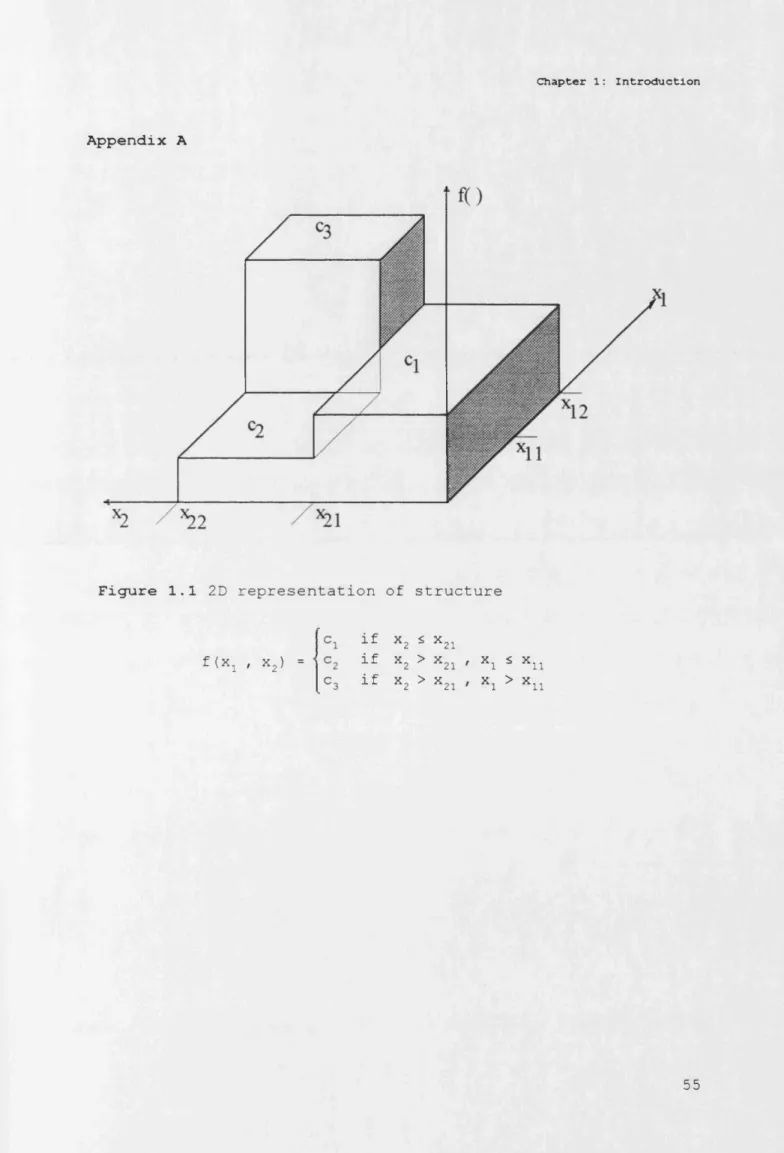
Consider, as an example, the following tree structure defined
on the set C2={[0,xi2], xi26R, i=l,2}
f(xx , x2)
if x2 £ x21 if x2 > x21 if x2 > x21
x i * x n
xi > xii
(1.16)
Figure 1.1 in Appendix A shows a two-dimensional representation
of this three-dimensional surface. If the structure had more
inputs, it would not be possible to draw this graph.
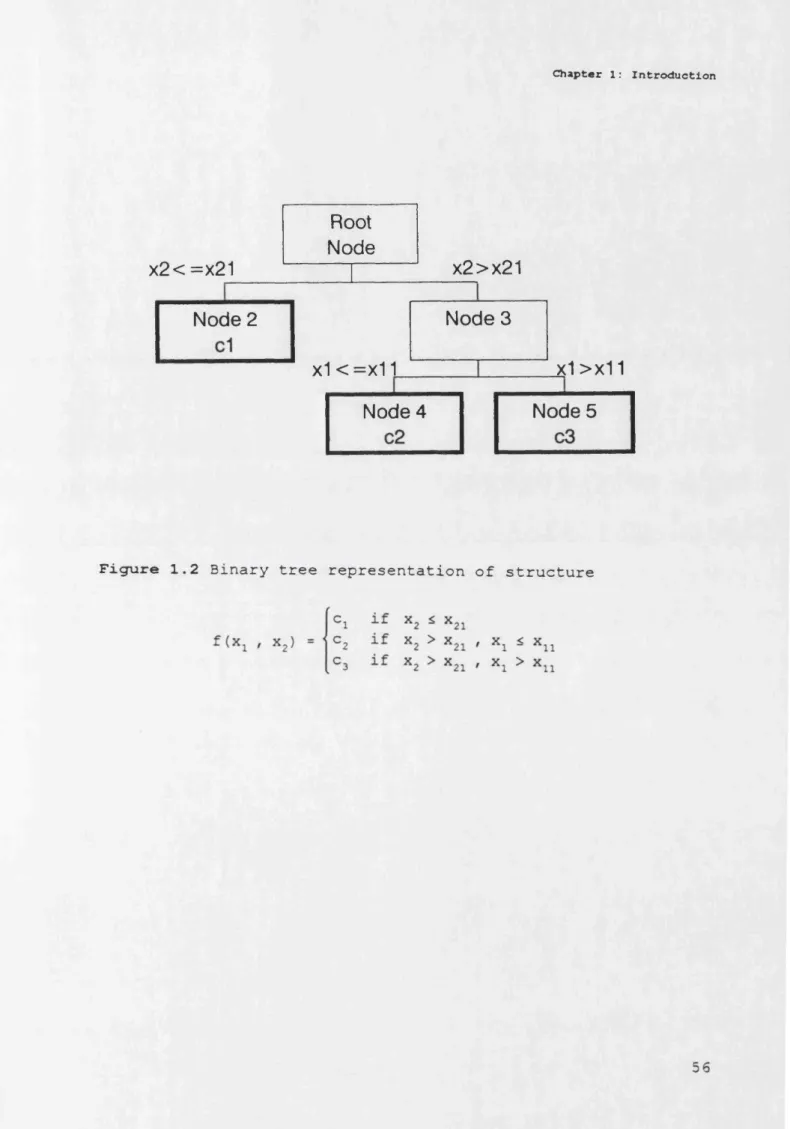
The same structure can be represented by Figure 1.2 in Appendix
A. This figure is a binary tree diagram. Each brand represents
a split of the input space. Each node of the tree represents a
subregion of the space. The root node represents the entire
space. The terminal nodes represent the regions, t, associated
with partition T.
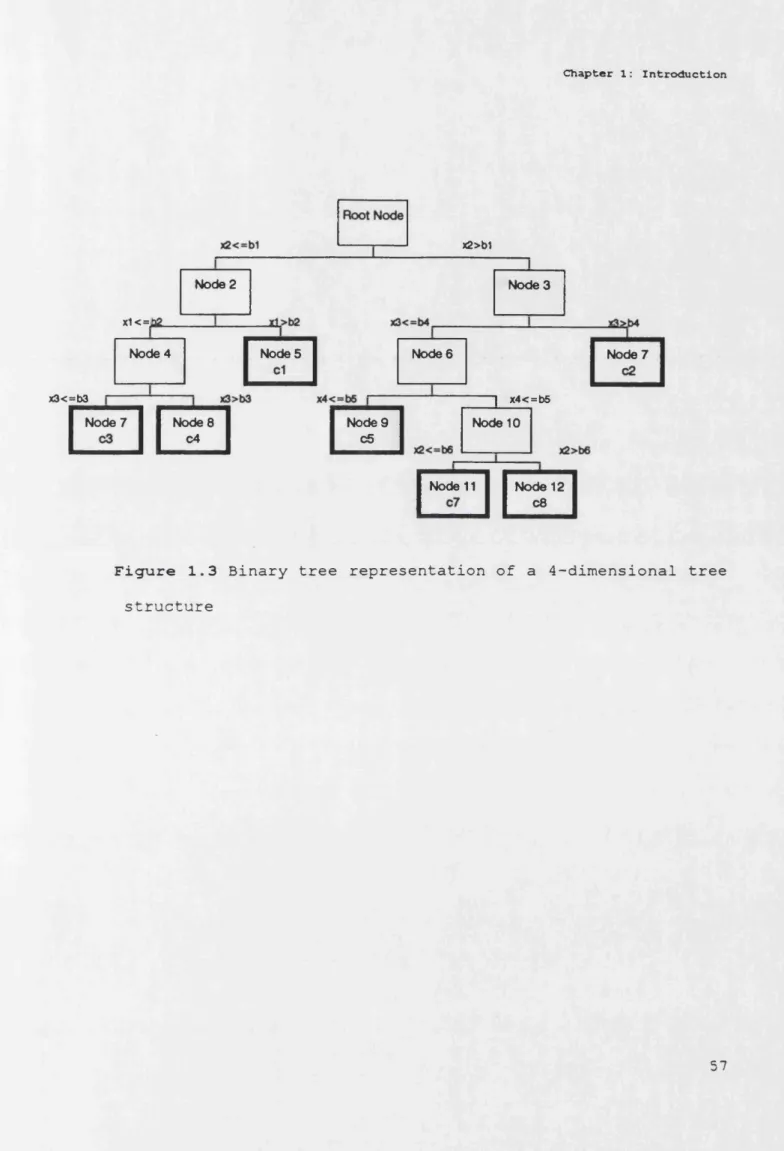
Another example of a tree structured model is shown in Figure
1.3 in Appendix A. The dimension of the input space is four.
Thus, it is impossible to draw something like Figure 1.1.
Nonetheless, all the relevant information that can be obtained
from graphs such as Figure 1.1 can also be obtained from tree
of edges.
The most important assumption in tree models such as (1.16) is therefore the existence of sudden changes in the flat surfaces.
This is a very bad assumption if the surface changes smoothly.
Another problem is the possibility that the surface does not
change along parallel lines from the axis. Figure 1.4 represents
a structure with these two features. These shortcomings suggest
generalizing (1.15) to propose
General models along this line have been implemented. They
mitigate the rigidity of the activation function by looking at
a very large number of splitting criteria and a large number of
surfaces. The cost comes both in terms of the complexity of the
efficient algorithms and the interpretation of the results.
1.1.5 Universal approximators
In the artificial neural networks literature, the models
reviewed in the previous sections are often interpreted as
approximations of the true model. A universal approximator is
a flexible functional form that can approximate an arbitrary
function to a particular level of accuracy. Neural networks,
projection pursuit and trees all share the functional form
h T(x|x € t) = ft(x, a fc) . (1.17)
Chapter 1: Introduction
These models are also universal approximators for the class of
all continuous functions in the sense that any arbitrary
continuous function f (•) admits the representation
oo
f(x) = £ a t • b ( x, y ) (1.19)
t-i
for some set of sequence coefficient values7 {am}“. Therefore,
these nonparametric models have similar spanning properties as,
for example, polynomials.
In spite of this result, it is reasonable to expect that in
small samples selection of the method becomes critical.
1.2 Estimation of regression trees
The original problem of estimating (1.15) is rather trivial if we know the tree structure. Since the constant c which minimizes
E [ (y-c) 2|xet] is E[y|xet], then the least squares estimator, LS,
is the sample average within each terminal node.
If we do not know the structure of the tree, then LS will not
be in general implementable for even not-too-high dimensional
problems. The reason is that LS will be a combinatorial -not an
analytical- problem in this context. In order to minimize (1.3)
one should evaluate all possible structures. This is an enormous
task. Consider LS on a sample with 50 different cells assuming
that the structure has at most two terminal nodes. The number
of possible models is near 6xl014. This is a very big number. If
we could process every iteration in a millionth of a second, we
would obtain LS only after 17 years of uninterrupted
computations. Given the state of computer technology other
alternatives must be considered.
A second best solution of the problem is recursive partition.
The initial region is divided into two regions according to a
splitting criterion. Then, recursive partition is carried out
on each region. This strategy is implementable because, as
partitioning takes place, the corresponding regions -nodes in
tree terminology- include smaller and smaller subregions of the
original input space. The number of nodes increases at every
step, but each node becomes ever more local. An essential
feature in the procedure is that splitting of each region is
assessed only by studying a limited number of possible splits.
Let us now describe the splitting or tree-growing algorithm.
Assume that we have already several nodes and a tree structure
T and that we want to split node t*, one terminal node in T.
Define d(x) as the tree structure projections from T. The
average residual sum of squares for tree T is
Chapter 1: Introduction
where N is the number of observations in our estimation sample.
We can also express R(T) explicitly as a function of the
residual sum of squares within each terminal node of the tree.
Then, (1.20) becomes
R(T)
= ^ E E (
Yi"
^ ( x j ) 2 (1.21)N teT Xjet
where d ( x±) = (1/Nt) • £ xet y ± .
Recursive partitioning is defined through recursive
optimization. Heuristically, when a variable has a strong
contribution to the true tree structure, a split based on that
variable will likely improve the fit and thus reduce R(T)
greatly. Thus, recursive partitioning can be defined by choosing
the split at each step of the algorithm such that the reduction
in R(T) is maximized. The split chosen at each step of the
algorithm, s*, satisfies
AR(s*,T) = max R (T) -R(T ) , (1 2 2 )
ses
where Ts is any tree obtained by splitting a terminal node, t,
into a left node, tL, and a right node, tR. Since
R(T) - R(TS) = i E ( Yi - d(Xi))
N,I‘et , (1.23)
-
TTE <
Yi - d U , ) ) 2 - _E
( Yi - d (xi))2iN x e t i L JN x e t
optimal split at each two new terminal nodes from the previous
split.
We can keep splitting the estimation sample until there are no
nodes with elements with different characteristics or the number
of observations reach a lower limit. This lower limit can be
fixed by the researcher according to the problem and is called
the splitting rule. Splitting ends when we obtain the largest
possible tree, T,^. Often, the result will be equivalent to
dividing the sample into all possible cells and computing within
cell averages, a standard nonparametric analysis.
Growing the tree until no further partitioning is possible helps
avoiding having to select a rule to stop splitting. Usually,
however, Tj^ will be too complex in the sense that some terminal
nodes could be aggregated into one terminal node. A more
simplified structure will normally lead to more accurate within
node estimates since the number of observations in each terminal
node grows as aggregation takes place. It is also intuitive to
see that if aggregation goes too far, aggregation bias will
become a serious problem.
In order to aggregate from we can use a clustering algorithm
procedure8. Breiman et alia (1984) propose to compute the
See e.g. Gordon (1993) and Hartigan (1975) for
Chapter 1: Introduction
error-complexity measure R(Q',T)=R(T)+ojT| for all possible trees
obtained from simplifying the structure by cutting, or pruning,
tree TV^. Here, |T| denotes the number of terminal nodes in T,
that is, the complexity of the tree, and O' is a given parameter.
Note that R(ar, T) is an error-complexity function by which a
model is selected trading variance with complexity.
The tree structured estimate for a given a is the value that
minimizes R(Q7 T) for the set of subtrees of The resulting
tree belongs to a much broader set of trees than the sequence
of all trees obtained in the recursive partition algorithm.
Heuristically, part of the harm done by recursive partition is
reduced. Thus, regression trees are much more powerful pattern
recognition tools than ordinary clustering algorithms.
Optimization of the error-complexity function for a l l possible
values of a leads to an increasing finite sequence of real
values 0 = a 1< a 2< • • • <qq anc* a decreasing finite sequence of
subtrees T1>T2> ...>{root}, such that for any real value
Gk+i) r Tk is the smallest subtree of T,^ minimizing R(o,,T). See
Breiman et alia, (1984, p.289) for a proof of this result.
Implementing cost-complexity minimization for all a is then
possible through a weakest-link algorithm.
an alternative use to clustering algorithms in time series
modelling. See Scott and Symons (1971) and Bryant and Williamson
Any branch, Tt, spanning from a nonterminal node t of a tree T,
is cut only if
•i E (
yi - d<*i>
>2
+ « s
1
E E <
y± - d(Xl>
>2
+ alTtI»<i.
24
)
N * i « t W t * e T t x ^ t *
so that the first branch to be cut minimizes
E (
yL
- d(x
.))2
- £ E (
yt
- d
(
Xi))2
*iet_________________ f«Tt »,«t-______________ (1.25)
|Tt| - 1
The initial intractable problem is thus reduced to one of
selecting an optimum-size tree from a decreasing sequence of
subtrees.
At each step of the pruning algorithm R(T) increases so that
R(TX) is the lowest value of the sequence {TX>T2 >. . . >{root}} . For
the learning sample, our estimates d(x) from Tx are therefore
least squares estimates among the sequence. This property is
satisfied in the estimation sample by definition, but it does
not have to do so in an independent sample. Choosing R(TX) as
our fit of the tree structured model may lead to overoptimistic
results for R(*) and the model will be overfitted.
There are three strategies to obtain unbiased estimates of R(*)*
The first one is the use of an independent test sample. This is
most appropriate, due to its simplicity, when the data set has
Chapter 1: Introduction
entire sample into a learning and a test sample. The tree is
grown and pruned with the learning sample, while unbiased
estimates of R(T) , Rts, can be obtained with the observations of
the test sample and the estimates of the learning sample.
The other two alternatives to obtain unbiased estimates of R(*)
are K-fold cross-validation and the bootstrap method. Since they
will not be implemented in the following chapters, I refer the
reader to Breiman et alia (1984) for an introduction to the
application of these methods in regression trees.
It is possible to compute standard errors for Rts from the test
sample, SE(Rts). Rts may be very flat along the sequence only to
increase at the last, coarser subtrees. When this happens it may
be difficult to justify the least squares subtree and it is
probably better to study several alternatives. Breiman et alia
(1984) suggest the 1 SE rule, which consists of selecting the
simpler tree whose Rts is not larger than the minimum Rts plus
1 standard error. Using these corrections may greatly reduce the
number of terminal nodes of the tree. In the regression trees
literature, sometimes this is referred to as the goal of
obtaining parsimonious models. In a more general context
parsimony and complexity are, however, different concepts. For
example, in a simple linear model with one continuous
independent variable, complexity is infinity, whilst we can
still talk of a simple parsimonious model. In parametric
reducing the number of projected values for the dependent
variable -complexity-, but also through the estimation of simple
relations between the dependent variable and the independent
variables. In the following, I will nonetheless use the concepts
of parsimony and complexity as interchangeable.
The small sample statistical properties of the estimator just
described are not known. This problem is not trivial because the
technique involves partitions of the input space based on the
learning sample. Thus, the estimates are the results of random
partitions.
Nonetheless it is possible to know something about the behavior
of the recursive estimates as the sample becomes larger and
larger. The fundamental consistency conditions for random
partitions are surprisingly general. All we need is an ever more
dense sample at all n-dimensional balls of the input space in
order to approximate in a q-square sense the nonparametric
surface. If the partition guarantees this, then the estimates
should converge to the true function. Cost-complexity
minimization together with test sample unbiased estimates of
R ( • ) guarantee that such condition is satisfied by regression
tree partitions. The basic results can be found in Breiman et
alia (1984, chapter 12).
A word of caution is nonetheless necessary. For small samples,
Chapter 1: Introduction
instability in the tree topology so that slight changes in the
learning sample may cause splits to be made on different
variables. In this case, the interpretation of the contribution
of each variable will become problematic.
1.3 Regression trees in economics
Although regression trees has been used in several scientific
fields such as medical diagnosis, automatic identification of
chemical spectra and pollution level predictors in urban areas,
its implementation in economics has been to date rather small.
Nonetheless, we have seen some examples of implementation of the
technique in economics during the 90s. Here I present a brief
summary of three of them.
They highlight in my view its potential applicability to study
economic issues. In the following section I will argue that the
study of wages is a field where this technique can be
interesting to apply.
1.3.1 A classification algorithm
Cotterman and Perachi (1992) describe a method for deciding how
to aggregate a set of elementary U.S. industries. The method is
based on regression trees methodology and it is an alternative
much broader set of aggregation alternatives.
The fundamental difference with respect to standard regression
trees is that their methodology simplifies the first algorithm,
growing-the-tree, into a simple clustering algorithm. The second
step corresponds to pruning-the-tree. Finally, since they are
only interested in reporting alternative levels of industry
aggregation, they do not implement cross-validation, but present
the differences between their aggregation techniques and the
15-industry level proposed be the U.S. Bureau of the Census.
In order to grow the tree, they propose two measures of
closeness between the elementary industries. First, using data
from the Current Population Survey prepared by the Bureau of the
Census, CPS, and a matching algorithm, it is possible to have
for some individuals two independent codings of the industry of
employment. For some workers, however, these codings do not
coincide. Further, they seem to affect some pairs of industries
more'than others. The authors attribute them to three potential
causes: data collecting errors, errors in the matching algorithm
or, finally, ambiguity in the definition of the elementary
industries. They assume that the last cause is the relevant one
and propose mismatch rates between industry codings as measures
of similarity. The second proposed measure of industry closeness
is the workers' transitions between industries. The measure is
reasonable when individuals move more frequently between similar
Chapter 1: Introduction
algorithms. Both measures led to different results for the
hierarchical tree. It is interesting that the authors depart
from common practice in clustering when they propose these
measures. The usual procedure is to define closeness through a
distance based on a vector of characteristics. They tried to
overcome the arbitrary step of defining this vector.
Optimal pruning using log-wage data for the years 1971-1982
again from the CPS was carried out. Residual sum of squares were
obtained from regressions of weekly wages on years of schooling,
years of experience and its square. The authors find important
differences in the various aggregation schemes, and conclude9
that since "(...) the outcome of much applied work may hinge on
the aggregates employed", then " (...) procedures for
classification and aggregation are legitimate and important
subjects of inquiry".
1.3.2 Melon prices
Russel Tronstad (1995) applies regression trees to estimate
discounts and premiums due to various characteristics of
wholesale melons. Characteristics considered are melon type,
size, grade, shipping container, week, and year.
Melons are highly perishable products, so that supply of melons
can be assumed to be perfectly inelastic. After correcting from
season, differences in prices between different types of melons
thus show differences in demands that are due to differences in
the characteristics, not in relative supplies.
The model was estimated with weekly price data from 3 January
1990 through 28 December 1993. Twelve different melon types were
considered. The data source was the L o s A n g e l e s W h o l e s a l e F r u i t
a n d V e g e t a b l e R e p o r t , published by the U.S. Department of
Agriculture.
The results compared favorably to standard parametric regression
in the sense of a higher coefficient of determination. The
author also considers that regression trees performed better
since it allowed for interaction between discrete variables.
Allowing for these interactions on the OLS regression would have
required a very large number of dummy variables. Efficient
estimation would have then demanded the implementation of some
model selection algorithm.
1.3.3 Multiple growth regimes
Durlauf and Johnson (1995) use regression trees to identify
national economies with different laws of growth.
They argue that a cross-section linear regression applied to
Chapter 1: Introduction
states can produce a negative initial income coefficient. Thus,
a negative sign in this coefficient cannot be taken as evidence
of convergence in income per capita for all countries.
The data source is Summers and Heston (1988) and the World
BankTs W o r l d T a b l e s and W o r l d D e v e l o p m e n t R e p o r t . The authors
initially carry out ad hoc splits of the countries into two,
three and four groups based on their initial per capita output
and literacy rates. They then test for the existence of a common
growth path for these groups. They reject the null hypothesis
against the alternative of multiple regimes in a human capital
specification and in an augmented version that tries to
incorporate social and political factors. In both cases, they
reject the hypothesis of a single growth regime against the
hypothesis of several regimes.
Regression trees allows for endogenously finding the number and
specification of growth regimes. The splitting criteria in the
tree are based on initial literacy rates and income per capita.
This is consistent with the multiple regime framework since if
economies are concentrated around several steady states, then
their initial values for these variables will cluster for each
group. Within nodes sum of squares are computed from the
residuals of the growth equations.
The algorithm partitions the world economy into four groups and
economies have access to different aggregate technologies.
In the following section I will consider the use of regression
trees in the study of the wage structure. I will present
empirical results that highlight the strong context-sensitivity
feature that wages present in the U.S.. I will then give an
outline of the rest of this volume and will end with a
description of the data and programming to be used in the
following empirical applications.
1.4 Nonparametrie Wage- Structures
1.4.1 Wage structures
The concept of the wage structure is fundamental in the
empirical analysis of the characteristics of the wage
distribution. It refers to the vector of prices set for various
labor market skills and the rents received for employment in
particular sectors of the economy.
The labor market is seen as a complex structure that consists
of interrelated local markets with different market equilibrium
wages. A description of this structure and its evolution is of
clear interest to study problems as varied as the effects of
technological change, the sources of wage inequality, and
Chapter 1: Introduction
We can start by simply assuming that the logarithm of the
market-clearing wage for any worker, wif depends on observed and
unobserved characteristics that position the worker in a segment
of the labor market.
It is customary to assume a linear relation between the observed
and unobserved effects, where the unobserved effect term will
have zero expected value and small variance a2. The general
specification for the econometric model in this literature is
then simply
w. = f(x.) + v. . (1.26)
The simplest and commonest specification for (1.26) is a
polynomial parametric relation between the explanatory
variables. For example, a squared term for experience on top of
a linear model is usually included since the publication of the
seminal work of Mincer (1974) 10.
The linear parametric approach implies that each variable’s
additional contribution to wages is constant or follows a
10 It is customary to refer to a wage equation that is
linear on the education level, experience, and experience2 as a
Mincer equation. The conection between human capital models and
this simple specification was one of the main contributions of
Mincer. This is nowadays sometimes recognized by referring to
be solved by adding just a few quadratic terms in the right-hand
side of the equation? My intuition is that it cannot. By
postulating a rigid structure, the researcher may distort the
information available in the data set so that the results will
not be useful.
In the next section, I will review the empirical evidence on
context sensitivity in the U.S. wage structure.
1.4.2 A survey on context sensitivity in the U.S. wage structure
There is a remarkable consensus in the economic literature on
the recent general trends of relative wages. It seems that the
fundamental dynamic features of wages are sufficiently well
described along just three or four dimensions.
First, there was a general trend of wage dispersion and a slow
down of growth in real wages during the eighties. Second, there
have been increases in the wage differentials between workers
with college and high school education for all demographic
groups defined by gender and age. Experience differentials have
continued a long-term increasing trend. On the other hand,
gender differentials narrowed further while race differentials
reported that the parameters of these terms were not
significantly different from zero when wages instead of earnings
Chapter 1: Introduction
remained stable in the last twenty years. Industry differentials
have also remained stable.
Compared with the trends observed in the sixties and seventies,
the growing inequality in the eighties was not a unique
phenomenon. Wage dispersion within groups and increases in
experience differentials were not new trends. However, the
reductions in the College premium during the 1970’s and the
narrowing of the race differentials before 1975 did not occur
later13.
On top of these general stylized facts we can find many reported
local cases of context sensitivity or nonhomogeneity in wage
differentials. Probably the best known of these is the different
behavior of the experience differential between high school and
college graduates. It seems that the combination of college
attendance and job experience was an unbeatable one during the
13 See, for example, Levy and Murname (1992) and Bus chins ki
(1994). Allen (1995) analyzes changes in the wage structure
across manufacturing over the years 1890-1990. He concludes that
interindustry wage differentials were highly stable over the
entire period for production workers. Interindustry wage
eighties14. Welch (1979) argued that college graduates are more
imperfect substitutes for more experienced graduates than is the
case for workers with less education.
Similar asymmetries can be found along other demographic
dimensions. Let us consider the interaction between education
and race. While the college-going rate for 18-24 year old,
white, high-school graduates increased from 31.2% to 38.1%
between 1979 and 1987, the college going rate for black high
school graduates in this age group fell from 29.5% to 28.1%,
suggesting that the college premium has a race story inside15.
The race differential for women almost disappeared in the 1970s,
while it remained stable for male16. Thus, either the wage
structure is becoming nonhomogeneous with respect to the race
differential, or it never was.
Some authors have studied the relationships between sector of
employment and race. Greene and Rogers (1994), for example, find
important differences between the private and public sectors
with respect to earnings of college-educated black and white
14 See, amongst others, Bound and Johnson (1992), Katz and
Murphy (1992), and Murphy and Welch (1992).
15 See Levy and Murnane (1992) and also Ashraf (1995).
16 See, for example, Murphy and Welch (1992) and Blau and
Chapter 1: Introduction
professionals.
Bound and Holzer (1993) estimate the effects of industrial
shifts in the 1970s on the wages and employment of black and
white males and find that while the magnitudes of these effects
are fairly small for many groups, they can account for about 40-
5 0 percent of the employment decline for less-educated young
blacks.
Firm and industry effects have also been compared on several
occasions. Davis and Haltiwanger (1991) find that steady growth
in wage differentials among plants in the manufacturing sector
between 1975 and 1986 accounts for half of the growth in wage
dispersion within this sector17.
Bound and Johnson (1992) find that when 45 instead of 17
industries were used for "all men” and "all women" groups, most
17 It is unclear whether this pattern extends to other
industries, particularly after considering that international
competition may have increased the pressure on firms to choose
between quality improvements or cost reductions in the labor
force. Levy and Murnane (1992) argue that the eighties may just
have been a period of adjustment for the manufacturing sector
that will end when those firms which chose the losing strategy
of the industry effects were picked up by the dummy variables
for 17 industries. The interesting exceptions were non-college
men during the 1980 fs, for whom the use of detailed industry
dummies increased the total industry wage effects by up to one-
half .
Blackburn (1990) shows that approximately 15 percent of the
increase in within-group variation for men stems from the
movement of workers from goods producing industries to services.
Other variables of potential interest have also been studied and
their interactions locally analyzed. A few examples follow.
There is no clear consensus on regional variations and their
effects on the wage structure. Eberts and Schweitzer (1994) find
that the trend in regional variation can be traced to declining
differences in labor market valuations of worker attributes
rather than to shifts in the regional composition of the
workforce. See also Gyimah and Fichtenbaum (1994) for an
investigation on the regional differences in labor market gender
and race discrimination. Larger differences do not imply larger
discrimination.
Immigrants with lower initial wages were assimilated in the U.S.
market faster than those with higher initial wages (LaLonde and
Chapter 1: Introduction
Social status has also been considered: Among males, growth in
the proportion of males in the labor force who are unmarried has
affected the married status differential18.
Finally, Adamson (1993) study differences in union affiliation
relative wages across gender and race and finds that the female
union effect declined over the 1970-1982 period whilst the size
of the male union effect remained stable.
The list of cases is not at all exhaustive. The examples
nevertheless transmit the message that local analysis unveils
context sensitivity. This is done by focusing on the
interactions of at most three variables. Note that in order to
observe context sensitivity using parametric techniques we must
include at least quadratic effects in the set of explanatory
variables or, more generally, estimate different wage equations
in different segments of the labor market. This, in effect,
eliminates the possibility of a global context-sensitive
parametric approach.
From the extensive literature on wage premiums we must conclude
that any global analysis of wages may suffer from aggregation
bias and that even local studies should take account of
nonhomogeneous features in the structure.
It seems therefore desirable to keep the empirical analysis to
the highest level of flexibility. A nonparametric approach over
all possible points of the input space cannot be used for
practical reasons. A simple example will fix ideas. Bound and
Johnson (1992) did not try a very detailed specification of the
input space. They took three periods (1973-1974, 1979, and 1988)
and for each of them the population was divided into 32
subsamples -according to education, potential labor market
experience and gender- on which wage regressions were carried
out with dummies for the following characteristics: Educational
attainment, nonwhite, part-time employment, residence in an
SMS A, four major regions and employment in 17 major industries.
The most complex nonparametric surface would involve 15,000
different labor groups. In order to have at least 50
observations for each type of worker, the research can only be
carried out with samples of at least 750,000 observations.
Thus, it seems that ad hoc searches for the best functional
local parametric specification is the only available strategy.
It is not. Parsimonious nonparametric econometric models such
as regression trees allow for simple nonparametric structures
in the sense of a low number of different expected equilibrium
wages19. They thus provide a very useful tool in the study of
local segments of the labor market.
19 This is the result when the splitting rule constraint is
Chapter 1: Introduction
1.5 Outline of the thesis
1.5.1 Outline of the thesis
The fundamental econometric problem that model (2.1) may have
is related to the statistical relation between the observed
variables and a subset of the unobserved variables. The general
idea is that if economic agents take decisions based on an
opportunity set not observable to the researcher, and if
opportunities vary across agents, then observable data will be
censored and the error term may not be independent of one of the
regressors.
In the context of measuring the returns to education, this self
selection/omitted variables problem would imply that OLS
estimates of the education coefficient may be upward biased.
Intuitively, individuals with higher ability, an unobservable
variable, will normally choose higher levels of schooling
because they can benefit most from it (e.g. Griliches (1977)).
The interpretation of the importance of the education variable
in the estimated tree will also present the same problem.
In the context of gender differentials, participation decisions
in the labor market censors especially female data. Again, LS
estimates will be biased if the decision to participate is
as education. The same problems affect again the interpretation
of the gender estimate in regression trees.
It is possible to define regression trees so that these problems
can be addressed. The main idea is to use standard parametric
regression techniques designed to cope with these problems at
each node instead of simple within node averages in order to
estimate the impurity at each node. This is, no doubt, a very
interesting direction to enlarge this study.
In the rest of the thesis, I will present, however, the results
of applying the simplest regression trees algorithms to samples
of populations for whom, I will argue, the econometric problems
just mentioned are minimized.
Three applications of regression trees on the study of the wage
structure are implemented in the following three chapters of
this dissertation:
a.- I will first estimate experience-wage profiles for
white male full-time employed workers.
b.- Secondly, I will decompose average wage differentials
of different groups using nonparametric structures estimated by
regression trees.
Chapter 1: Introduction
nonparametric wage structures estimated by regression trees.
Obviously, the choice of the subjects probably reflects mostly
the interests of the author and I would not like to suggest that
these fields are the most promising for the application of
nonparametric multivariate techniques to the study of wage
structures.
Before turning to the results of the empirical applications, I
would like to comment on the data set and the programming
language used.
1.5.2 Data and programming
In the following chapters I will use the outgoing rotation
groups of the Current Population Survey (CPS). The Current
Population Survey is a monthly survey of now about 60,000
households prepared by the Bureau of Labor Statistics, BLS. An
adult (the reference person) at each household is asked to
report on the activities of all other persons in the household.
There is a record in the file for each adult person. The
universe is the adult noninstitutional population.
Each household entering the CPS is administered four monthly
interviews, then ignored for eight months, then interviewed
again for four more months. If the occupants of a dwelling unit
unit are interviewed. Since 197 9 only households in months
fourth and eighth have been asked their usual weekly
earnings/usual weekly hours of work. These are the outgoing
rotation groups, and each year the BLS gathers all these
interviews together into a single Merged Outgoing Rotation
Group. A consequence of this construction is that an individual
appears only once in any file year, but may reappear in the
following year. The National Bureau of Economic Research, NBER,
has prepared a CD-ROM with extracts of the files.
These data have, however, some limitations as a data set for
studying the evolution of wages across different groups20. I will
comment on four problems that may distort results.
First, the definition of income does not include fringe
benefits, which have constituted a rising proportion of income
compensation. Levy and Murnane (1992) argue that after adjusting
for fringe benefits the difference between the rates of growth
of real wages for the sixties and eighties diminishes, but the
eighties value is still well below the pre-1973 period.
Second, to preserve confidentiality in the upper tail of the
income distribution, the statistics reported are top-coded at
$50,000 from 1968-1981, $75,000 from 1982 to 1984 and $99,000
20 For a more detailed discussion, see Levy and Murnane
Chapter 1: Introduction
from 1985. This problem can actually be lessened by avoiding all
together the tails of the distribution although more
sophisticated procedures have been proposed21.
The fact that the CPS lacks information on firm specific
activities can be important if workers have heterogeneous
characteristics and production potential across firms.
Finally, the CPS data may overstate the rate of growth during
the 198 0 ’s in the proportion of new labor market entrants who
were college educated and underestimate the earnings of workers
who completed a normal high school programme. Bishop (1991)
finds an unprecedented mismatch in the 1980's between the CPS
data on new entrants who had accomplished college education and
the number of degrees awarded in the U.S.. With respect to high
school graduates, before 1988 the CPS treated both holders of
the General Educational Development exam and traditional high
school graduates as having completed 12 years of schooling.
However, Cameron and Heckman (1991) find, with data from the
National Longitudinal Study of Youth data set, that the first
group earnings patterns are indistinguishable from high school
dropouts.
21 Truncation corrections for top coding normally assume a
gamma distribution for the upper tail of the yearly income
I implemented regression trees algorithms on large data sets of
wages. The computations were carried out using the author's
procedures programmed in GAUSS for regression trees on ordered
variables. An interesting feature of the chosen programming
language was the possibility of using a simple matrix
programming language together with large data sets. In
particular, the procedures were able to process sets with more
than 60,000 observations with speed in a personal computer and
limited memory. Available commercial software would not do the
Chapter 1: Introduction
Appendix A
Figure 1.1 2D representation of structure
f(xx , x 2) =
if x2 s x21 i f X2 > X21
if x2 > x21
X 1 s x u
X 1 > x u <