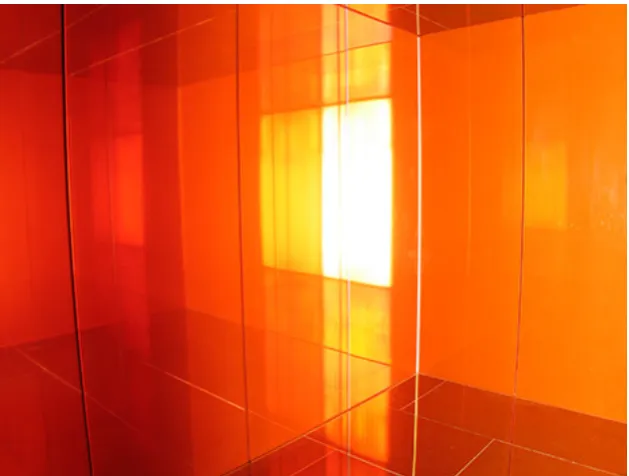
FAISAL ABDU'ALLAH Student No.0950745
A thesis submitted in partial fulfilment of the requirements of the University of East London for the degree of Professional Doctorate by Publication
Preface
Mirror to My Thoughts evolved from three dialogues. It was a sunny Wednesday afternoon and, as I sat meditating my attack on my beloved Apple Crumble, Pete Cobb leaned to my
left and asked if I had considered a Doctorate. Naturally I was mildly perplexed at the
distraction, but in the same breath intrigued. Could it be simply the right place, the right
time? Some weeks earlier, Stanford University were in negotiations with me regarding a
visiting professorship for the fall which incorporated a retrospective exhibition curated by
Professor Barbaro Martinez-Ruiz. I did the calculations – dates, times, what was
required, but, more importantly, whether I was able to intellectually abridge 20 years of
practice into a single document that would come to fruition in the same season.
It seemed appropriate.
Some time after Pete Cobb's proposition, I sat in my studio and listed my entire life's work,
arranging it into major themes. It was at this point I began to see reflecting back at me
a concentrated, complex, thought-provoking resource that was honest and true. Works on
identity, perception and degrees of separation were just a few themes that were
referenced in a number of key works.
In 2009-10, I was blighted by graduate students sending email requests for images and
essays and the fact became clear that a lifetime of work flying solo had not been
misspent. Unearthing, compiling, cutting and soul-searching has enabled me to pen this
Acknowledgements
The compilation of 20 years of memory is quite a daunting task with moments of accuracy
chipping away at your core moral fibre. Mirror to My Thoughts has enabled me to be objective about self and progressive about the new road that I am taking since this
document has come into existence.
I would like to thank, Professor Barbaro Martinez-Ruiz for placing my work amongst the
finest scholars to have walked Planet Earth; and finally, my late Father – there is not a
word or letter that has graced the page without his spiritual authority.
Faisal Abdu'Allah
Contents
Preface i
Acknowledgements ii
Contents iii
List of Illustrations iv
Foreword v
Introduction vi
Chapter 1 Early Years 2
Chapter 2 I Wanna Kill Sam 20 Chapter 3 Revelation and The Last Supper 28 Chapter 4 Garden of Eden 35
Chapter 5 Heads of State 42 Chapter 6 Goldfinger 46 Conclusion 52
Bibliography 53
Appendices 1 55
Appendices 2 57
LIST OF ILLUSTRATIONS
Figure 1. Michel de Montaigne, artist unknown (1580)
Figure 2 George Duffus, Passport Photograph (1955)
Figure 3 No Irish, Photograph, photographer unknown (1961)
Figure 3a Faisal Abdu’Allah, Armageddon, Watercolour (1988)
Figure 4 Marion S. Trikosoko, Malcolm X, Photograph, (1964)
Figure 5 Eddie Chambers, Destruction of the National Front, Collage (1980) Figure 6 Faisal Abdu’Allah, No Sell Out, Screen print (1990)
Figure 7 Julia Margaret Cameron, Eyre, Photograph (1867) Figure 8 Marianne Mulvey, Photograph, (2009)
Figure 9 David Hammons. Spirit Writing, Drawing on paper (1989) Figure 10 Faisal Abdu’Allah, Paper Ends, Print mixed media (1990)
Figure 11 Faisal Abdu’Allah, Thalatha Haqq, Screen Print on Glass (1992) Figure 12 Frank Bowling, Dog Days (A To A) (1971)
Figure 13 George Holliday, Rodney King (1991) Figure 14 Faisal Abdu’Allah, Fuck da Police (1992) Figure 15 Faisal Abdu’Allah, I Wanna Kill Sam (1993)
Figure 16 Faisal Abdu’Allah, Khalil, Screen Print on Metal (1993) Figure 17 Faisal Abdu’Allah, Akil, Screen Print on Metal (1993) Figure 18 Faisal Abdu’Allah, Hasan, Screen Print on Metal (1993) Figure 19 Stanley Spencer, Last Supper, Painting (1920)
Figure 20 Marisol Escobar, Last Supper, Sculpture (1982-84)
Figure 23 Wenceslaus Hollar, The Bowing Gentleman and Lady with a Houpette, Etching (1636)
Figure 24 Faisal Abdu’Allah, The Garden of Eden, 2006
Figure 25 Faisal Abdu’Allah,The Garden of Eden (Interior) (2006) Figure 26 Waleed Beshty, Passage, Photograph (2009)
Figure 27 Faisal Abdu’Allah, The Garden of Eden (2006)
Figure 28 Faisal Abdu’Allah, Heads of State, Screen Print on Paper (1997-99) Figure 29 Faisal Abdu’Allah, Heads of State, Installation (1997-99)
Figure 30 Artist Unknown, The Boxer of Quirinal, Bronze (330 BC)
Figure 31 Faisal Abdu’Allah, Goldfinger, Screen Print 24 Carat Gold (2007) Figure 32 Faisal Abdu’Allah, Goldfinger, Installation (2007)
Foreword
Too often, the art produced by Afro-British artists has been framed as being over-sensitive to social issues. Trained as a printmaker, Abdu'Allah's work is imbued with both the texture of the material and the nature of the issues explored within it. These issues recur in
different and multifaceted ways: the reconfiguration of community, masculinity, violence and faith. Together they provide a commentary that interrogates the historical and cultural contexts in which images, semantic and visual expressions originate. Abdu'Allah's work reacts against the general assumption that the Afro-British artistic production cannot successfully reconcile social conscience with aesthetic viability. There is a sensibility in his work that affords a gaze at an aesthetic grounded in both an analytical philosophy of popular culture, mass media and Western art history.
Faisal’s work situates him as the earliest and most accessible single artist of a generation and provides a commentary on the manner in which visual images of Afro-British and Muslim communities, the aesthetic of violence, popular culture sensibility and film have played a critical role in the shaping of contemporary British imagination.
Professor. Barbaro Martinez- Ruiz
Introduction
Mirror to My Thoughts is a collection of writings that sheds light on my earliest memories in London as a so-called 'third generation', embracing topics, discussions, books,
movements and sounds that have shaped my visual arts practice over nearly two
decades, from looking at the history of migration influenced by economics and opportunity
to how landmark shows curated by Rasheed Araeen – The Other Story (1989) – and texts – The Black Atlantic (1993)– by Paul Gilroy have helped in shaping my consciousness. This journey has taken me to many places and spaces but, more importantly, it has
enabled the formation of a body of work that can best be described as ‘epiphanic’. This
account is an attempt to record in loose chronology what my eyes have borne witness to
from my earliest memory of visual curiosity in the reading of religious paintings in the
home, which enabled me to position myself in the world, creating a critical point of
departure from which to construct vocabulary and nurture discernment.
The period covered in this dissertation 1993-2007.
Starting with the Early Years in chapter one which map my childhood influences and
euphonies, Chapter two, looking at place and dislocation with the seminal works, I Wanna Kill Sam and Fuck da Police, (1993), mapping the essence of distrust among the British youth in the late 90s. Chapter three, Revelations and Last Supper, (1996) annotations of how this photographic series offered an intimate insight into acts of faith and the myth of
pentecostalism. Chapter four, The Garden of Eden, (2003) deconstructing the politics of privilege space and identity through the architectural edifice, a collaboration with David Adjaye. Chapter five, Heads of State, exploring the plethora of young black men, who had died in tragic circumstances as a result of gun crime in the 1990’s and finally Chapter six,
Chapter
1
Early Years
The Negro represents natural man in all his wild and untamed nature. If you want to treat and understand him rightly you must abstract elements of respect and morality and sensitivity – there is nothing remotely humanized in the Negro character … nothing confirms this more than the reports of the missionaries1 …
800 BC-300 AD saw the hegemony of Kush, also known as the Ethiopian Dynasty,
controlling the Valley of The Nile after the conquest of Egypt. A plethora of black and mixed
Pharaohs ruled with resolute judgement and parity. Until the 10th Century, Europe was
essentially a forest and its main goods for export were wood and fur to the parallel
societies of Islam and Byzantium.
A range of scholars besieged our beloved bookshelves with texts about Africa: Carl
Linnaeus, Samuel Estwick, Edward Long et al. European nations were successful in the exploration of the African interior due to the hosts’ knowledge of the local landscape and
the colonisers’ interpretation of maps. David Livingstone2 remarked about coming to the
African continent as the superior race, irrefutably marking out the relationship early
between missionary and host as superior and inferior races. The scramble for Africa was
widespread as the land was plundered for its rich minerals and produce.
1 G.W.F. Hegel The Philosophy of History (1899) in W. D. Wright Critical Reflections on Black History
(Westport, CT., USA 2002) 31
Fig.1 Michel de Montaigne, artist unknown (1580)
In 1580, Michel de Montaigne (Fig.1) wrote On Cannibals, a text that shaped the visual interpretation of 'otherness', which went against the grain of prevailing judgements. It
talked about ‘the Noble Savage’, a concept which would come to fruition in the 19th
century and would later be synonymous with the African. This account would construct the
terms of endearment that some 450 years later would furnish the incongruous framework
of black ontology. A more interesting detail is that of Europe citing itself as the light of the
world and ark of knowledge even though its very own existence was reliant on the
The year is 1952 in Clarendon, Jamaica and my father is asleep in his bed, the night was
not unusual until he was awoken by a man perched on a chair in his room. They spoke for
sometime but my father (Fig.2) was slightly perplexed, was he dreaming or was this
fidelity?
Fig.2 George Duffus, Passport Photograph (1955)
But one thing he was very sure about, was who he was with. The man looking at him was
unshaven but had a cool burnt brass complexion, it was Jesus. He then remonstrated to
my father that he was to give up drinking, gambling and give his life over to the Lord. My
father from this point embraced the faith of pentecostalism and became Paster George
Duffus, the eloquent minister of Leghorn Road Baptist Church, London.
The man that would prophecy, evangelise to his terrestrial congregation but would also
At this time the dreaded smog reigned over London and provided a bleak backdrop for my
father who travelled in search of a better life. When my mother finally arrived some months
after, they were quickly exposed to numerous individuals and organisations who were not
at all comfortable with their presence. Landlords were happy to openly display their
intentions on their windows.
Fig.3 No Irish, Photograph, photographer unknown (1961)
Enoch Powell ‘Rivers of Blood’ speech from1968 had blighted the consciousness of the
British public. The sickly ideological hypothesis detailed in Powell’s imbecilic public
disquisition was a response to the new Race Relations act of 1968 by the Labour
government, which was primarily to improve housing for the new immigrant cohort.
My father recalls ascending the stairs of tenements and seeing grey cards scrawled,
sometimes with lipstick, 'No Irish, No Blacks, No Dogs' (Fig.3), and he would descend in
an expedient fashion with his self-esteem firmly below his weather-beaten brogues,
My earliest memories of home were full of fun and experimentation in the 70’s, space was
an issue and I soon realised that I could create space when I laid out my carefully
rendered cartoon caricatures and paintings around the home.
I utilised my childhood surroundings as inspiration, especially in the home. My walls were
adorned with copies of paintings depicting a handsome white male with blonde hair and
blue eyes, unlike the one my father described to me in his vision. Despite this he would
ceremoniously turn to this picture as he left the house daily and uttered supplications for
safety and deliverance.
Looking back, I tried to reconcile this ritual with the culture of fear and the premium of
obedience. If I adhered to all the rules in the book translated at the time of King James I, I
would be worthy of a place on the left side of God with copious amounts of milk and honey
on the day of judgement. This was the melancholy of childhood.
In 1985 I created my first formal painting under the auspice of my art teacher Mr May, an
ardent fan of Miles Davis and Chuck Close. The brief for our art project was ‘the
expression of fear’. For inspiration I recalled my first memory of deep seated trepidation
and it was a Saturday afternoon at the dinning table and my father was discussing the end
of the world and how imminent it was. Using this experience I painted Armageddon,
bright hues thickly applied in water-colour. The painting initiated numerous conversations
and critiques amongst my art teachers but also members of the staff form other disciplines.
I soon realised Paul Gauguin was right that art was either plagiarism or revolution.3 It was
a part of my life that needed no introduction, Mr May expedited my application for a
foundation degree at the Harrow School of Art and I swiftly embraced my new sense of
purpose and direction despite my parents desire for me to be a Doctor.
Fig.3a Faisal Abdu’Allah, Armageddon, Watercolour (1988)
My foundation year was like the time between underground stations, I was already
preparing my portfolio for my bachelor arts degree application, placing Central Saint
Martins as my first choice, it was my only choice. To my parents surprise I was awarded a
place and in my state of euphoria purchased my first pair of Levis Jeans and Doctor
Martins. The first year Paul Duffus (as I was known then) was the romantic bohemian
artist that was fascinated by Degar, Escher and Klee. All cultural references were based on
the western art system that reserved no place for black modernity.
In my second year at Central Saint Martins, I travelled to the USA on a student exchange
to the Massachusetts College of Art which would transform my entire arts practice, through
a haircut, a breakfast and a wedding. After four weeks in Boston I was in dire need of a
haircut so I ventured down town thinking that I would foolishly find a salon that specialised
in my type of hair. I grew tired as the sun was setting but I was still full of youthful
cocoa brown skin, wearing a Boston Red Sox baseball cap directed me to Danny’s the
pride of Boston.
The morning after my tonsorial exploration, Kriss Bell, a close friend sat with me over
breakfast before our painting class and commented on my haircut. He informed me that he
was also was adept with a pair of clippers and he had no problem being my personal
barber. Our friendship blossomed, every morning Kriss had more pearls of wisdom to
impart, he spoke about NAACP4, black nationalism, Marcus Garvey, Malcolm X, but most
importantly the two most prominent movements, The Harlem Renaissance citing Norman
Lewis, W.E.B Dubois, and the Black Arts Movement in London that I knew very little about.
Kriss was amazed at my level of ignorance and provided me with books on Aubrey
Williams and Frank Bowling, this formed the basis of my dissertation that I was writing at
the time.
Watching Kriss cut and debate in his dormitory was a live performance, which would take
me back to those early years of watching and waiting in my local barbershop as a child.
But more importantly what the barber shop meant to the community, being more than just
a space of trade but a place to share the experiences, the one in particular that of black
men. Near the end of the first semester Kriss injured his shoulder in a basketball game
and insisted I cut his hair, I became his personal barber until I returned to England.
Some weeks later Kriss and I went to a wedding, he came home to change for the
reception and whilst looking for a pair of shoes under his bed he found a book that he
thought was important for my dissertation. He kicked the book from under his bed which
slid and hit the side of my foot, I looked down and he asked me if I had read it. With great
4Founded in 1909, the NAACP is the nation's oldest civil rights organization, from voting rights to education,
British diplomacy I kicked it back and said I did not read black power literature as it only
isolates people. He kicked it back and on the third effort I picked it up and scanned the
front.
Fig.4 Marion S. Trikosoko, Malcolm X, Photograph, (1964)
On the cover there was a colour photograph of light skinned man, neatly groomed with an
After my time in the USA on a student exchange, I returned to Central Saint Martins in
London no longer the romantic bohemian that was selfishly obsessed with abstract notions
of line and form. Now an articulate, politically charged young nineteen-year-old, with a new
artistic language and fresh approach to modernity, now Black Modernity according to Paul
Gilroy 5.
It was self evident that the first generation of artists, Frank Bowling, Aubrey Williams, and
Rasheed Araeen came to Britain as practioneers who were clearly on the crest of the wave
of post war decolonisation6 when they arrived. The second wave of the late 1970s and
early 1980s was Eddie Chambers, Claudette Johnson and Keith Piper who formed the
BLK Art Group which came into existence because of the ethnocentric parochialism of the
British art education system.
Fig.5 Eddie Chambers, Destruction of the National Front, Collage (1990)
Chambers seminal work (Fig.5) incorporated elegantly modernists tropes of collage and
cubism, but more importantly reflected a global discontent of western imperialism, from the
unrest in South Africa to the streets of Northern Ireland.
This second generation of young artists, revitalised a revelatory role for black art in
opposition to western modernism. They were inspired by the aesthetics and content of
their first generational peers, but also the 1960s US Black Arts Movement, writings of
Malcolm X and Amiri Baraka. This sense of collective creative purpose inspired my first
series of screen prints with found images of Malcolm X on paper. (Fig.6)
Fig.6 Faisal Abdu’Allah, No Sell Out, Screen Print on Paper (1990)
The colour palette of No Sell Out suggested several symbolic themes that was being articulated in street attire and in the vernacular of Hip Hop, red for the blood shed in the
slave trade, black for the colour of our skin and green for the promised land of the African
continent. Showing Malcolm X as a type of hero in disguise counters the authoritative and
hypercritical texts and reviews of the era which portrayed him as an extremist who
preached racism, black supremacy and xenophobia. Contrary his ideas of self defence
were misconstrued as violence, despite inspiring the US Black Arts Movement, The Black
Fig.7 Julia Margaret Cameron, Eyre, Photograph (1867)
The Malcolm X photographs were composed using a typology similar to that employed by
Julia Margaret Cameron, (Fig.7) whom posed her models in front of the camera with a
black backdrop that helped to dramatise the subject and suggest a new physiological
dimension.
Her taxonomical approach with her subjects were to play an important role as I made my
departure from found images to selecting my own models and different lighting
approaches.
One Friday evening my nephew was on his way home from school and was stopped by an
elderly man Mr Aaron, who ran the local barber shop. He inquired about my nephews
fancy hair style that depicted a New York skyline on the side and back of his cranium. In
between his youthful slurps on his Ribena he replied to Mr Aaron that his uncle had cut the
design but he was at university and would not be home until the evening. Later that night I
was in the heart of Harlesden, a predominately afro caribbean and Irish community that
lived side by side in total harmony post Windrush. My first day was daunting as the activity
I did for fun had financial and personal ramifications. It became clear that the barber was
the fountain of knowledge, pillar of a community but more importantly a witness to the
evolution of ideas, policy and contemporary cultural attitudes.
Fig.8 Marianne Mulvey, Untitled, Photograph (2009)
Now standing in the heart of my community, listening to De La Soul, James Brown and the
controversial Ninja Man, it was clear that Hegel would add volumes to his current diatribe
on the Negro.
The 90s saw the rise and fall of two reggae icons on British soil, Beenie Man and Shabba
Ranks, berated for the lyrical content of their songs as propagating the literary slaying of
the gay community and all that it was associated with. As can be imagined, this became
covert homosexual patrons. It was clear a number of my clients were of this orientation,
but would not involve themselves in the discussion, resorting to a passive participation and
providing digressive scenarios rather than answers. Flashbacks to the falsitiesof Hegel’s
essay in my terse rebuttals to clients soon earned me the title of ‘gay sympathiser’.
On Saturday in the local barber-shop, it would be clear how the experience of the two
worlds that I was actively a part of had to interface. The Barber shop felt like a public
Front Room and the and my art studio felt like the Private Room, I had to dissolve the two
into one.
My weekly events at the RCA in the seminars and discussions about the merits of
iconography were playing over and over in my mind.
In the studio I was denigrating the surface of my prints in my response to society but
primarily in the quest to un-earth a material that could withstand my methodical cuts and
interventions. The issues of permanence plagued my thoughts as I recalled the Cy
Twombly drawing I had seen that was destructive and productive. Paper Ends self entitled
earmarked an important transition from paper to metal. An example of dematerialisation
but more importantly the nostalgia of losing a surface.
David Hammons (Fig.9) explored an electric written style in his work Spirit Writing 2004.
This type of approach stemmed from the Pentecostal and Revival religious traditions in
Fig.9. David Hammons. Spirit Writing, Drawing on paper (1989)
In Revival churches, such electric writing is strongly associated with God’s pulsation,
which manifests in an infinity zigzagging as a way to contain his vitality. My evangelical
approach also had a strong connection with Central African forms of graphic expression
seen throughout the Caribbean in which such writing represents the ancestors’ activities.7
7Salah M. Hassan and Cheryl Finley, eds. Diaspora Memory Place. Munich-Berlin-London-New York:
Fig.10 Faisal Abdu’Allah, Paper Ends, Mixed media(1990)
The burns in Paper Ends (Fig.10) harked back to the Armageddon painting from my early years that symbolised death but also a spiritual purification. The surface of the print with
applied mixed media annotated the pathological attempt to escape the realm of physicality
through the marked gesture. My recollections of making the print was plagued by this
sense of helplessness, but the process help inaugurate a new cycle that would incorporate
the use of alternative surfaces besides paper.
The pauses when I could stop talking to the customers whilst shaving them, gave me
moments to reflect and consolidate: was Mies van der Rohe a genius, or lucky? Was
G.W.F. Hegel correct in his observations, as he remonstrates about the merits of the negro
exhibiting the natural man in his completely wild and untamed state.8
In a South London Mosque on a Friday evening Paul Duffus as I was known then took his
Shahadah and became Faisal Abdu’Allah witnessed by several friends performed by Imam
Ishmael completing my reversion, which had taken me from a collective religiosity towards
a more intense spiritual consciousness.
I began the Royal College of Art as Faisal Abdu’Allah in 1991, robed in my white Jalabiya,9
neatly cropped beard and as radical as Malcolm x on ecstasy. In my transition I had
become well versed in the writings of W.E.B Dubois, Paul Gilroy and Kobena Mercer who
was the only author to address the aesthetic problems of Afro British artists.10
Thalatha Haqq (Fig.11) was the first sculptural work on glass made after my reversion, in
this piece my transformative fragile state is merged with an identity that is translucent and
fragile.
9 http://www.mideastweb.org/Middle-East-Encyclopedia/jalabiya.htm Is a traditional Arab garment worn by
both males and females
Fig.11 Faisal Abdu’Allah, Thalatha Haqq, Screen Print on Glass (1992)
Photographed at sunrise two blocks from the Picasso museum in Barcelona, I appear in
my traditional Islamic raiment tranquil and humble. A triptych annotates the three positions
of prayer where you see a public display of my faith and dislocation, being out of time and
out of place.
Browse by Decade
1950 1960 1970 1980 1990 2000 2010 All
Sort
Paintings per Pa
64 per page Show A
Fig.12Frank Bowling, Dog Days (A To A) (1971)
This weaving together of Africa, America and Europe was at the heart of this work very
similar to Frank Bowling’s transnational dislocated experience in the US that he painted.11
Heavily influenced by formal abstract expressionism by the likes of Clement Greenberg,
my own personal affiliation with Bowling was the position that he occupied. Often named in
the same canon with Aubrey Williams (Caribbean Art Movement)12 Bowling never really
occupied or exhibited under this political agency, but adopted a position of autonomy. Dog Days (Fig.12 ) embraced a colour palette that scribed a transcendent interdependence with his new adopted space. The handling of acrylic loosely applied created seamless
dialogue between the pigments leaving the viewer unable to locate themselves in the heart
of his topography.
11 Afro Modern, pg. 262
12 The Caribbean Arts Movement set up in 1966 by Kamau Braithwaite, Andrew Salkey, and publisher John
2
I Wanna Kill Sam
Hellbent addressing the factual inaccuracies that had visually seduced society about my
body in the popular landscape. Using my own image as the point of departure, I invited
some close associates who shared a similar philosophy and angst to a photo shoot. It was
apparent I had been raised on a visual diet of monuments that remind us of young men
who fought for our freedom and liberty, but clearly ignored the participation of the ‘other
brothers’.
Moving images asserted perceptions of the highly eroticised or savage black body, which
made more important my reason for creating visually coded rebuttalsthat would serve a
community whose voice of protest was silent. It was clear, that artists of other ethnicities
were making the same work that I was, however in the analysis of their work any racial
content was deemed as incidental.
On the 3rd March 1991 Rodney King's white Hyundai car was stopped by traffic officers of
the Los Angeles Police Department (LAPD) after a high-speed chase. King, whose friends
"Pooh" Allen and Freddie Helms were also in the vehicle, had been drinking and were
behaving erratically. Ordering King out of the vehicle, the officers, Laurence Powell,
Timothy Wind, Theodore Brines and Stacey Koon then proceeded to repeatedly hit Mr
Fig.13 George Holliday, Rodney King (1991)
Other officers at the scene did not intervene in the assault and as a consequence King
received a fractured skull and had internal bleeding. Unbeknown to the police, the incident
was caught on camera by George Holliday, (Fig.13) a manager of a plumbing company,
whose apartment was close by.
Within days the incident was world news and, on the 15th March, the tape was running on
news networks around the world, focusing international attention on the apparent brutality
of the LAPD. King was cleared and four officers charged with assault. Widespread rioting
followed after the officers’ acquittal in April 1992 and this resulted in 55 deaths, 2,000
injured and over 12,000 arrests. Sergeant Stacey Koon later received a 30-month jail term
although the LAPD claimed the officers had acted in self-defence to restrain King, who
they said was aggressive when being arrested.
This level of unrest was not helped by a Korean-American shopkeeper being handed a
lenient sentence in the Autumn of 1991 regarding the shooting of a young, black,
defenceless woman in his store. The emotive CCTV footage of her last seconds as she
Fig.14 Faisal Abdu’Allah, Fuck da Police (1992)
Fuck Da Police (Fig.14) was created as a response to these global of social trauma,
seeking to both represent and explore the tension between social trends informed by
racism. In other words, the work challenged existing representations of cultural, ethnic,
religious and national identity groups. Fuck Da Police took its title from the American
vernacular of violence and popular verbal phrasing about police brutality in the 1990s.
Fuck Da Police was the first work on metal, inspired by the influential hip-hop group
N.W.A.’s 1988 anthem, eloquently articulating the rage felt by many African American men
due to the racial profiling in urban centres especially Los Angeles.
Fig.15 Faisal Abdu’Allah, I Wanna Kill Sam (1993)
I Wanna Kill Sam’ Uncle was my first collaboration with the rappers, Scientist of Sound. Based in West London, the group was made up of four members, Raham, Hasan, Sadik
Fig.16 Faisal Abdu’Allah, Khalil, Screen Print on Metal (1993)
Numerous critics implied that I was merely turning the table of race and representation by
re-enforcing the stereotypical perceptions and that I was the Devil wearing Prada! The
difficulty in creating a work and a space for critical dialogue and objective exchange is
Fig.18 Faisal Abdu’Allah, Hasan, Screen Print on Metal (1993)
urban gangster who appeared to have declared war on white British society one could see
3
Revelation
and
The Last Supper
Just as Abdu’Allah’s practice is imbricated in their lives, so our presence is sutured into a lingering moment. Firearms, used for both offence and protection, upset the well-known narrative. A simultaneous sense of confrontation and defence ensues in which the viewer is inescapably implicated. Assumptions based on clothing, skin colour and faith unravel and a familiar composition is fundamentally destabilised.’13
I Wanna Kill Sam series singled me out as a young black radical artist that was supposed to be hell-bent on denigrating the modernist ocular vocabulary re-established by Stuart
Hall, Paul Gilroy, Korbena Mercer et al. It was now 1996 and in those three years the dust had settled and there was clearly no love lost between myself, the emerging community
and new allegiances. However, I was becoming acutely aware the realisation of being
informally ostracized from the fold (if such a thing existed) this enabled greater freedom of
thought, execution and rationalism in my practice. My retrospective look at Uncle Sam was
frustrating at this time but yet compounded my desire to develop an alchemical
transformative theory.
The Press
Many evenings were misspent as I pondered my next move. The words of Sarah Kent
were indelibly emblazoned in Time Out magazine as the ‘next one to watch’.14 This was
based on my first solo show Censored Nigger to Nubian, which was shown at the 198 Gallery in Brixton shortly after my Royal College of Art graduation show. Dean Ricketts
from the Watchmen Agency ran the article in the Face and sent Kofi Allen to photograph
me. Kofi and I instantly found a common ground and he suggested if I ever wanted to
collaborate, just call him.
Then the moment of pure epiphany, I was seated in my aunt’s front room, waiting for her to
bring me some good news about a family member, possibly a wedding. Dr Michael
Macmillan in his seminal historicisation of Black British culture observed that the traditional
first generation West Indian’s sitting-room was a space of hosting and cerebral
contemplation15. , highlights the significance of this space. In this study, McMillan draws
upon memories of his relatives’ homes in the 1960s and 1970s to show his vision of the
traditional ‘West Indian’ front room and the symbolism of particular objects. McMillan
examines how these rooms raised the issues of class, migration, aspiration, religion,
alienation, religion was my calling.
My eyes moved seriously around the room as they do. Looking at all the family
photographs, my aunt’s heinous colour sense and spatial coordination always made me
chuckle. But on a wall near the window was a traditional icon of my generation. It was in
my home, but also in the home of every God-fearing Jamaican – The Lord’s Last Supper. A colourful tapestry, which was riveting and distasteful in the same breath, it represented a
frozen moment in which one became engulfed as a silent participant. My mind started to
race and make dots on an imaginary page – 1, 2, 3, 4. My breathing became heavy as I
delved deeper into thought about this work I was trying to comprehend. Slowly trying to
connect the marks on this imaginary page, Stanley Spencer’s Last Supper (1920) flashes up, taking an unusual place on my imaginary page.
The disciples in Spencer painting (Fig.19) are playfully lined up, almost as dolls, looking on
at the moment Jesus breaks the bread.
Fig.19 Stanley Spencer, Last Supper. Oil Painting(1920)
The cramped space in which Jesus and his disciples sit is actually a malt-house in
Cookham, Spencer's beloved childhood home. I receive another series of flash’s: Da Vinci,
then Warhol and, finally, my picture is complete with Marisol Escobar’s (Fig.20) sculpted
Fig.20 Marisol Escobar, Last Supper. (1982-84)
My aunt returned with the news but I was in a trance, similar to the one my father
experienced in 1968, I had just seen my next work, The Last Supper. The Pentecostal background that I loathed since my time of enlightenment had returned once again to
remind me of my spiritual ernest, I made the call to Kofi.
The Last Supper and Revelation
looked like the saviour on my wall. After all, my sisters were burning their hair to look like his, so he must be the image of purity.16
Fig.21 Faisal Abdu’Allah, The Last Supper I, Print on Paper (1996)
Fig.22 Faisal Abdu’Allah, The Last Supper II, Print on Paper (1996)
In these pieces, (Fig.22) I engaged in an exchange with classical art historical pieces
which have also clearly influenced the history of photography. At first glance, the careful
posing of the people in the photos created a feeling of having documented a single
moment in time. Like in Wenceslaus Hollar’s etchings The Bowing Gentleman and Lady
with a Houpette, (Fig.23) I photographed my subjects in full costume, paying particular
attention to highlighted details such as the gun, the ring and the religious garments as well
as elements symbolic of status including emblems of labor such as boots, popular fashion
Fig.23 Wenceslaus Hollar’s etchings The Bowing Gentleman and Lady with a Houpette
The embodiment of such visual symbols speaks to the way in which popular culture is
transformed visually and coded using the body as medium and in which beauty, politics,
cultural identity and leisure are realised largely as intellectual achievements of the
vernacular culture.
The second level of engagement with the traditional religious legacy of western art history
is a deliberate association with Leonardo Da Vinci’s famous Last Supper. The Last
Supper’s symbolic sharing of a religious and spiritual legacy alludes not only to Western
religious tradition but negotiates a new type of inclusion within the realm of religious
artwork and advocates that discourse around issues of hybridity, creolisation and
4
The Garden of Eden
The edifice and the word are one and indivisible17
Garden of Eden was the comprehensive shift in which the reliance on image for metaphor and signifier of content was no longer utilised. Now the simple elements of light and
science were the tools that conceptually navigated a curious audience. The human
genome of eye colour became became a factor that dictated the space the audience were
privileged to enter.
A firm believer that we live in the same world, but live in different, parallel worlds, was
always my Achilles’ heel. Looking through the lens of momentary privilege and opulence
that arts practice naturally embraces, one can’t help but wonder when does this ride come
to end.
We were reminded in The Matrix taking the blue pill or the red, at a cross road in ones life will either enable you to stay in the mire of your own ignorance as humanity propels you
into the every day slavery. The red pill symbolic of the motivation for discovering truth; the
blue pill is the response you want to hear.
Stepping off the train at Linz station, this was my Matrix, a 3-day revelation that the other
world does exist. Judging by the gaze that was afforded to me as a commuter on the
national rail by its inhabitants, it was a flashback as if I were the gift for Prince Henry on
Portuguese soil some 500 years ago. An object of wonder, disgust and currency, I
summarised my feelings in my note book in the safety of my hotel room after my ordeal. I
dropped my head and just put pen to paper so that as much detail could be recounted on
that evening’s events alighting the train.
It’s 11.58 pm as the train coasts into Linz. I rise to check my reflection and straighten my tie. I clasp my hand luggage and attempt to appreciate the Austrian vista. Skirmishing with difficulty against the laws of refraction and reflection, I can only make out shaved craniums approaching my exit. Like binary fission they multiply, each similar in height, weight and motion. As the door throws back I am saluted by Austria’s Combat 18. As I walk through the line they have created for my heroic welcome, they chant in unison Ku Klux Klan 18
Epiphanies happen in the most unexpected places and moments. The Garden of Eden (Fig.24) was realised in this moment of fragile anguish. Variance played out through the
host in the oral tradition enabled my experience to inform the architectural edifice that
would seduce the public through my factor of a conceptualised difference.
Fig.24 Faisal Abdu’Allah, The Garden of Eden, 2006
The black space of The Garden of Eden is a metaphor for the body; the body of
Abdu’Allah as external to the internal; the glass cube as heart-beat where sound and light is muted and refracted. Refracted performatively, the work is about movement and how we navigate crossing liminal boundaries that question the meaning and experience of
difference. Just as in the song The Bottle, by the poet Gil Scott Heron, The Garden of Eden is a metaphor for our mortality and political isolation as our bodies navigate physical and imagined space, witnessed through sight. The eye is not only a tool of discernment but also a medium of exchange and a nucleus of who we are19.
Garden of Eden marked a comprehensive shift where the image was no longer the metaphor and signifier of content but just light and our human genome, that of eye colour.
The human body becomes central to the Garden as it charges the void with the presence
of the human form. Collaborating with David Adjaye was of primary importance as it
enabled Adjaye the God space to realise the traumatic experience on the dreaded night in
Linz through the installation, and also heighten the socially engaged element of the
work.”20
The extremity of the disparity of spaces and the restricted access to each unique space
determined by eye color mirrored the extreme social situation of racism. A similar kind of
conceptual understanding is visible in the site-specific installation Passage exhibited in 2009 at LAXART, Los Angeles by artist Walead Beshty.
19 Dr Michael McMillan The Garden of Eden, 2005
Fig.26 Waleed Beshty, Passage, Photograph (2009)
Beshty’s work (Fig.26) focuses on the idea of artistic materialization, particularly through
photography, depending on random occurrence as a mode of transformation, a process he
called ‘brute materiality.’21 His prints are the result of radical changes in the physical
properties of the films caused by exposure to X rays, the mishandling of the luggage and
the opening of the film by security. The concern around recording the material condition of
the structure at a particular point in time is one that Beshty and I share as artists, one
characterized by increased globalization and the sense of a possible new order, an
opportunity to explore metaphysical, political and psychological crossroads.
The Garden of Eden also used text as a primary conceptual tool, a form of verbal support designed to frame specific ideological responses to physical enclosures conditioned by the
verbal references conveyed through the text. In this piece, a dialogue between the “Neo”
and “Morpheus” characters, as re-phrased. In the dialogue I replaced certain key words
from the original script, those that I viewed as most relevant to the experience or process
of artistic cognition.
Fig. 27 Faisal Abdu’Allah, The Garden of Eden (2006)
In doing so, Abdu’Allah turns a conceptual text of publicly consumed, and thus accessible, media into an ideological reference to the lack and openness around themes common across his work such as race and violence.22
On the floor of the Garden it read:
“It is an honor to meet you.
I imagine that right now you are feeling like Alice, tumbling down the rabbit-hole? Hmm? I can see it in your eyes.
You have the look of a man who accepts what he sees because he is expecting to wake up. Ironically this is not far from the truth.
Do you believe in fate? No.
Why not?
I don’t like the idea that I’m not in control of my own life. I know exactly what you mean.
Let me tell you why you’re here. You’re here because you know something. What you know you can’t explain, but you feel it.
You felt it your entire life. That there’s something wrong with the world.
You don’t know what, but it’s there, like a splinter in your mind driving you mad. It is this feeling that has summoned you before me.
Do you know what I’m talking about? Do you know what it is?
The Garden is everywhere, it is all around us, even now in this very room you”23
The concept of lyrical fragmentation is explored as the script from Matrix is remixed
incorporating Hip Hop idiom, a manner of short hand capable of representing a vernacular
philosophy and state of mind24.
23 Text re-phrased by Abdu’Allah from the original script of The Matrix film. The Matrix: Dirs. Andy and Lana
Wachowski. Perf. Keanu Reeves, Laurence Fishburne, and Carrie-Anne Moss. Warner Bros. Pictures, 1999.
24See for example, the use of lyrics by Tupac Shakur in Last Supper; from Notorious B.I.G.’s 1997 album
5
Heads of State
Paul Callum bids me farewell – the clenched touch, fist to fist, is the urban gentleman’s
handshake. He walks outside, mobile pressed hard to his left ear and nonchalantly jumps
into his car. He is off for the weekend. Unfortunately, this was his last weekend above
ground. Stopping at a fast-food shop for a late lunch, he was confronted by assailants who
attempted to relieve him of a gold chain he was wearing. A handgun went off. Paul
slumped to the floor with chain intact as his robbers fled empty-handed. He was two days
on life support, but his injuries were far too severe for him to come round. The angels
called him home, an innocent man just minding his own and raising a family.
Paul’s murder would be the first of many over a number of years. My thoughts and feelings
had no room for reconciliation or rest. Frustrated at the loss of young life and the
ineffectual investigations by the London Metropolitan Police, Heads of State came into being.
Heads of State showcased in the late 90s and dealt with the violence in the community where I resided, rested and played. The media would categorise the problem as 'black on
black', as opposed to publicising the act as one nauseating proportions against society,
Fig.28 Faisal Abdu’Allah, Heads of State, Screen Print on Paper (1997-99)
Heads of State (Fig.28) brought attention to the rising death toll, with a conspiracy theory in tow of the authorities redistributing certain communities with hand guns and crack
cocaine seized from previous police raids. In order to effectively communicate the powerful
message behind the piece, I created a space that exacerbated a feeling of confrontation
and entrapment. Drawing on James Turrell Chapel I was able to embed a sense of
helplessness and a harsh lived reality that this life is inescapable, the viewer would also be
entrapped and immersed in that pain. I recreated the experience of being in a morgue. The
Fig.29Faisal Abdu’Allah, Heads of State, Installation (1997-99)
Their identities were masked to highlight equality, as we all make this rite of passage. The
physical space of the installation was neutralised; the sensorial experience was achieved
by dropping the temperature of the room; the lighting was reduced significantly so that the
edges of the space were rendered invisible. The floor was mopped with formaldehyde
each morning to keep the clinical stillness and spirit of emptiness. This show pioneered my
first attempt in the re-configuration of space such that the walls that were once
perpendicular now converged in the shape of a trapezium. As the walls converged, your
world converged, intensifying feelings of confinement. With sight, sense of smell, and
mobility impaired, you were subject to an assimilation with death.
The effect was to enhance the visual element, by removing normal reality and placing the
viewer in my own.
I am interested in what I call ‘little memory’, Boltanski explains, an emotional memory, an everyday knowledge, the contrary of the Memory with a capital M that is preserved in history books. This little memory, which for me is what makes us unique, is extremely fragile, and it disappears with death. This loss of identity, this equalisation in forgetting, is very difficult to accept. The island is going to be the island of death and in the end the piece is not about life, but about death25.
Christian Boltanski’s Island of Death is a stark reminder of all that is profound about this rite of nature. He recorded the heart beats of over 30,000 people. These recordings are
housed in a booth on an uninhabited island of Teshima in Japan. Visitors are encouraged
to contribute their own recording to bolster the already expansive archive of the driving
force of humankind – clearly a polar opposite to Heads of State, which gives permanence about the trauma of death through the click of the camera shutter, mirroring the click of an
illegal handgun that has caused the subject to transform their state of existence to eternal
rest.
25 Christian Boltanski, Island of Death, 2012
6
Goldfinger
Sitting in the National Museum of Rome under soft lighting, cool, pensive and scarred, is
'The Boxer of Quirinal'. He may be by Apollonios, the Athenian sculptor who carved the famous Belvedere Torso. Whether or not they are the work of the same man, the
bronze-caster who made the boxer (Fig.30) seems to have sculpted from life a professional
athlete rather than an amateur who competed for honour at Olympia, suppressing the
Greeks’ urge to idealise, beautify and indulge in what Picasso called "lies".
He is not likely to have wandered into the artist's establishment after a bout in search of
some artefact to decorate the walls of his home, but it is not hard to imagine the two men,
from two different walks of life, in an exchange.
Fraternising, exchanging news and views, and gaining an appreciation of the other’s work, life and the sacrifices each makes for his art.26
It is this notion of Olympia, the chief sanctuary of the gods where malevolence is played
out for pain and pleasure, and the value-judgement that victory enables you to have status
and reputation linked purely to a physical act, reactivated my interest in a particular social
group. This very tenuous link ran through numerous works, in particular I Wanna Kill Sam, obsessed with representation of local rap icons and mirrored years later with Grave
Diggaz, which was comprised of international rap icons that sited death as celebratory, shedding oneself of the stresses of life. Innocence Protects You and An Affair of Honour disrupted notions of what are the silent stories behind Museums collections, in particular
the Horniman and National Maritime Museum. All the works made some comment on
morality, perception and an invisible nihilism by a society selfishly consuming whoever
stumbles into its path.
Feeling the warmth of the gaze from a curious middle-class society that selfishly claimed
to understand the street, I turned the table in a moment of enlightenment. Speaking with
Jason Jules over a virgin Mojito at the Great Eastern Hotel, he questioned the quality and
relevance of surface in my previous work. Suspiciously, my mind quickly ran the data,
thinking about the bronze Quirinal boxer I had seen all those years ago, slumped but
capable of inflicting instantaneous discomfort, coupled with the flashbacks of Ice Cube
walking across the stage at the Brixton Academy singing ‘Dam, I Wanna Kill Sam’. The kaleidoscopic cocktail of my slumped pugilist coupled with Cube’s oratory truculence, I
moved back into Jason's world, I had missed possibly 3 minutes of his question/statement
and as I phased in again, he asked about the precious metals – in particular, gold. It was
as if the angels had sounded and I was seated at the feet of the holy one. The sculptor,
the pugilist, the artist, the gangster – what was the difference, all being remembered in
perpetuity?
Permanence being at the forefront of the imaginative process Goldfinger, (Fig32)was realised moments after my conversation with Jason Jules. The roots weremy Olympian
pugilist which sat in the Terme Museum slumped but carefully rendered by the sculptor
which gave him life as if he was pausing for a breathe.
The conversations that took place between artist and subject seemed collaborative purely
through the gaze but more importantly the mutual trust knowing he the 'Boxer of Quirinal' would be rendered for eternity in the canon of the history of art. The local barber-shop was
the new sculptors studio, I was the sculptor and shaper of ideas and my pugilist was now
Phil Jones and Mitch Pyle the portal to the self entitled British Mafia.
Fig.32 Faisal Abdu’Allah, Goldfinger, (Installation) Screen Print 24 Carat Gold (2007)
us to read the works not as a monument to decadence, but as a product of alchemical redemption. In listening to Abdu’allah discuss his pieces, particularly those which involve photographic portraiture, it is clear that, for him, the photograph captures more than just the physical body and appearance.
It has, he believes, the ability to capture that person’s spiritual essence27.
Fig.33 Faisal Abdu’Allah, Goldfinger, Screen Print 24 Carat Gold (2007)
Goldfinger brought together ways in which violence has been represented in the history of Western thought. The piece built upon Plato’s rejection of form of mimetic practices such as poetry, painting, sculpture and music as tools for the manipulation of human emotion and views that fear and desire are seen as irrational because they undermine our mental self-control.28 I view Plato’s rejection of all dramatic forms as a rejection of straight literary
Fig.34 Faisal Abdu’Allah, Goldfinger Buretta, 24 Carat Gold (2007)
association with images of violence and over-sensationalized representation. Plato’s advocacy for a more conceptual use of art and representation that can be recognized in the conceptual narrative resonated with me, but more importantly I understood the process of becoming, of reinterpreting the knowledge of one’s art history legacy within a specific contextual socio-political realm to be a fundamental part of the my new creative process.
Conclusion
Mirror to my Thoughts has been the anthology which has assembled my thoughts and studio practice. The onset was to clearly define the critical frame work that has illustrated black modernity, but more importantly my very own. I drew upon African and American histories that were seen through the every day realities commencing with my early childhood memories. This journey has help uncover six stages of my evolutionary process, malevolence through I Wanna Kill Sam, redemption in Revelations, enlightenment in The Garden of Eden, ascension in Heads of State, essentialism in Thalatha Haqq and cold utopias of Goldfinger. Despite these kaleidoscopic conditions my intent and sense of purpose has always remained consistent, to simply tell the truth with a cohesive determination.
Frank Bowling and Eddie Chambers have been instrumental in shaping the social consciousness of post war Britain. The Black Arts Movement inspired landmark exhibitions The Other story, Transforming the Crown and seminal publications The Black Atlantic and Shades of Black. Their experience in the discourse of prejudice, rights and entitlements are sentiments that echo from the very first steps my father took as he innocently was looking for a room to rent. The road map to creating more connected society has been written, the blueprints have been left by the artisans of antiquity.
Bibliography
Alexander, C (1996). The Art of Being Black: The Creation of Black British Youth Identities. Oxford-New York: Clarendon Press
Bailey, D., Baucom, I. and Boyce, S. (ed.) (2005). Assembling the 1980’s: The Deluge – and After,” in Shades of Black: Art in 1980’s in Britain. Durham, US: Duke University Press.
Barasch, M (2000). Theories of Art: From Plato to Winckelmann. London: Routledge. Bleich, E (2003). Race Politics in Britain and France: Ideas and Policymaking since the 1960s. Cambridge: Cambridge University Press.
Bourriaud, N (2009). Altermodern: Tate Triennal. London: Tate Publishing.
Cowcher, K and Newman, R. (2010). Beyond the House of My Father in Martinez-Ruiz, B and Choudhury, I. (ed.) The Art of Dislocation Stanford: Orbis Africa Press.
Dean, T and Millar, J (ed.) (2005). Art Works: Place. London: Thames & Hudson. Gilroy, P (1993). The Black Atlantic. London: Verso
Godfrey, R (1995). Wenceslaus Hollar: A Bohemian Artist in England. New Haven-London: Yale University Press.
Golden, T(1994). Black Male. New York: Whitney Museum.
Hall, S and Sealy, M (2001). Different: Contemporary Photography and Black Identity. London: Phaidon.
Hall, S (2001). “Feature Black Arts” in History of Workshop Journal, Issue 61, Oxford. Haley, A (1992). The autobiography of Malcolm X. New York: Ballantine Books.
Hooks, B (1995). Reconstructing Black Masculinity in Perchuk, A and Posner, H (ed.) The Huneker, J (1913) Pathos of Distance. New York: Charles Scribner’s Sons. p. 128, Art of Every Individual
Masculine Masquerade: Masculinity and Representation. Boston-London: The MIT University Press.
Larsen, L (1992). Dis-assembly. London: Serpentine Gallery. pp38-58
Lord, C (ed.) (1993). The Theatre of Refusal-Black Art and Main Stream Criticism. California: University of California Press
Ligon, G (1995). A Feat of Scraps in Andrew Perchuk and Helaine Posner, (ed.) The Masculine Masquerade: Masculinity and Representation Boston-London: The MIT University Press.
Mercer, Kobena (1994). Welcome to the Jungle. London:Routledge
Owusu, K (2000). Black British Culture and Society: A text-reader London-New York: Routledge. pp. 220-229
Pieterse, J (). White on Black.
Plato, (2006). The Republic. New Haven-London: Yale University Press. Reiss, V (2007) Art of Negotiation. London: Cornerhouse Press.
Ritchin, F (2009). After Photography. London: W.W. Norton & Company. pp37-61. Saunders, G and Miles, R (2006). Print Now: Directions and Definitions. London: V&A Publications.
Snowden, F (). Blacks in Antiquity. Snowden, F(). Before Colour Prejudice.
Tawadros, G (2006). Life's More Important Than Art. London: Ostrich Press
Tawadros, G and Clarke, V (ed.) (1999). Annotations 5: Run through the Jungle: Selected Writingsby Eddie Chambers. London: Institute of International Visual Arts.
Appendices 1.
Faisal Abdu'Allah CV
Born London1969
Lives and works in London Nationality, British
Invited Fellow of the Royal Society of the Arts
Education
1988-1991 BA Fine Art, Central St. Martin’s College, London 1989 Massachusetts College of Art, Boston
1991-93 MA Fine Art, Royal College of Art, London 2012 University of East London PHD
Awards
1994 Individual Artist Award, London Arts Board 2004 Chrisi Bailey award prize, Iniva and A-space 2004-2005 Individual Artist Award, Decibel (Arts Council) 2006 Grant for the Arts
2007 First Prize at the Tallinn Print Triennale, Estonia 2012 Mayor of London Award for Sustainability
Residencies
2010 Stanford University. USA
2009 National Portrait Gallery. London 2008-09 Gallery Momo. South Africa 2008 Tate Britain. London
2007 Serpentine Gallery. London 2007 Tate Modern. London
2007 British Film Institute. London 2007 Chestnut Grove School. London 2006 Project Row Houses, Houston. USA
2005 Artist Residence, Serpentine Gallery. London 2004 Walsall Gallery. Walsall
2003 Camden Arts Centre. London 2001 Horniman Museum. London
2001 National Maritime Museum. London
Solo Exhibitions (selected)
2012 CAAM, The Art of Dislocation. Spain (book*)
2010 Stanford Welton Gallery, The Art of Dislocation. USA (cat*) 2009 Whitechapel Art Gallery, W.H.I.T.E. London
2009 National Portrait Gallery, Chasing Mirrors. London 2008 BFI Gallery, The Browning of Britannia. London (cat*) 2007 Café Gallery, Goldfinger. London
2006 Iniva, Threshold. London
2003 Chisenhale Gallery, The Garden of Eden. London Touring. (cat*) 2002 Horniman Museum, Innocence Protects you. London
Group Exhibitions (selected)
2009 Museum of Docklands, Landfall. London 2008 Tate Britain, Nahnou. London
2007 Hastings Museum, Yes Yes Y'all. Hastings
2007 Novas Contemporary Urban Centre, Dream Home. London 2006 Serpentine Gallery, Diss-assembly. London (cat*)
2004 Xippas Gallery, Britannia Works. Athens, Greece (cat*)
2003 Sharjah Biennial, Sharjah Biennial. United Arab Emirates (cat*) 2003 Camden Art Centre, Image Conscious. London (cat*)
2003 INIVA The Veil. London (book*) (touring exhibition) 2003 MOMA, Oxford (cat*)
Public Art Commission
2006 South Kilburn Estate
2002 Chiltern Sculpture Park (book*) 1996 Stonebridge Adventure Playground
Press/TV (selected)
2010 Stanford Daily, review by Alex Fialo 2009 Flash Art, review
2008 Art Monthly, The Browning of Britannia, review
2008 New Statesman, Faisal Abdu’Allah, Artists tackle ten existential questions 2008 Time out, Faisal Abdu’Allah, In the Studio section, review
2008 BBC Radio 4, Midweek, hosted by Hardeep Singh Kolhi 2008 CNN, Diss-assembly, review
2006 Frieze, Are you being served? By Tom Morton 2006 Time Out, Threshold, review
2006 Time Out, Diss-assembly, review
2005 The Guardian, Faisal Abdu’Allah, feature 2004 BBC London Radio, Threshold, review 2004 A-n Magazine, interview with Rohini Malik 2003 Time Out, Garden of Eden, review
2003 Art in America, Still Lives, review by Roy Huxley
2002 Untold Magazine, Faisal Abdu’Allah, feature by Tessa Card 2001 The Guardian, Faisal Abdu’Allah, Maritime Museum
2001 BBC2, Faisal Abdu’Allah in conversation with Prince Charles, Maritime Museum 2001 BBC2, Harlesden, featured, TV documentary
2000 Flash Art International, Still Life, review by Roy Exley
Collections
Arts Council England, London CAAM, Spain
Celebrity Cruises, Los Angeles, USA Museum Lagrafique, Italy
National Maritime Museum, London Royal Armouries, London
Appendices 2.
List websites, catalogues and books Websites:
Artist News Letter
http://www.a-n.co.uk/artists_talking/image_bank/single/22820
http://www.exacteditions.com/exact/search.do?term=FAISAL+ABDU %27ALLAH&issueId=&titleId=351&sort=0&type=magazine
Barber Cultural Space
http://www.guardian.co.uk/lifeandstyle/audioslideshow/2011/sep/22/faisal-barbers-harlesden-london-audio-slideshow
Barber collaboration artist Oreet Ashery http://www.othergallery.com.cn/news/index.php?
option=com_content&view=article&id=93&Itemid=58&lang=en
BBC Radio 4
http://www.bbc.co.uk/radio4/factual/midweek_20080213.shtml
BLK Group
http://en.wikipedia.org/wiki/BLK_Art_Group
Commercial
http://www.autograph-abp.co.uk
Garden of Eden
http://www.culture24.org.uk/art/sculpture+%26+installation/art17971
Gateway to Faisal Websites
http://pipl.com/directory/name/Abdu'allah/Faisal/
Goldfinger
http://www.youtube.com/watch?v=6bYMPrN7cYk
http://www.wpr.org/hereonearth/archive_111219k.cfm
Heads of State
I Wanna Kill Sam
http://www.magnoliaeditions.com/artists/faisal-abduallah/ http://www.culture24.org.uk/spliced/objects/tra62387
On the Bright Side Publication and Exhibition
http://www.victorsloan.com/2012/01/return-to-news-archive-on-bright-side.html
Over view
http://www.magnoliaeditions.com/wp-content/uploads/2012/03/MagnoliaIntroduction.pdf
http://www.magnoliaeditions.com/wp-content/uploads/2012/03/MagnoliaNewsletter22.pdf
Tate Encounters
http://www.tate.org.uk/research/tateresearch/majorprojects/tate-encounters/edition-6/
Thalatha Haqq
http://www.vam.ac.uk/vastatic/microsites/1341_black_british_style/the_exhibition/ related_collections_detail.php?id=11&selImage=3
Catalogues and Books*
2012 On the Art of Dislocation. pub CAAM, Spain* 2010 The Art of Dislocation. pub Stanford University
2007 Political / Poetical, Eve Kask, pub. Kumu Kunstmuseum, Tallinn, Estonia
2007 The Nature of the Beast, Cultural Diversity and The Visual Sector, A Study of policies, initiatives and attitudes 1976 – 2006, Richard Hylton, pub. ICIA, Bath*
2007 Life Is More Important Than Art, pub. By Ostrich, London* 2006 Art Of Collaboration, Vivienne Reiss, London*
2006 Engage 18, Gallery Education as Research by Faisal Abdu’Allah, Winter Issue 2005 Garden of Eden, Faisal Abdu’allah, published by Autograph with the support ACE* 2005 Magic Moments, by Anna Harding, pub. Black Dog, London*
2004 Private Views, Judith Palmer, Serpents Trail ed.* 2004 God & the Gangs, Dr Robert Beckford (cover) ed. 2003 Art and Photography, Ian Farr, Phaidon press
2003 Hackney Wick, Lucy McMenemy, pub. The Learning Trust, London 2002 Turin Biennale Catalogue
2000 Warning shots, Contemporary art exploring themes of conflict & violence, Vaughan Allen, Royal Armouries Museum, ed. Clifford Press, Coventry
2000 LKW, Paolo Bianchi, Kunsthalle Bregenz, Verlag Buchhandlung Walter Koenig, Cologne* 1999 LKW, Paolo Bianchi, OK Centrum fur Gegenwartskunst ed., Ritter Verlag
1999 Missing Link, The Human Image in Photography, Christoph Doswald, Bern* 1998 Faisal Abdu’Allah, Heads of State, Nicholas Barker, Fourth Dial ed., London* 1998 They Don’t Know Me But..,
De La Warr Pavilion, Brighton, Winchester art gallery, Pitshanger Manor, London 1997 Transforming the Crown, Studio Museum in Harlem, New York*
1997 The 90s: A Family of Man, Forum de l’ Art Contemporain, Luxembourg* 1997 Invisible Light, Chrissie Isles and Russell Roberts, MOMA ed., Oxford* 1997 Out Of the Blue, Anne Barlow, Glasgow Museums ed.
1996 Radical Images, Werner Fenz, Neue Galerie ed., Austria1996 The Impossible Science of Being, The Photographers Gallery, Leeds Museum Gallery, Brighton Museum
1995 Make Believe, Royal College of Art, London* 1995 Presences, The Photographers’ Gallery, London
1994 Different Stories, (Photo International), Netherlands Photo Institute, Rotterdam 1994 Us An Dem, The Storey Institute, Lancashire
1993 Censored, Nigger to Nubian, 198 Gallery, London