Regulating the Technological Actor
How governments tried to transform the
technology and the market for cryptography and
cryptographic services and the implications for the
regulation of information and communications
technologies
Ian R Hosein
The London School of Economics and Political Science Submitted for a PhD in Information Systems
Abstract
The formulation, adoption, and transformation of policy involves the interaction of actors as they negotiate, accept, and reject proposals. Traditional studies of policy discourse focus on social actors. By studying cryptography policy discourses, I argue that considering both social and technological actors in detail enriches our understanding of policy discourse.
The case-based research looks at the various cryptography policy strategies employed by the governments of the United States of America and the United Kingdom. The research method is qualitative, using hermeneutics to elucidate the various actors’ interpretations. The research aims to understand policy discourse as a contest of principles involving various government actors advocating multiple regulatory mechanisms to maintain their surveillance capabilities, and the reactions of industry actors, non-governmental organisations, parliamentarians, and epistemic communities.
Table of Contents
ABSTRACT... 2
TABLE OF CONTENTS... 3
FIGURES AND TABLES... 5
DEDICATION AND MEMORIAM... 6
ACKNOWLEDGEMENTS... 7
PREFACE... 8
A note on formatting ... 9
CHAPTER 1:INTRODUCTION... 10
1.0 Cryptography as a Challenge... 10
1.1 Cryptography as Artefact... 12
1.2 Cryptography as Technology and Technique... 14
1.3 Cryptography as Policy... 21
1.4 Does Politics have Technology?... 23
1.5 Cryptography as a Technology and an Actor... 26
Endnotes... 27
CHAPTER 2:TECHNOLOGY POLICY AND REGULATION... 28
2.0 Introduction ... 28
2.1 On Technology and Economic Action... 30
2.2 On Regulation... 32
2.3 Regulation and Technology... 37
2.4 On Transformative Regulatory Discourse... 40
2.5 Technology within a Changing Regulatory Discourse... 45
CHAPTER 3:CAPTURING THE TECHNOLOGICAL ACTOR... 49
3.0 Cryptography Determines or is Determined by?... 49
3.1 Technology and Society within IS ... 51
3.2 The Challenge of Symmetrical Actors... 52
3.3 Finding Moments within Society and Technology Research... 54
3.4 Articulations, Translations, and Symmetrical Actors... 62
3.5 The Technological Actor and Moments of Interest ... 66
CHAPTER 4:AMETHODOLOGY FOR ACTORS AND MOMENTS... 69
4.0 Introduction and Summary ... 69
4.1 The Researcher as a Multicultural Subject... 71
4.2 Theoretical Paradigms and Perspectives... 74
4.3 Research Strategies... 76
4.4 Methods of Collection and Analysis ... 78
4.5 The Art of Interpretation and Presentation... 87
4.6 Integrity of this Research... 88
CHAPTER 5:DOMESTIC AND FOREIGN POLICIES AND RECALCITRANCE IN THE U.S. ... 90
5.0 Introduction ... 90
5.1 The Story of Strong Cryptography ... 91
5.2 Hardcoding Escrow: The Clipper Policies... 96
5.3 The Story of Soft Key Escrow... 105
5.4 Enrolling Industry and Export Controls... 117
5.5 Liberalisation and Conclusions... 137
Endnotes... 141
References... 141
CHAPTER 6:E-COMMERCE AND SURVEILLANCE POLICIES IN THE UNITED KINGDOM... 149
6.0 Introduction ... 149
6.1 Regulatory Intent and Conservative Consultation ... 150
6.2 De -Coupling E-Commerce and Law Enforcement Interests... 159
6.3 Lawful Access and RIP ... 164
6.4 Evolution of RIP... 165
6.5 Conclusions... 178
Endnotes... 182
References... 183
CHAPTER 7:UNDERSTANDING SOCIO-TECHNOLOGICAL REGULATORY DISCOURSE... 186
7.0 Introduction to the Analysis of Regulatory Shifts... 186
7.1 Socio-Technological Discourse as a Regulatory Discourse... 187
7.2 A Regulatory Discourse: Policy Shifts in the U.S. ... 189
7.3 Another Regulatory Discourse: Shifts in the UK... 196
7.4 Patterns in Cryptography Policy Regulatory Discourse... 199
7.5 Summary: Discourse as a Contest of Principles... 211
CHAPTER 8:IMPLICATIONS OF THE TECHNOLOGICAL ACTOR... 221
8.0 Introduction ... 221
8.1 On Assumptions and Weaknesses ... 223
8.2 Understanding the Technological Actor... 226
8.3 Understanding Socio-Technological Regulatory Discourse Settlements... 229
8.4 The Technological Actor and Other Policy Discourses... 231
8.5 Global Policy Issues ... 236
8.6 An Agenda for Future Research... 238
Figures and Tables
Table 1.1 Cryptography Policy Typology ... 24
Table 2.1 Cryptography Policy Types ... 28
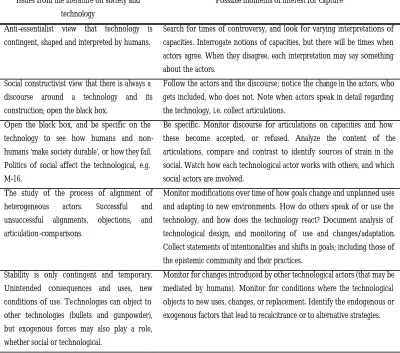
Table 3.1 Summary of Moments of Interest ... 67
Figure 4.1 RIP News Articles analysis, by Edgar Whitley ... 78
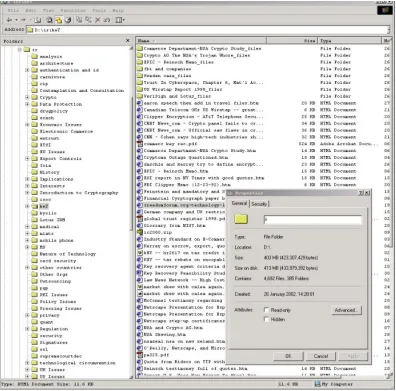
Figure 4.2 File System snapshot as of September 2002 ... 84
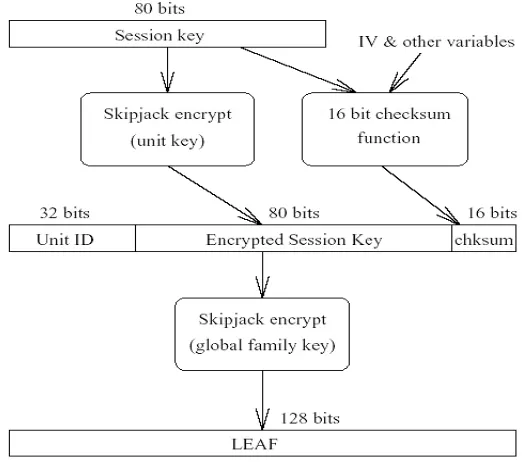
Figure 5.1 The EES' Law Enforcement Access Field (LEAF) ... 101
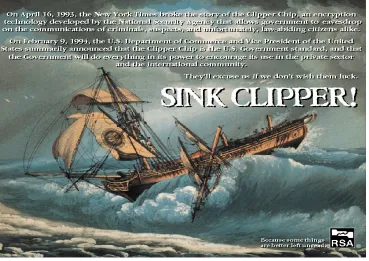
Figure 5.2 Sink Clipper Campaign poster... 103
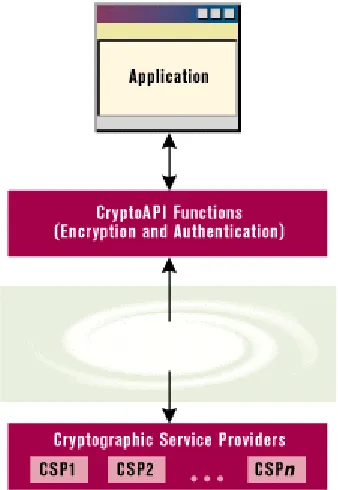
Figure 5.3 CAPI Abstraction ... 128
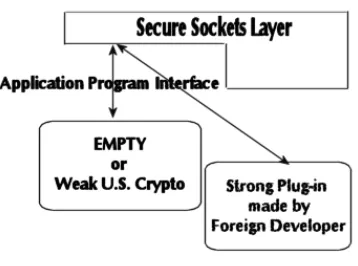
Figure 5.4 API with a hole ... 129
Figure 5.5 CAPI with Signed CSPs ... 129
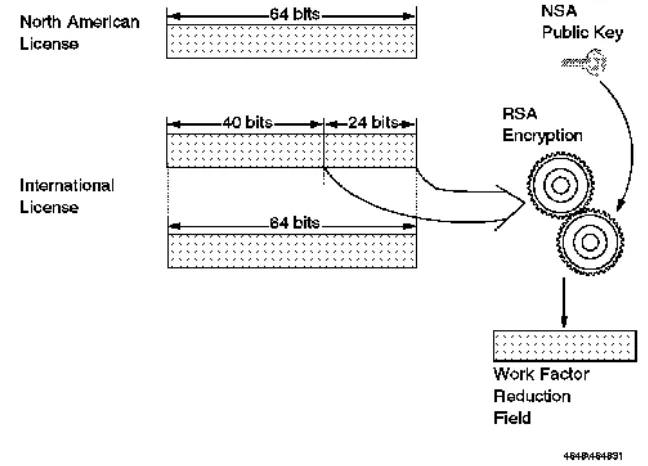
Figure 5.6 Lotus Workfactor Reduction... 135
Table 6.1 Issues arising from the 1997 UK consultation process... 151
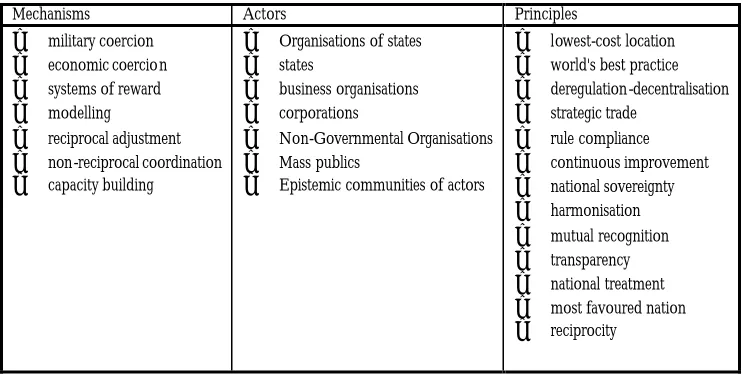
Table 7.1 Actors, Mechanisms, and Principles from Braithwaite and Drahos... 189
Table 7.2 Cryptography policy types ... 189
Table 7.3 Granular Actor-Categories, or entities ... 200
Table 7.4 Regime: NSA control over cryptography research ... 212
Table 7.5 Regime: NSA Intervention on Standards ... 213
Table 7.6 Regime: Clipper and EES... 213
Table 7.7 Regime: Key Recovery... 214
Table 7.8 Regime: Mandatory TTP Licensing ... 215
Table 7.9 Regime: Voluntary TTP Licensing ... 215
Table 7.10 Regime: GAK in E-Commerce bill... 216
Dedication and Memoriam
To my students over the years, for their tolerance, patience, and liveliness.
To Alan Hardcastle, a dear friend who would have liked to be here for this, yet I rest assured that he understood why I did what I do.
To Roger Needham, who I avoided for too long.
Finally, to Tommy Casey, who never got a chance to finish his.
Ian Hosein, 2003.
Acknowledgements
I owe many people much for their assistance and guidance. I will keep this as brief and professional as possible.
Within the doctoral process, Ian Angell for the incredible support and for choosing me and our conditions; Susan and the Boy Scott for getting me into this mess and for caring throughout; and Edgar Whitley for getting me out of it, and accompanying me along on the exit strategy.
Within the IS Department, Lucas Introna, Shirin Madon and Steve Smithson, Jimmy Tseng, and the administrative staff, who were always on hand for support and friendship. Similarly, within the world of policy, David Banisar, Ian Brown, Alberto Escudero-Pascual, David Sobel (and EPIC generally), Barry Steinhardt, and my colleagues on the FIPR advisory board. Academic reviewers to published work were also very helpful with their suggestions and encouragements.
For financial and administrative support, Roger Needham and Maggie Nicell, Mari Ann Lindqvist, Angela Leeke, Dieter Gollman at Microsoft Research. At IBM Research, Bill McLean and Joe Nemni. The Electronic Privacy Information Center and the Global Internet Liberty Campaign for trips to Washington and Brussels. Oshoma Momoh and Jason Whitehead for the accommodation and entertainment in Seattle and Washington. Department of Information Systems assistance and for letting me attend the Short Course on Regulation; and for general resources. Zero-Knowledge Systems for resources and attendance to G8-related events. Oxford University’s Programme in Comparative Media Law and Policy, the Social Science Research Council, and Columbia University for the assistance.
For contact for research purposes, Brian LaMacchia and George Spix, Lyne Simard, Vera Murray, Kevin Lynch, Brian O'Higgins, Lynn McNulty, Israel Ben-Ishai; and all the people involved within John Young's Cryptome, Declan McCullagh's Politech mailing list, Phil Agre's Red Rock Eater list, GILC news, EFF, Crypto.com, FIPR, and yes, even the cypherpunks.
Preface
Portions of this work has appeared in lectures, conference proceedings, book chapters, and journal publications. These are itemised below. I acknowledge my co-authors and the editorial staff and reviewers, while the research and the analysis presented in this dissertation is my own.
Chapter 1 is a result of
o lectures to IS140 on Introduction to Information Systems, IS143 on
Introduction to the Information Society, an MSc module on networks, IS489 on Privacy and Data Protection, IS477 on Interorganisational Systems, and a presentation at Outlook for Freedom, a conference for Russian human rights organisations, Moscow, April 2000.
Components of chapter 2 have appeared in
o Hosein Ian (2001) The Collision of Regulatory Convergence and
Divergence: Updating policies of surveillance and Information Technology. The Southern African Journal of Information and Communication 2(1), 18-33.
o Hosein Ian, Prodromos Tsiavos, and Edgar Whitley (2003) The Footprint
of Regulation, in IS Perspectives and Challenges in the Context of Globalization (Poulymenakou Angeliki et al. eds), Kluwer Press.
Components of chapters 2, 3, and 5 have appeared in
o Hosein Ian, Prodromos Tsiavos and Edgar Whitley (2003) Regulating
Architecture and Architectures of Regulation: Contributions from Information Systems, the International Review of Law, Computers & Technology, volume 17, no.1, 85-97.
Components of chapter 3 have appeared in
o Hosein Ian (2002) A Research Note on Capturing Technology: Towards
Moments of Interest. In Global and Organizational Discourse about Information Technology (Wynn Eleanor H., Edgar A. Whitley, Michael D. Myers and Janice I. DeGross eds.), 133-154.
o Sørensen Carsten, Edgar A. Whitley, Shirin Madon, Dasha Klyachko, Gus
Hosein and Justine Johnstone (2001) Cultivating recalcitrance in information systems research. In Realigning Research and Practice in IS Development: The Social and Organisational Perspective (Russo Nancy, Brian Fitzgerald and Janice I. DeGross eds.), 297-316, Kluwer, Boise, Idaho. (ISBN 0-7923-7420-7)
Components of chapters 3 and 6 have appeared in
o Hosein Ian and Edgar A. Whitley (2002) The regulation of electronic
o Whitley Edgar A. and Ian Hosein (2001) Doing politics around electronic
commerce: Opposing the Regulation of Investigatory Powers Bill. In Realigning Research and Practice in IS Development: The Social and Organisational Perspective (Russo Nancy, Brian Fitzgerald and Janice I. DeGross eds.), 415-438, Kluwer, Boise, Idaho. (ISBN 0-7923-7420-7) Components of chapter 6 have appeared in
o Hosein Gus (1998) Consultation and Contemplation -- What has Gone
Before, a summary of the first UK Cryptography Policy consultation process. In Electronic Privacy Information Center 1998 Sourcebook, Washington D.C.
Components of chapters 7 and 8 have and will appear in
o Escudero-Pascual Alberto and Ian Hosein (200x) The hazards of
technology-neutral policy: questioning lawful access to traffic data. Accepted on October 24, 2002 for publication in the Communications of the ACM.
o Hosein Ian (2000) Logical Propositions on Free Expression, Regulation,
Technology, and Privacy, Media Asia, Volume 27, Number 2, 2000, pp.68-73, by Asian Media, Information and Communication Centre (AMICS) and the School of Communication Studies, Nanyang Technological University (SCS-NTU).
o Canadian Delegation Discussion Paper for Data Retention Workshop.
Tokyo: Group of 8 Conference on High-Tech Crime, 2001, as a contributing author.
o Hosein Ian (200x) International Cooperation in Criminal Matters and
Cybercrime, will appear in Governing Global Electronic Networks (Drake William and Ernest Wilson III eds.), MIT Press.
o Government of Canada Ministry of Justice-commissioned comparative
study on interception of communications regimes in Australia, Germany, the Netherlands, United Kingdom, and the United States, April 2001, as a contributing author and co-editor.
A note on formatting
Chapter 1: Introduction
I am not an advocate for frequent change in laws and constitutions, but law and institutions must go hand in hand with the progress of the human mind as that becomes more developed, more enlightened, as new discoveries are made, new truths discovered and manners and opinions change. With change of circumstances, institutions must advance also to keep pace with the times. We might as well require a man to wear still the coat which fitted him when a boy as civilised society to remain ever under the regimen of their barbarous ancestors.
-- Thomas Jefferson, an American Cryptographer and Founding Father
Serendipity is looking for a needle in a hay stack and finding the farmer’s daughter.
-- Professor Roger Needham
Abstract
Cryptography is considered an important technology, a technique essential for securing and generating trust in digital transactions. This chapter introduces cryptography as an artefact, as a technology in some of its mathematical splendour, and as a subject of policy. The chapter also presents the main argument for the dissertation: studying both the technology of cryptography and the policies to shape its development and use is required in order to understand the discourse of cryptography policy.1
1.0 Cryptography as a Challenge
In November 1992, enrolled as a first year student at the Faculty of Mathematics at the University of Waterloo, I decided to skip an Algebra lecture. I did not realise at the time that it would be important for me to learn the Euclidean Algorithm and the Chinese Remainder Theorem. The next lecture, however, I had been looking forward to for the entire term: Cryptography. Just as it was when I was young and could never fully understand the pig-Latin that my friends were so accustomed to conversing when parents were in the room (and no, I never had a secret decoder ring), the lecture on Cryptography made little sense to me. It was not due to the cryptic nature of the topic with its algorithms and keys; rather it was my lack of aptitude towards mathematics, and lack of appreciation, at the time, of mathematical theory.
infrastructure, and government policies. This was all because the President of the United States announced the U.S. domestic cryptography policy. It was not the last such announcement; and over the years other countries also came forward. In 1996, the United Kingdom government announced its own policy. If only policy was so easy: statements and articulations to direct a path for a technology were not enough.
Cryptography is an art and a science, and requires a level of competency prior to application. Cryptography policy is no different. According to a team of leading private sector and academic cryptographers, cryptography policy is a complex arena, with scientific, technical, political, social, business, and economic dimensions (Abelson and others 1998). I aim to explicate this complex arena (Latour 1991, p.129), which in turn requires an understanding of these technological, political, and economic dimensions and their interplay. This interplay of these dimensions is what I call policy discourse: the interaction of actors as they negotiated, deliberated, consulted, objected, questioned, implemented, or ignored proposed policies.
The primary objective of this research is to understand the relationship between technology and society through looking at one of the more contentious technology policy debates of the 1990s. The secondary objective is to devise means through which we may understand regulation, possibly as a socio-technological phenomenon. This research aims to study the discourses surrounding the cryptography policy initiatives in the United States and the United Kingdom. I will argue that we may derive a deeper understanding of policy discourse if we take a socio-technological approach. Such an approach allows for greater detail regarding actors, their interests, and how alliances form and transform.
The goal of my research is to argue that a socio-technological approach enhances our understanding of actors and their interests; of the discourse and its outcomes; and regulatory change. This is not so simple as to consider technology alongside social forces; it is rather a more subtle heuristic involving social and technological actors at a granular level, translating action through various mechanisms, and articulating principles. Such a socio-technological approach will answer the call from Orlikowski and Iacono (2001) for attention to the technological within the social sciences; attend to Stigler’s call for research on the process of policy formation rather than only its effects (1983, p.541), while also provide further depth in understanding policy transformation (Hood 1994).
presented in Section II (chapters 4, 5, and 6). The analysis and implications for other technology-policy discourses is discussed in Section III (chapters 7 and 8).
The present chapter will introduce the challenge of cryptography policy, by discussing its political and technological traits; and in turn the policy strategies that have been pursued, and their relationships with cryptography itself. Section 1.1 will first review cryptography as a socio-historical artefact. Section 1.2 will present cryptography as a science, technique, and technology; while §1.3 will present some of the policy views regarding cryptography. These strands will converge at §1.4 where I will present a typology of policy strategies that will be used to classify the policies discussed later in this dissertation.
1.1 Cryptography as Artefact
The history of cryptography is as rich and interesting as the stories of society itself. In the seminal study on the history of cryptography, David Kahn's The Codebreakers (Kahn 1996) notes,
It must be that as soon as a culture has reached a certain level, probably measured largely by its literacy, cryptography appears spontaneously -- as its parents, language and writing, probably also did. The multiple human needs and desires that demand privacy among two or more people in the midst of social life must inevitably lead to cryptology wherever men thrive and wherever they write. (p. 84)
Kahn finds that one of the earliest known occurrences of the use of cryptography was in 1900 BC, when an Egyptian scribe used non-standard hieroglyphs in an inscription. As well, he found multiple motivations for the use of cryptography beyond political secrecy,
The Yezidis, an obscure sect of about 25,000 people in northern Iraq, use a cryptic script in their holy books because they fear persecution by their Moslem neighbours. Tibetans use a kind of cipher call 'rin-spuns' for official correspondence (...). The Nsibidi secret society of Nigeria keeps its pictographic script from Europeans as much as possible because it is used chiefly to express love. (p. 85)
Cryptography was often used to protect state communications; the most common example was its use by the Roman Empire.
The model described from Caesar’s time is very traditional: the plaintext that is encrypted into ciphertext, using a relatively small key (three, the size of the letter shift).
The Catholic Church during the 16th century pioneered the use of ciphers to protect diplomatic correspondence. By the 18th century, European governments routinely read diplomatic mail by breaking the algorithms of other nations (NYT Staff 1998).
The majority of the developments outlined in Kahn’s book and other works on the history of cryptography, however, are civilian developments (Ellison 1996).
It was the amateurs of cryptology who created the species. The professionals, who almost certainly surpassed them in cryptanalytic expertise, concentrated on down-to-earth problems of the systems that were then in use but are now outdated. The amateurs, unfettered to those realities, soared into the empyrean of theory. (Kahn 1996, p. 125-126)
Non-governmental applications include the Kama Sutra of Vatsyana, that lists cryptography as the 44th and 45th of 64 arts men and women should know and practice. Interestingly, perhaps the earliest use of regulation and restriction arises from this very same situation: "Man should study the Kama Sutra and the arts and sciences subordinate thereto (…). Even young maids should study this Kama Sutra, along with its arts and sciences before marriage and after it they should continue to do so with the consent of their husbands." (from Ellison 1996)
In 1930s America, Mafia bootleggers used cryptography to communicate details of shipments of alcohol. "Some of these (ciphers) are of a complexity never even attempted by any government for its most secret communications," wrote Mrs. Elizebeth Smith Friedman, a leading government cryptanalyst at the time (from (Kahn 1996, p. 804)). In 1917 Gilbert Vernam at AT&T developed the Vernam cipher, using a key that is completely random and never repeats -- a one-time-pad. This is a provably secure cipher, i.e. unconditionally secure (Stinson 1995, p.51). Designed as a machine, it was offered to the U.S. Government for use in World War I but was rejected and put on the commercial market in 1920 (Kahn 1996, p.401), but failed because of efficiency factors (Kahn 1996,p. 402; Stinson 1995, p.51).
More widely known are the efforts of mathematicians, academics, and even chess players at Bletchley Park in Coventry, England, gathered by Winston Churchill with the mission of intercepting and understanding German communications. The Germans encrypted their communications using a rotor-based machine, Enigma. Breaking the code was an invaluable source of intelligence for the Allies.
After the war, cryptography policy began, albeit quietly. President Truman placed cryptography on the U.S. Munitions List, restricting its export. In 1952 Truman secretly signed the directive that created the formal agency of the U.S. Government that was responsible for continuing the mission of intercepting communications and decrypting foreign communications, the National Security Agency (NSA). Today this secretive agency has one of the largest governments budgets, in the order of $3.6 billion.2
The post-war period included the increased use of computing by an increased amount of sectors of society and the growth of digital communications networks. This in turn gave rise to new conditions for cryptography, and new potential applications. Algorithms grew more complex, keys grew larger, and were sometimes separated.
There are two periods of modern cryptography history: before 1976 and after (Dunn 1997). In 1976, Whitfield Diffie and Martin Hellman, and Ralph Merkle independently, developed publicly the notion of public key cryptography. In this decade, cryptography changed radically. In order to appreciate fully not only this change, but also how it affected the actors and interests within the arena of cryptography policy, a review of cryptography as a technique is required.
1.2 Cryptography as Technology and Technique
Cryptography is the mathematical art and science of securing data for viewing only by its intended audience. Modern cryptography depends on the existence of difficult mathematical problems (RSA Laboratories 1998) to create and break cryptosystems.
Stinson (1995) defines a cryptosystem formally as:
.. a five-tuple (P, C, K, E, D) where the following conditions are satisfied: 1. P is a finite set of possible plaintexts
2. C is a finite set of possible ciphertexts
3. K, the keyspace, is a finite set of possible keys
This is a general definition, while below I will present two specific definitions: one where k for encryption is the same as decryption; and another where each operation uses different keys.
1.2.1 Symmetrical Cryptography
Cryptography is accordingly a tool for information security. Information security principles include confidentiality, integrity, and authentication.3 Cryptography affords confidentiality to plaintext by transforming it into ciphertext. Integrity of the message, i.e. assuredness that the message has not been altered, can be derived from the decryption process: if the message decrypted properly (without errors), then it can be assumed that the message was not changed since being encrypted. Finally, authentication is provided through key distribution. That is, the recipient has a good idea of the authority of the sender of an encrypted message, because if the message decrypts successfully, the recipient can assume that it was encrypted using the same key used for decryption. If the recipient assumes that the only person with such a key would be the person that he expected to receive the message from, then he can be sure that it was indeed she who sent it. These principles hinge on the trustworthiness of the algorithm and appropriate key distribution and management procedures.
In this process, the keys and the algorithms are the essential information; even more valuable than the message content. That is, if the message is recovered, then the confidentiality of a single message is lost; if the algorithm is flawed or key is divulged, all messages, past and future are compromised.
Keys, in their modern usage, tend to be a very large number, ranging in size from 240, to 256, 264, 280, to 2128 and even 2256.4 Another notation for these key-lengths is to refer to keys in the order of 2x as being x-bit keys (e.g. keys of the order of 2256 are 256-bit keys). A method of attacking this cryptosystem would be to use brute force: if the key exists within the keyspace (Stinson's 'K') of 1 to 240, then an attacker can use a computer (or many) and try every number in the keyspace and see which one provides understandable plaintext.
algorithm as a standard, academics and practitioners endeavour for credibility by finding flaws, governments concerned with national and domestic security create their own solutions; the presumption of open review is that stronger algorithms will emerge.
1.2.2 Asymmetric Cryptography
In the late 1970s, Diffie and Hellman (1976), and Merkle (1978)5 independently found solutions to problems that plagued symmetric cryptosystems: how do you communicate securely with multiple untrusted people? and how do you secure a message over an insecure medium? (Levy 2001) If the medium is insecure, sharing keys will be a hazardous exercise. The more recipients that exist within a network of communicators, the more keys that are required, and managing these secret keys becomes burdensome.
Using an elegant mathematical problem of computing the logarithms of large numbers, Diffie and Hellman created the Diffie-Hellman Key Exchange algorithm. Here, two people, Alice and Bob6, are able to create a symmetric key over an insecure network so that even if someone was passively intercepting their initiating conversations in the process of creating a shared key, the secrecy of their communication will not be compromised.
Alice selects a random number a, and Bob selects a random number b.
Both users agree upon a non-secret number pair x and n. Alice raises x to the power of a,modulon, thus xamodulon and sends the result to Bob.
Bob raises x to the power of b,modulon, thus xbmodulon and sends the result to Alice.
Alice now has a and xb and computes (modulon) xab = (xb)a. Bob now has b and xa and computes (modulon) xab = (xa)b.
Both users are in possession of the same value xab, but an eavesdropper can only capture
the values xa and xb. With a sufficiently large modulus it is computationally infeasible for
the eavesdropper, Eve, to compute the common key without knowledge of a or b. This
value of xab can be used within a symmetric algorithm as the key for encryption and
decryption purposes. Diffie and Hellman also suggested the notion of keypairs, claiming that if there were two keys then it would be possible to create the digital equivalent of signatures.
Select two large (e.g. over 100 digit), unequal prime numbers, p, and q.
Compute n = pq.
Compute f(n) = (p-1) (q-1).
Randomly select an integer d that is larger than p and q, and less than n-1, and ensure that d and f(n) have no common factors. Compute e = d-1modulof(n)
Publish the encryption key e and n, while strictly maintaining the secrecy of the decryption key d, and the numbers p, q, which are used in the computation of d and e.
To Encrypt: C = Memodulon
Where M is the message coded into numbers, C is ciphertext.
To Decrypt: M = Cd modulon
Their contribution was a successful algorithm allowing for two keys: an encryption key (e, n) and a decryption key (d). The public encryption key (public key or encryption key) can be
published widely without any concern about its security, while the private encryption key (private key, decryption key, or secret key) can remain solely in the possession of the recipient. The mathematical relationship between the keys is such that if a message is encrypted with one key, only the other can decrypt it.
If Alice wished to communicate securely with Bob over an insecure medium, Bob would first generate a public and private encryption keypair. Bob would then send the public key over the insecure medium to Alice (or the key could be published in a database, or keyserver where Alice could retrieve this key) who would then use it to encrypt the message. The moment the message is encrypted, Alice can no longer decrypt the message; the only person who could feasibly decrypt the message is the owner of the private key, presumably Bob.
RSA relies on the challenge of factoring large integers. Thus, the resulting keys for RSA are usually longer than 512-bits, and tend to be 768, 1024, or 2048-bits in length. Other schemes exist based upon other mathematical problems, requiring different key-lengths. For example, Rabin's security is derived from the difficulty of finding square roots modulo a composite integer (Schneier 1996, p.475). Another example is Elliptical Curve Cryptography, which allows for keys in the order of 128-bits.
Meanwhile, ElGamal is similar to Diffie-Hellman Key Exchange in that it relies on the difficulty of calculating discrete logarithms (Stinson 1995, p.115).
Calculate y = gxmodulop
The public key is (y, g, p). The private key is x.
ElGamal allows for an additional capability: digital signatures (Stinson 1995, p.205). What is interesting about some implementations of ElGamal and its keys is that there is the possibility of another key, that is the private signature key, which unlike in RSA implementations, this private signature key is similar to the private encryption key, but it is restricted to acts of signing. This will be discussed in greater detail in chapter 5, with an outline of the development of the Digital Signature Standard.
1.2.3 Some Implications of Public Key Cryptography
The most notable contribution of public-key cryptography is the notion of the digital signature, and associated services of certification.
Digital Signatures I
The mathematical relationship between the public and private keys is symmetric. If Bob was to encrypt a message using his private key, then anyone who had Bob’s public key could decrypt it, including Alice, the intended recipient, Eve the eavesdropper, and Mallory, the malicious actor. In this case, however, Bob is not necessarily concerned with confidentiality, but rather cares only about authentication.
Consider the distribution of the keys: while everyone in the world can have a copy of Bob’s public key, Bob is, under ideal information security circumstances, the only person with possession of his own private key (Abelson and others 1998). If the recipient of Bob’s encrypted message can decrypt the message using Bob's public key, then she can safely assume that because of the mathematical relationship between the two keys in the keypair, the person who encrypted the message held the private key. Presuming that Bob is the only person in possession of this private key, then Alice can assume with some level of certainty that Bob created the message. This is authentication, where information regarding the origin of a message can be inferred.7
Certification
Alice can not always be certain that Bob is in fact the owner of the private key. Consider the case of Mallory, the malicious intruder in their conversation.
What if Bob sends his public key to Alice, but the communication stream is intercepted by Mallory? Mallory can then create her own keypair, and send a copy of her public key to Alice as though it was Bob's; without Alice knowing any better. After all, a key is merely a large number. When Bob sends a signed message to Alice, Mallory can intercept the message, remove the signature, alter the message, then sign the message with her own private key and send the message onward to Alice. Alice receives the message, and verifies the signature with the public key she thinks comes from Bob (which in fact came from Mallory). Alice is led to believe that Bob had signed the message.
The same applies to public key cryptography for confidentiality purposes. That is, Alice can retrieve Bob’s public key from a server, when it is in fact Mallory’s key that Mallory slipped into the key server without Bob’s knowledge. Any subsequent message that Alice encrypts to Bob is in fact being encrypted to Mallory, who then intercepts, decrypts, reads, possibly alters and may send on to Bob without either Alice or Bob being any the wiser.
There are various solutions to this problem, the leading scheme being certification. A certificate consists of a public key, and personal and technical information regarding this public key and its owner. That is, Bob’s certificate could consist of his public key, information about the public key (e.g. its size, date created), and his personal information, (e.g. email address and home address).
To ensure that the information on the certificate is accurate and not fraudulent, some have suggested the creation of a public key infrastructure (PKI). Each certificate is digitally signed by a Certification Authority (CA), a third party who is responsible for verifying that Bob’s details are true: that Bob is in fact Bob, and that Bob’s key is in fact Bob’s. If the CA agrees with these details about Bob, then the CA signs Bob’s certificate with its own private signature key, thus certifying Bob’s public key. The CA's signature can be verified with its public key, which may also be a certificate, signed perhaps by a Regulatory CA, and so on ad infinitum. This structure and scheme is consistent with the X.509 standard of certificates, a commonly implemented standard.
Constraints on Public Key Schemes
using RSA and ElGamal cryptosystems are very demanding processes, compared to symmetric algorithms at least. When implemented in hardware, RSA is about 1000 times slower than DES, a common symmetric cryptosystem; while in software, RSA is about 100 times slower than DES (Schneier 1996, p. 469). ElGamal is also remarkably slower than RSA (Schneier 1996, p. 479). Generally, symmetric cryptography is used when a large amount of data needs to be encrypted; asymmetric cryptography is used for shorter messages.
Hybrid Cryptography
Due to the resources constraints of public key cryptosystems, a hybrid scheme is commonly used. In most practical implementations, public-key cryptography is used to secure and distribute an ephemeral random session key.
These session keys are generated and then used with symmetric algorithms to secure message traffic (Schneier 1996, p. 33). That is, Alice generates a random session key, and encrypt the message with that session key and a symmetric algorithm. She then encrypts the session key using an asymmetric algorithm and Bob’s public key, and appends it to the message. Bob decrypts the session key with his private key and asymmetric algorithm, and then decrypts the message with the session key and the symmetric algorithm.
Digital Signatures II
The process of a digital signature is also different due to resource constraints. If Bob wanted to sign a message to Alice, Bob would generate a hash of that message. A hash is a one-way mathematical function. That is, it takes the message, and transforms it into a relatively unique value, though this value can not be reversed back to the original message. As commonly implemented, the likelihood of two messages having the same hashed value is only one in 2160 (Schneier 1996, p. 37). If the message is changed even slightly in transit, the hash of the transmitted message would be noticeably different from the original hash.
Upon generating the hash of the message, or the message digest, Bob signs it with his private key, and appends the signed message digest to the original plaintext message. Bob will then send the message and the signed message digest to Alice.
A final point to draw is that within RSA the private key is used to create signatures. That is, the private encryption key is the same as the private signature key, with the same functionality. This is not always the case, however. ElGamal has a signature key that can only be used to generate signatures, not for decryption; the U.S. federal standard, the Digital Signature Scheme, is structured similarly. This was a source of techno-political controversy; the reasoning behind the key separation will be raised in chapter 5, while some implications for cryptography policy will be discussed in chapter 6.
1.2.4 Algorithms and Implementations
Effective cryptography is not as simple as ensuring effective algorithms. Implementing cryptography into hardware, software, modules, and programmes is a challenge. Even if programmers are granted access to all the cryptography-enabling programming libraries available, and the algorithms are reviewed openly and accepted by the community, security is still not assured.
Implementing cryptography is very complex. This includes assuring sufficient randomness in pseudo-random number generators for key-generation, as was discovered faulty in Netscape's Secure Sockets Layer (Goldberg and Wagner 1996); highlighting enforced weaknesses in the keys, as discovered in the GSM phones where the key size, although 64-bit, included a large set of zeros (Briceno 1999); avoiding faulty design of key protection, as Anderson (1993) notes regarding Automated Teller Machine cards and passcodes; defending against statistical analysis, as with 802.11 standard for wireless communications (Borisov, Goldberg, and Wagner 2001); to name a few conditions.
As a result, within the epistemic community (Haas 1992, see chapter 2) of cryptography and security experts, trust in applications is developed over time, and often-times through openness similar to the treatment of the algorithms (Levy 2001; Schneier 1996). In chapter 5, a selection of implementations will be reviewed. Although these implementations often include traditional trusted algorithms, the details of the implementation are interesting, particularly due to the political environment of their development. Therefore, I will not treat cryptography as a black box. Understanding the politics of cryptography requires opening that black box; as will be argued in chapter 3.
1.3 Cryptography as Policy
then electronic commerce and the dot-com boom, cryptography was considered to be a key component for security and trust.
There was a felt need, by governments mostly, to establish policies. These policies often gave rise to debates, sometimes heated. According to a seminal National Research Council report on cryptography policy,
The debate over cryptography policy has been hampered by an incomplete analysis and discussion of various policy options -- both proponents of current policy and of alternative policies are forced into debating positions in which it is difficult or impossible to acknowledge that a competing view might have some merit. (NRC 1996, p. ix)
The now defunct U.S. Congress Office of Technology Assessment (OTA) introduced the issue likewise:
Policy discourse over cryptography used to be as arcane as the technology itself. Most people didn't regard government decisions about cryptography as directly affecting their lives. However, as the communications technologies used in daily life have changed, concern over the implications of privacy and security policies dominated by national security objectives has grown dramatically, particularly in business and academic communities that produce or use information safeguards, but among the general public as well. (OTA 1994, p.9)
Rarely does technology policy prompt this level of controversy. Even in the first public announcement of the Clinton Administration's first cryptography policy initiative, the actors and their conflicting interests were identified.
For too long, there has been little or no dialogue between our private sector and the law enforcement community to resolve the tension between economic vitality and the real challenges of protecting Americans. Rather than use technology to accommodate the sometimes competing interests of economic growth, privacy and law enforcement, previous policies have pitted government against industry and the rights of privacy against law enforcement. (The White House 1993)
Cryptography policy in the April 1993 announcement discussed the use of cryptography for communications over telecommunications infrastructure, the concerns of law enforcement, of individuals, of industry, and ultimately, the notion of regulation, keys, and key escrow.
From this announcement, a crisis followed. According to the editor of the NRC report,
The NRC report listed the multiple and varied interests as including personal liberties and constitutional rights, the maintenance of public order and national security, technology development, and economic competitiveness and free markets.
At a minimum, policy makers (and their critics) must understand how these interests interrelate, although they may decide that one particularly policy configuration better serves the overall national interest than does another. (NRC 1996, p. viii-ix)
Similarly in the United Kingdom, a wide ranging set of actors arose and interests emerged in the discourse surrounding the policies announced from 1996, to the passing of the Regulation of Investigatory Powers Act in 2000.
The empirical data section of this dissertation will present the proposed policies and regulatory regimes, the actors, their articulated interests, and some of their actions. Cryptography policy was indeed a policy crisis, an attempt to regulate the development or use of a technology that faced serious opposition. To appreciate fully the challenges in cryptography policy, however, a socio-technological approach is required. That is, to understand the types of strategies and policies used, their implications for technological design and social use, some understanding of keys, processes, algorithms, key lengths, etc., is required.
1.4 Does Politics have Technology?
One challenge for the regulatory policies is to enable cryptography to proliferate without causing harm to law enforcement and national security interests. The same confidentiality that cryptography offered to governments is now being developed and used by individuals; equivalent levels of protection only afforded to governments are now deemed necessary for electronic commerce (e-commerce), the protection of human rights, among many other applications. The policy crisis necessarily involved social actors, but it also involved a technology, and a shifting technological environment, that in turn affected the actors and their interests.
The environment has changed significantly since 1993 with the growth of the Internet and global communications; much as the environment changed since 1976 in heavily regulated telecommunications networks; or as the environment changed since 1900 BC with atypical Egyptian hieroglyphs. What remains is a perceived need for secure communications and transactions, and this affects actors and their interests in a variety of ways. How the regulatory frameworks designed for one environment change as the environment changes is worthy of study.
A number of countries with varying legal, political, economic, and technological environments over the years have tried to regulate cryptography. In its international review, the Electronic Privacy Information Center (EPIC) noted a number of controls.
? controls maintained by the governments on the domestic use of cryptography in their countries
? controls maintained by the governments on the importation to their countries of applications and equipment that allow use cryptography
? controls maintained by the governments on the export of applications and equipment that use cryptography (Electronic Privacy Information Center 1999, p5)
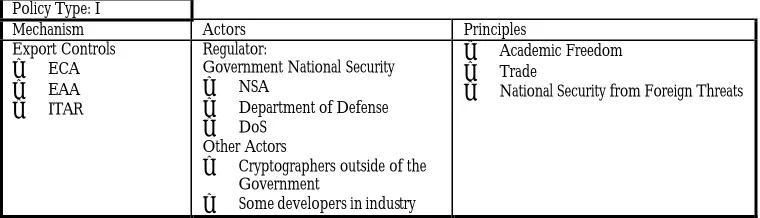
While this typology of controls is useful, I offer an alternative conceptualisation. The EPIC typology is useful to identify political strategies, but does not sufficiently identify the technological nature of these regulations. Rather, I offer the following typology of policy strategies in order to present the regimes as both a social and technological phenomena.
Type 0
Restricting the development, implementation, and use of cryptography. Type I
Policies affecting the development, implementation and use of algorithms Type II
Policies of allowing for lawful access to keys Type III
Policies maintaining capacities to brute-force keys
Table 1.1 Cryptography Policy Typology
As the regulations were socio-technological in nature, this dissertation will study the discourses surrounding the regulations in a socio-technological manner. Through looking at how cryptography policies were introduced, discussed, and embedded into technology and circumvented using technology, objected to, and ignored, I will monitor the regulatory shifts and transformations within each discourse. Understanding the role of the technological actor alongside the traditional social actors will contribute to our understanding of regulatory change.
In chapter 2, I review the regulation literature, focussing particularly on the existing ability of the diverse theories on regulatory regimes to accommodate policy shifts, reversals, and technological change. I contend that the literature may benefit from a more socio-technological approach to understanding regulatory regimes and policy environments.
To understand the relationships between technology and society, in chapter 3 I review the society and technology literature. Viewing each discourse as a socio-technological phenomenon is non-trivial from a theoretical perspective, as it entails treating technology as an actor along-side the traditional social actors that we commonly consider. I develop a frame of capture, moments of interest within a discourse where social and technological actors take form and translations occur, that I will use to decide upon socio-technological data.
Cryptography policies were heavily debated political discourses. In chapter 4 I present the methodology used to gain access to the discourses and to collect data. This interpretive research was a combination of a number of methodologies and methods in order to gain access while also ensuring a fair representation of the various actors and their interests.
The policy discourse in the United States is presented in chapter 5, focussing primarily on the period from 1993-2000. The chapter shows the variety of policy strategies used by the Clinton Administration, the shift in instruments and regulators, the shift in focus from mandated technology to development-guidelines. I also present a number of technologies that were introduced to the discourse, and open their black boxes to see what they represent, the politics inside, and the arising challenges.
The analysis chapter, chapter 7, compares and contrasts each discourse, using a framework of analysis from the literature on regulation, noting the regulatory mechanisms used, the actors present, and their articulated principles. The chapter highlights the emergent actors in each discourse and the subsequent shift in policies, and the detailed socio-technological nature of the policies and their implications. It outlines the attempts at translation by various actors, how some were more successful than others, and accounts for these changes using regulation theory while incorporating the technological actor.
The implications of this research are discussed in chapter 8. The socio-technological research approach is presented as a contribution to Information Systems research. The additional understanding that a socio-technological approach offers to the study of regulation is also discussed in further detail, as other examples of technology policy discourses are considered.
1.5 Cryptography as a Technology and an Actor
In a Secret and blacked-out report from the U.S. National Security Agency that developed the policy threat model, i.e. the potential opposition to proposed policies, the NSA included the following,
? Rights to privacy supersede law enforcement needs. Law enforcement needs outweigh rights to privacy.
? Any government solution which involves the NSA would be suspect.
? If Government wants to decrypt, they should pay to keep up with technology. ? Voluntary co -operation vs. legislation.
? Government ability to decrypt will make US products non-competitive in the world market (and vice versa).
? Government action would displace RSA/DES.
? Mandating a solution restricts future improvements or changes to cryptographic products. ? Government solution will hold back/restrict technology.
(NSA Undated)
In retrospect, the NSA's predictions were relatively accurate, not just for the early policies in the U.S., but also the later policies and even the discourse in the United Kingdom. This dissertation's challenge is to capture and explain two policy discourses that include these articulations, and the actors surrounding each.
a clear collision course. A deeper investigation of these interests, alongside the notion of a technological actor, however, will show that these elaborations are simplistic, and that even the interests are quite complex. It is my hope that viewing cryptography and other technologies as actors that must be investigated in detail alongside other actors, will permit deeper understanding regarding the nature of technology policy discourse.
Endnotes
1. This chapter is dedicated to my algebra professors.
2. This amount is derived and estimated by the Federation of American Scientists for 1998. FAS argues it is within a 5% margin of error. See
http://www.fas.org/irp/agency/budget1.htm for more information.
3. A common listing of the C-I-A principles tends to include Availability, rather than Authentication; authentication is often included as a fourth.
4. Key sizes represented in bits refer to binary digits, where a 512-bit key is equivalent to a key that is in the range of 2512. For reference, 256=72,057,594,037,936, while 257 is twice that amount.
5. Although both contributions were written in 1976, Schneier (1996) states that "due to a glacial publishing", Merkle's work was not published until 1978.
6. Alice and Bob are common elaborations of A and B, used in the cryptography world as two sources and destinations of information. Eve, or 'E' tends to refer to a passive listener, and Mallory, or 'M' refers to a malicious active interceptor.
Chapter 2: Technology Policy and Regulation
We felt that (installing seat belts) was an unnecessary imposition and unnecessary cost...because the belt would do the customer no good unless used.
-- Paul Ackerman in 1959, then-vice-president of Chrysler
Many of the temporary standards are unreasonable, arbitrary, and technically unfeasible...If we can't meet them when they are published we'll have to close down.
-- Henry Ford II in 1966 on federal safety requirements for laminated windshields, collapsible steering assemblies, enhanced door locks, and lap and shoulder safety belts.
But the shoulder harnesses, the headrests are complete wastes of money ... and you can see that safety has really killed all of our business. We are in a downhill slide, the lik es of which we have never seen in our business. And the Japs are in the wings ready to eat us up alive.
-- Lee Iacocca in 1971, then-president of the Ford Motor Company, in a (taped) conversation with President Nixon.
Abstract
Understanding cryptography policy requires an understanding of the literature on technology policy. While the technology and economic policy literature argues that we must look specifically at the technology in order to understand the policies, this literature assumes that government has benign interests. The literature on regulation sees regulation as a political act, involving actors and interests; however technology is often in the background of analysis. I present the case for bringing technology forward, so long as it is studied in the context of the policy discourse. This will lead to chapter 3 where I present the tools to capture socio-technological discourse.
2.0 Introduction
The first chapter of this dissertation presented a typology of cryptography policy that highlights the socio-technological nature of the regulatory regimes.
Type 0
Restricting the development, implementation, and use of cryptography. Type I
Policies affecting the development, implementation and use of algorithms Type II
Policies of allowing for law ful access to keys Type III
Policies maintaining capacities to brute-force keys
Types I to III are identified by looking at the process through which cryptography functions. That is, the trustworthiness of the processes of encryption, decryption, and signature verification can be relayed by the algorithm used, whether it has any faults, intentional or unintentional.
This trustworthiness is often established through open review of the algorithm, which is an interpretation of Kerckhoffs' principle that security should not rely on the algorithm's secrecy (Kerckhoffs 1883; Schneier 2002). Any limits to this review, or shaping of the process is a Type I policy. Similarly, a policy that mandates a specific form of implementation is also of Type I.
If we treat the algorithm as a black box, then access to plaintext can be achieved via the keys. So Type II policies try to establish procedures for lawful access to these keys, achieved through legal and technological means.
Type III policies aim to ensure that these keys are weak. Such a policy usually dictates that keys are kept sufficiently short in length ensuring a limited number of keys are available (i.e. a small keyspace). Fewer keys means that the computational burden of brute-forcing is minimised.
Finally there is an alternative policy of Type 0 that bans cryptography outright. Although implemented in some countries, Type 0 policies were not formally proposed in either country in this study.
Each of these policy types indicates an interplay between technological and social controls. A Type I policy affects both the conduct of the cryptographers, but also how the cryptography may be implemented. Similarly, a Type III policy affects the actions of companies developing software, but also affects the constitution of code developed. An understanding of technology policy and regulation is required to make sense of how such policies are formed and implemented, how they are transformed within discourse, and ultimately succeed or fail.
2.1 On Technology and Economic Action
The literature on economics and technology begins by 'opening the black box' of technology (Rosenberg 1982, pvii). Once opened, markets, policies, and institutions emerge. This body of literature studies the interaction between institutions that govern innovative activities and market-based patterns of change (Dosi and Orsenigo 1988, p.21). The work focuses on diffusion and use of technology and how a technology becomes embedded in infrastructure (Arthur 1988, p.591); and less so on the policy process itself.
Technology may embed itself within a market; but this does not mean that stasis is inevitable. Rosenberg (1982, p.106) acknowledges that technology, as argued by Schumpeter, disrupts and structures markets. Much of Rosenberg's focus resides, however, on how policies structure innovation within the market; such as how government policies in the aircraft industry affected demand, research and development, and market structure (p.163). Rosenberg and Mowery's research shows that government is powerful at choosing winners and losers and creating incentives for development and innovation (Rosenberg 1982, chapter 8). Rosenberg and Mowery view this generally as an acceptable development, since government would possess a great amount of information regarding the technologies and the appropriate market structure.
This information does not give the government full agency in influencing technology diffusion. Arthur (1988) notes that an authority with full information can tilt the market within narrow windows of opportunity to create change where it may not have otherwise arisen. This is admittedly merely theoretical: Arthur notes that full information is unlikely, as is knowing the 'best' technology ahead of time (1988, p.602).
Granting government the power to set policies to choose winners and losers in the marketplace is regarded generally as a positive development within this literature. Rosenberg and Mowery argue that the classical theories that view innovation decided by market forces are unsupported by evidence (Rosenberg 1982, p.194). Rather, they argue that not only do governments have a large role to play in fostering innovation, but governments and policies may be necessary to innovation (1982, p.236). They take a benign view of the interests of the policy makers towards the technology, as they assume that innovation is being promoted.
defined contextually as "the needs that are meant to be fulfilled, the scientific principles utilised for the task, the material technology to be used". That is,
A technological paradigm can be defined as a 'pattern' for solution of selected techno-economic problems based on highly selected principles derived from the natural sciences. (Dosi 1988, p.224)
Technologies are considered to be 'notional possibilities' within paradigms (van den Belt and Rip 1987, p.138-139). However, this paradigmatic approach does not include consideration for the politics of these patterns: the politics involved in the selection process and the technologies that are eventually developed. While the literature notes that the market is not the over-riding concern, and that government can stimulate relationships in the user-producer field (Lundvall 1988, p.358), they tend to ignore the interests of government. In particular, governments may be interested in preventing technology diffusion.
On occasion the literature notes some interesting selections of technologies based on policy. In discussing the case of nuclear power in the United States, Cowan (1990) documents how government’s interests are very powerful in deciding winners and losers and shows how the 'best' technology may not win, presenting the case of nuclear reactors. The 'winning' technology was chosen based on the interests of the Department of Defense. Even in deciding which was the weaker technology, between the technology promoted by the U.S. and Canada, choosing the metrics for making the decision was also a political process. The U.S. eventually started exporting the technology to developing countries, in spite of export controls, because of fears of the Soviets selling their technology instead.
In summary, the technology and economics literature assumes a benign policy. It is argued that the technology policy promotes the development of technology and its diffusion. Finally, technology is seen as a creator of externalities, and accordingly is induced by and induces economic change (Nelson and Soete 1988 p.633). Within cryptography policy, however, the policy-setters are self-interested, and diffusion is not necessarily supported by the policies considered. Cryptography, arguably, does more than create externalities; it also shapes interests and constrains action. A more ideal body of literature, for this study, would recognize the prevalence of self-interest within all the actors, and a more active role for technology apart from the end result of policy or a creator of externalities.
2.2 On Regulation
The literature on Regulation has long seen the politics involved in regulatory policy. It also has a poverty in explication, however. According to Stigler,
There is an interesting asymmetry in the success of this literature in dealing with two problems into which the theory is commonly divided: Why are regulatory policies adopted and abandoned? What are their effects? Economists have been much more successful in measuring effects of policies than in explaining their adoption. The explanation is that one can choose the effects of a policy to study, and usually more easily measured effects are chosen for study. (Stigler 1983, p.541)
Explaining the formation and transformations in cryptography policy in the U.S. and the UK is therefore a challenging task. This section will review the approaches of regulation theories.
The literature on regulation is filled with divergent theories on actors, interests, and even explanations of policy shifts. In fact, even a description of what constitutes regulation remains unresolved. Separating the definition of regulation from the politics of regulation is not easy.
The paramount role traditionally assigned to government regulation was to correct the failures of the private market (the unconsidered effects of behavior on outsiders), but in fact the premier role of modern regulation is to redistribute income. (...)This change in the fundamental role of regulation is so widely accepted, and so copiously documented, that it would be pedantic to cite the vast and growing host of supporting studies. (Stigler 1988, p.xii)
This regard acknowledges self-interest and politics: policy is not necessarily benign.
resources that governments possess and which can be used to influence industrial, economic, or social activity" (p.34). Governments have the capacity to command using legal authority to pursue policy objectives; the ability to harness markets through channelling competitive forces to particular ends; to manage information flows such as those used in consumer protection; to confer protected rights, using incentives and constraints; and to act directly on the market and affecting individuals.
Knowing how government regulates, and what regulation does, does not mean that there is a consensual understanding of regulation and its purpose. Other disciplinary approaches to understanding regulation have arisen, growing beyond economic theories (Baldwin, Scott, and Hood 1998, p.35). Each discipline in turn has its own perspective on the roles of regulation. According to Thatcher (2000), the differing interpretations of regulation can be summarised as
Classical economics
Regulation is an interference in the market that may be necessary
Political economy
Regulation is inherent to society, such as laws of contracts, used by the state to ensure that the market functions
Political Science and Law
Regulation steers public activity; regulation is concerned with controls over private activity
Sociological
Regulation is information norms that guide behaviour
Thatcher argues that each of these are problematic: classical economics rests on a purist view of what constitutes a market; political economy fails to discern between purposeful action and action that occurs anyway; the political science and law interpretation is culturally-bound; and the sociological is too broad.
Thus a notion of intentionality about the development of norms is dropped, and anything producing effects on behaviour is capable of being considered regulatory. Furthermore a wide range of activities which may involve legal or quasi-legal norms, but without mechanisms for monitoring and enforcement, might come within the definition. (p.4)
This last definition is sometimes considered the 'European approach', taken as a synonym for 'governance' (Hood 1994, p.19); and is consistent with approaches taken in socio-legal studies (Lessig 1998).
The social-control or socio-legal definition is taken further by Braithwaite and Drahos (2000), who reframe the very objects and subjects of regulation, incorporating a number of mechanisms used by both the powerful and the weak. Regulation, in their view, consists of plural webs of many actors that regulate while being regulated themselves; individuals, states, industries, organisations are objects and subjects of regulation (p.10). In their compendium of global business regulation, Braithwaite and Drahos identify actors, mechanisms, and principles that arise within a discourse, of what they call a web-of-influence. This framework (actors-mechanisms-principles) helped them to analyse the conduct of the discourse and the regulatory outcome. In each discourse studied, a number of these actors attempted translations (to ally or co-opt other actors; see chapter 3), and principles conflicted and aligned, as various policies were attempted using different mechanisms. In a sense, the regulation can not be separated from the discourse.
As a result, this dissertation interprets regulation as a sociological phenomenon, in accordance with Baldwin, Scott, and Hood's consideration of wide mechanisms of control. While I focus on regulations that begin with intervention from the state, the outcome of the regulations that are included in this study are not limited to state-sanctioned activity. Therefore, the Braithwaite and Drahos definition involving actors, mechanisms, and principles sought within what I call a discourse, and they consider a web -of-influence, is the definition of choice for the purpose of this study.
As with definitions of regulation, both the conduct of the actors within regulatory discourse and the means of explanation vary. The following subsection will review the theories of actors and action commonly used in regulation studies.
2.2.1 On Regulatory Actors and Interests
Public Interest
This is the oldest approach to regulation, involving a functionalist perspective with an apolitical ontology. That is, state action is considered a means to correct market failures, or in the 'public interest', managing natural monopolies, public goods, and externalities that may arise (such as in the area of defence, or pollution issues), informational problems, and transaction costs.
This is a paternalistic approach where government is assumed to have more information than other actors. Regulation is considered a positive development in its own right (Hood 1994, p.20). There is often little explanation, however, of how the 'public interest' is actually achieved through regulation. This is symptomatic of a lack of regard of the self-interest of government and the regulators, similar to the problems with the technology and economics literature.
Capture/Cyclical
This theory arose as political scientists noted that in some cases the regulators and the regulated achieved a level of consensus. This occurred particularly when regulatory agencies were taken over by the interests of the regulated (Hood 1994, p.21); in effect they become enrolled (Latour 1991). In this view, regulations are a means of protecting the interests of the regulated industries rather than as a means of protecting the interests of consumers and new entrants into a market (Baldwin and Cave 1999, p.36).
A benefit of such an approach is that it explains regulatory change (as regimes are translated in the interests of the regulated), emphasising conflict, interpretive flexibility of regimes, and subversion of intentionality. This theory is weak, however, at explaining why some regulations fail to meet the interests of the regulated industries, as it lumps together the interests of the regulator and the regulatees uncritically. Even within a given industry affected by a regulation, a number of interests may exist; this theory presupposes monolithic interests that may be embedded within a regulator, something that Hood (1994, p.22) qualifies as 'simplistic'. It also pays insufficient attention to the interests and actions of other actors such as the courts, consumers, and voters.
The Economic Theory
The Economic Theory of Regulation is associated with the Chicago School (Stigler 1988). Regulation is seen as arising from the interaction between rent-seeking interest groups demanding regulation and politicians supplying it. It is argued that all forms of regulation actually disadvantage consumers, as interest groups pursue regulatory rents, and these groups tend to be producers or powerful users (Hood 1994, p.23).
This approach allows for an analysis of specific interests in specific actors. The school's view of interests, however, is criticised as being too narrow as it focuses only on material self-interest, failing to see other possible interests (Hood 1994, p.24). Assuming the interests of actors for the sake of explanation is hazardous; rather articulated interests may emerge from the discourse, be contingent, and perhaps conflicting.
Public Choice Theory
Public choice theory separates politicians from regulators, seeing even more actors make up the discourse. Politicians are seen as a group of actors interested in maximising budgets, distributing patronage; or perhaps instead as actors seeking smaller government through tax cuts. Bureaucrats and regulators are seen as actors pursuing larger budgets, or wishing for autonomy, power, and prestige.
Approaching regulation studies in this way permits an elicitation of numerous motivations behind a given regulatory regime, beyond simpler rents like money and votes. This view does not explain deregulation adequately, however: if interests are aligned behind a regulatory regime, there is little reason for regulatory change (Noll 1998, p.140).
Historic Institutionalism
In this theory, institutions are the most important units of analysis. That is, institutions are stable and have a history, and in turn affect which actors have power. This view helps to explain why different states develop different interests and in turn different regulations.
In a move beyond economic and public choice theories, interests are seen as emerging from a context, rather than something to be assumed. While this theory can explain differences among regimes, it suffers from failing to explain regulatory trends and changes (Thatcher 2000).