item and our policy information available from the repository home page for further information.
Author(s):Hames, Dominic
Article title: Effect of Record Length on Prediction of Extreme Events Using River Flow Data
Year of publication:2006
Citation: Hames, D. (2006) ‘Effect of Record Length on Prediction of Extreme Events Using River Flow Data’Proceedings of the AC&T, pp.107-112.
Link to published version:
EFFECT OF RECORD LENGTH ON PREDICTION OF
EXTREME EVENTS USING RIVER FLOW DATA
Dominic Hames
Built Environment Research Group
Abstract: This paper considers the effect of record length on the sensitivity of extreme predictions
based on the analysis of annually recorded maximum flow records for a number of locations worldwide. Locations have been chosen based on the criterion of a minimum of 100 years of standardised records, with extremes that closely follow standard statistical techniques.
Based on the analysis carried out, confidence of extreme predictions appear to be a function of the log of the return period event required, the reciprocal of the square root of the record length and a parameter unique for each river. Using the techniques outlined in this paper, methods are proposed to give confidence on extreme predictions using limited data sets. However, more work is required to define the unique parameter for each river, which has not been considered in this paper.
1. Introduction
The determination of extreme events for design purposes is based on the analysis of past records. With often little data available, predictions can become highly variable with an unknown level of confidence. As with time more data becomes available, predictions usually become more robust and can indicate extreme predictions noticeably different from previous estimates. The effect of unreliable predictions can result in increased costs due to over designed schemes, or continuing damage and often wasted design costs due to under designed schemes.
This paper investigates the effect of record length on the sensitivity of extreme predictions of river flow using standardised annual maxima records at locations around the world where at least 100 years of records are available. Locations chosen were based on records published in Herschy, 2003 and 2004. Locations which were observed to not follow the well known Gumbel distribution were excluded from the analysis. This gave data sets where predictions of extremes using the full record
length could be considered robust, and where sub-samples of data sets would follow an underlying statistical distribution. Based on the criteria outlined above, 9 locations were analysed which are outlined in Table 1.
2. Analysis methodology
position (Marriott et al, 2004) as this is the distribution followed by a Monte Carlo simulation. The distribution of the return period estimates was investigated as the variation of the predictions relative to the return periods determined using the original (standardised) annual maxima record.
2.1. Extreme predictions
The Gumbel distribution is given by equation 1.
( )
− = − − θ ξ η η eF exp (1)
where:
ξ is the position parameter
θ is the scale parameter This can be written as:
ξ θ
η = X + (2)
where:
( )
(
Fη)
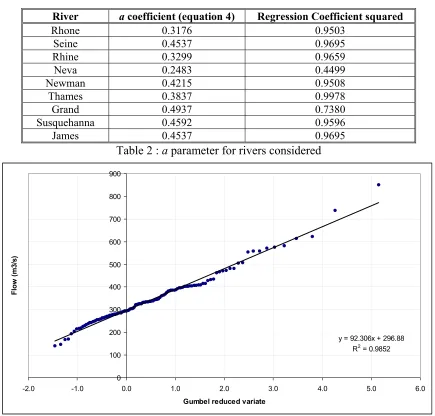
X =−ln −lnUsing the Gumbel distribution in this form, the values of ξ and θ can be determined by a least squares analysis and this is shown for the River Thames data using the binomial plotting position in Figure 1.
2.2. Distribution of simulated extremes
Based on the analysis carried out, extreme estimates of flow from simulated annual maxima were seen to follow a normal distribution of near mean zero, and standard deviations proportional to the reciprocal of the square root of the simulation. This is shown for 20 year simulations for the River Thames in Figure 2, where the difference (Ef) is given by equation 3.
C C S f E η η η −
= (3)
where:
ηC is the calculated ‘actual’ flow
ηS is the estimated flow from the simulation
Considering different simulation lengths, the standard deviation of Ef was found to be
approximated by equation 4.
( )
n T a a T ln =σ (4)
where:
σT is the standard deviation of Ef
T is the return period required
n is the record length
a is a constant (different for each river)
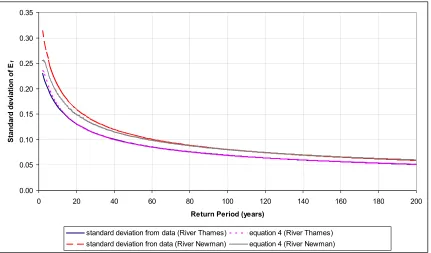
This is shown for the River Thames and the River Newman in Figure 3. This shows good correlation, particularly for the River Thames. The correlation for the River Newman is typical of the remaining rivers considered in this paper (apart from the River Neva which is quite poor).
The values of a appear to be unique for each individual river, and for the rivers considered in this paper are shown in Table 2. Also shown in this table are estimates of the regression coefficient squared, which gives an idea of the accuracy of the fit of equation 4.
3. Accuracy of extreme estimates
( )
± =
n T a z
a
C S
ln 1 %
η
η (5)
where:
z% is the standard normal variable
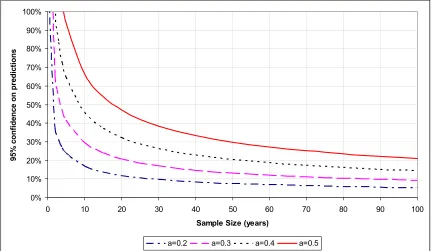
Considering the 95% confidence in predictions, this is shown for different values of a for a 100 year return period event in Figure 4. For the River Thames (for example), which has an estimated a
value of 0.3837, the 100 year return period event would be estimated to be calculated (for 95% confidence) to within 43% using a 10 year record length, and within 19% using a 50 year record length.
4. Conclusions
Based on the analysis in this paper, confidence in estimates of extremes from limited data sets for the rivers considered has been proposed. However, for these rivers large data sets are already available and predictions can be considered robust. For rivers with limited data sets (less than about 20 years), predictions are less robust and the methods proposed in this paper can be used to investigate the confidence in predictions of extremes.
Two problems clearly exist in using this technique in these cases. These are the determination of the a parameter in equation 4 for the level of accuracy, and the ‘actual’ flow (ηC) for use in equation 5. Although
the variation in the a parameter for limited data sets has not been studied in this paper, this could easily be considered in a future publication. This would give a level of confidence in its prediction, and confidence placed on its value. The variation of the ‘actual’ flow could also be investigated however, as this is the variable that confidence is being placed on, an
investigation of this type could be considered spurious and is not necessary.
5. References
Gumbel E.J, Statistics of Extremes, Columbia University Press, New York, 1958.
Herschy R, World Catalogue of Maximum Observed Floods, IAHS Publication 284, IAHS Press, 2003.
Herschy R, World Catalogue of Maximum Observed Floods (Errata and Supplementary Data), IAHS Press, 2004.
River Gauging Location Catchment Range Years
Rhone Beaucaire (France) 96500 km2 1845 - 1982 138
Seine Paris (France) 44300 km2 1733 - 1982 245
Rhine Lobith (Holland) 160000 km2 1901 - 2000 100
Neva Novosaratovka (Russia) 281000 km2 1859 - 1979 118
Newman Smalininkai (Russia) 81200 km2 1812 - 1978 164
Thames Kingston (UK) 9948 km2 1884 - 2003 120
Grand Lansing (USA) 3190 km2 1901 - 2000 100
Susquehanna Harrisburg (USA) 62400 km2 1891 - 2001 111
James Buchanan (USA) 5374 km2 1893 - 1999 107
Table 1: Locations and records considered
River a coefficient (equation 4) Regression Coefficient squared
Rhone 0.3176 0.9503
Seine 0.4537 0.9695
Rhine 0.3299 0.9659
Neva 0.2483 0.4499
Newman 0.4215 0.9508
Thames 0.3837 0.9978
Grand 0.4937 0.7380
Susquehanna 0.4592 0.9596
[image:5.595.79.514.272.688.2]James 0.4537 0.9695
Table 2 : a parameter for rivers considered
Figure 1 : Extreme estimates of flow for the River Thames (for 2003) y = 92.306x + 296.88
R2 = 0.9852
0 100 200 300 400 500 600 700 800 900
-2.0 -1.0 0.0 1.0 2.0 3.0 4.0 5.0 6.0
Gumbel reduced variate
Fl
o
w
(
m
3/
Figure 2 : Error in estimates for 20 year simulations (River Thames)
Figure 3 : Variation in standard deviation of Ef for different return periods
0.0 0.5 1.0 1.5 2.0 2.5 3.0 3.5 4.0
-0.4 -0.3 -0.2 -0.1 0.0 0.1 0.2 0.3 0.4
Ef
E
f
de
ns
it
y
10 year return period 50 year return period
0.00 0.05 0.10 0.15 0.20 0.25 0.30 0.35
0 20 40 60 80 100 120 140 160 180 200
Return Period (years)
S
ta
nda
rd
de
vi
at
io
n of E
f
[image:6.595.83.514.441.694.2]Figure 4 : 95% confidence in predictions for different a values (100 year return period event)
0% 10% 20% 30% 40% 50% 60% 70% 80% 90% 100%
0 10 20 30 40 50 60 70 80 90 100
Sample Size (years)
95
%
c
onf
ide
n
ce
on pr
ed
ic
ti
ons