peripheral participation in mature, community-led
Free/Open source software projects
Evange
li
a Berdou
A thesis submitted in partial fulfilment of the requirements for
the degree of Doctor of Philosophy in Media and Communications
London School of Economics and Political
Science
Where information has been derived from other sources, I confirm that this has been
indicated in the thesis.
The thesis investigates two fundamental dynamics of participation and collaboration in mature, community-led Free/Open Source (F/OS) software projects - commercialization and peripheral participation. The aim of the thesis is to examine whether the power relations that underlie the F/OS model of development are indicative of a new form of power relations supported by ICTs.
Theoretically, the thesis is located within the Communities of Practice (CoP) literature and it draws upon Michel Foucault's ideas about the historical and relational character of power. It also mobilizes, to a lesser extent, Erving Goffman's notion of `face-work'. This framework supports a methodology that questions the rationality of how F/OS is organized and examines the relations between employed coders and volunteers, experienced and inexperienced coders, and programmers and non-programmers. The thesis examines discursive and structural dimensions of collaboration and employs quantitative and qualitative methods. Structural characteristics are considered in the light of arguments about embeddedness.
The thesis contributes insights into how the gift economy is embedded in the exchange economy and the role of peripheral contributors. The analysis indicates that community-integrated paid developers have a key role in project development, maintaining the infrastructure aspects of the code base. The analysis suggests that programming and non-programming contributors are distinct in their make-up, priorities and rhythms of participation, and that learning plays an important role in controlling access. The results show that volunteers are important drivers of peripheral activities, such as translation and documentation. The term `autonomous peripherality' is used to capture the unique characteristics of these activities. These findings support the argument that centrality and peripherality are associated with the division of labour, which, in turn, is associated with employment relations and frameworks of institutional support.
The PhD often appears as a solitary undertaking. One thing that PhD students, however, learn very quickly, is that impossible to maintain the degree of focus and dedication required for its completion without the help of many people.
My supervisor, Professor Robin Mansell, provided her unfailing support and guidance, while challenging me to move beyond my intellectual comfort zones. I would not have been able to do this without her.
I am indebted to the Greek State Scholarships Foundation which funded the first three years of my study. I would also like to thank the DBE and OPAALS European projects, and especially Dr. Paolo Dini, that supported my research over the last two years.
I am grateful for the time and openness of all the F/OS contributors who participated in my research. I would like to especially thank Thomas Zander, Federico Mena Quintero, Scott Wheeler, Telsa Gwynne, Luis Villa, Christian Schaller, Gerard Briscoe, Yiota Tsatsou and Ellen Helsper, for their generous assistance in various aspects of my study.
Dr. Gordana Uzelac and Elizabeth Van Couvering were there for me through the best, and the worst, at late nights and early mornings.
Ute, Marianna and Constantina believed in me before I did.
Lastly, I am forever grateful to my husband, Alexandros, and my parents for their love and support.
List of Figures
7
List of Tables
7
I Introduction 9
1.1 Overview 9
1.2 The F/OS model of development: briefhistory and major
characteristics IO
1.3 F/OS: changingperceptions, unanswered questions 12
1.4 Sigm tcance of the research 20
1.5 Primary case studies and methodology 21
1.6 Thesis Outline 23
1.7 Conclusion 24
2
Theoretical and
conceptual framework 252.1 Chapter overview 25
2.2 The Communities ofPracticeperspective 25
2.3 Foucault and the study ofpower in Free/Open Source 32 2.4 Enacting structures: Goffman, face-work and the negotiation of image
in Free/Open source 43
2.5 Meshworks, Cathedrals and Bazaars 5o
2.6 Conceptual Framework 53
3 Methodology
56
3.1
Chapter overview 563.2 Overview of the research design 56
3.3 Selection ofprimary case studies: the GNOME and KDE projects 59
3.4 Phase I: Interviews 6i
3.5 Phase 2: Nested Case Studies
65
3.6 Analysis of qualitative data
69
3.7 Phase
3:
2uantitative examination ofpatterns of contribution andmaintenance 74
3.8 Analysis of quantitative data 8o
3.9 Conclusion 83
4 Communities and the economy: commercialization ofmature F/OS
projects
84
4.1 Chapter overview
84
4.2 F/OS communities and the economy
84
4.3 Paid developers in community managed F/OS projects
86
4.4 Gstreamer and Fluendo SL: At the intersection of company andcommunity 93
4.5 The GNOME Bounty Hunt: testing a new interface between companies
5 Peripheral participation, learning and the division of labour in
F/OS communities
110
5.1 Chapter overview
rio
5.2 Between communities and practices: peripherality, learning and power
in F/OS projects r10
5.3 Intercoderperipherality: new developers (newbies) learning and
participation
1125.4 Autonomous
peripheral participation and development 117
5.5 Autonomous peripherality in context
123
5.6 Conclusion
126
6 Commercialization and peripherality tested: A quantitative
examination ofpatterns ofcontribution and engagement in mature,
community led F/OS projects
132
6.1 Chapter overview
132
6.2 Working
hypotheses for the quantitative examination ofpatterns of
contribution and involvement
132
6.3 The GNOME community
1
34
6.4 The KDE community
15o
6.5 Conclusion
165
7
Technologies of communities and the relational meshwork:
Principal findings and theoretical implications ofthe research 170
7
r Chapter overview
170
7.2
Commercialization and peripheral participation in mature
community-led F/OS
projects: Recapitulation and discussion ofempirical
findings
170
7.3 Technologies of communities and the relational meshwork: wider
theoretical implications ofthe research
18o
7.4 Alternative frameworks of interpretation and the baselinefor
comparing the F/OS model
i88
7.5 Conclusion
192
8 Conclusions
1
95
8.i Chapter overview
1
95
8.2 Theoretical, methodological and empirical contributions 195
8.3 Limitations ofthe study
208
8.4 Avenues forfuture research
2108.5 Concluding remarks
213
Bibliography
215
List of Figures
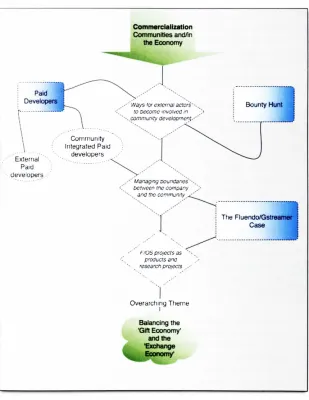
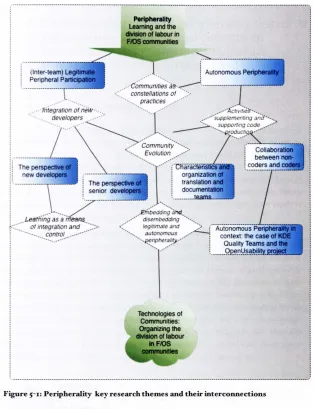
Figure 3-1 Codes on commercialization generated through Atlas Ti 71 Figure 3-2 : Codes on peripheral participation generated through Atlas Ti 72 Figure 4-I: Commercialization key research themes and their interconnections 107 Figure 5-1: Peripherality key research themes and their interconnections 535 Figure 6-1: Breakdown of GNOME Foundation respondents according to their employment status
(volunteers and affiliated) 136
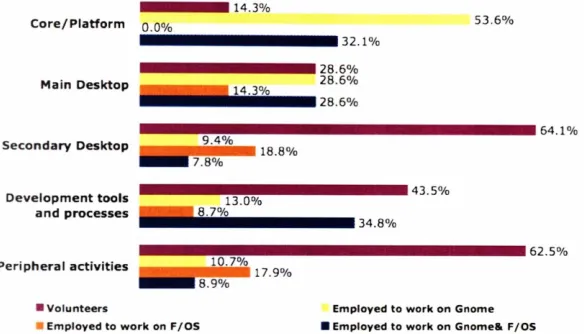
Figure 6-2: Analysis of involvement of paid and volunteer GNOME contributors in principal areas
of development at the short-term level 139
Figure 6-3: Distribution of effort by group at the short-term level 140 Figure 6-4: Frequency of participation of volunteers and affiliated in GUADECs held between 2003-
05 143
Figure 6-5: Distribution of GNOME contributors according to number of modules maintained. 146 Figure 6-6: Distribution of modules maintained by affiliated, non-affiliated and by affiliated and
non-affiliated GNOME developers 147
Figure 6-7: Analysis of modules maintained by affiliated and non-affiliated GNOME contributors in
principal areas of development. 148
Figure 6-8: Breakdown of KDE e.V. respondents according to their employment status 152 Figure 6-9: Analysis of involvement of paid and volunteer contributors in principal areas of
development in the short-term 154
Figure 6-1o: Distribution of effort by group at the short-term level 155 Figure 6-11: Frequency of participation in Akademy for volunteers and affiliated 1S7 Figure 6-12: Distribution of number of modules maintained by volunteer and affiliated members of
KDE e.V 158
Figure 6-13: Distribution of KDE contributors according to number of modules maintained 16o Figure 6-14 : Distribution of modules maintained by affiliated, non-affiliated, and affiliated and non-
affiliated KDE maintainers 161
Figure 6-15: Analysis of modules maintained by affiliated and non-affiliated KDE developers in the
principal areas of development 162
Figure 6-16: Distribution of number of modules maintained by non-affiliated and affiliated KDE
developers 163
Figure 7-1:Insights from first level analysis of commercialization and peripherality 177
Figure 7-2: Technologies of communities t86
Figure 7-3 The relational meshwork 188
Figure 8-1: A synthesized FLOSS development team structure from Crowston and Howinson, 2005: 203 Figure 8: Revised version of Crowston and Howick's Figure based on research findings 203
List of Tables
Table 3-I:Operationalization of research questions and phases S9
Table 3-2:Interviewee sample 61
Table 3-3 Connection of the study of power and Phase i 64
Table 3-4: Breakdown of GNOME and KDE modules 82
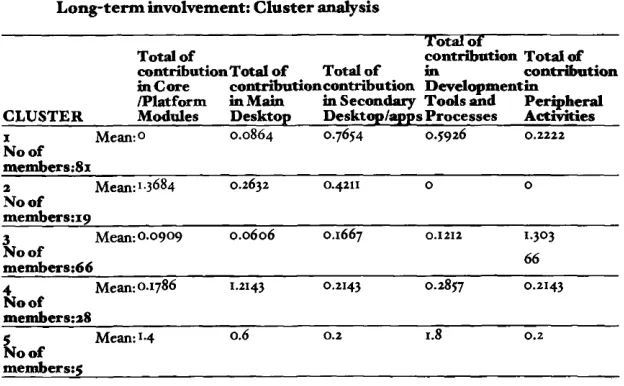
Table 6-1: Mean analysis of a five-cluster solution produced by hierarchical cluster analysis grouping individuals on the basis of their scores in each area of development 137 Table 6-2: Significance of long-term patterns of contribution between different groups of
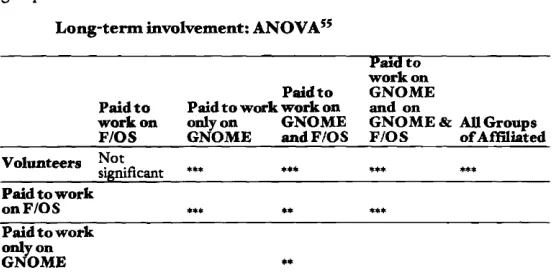
contributors 138
Table 6-3: Crosstabulation of main area of contribution* affiliated and volunteers 141 Table 6-4: Detailed overview of patterns of contribution between volunteers and affiliated at the
short-term level for different group combinations 142
Table 6-5: Crosstabulation of no of GUADECs attended by affiliated and volunteers 144 Table 6-6: Detailed overview of patterns of conference attendance between volunteers and affiliated
for different group combinations. Source: GNOME Foundation survey, N=199 144 Table 6-7: Model Parameters for Logistic Regression. Source: GNOME Foundation survey, N=,7o
145
Table 6-8: Crosstabulation of cases of exclusive maintainership (modules maintained exclusively by non-affiliated and modules maintained exclusively by affilitated) with the areas the modules
belong in. 149
Table 6-9: Crosstabulation of affiliation with number of modules maintained.Source: Online search,
N=9z (maintainers) ISO
Table 6-10: Mean analysis of a four-cluster solution produced by a hierarchical cluster analysis grouping individuals on the basis of their scores in each area of development 1 53 Table 6-11: Significance of long-term patterns of contribution between different groups of
contributors 1 54
short-term level for different group combinations 156 Table 6-14: Crosstabulation of no of Akademy events attended by volunteers and affiliated 1S7
i Introduction
1.1
Overview
This chapter provides an introduction to the research, which examines power relations in Free/Open source (F/OS) software projects. The F/OS model of development is often considered to be one of most promising new models of production and labour organization to emerge as a result of the widespread availability of information and communication technologies (ICTs) in the last Is years. Part of its significance lies in that it may be applicable to other domains of production, such as content production, as indicated by the success of Wikipedia. However, existing explanations of its success tend to adopt a limited perspective that fails to address important issues of access, control and power.
The central question addressed in this study concerns the structure and dynamics underlying the F/OS model of development which is often perceived as a socio-technical process. F/OS software is developed by online communities of globally distributed contributors, the majority of whom are volunteers who rarely meet face to face. Despite this, they develop strong collaborative ties and abide by the principles of cooperation. F/OS developers are often said to adhere to the ideal of meritocracy, be driven by the principle of reciprocity and be guided by peer-review practices. This shared value system is often considered to underlie F/OS's emergent social organization, where the most skilful and dedicated contributors achieve the highest status among their peers. If adopted unquestioningly this perspective can lead to the idea that F/OS projects are self-contained and reasonably homogenous and that they adhere to their own functional logic. However, it is argued in this thesis that this perspective provides an incomplete picture of F/OS development because it fails to account for a number of issues and tensions associated with cooperation and participation, such as those concerned with different levels of access or with the differential value that may be attributed to different types of contribution.
To address this weakness in the literature, the present research seeks to answer:
• What are the dynamics that underlie F/OS software projects?
1.2
The F/OS model of development: brief history and
major characteristics
The term 'open source' describes:
a) Software protected under special copyright licences aimed at ensuring
availability and free (re)distribution of the source code. Source code refers to the set
of instructions written by developers that make up a program. Proprietary software is
distributed only in the form of object code, the machine readable translation of the
source code, which is required for computers to run programs. Open source software
is distributed both as source and object code.
b)A process of software development that incorporates some unique technical
and social characteristics, such as the ability of users to suggest new features, report
faults in programs, etc.
c) A movement based on the ideals of the hacker culture which is premised
upon the freedom to use, create, and tinker with software, and the values of the gift
culture, such as the ideal of reciprocity (Kollock, 1999).
Prominent examples of open source software include the GNU/Linux
operating system, the Apache server program and the Python computer language.'
Initially, most of the software produced by the F/OS movement had an infrastructural
character. As Castells (2001) indicates this meant that its users consisted of
programmers and system administrators and very few applications were addressed to
the average, non-technical user. However, this is rapidly changing. F/OS is being
adopted by a growing number of public and corporate organizations, and reaching a
wider and more diverse non-technical user base compared to its earlier phases of
development.'
Open source is frequently used as an alternative to, or in conjunction with the
term 'free software' (as in FLOSS - Free Libre Open Source Software), as a reference
to the movement and the special characteristics of its development process. However,
these two terms can also be used to describe two different agendas in the F/OS
movement. Free software
(hrrp•//www.gnu nrg/philosophy/free-sw html,last accessed
05/05/07), which originates from Richard Stallman and the Free Software Foundation,
is often associated with an emphasis on the ethical and philosophical commitments of
the movement and, specifically on the notion of 'freedom'. The term open source
I The GNU/Linux (see, hrrp•//www.linuv.org, last accessed 05/06/06) operating system is the F/OS
software equivalent of Windows. The Apache webserver is a F/OS program that allows computers to handle HTTP requests from clients (hrrp•//hrtpd aparhe.or , last accessed o5/o6/zoo6). Python is a high-level computer programming language created by Guido van Rossum in 1991 (see
hrrp;//www.python org, last accessed 03/04/2006).
2 Some prominent examples include the LinEx project developed in Extremadura, Spain which
developed its own Linux distribution used in school computers across the region, and the
(http://www.opensnurcv.nrgdnrs/definition.php, last accessed 05/05/07), which was originally coined by Bruce Perens and Eric Raymond, is employed to depict what they and others consider to be a more commercially viable approach that is less restrictive from a business perspective, with regard to licensing terms, than FLOSS.
F/OS is protected under copyright that restricts the way the software is used, modified and distributed. F/OS licences were developed in order to prevent anyone hijacking the code. There are two main types of F/OS licences: copyleft and non-copyleft (Lessig, zooz). The best known example of a non-copyleft licence is the GNU Public License (GPL). The viral nature of the GPL, that is the requirement to licence the modified software under the same terms as copyleft, has been regarded as a disincentive to commercial exploitation. Non-copyleft licences, a subset of which conforms to the Open Source Definition (htrp://www.npensnnrce.orgdncs/dPflnition.php, last accessed 05/05/07) were created to address the desire for easier commercial exploitation. These licences protect the right to freely distribute and modify code, but impose fewer restrictions on subsequent use and distribution (Lessig, 2002).
Its recent popularity belies the long history of the F/OS movement. The tradition of sharing and cooperation that underlies the F/OS model of software production dates back to the early days of software development in the 195os. It is founded on an engineering culture that grew out of major academic institutions such as MIT, the University of California at Berkeley and the Carnegie Mellon Institute. This tradition is associated with the set of values that form the basis of what is widely known as the `hacker culture'. Among the prominent features of this culture are the pursuit of technical excellence and the joy of creativity (Castells, zoos; Himanen, 2001; Levy, 1984). In agreement with Richard Stallman, Castells (zoos: 46-47) notes that: "paramount in this set of values is freedom. Freedom to create, freedom to appropriate whatever knowledge is available, and freedom to redistribute this knowledge under any form and channel chosen by the hacker".
The apparent undermining of this freedom by commercial software companies through their withholding of the source of software programs, deprived hackers of the opportunity to tamper with it. This motivated Richard Stallman to build his Free Software Foundation. One of the Foundation's initial goals was to create a functioning clone of UNIX, the operating system that was developed in the 196os and 197os by a group of employees at AT&T (American Telephone and Telegraph Company), which included Ken Thompson, Dennis Ritchie and Douglas Mcllroy, that was commercialized in the 198os.
doctrines of traditional software development and management, such as `Brooks' law' (Brooks, 1995). According to this law the complexity and communication costs of a software project rise with the square of the number of developers, but the rate of productivity follows a linear function.
In their book
Understanding Open Source Development
Joseph Feller and Brian Fitzgerald (2002: 84) provide a useful description of the main characteristics of F/OS. F/OS development is said to be:• "Parallel, rather than linear;
• involves large communities of globally distributed developers; • utilizes truly independent peer preview;
• provides prompt feedback to user and developer contributions;
• includes the participation of highly talented, highly motivated developers; • includes increased levels of user involvement;
• makes use of extremely rapid release schedules."
The term parallel refers to a process of development whereby the code can branch out into multiple lines of development and to the process through which the same code development may be pursued by different people simultaneously. Parallel development can apply to such activities as adding new features, reporting and fixing bugs3 or testing, and to different levels of the code. An advantage of this method is that it allows developers to alternate between stable and experimental code releases and simultaneously to pursue different solutions to a problem or desired program feature. It is assumed that it is the best available technical solution that is incorporated in the code. It has been suggested that the ability to revert to older and more stable versions of the code encourages experimentation and innovation. The replication of effort associated with parallel development is regarded as evidence of an abundance of labour, provided by the principle of reciprocity underlying the gift economy (Barbrook, 1998; Raymond, z000a).
As indicated in the next section, some authors have argued that these characteristics are not unique to F/OS. Proprietary software development can share many of the practices of the F/OS model, including the globally distributed character of development.
1.3 F/OS: changing perceptions, unanswered
questions
This section provides an account of the insights emerging from the F/OS literature by focusing on the theoretical, methodological and empirical contributions
that are related to the issues of organization, power and control. The breadth of perspectives is considered in section 1.3.1, which focuses not only on the success of the movement, but also on expectations in relation to its potential benefits. Section 1.3.2 provides a synthesis of the findings relating to the issues of power, coordination and control in F/OS development.
1.3.1 Reception and appropriation of the F/OS phenomenon
F/OS is an evolving phenomenon. This is reflected in the multitude of perspectives from which it has been examined. F/OS has become emblematic of processes that are widely associated with the `network economy' (Shapiro and Varian, 1999). F/OS appears to some to provide evidence of many of the ways in which the promises inherent in discourses concerning the `new economy' (Herzenberg, 1998) or the `information society' (Webster, 1995) are being realized.
To be more precise, F/OS has been regarded as:
• A revolutionary
method of software development
that could potentially provide the solution, be the `silver bullet', to the problem of software productivity which has led to the software crisis (Bauer and Pizka, 2003; Bezroukov, 1999a; Feller and Fitzgerald, 2002; Raymond, 2ooia, b; Weber, 2004).• A platform for a
novel innovation process,
one that is distributed and user-driven, which appears to bridge between the consumers and producers of information (Garcia and Steinmueller, 2003b; von Hippel, 2002; von Hippel and von Krogh, 2003; Weber, 2004).• A movement that has led to the
emergence of a new commercial actor,
community-driven open source projects, which indicates an evolution in the relationship between community, culture and commerce. (O'Mahony, 2003, 2002; Weber, 2004).• A generator of
new business models
that have the potential to change the structure of the software industry (Behlendorf, 1999; Krishmamurti, 2005).• An
engine of development
and empowerment of the public sector (Dravis, 2003; Schmidt and Schnitzer, 2002; Weerawarana and Weeratunga, 2004).• An
alternative to the rationality of the exchange economy, the gift economy
which expresses the essence of community, promotes the idea of software as a public good and is based on the principle of anticipated reciprocity and peer-to-peer exchange (Berguist and Ljungberg, 2oo1; Kollock, 1999; Newmarch, 2001; Raymond, 2000a; Raymond, 2ooia, b).Steinmueller, 2oo3b; Ljundgberg, 2000; Moon and Sproull, 2002; Stalder and Hirsh, 2002).
These claims will be discussed in greater detail in the succeeding chapters of this thesis. It is only necessary here to note that this synthesis shows that initial assumptions about the F/OS model, such as its pure meritocratic or even collective basis, have been challenged. Nevertheless, there is significant scope for a critical examination of aspects of F/OS development that have been understudied, both in relation to the internal dynamics of cooperation and to the links of F/OS development with other actors.
1.3.2 An examination of the organizational, collaborative aspects of F/OS
The complexity of the F/OS phenomenon is reflected in the richness of the academic literature. Nevertheless, there are some persistent characteristics and weaknesses in the theoretical, empirical and methodological orientation of this literature towards the issues of coordination and control.
Most examinations of the F/OS phenomenon rely on a combination of three main perspectives:
•
Cultural, ideological perspectives.
These draw on influential practitioner accounts (Raymond, zoorb), emphasizing the role of ideology and the desire to participate in the gift economy as the primary factors in the success of the movement (Elliot and Scacchi, zoo3b; Hemetsberger and Reindhart, zoo4; Stewart and Gosain, 2006).• Socio-technical peroectives.
F/OS projects are regarded as systems with technical and social aspects that involve a recursive process of technology and social shaping. These tend to emphasize the infrastructural aspects and technical characteristics of F/OS developments as the prerequisites for the ability to scale up F/OS projects and reach a high level of complexity (Baldwin and Clark, 2005; Ducheneaut, zoos; Shaikh and Cornford, 2003, 2004).•
Techno-economicperspectives.
Few F/OS studies employ formal economic models and several studies are framed by insights from organizational studies, labour economics and the economics of innovation (Dalle and David, zoos; Dalle, et al., zoos; Garcia and Steinmueller, 2oo3a, b; von Hippel, 2002; von Hippel andvon Krogh, 2003).
and Gosain, 2006). This view is problematic in that it offers a cyclical explanation of
why F/OS works, but does not address important questions related to issues of control
and power. This issue is addressed in more detail in Chapter
2.Cultural perspectives
also dominate explanations of the way new developers become incorporated into
communities. The process of integration is consequently often described as a process
of socialization into the established practices and values of the hacker culture (von
Krogh, et al., 2003). However, the barriers to access in F/OS arguably not only involve
an appropriation of relevant values, but may also express the dynamics of power that
are shaped by the development process itself.
Those writing from a socio-technical perspective argue that coordination and
consensus are achieved mostly through the technical design of F/OS. For example,
Baldwin and Clark (2004) suggest that the modular architecture of F/OS mitigates
free-riding, reduces the costs of communication, provides rewards, and encourages
repeated interactions. Although Weber (2000) agrees with Baldwin and Clark that it
is the architecture of the technical system that underlies F/OS organization, Reagle
(2004) turns this argument on its head suggesting that bug tracking tools embody the
values of how a community should come to agreement or even disagreement.
Similarly, Shaikh and Cornford
(2003;Shaikh and Cornford, 2004) have examined
issues around version tracking tools reflecting governance and decision making in the
Linux Kernel project community, suggesting that these tools create a learning
environment. This work is often informed by a social construction of technology
framework,
4
suggesting that the socio-technical interdependencies of F/OS source
projects deserve greater attention. These authors provide useful insights into
community development, but the work is limited in that it does not provide insights
into the dynamics that comprise this recursive process of technology in the F/OS
context.
Techno-economic perspectives include influential contributions, such as
Lerner and Tirole's studies (Lerner and Tirole, 2002a, 2005) of the economics of F/OS
and von Hippel's (2005) conceptualization of F/OS projects as horizontal, user-driven,
innovation networks. In addition to investigating questions of motivation,
coordination and conflict resolution, which are also studied within cultural and
socio-technical perspectives, those writing within techno-economic frameworks tend to
examine questions of resource allocation more systematically (Dalle, et al.,
2005;Garcia and Steinmueller, 2003b). They also consider issues of F/OS software
competitiveness in relation to proprietary software and whether F/OS projects meet
the long-term needs of users in society. In most of these studies individuals are treated
as the unit of analysis, especially where the focus is on the motivations of F/OS
developers.
The question of `why hackers do what they do' (Lakhani and Wolf, 2005;
Roberts, et al., 200ób; Shah, 2003), namely why programmers contribute to
developing software without monetary reward, pervades most research on the F/OS phenomenon. Many studies have suggested the prevalence of intrinsic rather than extrinsic motivations. Intrinsic motivations have been associated with activities that satisfy basic psychological needs, such as enjoyment, competence and control. In the case of F/OS developers intrinsic motivations are said to include the joy derived from problem-solving and learning, and the satisfaction that derives from contributing to a public good (Lakhani and Wolf, zoo5),In contrast, extrinsic motivations are said to be needs, such as peer-recognition and material and monetary rewards. These claims have been challenged by empirical studies revealing that developers do obtain financial benefits from their involvement in projects (David, et al., 2003; Hann, et al., 2oo4)5 For example, Hann et al. (2004) indicate that the recognition earned through participation in the Apache project is associated with significantly increased wages. The results of some later studies suggest that F/OS development is driven by a mix of intrinsic and extrinsic motivations and that their balance can be influenced by a variety of technical and institutional factors, such as the licensing scheme (Aigrain, 2002; Lerner and Tirole, zoozb), and the personality of project leaders.
Most writings suggest that the success of F/OS projects hinges on the balance
between
intrinsic and extrinsic motivations and the private and the public (von Hippeland von Krogh,
2003). Researchers have begun to pay more attention to theimplications of the corporate and public sectors in the funding of F/OS development (Schmidt and Schnitzer, 2002). Despite progress being made on elaborating a framework for understanding motivations underlying F/OS development, however, the focus on motivations and, specifically, on the dichotomy between intrinsic and extrinsic motivations, provides a rather narrow and instrumental view of the dynamics that influence cooperation in F/OS projects.
The methodology that predominates in F/OS research is quantitative. This is partly because of the availability of publicly archived data in mailing lists, code submissions and bug databases. Large-scale surveys of development communities (David, et al., 2003; Ghosh, et al., 2002; Lakhani and Wolf, 2002) are being
complemented by studies using data from code repositories and Concurrent Version Systems (CVS)6. Their structure resembles a tree, providing programmers with the advantage of retrieving older versions of the programs that they are working on and the possibility of simultaneously exploring and working on different technical solutions. CVS is also used by non-programming groups within projects, such as translators and documenters who use them as a means of coordinating their work. However, not all aspects of F/OS development are captured by the CVS.
Research based on data mining from CVS and other public data sources falls into two main categories. The first consists of software engineering studies on performance related aspects of F/OS development, for example, code reuse, patterns
of source commits, and quality control (Neamtiu, et al., 2005; Sliweski, et al., 2005). The second consists of studies that draw on software engineering and social science and that focus on the structure and organization of F/OS communities. Although some of these utilize CVS data (Huang and Liu, 2005; Koch and Schneider, 2002;
Lopez-Fernandez, et al., 2004; Spaeth, 2005), others use data from mailing lists (Crowston and Howison, 2005; Roberts, et al., 2006a). The majority of these studies rely on one source of information and assume that the projects' organization is based on internal dynamics of collaboration and participation. Moreover, social network analysis studies employing data from mail archives infer patterns of collaboration from patterns of communication. These studies have some limitations if the aim is to examine questions related to community organization and evolution.
Despite these methodological limitations some of these writings offer insights
that
challenge established ideas about F/OS development. For example, in contrast tothe
view that F/OS development is a highly collective endeavour, Ghosh and David's (2003) study on the Linux kernel indicates that development takes place in small groups. The idea that developers work in small groups is also supported by Milchmayr and Hill's (2003) study: `Quality and Reliance of Individuals in Open Source Projects'.Whereas they embrace Raymond's (2001a: 59) view that "given enough eyeballs all bugs are shallow" they do not find that the development of software benefits from parallel development in the same way that debugging does. These findings are consistent with Koch and Schneider's (2002) study on effort and cooperation which demonstrates that individual developers work more or less in isolation, on different modules. The collective nature of cooperation in F/OS is also contested by Krishnamurti (2002) who concluded that many F/OS programs listed in SourceForge net7 are produced by a handful of developers. Also, Howison et al. (2006) found that the centralization of projects, as defined by developers' communication patterns, varies widely, and that the team of individuals with the strongest communication ties rarely changes.
Studies using social network analysis frequently suggest that the social organization of F/OS communities is such that hierarchies and a core group of developers become established on the basis of talent and competence. An emergent view of F/OS takes up the biology metaphor in referring to self-organizing systems (Lakhani, 2006). These studies do not investigate the origins of these divisions and
whether they are associated with structural factors, such as developers' employment status. They also generally fail to address the theoretical implications of the decentralized model of F/OS development. An exception is Derail and Lecoque's (2006) study which compares the F/OS bazaar with the governance mechanisms of firms, markets and networks. Demil and Lecoque argue that the bazaar governance structure, characterized by a specific contractual framework and by innovative coordination mechanisms, is potentially as efficient as other forms of governance.
7 The SourceForge net is an online development and download repository for F/OS projects (see,
These studies have been complemented by works that draw attention to the
institutional and structural factors affecting meritocratic participation. O'Mahony and
Ferraros's (2003) study of membership in the Debian
8
community indicated that
changes to the social structure of the project affected the evolution of membership
mechanisms and the determination of gatekeepers. In this project membership was
institutionalized and criteria were established that defined that an individual was
recognized as a member of the community on being given a CVS and an email
account. This was deemed necessary in order to control the flow of new developers
and to assure the quality of contributions. This study suggests that the introduction of
new coders does not depend only on their ability to assimilate the values of the hacker
culture, but also hinges upon structural factors.
In contrast, Daniel Stewart's (2004) study on patterns of peer certification in
Advogato
9
indicates how important it is for members that want to achieve high status
to work quickly to establish a positive reputation if they do not want to run the risk of
being cast in a low status position. Stewart's findings undermine the idea of an
individual proactively managing his/her own career, slowly progressing from a low to
high status position. Instead, Stewart maintains that participants quickly decide about
newcomers that immediately begin to work to establish a position in the community's
social structure. However, Advogato is not an F/OS project; it is a community
resource for free software developers and a research testbed for work on group trust
metrics. Many newcomers are well-known developers with established reputations.
Despite the study's methodological shortcomings, however, Stewart's findings are
inconsistent with the `small world hypothesis' that emerges from other studies (Koch
and Schneider, 2002).
It is not only the collective and purely meritocratic basis of F/OS that is
questioned in the literature. Garcia and Steinmueller (2oo3b) argue that many F/OS
practices, also take place in proprietary contexts, such as in the case of commercially
Distributed Software Development. This argument is supported by the observations
of Divitini et al. (2003) and Fuggetta (2003), who suggest that F/OS projects share
socio-technical similarities with proprietary software development, for example,
forging alliances, organizational manoeuvres, and daily software builds.
With regard to authority in F/OS, the assumption underlying most studies is
that it is dependent upon technical rationality and excellence, which is in line with the
meritocratic view of collaboration. Garcia and Steinmueller (2oo3b), however, suggest
that technical decisions often involve a degree of arbitrariness, although there are
indications of the development of sets of heuristics and rules of thumb. They provide
8
Deb
i
an (see
hrrp://www.debian ore, last accessed o5/o5/2o06) is one of the most popular community-led GNU/Linux distributions. The distribution bundles together differentprograms
(operating system, drivers, Graphical User Interface, user applications) and provides an easy-to follow installation process that allows non-technical users to install and run a fully functional GNU-Linux system on their computers.a functional explanation for the management of complexity in F/OS projects, by drawing attention to their underlying hierarchies. The development of hierarchy, as in the emergence of an inner circle of developers is said to be a response to the growth of projects, both technically and socially. Garcia and Steinmueller's argument about models of distributed authority is indicative of the efforts to draw out the wider organizational implications of the F/OS model of development. In examining the F/OS model of development most studies view F/OS projects as contained, static systems, underpinned by their own functional logic.
One of the first studies to provide findings regarding F/OS-corporate interactions was conducted by Siobhan O'Mahony (2002). It indicated how the community-managed projects and companies "created a set of social arrangements that were new to both of them. Competing processes of mutual accommodation and preservation helped define the attributes of the new form: private non-profit software foundations" (O'Mahony, 2002: vii).
Very little of the work on how communities and companies interact, has focused on the question of how the increasing professionalization of the community, primarily expressed through the involvement of paid contributors, affects the dynamics of cooperation and participation. Most studies, do not take into account this potentially important structural aspect of participation."' As projects consolidate their relations with industry these issues will become increasingly important and F/OS source projects can no longer be conceived as closed systems that relate to the outside world only through specially designed interfaces.
In addition, most studies so far have focused on coders. However, as F/OS communities scale up, they need to mobilize other skills than programming. Documentation for developers, for example, is a crucial part of the effort to lower the barriers to participation for new volunteers. Translations of documentation and of program interfaces play a crucial part in program's dissemination. In addition, as F/OS reaches a wider, non-technical, user base, questions of usability and design are becoming more crucial. The issue of how relations between these different types of contributors are organized, therefore, will become increasingly important.
This section has highlighted insights from the literature with regard to issues of organization and control, which paints a rich picture of F/OS development. The highly collective and purely meritocratic basis of F/OS development and the innovativeness of its technical and organizational characteristics have been challenged. Many contributions draw attention to a core/periphery model of F/OS development in which a core group of programmers is responsible, substantiating arguments concerning the emergent nature of F/OS organization.
Not only are there significant pieces missing from the puzzle of what constitutes F/OS development, but the pieces seem to belong to other different
1O David et al.'s (2003) preliminary findings from the FLOSS US survey, indicate e.g. that 2o% of
puzzles. Research findings provide an incoherent picture. This may be due to the persistence of a functional perspective on the F/OS model of development in which F/OS developers are understood to operate in a space outside the commercial market. This gap in the literature comes about as a result of the narrow focus on experienced code contributors and by the view of new coder integration as a process of enculturation.
1.4 Significance of the research
Dominant discourses concerning the information society stress the increasing importance of ICTs in contemporary societies (IV European Union, 2006; United Nations ICT Task Force, 2004, 2005). The terms network information and knowledge societies are so frequently used and abused that the concepts have become almost invisible, empty of content and meaning. Emphasis is often placed on the quantitative aspects of the information societies that have been envisaged in recent decades or on how intensively technology pervades our everyday lives. However, these approaches give little insight into the substantive and qualitative transformations that are associated with today's information society (Webster, 1995).
To address this it is useful to draw attention to two phenomena that bring into focus two interrelated, qualitative transformations signified by the emergence of the information society. The first is associated with the emergence of the bazaar model of development, which, as we have seen, represents a new, decentralized model of production and distribution. This term was coined by Eric Raymond (2000) to describe the decentralized, bottom-up, almost organic, process of software production represented by the F/OS model of development The second relates to the generalization of the gift economy through the Internet (Leyshon, 2003).
Raymond (2000b) first used the term `bazaar' in his famous essay The Cathedral and the Bazaar' in which he contrasted the F/OS model with the traditional model of software development which had been conceptualized by an influential software engineer, Frederick Brooks (1995) as a process resembling the building of a cathedral. Whereas in the cathedral model order is achieved through centralized control and adherence to a master plan, in the bazaar model, order seems to emerge organically through the complex interactions of a multiplicity of actors.
collective effort. In F/OS the value system underlying this particular form of gift giving is often referred to as the `gift culture'. In line with Cheal's argument that rather than being extinguished the gift economy has undergone a continuous transformation, many have argued that the networking potential of new technologies combined with the underlying values of high-tech groups have induced a generalization of the gift economy through the Internet (Barbrook, 1998; Leyshon, 2003; Veale, 2005). Benkler (2006) in fact talks about the F/OS model of development and of other forms of peer-to-peer production as a new form of `social production'.
An instrumental definition of the notion of community is adopted in the present study. As is discussed in greater detail in Chapter 2, the idea of community is
defined on the basis of the pursuit of a shared enterprise, that usually takes place within the workplace. This definition of community has its roots in organizational theories of learning and innovation (Wenger and Lave,1991).
In this thesis it is suggested that these two phenomena, the bazaar organization and the extended boundaries of the gift economy, constitute two important aspects of the emerging information society which converge in the growing significance of the role of volunteer communities in knowledge production and innovation.'
Although these two phenomena provide an intuitive basis for the understanding of possible transformations in the processes of production and
innovation, they do not help us to understand how this process is carried out through the F/OS community members' practices, or how to develop a framework for examining the multiple interconnections developing between different spheres of economic activity. The growing significance of F/OS software and the increasing importance attributed to peer-to-peer models of production and distribution underlain by the values of the gift culture, testify to the need for theoretical frameworks that will allow a more comprehensive understanding of how these communities structure participation and organize practice, and the relation of these emerging organizations with established organizations at the level of everyday development.
1.5 Primary case studies and methodology
This chapter has introduced the main characteristics of the F/OS phenomenon. The significance of F/OS for understanding the transformations associated with the rise of the information or network society were discussed and the main empirical and theoretical approaches in the literature identified together with gaps in our understanding of the dynamics of F/OS. The aim of this study is to investigate:
What are the dynamics that underlie F/OS software projects?
How are power relations between various actors constituted and maintained at different levels of interaction?
This chapter has highlighted trends in the examination of F/OS and arguments emerging from many of the existing studies. Given the persistent gaps in the understanding of the way power operates in F/OS, the research questions will be examined by focusing on the specific dynamics of participation and collaboration. The first is the impact of commercialization. The second is the issue of access and the collaborative ties between new and senior developers and between different types of contributors.
The research examines these issues at the level of mature, community-led F/OS projects. Specifically, the primary case studies for this research are the GNOME (GNU Network Object Model Environment) and KDE (K Desktop Environment) projects. The aims of these projects together with their degree of technical maturity and the types of relations examined, frame the generalizability of the research findings.
GNOME and KDE are aimed at developing a complete graphical user interface (GUI) for the Unix operating system (in all its different variations), providing a host of end-user applications, for example, office suites, and developing the tools necessary to further develop both the platforms and the end-user applications. The parallel examination of two very similar projects challenges the dominant view that the organization of projects is dictated by their development needs.
In order to fulfil their aims GNOME and KDE have mobilized varied contributor communities, which include both programmers, and contributors with non-technical skill sets. The technical and the non-technical contributions that underlies development in KDE and GNOME are more balanced than in other types of F/OS projects, such as those that are addressed to a more specialized audience, mainly programmers and system administrators. It is reasonable to expect that the dynamics of collaboration between different types of contributors depend on the projects' primary audiences and the domain knowledge associated with the areas of their application.
Both these projects have reached a significant level of technical maturity, as indicated by their many releases and their long-standing presence. This means that their ties with the commercial world have had more time to develop than those of immature projects that have yet to prove their technical viability. Furthermore, the fact that they are community-initiated and led, differentiates them from corporately initiated F/OS projects that seek to invite voluntary contributions and which usually maintain a stronger degree of control over what is accepted in the code. These two characteristics have a considerable influence on the dynamics of cooperation between paid and voluntary contributors.
meaning to the experience of participants; and b) by mapping the practices and
material factors that structure access and participation, including contributors'
employment status.
To achieve this the research adopts an iterative, three-step research design
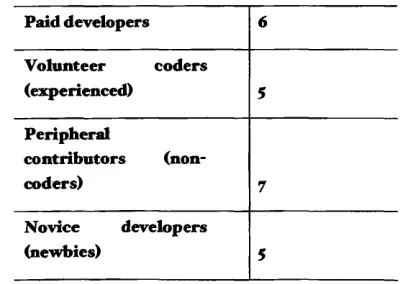
that combines quantitative and qualitative methods. Phase t consists of 23 interviews
conducted with a sample of four groups of participants: experienced and novice
programmers, volunteer and paid developers, non-programmers and community
members involved at a high administrative level. These interviews examined how
contributors occupying different strategic positions in the community reflected on a
similar set of issues, and elicited information on different aspects of development and
cooperation. Phase
2consists of three nested case studies, which involved 16
additional interviews, which examined in more depth aspects of commercialization
and relations between experienced coders and new programmers, and programmers
and non-programmers, which emerged through the interviews conducted in phase t.
In addition to the interviews, in phases t and
2seven F/OS community events were
observed.
Phase 3 consists of a quantitative analysis of patterns of contribution of
GNOME Foundation and KDE e.V.
12
members and of the two project maintainer
networks. This phase of the research aimed to examine specific hypotheses regarding
patterns of volunteer and paid developer contributions and non-programmer and
programmer contributions as they emerged through phases t and 2. One hypothesis
was that paid developers usually focus on critical aspects of development.
1.6 Thesis Outline
The thesis is structured as follows:
In Chapter
2the theoretical and conceptual framework of the research is
presented and discussed.
In Chapter 3 the methodology of the research is outlined and the primary case
studies and research design are presented in detail.
In Chapter 4 the analysis of the empirical findings relating to commercialization is
presented.
In Chapter S the analysis of the empirical findings concerning access and cooperative
relations between new and experienced programmers and between programmers and
non-programmers is presented.
12 The GNOME Foundation (hrrp_//fnundarinn.gnnme.orgl, last accessed 01/05/07) is an
In Chapter 6 the results of the quantitative investigation of the network of GNOME Foundation and KDE e.V. members and of the two projects' maintainer networks are outlined.
Chapter 7 provides a synthesis and a discussion of the empirical findings in Iight of the theoretical framework adopted and the principal research questions.
Chapter 8 discusses the contribution of the research in the context of related work, the limitations of the study and avenues for future research.
1.7 Conclusion
Overall, the research is designed to contribute to a better understanding of the dependencies developing between the gift and exchange economies and the dynamics of participation and cooperation that develop among different types of contributors, namely paid and volunteer developers, programmers and non-programmers and experienced and new programmers. A typology of engagement of paid contributors based on employment arrangements and community ties is developed and the new types of interfaces that develop between communities and corporate actors are highlighted. The research indicates that community integrated paid developers have a key role in project development and that, in addition, programming and non-programming groups are distinctive in their make-up, priorities and rhythms of participation, with volunteer programmers driving peripheral activities. Furthermore, the findings indicate that
learning plays an important role in controlling access to the
community's centre.
Theoretical and conceptual framework
2.1
Chapter overview
This chapter sets out the theoretical and conceptual framework of the research that underpins the examination of the power relations in F/OS communities and more specifically those associated with the dynamics of commercialization and peripheral participation. This framework combines elements from three theoretical perspectives: communities of practice (CoP), Michel Foucault's conception of power and his methodology for studying power relations, and Erving Goffman's idea of face-work.
The chapter is structured as follows. Section 2.2 outlines the CoP perspective, indicating how it has been appropriated in the context of F/OS and specifies which elements of this perspective are adopted within the context of this research. The CoP perspective
is
critically assessed and further developed in orderto
apply it to the study of power relations between new and experienced members of a community, and relations between members of different communities. Section 2.3 focuses on Foucault's ideas on power, and particularly his ideas about the historical, contingent and relational character of power. It examines his methodology for studying power relations. In order to situate the discussion on power in F/OS, Foucault's conception of power is compared with Bourdieu's notion of habitus and Giddens' structuration theory (section 2.3.3). Section 2.4 focuses on Goffman's idea about team and individual face-work. The compatibility between the theoretical elements borrowed from Foucault and Goffman is discussed (section 2.4.3). Section 2.5 introduces the concept of meshwork, a concept that is used heuristically and analytically. The chapter concludes with an outline in section z.6 of the conceptual framework within which the empirical partof the study is situated.
2.2
The Communities ofPractice perspective
The primary framework for the research is drawn from the CoP perspective, an approach that was developed to account for forms of learning that take place outside formal education contexts. This theory has frequently been adopted to explain some aspects of F/OS projects because it provides an intuitive way of understanding the social organization of F/OS that is consistent with practitioners' explanations. Section 2.2.1 provides an overview of how the theory has been appropriated and highlights the research programmes within which the approach has been registered.
appropriations, this research applies the CoP perspective to challenge the idea of F/OS projects as homogenous communities built exclusively around the practice of programming in which learning functions as an enculturation process. This is achieved through an examination of F/OS communities as constellations of practice and by highlighting learning as a structuring factor of participation.
Section 2.2.3 recapitulates how this application of the CoP approach provides a basis for developing a better understanding of the dynamics of cooperation in mature F/OS projects and the potential to augment this approach with respect to understanding the power relations between community members.
2.2.1 The CoP perspective in context
Since 1992 there has been an increasing interest in the role of community in knowledge production and innovation. Notions such as epistemic cultures, epistemic communities and CoP have been formulated in order to express what has been perceived as the increasing importance of communities as repositories of knowledge and cradles of innovation (Knorr-Cetina, 1999; Lesser, et al., 2000). The role of ICTs in this surge of interest has been instrumental, primarily because they allow some of the traditional knowledge communities to transcend the confines of space and time thus enhancing their reach and effectiveness, and because they enable the formation, or indeed, the design, of new communities.
It is perhaps worth noting that all these different notions, which in one way or another stress the link between community, work and creativity, have emerged in slightly different contexts. Peter Hass (1992) formulated the notion of epistemic communities within the framework of international policy coordination and International Relations (IR). Epistemic communities are networks of professionals with recognized expertise who share common normative and causal beliefs, common notions of validity and policy goals. Knorr-Cetina (5999) studied the role of epistemic cultures, "those amalgams of arrangements and mechanisms-bonded through affinity, necessity and historical coincidence-which in a given field, make up how we know what we know" (1999:1) primarily within the context of science and science institutions. In exploring the culture and practices of personnel maintaining Xerox copiers, Julian Orr (1996) coined the term `occupational communities'. Finally, Wenger and Lave (1991) developed the idea of CoP as a theory of learning and socialization within and across traditional organizations.
within which mutual engagement works out common sense practices. These concepts are also based on the idea that a community's collective knowledge is greater than the sum of the knowledge of its individual members. And, in addition, these ideas are usually associated with a bottom-up view of how work and cooperative relations operate in institutions and organizations, which cuts across traditional boundaries and managerial structures.
The emphasis on the communal and cultural aspects of practice, prevalent in the CoP perspective, usually overshadows other aspects of community life and activity, namely issues of access and power within and across its boundaries. This is partly due to the strong administrative agenda that underlies most existing studies that adopt this approach, which regard CoP as vehicles for innovation and competitiveness. Wenger's (2002) book entitled
Cultivating Communities of Practice: a
guide to managing knowledge
is indicative of this growing trend. As John Brown and Paul Duguid (zooia: 203) point out:The ideas of communities of practice has been taken up with a remarkable amount of enthusiasm. It nonetheless (or perhaps for this very reason) needs handling with care, much like the notion of `culture' over which we hesitated above. On the one hand, much on the enthusiasm turns on the appeal of the word community, which Williams (1976) suggests can be a deceptive but "warmly persuasive word" (It is worth contemplating how wide the notion would have spread had Lave and Wenger decided to talk about a cadre or a commune of practice.)
Jacky Swan et al.'s (2002) study provides an alternative, more critical perspective of how managers attempted to construct a new community of practice as a vehicle for innovation by using the notion of communities as a rhetorical device for overcoming some of the competing interests of different professional groups. Their case study chronicled how the managers of a bioscience company tried to enrol different groups of medical professionals in the advancement of a new prostate cancer therapy. Their study highlights the shift that occurred in managers' practices when faced with powerful professions and limited organizational support; they "employed a strategy centered on constructing a community that was focused on the disease rather than on the product. Adopting such community building "reflected managers' lack of power to intensify innovation by other means" (Jacky et al., 2002: 477). This study is intriguing because it raises some important questions regarding not only the role and function of CoP, but also the hidden dynamics that invocation of the idea of community might imply.
2.2.2
CoP and
F/OS:
opening up practice and structuring participation
research, namely the conceptualization of F/OS projects as `constellations of practice' and the reworking of the concept of the periphery.
The CoP approach offers an intuitive way for understanding the organization of F/OS projects. Its structural elements, for instance, the centre and periphery division, and its view of integration as socialization are compatible with a cultural
view
of F/OS, which argues that the success of the movement relies on the values of the hacker culture. Moreover, this view is consistent with practitioners' explanations regarding a bottom up view of power as in the bazaar metaphor, and the meritocratic basis of participation, which establishes a social hierarchy founded on the practice of programming. As a consequence, the CoP approach has been adopted in a number of F/OS studies, either as the principal frame of analysis (Elliot and Scacchi, 2003a; Samer and Wasko McLure, 2002; Sharma, et al., 2002) or as part of a wider theoretical agenda (Berguist and Ljungberg, 2001; Madanmohan and Navelkar, 2002).
With the exception of Berguist and Ljungberg's (200!) article `The power of gifts: organizing social relationships in open source communities', which draws attention to the differential power dynamic of gift-giving and the unequal relationships that it establishes, most of these studies stress the communal and ideological elements of participation and consider learning as a process of enculturation. This approach often leads to rather circular explanations about how the F/OS model works. For example, in their article on resolving conflict and fostering collaboration in F/OS source projects, Elliot and Scaatchi (2003: 1) see conflicts arising as a result of different norms regarding the use of non-open source tools in the development and, at the same time, regard disputes as being settled through daily discussions which "serve to build and perpetuate the global community of GNUe'3 contributors as well as F/OSS developers in general". The under-theorized aspects of power relations in approaches that adopt the CoP perspective in the study of F/OS reflect the poorly developed framework in the CoP literature for understanding power. In
Situated learning and Peripheral Participation,
the book that introduced the notion of `communities of practice', Lave and Wenger (1991: 42) acknowledge that:
The term `communities of practice' is left largely as an intuitive notion, which serves a purpose here but which requires a more rigorous treatment. In particular unequal relations of power must be included more systematically in our analysis.
Given the original focus of the theory this is not surprising, but Lave and Wenger's programmatic statement has not been followed, and the issue of power has not been rigorously addressed within the CoP literature (Contu and Willmott, 2003; Fox, 2000). For example, Wenger's (1998) more systematic account of the CoP
13 GNU Enterprise (GNUe) is a sub-project of the GNU Project. GNUe's goal is to create free
"enterprise-class data-aware applications, (enterprise resource planners etc.)
perspective, published seven years the after his original contribution with Lave, concentrates on the social constructionist aspects of CoP and brings the issue of power to the fore primarily in relation to the process of identity formation.
The CoP perspective, therefore, was initially developed in order to account for and to systematize forms of learning that take place outside formal education, primarily within multiple work contexts. Strictly speaking, the idea of a community of practice implies a group of people involved in a shared practice. Lave and Wenger illustrate their ideas by five examples: Mayan Midwives in Yucatec, a group of non-drinking alcoholics, meat cutters in a supermarket, quartermasters in the US navy, and Vai and Golan tailors in West Africa. They suggest that these groups are based on triadic relations between `masters' ("old timers"), `young masters' or ("journeymen") and `apprentices' (or "newcomers"), the dynamics of which are very different from traditional teacher-student relationships. Newcomers must essentially learn from the masters, but their learning involves some contribution to the community, usually in the form of execution of routine tasks. As the skills of the newcomers evolve and they adopt the ways of the community, they gradually move from the periphery, where if accepted, they hold the status of legitimate peripheral members, to the centre.
One aspect of power that is addressed by the CoP perspective, at least in Wenger and Lave's original contribution, is that of access. They examine this aspect of CoP through the example of the apprenticeship of meat cutters. In this case newcomers were granted the status of apprentices, but they were denied access to the more mature practices of the community. Thus newcomers were granted peripherality, but were denied legitimacy. Wenger also addresses the issue of participation by pointing to the difference between peripherality and marginality. Peripherality is conceived as an experience of non-participation that acts as an incentive for the pursuit of deeper involvement while marginality is defined as a negative experience of non-participation that results in a sense of exclusion. Relations of inequality and hierarchy are therefore primarily established within CoP through the granting or the denial of status to would-be members.
A closer look at F/OS communities, however, shows that they are more complicated. Within the F/OS context inequality continues to be an issue long after member status is granted. The fluid boundaries of the community combined with the open character of contributions may allow for a broadened view of membership, but participation is carefully structured through the formal and informal regulation of different degrees of access in projects and resources, which result in a renewed sense of hierarchy. Although obtaining a CVS account14 is considered by many to be the de facto sign of membership there are other levels of access, such as becoming a member of the project's administrative body. In addition, in some projects, for example KDE, having an email account with the project's domain name is a more distinguishable sign
14 A CVS (Concurrent Versions System) is an open source version control software tool that allows
of membership than being allowed to commit to the CVS tree, especially to the outside world. Controlling access to an email account means control over who is seen as member of the project and who effectively has the right to represent the community. Availability of the source code does not necessarily therefore mean access to more important levels of information or decision-making. In addition, the involvement of paid developers poses significant issues with regard to the role of employment as an additional factor for structuring participation and raises the question of whether employed hackers constitute a distinctive community of practice. F/OS projects seem then to be underpinned by practices and processes that establish a more complex and gradated idea of membership than the one implied in Wenger's and Lave model. At the same time, the reality of participation in mature F/OS communities challenges us and forces us to rethink the idea of peripheral participation and the established notion that the projects constitute a homogenous community of practice, that of programming.
The CoP approach assumes that all peripheral members are newcomers who are eager to make their way to the next level of initiation. This may not always be the case in mature open source projects. In both the GNOME and the KDE projects, the two case studies that form the core of the empirical study in this thesis, the primary communities of programmers are from time to time complemented by groups of individuals who work on non-programming tasks, such as translation, documentation, creating artwork, community public relations. Some of these individuals may be peripheral participants in Wenger and Lave's sense: programmers who make the decision to contribute to a less demanding part of the project as part of a learning strategy that will allow them to move on to programming. However, many of these peripheral or supporting tasks may be carried out by people who do not wish to move on to the centre of the primary developers' community. Indeed, many of these tasks can be seen as themselves constituting a CoP.
In order to examine these issues, this study adopts an idea that is part of the original CoP framework, but which has not been utilized in the wider literature, the notion of a
constellation of practices
(Wenger, 1998). Instead of conceptualizing F/OS communities as being founded solely on the practice of programming, in this study it is suggested that F/OS projects can be regarded as constellation of practices, a configuration of diverse but interconnected CoP. This view adopts, in part, Wenger's (1998) idea of organizations which he perceives as consisting of different CoP that give life to the institutional design. This idea is adapted to the context of F/OS, in which the institutional elements are created in response to growth and the boundaries between the different practices are not fully defined.CVS, mailing lists, IRCI5 channels, bugs databases that support F/OS developmen