linguistic analysis through corpus comparison
A thesis submitted to Lancaster University
for the degree of
Ph.D. in Computer Science
September 2002
Paul Edward Rayson B.Sc.
Computing Department
Abstract
Matrix: A statistical method and software tool for linguistic
analysis through corpus comparison
A thesis submitted to Lancaster University for the degree of Ph.D. in
Computer Science
Paul Edward Rayson, B.Sc.
September 2002
Declaration
I declare that the work presented in this thesis is, to the best of my knowledge and belief, original and my own work. The material has not been submitted, either in whole or part, for a degree at this or any other university.
Acknowledgements
First of all I’d like to thank Pete Sawyer, who, as we were sitting in a bar in Barcelona, convinced me that writing this up was possible, and he paid for the cerveza too. None of this work would have been possible without Roger Garside who was not only my supervisor but also ignited my interest in natural language processing when I began my third year project as an undergraduate in 1989.
During my work on this thesis, and before I started my PhD research, I have been a member of the UCREL research group at Lancaster University, and I would like to thank the members of the group, specifically, Geoffrey Leech, Jenny Thomas and Andrew Wilson, all of whom I worked with from 1990, along with Roger Garside. The early seed of this work was sown then. Nick Smith, David Lee, Simon Botley and Tony McEnery have given me support along the way. From the Centre for Applied Statistics at Lancaster University, Damon Berridge and Brian Francis have been of invaluable assistance when I posed many statistical questions to them over the past few years. My thanks also to Sylviane Granger for many interesting discussions during our work together in Lancaster and at the Université Catholique de Louvain.
I should also thank my parents who bought me a BBC Micro Computer as a combined birthday and Christmas present. I wrote my first piece of software on it. The 32K RAM seemed to be sufficient in 1982.
As I sat at the keyboard at home and in the office typing this thesis, the music of Jean Michel Jarre has assisted my concentration during the final writing stages of the work.
Contents
Abstract...ii
Declaration ...iii
Acknowledgements ...iv
Contents ...v
List of tables ...viii
List of figures...x
List of abbreviations and acronyms...xii
1.
Introduction ...1
1.1 This thesis ... 1
1.2 Corpus linguistics... 2
1.3 Statistical profiling... 3
1.4 Corpus annotation ... 5
1.5 Objectives of the study... 5
1.6 Thesis structure ... 6
2.
Corpus Linguistics ...8
2.1 Introduction... 8
2.2 Corpus Linguistics in Context ... 8
2.3 Corpus linguistic methodology ... 12
2.4 Corpus annotation and encoding... 17
2.6 Frequency Profiling ... 33
2.6.1 Word frequency profiling ... 34
2.6.2 Annotation profiling... 37
2.7 Comparison of frequency profiles ... 40
2.7.1 Statistical tests... 43
2.7.2 Systematic approaches ... 51
2.8 Summary ... 58
3.
Software for Corpus Linguistics...60
3.1 Introduction... 60
3.2 Corpus development and analysis tools... 61
3.2.1 CLAWS part-of-speech tagger... 63
3.2.2 The USAS semantic tagger... 65
3.3 Corpus editing tools ... 69
3.3.1 Manual annotation editing ... 69
3.3.2 Automatic annotation editing... 73
3.4 Retrieval and extraction of linguistic information ... 74
3.5 Multi-purpose tools and architectures... 84
3.6 Summary ... 85
4.
The Matrix method and tool ...88
4.1 Introduction... 88
4.2 Frequency profiling... 88
4.3 The Matrix method: statistical comparison of frequency profiles ... 95
4.4 Worked example of annotation profile comparison... 100
4.4.1 Comparison at the word level ... 101
4.4.2 Comparison at the POS level ... 106
4.4.3 Comparison at the semantic tag level ... 109
4.4.4 Conclusion to the worked example... 112
4.5 The Matrix tool ... 114
4.5.1 The user interface... 114
4.5.2 Architecture of Wmatrix ... 123
4.5.3 Further functions of Matrix... 125
5.
Evaluation of Matrix...127
5.1 Introduction... 127
5.2 Statistical and comparative evaluation of the method ... 127
5.2.1 Results and discussion. ... 130
5.2.2 Conclusion to the statistical comparison... 139
5.3 Evaluation of the Matrix tool in practice ... 139
5.3.1 Case study one: Vocabulary studies ... 140
5.3.2 Case study two: Grammatical analysis of learner corpora... 144
5.3.3 Case study three: Semantic analysis and information extraction... 148
5.4 Summary ... 151
6.
Conclusions ...152
6.1 Summary of the work... 152
6.2 The method proposed... 153
6.3 Limitations and future work... 155
6.4 Objectives and novel contributions... 157
7.
References ...158
Appendix A.
CLAWS C7 tagset ...183
List of tables
Table 2.1 Summary of papers from ICAME 1997 and 1998... 16
Table 2.2 Levels of corpus annotation (adapted from Leech, 1997: 12) ... 19
Table 2.3 Frequency distribution for words and tags in the BNC sampler corpus ... 39
Table 2.4 Contingency table for the chi-squared test ... 44
Table 3.1 Comparison of software capabilities for retrieval tools... 79
Table 4.1 Contingency table for log-likelihood calculation ... 96
Table 4.2 Top 20 most frequent words in Labour and LibDem manifestos ... 101
Table 4.3 Top 20 most significant differences at word level between Labour and LibDem manifestos... 103
Table 4.4 Top 20 most significant differences at POS level between Labour and LibDem manifestos... 107
Table 4.5 Top 20 most significant differences at semantic level between Labour and LibDem manifestos... 110
Table 5.1 Comparison of NR and LL values ... 128
Table 5.2 Expected values of the 2×2 tables considered in the experiment ... 130
Table 5.3 Means and standard deviations of the 95th simulated percentile of the chi-squared test statistic under independence for various 2×2 tables with p=1/16000131 Table 5.4 Smallest expected values in the 2×2 tables when p=1/16000... 132
Table 5.5 Accuracy of chi-squared and likelihood tests at 5%, 1%, 0.1 and 0.01% levels, for various values of size, proportion and ratio ... 134
Table 5.6 Distribution of the BNC demographic subcorpus between female and male speakers... 141
Table 5.7 Words most characteristic of male speech... 141
Table 5.8 Words most characteristic of female speech... 142
Table 5.9 POS as percentage of word tokens... 143
Table 5.10 Patterns of over- and useruse in the NNS corpus ... 145
List of figures
Figure 2.1 Section from untagged LOB corpus ... 22
Figure 2.2 Vertical format from the tagged LOB corpus... 23
Figure 2.3 Horizontal format from the tagged LOB corpus ... 23
Figure 2.4 SGML version of section from untagged LOB corpus... 25
Figure 2.5 SGML POS encoding in the British National Corpus... 25
Figure 2.6 TIGER XML encoding sample for a syntactically annotated corpus... 26
Figure 2.7 Frequency distribution for words and tags in the BNC sampler corpus... 40
Figure 3.1 An example of CLAWS4 POS tagging ... 64
Figure 3.2 An example of lexical semantic tagging ... 66
Figure 3.3 Screenshot of the main Xanthippe window... 71
Figure 4.1 Flowchart showing basic frequency list process ... 91
Figure 4.2 Matrix internal index ... 93
Figure 4.3 Concordance of key word would from LibDem manifesto ... 104
Figure 4.4 Concordance of key word now from Labour manifesto... 106
Figure 4.5 Relative use of modal verbs in LibDem and Labour manifestos ... 108
Figure 4.6 Concordance of key concept permission from LibDem manifesto ... 111
Figure 4.7 Screenshot of Tmatrix menu ... 115
Figure 4.8 Tmatrix frequency profile for the LibDem data ... 115
Figure 4.9 Tmatrix concordance for the word 'our'... 116
Figure 4.10 Tmatrix screenshot showing frequency profile comparison... 117
Figure 4.11 Xmatrix screenshot of main window... 118
Figure 4.12 Xmatrix screenshot of the concordance window... 118
Figure 4.13 Wmatrix screenshot of the workareas ... 120
Figure 4.14 Wmatrix screenshot of libdem workarea... 121
Figure 4.15 Wmatrix screenshot showing LibDem frequency list ... 122
Figure 4.16 Wmatrix screenshot showing LibDem concordance ... 122
Figure 4.18 Architecture of Wmatrix... 124
Figure 4.19 Wmatrix flow of operations when comparing frequency profiles... 125
Figure 5.1 Major word category breakdown in NS and NNS corpora ... 147
List of abbreviations and acronyms
ACASD Automatic Content Analysis of Spoken Discourse ATC Air Traffic Control
BNC British National Corpus CES Corpus Encoding Standard
CHILDES Child Language Data Exchange System
CLAWS Constituent Likelihood Automatic Word-tagging System d.f. degrees of freedom
DTD Document Type Definition
EAGLES Expert Advisory Group on Language Engineering Standards FTF Fuzzy Tree Fragment
HMM Hidden Markov Model HTML Hypertext Mark-up Language ICE International Corpus of English ICECUP ICE Corpus Utility Program
ICLE International Corpus of Learner English IE Information extraction
KWIC Key Word In Context
LibDem Liberal Democratic Political Party (UK) LL Log likelihood, likelihood ratio or G2 LOB Lancaster/Oslo-Bergen Corpus
MICASE Michigan Corpus of Academic Spoken English MWU Multi-word units
NLP Natural Language Processing NNS Non-native Speaker
NR Normalised ratio NS Native Speaker
REVERE Reverse Engineering of Requirements project SARA SGML-Aware Retrieval Application
SEC Lancaster-IBM Spoken English Corpus SGML Standard Generalised Mark-up Language TACT Text Analysis Computing Tools
TEI Text Encoding Initiative
TOSCA Tools for Syntactic Corpus Analysis
UCREL University Centre for Computer Corpus Research on Language USAS UCREL Semantic Analysis System
WSJ Wall Street Journal WWW World Wide Web
1. Introduction
“In the beginning was the word. But by the time the second word was added to it, there was trouble.” Simon, J. (1981: 111) Paradigms lost: reflections on literacy and its decline. Chatto & Windus.
London.
1.1 This thesis
Traditionally, quantitative research in corpus linguistics has been hypothesis-driven. In other words, a specific linguistic research question, which is identified at an early stage in a research project, leads to the collection or selection of a corpus and some phenomenon is investigated using that corpus. This research process is usually focussed on investigating a small number of linguistic phenomena that have been selected prior to the investigation. The problem with this kind of approach is that during the investigation, we can search only for evidence, or lack of evidence, for what we expect to find. The alternative to hypothesis-driven research is data-driven
research1, in which we are informed by the corpus data itself and allow it to lead us in all sorts of directions, some of which we may never have though of. It is a process where the phenomena are identified in the course of the research project rather than at the outset. It allows us to have a wider focus on a whole corpus or text rather than on specific features contained within it. This thesis describes a technique that allows the corpus data to direct the research in sometimes new and unexpected ways, and also introduces a piece of software which implements this method. The technique allows us to explore the corpus data more completely in a shorter amount of time, and directs us to where further in-depth study should perhaps take place. It enables us to find unexpected phenomena that we would not otherwise have considered for study.
1 We have chosen to call this data-driven to distinguish the methodology from corpus-driven
This thesis describes a method of statistical profiling within corpus linguistics. It focuses on a method (called Matrix, together with a piece of software implementing this method2) that was developed by the author and has already been used in both academic and commercial contexts. The Matrix software is principally a tool for use with annotated corpora and has the novel ability to perform statistical comparisons of corpora at multiple levels of annotation, including the lexical level. The frequency profile is the first port of call when investigating corpora and leads on to other research activities such as concordancing, and collocation analysis. These tasks can be applied to aid investigation and understanding of bodies of text in areas such as language teaching, linguistic research, content analysis, software engineering, machine translation and lexicography.
The next three sections of this first chapter introduce the notion of statistical profiling and annotation within the field of corpus linguistics. We then outline the objectives of the study. The final section describes the structure and content of the remaining chapters of this thesis.
1.2 Corpus linguistics
A corpus is defined in the Concise Oxford English Dictionary as a ‘body, collection of writings’. Aston and Burnard (1998: 4) note that the second edition of the Oxford English Dictionary lists five distinct senses for the word. Only two of these particularly refer to language. However, preliminary standards guidelines have distinguished between the terms corpus and collection or archive, of which only
corpus is related to some linguistic purpose (Sinclair, 1996). The most commonly agreed upon plural of corpus is corpora.3 There is no accepted minimum or maximum size for a corpus, or specification of what it should contain. A corpus could contain
2 The choice of the name Matrix relates to the appearance of the output of the tool: a matrix in
mathematics is a rectangular array of elements set out in rows and columns. No link is intended to the film starring Keanu Reeves.
3 The frequency and acceptability of other plural forms of the word corpus (e.g. corpuses) have been
the entire works of Shakespeare, sets of instructions from washing powder boxes, or the text of the match-day programmes from Nottingham Forest Football Club in the season they won the League Championship. Corpora need not contain only written language; spoken corpora can be built by transcribing the recorded speech from, for example, news broadcasts or conversations of people giving directions in the street.
Corpora are usually collected with a particular linguistic research project in mind, such as providing frequency information for dictionary entries or advanced language learning of German (Jones 1997) or classroom teaching of French (Xunfeng and Kawecki, 2001). Sometimes corpora are collected without a specific purpose and are made available as a general language resource to linguists, social scientists, language teachers, market researchers and others. In recent years with the advent of CD-ROMs and the World Wide Web (WWW), a corpus can be a multimedia (or multimodal)
corpus, which includes still pictures, video and sounds.
The term corpus linguistics has been described (McEnery and Wilson, 1996) in simple terms as the study of language based on examples of ‘real life’ language use. It has a relatively long history. Corpus linguistics is not a branch of linguistics such as syntax, semantics and pragmatics that concentrate on describing or explaining some aspect of language use. It is a methodology that can be applied to a wide range of linguistic study.
1.3 Statistical profiling
quick guide to the distribution of words in a text, an alphabetic listing is built mainly for reference, but a frequency-ordered listing highlights the most commonly occurring words in the text. For example, Juilland produced a series of frequency dictionaries for Spanish, Rumanian and French (Juilland et al 1964, 1965 and 1970). Even the more traditional dictionaries can make use of frequency information. The texts on which the American Heritage Word Frequency Book (Carroll et al, 1971) was built formed the citation base for the American Heritage School Dictionary.
Francis and Kučera (1982) take the simple word frequency list one stage further by reporting grammatical word frequencies. This gives frequencies of words with their associated part-of-speech (POS) tags in the (tagged version of the) Brown corpus (Francis and Kučera, 1964). The frequency profile for a given text can be compared to that of other similar texts or to that of large bodies of text. Since the high frequency items tend to have a stable distribution generally, significant changes to the ordering of the words in the frequency list can flag items of interest to the researcher (Sinclair 1991: 31). Such techniques can be carried out manually for a small corpus but otherwise we need the aid of a computer program. Although the computer saves us time with its processing of the texts into frequency lists, it presents us with so much information that we need a filtering mechanism to pick out significant items before the analysis can proceed. Hofland and Johansson (1982) use Yule’s K statistic and the chi-squared goodness-of-fit test in their comparison to pick out statistically significant different word frequencies across British and American English. Various formulae can be applied to adjust the raw frequencies for the distribution of words within a text, or to describe the dispersion of frequencies in subsections of a corpus.
1.4 Corpus annotation
Recently, with so much work being done on the analysis of corpora, it is seen as essential to annotate a corpus with the results of the research. Obviously, this can act as a bootstrap for an increasingly detailed and accurate analysis at the same linguistic level or for the next level of research. We can build a hierarchy of analyses from POS tagging, parsing, semantic tagging to discourse analysis. We will examine this hierarchy further in section 2.4. This enables us to revisit the results obtained from word frequency analysis and obtain frequency profiles for POS tags, semantic categories and so on. By applying the same significance testing methods, we can extend and refine our analysis based on more precise linguistic categories. This is the novel approach described in this thesis. We can perform a statistical comparison of annotated corpora and obtain results at each level of annotation contained within the corpus.
1.5 Objectives of the study
Leech and Fallon (1992) describe a two stage process in their examination of cultural differences using corpora of British and American English. Stage one is to use a comparative alphabetical list of word frequencies in the two corpora to select groups of words for further study. This stage examined the Hofland and Johansson (1982) lists of word frequencies in British and American English to select the items marked with significant differences. Stage two made use of a concordance tool to examine the contexts of the selected words from the Brown and LOB corpora. Leech and Fallon cite two main reasons for consulting the concordance lines:
1. To check whether the frequency of the graphic form actually reflected the sense of the word they were interested in.
2. To check that the high frequency of an item was not due to any obvious skewing of its distribution in the corpus.
researchers in their studies. The most used current techniques to reduce the number of concordance lines for inspection are that of random sampling, and collocation statistics (arising out of the needs of lexicographers, see Kilgarriff and Tugwell 2002).
The main research question investigated in this thesis is whether we can provide some level of automation for these two stages in terms of a method and tool support in order to assist corpus researchers. This objective breaks down into sub-objectives as follows:
1. to provide support for suggesting linguistic features to be further investigated: a. to investigate a data-driven method for corpus comparison which uses
macroscopic analysis (the study of the characteristics of whole texts or varieties of language) to inform the microscopic level (focussing on the use of a particular linguistic feature)
b. to investigate the use of comparison of corpora annotated with word-class and semantic tags in order to home in on particular word forms c. to provide range and dispersion information alongside the frequency of
an item to highlight any skewing of the frequency distribution
2. to provide a method that can be used for comparison of differently sized corpora
3. to evaluate the suggested method statistically and by the results of the application of the software tool that implements the method
1.6 Thesis structure
of frequency distributions in corpora. This leads on to a discussion of how representative corpora can be used as a form of control dataset with which to compare a new corpus.
Chapter three discusses the most widely available tools used for standard tasks of text analysis. It will be made clear that these tools have limitations that are remedied by the development of Matrix method and tool.
Chapter four describes the Matrix method and the software tool implementing this method. Chapter four includes a worked example showing the application of the tool to study the language used in the United Kingdom General Election manifestos of the Labour and Liberal Democratic (LibDem) parties from the June 7th 2001 election.
Chapter five is an evaluation of the Matrix method and software from two perspectives. Firstly we evaluate the statistical validity of the choice of statistic in the method, and then we go on to look at three case studies of the software and method in use.
2. Corpus Linguistics
Dr. Johnson: “The dictionary contains every word in our beloved language.” Blackadder: “Every single word?”
Dr. Johnson: “Every single word, sir.”
Blackadder: “May I offer the Doctor my most enthusiastic contrafibularities.”
(Blackadder the Third, Ink and Incapability, British Broadcasting Corporation, 1987).
2.1 Introduction
In this chapter, we begin with some definitions of terms in order to place the work presented in this thesis in context. We will describe the typical process model of corpus linguistic research and the characteristics of the paradigm. Next, corpus annotation and encoding methods and standards employed will be surveyed. Finally, we will move on to review the previous research in the area of statistical profiling in corpus linguistics, paying particular attention to details of statistical tests for the comparison of frequency data.
2.2 Corpus Linguistics in Context
As we have described in section 1.2, a corpus can have a wide range of content and applications. Sinclair (1995) prefers to define a corpus in a less flexible way in order to make it more useful to the study of language. He defines certain linguistic criteria and characteristics that a corpus is assumed to have: quantity, quality, simplicity, and documentation. He lists various types of corpora (my examples):
2. Monitor corpus: of constant size, but constantly refreshed with new material, while old material is removed to archival storage (although this is no longer strictly necessary due to the increase in computing power) e.g. the Bank of English / Birmingham Corpus (Renouf, 1987: 21).
3. Parallel corpus: collection of texts, each of which is translated into one or more other languages, e.g. the CRATER corpus (McEnery et al, 1997).
4. Comparable corpus: similar texts in more than one language, although Sinclair notes that there is no agreement on the nature of the similarity, e.g. the International Corpus of English (ICE) (Greenbaum, 1996).
Sinclair prefers to avoid using the term multilingual corpus in favour of the names parallel and comparable, although the term is suitable for a parallel corpus before it has been aligned. Hunston (2002: 14) adds the following types of corpora (Hunston’s examples):
1. Specialised corpus: collection of texts of a particular type designed to be representative only of a given type of text, e.g. the Michigan Corpus of Academic Spoken English (MICASE)
2. Learner corpus: collection of texts produced by learners of a language, e.g. the International Corpus of Learner English (ICLE)
3. Historical (diachronic) corpus: texts from different periods of time, e.g. the Helsinki corpus
Biber, Conrad and Reppen (1998: 4) list the essential characteristics of corpus-based linguistics:
• it is empirical, analysing the actual patterns of use in natural texts;
• it utilises a large and principled collection of natural texts, known as a “corpus”, as the basis for analysis;
• it makes extensive use of computers for analysis, using both automatic and interactive techniques;
A related and sometimes overlapping term is computational linguistics, which is similarly a methodology within language study. Grishman (1986) describes it as “the study of computer systems for understanding and generating natural language”. Computational linguistics concentrates on “using computers as a tool to model (and, sometimes, verify or falsify) fragments of linguistic theories deemed of particular interest” (Boguraev et al, 1995). Computational linguistics has focussed on three application areas: machine translation, information retrieval and human-computer interfaces. Building systems to perform these tasks often involves integrating software modules that analyse language at many different levels: morphology, syntax, semantics, and prosody, for example. Hence, a new term, language engineering4, has appeared recently to describe this process.
The larger field of natural language processing (NLP), which involves the development of computer systems to imitate intelligent human linguistic behaviour, can be split into two distinct areas (see Leech 1986: 208). The first area is to provide the computer program with enough linguistic and real-world knowledge so that it can communicate within a limited domain of discourse such as the tabletop world of Winograd (1972). The second area is to process a wider range of discourse but at a restricted level of analysis (e.g. syntax or semantics). Corpus linguistics generally overlaps with natural language processing in this second category.
Two distinct phases in modern corpus linguistics have been identified by Leech (1991). The first phase, structural linguistics, ended in the late 1950s when Chomsky presented his views on the inadequacy of corpus data. The second phase, initially unfashionable, began soon after in two main locations: Randolph Quirk planned the Survey of English Usage at University College London in the UK and Nelson Francis and Henry Kučera began corpus work at Brown University in the USA. Today, we assume that corpora are machine-readable and that corpus linguists generally use
4 The term language engineering seems to have another meaning which predates this sense. A branch
computers in their studies. Leech (1992) describes the field as computer corpus linguistics “a new philosophical approach to the subject”. In the same book, Francis surveys corpora before the arrival of computers (Francis, 1992). Stubbs (1993: 9, 1996: 31) attempts to contrast the approach taken by Sinclair with others in British corpus linguistics along the lines of invention of data.
Wikberg (1997) contrasts corpus studies with discourse analysis (text linguistics), where discourse analysis is to be seen as traditional text study, not based on machine readable corpora. The relevant properties of each field are identified by Wikberg as:
Corpus studies Discourse analysis
1. language as product (static) language as process
2. microanalysis micro-macroanalysis 3. form →meaning form ↔ meaning
4. qualitative research based on quantity focus on quality
5. distribution in genres and corpora distribution in single texts
Corpora are used to derive empirical knowledge about language, which can supplement, and frequently supplant, information from reference sources and introspection (Leech, 1991; 1992). Because they are well suited to quantitative analysis, corpora can provide information about the relative frequencies of many aspects of language. These frequencies can then be employed in probabilistic analysis techniques.
linguists are now taking an increased interest in probabilistic methods and corpora (Tsujii, 2000).
According to Sinclair (1991: 36) “the most exciting aspect of long text data processing, however, is not the mirroring of intuitive categories of description. It is the possibilities of new approaches, new kinds of evidence and new kinds of description”. In this thesis we present Matrix as one approach which can lead research in new directions.
Of particular relevance to this thesis is the process of corpus annotation. Leech (1997) defines it as the practice of adding interpretative, linguistic information to an electronic corpus of spoken and/or written language data. A typical example of this is grammatical tagging (another name for part-of-speech tagging) which associates a string (called a tag) with each lexical item in a text to indicate its grammatical class in context. Corpus annotation is a process that can be done completely by hand or in an automatic manner by computer program, or sometimes by a combination of these two methods. Usually, the computer program takes its training data from a corpus that has first been analysed by hand. Section 2.4 examines the various types of corpus annotation in more detail.
The work described in this thesis is centred on the area of corpus linguistics, providing a method and software tool to aid the investigation and study of real language. The next section looks in more depth at the standard methodologies applied in the field of corpus linguistics.
2.3 Corpus linguistic methodology
these various areas of linguistic study, there are five main steps when we examine the corpus-based approach:
1. Question: A research question or model is devised 2. Build: Corpus design and compilation
3. Annotate: Computational analysis of the corpus
4. Retrieve: Quantitative and qualitative analyses of the corpus
5. Interpret: Manual interpretation of the results or confirmation of the accuracy of the model
A simplified process model of the corpus-based methodology typically used by researchers is as follows: it would begin with the identification of a research question, continue with building and annotating a corpus with which to investigate the topic, and finish with the retrieval, extraction and interpretation of information from the corpus which may help the researcher to answer the research question or confirm the parameters of the model. In some cases, the process may be an iterative one, where, following the interpretation of the results some refinement is needed on the research question or annotation of the corpus.
There are two main kinds of research question (step 1 above) that can be investigated. Firstly, we can focus on the use of a particular linguistic feature, possibly a word or grammatical construction. We will call this type I. Secondly, we can examine the characteristics of whole texts or varieties of language, and we will call this type II. These two types are sometimes referred to as microscopic (type I) and macroscopic (type II), for example see Biber (1988: 61). Traditionally, studies tend to focus on type I and examine linguistic (lexical or grammatical associations of the feature), and non-linguistic aspects (distribution of the feature across different types of text or speech). Type II inverts this relationship in investigating, for example, register variation across text, by examining how certain features or groups of features characterise a text.
are available ‘off-the-shelf’ (Meyer 1991). We will give examples of corpora and corpus annotation in section 2.4. Software tools to carry out compilation, annotation and retrieval from corpora (steps 2, 3 and 4 in our process model) will be reviewed in chapter 3. There are two major methods used in corpus linguistics to retrieve and interpret (steps 4 and 5) data from corpora. These are frequency profiling and concordancing. We will examine statistical profiling in section 2.6 and concordancing tools in section 3.4.
Our process model, as described above, is in line with Leech’s (1992) view of the corpus linguistic paradigm. Leech argues that the corpus-based methodology conforms to standards commonly ascribed to ‘the scientific method’: falsifiability, completeness, simplicity, strength, and objectivity. In this thesis, it is hoped that these characteristics will be amply demonstrated.
There are many examples of both types of research question in the many conference publications, journals and edited collections that have appeared. Common to both is the prior selection of which linguistic features to study. The method proposed in this thesis allows a different approach: decisions on which linguistic features are important or should be studied are made on the basis of information extracted from the data itself; in other words, it is data-driven. We will call this type III. It combines the approaches of types I and II by first focussing on whole texts and then suggesting specific linguistic features to study in further detail. In other words, the ordering of the five main steps above will change to the following (with iteration back from step 4 to step 3, which enables refinement of the research question following a retrieval step):
1. Build: Corpus design and compilation
2. Annotate: Computational analysis of the corpus
3. Retrieve: Quantitative and qualitative analyses of the corpus
4. Question: A research question or model is devised (iteration back to step 3)
Our type III process model shown here is similar to that of corpus-driven linguistics
as presented by Tognini-Bonelli (2001: 85), in which the corpus is the main informant (Francis, 1993). However, we decided to use the term data-driven to distinguish our approach from that of Sinclair, presented by Tognini-Bonelli (ibid: xi). The corpus-driven approach questions the “underlying assumptions behind many well established theoretical positions” (ibid: 48) stating that they need to be re-established or replaced based on evidence from corpora. For example, it proposes a “new unit of meaning” (ibid: 85) and states that there is “no such thing as a synonym”. In this study, we will rely on currently existing POS tagsets for example. In the corpus-driven approach, Stubbs (1993: 17) notes that even the traditional POS system “is under attack”.
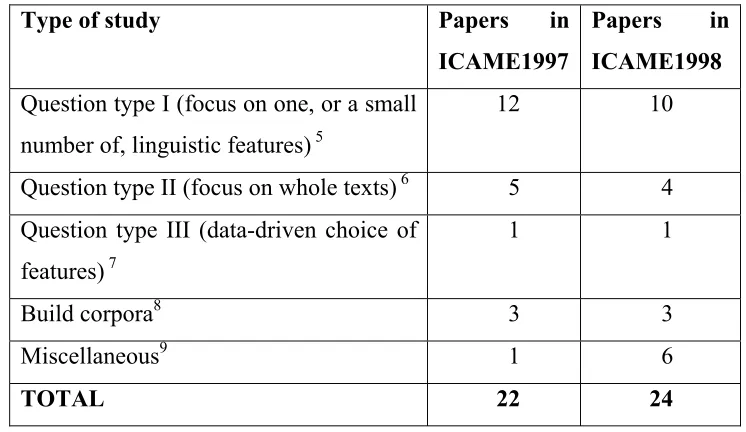
In Table 2.1 we have summarised the number of papers in each of these three categories of research in two recently published edited volumes forming the proceedings of the ICAME conferences, 1997 in Renouf (1998) and ICAME-1998 in Kirk (2000). For each paper, we have identified the main research theme. Some papers contain other sub-themes, but this is not considered in the table. We also show papers describing corpus building or collection, and lastly, in the miscellaneous section, we count papers whose main theme is the description of tools or methods for use within the corpus linguistic paradigm. As can be seen from the figures in the table, type I research is the most frequent. Type II is less frequent, but data-driven research, type III, occurs only twice. The two papers in question are Ringbom (1998) and Hoffmann and Lehmann (2000).
when compared to the native speaker data. We will argue in this thesis that studies need not be restricted to high frequency items and we will make use of more reliable statistical techniques to identify possible candidates. If we observe less than 20 occurrences of a word or phrase when we would expect to see many more than 20, then this is a phenomenon worth investigating further.
Table 2.1 Summary of papers from ICAME 1997 and 1998 Type of study Papers in
ICAME1997
Papers in ICAME1998
Question type I (focus on one, or a small number of, linguistic features) 5
12 10
Question type II (focus on whole texts) 6 5 4 Question type III (data-driven choice of
features) 7
1 1
Build corpora8 3 3
Miscellaneous9 1 6
TOTAL 22 24
We have classified Hoffmann and Lehmann (2000) as type III since they used collocational10 evidence from the British National Corpus to select pairs of related words that were then used in a study to discover native and non-native speakers’
5 Papers in the type I category from ICAME97 are Johansson and Geisler, Kjellmer, Levin, Ljung,
Mair, Markus, Nevala, Nurmi, Renouf and Baayen, Sand, Wichmann, Wynne et al; and from ICAME98 are Blackwell, McEnery et al, Gerner, Kjellmer, Lindquist, de Mönnink, Paradis, Seppänen and Trotta, Stenström, Vihla
6 Papers in the type II category from ICAME97 are de Hann, Oostdijk, Collier, Pacey, Peters; and from
ICAME98 are Kennedy and Yamazaki, Ooi, Taavitsainen, Granger and Wynne
7 Papers in the type III category from ICAME97 are Ringbom; and from ICAME98 are Hoffmann and
Lehmann
8 Papers in the build category from ICAME97 are Hasund, Keränen, Bergh et al; and from ICAME98
are Minugh, Brekke, Rahman and Sampson
9 Papers in the miscellaneous category from ICAME97 are Aarts et al; and from ICAME98 are
Lehmann et al, Mason, Oostdijk, Tapanainen and Järvinen, Voutilainen, Wallis et al
10 Collocation is the occurrence of two or more words within a short space of each other in a text. Firth
familiarity with the word pairs. However, they did not pursue the usual type I path of performing a more in-depth linguistic analysis on the collocates that they discovered. Instead, the paper focuses on analysing the results of the familiarity questionnaire. Due to the large size of the corpus, they selected collocation pairs with less than 100 occurrences to avoid problems of excessive computation. They used the log-likelihood statistic to select 150 collocations.
Missing from this survey of techniques fitting into our type III category is the keywords method by Scott implemented in his WordSmith software (1996-99). We will examine this method in more detail in section 2.7.2. Leech and Fallon (1992) also describe a two-stage research process which we would categorise as type III. Their work is described in section 4.3
2.4 Corpus annotation and encoding
We will see in the next few sections how UCREL and other research groups have acted as corpus builders and annotators. They collect and analyse data for corpora that aim to be representative of general language, and provide the results for others to use. These corpora can then be used in any of the three types of corpus study defined in the previous section. Investigators can make use of these off-the-shelf collections in their own studies. Alternatively, researchers can collect their own corpus or select subsets from the general corpora, and use these in their analysis.
As well as for linguistic study, there are many reasons for annotating a corpus. Leech and Smith (1999) examine in detail the possible uses for wordclass tagging, and we summarise the discussion here:
1. Adding further annotations: wordclass tagging is a useful first step and simplifies the tasks of syntactic annotation (parsing), semantic annotation, discourse annotation (see below for examples)
2. Information extraction: extracting frequency information, lemmatisation, and collocations from corpora
4. Word processing: spelling and grammar checkers 5. Speech processing: synthesis and recognition 6. Handwriting recognition: language modelling
7. Machine-aided translation: annotation of multi-lingual corpora
8. Dictionaries and grammars: discriminating homographs for lexicographers writing corpus-based dictionaries
9. Language learning: students examining real data for grammatical structures used by native speakers
10. Development of NLP software: training corpus for a part-of-speech tagger or evaluation corpus for a parser
In this section, we will review annotation research work performed by the corpus builders. First of all, we should distinguish between two types of corpus mark-up:
• Annotation: the practice of adding interpretative, linguistic information to a corpus (Leech, 1997: 2)
• Encoding: the insertion of symbols in to the electronic version of a corpus to represent annotation, orthographic and structural features of the text (e.g. characters, symbols, paragraphs, headings) (see section 1 of Sperberg-McQueen and Burnard, 200211)
The two forms are sometimes referred to as ‘encoding’ (Hockey 2000: 24, Edwards 1995: 34) or ‘annotation’, but these are the definitions we shall use in this thesis following the distinction made in the TEI and CES standards (see later in this section). The second issue really deals with formats of the strings we insert into a corpus and meta-data describing the contents of the corpus. The two types of mark-up are intertwined, and in early corpus collection the corpus annotation was recorded in a different format in different corpora. Annotation and encoding schemes developed in an ad hoc manner in each research centre, and this continues to be the case alongside standardisation initiatives as we shall see later in this section. We find that for corpora such as Brown (Francis and Kučera, 1964) and LOB (Johansson et al, 1978 and Johansson et al, 1986), a separate manual was produced describing the corpus file
format and contents. Recently produced corpora such as the British National Corpus (Burnard, 1995) contain large amounts of meta-data within the electronic files themselves. It is only in the last few years that standardisation efforts have taken place and have separated corpus annotation from encoding.
Firstly, let us focus on the interpretative notion of corpus annotation. There are multiple levels of such annotation that can be applied to a corpus. We will see in the next section the POS, syntactic and semantic levels. These fit together in a hierarchy of annotation as shown in Table 2.2 (adapted from Leech, 1997). Whether, the annotation is applied manually, automatically or semi-automatically we can still attach each level to a corpus.
Table 2.2 Levels of corpus annotation (adapted from Leech, 1997: 12) Linguistic
level
Examples of features annotated
Orthographic Interpretation of italics, initial capital letters or the full stop / period. Delimitation of words by spaces.
Phonological Syllable boundaries. Phonetic or
Phonemic
Phonetic / phonemic segments: consonants and vowels.
Morphological Prefixes, suffixes and stems.
Lemma Roughly equivalent to dictionary headwords. For example, the lemma BE (verb) could be assigned as a tag to the following forms: ’m, ’re, ’s, am, are, be, been, being, is, was, were. Lemmatisation has been carried out in Fligelstone (1995) and Sampson (1995).
Prosodic Transcription of stress, intonation, pauses. For example in the London-Lund corpus (Peppé, 1995):
Grammatical Otherwise know as POS tagging or morphosyntactic annotation: assigning word-class labels for not only major parts of speech (noun, verb, preposition, etc.) but also values defining sub-classes, such as singular and plural nouns, positive, comparative and superlative adjectives, and so on. For example, POS tagging using the Penn tagset (Marcus et al, 1993):
Origin/NN of/IN state/NN automobile/NN practices/NNS ./. The/DT practice/NN of/IN state-owned/JJ vehicles/NNS for/IN use/NN of/IN employees/NNS on/IN business/NN dates/VVZ back/RP over/IN forty/CD years/NNS ./.
Syntactic Partial (or skeleton) parsing from for example the Lancaster/IBM Spoken English Corpus (Knowles, 1993):
[S[N Nemo_NP1 ,_, [N the_AT killer_NN1
whale_NN1 N] ,_, [Fr[N who_PNQS N][V ‘d VHD
grown VVN [J too RG big JJ [P for IF [N
his APP$ pool NN1 [P on II [N Clacton NP1
Pier NNL1 N]P]N]P]J]V]Fr]N] , , [V has VHZ
arrived VVN safely RR [P at II [N his APP$
new JJ home NN1 [P in II [N Windsor NP1 [
safari_NN1 park_NNL1 ]N]P]N]P]V] ._. S]
Full parsing from the ICE-GB corpus (Nelson, Wallis and Aarts (2002):
<ICE-GB:W1A-001 #24:1> <#24:1> <sent> PU,CL(main,montr,pres) [ SU,NP() [ DT,DTP() [ DTCE,PRON(dem,plu) {These} ] ] [ NPHD,N(com,plu) {civilian ][ aristocrats} ]] [ VB,VP(montr,pres,semi,perf) [ OP,AUX(semi,pres) {seem ][ to} ] [ AVB,AUX(perf,infin) {have} ] [ MVB,V(montr,edp) {used} ]] [ OD,NP() [ DT,DTP() [ DTCE,ART(def) {the} ]] [ NPPR,AJP(attru) [ AJHD,ADJ(ge) {old} ]] <foreign> [ NPHD,N(com,plu) {civitates} ]] </foreign> [ A,PP() [ P,PREP(phras) {as} ] [ PC,NP() [ NPHD,N(com,plu) {power ][ bases} ]]] [ PUNC,PUNC(per) {.} ]
There_Z5 ’s_Z5 been_A3+ more_N5++ violence_E3-in_Z5 the_Z5 Basque_Z2 country_M7 violence_E3-in_Z5 northern_M6 Spain_Z2 :_PUNC one_N1 policeman_G2.1/S2m has_Z5 been_Z5 killed_L1-,_PUNC and_Z5 two_N1 have_Z5 been_Z5
injured_B2- in_Z5 a_Z5 grenade_G3 and_Z5
machine-gun_G3 attack_G3 on_Z5 their_Z8 patrol-car_M3/G2.1 ._PUNC
Discoursal For example, anaphoric annotation showing cohesive relations in text (Fligelstone, 1992):
(0) The state Supreme Court has refused to release {1[2 Rahway State Prison 2] inmate 1}} (1 James Scott 1) on bail .(1 The fighter 1) is serving 30-40 years
Pragmatic The mark-up of speech act types (Stiles, 1992).
Stylistic One aspect of style annotated in corpora is the linguistic representation of people’s thoughts and speech, for example, distinguishing narrative, direct and indirect speech (Short et al, 1996).
Application (or problem) oriented
Orthogonal to the above levels. For example: Error tagging showing learner errors (Meunier 1998 and Granger 1999). Dialogue act mark up for the Verbmobil project (Alexandersson et al, 1998). Annotation of swear words and terms of abuse (McEnery, Baker, and Hardie, 2000).
The first large machine-readable corpus of British English was the LOB corpus (Johansson et al, 1978). An example of the encoding of this corpus is shown in Figure 2.1. Certain features from the original texts were omitted, such as diagrams, maps, reference lists. These were encoded in a comment tag e.g. **[diagram**]. Although the original physical form of the document is lost, typographical features are preserved, such as bold (*6) and italic (*1), and a vertical bar indicates paragraph beginnings. A reference system was introduced; each line in the text begins with a text identifier and a line number within the text.
A01 1 **[001 TEXT A01**]
A01 2 *<*'*7STOP ELECTING LIFE PEERS**'*> A01 3 *<*4By TREVOR WILLIAMS*>
A01 4 |^A *0MOVE to stop \0Mr. Gaitskell from nominating any more Labour A01 5 life Peers is to be made at a meeting of Labour {0M P}s tomorrow. A01 6 |^\0Mr. Michael Foot has put down a resolution on the subject and A01 7 he is to be backed by \0Mr. Will Griffiths, {0M P} for Manchester A01 8 Exchange.
A01 9 |^Though they may gather some Left-wing support, a large majority A01 10 of Labour {0M P}s are likely to turn down the Foot-Griffiths
A01 11 resolution.
Figure 2.1 Section from untagged LOB corpus
There are two versions of the corpus that contain POS annotation; the vertical format, with one word per line, and the horizontal format, where each word is followed by its associated tag, see Figure 2.2 and Figure 2.3. The vertical format consists of a number of columns showing, from left to right, a unique reference number, the POS tag, and the word itself, followed by orthographic formatting codes such as ‘H’ for heading. The horizontal format is similar to the untagged version, but includes POS tags linked to each word by an underscore character.
Johansson (1994) contrasts the LOB encoding and a more recent standard proposed by the Text Encoding Initiative (TEI), whose guiding principles at the time (Sperberg-McQueen and Burnard, 1990) were to:
• Suggest principles for the encoding of texts in the same format; • Propose sets of coding conventions suited for various applications; • Maintain compatibility with existing standards as far as possible.
A012001 --- --- A012002 *' *' H
A012010 VB stop H A012020 VBG electing H A012030 NN life H A012040 NNS peers H A012041 **' **' H
A012042 . . H @ A013001 --- --- A013010 IN by H
A013020 NP Trevor H A013030 NP Williams H
A013031 . . H @ A014001 --- --- A014010 AT a P A014020 NN move
A014030 TO to A014040 VB stop
[image:36.595.178.471.159.462.2]A014050 NPT \0Mr \0 A014060 NP Gaitskell
Figure 2.2 Vertical format from the tagged LOB corpus
A012 ^ *'_*' stop_VB electing_VBG life_NN peers_NNS **'_**' ._. A013 ^ by_IN Trevor_NP Williams_NP ._.
A014 ^ a_AT move_NN to_TO stop_VB \0Mr_NPT Gaitskell_NP from_IN A014 nominating_VBG any_DTI more_AP labour_NN
A015 life_NN peers_NNS is_BEZ to_TO be_BE made_VBN
Figure 2.3 Horizontal format from the tagged LOB corpus
Interchange. The first public draft was published in November 1990 (TEI P1). After revision, the first official (non-draft) version of the guidelines became available in May 1994 (TEI P3). At the time, the TEI claimed to be “the only systematised attempt to develop a fully general text encoding model and set of encoding conventions based upon it, suitable for processing and analysis of any type of text, in any language, and intended to serve the increasing range of existing (and potential) applications and use”. In March 1999, four hosts formed a consortium to continue the work of the TEI: Brown University Scholarly Technology Group, Oxford University Humanities Computing Unit, University of Bergen Humanities Information Technologies Research Programme, University of Virginia Electronic Text Center and Institute for Advanced Technology in the Humanities.
The complete TEI P3 guidelines are over 1,000 pages long and this is not the place the summarise them. However, we will extract the main points that are relevant here. The rules and recommendations made in the TEI guidelines make use of ISO 8879, an international standard for the description of marked-up electronic texts, which defines the Standard Generalised Mark-up Language (SGML) (see van Herwijnen, 1994). The building blocks of SGML are the tags, attributes and entities. The special characters used to mark SGML tags are left and right angled brackets (<, >), and SGML entities are shown between ampersand and semi-colon (&, ;). The types of tags and entities in a document are governed by a formal grammar, called a document type definition (DTD). This is perhaps easiest to illustrate by converting the example from Figure 2.1 into SGML format as in Figure 2.4. In this example, we see headings marked by the SGML tags <head> and <subhead>, paragraphs marked by <p> and begin and end quotes marked by entities &bquo; and &equo; respectively.
<text id=LOBA01>
<head>&bquo;STOP ELECTING LIFE PEERS&equo;</head> <subhead>By TREVOR WILLIAMS</subhead>
<p>A MOVE to stop Mr. Gaitskell from nominating any more Labour life Peers is to be made at a meeting of Labour MPs tomorrow.
<p>Mr. Michael Foot has put down a resolution on the subject and he is to be backed by Mr. Will Griffiths, MP for Manchester Exchange.
<p>Though they may gather some Left-wing support, a large majority of Labour MPs are likely to turn down the Foot-Griffiths resolution.
Figure 2.4 SGML version of section from untagged LOB corpus
The TEI proposals for encoding of corpus annotation have changed since Johansson’s paper was published and were applied in the mark-up of POS tagging in the British National Corpus (see Figure 2.5 for an example of this encoding). Here, we can see that the POS tag precedes the word it applies to, for example <w NN1>condition
indicates that the word condition is tagged as NN1 (singular common noun). Punctuation items are marked with the <c …> SGML tag.
<text complete=Y org=SEQ decls='CN004 HN001 QN000 SN000'> <div1 complete=Y n=1 org=SEQ type=item>
<head type=MAIN> <s n=001>
<w NN1>FACTSHEET <w DTQ>WHAT <w VBZ>IS <w NN1>AIDS<c PUN>? </head>
<p> <s n=002>
<hi r=bo> <w NN1>AIDS <c PUL>(<w NP0>Acquired <w AJ0>Immune <w NN1-NP0>Deficiency <w NP0>Syndrome<c PUR>) </hi> <w VBZ>is <w AT0>a <w NN1>condition <w VVN>caused <w PRP>by <w AT0>a <w NN1>virus <w VVD-VVN>called <w NP0>HIV <c PUL>(
<w AJ0-NN1>Human <w NN1-NP0>Immuno <w NP0>Deficiency <w NP0>Virus<c PUR>)<c PUN>.
Figure 2.5 SGML POS encoding in the British National Corpus
Following the World Wide Web Consortium’s (W3C) release of the recommendation for an Extensible Mark-up Language12 (XML) in 1998, SGML encoding initiatives for corpora have evolved into encoding in XML. The TEI Guidelines are now fully XML-compliant and published as TEI P4 guidelines (Sperberg-McQueen and Burnard, 2002). XML mark-up looks like SGML (and HTML) and XML schemas (rather than DTDs) are used to define the structure of XML documents.
The TIGER project in Stuttgart has also proposed an XML encoding scheme for syntactically annotated corpora, and this is shown in Figure 2.6 (Mengel and Lezius, 2000).
<s id=”s1” href=”#id(n1_500)”/> <n id=”n1_500” cat=”S”>
<edge id=”edge1_1” href=”#id(n1_501)”/> <edge id=”edge1_2” href=”#id(n1_502)”/> </n>
<n id=”n1_501” cat=”NP”>
<edge id=”edge1_3” href=”#id(w1_0)”/> <edge id=”edge1_4” href=”#id(w1_1)”/> </n>
<n id=”n1_502” cat=”VP”>
<edge id=”edge1_5” href=”#id(w1_2)”/> <edge id=”edge1_6” href=”#id(n1_503)”/> </n>
<n id=”n1_503” cat=”NP”>
<edge id=”edge1_7” href=”#id(w1_3)”/> <edge id=”edge1_8” href=”#id(w1_4)”/> </n>
<w id=”w1_0” word=”The”/> <w id=”w1_1” word=”boy”/> <w id=”w1_2” word=”likes”/> <w id=”w1_3” word=”the”/> <w id=”w1_4” word=”girl”/>
Figure 2.6 TIGER XML encoding sample for a syntactically annotated corpus
The Expert Advisory Group on Language Engineering Standards (EAGLES)13 project was funded by the European Commission. The aim of EAGLES was to “accelerate the provision of standards for (1) very large-scale language resources (such as text corpora, computational lexicons and speech corpora); (2) means of manipulating such knowledge, via computational linguistic formalisms, mark-up languages and various software tools; and (3) means of assessing and evaluating resources, tools and products”. Amongst the EAGLES guidelines is one detailing recommendations for corpus encoding, the CES (Corpus Encoding Standard) guidelines (Ide 1996, 1998). This work is now being continued in XCES14, the corpus encoding standard for XML, and it is planned for XCES to be used as the standard for encoding the forthcoming American National Corpus15 which is partially modelled on the British National Corpus. The work of EAGLES is continuing in the International Standards for Language Engineering (ISLE) initiative16.
So far, we have seen how annotations are usually interspersed with the base text, as part of the same composite document. Two other arrangements are possible. One is to use the form of a relational database, and the other is to hold the base text and the annotations in separate files, called stand-off annotation, with links relating each part of the one to each part of the other. These two possibilities are expanded upon in section 3.2.
The work on annotation graphs in the Linguistic Data Consortium at the University of Pennsylvania focuses on the logical structure of linguistic annotations and aims to cover a common conceptual core (Bird and Liberman, 1998). They contend that the file formats and the tags and attributes for describing content are secondary (Bird and Liberman, 2001). Their work is now producing open-source tools for annotation of time-series data (Bird et al, 2002).
13 See the website at http://www.ilc.pi.cnr.it/EAGLES/home.html
14 Which stands for XML CES; at the time of writing, version 0.2 of XCES appears on
http://www.cs.vassar.edu/XCES/ and http://www.xml-ces.org/
15 See the website at http://americannationalcorpus.org/
As well as standards for the encoding of corpus annotation, the European Union has funded the writing of standards for tagsets. The EAGLES morphosyntactic annotation guidelines were disseminated in 1994 in the interests of interchange and reuse of annotated corpora (Leech and Wilson, 1999). The guidelines describe an extensible intermediate tagset mainly influenced by Indo-European languages.
At the time of writing, other initiatives are ongoing, such as OLAC17 (Open Language Archives Community) which “is an international partnership of institutions and individuals who are creating a worldwide virtual library of language resources by: (i) developing consensus on best current practice for the digital archiving of language resources, and (ii) developing a network of interoperating repositories and services for housing and accessing such resources”. The Linguistic Data Consortium now documents all of its corpora using the OLAC metadata set.
2.5 The main research centres
Corpus linguistics draws on research from academics in several disciplines: statistics, linguistics, and computing. Through the work of the main research centres, we will see how modern corpus linguistics has developed over the last thirty years. Let us first focus on the UCREL (University Centre for Computer Corpus Research on Language) research centre at Lancaster University, described by Mair (1997) as “one of the hotbeds of corpus linguistics”.
The software and method described in this thesis were developed as a result of the author’s experiences within several UCREL research projects, and by working with other staff and researchers on related projects. It is useful at this point to detail some of the history of the UCREL research centre to put into historical context the work described in this thesis.
The research centre draws upon the expertise of the Department of Linguistics and Modern English Language and the Department of Computing. UCREL has pioneered
an approach to natural language processing that is based on corpus linguistics. UCREL’s work is very much focused on practical outcomes. It has engaged in corpus-based research contributing to such practical applications as speech synthesis, speech recognition, machine-aided translation, dictionary publishing, social surveys, interview analysis, and computer-aided language teaching.
UCREL began its existence in 1970 when Geoffrey Leech founded a group under the name of CAMET (Computer Archive of Modern English Texts) within the then Department of English. The CAMET group’s aim was to compile a one-million word corpus of written British English in machine-readable form as a parallel to the Brown corpus of American English developed at Brown University, Rhode Island, by Nelson Francis and Henry Kučera (the first computer corpus of English). The project, which was completed in 1978, was assisted by the involvement of the Norwegian universities of Oslo and Bergen, and the completed corpus was hence called the Lancaster/Oslo-Bergen (or LOB) corpus (Johansson, Leech and Goodluck, 1978).
The Brown University team had developed computer software (TAGGIT) for assigning a part of speech (or word class) to each word in a corpus or text (Greene and Rubin, 1971). This software had a success rate of around 77% without manual intervention. In order to carry out a grammatical analysis of the corpus, the Lancaster team developed POS tagging software. This work, which involved collaboration with Roger Garside of the Computer Studies Department, culminated in the first version of the software package called CLAWS (Constituent Likelihood Automatic Word-tagging System) which, in much revised and improved form, is still a major component of UCREL’s work (Garside, 1987; Leech et al, 1994b; Garside and Smith, 1997). The CLAWS system employed a rich blend of decision making techniques, based in particular on statistical probabilities of tag co-occurrences, using data derived from the manually-corrected tagged LOB corpus (Marshall, 1983). It achieved a success rate without manual intervention in the high 90s percentage accuracy. We will describe the CLAWS software in more detail in section 3.2.1.
by then called the Department of Linguistics and Modern English Language and the Department of Computing and CAMET was thus transformed into UCREL.
In 1983-84 UCREL began further work on the grammatical analysis of the LOB corpus (see Atwell, Leech and Garside, 1984). It included (i) the development of a syntactic parser using probabilistic models of analysis to determine the most likely analysis of a sentence (Beale, 1985a; 1985b; Garside and Leech, 1985; Leech, 1987) (ii) the production of a manually parsed sample of the LOB corpus as a data source for the probabilistic parser (Sampson, 1987b), now known as the Lancaster-Leeds Treebank (iii) the production of software which can derive a distributional lexicon from CLAWS tagged text, i.e., a lexicon showing the base form of each word (i.e. a
lemma, or head word in a dictionary), all its inflectional variants, and the frequencies of its lexical collocations in the corpus (Beale, 1987; 1989).
A context-sensitive spelling checker project (funded by the computer manufacturers ICL) employed a probabilistic approach to the identification of spelling errors which, because they happened to form correctly-spelled English words different from the ‘target’ word, would not be detected by the ordinary type of spelling checker; for example the confusion of ‘there’ and ‘their’ (Atwell and Elliott, 1987).
Also in 1984, UCREL began a project with IBM UK Laboratories that involved with speech processing. The main goal of this project was to compile a corpus of modern spoken English, with a prosodic transcription showing features of stress, intonation and pauses (Taylor and Knowles, 1988). The resulting corpus of c. 53,000 words, the Lancaster-IBM Spoken English Corpus (SEC), also exists on audio-tape for instrumental analysis. Funding was later extended for a study of prosodic stylistics to examine how prosodic patterns differ between different kinds of discourse (Wichmann, 1991), and a grant was obtained to produce a speech database (MARSEC) based on the SEC. Among other things, the MARSEC project produced a digitised sound version of the corpus, and a phonetic transcription of the texts.
1991). The resulting ‘treebank’ was applied in the development of probabilistic models of language. The scope of annotation was extended to provide texts annotated with anaphoric relations between pronouns and noun phrases (Fligelstone, 1992).
In the summer of 1988, UCREL branched out into semantic analysis (tagging words based on their semantic field). In the ACASD (automatic content analysis of spoken discourse) project and others, success rates for semantic tagging of over 90% were achieved (Wilson, 1991, Wilson and Rayson, 1993, Rayson and Wilson, 1996). The resulting system called USAS is described in more detail in section 3.2.2. Work on semantic analysis was also carried out on the Lancaster Database project (Fligelstone 1995).
From 1991, UCREL participated in the British National Corpus project. UCREL was a member of a national consortium of academic and industrial partners, the other members being Oxford University Press, Oxford University Computing Services, The British Library, Longman Group Ltd. and W. & R. Chambers Ltd. The goal of the BNC project was one of compiling a representative 100-million word corpus containing a wide variety of present-day written and spoken British English (see Burnard, 1995 and Leech, Garside and Bryant, 1994a).
There is a whole spectrum of different methodologies in the NLP domain. These range from techniques based on introspection alone, through empirical and corpus-based work, to the totally automatic statistical work carried out using neural nets. A neural network can be seen as a black box from which we can extract nothing to extend theories of language. Lancaster’s approach as described above is largely a probabilistic one. Leech (1987:3) recognises the strengths and weaknesses of this approach: “it is able to deal with any kind of English language text which is presented to it: it is eminently robust” but “probability admits the possibility of error”. Some mistakenly assume that this is the only methodology used within UCREL. Oostdijk (1991: 3) and Karlsson (1994) contrast it with the non-probabilistic rule-based approach used within the TOSCA group at Nijmegen University in The Netherlands. However, as described in Fligelstone et al (1996, 1997), UCREL increasingly employs a non-probabilistic technique called template analysis as a complement and sometimes an alternative to the statistical Markov-modelling methods. Template-based methods are used to reduce errors and/or ambiguity within CLAWS POS tagging, and more generally, without a statistical counterpart, in semantic annotation: for example in linking nouns with related adjectives or verbs (see Wilson 1993, Rayson and Wilson 1996). In any event, we can view an analysed corpus as a database that is consulted to obtain frequency and distribution information about linguistic structures. In fact, the software described in this thesis performs exactly this task.
The Nijmegen approach, as characterised by Aarts (1991), takes a corpus to be a collection of samples of running text. The samples can be spoken or written and they are subjected to syntactic analysis using a specific grammar formalism.
research institutions. The archive is based at the Norwegian Computing Centre for the Humanities (NCCH) in Bergen, Norway. Members of ICAME meet annually. In section 2.2, we summarised the results of 2 recent ICAME conferences.
Elsewhere in the UK, corpus research has been carried out on international varieties of English, within the International Corpus of English project co-ordinated at the Survey of English Usage at University College London. The Survey of English Usage was founded in 1959 by Professor Randolph Quirk (now Lord Quirk) to collect a million-word corpus, which samples written and spoken British English produced between c. 1955 and 1985. The corpus was originally compiled on paper, but is has since been digitised. Lexicographers and corpus linguists worked together in Glasgow and at the University of Birmingham on the Collins COBUILD project, resulting in the COBUILD series of dictionaries and grammars. Since 1980, the corpus (known as the Bank of English from 1991) has expanded to over 400 million words. The corpus mainly contains British and American newspapers, magazines and books.
Computational linguistics and language engineering research in the UK occurs on various research areas. Amongst others, this takes place on the lexicon and text generation at the University of Brighton, on natural language understanding at the University of Durham, on mark-up languages for encoding corpora at the University of Edinburgh (see related work on XML in section 2.4), on spoken dialogue processing and applications to English language teaching at the University of Leeds, on computer-aided language learning and information extraction at UMIST, on software architectures for NLP and information extraction at the University of Sheffield, and on anaphora resolution at the University of Wolverhampton.