Munich Personal RePEc Archive
Preliminary Criteria Reduction for the
Application of Analytic Hierarchy
Process Method
Gawlik, Remigiusz
Cracow University of Economics
2008
Online at
https://mpra.ub.uni-muenchen.de/45348/
PRELIMINARY CRITERIA REDUCTION FOR THE
APPLICATION OF ANALYTIC HIERARCHY
PROCESS METHOD
Remigiusz Gawlik
Cracow University of Economics, Poland
ABSTRACT
The Analytic Hierarchy Process (AHP) is a method for multi – criteria decision making. It consists principally of three levels – Main Goal, Criteria and Alternatives. The Main Goal level can be extended into forces and actors influencing the decision making process, the Criteria level can be divided into criteria and sub
– criteria, whereas the decision alternatives can be treated as action scenarios and prognostics of their effects. In turbulent environments of actual global economic reality the number of criteria that need to be taken into account when making strategic decisions can be broad. Theoretically the more determinants at the preparatory stage, the better decision making. In fact, multiplying the number of factors can obfuscate the main goal and result in inefficient final decision. For this reason some kind of rationalization of amount of criteria seems to be necessary. According to T. L. Saaty, the author of AHP method, the number of criteria and alternatives analyzed in decision making processes should not exceed 7 (+/- 2), which gives 9 criteria / alternatives maximum. The article attempts at finding a method for reducing the number of factors taken into account when performing data collection for future decision making. Geopolitical determinants of functioning of international corporations have been used as criteria. The author tries to emphasize the aspect of final decision quality, which should not be impoverished because of limitations of amount of analyzed criteria and strategic alternatives.
Key Words: Analytic Hierarchy Process, Decision Making, Strategic Planning, Geopolitics
INTRODUCTION
Effective decision making at strategic levels requires a correct identification of factors that can influence business in future time periods. The business environment of international companies consists of a multitude of determinants having stronger or weaker impact on managerial decisions. The ideal situation would be to include all of them as variables decision making process, but such an inflow of information would obfuscate our perception and finally make the distinction between important and unimportant variables impossible. Also methods for multicriterial decision making such as Analytic Hierarchy Process (AHP) accept only a limited number of criteria and alternatives. For this reason the author perceives a need for elaboration of a method that could help dividing the factors into two groups: those that absolutely need to be taken into account and those that could be omitted. When using AHP it is very important to adapt the criteria set to the particularity of the enterprise, namely its goal, size and environment, as well as to the specificity of decision to be made.
1.
GEOPOLITICAL CONDITIONS OF FUNCTIONING OF
INTERNATIONAL ENTERPRISES
According to the Open Systems Model the environment of international enterprises can be divided in three groups. These are the following:
Determinants of Operating Environment.
Determinants of Host – Country Environment.
Determinants of Mega Environment (Deresky, 2006, p. 13 – 25).
The determinants of Operating Environment can be divided into:
Legal Regulations – a set of legal acts determining the functioning of mother country companies. Three main types of legal systems can be actually found in the world - European Continental Law (codes and legal acts), Common Law (judicial precedents) and Religious Law (religious books).
Culture in Organizational Aspect – mainly understood as the influence of local human factor on numerous aspects of organizational behaviors. From the organization’s spectrum the cultural factors that bear the most important effect on the functioning of organizations are: the level of orientation towards the results, the ability of strategic planning and the orientation towards a human being.
Skills – special predispositions and preparation of mother country population towards entrepreneurship, team work, problem solving and adaptation to variable environment. Another group of skills are those areas of industry and economy in which the mother country population shows competitive advantage due to some historical reasons or unique conditions of local natural environment.
Social Responsibility – the level of awareness of mother country population about the questions from
Corporate Social Responsibility area. In general this idea bases on an assumption that an enterprise’s
managerial board should take into account the needs of all shareholders, not only the major ones, i.e. workers, suppliers, local communities, Non – Governmental Organizations, business partners, investors, individual shareholders or single proprietors.
Ethics – directly linked with social responsibility. It determines the strength of moral rules enrooting in mother country society and shows the level of compliance to these ideals in economic praxis. Ethics can be also understood as a general ability of the society to solve the entity of problems that arise with economic development of a country in an ethical way.
The Host – Country Environment Determinants form the following group:
Economic Factors – general economic system (free market economy, a centrally planned one or a totalitarian system with elements of free market); investment risk in host – country; stability of host – country economy as an indicator of investment attractiveness; stage of economic development (rich developed countries, developing countries or Third World countries); GNP structure; adopted economic and fiscal policies; disproportions in welfare distribution; model applied for redistribution of fruits of
society’s work. Although Deresky sees the local competition as a separate determinant the author decided to include it into the group of Economic Factors as well.
Political Factors –every enterprise’s investment decision has to be preceded by an analysis of host – country political risk. T.W. Shreeve divides this risk in two types: the macro – political and the micro – political risk and proposes a list of seven possible events from the political risk area: expropriation of
enterprise’s assets without due and adequate recompense; forced sale of actions to host – country citizens, usually below their real value; discriminative treatment of foreign companies when applying the rules of law; creation of abroad fund transfer barriers (profits or actions); deprivation of technology or other intellectual property (patents, trademarks, brands); interference in decision making processes; fraud of state authorities and their representatives, including the recalling or changing of former agreements, bribe extortion, etc (Shreeve, 1984, p. 111 – 118).
into scientific research and education, existence of national innovation strategy, level of intellectual property protection, incentive programs for creation of research nets, number of international R&D projects, level of compliance of technical and informatics solutions elaborated and applied in host – country with those available in the rest of the World (Ostry, 1998, p. 85 – 99).
Culture in Individual Aspect – mainly understood as its influence on communication between individuals. It can be observed in the following areas: varying society organizations (hierarchical, democratic); adopted system of values; individual ways of thinking (depending on the obtained education); varying social roles of citizens; attitudes towards entrepreneurship and other forms of activity; perception of time (circular or linear); role of language and non – verbal communication (including the body language); proxemics – the extent of personal space in both private and professional life; role of touch and cultural context in multicultural communication.
Subsidiary & Host – Country Interdependence – level of interdependencies between companies investing and operating outside their country of origin and the host – country. Some countries will be encouraging the inflow of Foreign Direct Investment by providing numerous incentives for foreign enterprises interested in entering their internal markets (tax deductions, cheap ground, infrastructure, technology, trained staff), whereas others will be protecting their local businesses by rising market entry barriers for foreign companies (excessive licensing, high customs levels, direct and indirect aid available to competitive local companies, strengthening of national monopolies).
The Mega Environment determinants are:
Global Trends and Forces – the entity of economical and political phenomena that together with international and global institutions and Intergovernmental Organizations are bearing an indirect, but
important influence on strategic decisions of managerial boards of enterprises. The manager’s role is to identify and rank a big number of events from this area. The ability of selecting the important ones, a consequent and skilful building of enterprise’s international position and lobbying groups becomes today a crucial skill in the field of international management. PR agencies, lobbying groups and some of the NGOs can be very helpful in this field.
Global Competition – the functioning of international enterprises in global competition does not essentially differ from its substance on a local or regional market. Still two main pillars of the system – consumers and producers do exist. The difference comes with a higher number and scale of competing subjects, new marketing forms and distribution channels, size of logistics operations, diversified access to raw materials and others. All of the above causes automatically a much higher complexity of issues to deal with.
Multi – National Companies & Host – Country Interdependence – the main difference between this determinant and the Subsidiary & Host – Country Interdependence is the direction of the relation. When at a regional level it was rather the foreign or mother country company that was the beneficiary of potential help from the state, in the actual case it is the host – country that can be strongly dependent on international businesses operating and paying taxes on its territory. Difficulties encountered by global businesses can have strong effects on host – country’s economy, in particular on its tax revenues, unemployment rates or accessibility to modern technologies and level of innovation inflow.
International Law – the multilateral international agreements, the United Nations Universal Declaration of Human Rights, International Court of Justice rulings and laws issued by other international organizations (i.e. EU, WHO, WTO, WIPO, ITU, UNESCO) are forming the body of public and private international law and do strongly influence the global environment of International Companies.
Level of Global Technological Advancement – available technologies in World’s scale. When taking a decision about entering the market and investing in a particular host – country the leaders have to take into account the relation of host – country’s technological advancement and its ability of new innovations creation in comparison to the level of technology available around the World in general.
2.
ANALYTIC HIERARCHY PROCESS
–
METHOD
PRESENTATION
The Analytic Hierarchy Process (AHP) as well as its evolution – the Analytic Network Process (ANP), both developed by T. L. Saaty, are tools for decision making. Their application seems to be the most reasonable in situations when the decision problem is characterized by high level of complexity. The AHP method can be applied only in cases when the problem structure can be presented as hierarchical and upper hierarchy elements do not interact nor influence the elements placed lower on the hierarchical ladder. Whereas the application of AHP method should be proposed in first instance as an easier solution (when possible), the ANP method does not fall under the same limitations and should be treated as a development of AHP method for fuzzy and more complicated decision making problems. The main difference between both methods is that ANP allows analyzing how elements of different factors interact between each other, not only in pairs (Saaty, 2001).
In situations when the optimal solution has to be chosen from a set of alternatives on a subjective basis (i.e. a managerial decision) the Analytic Hierarchy Process should be taken into consideration. The case of International Corporations acting in a turbulent and uncertain geopolitical environment seems to fall very well under this scope (Saaty, 1999). For this reason the AHP method has been chosen by the author for analyses presented in further parts of the present paper.
According to Saaty, the decision making process involves multiple stages, such as “…planning, generating a set of alternatives, setting priorities, choosing a best policy after finding a set of alternatives, allocating resources, determining requirements, predicting outcomes, designing systems, measuring performance, insuring the stability of a system, optimizing and resolving conflict” (Saaty, 1996, p. 5). The AHP method is composed of three main levels, which are taking into account all of the concerns listed above:
Main goal level – the goal to be achieved by the analyzed decision making process.
Level of criteria and sub – criteria and their indicators – used for evaluation of dominance of factors.
Alternatives – subject to expert opinions with respect to criteria above; also the researched optimal solution arises from this level (Saaty, 1996, p. 5 - 7).
The core of AHP method consists of pairwise comparisons of different alternatives, criteria indicators and entire criteria between each other. For this purpose a hierarchy composed of factors of lowering importance is being formed. Their gradation constitutes the first step of AHP method. In next step these factors are being analyzed in pairs on each hierarchical level. As a result, the dominant factor from the pair below is being linked with the dominant factor from the pair straight above, which gives us a ranking of importance of different criteria. It is important to realize that the gradation allows to include the non – measurable criteria into the decision making process. The transition of non – measurable expert evaluations into numerical data that can be subject for comparisons with existing results of research and available statistical data constitutes the main advantage of AHP method. Last, but not least – obtained numbers are a clear proof for the superiority of alternative A over alternative B (accordingly to the pre – selected criteria) because of their mathematical notation. The cited transition can be effectuated by applying the following instruments:
Fundamental Comparison Scale.
Pair – Wise Comparison Matrix.
Consistency Check.
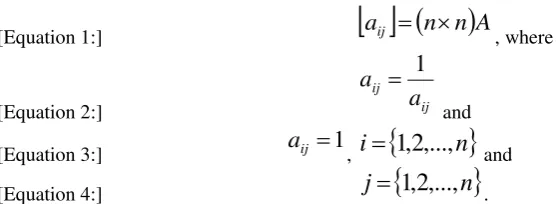
[Equation 1:]
a
ij
n
n
A
, where[Equation 2:] ij
ij
a
a
1
and
[Equation 3:]
a
ij
1
,i
1
,
2
,...,
n
and [Equation 4:]j
1
,
2
,...,
n
.An example of Pair – Wise Comparison Matrix has been presented below:
[Equation 5:]
1
1
1
1
1
...
1
2 1 2 12 1 12 n n n na
a
a
a
a
a
A
Such a matrix must be normalized in the following way:
[Equation 6:]
n j ij ij ija
a
a
1 , where
[Equation 7:]
i
1
,
2
,...,
n
.The sum of normalized verses of the matrix allows the calculation of matrix eigenvector.
The goal of Consistency Check is to exclude non – consistent expert opinions. The Consistency Ratio (CR) formula is presented below:
[Equation 8:]
RI
CI
CR
, where
CR – Consistency Ratio; CI – Consequence Index; RI – Random Index.
The Consequence Index can be calculated from the following equation:
[Equation 9:]
1
max
n
n
CI
, whereCI – Consequence Index;
max– matrix eigenvalue; n – dimension of the matrix (Saaty, 1996, p. 17 – 25). [image:6.612.88.367.69.171.2]The Random Index (RI) values depend from the dimension of the matrix and can be found in Table 1 below:
Table 1: Random Index values
N 1 2 3 4 5 6 7 8 9 10 11 12 13 14 15
Expert opinions are inconsistent when the Consistency Ratio (CR) value exceeds 0,1.
In the following Chapter the author provides two proposals of methods for limitation of number of AHP criteria and alternatives.
3.
PRELIMINARY CRITERIA REDUCTION
Between many statistical methods conceived for grouping and arranging of various analytic criteria the author did not find any strictly applicable for the reduction of criteria number in multicriterial decision making processes. Although Saaty says that his model accepts an unlimited number of entries at the Criteria and Sub – criteria levels, he states clearly that only a limited number of analyzed criteria and alternatives can assure an appropriate precision of obtained results. Saaty defines this number as 7 +/- 2 (which means 9 maximum – Saaty, 2003). At the same time he does not propose any methods of reduction of criteria amount. The author assumes that the reason of this moderation is the particularity of every decision making process. A separate list of criteria should be created for each decision making problem.
Taking all of the above into consideration, the author proposes two separate possibilities of criteria amount reduction:
Analytical Method – elimination of less important criteria or less likely to happen alternatives based on expert evaluations.
Deductive Method – elimination of less important criteria accordingly to the particularity of analyzed subject and the evaluation of criteria variability in time (constant and variable in short-, medium- and long time period).
Both proposed methods are author’s own concepts and have their positive and negative sides. The main advantage of Analytical Method is that feedback is provided from various sources (more than one expert engaged in criteria evaluation process) which causes a higher certainty of obtained results. The disadvantage could be higher method complexity. The author also doubts seriously whether same experts as for AHP ranking can be used – the risk of self – suggestion seems to be extremely high, which could result in a situation where non eliminated criteria could be perceived as more relevant than in reality. The elimination of this inconvenience would require an extra amount of experts to be hired, which would cause higher financial costs and a larger time span for elaboration of a correct set of AHP criteria.
Between the advantages of Deductive Method (DM) the author would like to underline lower complexity of the method and the fact that it can be applied by the same person that is elaborating the set of AHP criteria. Additionally, if used correctly, DM application can be based on real economic data and as such – become subject to verification and comparisons with available databases. Another positive of DM is that constant and variable determinants in short-, medium- and long period of time are easy to define. On the negative side should be cited the higher uncertainty of results – because of evaluation performed by one person only. For the same reason the Deductive Method leaves more space for mistakes that the Analytical Method.
Despite the existence of important disadvantages, the author bows towards the application of Deductive Method. This decision can be justified by the fact that the cited disadvantages can be easily diminished by several means, i.e. consulting the elaborated list of AHP criteria with other members of enterprise’s managerial board or specialists within the company, without hiring external experts. The following Chapter is a proposal of application of Deductive Method. The goal is the limiting of amount of geopolitical determinants of functioning of international companies (presented in Chapter 1) in order to elaborate a list of maximum 9 AHP criteria. The application of Analytical Method has been omitted on purpose – the application of expert evaluations for
Analytic Hierarchy Process ranking has been presented in another author’s works (Gawlik 2007, CUE & Gawlik
4.
SOLUTION PROPOSAL
The purpose of the current Chapter is to limit the number of environmental determinants of functioning of international companies (described in Chapter 1) to the number of 9 maximum. The author decided to apply the Deductive Method presented in Chapter 3 above. Recapitulating, the Deductive Method has three main features forming the Deductive Method Features List below:
1. It takes into account the particularity of the decision making process. 2. The features of analyzed subject remain in sight.
3. The evaluation is based on the variability in time of each determinant.
When describing the Deductive Method some more space should be devoted to the issue of criteria variability in time. Usually the first step of strategic decision making consists of determination of time horizon of planning. Most common intervals are short-, medium- and long time periods. Short time period equals up to one year, medium time period up to 3 years, long time period means a time span no longer than 5 years (Détrie, 2000). Planning over the mentioned 5 years is threatened by a high level of risk coming from instability of
enterprise’s Operating, Host – country and Mega – environment. In other words it is economically unreasonable to plan any enterprise strategy for time periods longer than 5 years because of high unpredictability of geopolitical environment of the enterprise. Hence we can assume that some of these geopolitical determinants in long time periods can be treated as stable, unchangeable – constans. The question which determinants can be treated this way without harm to the quality of strategic decision making remains crucial. The author will try to distinguish them from a list of determinants describing the environment of international companies in order to obtain a correct list of AHP criteria. It is important to add that the main goal of the decision making is to assure a constant growth of examined international company.
Two determinants from the Operating Environment seem to be possible subject for reduction. These are
the enterprise’s Social Responsibility and Ethics. The basis for the elimination of those two determinants is point
1 of Deductive Method Features List described above – the particularity of decision making process. Although the importance of Corporate Social Responsibility, as well as the need of implementing ethical standards in any enterprise seems to be undisputable, it will not assure company’s growth. Under these assumptions the inclusion of these factors into the set of analyzed criteria seems to be irrelevant. Both of these issues cannot be treated separately from economic indicators describing the condition of analyzed company. For this reason they will not be taken into account in further AHP analysis. At the same time the first three determinants – Legal Regulations, Organizational Culture, personnel Skills and managerial Know - How bear a strong influence on strategic decision making in enterprises.
In the group of Host – country environment determinants Economic, Political and Technological factors cannot be omitted due to their high significance at numerous fields of enterprise functioning. Referring to point 2 of Deductive Method Features List, Culture in Individual Aspect and the Interdependence between subsidiary enterprise and Host – country can be seen as independent from company’s authorities. When trying to reformulate this idea, we could say that in opposition to Legal Regulations, Organizational Culture, Skills (from the Operating Environment determinants) or Economic, Political and Technological factors, these determinants
cannot be changed or even influenced by any moves made by company’s management, including lobbing. Under this assumption they can be deducted from the AHP criteria set as well. This does not necessary mean that their
influence on enterprise’s decision making effectiveness is unimportant. They simply belong to the group of factors excluded from management’s decisiveness.
Mega Environment determinants are a good example for reduction of number of AHP criteria based on point 3 of Deductive Method Features List, namely the variability of factors in time. Whereas Global Trends and Forces, Global Competition and the Interdependence of Global Companies and Host – Countries can change
and medium time periods. In other words they can be omitted on the AHP criteria list because of their invariability in time periods relevant for strategic planning.
At this point it is important to underline that the elimination of factors from the list of AHP criteria does not mean that they become unimportant. For the needs of analyzed decision making process they will be simply
treated as the statistical group of “other environmental factors”, the influence of which can be omitted, but only when making decisions with a short or medium planning horizon.
CONCLUDING REMARKS
The author believes that the Analytical and Deductive methods of preliminary criteria reduction presented above can become useful tools for elaborating a correct list of criteria for Analytic Hierarchy Process application. Although their simplicity, they can prove themselves as useful in multicriterial decision making processes, where the number of criteria exceeds the amount allowed by the method or could obfuscate the
correct perception of enterprise’s environment, which could result in ineffective final decision.
REFERENCES
Deresky, H., International Management. Managing Across Borders and Cultures, Pearson Education International, Vth ed., New Jersey, 2006, p. 13 – 25
Détrie, J-P., STRATEGOR, Politique Générale de l’Entreprise, Dunod, Paris, 2000
Gawlik, R., Analysis of International Corporations Operating Environment with application of Analytic Hierarchy Process, in: International Management in World’s Socio – Economic Transformation, IIIrd International Management Conference, Cracow University of Economics, Kraków, 2007
Gawlik, R., The Influence of Intergovernmental Organizations on Main Determinants of the Open Systems Model with Correlation Analysis Method Application, in: 11th International Conference on Human Aspects of Advanced Manufacturing Agility and Hybrid Automation (HAAMAHA): Managing Enterprise of the Future, IAE Press 2007
Ostry, S., Technological Productivity and the Multinational Enterprise, in: Journal of International Business Studies 1998, 29, 1, p. 85 – 99
Saaty, T.L., Rank, Normalization and Idealization in the Analytic Hierarchy Process, ISAHP, Bali 2003
Saaty, T.L., Creative Thinking, Problem Solving and Decision Making, RWS Publications, Pittsburgh 2001
Saaty, T.L., Decision Making for Leaders: The Analytic Hierarchy Process for Decisions in a Complex World: 1999/2000 Edition, 3rd Rev. ed., RWS Publications, Pittsburgh 1999
Saaty, T.L., The Analytic Hierarchy Process, RWS Publications, Pittsburgh 1996
Shreeve, T.W., Be Prepared for Political Changes Abroad, in: Harvard Business Review (July – August), 1984, p. 111 – 118