Elements and Steps of E-Learning Benchmarking Model
for Higher Education Institutions
Jirasak Sae-Khow1, Onjaree Na-Takuatoong2, Jintavee Khlaisang2
1
Faculty of Education, Suratthani Rajabhat University, Suratthani, Thailand; 2Division of Educational Communications and Tech-nology, Chulalongkorn University, Bangkok, Thailand.
Ema
Received October 2013
ABSTRACT
The purposes of this research were to 1) develop of an e-learning benchmarking model for higher education in-stitutions; 2) analyze and synthesize e-learning indicators for e-learning benchmarking model. The research was conducted using the research and development methods. The result shows that there are eight elements of e-learning benchmarking model: 1) team/staffs 2) benchmarking’s title 3) comparative companies 4) bench-marking indicators 5) data collection method 6) analysis data and results 7) report of results and 8) action plan development. Moreover, four steps of benchmarking model will be used in this research. “Plan” is the step of setting team for benchmarking title and choosing the company to collect the benchmarking while “Do” is a field study in order to analyze and collect each indicator. The step “Check” presents the data to stakeholders and set the purposes of action plan. Finally, “Act” which is the development of action plan leads to the practice or im-plementation which related to auditing and evaluating.
KEYWORDS
e-Learning; Benchmarking; e-Learning Benchmarking Model
1. Introduction
E-learning operation in the university level has been de-veloped and expanded continuouslyin almost every part of the world. One method commonly used in the United States, Europe, Australia and New Zealand is to improve the quality of benchmarking e-learning which is useful for identifying organizational strengths and weaknesses with developing a strategic plan for e-learning as well as its quality assurance. Moreover, it can determine the ex-tent of success from the e-learning operation. Changing concepts and improving e-learning, for example, e- learning benchmarking in Australia is ACODE (Austra-lasian Council on Open, Distance and E-learning) [1]. Has developed strategies for the implementation and also brought to the success in three aspects of the perfor-mance—operation result, management efficiency and e- learning services improvement [2,3].
Among the European countries, England is a leader in e-learning benchmarking method in higher education. The Higher Education Academy (HEA) and the Joint Information Systems Committee (JISC) is a pioneering project of the initiative, and comparable performance in England [4]. The study of comparison in five benchmark-
quality and it moves onward with the changes occurring in the future.
2. Literature Review
Benchmarking is a systematic and continuous developing process for evaluating institution’s performance quality to determine how the different accepted famous orga- nizations work by studying the best practice by setting standard indicators and comparing from the indicators and finally, apply the result to improve the performance quality both in producing and service processes [6-10].
2.1. Elements of Benchmarking Model
Academics have discussed the elements of benchmarking as followings:
Andersen and Pettersen and Camp discussed the ele-ments of benchmarking that it started by setting a com-parable performance team and then clearly defined the structure of the Executive management, the position and the role of each division to be flexible and consistent promotion of each other. Learn to observe the process of the Organization and understand the processes running in your own organization to identify methods and operating procedures to determine the criteria for selecting an or-ganization that uses a pair of equivalent performance to determine indicators for comparable performance to se-lect methods and tools to colse-lect information to analyze data throughout the report and apply the results to con-tinue to improve enterprise development [6,7].
Robere described setting up a team is an important element in the comparable performance as well as defin-ing the compared Agency, collectdefin-ing data and analyzdefin-ing data on indicators, summarizing and reportingthe results of operations and communications informing people in all levels through the Organization by using various me-thods to make final plans to perform the objectives of the organization. Finally make a plan to accomplish the or-ganization’s goal [9].
Camp mentioned the important component of compa-rable performance is to identify what elements we want to compare by considering missions from both organiza-tions, how to collect the comparative organization, de-termining how to collect information and a variety of information gathering, analyzing, summarizing, imple-menting report and plans for future operation [7].
Kelly mentioned that to specify the elements of com-parable performance we need to consider the functions in the operation of the team, choose a format that will make comparable academic performance documents and re-lated information, pick a pair compared organization and appoint the comparable performance team, analyze data using statistical method, present the presentation was updated and how to perform the best (Best Practice),
write a summary of a plan and publish a policy and fi-nally, turning into action, work together is the policy in the last work together to hand coordination planned to-gether to take a step towards to excellence [8].
2.2. Steps of Benchmarking Model
Andersen and Pettersen have divided benchmarking model into 5 steps. Plan is the most important process that will bring benchmarking to be successful and effec-tive and get the good implementation. Search is the step to find the best comparative companies. An activity re-quired in this step is to define the criteria for selecting potential comparative companies. Observe: the purpose of observing is to define and understand the performance process of the comparative companies to improve per-formance process in your own company. Analyses: to determine the gap of the process and analyze the prob-lems that cause the gap and discuss the results of the data obtained to develop performance process, and Adapt: to improve operating process is necessity in comparable performance. To define the opportunity in improving and developing after getting the Best Practice, team needs to consider the elements of time and resource, and necessi-ties of company, availability of personnel processes in-volved in developing and targeting must be able to measure and assess, to report operating results as a sum-mary execution from the beginning until the end and to add some comments and further suggestions [6].
Robere and Associates Benchmarking Model have developed a format derived from the ideas of the compa-rable performance experts an experience in the field of quality more than 20 years. They have merged to bright out the strengths model as part of the model by combin-ing the steps of Edward De Mcombin-ing as followcombin-ing below. Plan—Select the process you want and provide compa-rable performance team. Do—Collect and analyze the data, examine the differences, advantages and strengths that have been found in the company. Study—Study sys-tematically and inform involved people all findings of the benchmarking and set the targets. Action—Create action plan development [9].
carefully to get the best information. Phase 2: Analysis phase: to analyze, compare and understand our company and to see the different data of comparative company. What are the weaknesses and strengths of comparative company, where is the best practice? How to bring the process to use with our company? Sub-step 4: set the performance space and take report results in our organi-zation and compare with the comparative company in quantity or quality comparison. Sub-step 5: determine the plan or the level of operations in the future. Phase 3, In-tegration phase. In order to change or improve organiza-tion, integrating new techniques or new innovation is very important. Sub-step 6: communicate or inform the discovery to everyone in company to know the result and findings from the benchmarking. Sub-step 7: set opera-tion’s goals. Phase 4: action phrase Sub-step 8: planning development. Sub-step: monitoring and following up Sub-step: evaluating and comparing results with the standard criteria. Phase 5: Maturity, the operation in this phase is to make the best element, that is, the execution of all processes in the organization and competency de-velopment to participate at the same time [11].
Kelly there are 8 steps in educational benchmarking as follows: 1. Decide to make a benchmarking by consider-ing from function and its results. 2. Select the format or model to be com-pared by consulting from the documen-tation and relevant information, selection of a suitable performance compared with the job. 3. Select the com-parative companies and assign the team to operate by choosing equivalent comparative company that has equivalent performance and same environment and as-sign the efficiency of personnel to take responsibility. 4. Select the appropriate comparable performance by stud-ying and comparing the results of each process. 5. Com-pare possible results by creating with 3 steps: create a draft questionnaire, tryout and develop and use it to col-lect data at last. 6. Result comparison, there are 2 steps; statistic data analysis and comparing to find the space of the performance.7. Design new operation and set the targets. There are 2 steps; one is to define and create the models and the other one is to reduce the performance’s gap in presenting new model to board committees to consider the new improved model. 8. Improving and de-veloping. There are 3 steps, these are; take the sugges-tions and comments of the committees to improve and develop to be the best practice. Summarize plans and declares as the policies in cooperating and follow the action plan. The template is used to format your paper and style the text. All margins, column widths, line spaces, and text fonts are prescribed; please do not alter them. You may note peculiarities. For example, the head margin in this template measures proportionately more is customary. This measurement and others are deliberate, using specifications that anticipate your paper as one part
of the entire proceedings, and not as an independent document. Please do not revise any of the current desig-nations [8].
3. Methodology
3.1. Study and Analyze Theoretical Concept
Documents related to the elements and steps of ben-chmarking as follow:
• the benchmarking handbook: step-by-step instruction [6].
• Benchmarking: A system approach for continual im-provement [9].
• Business Process Benchmarking: Finding and Imple- menting Best Practices [7].
• Benchmarking for School Improvement: A practical guide for comparing and achieving effectiveness [8].
3.2. Opinion Interview and Confirming Data
• Opinion interview and confirming data from the spe-cialists about the elements of e-learning benchmark-ing to get suggestions and opinions about the ele-ments and steps that related and suitable with e-learn- ing benchmarking including data confirmation from the specialists. The researcher used the interview question covered the important weight and appro-priateness of elements and steps of e-learning ben-chmarking.
• 5 representative samples who answered the question-naire were chosen by using purposive sampling. In-terview question was used as a tool for this research. Collecting and analyzing comments from the special-ists based on the content validity comparing with theoretical concepts related to the issues and consi-dered the appropriateness and consistency of data. Mean and SD were used as the statistical procedure to analyze data.
4. Results
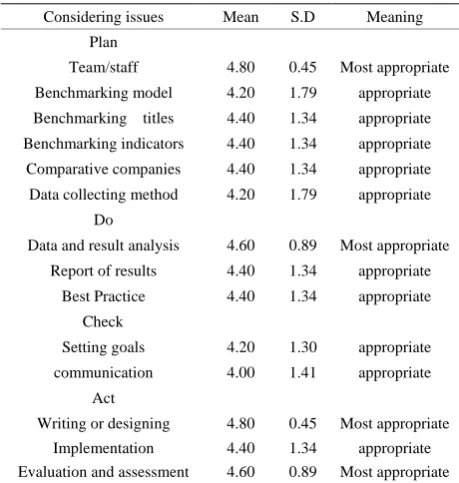
The opinion interview and questionnaire results about the elements and steps of e-learning benchmarking were taken from five specialists and summarized shown in Tables 1 and 2 below.
The consideration results from the experts found that the elements of benchmarking consist of 8 elements as follow: 1) team/staffs 2) bench marking’s title 3) com-parative companies 4) benchmarking indicators 5) data collection method 6) analysis data and results 7) report of results 8) action plan development.
Table 1. Elements of e-Learning Benchmarking.
Considering issues Mean S.D Meaning
team/staffs 4.60 0.89 Most appropriate
benchmarking title 4.60 0.89 Most appropriate
comparative companies 4.60 0.89 Most appropriate
benchmarking indicators 4.60 0.89 Most appropriate data collection method 4.60 0.89 Most appropriate
analysis data and results 4.40 1.34 Most appropriate
report of results 4.60 0.89 Most appropriate
action plan development 4.40 1.34 Most appropriate
Table 2. Steps of e-Learning Benchmarking Model.
Considering issues Mean S.D Meaning
Plan
Team/staff 4.80 0.45 Most appropriate
Benchmarking model 4.20 1.79 appropriate
Benchmarking titles 4.40 1.34 appropriate
Benchmarking indicators 4.40 1.34 appropriate
Comparative companies 4.40 1.34 appropriate
Data collecting method 4.20 1.79 appropriate
Do
Data and result analysis 4.60 0.89 Most appropriate
Report of results 4.40 1.34 appropriate
Best Practice 4.40 1.34 appropriate
Check
Setting goals 4.20 1.30 appropriate
communication 4.00 1.41 appropriate
Act
Writing or designing 4.80 0.45 Most appropriate
Implementation 4.40 1.34 appropriate
Evaluation and assessment 4.60 0.89 Most appropriate
ing method 2) Do in-cludes data and result analysis, re- port of results and best practice 3) Check includes setting goals, communication 4) Act includes writing or design- ing, implementation and evaluation and assessment.
The result of this paper shows that there are eight ele-ments of e-learning benchmarking model: 1) team/ staffs 2) bench marking’s title 3) comparative companies 4) benchmarking indicators 5) data collection method 6) analysis data and results 7) report of results and 8) action plan development. Moreover, four steps of benchmarking model will be used in this research. “Plan” is the step of setting team for benchmarking title and choosing the company to collect the benchmarking while “Do” is a field study in order to analyze and collect each indicator. The step “Check” presents the data to stakeholders and sets the purposes of action plan. Finally, “Act” which is the development of action plan leads to the practice or
implementation which related to auditing and evaluating.
5. Conclusion
All research projects are ongoing, so the conclusion can explain the results of first stage which are partly from the main research of e-learning benchmarking model for higher education institutions. The researcher presented the eight elements as the key and continued with four steps of e-learning benchmarking. The results will con-tribute and encourage benchmarking techniques for using e-learning in higher education institutions which can help the operating staffs in using and developing an efficient e-learning for students. These also lead to the develop-ment of a good standard of e-learning and will be a good practice model in higher education institutions.
Acknowledgements
The support of this work by the Office of the Higher Education Commission, Thailand through a grant in the program “Strategic Scholarships for Frontier Research Network for the Ph.D. Program, Thai Doctoral degree” is gratefully acknowledged.
REFERENCES
[1] Australasian Council on Open, Distance and e-Learning. (ACODE), “Benchmarks for E-Learning in Universities and Guidelines for Use,” 2007.
http://www.acode.edu.au/benchmarks.php
[2] C. Sarojni, “Benefits of E-Learning Benchmarks: Aus-tralian Case Studies,” The Electronic Journal of E-Learn- ing, Vol. 5, No. 1, 2007, pp. 11-20.
[3] H. Smith, M. Armstrong and S. Brown, “Benchmarking and Threshold Standards in Higher Education,” Kogan Page Limited, London, 1999.
[4] Higher Education Academy, “Challenges and Realiza- tions from the Higher Education Academy/JISC Ben-chmarking and Pathfinder Programme: An End Pro-gramme Review by the Higher Education Academy, Eva- luation and Dissemination Support Team,” 2008. http://elearning.heacademy.ac.th/webloogs/pathfinder/wp -content/uploads/2008/09/Bench_and_PathFinalReview2 0080926.pdf
[5] N. Joanicjusz, K. Z. Katarzyna, S.-P. Elzbieta and U. Joanna, “The General Concept of Benchmarking and its Application in Higher Education in Europe,” Higher Edu- cation in Europe, Vol. 34, 2009, pp. 3-4,
[6] B. Anderson and P.-G. Pettersen, “The Benchmarking Handbook: Step-By-Step Instruction,” Chapman & Hall, London, 1996.
[7] R. C. Camp, “Business Process Benchmarking: Finding and Implementing Best Practices,” APQC Quality Press, Wisconsin, 1995.
[image:4.595.57.287.275.517.2]Effective-ness,” Routledge Famer, Taylor & Frances Group, Lon-don, 2001.
[9] P. J. Robere, “Benchmarking: A System Approach for Continual Improvement,” Durakitbundit University Press, Bangkok, 2000.
[10] S. Tucker, “Benchmarking A Guide for Education,” Cor- win Press, California, 1996.