Jamie WARD
BEng Dissertation Report
Neuro-electronic Technology
in Medicine and Beyond
May 2000
Abstract
i
Table of Contents
Abstract
i
Table of Contents
i
List of Abbreviations
ii
Chapter 1 Introduction
1
1.1 Introduction 1
1.2 The body electric 1
1.3 Dissertation 2
Chapter 2 Human Nervous System
3
2.1 The Nervous System 3
2.1.1 Hearing 3
2.1.2 Vision 4
2.2 Reading Neural Signals 5
2.2.1 Eye Potential 5
2.2.2 Brain Waves 5
2.2.3 Applications 7
2.3 Summary 8
Chapter 3 Implants for Neural Stimulation
9
3.1 Introduction 9
3.2 Artificial Hearing 9
3.2.1 Cochlear implant 9 3.2.2 Brain-stem implant 12
3.3 Artificial Vision 13
3.3.1 Visual cortex implant 13 3.3.2 Retina implants 15
3.4 Other Implants 17
3.5 Summary 18
Chapter 4 A Sixth Sense
20
4.1 Introduction 20
4.2 Brain control 20
4.3 Augmented senses 21
4.4 Interfacing memory 21
4.5 Summary 22
Chapter 5 Neural Implants in Society
23
5.1 Introduction 23
5.2 A Medical Solution 23
5.2.1 Risks 23
5.2.2 Cultural perception 24
ii
5.3 Implants for Fun 25
5.3.1 In the Name of Convenience 25
5.4 Conclusion 26
Chapter 6 Summary
27
Acknowledgements
29
References
30
List of Abbreviations
AM Amplitude Modulation of an electrical signal
Biphasic Positive current pulse paired with one of equal and opposite charge Bipolar Both positive and negative (anode and cathode) charged poles
(electrodes)
CCD Charge Coupled Device – used for digital video cameras
CG Common Ground
DBS Deep Brain Stimulation – Medtronic device for Parkinson’s disease
EEG Electroencelography
EMG Electromyography
EOG Electrooculography
EP Evoked Potential
HUD Head Up Display
OTH On The Head – cochlear device by AllHear Percutaneous Direct through the skin connection
Prosthesis Replacement of part of the (human) body Transcutaneous Connection that doesn’t break the skin
Introduction 1
Chapter 1
Introduction
1.1
Introduction
The last hundred years or so have seen technology advance at a phenomenal rate. More recently the advent of microelectronics and computer technology have revolutionised the way people go about their day to day lives. Technology is not simply a tool, it is a powerful force in helping to shape the way humans act and live. It serves to break down barriers - in particular the barriers of distance, with fast air travel and ease of world-wide communication via telephone and Internet technologies. It also serves to improve quality of human life. Progress in medical technologies have dramatically altered the ability of doctors to save lives and cure problems that would have previously been viewed impossible.
One area of medicine that has particularly benefited from new technology is that of prosthesis. Part mechanical, part electrical heart implants are one example that have been around for a number of years. Artificial limbs are another example. These all involve some combination of mechanical and electrical technology. The holy grail of prosthesis however, is to provide some form of neural prosthesis – replacement of damaged brain and/or nervous system components. Steps towards this are already being taken with the advent of the electronic cochlea implant. This can provide severely deaf people with the ability to hear using electrical stimulation of auditory nerves. More recently similar steps have been made with the development of artificial vision. It is hoped that one day it may even be possible to replace damaged sections of brain with electronics.
A further ‘spin-off’ of this technology may be the eventual widespread use of electronic implants for purposes other than medicinal. The ability to artificially stimulate the sense nerves and musculature may have far-reaching applications in the home-entertainment and/or games market.
1.2
The body electric
Introduction 2
1.3
Dissertation
Human Nervous System 3
Chapter 2
Human Nervous System
2.1
The Nervous System
The nervous system is an incredibly complex electro-chemical communications system. It provides the channels through which the brain can control and gain feedback from all other parts of the body. It allows the brain to control musculature, while receiving feedback about the five senses of touch, taste, smell, hearing and vision. These senses allow the brain to perceive its environment, and are essential for communication with the outside world. In a human, the senses of hearing and vision are perhaps the most essential – these are the primary senses.
2.1.1 Hearing
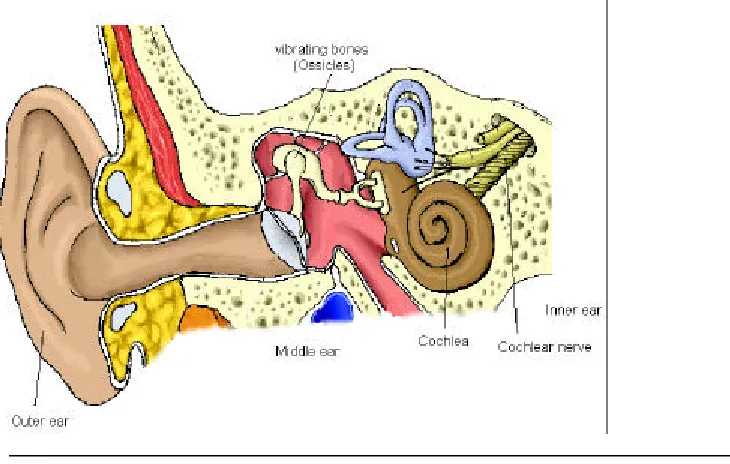
The human hearing system is composed of the outer, middle and inner ear1. See Figure 1. Sound undergoes several transformations as it passes through these towards the brain. The outer ear picks up acoustic pressure waves and passes them to the middle ear where they cause a series of small bones (Ossicles) to vibrate. Inside the inner ear, the cochlea, a snail-shaped cavity filled with fluid, transforms these vibrations into fluid vibration. The resultant pressure variations in fluid cause the basilar, a flexib le membrane running along the cochlea, to be displaced. The position of displacement contains information about the frequency of the acoustic signal. Attached along the length of the basilar membrane are a series of sensitive hairs which bend according to the displacement of the membrane. When disturbed these hairs release an electro-chemical substance that causes neurones to fire in the spiral ganglion cells at the cochlea base. These ganglion cells convey acoustic information to the brain via the central nervous system. The part of the brain responsible for dealing with auditory information is called the cochlea nucleus.
[image:6.596.156.521.505.737.2]Human Nervous System 4
2.1.2 Vision
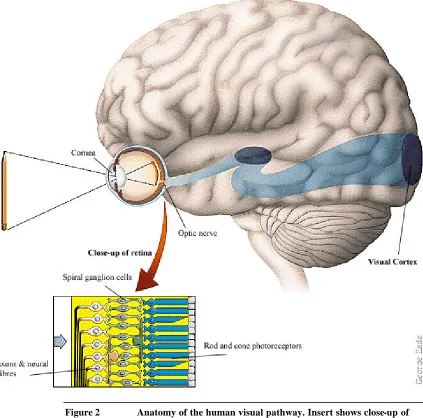
[image:7.596.97.520.224.642.2]At the front end of the visual system is the eye. The bulk of the eye is concerned with collecting light from an image and projecting it onto the retina at the back of the eye2. The back of the retina is coated with light-sensitive receptors known as rods and cones. These convert light information into neural signals which propagate forward to ganglion cells on the front of the retina. Nerve fibres from these cells, called axons, traverse the retina towards the optic disc, or blind-spot. Here they join and form the optic nerve, carrying signals to the visual cortex – the part of brain responsible for processing visio n. See Figure 2.
Human Nervous System 5
2.2
Reading Neural Signals
In 1849 the German physiologist Emil Heinrich Du Bois-Reymond first reported measurements of tiny electrical impulses from muscle contractions3. In his experiment he induced blisters in each of his arms to allow insertion of electrodes underneath the skin. The electrodes, wires attached to saline-soaked patches of blotting paper, were attached to a primitive voltage measuring device called a galvanometer. He noticed changes in the voltage measured as he moved his arms around.
More recently, modern silver chloride electrodes and sensitive electronic amplifiers can detect even the tiniest voltages, without the need to break skin. Since the 1970s it was discovered that electrical signals from muscle contractions could be used to control mechanical limb prosthesis4. Further applications include allowing severe physically handicapped individuals to control electronic equipment using amplified impulses from muscles. These electrical signals detected from muscles are called electromyographic signals, or EMG5. Specialised hardware and signal processing software is used to analyse and interpret these EMG signals. The process generally involved amplification of the analogue signal; removal of electrical “noise”; conversion to digital using a suitable ADC; and interpretation by software on a computer. The last (software) stage may involve further removal of any residual noise as part of extracting the desired signal.
2.2.1 Eye Potential
A very different electrical phenomenon can be used detect the exact positioning of the eyes. EOG, or electrooculographic signals can be detected by placing electrodes on the skin around the eyes6. These can be used to measure the corneal-retinal potential7. This is due to increased metabolic activity of the retina in relation to the rest of the eye resulting in a slightly more negative voltage than that of the cornea. The eye effectively acts as a weak electric battery. When it moves, the voltage difference fluctuates in proportion to the eye’s orientation. Detection of this voltage allows the exact orientation or gaze direction to be determined8.
A problem with using EOG signals is that the corneal- retinal potential is so small that it is easily drowned out by background electrical “noise”. The noise is in part produced by other signals on the skin and the tendency of voltage on electrodes to “drift”. This can be solved using advanced signal processing techniques once the signal has been digitised. One such technique makes use of so-called fuzzy logic to discriminate between true eye movement and electrode drift9.
2.2.2 Brain Waves
Human Nervous System 6
For many years scientists have attempted to build a functional map of the cerebral cortex, determining which EEG signal patterns correspond to which bodily functions or mental processes. Due to the highly complicated nature of the human brain, this work has proceeded with a mixed degree of success, and only some brain waves can be mapped with any consistency. There are five wave bands that form a typical EEG reading and are categorised by frequency, as shown below, these are: alpha, beta, theta, delta and mu.
• Alpha, between eight and thirteen hertz, are strong waves that can be brought on easily by simple motor actions, such as closing one’s eyes. These diminish in amplitude when a person is stimulated visually or engage in some form of mental effort.
Figure 3 Alpha waves (8-13 Hz)
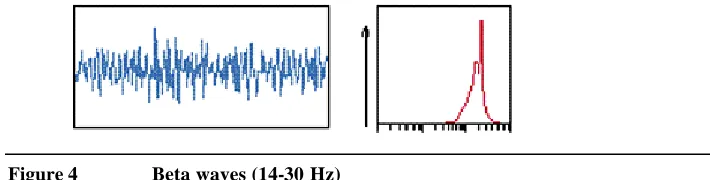
• Beta waves, between fourteen and thirty hertz, are associated with alert mental state. These can reach frequencies of up to 50 hertz during intense mental activity.
Figure 4 Beta waves (14-30 Hz)
• Theta waves, four to seven hertz, are brought on by emotional stress, particularly frustration or disappointment.
Figure 5 Theta waves (4-7 Hz)
• Delta waves, bellow 3.5 hertz, occur during deep sleep.
[image:9.596.158.513.376.466.2] [image:9.596.101.530.385.761.2]Human Nervous System 7
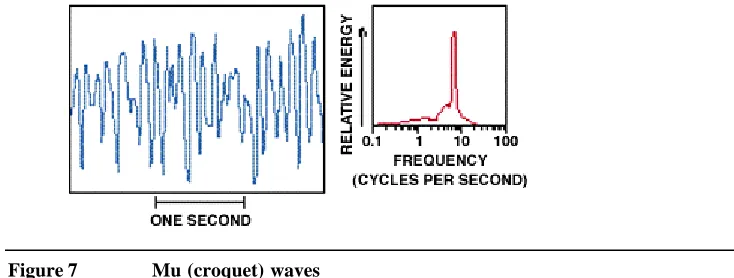
• Mu waves are related to motor activities. They diminish with movement or the intention to move. Unlike the other waves, mu signals are distinguished not so much by frequency, but by shape. They are also known as the wicket rhythm, due to the similarity of the waves with wickets used in lawn croquet.
Figure 7 Mu (croquet) waves
With ‘thought control’ training, people can learn to change the amplitude of their alpha and mu waves at will. One technique in particular allows users to control a computer cursor using mu waves simply by visualising vario us motor activities such as smiling or chewing3. Another study into alpha waves produced a brain-activated switch for use by severely physically disabled people. The switch could be turned on or off simply by focusing or unfocusing one’s attention11.
A second type of measurable brain wave is known as evoked-potential, or EP. This arises in response to provocation by certain stimuli, such as a loud noise or flash of light. Again, the ability to modify the amplitude of these signals at will can be learned. The US airforce is currently investigating a system whereby pilots can activate course auxiliary controls while their hands and feet are busy flying the aeroplane.
2.2.3 Applications
By monitoring muscular or corneal-retinal signals, it is possible to control mechanical or electrical devices with little more than a twinge of a muscle or shift of an eye. The use of EMG monitoring to control prosthetic limbs is well documented4. Similarly, EOG control is already being used in some hospitals to assist doctors position the camera view when performing endoscopic (key-hole) surgery. This leaves their hands free to operate other surgical instruments12.
Monitoring brain waves can provide an even more intimate control mechanism between human and machine. As already mentio ned above, people can learn to vary the amplitude of some brain waves. These can then be interpreted for control of a computer or even auxiliary control in an aeroplane. The applications for severely handicapped people, particularly those immobilised physically, are perhaps the most promising.
[image:10.596.158.525.142.281.2]Human Nervous System 8
computer know whether the user wishes to move the cursor, or has just been told a funny joke?
2.3
Summary
The problems identified above stem from the limited understanding there is of the human brain. The functional mapping of brain waves is at best inexact, at worst almost random. Using existing EEG techniques, there can never be say, a dedicated thought for controlling a computer cursor. It will always overlap with some other physical action or mental state. There is much on- going research into this area however, and the future may yet uncover a more effective means of interfacing with the brain.
Implants for Neural Stimulation 9
Chapter 3
Implants for Neural Stimulation
3.1
Introduction
It has long been known that nerves respond to artificial stimulation by electricity. In 1800, Alessandro Volta performed an experiment to test whether he could stimulate auditory nerves using a galvanic pile13. He reported inserting a pair of electrodes deep into each ear and connecting them to a stack of electrochemical cells, whose potential was later estimated at 50V. He reported hearing a “sound like a boiling viscid fluid”. Techniques for successful stimulation of nerve tissue have improved vastly since then. The success of cochlea implants has shown that auditory nerves can be artificially stimulated to the extent of communicating sound information directly to the brain. More recently similar success is being reported with artificial vision for the blind. This chapter explores the use of electronics for neural stimulation. In particular those used for implantation in medical applications as a replacement for damaged or missing neural sensors.
3.2
Artificial Hearing
3.2.1 Cochlear implant
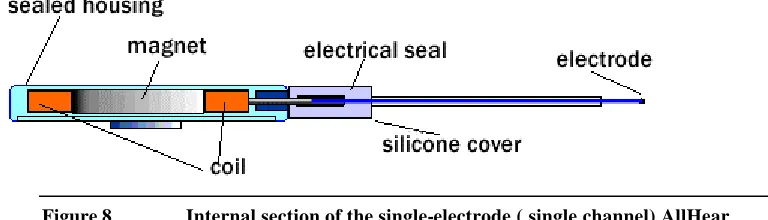
A typical cochlear implant is comprised of three sections: the electrode, implanted inside the cochlea; the external sound processor unit; and the transmitter-receiver, responsible for sending power and audio signals from the sound processor to electrode. Sound is captured by a microphone, amplified and then filtered by the external processor unit. Early designs used a direct ‘plug in the head’, or percutaneous connection to the electrode, but fears of possible infection led to the development of inductive based transcutaneous links14. These allowed both power and audio signals to be transmitted through the scalp to the electrode using inductive coils, one external (the transmitter) and the other internal (the receiver.) The external transmitter is kept in place on the scalp using magnets attached to both external and internal sections. Figure 8 and Figure 2 show the internal and external sections of the AllHear OTH (on the head) cochlear implant15. The design of the OTH is simplified so that all of the external sections, both sound processor and transmitter, are housed in a single unit. This is small enough to be worn directly on to the scalp.
[image:12.596.141.525.610.720.2]Implants for Neural Stimulation 10
Figure 9 External section of the AllHear OTH
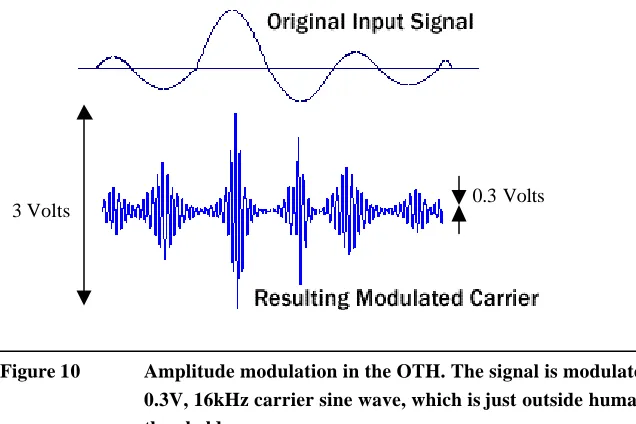
The AllHear OTH uses a short single electrode implanted into the base of the cochlea with a common ground (CG) electrode located in the middle ear, outside the cochlea. Audio signals are amplitude modulated (AM) on a high frequency carrier wave outwith the human hearing range and transmitted as an electrical signal via the electrode. The amplitude range allowable for comfort of hearing is between 0.3 and 3 Volts.
[image:13.596.162.526.68.231.2]0.3 Volts 3 Volts
Figure 10 Amplitude modulation in the OTH. The signal is modulated on a 0.3V, 16kHz carrier sine wave, which is just outside human hearing threshold.
The OTH is unusual in that it uses only a single electrode. Most of the implants in common use today make use of the so-called multi-channel electrode configuration. This includes the most popular implants, the Nucleus 2216 and the Clarion17. This is where a banded array of multiple electrodes is inserted along the length of the cochlea18.
[image:13.596.162.480.354.566.2]Implants for Neural Stimulation 11
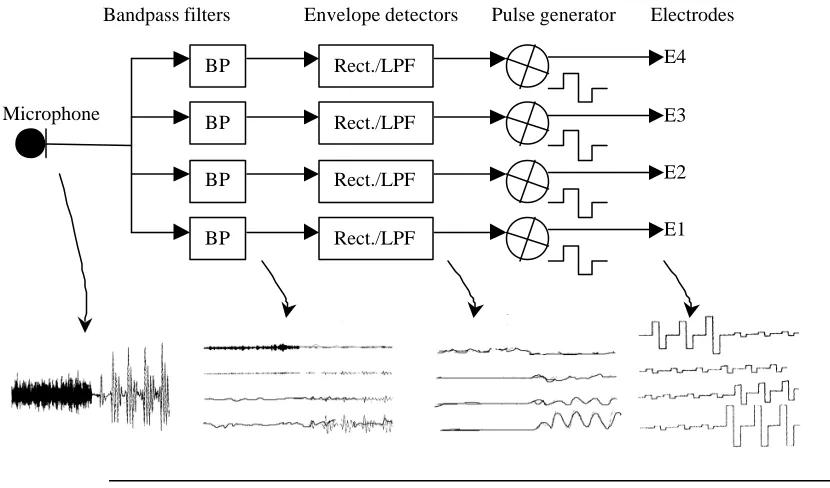
The operation of a typical four-channel cochlear implant is shown in Figure 11. Analogue sound from the microphone is processed into four frequency bands by a set of bandpass filters. Envelope detectors are then used to produce an amplitude response for each band. The remaining signals are then converted into biphasic (+/-) pulses of equal width and output to the electrodes.
BP BP BP
BP Rect./LPF Rect./LPF Rect./LPF Rect./LPF Microphone
[image:14.596.106.521.155.399.2]Bandpass filters Envelope detectors Pulse generator Electrodes E4 E3 E2 E1
Figure 11 Operation of a 4-channel cochlear implant.
Using fixed-width pulses instead of the filtered analogue signal helps to reduce channel interactions, or ‘crosstalk’ between different stimulus locations. The perception of sound, despite the removal of frequency information in the signals, is analogous to how a piano works; the tone produced doesn’t depend on how fast the keys are pressed, but on the location of the key pressed. An additional method for reducing channel interactions is to localise each channel’s stimulation field as much as possible. This can be achieved by arranging the electrodes in bipolar configuration, with sets of closely paired cathodes and anodes.
Although widely used, there are some disagreements concerning the use of tonotopic theory as a basis for cochlear implants. One argument championed by William House, the founder of AllHear, claims that although the theory may hold true for normal hearing, in deaf patients it cannot. In deaf patients, many nerve cells along the basilar required for tonotopic stimulation are damaged or missing, thus rendering the corresponding electrodes in a multi-channel implant useless19.
Implants for Neural Stimulation 12
field wide enough to stimulate the ganglions. He maintains that single channel devices, positioned correctly, are equally effective as an aid. They also have the additional benefit of requiring less signal processing, shorter simpler electrodes and are cheaper to build.
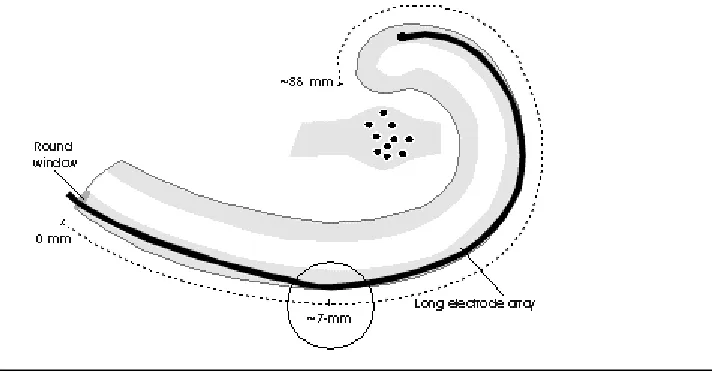
[image:15.596.163.519.223.409.2]A further concern with long (greater than 7mm) multi-channel electrodes is that the surgical procedure for inserting them deep into the snail shaped cochlea carries a severe risk of scraping against and damaging the basilar membrane. This can destroy any residual hearing the patient may have21. Consequently, by 1994, almost eight percent of people implanted with the Nucleus 22-channel device had suffered some form of residual hearing22 loss.
Figure 12 Long electrode insertion into cochlea scraping membrane wall
3.2.2 Brain-stem implant
Implants for Neural Stimulation 13
3.3
Artificial Vision
3.3.1 Visual cortex implant
Although methods for stimulating the visual cortex using electrodes have been around since the 1960s, it is only recently that scientists have managed to develop a system allowing a completely blind person to ‘see’. Previously, using single electrode probes, neuroscientists were able to stimulate the appearance of bright dots, or ‘phosphenes’ by applying small electrical pulses to sections of visual cortex in both blind and sighted patients23. Exactly how the visual processing in the brain is carried out is not known, but this phenomenon opened a window to the possibility of artificial sight for the blind. In the late 1970s, a number of blind volunteers had arrays of up to 64 electrodes implanted directly onto their visual cortex, underneath the skull24. Stimulation of these electrodes allowed a crude but useable form of vision, rather like viewing a small dot-matrix display at arms length.
One implant in particular has created much media interest as the first implanted artificial vision aid. The Dobelle institute of New York successfully implanted a patient with an electrode array in 197825. Thanks to advances in cutting-edge computer technology, the same subject, 20 years on, is now able to navigate his way around and read large printed text. It is hoped that he may soon be able to connect to the internet or television using an enhanced version of the same system26.
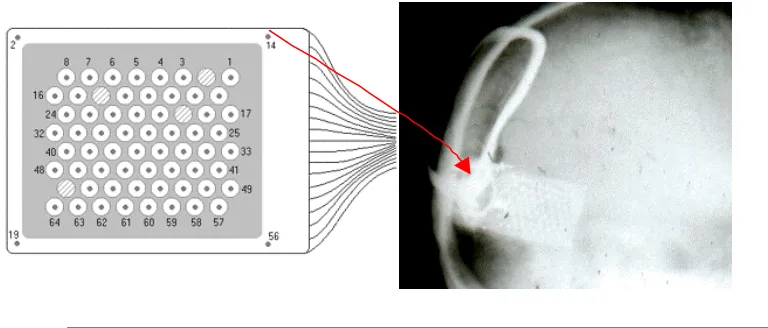
[image:16.596.127.511.484.648.2]The implant itself is comprised of a hexagonal 8x8 array of flat 1mm diameter electrodes, these are spaced in 5mm holes on a platinum foil ground plane. The whole array is held together by a flat carbon plate. Each electrode is connected by a separate teflon insulated wire to a connector contained in a carbon percutaneous (through the skull) pedestal. See Figure 13 showing the electrodes and position on skull.
Figure 13 Electrode layout and X-ray of implant. Electrode #14 ( shown by arrow) in the upper right -hand corner of the array corresponds to the electrode in the upper left hand corner of the X-ray.
Implants for Neural Stimulation 14
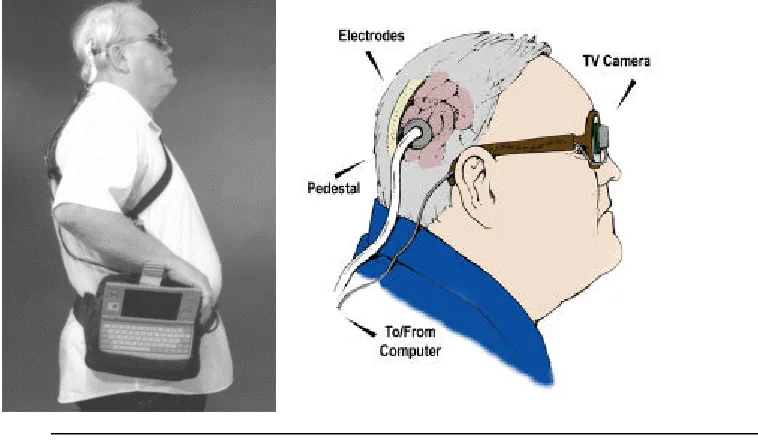
[image:17.596.135.514.144.366.2]computer, is used to run the software for processing images from the digital camera. The camera itself, a 292x512 pixel black and white charge coupled device (CCD) is fitted to a pair of sunglasses. The subject can then adjust his view simply by facing his head in the desired direction.
Figure 14 Complete artificial vision system showing the computer and electronics package on the belt with output cable to the electrodes.
Stimulation delivered to each electrode typically consists of a train of six pulses delivered at 30Hz to produce each frame of the image. Each pulse is a balanced biphasic (positive current pulse paired with one of equal and opposite charge) with a width of 500us (1000us total). The threshold amplitudes are unusually high for an implant device at between 10-20 volts (zero to peak.) This is likely to be because of the effect of the ground plane allowing only very localised stimulation, thus requiring more current to produce a large enough field to provoke a response from the nerves being stimulated. This effect may be similar in many ways to that observed using the closely paired bipolar electrode configurations for cochlea implants. This suggests that perhaps the nerves necessary for stimulating perception are not actually those directly attached to the electrodes, but are deeper underneath the cortex surface.
Implants for Neural Stimulation 15
Figure 15 Phosphene map in visual space. The electrode array produces an 8 inch by 3 inch array of phosphenes (at arm's length) in the left visual field.
3.3.2 Retina implants
Another approach favoured by many researchers is to implant a device as early in the visual pathway as possible. In principle a subject should ‘see’ something if any location along the visual path is stimulated electrically. The earlier in the path, the easier it is to obtain a stimulated image that correlates closer with the actual image. Additionally, surgery on the eye itself is much less daunting and risky than the full blown brain surgery required for working on the visual cortex.
One team based in Chicago are researching a retina implant based on photodiodes28. The work is aimed at blind or low vision sufferers who have defective rod and cone photoreceptors. A thin silicon array of photodiodes is implanted between the retina and the back of the eye with a tiny array of electrodes facing the defective rods and cones. Light signals focus sed on the photodiode array drive enough current through the electrodes to stimulate neural elements within the retina.
The problems with this however is that such placement of a device may interfere with the necessary supply of nutrients to the eye supplied by the retina lining (epithelium). Another problem is with the ability of photodiodes to produce appropriate stimulation signals. Previous research has shown that in order to safely stimulate nerve tissue, a balanced biphasic (+/-) signal is required. As yet it is difficult to fabricate photodiodes that can do this.
Implants for Neural Stimulation 16
Figure 16 Layout of the cells in the retina. Implant device location also shown.
Implants for Neural Stimulation 17
Figure 17 External and internal components for the retina implant prototype
One of the major obstacles of this proposed system is in gaining access to the implant site. An implant on the front of the retina requires that the eye is cut open, a tricky procedure with risks of the eye collapsing in on itself or possible retinal detachment. Recent advances in surgical procedure have improved the chances of success in such operations. A problem that remains to be resolved though is whether the retina can stand up to the trauma caused by implant of a foreign body. For this reason much current research is being focussed on finding suitable materials for successful eye implantation.
A further complication that may render the entire device useless would be if the electrodes stimulated the nearby axons as opposed to ganglion cells. The convoluted nature of axons means that any electrical stimulation would result in large meaningless ‘blobs’ being viewed. To avoid this, further work may be required on novel electrode designs with more precise stimulation focus.
3.4
Other Implants
Implants for Neural Stimulation 18
[image:21.596.110.526.110.362.2]from suffering epileptic fits. The device used is shown in Figure 18. Both of these systems seem to work rather well, but the exact reasons why they work is not yet known.
Figure 18 Cyberonics Model 100 NCP Vagus Nerve Stimulator, internal unit.
3.5
Summary
The advances in electronics and computer technology has brought about a radical change in the way medicine is viewed. Not so long ago giving a blind person sight and a deaf person hearing were problems only miracles could solve. Now it is becoming increasingly likely that doctors may soon have access to technology that can perform these miracles. Artificial cochlea hearing aids are already widespread, and although the sound reproduced is fairly crude, they do allow profoundly deaf people to successfully conduct conversations. It is only a matter of time before before technology advances to the stage where artificial hearing is on a par with natural hearing. Similarly with artificial vision implants. Although the ‘sight’ offered by such systems as that at MIT is no more than a collection of bright dots, the potential exists for advanced systems allowing an almost full field of view, albeit in black and white. Edge-detection software and fast computer processors can all contribute to make the system more effective as an aid. Although it seems unlikely that this vision would ever rival true sight, it would allow blind people to go about daily tasks such as walking and reading.
Implants for Neural Stimulation 19
caused, or the patient having learned to use one system before the other, hence introducing bias. It is also difficult to gauge exactly what a patient is ‘hearing’. The brain is remarkable at adapting to any kind of stimulus; it is therefore difficult to predict how much is being done by the brain, and how much assistance is provided by electronic signal processing - if any.
Similar problems will no doubt surface with the projects in artificial vision. An additional problem, particularly with the retina implant is in developing suitable materials for contact with sensitive eye tissue. Miniature electronic chips and electrodes are currently made possible using silicon technology. This has been discovered to cause problems when implanted into the eyes of rabbits. Even if suitable material are found, it remains to be seen whether there will be any long term effects of a foreign body attached to the retina.
Neural Implants in Society 20
Chapter 4
A Sixth Sense
4.1
Introduction
Most of the technology for interfacing electronics to the human nervous system is directed primarily at medical applications. These are generally applications where electronics are used only as a replacement or aid for some damaged part of an important bodily function, such as hearing or sight. Certainly no implant devices have been developed for any function other than purely medicinal.
But what if existing bodily functions could in some way be enhanced by an electronic device. An implant that offers additional functionality as opposed to one that merely replaces the existing. This may seem far fetched, but with continuing research into medical implants together with the massive financial drive of home entertainment and games markets, it is becoming increasingly likely that such technology may one day exist.
4.2
Brain control
Already, non- intrusive ‘add-ons’ to healthy human nervous system are emerging. The auxiliary flight control based on reading a pilot’s brain signals, as described in chapter 2, is one example. Another is the use of EOG readings for determining gaze-direction for applications such as view adjustment during surgical endoscopy.
With the growing industry of virtual reality gaming, such technology would provide far more realistic forms of control than the traditional game-pads and joysticks. The only contact required would be a discrete headband containing the electrodes and possibly some radio link for connecting to the processing circuitry. A further advantage of using neural signals as a means of control is that the hardware required is minimal, and therefore extremely cheap.
Neural Implants in Society 21
4.3
Augmented senses
Whereas a rudimentary control system can be set up to read neural signals using only external electrodes, any two-way communication would require a far more intimate interface. Using existing technology, nerve cells cannot be stimulated individually without some direct physical connection. This connection can only be achieved through surgical implantation of electrodes. As yet very little is known about the human nervous system, and even less about the brain. Technology does exist for stimulating neurones artificially to provoke a perceived response. Whether this response could be from some mechanism outwith the existing senses, a possible sixth sense, remains to be seen. This may depend on whether humans have a fixed capacity for perception or not.
It is possible that electronic implants to the nervous system may provide added, or augmented functionality to existing senses. The work on artificial vision for the blind is already providing clues to what may soon be possible. The same team who developed the visual cortex implant discovered that stimulation of the visual cortex in a fully-sighted subject provoked the appearance of phosphenes over their existing vision34. The experiments did not indicate any damage, or detrimental effects to the subject’s vision. They even discovered that it was possible to change the colour of these phosphenes – something that was not possible in blind subjects.
One future application, leading from the development of advanced cortex implants, could be an implanted vision chip providing some form of enhanced or augmented vision. This may be similar to the existing technique of augmented reality, where HUD is used to provide auxiliary textual (or other) information on top of a real- world view35. Driven by some external processor with network connections, the system could be used for providing textual information, such as email or subtitles to films, directly over the subject’s true vision. With the continual miniaturisation of electronics, the entire vision processing system and networking capabilities could be built onto a single chip. Either completely implanted, with optional programmable upgrades; or connected to the scalp via a transcutaneous link to the brain. The whole system could be controlled either using brain waves, speech or by some more conventional means.
This could be just a single step away from complete immersive reality. Ultimate realism could be obtained by linking the visual cortex directly to computer display for say, games, immersive TV, video-conferencing, and many more applications.
A similar system may be developed for direct audio connection to the brain. Some notable applications being the ability to link up directly to a hi- fi or telephone, without the need for an earpiece. This may even lead to the emergence of brain implanted mobile phones. An implant offering ‘electronic telepathy’, where complete conversations may be carried out using ‘thought’ alone.
4.4
Interfacing memory
Neural Implants in Society 22
or even manipulating and enhancing; the possibilities could be endless. This technology may eventually help answer the fundamental philosophical questions of what consciousness is, and the artificial intelligence (AI) questions of whether it can be transferred or stored artificially.
If this was ever to be made possible, some significant obstacles must be overcome beforehand. One such obstacle is the sheer lack of knowledge about the workings of the brain. Neuroscientists have a very basic understanding of how the brain is structured and how its components interact at a cellular level, but beyond this little is known about how thoughts and memory are processed. What is known is that it is very complicated. The thought processes of the brain are not organised into strict functional ‘blocks’ as was previously assumed – there is no one particular section of brain responsible for solving logic equations for example. Rather each thought is a complex electro-chemical process involving all brain regions working in concert.
It has been suggested that it may never be possible to ‘read’ or download memory, at least not with the technology available today36. This is based on the theory that memory is not simply composed of localised semantic (facts) and episodic (what happened) instructions, but rather a convolution of the entire brain’s physical state. Memory is formed by physical links in the brain involving emotion and feelings, not just information. In order to read a particular memory therefore, it would be necessary to reconstruct the exact conditions of the entire brain – including capability for emotion. The technology that would be required to achieve this, if ever possible, is a long way off.
4.5
Summary
Neural Implants in Society 23
Chapter 5
Neural Implants in Society
5.1
Introduction
In the face of ever advancing technological breakthroughs, particularly in the last century, people are ever more willing to accept major changes to their way of life in the name of progress. Over the last 100 years in particular, advances in technology have changed the way people live their lives dramatically. Use of cheap air-travel allows millions to enjoy holidays in far off countries; something previously restricted to the upper classes before the invention of the aeroplane. Radio, telephone, television and now the Internet all play a part in enhancing communication and making the world a much smaller, more accessible place.
“Technology has and continues to prove not merely an aid to human activity, but also a powerful force acting to reshape that activity and its meaning.” 43
The introduction of sophisticated new medical technologies and instrumentation do not just change what doctors do, but also the way people think about their health, sickness and medical care. People are willing to accept the invasion of new technology, despite the risks, if it serves to enhance their lives in some way. With a technology that involves surgery and the implantation of electronics into sensitive parts of the human anatomy, the question is will people continue to accept it. Cochlear implants are already widely accepted for medicinal use, but wo uld the same ever be true for a future implant offering purely entertainment or extra- human functionality?
To help answer this, it may be worth considering further the effect of existing medical implants and the public perceptions of technology in general. In particular the growing acceptance of technology in everyday life.
5.2
A Medical Solution
5.2.1 Risks
In any instance where the benefits of a new medicine technology begin to outweigh the risks, people are generally willing to submit themselves to the surgeon’s knife. People are often willing to risk taking any solution that may offer a better quality of life. This is especially so when the problem is loss of a primary sense or function.
Neural Implants in Society 24
caused by implantation remain a concern however. For this reason only the most severe cases of hearing loss are considered. It is likely that as these risks are reduced and the technology improves, more ‘border-line’ partially-deaf cases will also be considered.
In the eagerness to embrace the golden solutions offered by new technology however, there is a danger that false hopes of completely restored vision or hearing may only lead to disappointment. Research into implant technology shows that ability to adapt and use a new aid successfully decreases with age38. People are most able to cope with the effects of blindness or deafness if they are born that way. The same people, if implanted young, are also more likely to adapt to using an aid successfully. Those most likely to actually need an aid to help them cope are those who have lost their vision or hearing later in life. In a cruel twist of fate, these are also the same people who are less able to benefit from one.
5.2.2 Cultural perception
The brain has proven to make the most out of a ‘bad’ situation; it will make up for any shortcomings in one area by enhancing another. People born blind, or who go blind at an early age – while their brain is still developing at an accelerated rate - tend to have enhanced abilities in other senses: notably hearing, but also smell and touch. It has even been suggested that many people develop a sixth sense, an extra-perceptual ability or greatly enhanced awareness of their surroundings to replace the lost vision. To these people the world is not a visual one. In order to cope with life in a world where sight is the primary sense, they must accept that vision is not essential and that blindness is not necessarily a disability. It could be argued that by introducing a second-rate solution, such as crude vision implants, they are being forced into an alien world. A world where vision rules and they can never be equal with the ‘normal’ sighted. Instead of assisting them, introduction of this technology may in fact disable them.
Since the late 1980s, a cultural revolution has taken place among deaf people, especially in the United States39. A so-called ‘deaf-culture’ has evolved whereby sign language is the only acceptable form of verbal communication. These cultures thrive and can be entirely self- sufficient. Hearing is no longer viewed as an essential sense, in many cases it is completely unwanted. The problem arises however when a baby, known to be deaf when born, has the opportunity of a cochlea implant and to be given the chance to hear. With such an implant the child can grow up just like any normal hearing child, her brain adapting fully to make full use of the artificial aid. A good thing? To most, this would appear so, but only because of the prevalent social attitude that views deafness as a disability. Imposing this view on a newly born deaf child and implanting some second-rate sense may be viewed as denying her cultural rights - forcing her into a wholly ‘unnatural’ situation.
5.2.3 Sleepwalking
Neural Implants in Society 25
unnatural. The nature of humanity is to change things, to advance its condition through the tools available. Technology has and continues to provide the tools for this advancement, and with it to redefine what is viewed as normal. [A further discussion of this argument, outwith the scope of this dissertation can be found in some of the references provided, in particular the article by Joseph Fletcher40,41,42.]
The argument of implants not ‘feeling’ natural is primarily emotive, and therefore subject to change: but how far can people be changed, where does it all end? There is a danger that if left unchecked technology will run out of control. In a sense, it already is out of control and people are allowing it to change their lives, in many cases oblivious of the consequences. In his book, “The Whale and the Reactor” 43, Landon Winner notes that:
“The interesting puzzle in our times is that we so willingly sleepwalk through the process of reconstituting the conditions of human existence.”
Often, in the enthusiasm for progress the downside of new technology is hidden in such a way that it is not really seen at all. This is not to say that the technology itself is a bad thing and should not be pursued, as this would run contrary to human nature, but that it should be used appropriately. It can be argued that, as with genetic technologies, neural implants if used appropriately are as natural as any other human advancement.
5.3
Implants for Fun
5.3.1 In the Name of Convenience
This leads to the question of whether otherwise healthy people would ever be willing to have electrodes implanted into their brains. Although it may seem unlikely at first thought, further consideration of the way humanity has already allowed itself to be grossly altered by technology indicates otherwise.
A good example of can be found by looking at the situation in many parts of the USA. The massive growth of television and electronic communication means that more and more people choose live their lives from the comfort of their own armchair. Food and other such essentials can be provided by dial- up or web delivery. Worryingly, a quarter of Americans are classified medically obese, it is suggested as a direct result of this culture44. Many do not worry however, as any serious weight problems can be taken care of by technology: liposuction for example, or reliable prosthetic hearts in the event of heart failure. An array of health drugs are also available. Many people have voluntarily forfeited their ability to walk, and why not? With the world at the end of a web browser or television screen, there is no longer a need to walk anywhere. A button press of a remote control or mouse can do all the walking they need, and why stop there? Surely the next logical step is a brain wave television control with images beamed directly to the brain. The advantages are enormous, leaving hands free to perform other necessary functions, like eating and resting. This may seem a ridiculous situation, but statistics already show that the average American spends at least one-third of his or her life in front of a television screen43.
Neural Implants in Society 26
lifestyle of many people. The advent of mobile communications and Internet technology is already heralding a similar change to people’s lifestyles, thankfully in a mostly positive way.
Miniaturisation of communications technology has brought portability, and with this increased humanisation, allowing easier integration into society. Driven by desire for added convenience in lifestyle, humanity has embarked on a communications revolution. The mobile phone stands testament to this - it has become the fastest widely embraced technology in history. As yet its interface remains strictly human-computer: two separate entities interacting via the human senses of sound and vision, but this is only a step away from a direct communications link to the brain - the ultimate ‘hands- free’ application.
5.4
Conclusion
People may talk of a desire to escape from technology, the freedom to turn- it-off, to be ‘human’ again. Of course, the freedom still remains to turn the television off, to escape from the technology, or does it? More and more people choose not to escape. The ‘Off’ button may still be included as standard, but it is becoming rarely used in practice. The more a technology becomes embedded into society, the less able people are to escape it. As part of the barga in for added convenience and ‘improved’ lifestyle, independence from technology is forfeited:
“As they become woven into the texture of everyday existence, the devices, techniques, and systems we adopt shed their tool-like qualities to become part of our very humanity.” 43
Conclusion 27
Chapter 6
Summary
Despite what little is known about the functioning of the human brain, practical applications for communicating electrically with it can be realised using existing technology. With the use signal processing hardware and computer software, this communication can be carried out cheaper and more effectively than ever before.
Neural signals from the peripheral nerves and even the brain can be ‘read’ electronically. Although it is unlikely that actual thoughts and memories could ever be read in this way, basic signals for peripheral control can be detected. These signals can be used for a wide variety of applications; most notably for the use in limb prosthesis, and in severe cases of physical disability.
Nerves can also be stimulated artificially using directly implanted electrodes. This makes use of the brain’s ability to interpret even the most crude electrical signals and make some sense from them. A notable application, already in wide use, is the cochlear implant. Despite the arguments over exactly how these should work, the fact is that the success rate of these devices is high, and they generally do work. This allows for the first time sufferers of sensorial deafness to be given some form of effective audio perception capability - to allow them to hear. Similar research, based on electrical stimulation of the human visual system, promises to offer blind people the ability to see. Although largely still in development, one approach based on stimulation of the visual cortex already allows a completely blind man to perceive an image made up of bright dots. Problems exist however in obtaining a useful correlation between stimulus applied and the actual vision obtained. Another approach is based on stimulating the visual pathway at its source – the retina. It is hoped that this may solve the image-view mapping problem and provide a surgically easier to implant solution. Problems may arise with the ability to pinpoint visual stimulation with any useful degree of resolution. Further, the issues of implanting foreign materials into the eye may be a significant stumbling block. Despite the problems however, interest and research into neural stimulation technology is advancing rapidly, and it is becoming increasingly likely that this technology will someday provide viable solutions to many medical problems.
There is also much potential for neuro-electronics in non- medicinal applications. The use of extra-sensory electronic stimulus for day-to-day activities may one day be possible. Augmented reality systems, based on existing technology for visual cortex implants, may uncover a whole new potential for mobile communications. It is unlikely that a direct communication with the mind itself will ever be possible, at least not with methods based on current technology. Further applications creating a possible sixth-sense, or extra brain functionality may arise, but will be determined on whether humans have a fixed capacity for perception, or whether there will be some trade-off of existing senses.
Conclusion 28
Driven by the desire to enhance their lifestyle and embrace technology that offers added genuinely useful functionality, it seems likely that people will accept implanted chips as further step on the evolutionary ladder.
Conclusion 29
Acknowledgements
I would like to thank my supervisors Dr Tim Hopkins and Dr Damal Arvind for hearing my presentations. Additionally, I thank all those who supplied me with interesting ideas and material on brains, electrodes and the Changing of Man. A dear thanks to my friends who were prepared to offer some last minute proof reading.
30
References
[1] BRUCE,GREEN,GEORGESON:'Visual Perception', Psychology Press - Taylor and Francis, pp3-24, 1996
[2] YOST,NIELSEN: 'Fundamentals of Hearing: An Introduction', Holt Reinhart & Winston, 1985
[3] LUSTED, KNAPP: ‘Controlling Computers With Neural Signals’, Scientific American 1096, June 1999
[4] LOEB, G.E.: ‘Neural prosthetic interfaces with the nervous system,’ TINS, vol. 12, pp195-201, 1989.
[5] HEFFNER, ZUCCHINI, JAROS, ‘The Electromyogram (EMG) as a Control Signal for Functional Neuromuscular Stimulation-Part I: Autoregressive Modeling as a Means of EMG Signature Discrimination’, IEEE Trans. Biomed. Eng., vol. 35, pp. 230-236, April 1988.
[6] MOWER. RUCH, MILLER: ‘The corneo-retinal potential difference as the basis of the galvanometric method of recording eye movements’, American Journal of Physiology, vol. 114, p. 423, 1936
[7] CARL, ‘Principles and Techniques of Electro-oculography’, in ‘Handbook of Balance Function Testing’, G. P. Jacobson, C.W. Newman, and J. M. Kartush (eds.), Mosby Year Book, 1993
[8] GIPS, OLIVIERI, TECCE: ‘Direct control of the computer through electrodes placed around the eyes’, ‘Human-Computer Interaction: Applications and Case Studies’, M.J. Smith and G. Salvendy (eds.), Elsevier, pp 630-635, 1993 [9] KOSKO, ISAKA, ‘Fuzzy Logic’, Scientific American, July 1993
[10] A good tutorial on EEG signals can be found at Delsys Corporate Website,
http://www.delsys.com/emg_articles/EMG.shtml, 2000
[11] SUTTER, E.E.: ‘Handbook of Amyotrophic Lateral Sclerosis’, (comms. technology for disabled persons), edited by R. Allan SMITH, Marcel Dekker, 1992
[12] LUSTED, KNAPP: ‘Controlling Computers With Neural Signals’, reference to endoscopy work with Stanford University, Scientific American 1096, June 1999 [13] SIMMONS, F.B.: ‘Electrical stimulation of the auditory nerve in man’, Arch
Otolaryng 84, pp24-76, 1966
[14] HOUSE, BERLINER: ‘Cochlear implants: from idea to clinical practice’, in’ Cochlear implants: A Practical Guide’, H. Cooper, Singular Publishing, San Diego, pp9-33, 1991
[15] HOUSE,W.F.: AllHear Corporate Website, http://www.allhear.com, 1999 [16] ANONYMOUS: ‘Nucleus multielectrode implant’, Cochlear Corporation
Website, http://www.cochlear.com, 1999
[17] ANONYMOUS: ‘CLARION multielectrode implant’, Advanced Bionics Corporation Website, http://www.cochlearimplant.com, 1999
[18] CLARK, TONG, BLACK, FORSTER, PATRICK, DEWHURST: ‘A multiple-electrode cochlear implant’, J.Laryngol. Otol.91, pp935-945, 1977
[19] HOUSE,W.F.: ‘Cochlear Implants: My Perspective’, AllHear Corporate Website, http://www.allhear.com, 1999
[20] SHINDLER, MERZENICH: ‘ Cochlear Implants’, Raven Press NY, p601, 1983 [21] BOGIES, BAKER, BALKANY: ‘Loss of residual hearing after cochlear
31
[22] DYE (et al): ‘Measurable Residual Hearing Following Cochlear Implantation’, Advances in Otolaryngology – Head and Neck Surgery. Vol. 4, pp61-79, 1990 [23] BRINDLEY, LEWIN: ‘The Sensations produced by electrical stimulation of the
visual cortex’, J.Physiol (Lond) 196, pp479-493, 1968
[24] KLOMP, WOMACK, DOBELLE: ‘Fabrication of large arrays of cortical electrodes for use in man’, J. Biomed Mater Res 11, pp347-364, 1977
[25] DOBELLE, QUEST, ANTUNES, ROBERTS, GIRVIN.: ‘Artificial Vision for the Blind by electrical stimulation of the visual cortex ’, Neurosurgery 5, pp521-527, 1979
[26] DOBELLE, W.H.: ‘Artificial Vision for the Blind by Connecting a Television Camera to the Visual Cortex’, American Society of Artificial Internal Organs, Journal 46, pp3-9, 2000
[27] KLOMP, WOMACK, DOBELLE: ‘Percutaneous transmission of electrical energy in humans’, American Society of Artificial Internal Organs, Journal 25, pp1-7, 1979
[28] CHOW, A: unpublished reference from article by WYATT & RIZZO: ‘Ocular implants for the blind’, IEEE Spectrum, Vol.33, pp47-53, May 1996
[29] WYATT & RIZZO: ‘Prospects for a Visual Prosthesis’, Neuroscientist, Vol.3, pp.251-262, July 1997
[30] WYATT & RIZZO: ‘Retinal Prosthesis’, in ‘Age-Related Macular Degeneration’, J.W. Berger, S.L. Fine and M.G. Maguire, eds., Mosby, St. Louis, pp. 413 – 432, 1998
[31] ‘Deep Brain Stimulator’, Medtronic Corporate Website,
http://www.medtronic.com, 2000
[32] ‘Vagus Nerve Stimulator’, Cyberonics Corporate Website,
http://www.cyberonics.com, 2000
[33] Smith-Kettlewell Eye Research Institute Website, htttp://www.ski.org, 2000 [34] DOBELLE, MLADEJOVSKY: ‘Phosphenes produced by electrical stimulation of
human occipital cortex, and their application to the development of a prosthesis for the blind’, J Physiol (Lond) 243, pp553-576, 1974
[35] WEBSTER, FEINER MacINTYRE, MASSIE, KRUEGER: "Augmented reality in architectural construction, inspection and renovation." Proc. ASCE Third Congress on Computing in Civil Engineering, Anaheim, CA, June 17-19, 913-919, 1996
[36] GREENFIELD, S.: lecture on ‘Why the Human Mind is not like a Computer’, Edinburgh, Feb 2000
[37] HOUSE, URBAN.: ‘Long term results of electrode implantation and electronic stimulation of the cochlea in man’, Ann. Otol. Rhinol. Laryngol. 82, pp504-514, 1973
[38] WATSON, C.S.: ‘Auditory perceptual learning and the cochlear implant’, Am J Otol, 12:77, 1991
[39] WRIGLEY,O: ‘The Politics of Deafness’, ISBN 1-56368-052-1, Gallaudet University Press
[40] FLETCHER, J: ‘Technological Devices in Medical Care’, from ‘Who Shall Live’ by Kenneth Vaux, Fortress Press, pp115-142 1970
[41] VERHEY, A: ‘ “Playing God” and Invoking a Perspective’, J. Medicine and Philosophy 14, pp347-364, 1995
32
33
1
BRUCE,GREEN,GEORGESON:'Visual Perception', Psychology Press - Taylor and Francis, pp3-24, 1996
2
YOST,NIELSEN: 'Fundamentals of Hearing: An Introduction', Holt Reinhart & Winston, 1985
3
LUSTED, KNAPP: ‘Controlling Computers With Neural Signals’, Scientific American 1096, June 1999
4
LOEB, G.E.: ‘Neural prosthetic interfaces with the nervous system,’ TINS, vol. 12, pp195-201, 1989.
5
HEFFNER, ZUCCHINI, JAROS, ‘The Electromyogram (EMG) as a Control Signal for Functional Neuromuscular Stimulation-Part I: Autoregressive Modeling as a Means of EMG Signature Discrimination’, IEEE Trans. Biomed. Eng., vol. 35, pp. 230-236, April 1988.
6
MOWER. RUCH, MILLER: ‘The corneo-retinal potential difference as the basis of the galvanometric method of recording eye movements’, American Journal of Physiology, vol. 114, p. 423, 1936
7
CARL, ‘Principles and Techniques of Electro-oculography’, in ‘Handbook of Balance Function Testing’, G. P. Jacobson, C.W. Newman, and J. M. Kartush (eds.), Mosby Year Book, 1993
8
GIPS, OLIVIERI, TECCE: ‘Direct control of the computer through electrodes placed around the eyes’, ‘Human-Computer Interaction: Applications and Case Studies’, M.J. Smith and G. Salvendy (eds.), Elsevier, pp 630-635, 1993
9
KOSKO, ISAKA, ‘Fuzzy Logic’, Scientific American, July 1993
10
A good tutorial on EEG signals can be found at Delsys Corporate Website,
http://www.delsys.com/emg_articles/EMG.shtml, 2000
11
SUTTER, E.E.: ‘Handbook of Amyotrophic Lateral Sclerosis’, (comms. technology for disabled persons), edited by R. Allan SMITH, Marcel Dekker, 1992
12
LUSTED, KNAPP: ‘Controlling Computers With Neural Signals’, reference to endoscopy work with Stanford University, Scientific American 1096, June 1999
13
SIMMONS, F.B.: ‘Electrical stimulation of the auditory nerve in man’, Arch Otolaryng 84, pp24-76, 1966
14
HOUSE, BERLINER: ‘Cochlear implants: from idea to clinical practice’, in’ Cochlear implants: A Practical Guide’, H. Cooper, Singular Publishing, San Diego, pp9-33, 1991
15
HOUSE,W.F.: AllHear Corporate Website, http://www.allhear.com, 1999
16
ANONYMOUS: ‘Nucleus multielectrode implant’, Cochlear Corporation Website, http://www.cochlear.com, 1999
17
ANONYMOUS: ‘CLARION multielectrode implant’, Advanced Bionics Corporation Website, http://www.cochlearimplant.com, 1999
18
CLARK, TONG, BLACK, FORSTER, PATRICK, DEWHURST: ‘A multiple-electrode cochlear implant’, J.Laryngol. Otol.91, pp935-945, 1977
19
HOUSE,W.F.: ‘Cochlear Implants: My Perspective’, AllHear Corporate Website, http://www.allhear.com, 1999
20
SHINDLER, MERZENICH: ‘ Cochlear Implants’, Raven Press NY, p601, 1983
21
34
22
DYE (et al): ‘Measurable Residual Hearing Following Cochlear Implantation’, Advances in Otolaryngology – Head and Neck Surgery. Vol. 4, pp61-79, 1990
23
BRINDLEY, LEWIN: ‘The Sensations produced by electrical stimulation of the visual cortex’, J.Physiol (Lond) 196, pp479-493, 1968
24
KLOMP, WOMACK, DOBELLE: ‘Fabrication of large arrays of cortical electrodes for use in man’, J. Biomed Mater Res 11, pp347-364, 1977
25
DOBELLE, QUEST, ANTUNES, ROBERTS, GIRVIN.: ‘Artificial Vision for the Blind by electrical stimulation of the visual cortex ’, Neurosurgery 5, pp521-527, 1979
26
DOBELLE, W.H.: ‘Artificial Vision for the Blind by Connecting a Television Camera to the Visual Cortex’, American Socie ty of Artificial Internal Organs, Journal 46, pp3-9, 2000
27
KLOMP, WOMACK, DOBELLE: ‘Percutaneous transmission of electrical energy in humans’, American Society of Artificial Internal Organs, Journal 25, pp1-7, 1979
28
CHOW, A: unpublished reference from article by WYATT & RIZZO: ‘Ocular implants for the blind’, IEEE Spectrum, Vol.33, pp47-53, May 1996
29
WYATT & RIZZO: ‘Prospects for a Visual Prosthesis’, Neuroscientist, Vol.3, pp.251-262, July 1997
30
WYATT & RIZZO: ‘Retinal Prosthesis’, in ‘Age-Related Macular Degeneration’, J.W. Berger, S.L. Fine and M.G. Maguire, eds., Mosby, St. Louis, pp. 413 – 432, 1998
31
‘Deep Brain Stimulator’, Medtronic Corporate Website, http://www.medtronic.com, 2000
32
‘Vagus Nerve Stimulator’, Cyberonics Corporate Website, http://www.cyberonics.com, 2000
33
Smith-Kettlewell Eye Research Institute Website, htttp://www.ski.org, 2000
34
DOBELLE, MLADEJOVSKY: ‘Phosphenes produced by electrical stimulation of human occipital cortex, and their application to the development of a prosthesis for the blind’, J Physiol (Lond) 243, pp553-576, 1974
35
WEBSTER, FEINER MacINTYRE, MASSIE, KRUEGER: "Augmented reality in architectural construction, inspection and renovation." Proc. ASCE Third Congress on Computing in Civil Engineering, Anaheim, CA, June 17-19, 913-919, 1996
36
GREENFIELD, S.: lecture on ‘Why the Human Mind is not like a Computer’, Edinburgh, Feb 2000
37
HOUSE, URBAN.: ‘Long term results of electrode implantatio n and electronic
stimulation of the cochlea in man’, Ann. Otol. Rhinol. Laryngol. 82, pp504-514, 1973
38
WATSON, C.S.: ‘Auditory perceptual learning and the cochlear implant’, Am J Otol, 12:77, 1991
39
WRIGLEY,O: ‘The Politics of Deafness’, ISBN 1-56368-052-1, Gallaudet University Press
40
FLETCHER, J: ‘Technological Devices in Medical Care’, from ‘Who Shall Live’ by Kenneth Vaux, Fortress Press, pp115-142 1970
41
VERHEY, A: ‘ “Playing God” and Invoking a Perspective’, J. Medicine and Philosophy 14, pp347-364, 1995
42
AUGENSTEIN, L.: ‘Come, Let Us Play God’, Harper & Row, New York, 1969
43