Eect of dephasing on charge-counting statistics in chaotic
cavities
Ya.M. Blanter
a;b;∗, H. Schomerus
c, C.W.J. Beenakker
c aDepartement de Physique Theorique, Universite de Geneve, CH-1211 Geneve 4, SwitzerlandbDepartment of Applied Physics, Delft University of Technology, Lorentzweg 1, 2628 CJ Delft, The Netherlands cInstituut-Lorentz, Universiteit Leiden, P.O. Box 9506, 2300 RA Leiden, The Netherlands
Received 21 October 1999
Abstract
We calculate the cumulants of the charge transmitted through a chaotic cavity in the limit that the two openings have a large number of scattering channels. The shot noise, which is the second cumulant, is known to be insensitive to dephasing in this limit. Unexpectedly, the fourth and higher cumulants are found to depend on dephasing: A semiclassical theory and a quantum mechanical model with strong dephasing give a result dierent from a fully phase-coherent quantum mechanical theory. c2001 Elsevier Science B.V. All rights reserved.
PACS:05.60.−k; 03.65.Sq; 73.23.Ad; 73.50.Td
Keywords:Shot noise; Fluctuations; Quantum statistics; Transport processes; Quantum dots
1. Introduction
The theory of shot noise in mesoscopic systems has developed along two parallel lines, one fully quantum mechanical, the other semiclassical (see Refs. [1,2] for reviews). The semiclassical method treats the dynam-ics of the electrons according to classical mechandynam-ics, but includes quantum statistical eects following from
Presented at The International Workshop and Seminar on Dynamics of Complex Systems, Dresden, Germany, 31 March–15 June 1999. See Physica E, Volume 9, issue No. 3.
∗Corresponding author. Fax: +31-15-278-1203.
the Pauli exclusion principle. The fully quantum me-chanical method includes interference eects that are ignored in the semiclassical approach. Both methods are expected to give identical results in the limit that the Fermi wavelength goes to zero, or equivalently,
in the limit that the number of scattering channelsN
goes to inFnity, corresponding to a large conductance
compared to the conductance quantume2=h.
For example, in a diusive conductor the
shot-noise power S → 2
3eI in the limitN → ∞ (with
I the mean current), and this result has been
ob-tained both quantum mechanically (using random-matrix theory [3] or Green’s functions [4–6]) and
semiclassically (using the Boltzmann–Langevin equa-tion [7]). Another example of the correspondence principle between quantum mechanics and
semi-classics in the large-N limit is the shot noise of a
double-barrier tunneling diode [8–11].
The shot-noise power is the second cumulant of the charge transmitted through the conductor in a certain time. For the complete counting statistics, one needs to know the higher cumulants as well. The only existing semiclassical calculation of higher cumulants was done for the double-barrier tunneling diode [11], and was found to be in complete agreement with the
quan-tum mechanical theory [12–16] in the large-N limit.
In this paper we present a semiclassical theory for the counting statistics of charge transported through a chaotic cavity, using the ‘minimal correlation’ ap-proach developed recently by Sukhorukov and one of the authors [17]. Much to our surprise, we do not
re-cover the quantum mechanical results in the large-N
limit: the fourth and higher cumulants dier. We need to introduce dephasing into the quantum mechanical theory (by means of a voltage probe [18–21]) to ob-tain agreement with semiclassics.
2. Transmitted charge
We consider a chaotic cavity (or quantum dot) connected to two equilibrium reservoirs by ballistic contacts (Fig. 1). (Since our results do not depend on the dimensionality of the cavity we focus on the two-dimensional situation, which simpliFes notation.)
A voltage V is applied between the reservoirs. The
reservoirs are described by equilibrium Fermi func-tions, which at zero temperature (the case of interest
in this paper) have the formfL(E) =(eV−E) and
fR(E) =(−E). The cross-sections of the contacts
[image:2.544.67.242.558.638.2]are denoted byLandR. Since we want to exploit
Fig. 1. Two-terminal chaotic cavity. The left and right contacts have cross-sectionsL,R, and outward normalsnL; nR.
the chaotic dynamics of the electron motion, we as-sume that there is no direct transmission between the contacts. In addition, the contacts are narrow as compared to the circumference of the cavity, but
are classical in the sense that the number NL,NR of
propagating modes through each contact is large. We are interested in the statistics of the charge trans-mitted through any of the contacts in a given time
intervalt,
Q(t) =
t
0 I(t
) dt; (1)
whereI(t) =I+I(t) is the Muctuating current. We
take the limitt→ ∞. For deFniteness, we consider the
current through the left contact, with the convention that positive current is directed towards the sample. In the long-time limit the charge transmitted through the right contact is the same, due to current conservation. The average transmitted charge gives the
aver-age currentI= limt→∞t−1Q(t), and the variance
of the transmitted charge gives the zero-frequency shot-noise power,
S= 2
∞
−∞I(0)I(t)dt
= 2 lim
t→∞t
−1(Q2 − Q2): (2)
Higher cumulants ofQ(t) determine higher-order
cor-relation functions of the current.
Classically, the current is expressed in terms of the
distribution functionf(r;n; E; t), withnthe direction
of momentum. The absolute value of the momentum
pF may be regarded as a constant. The current is
given by
IL(t) =−2ep˜F2
L
dyL
dE
×
dn(nL·n)f(x; t); (3)
wherenL is the outward normal to the surface of the
cavity at the location of the left contact (Fig. 1), yL
is a point at the cross-section of the contact, and we
have abbreviated x ≡ {r;n; E}. The angular integral
is normalized to unity,dn= 1.
Electrons incident from the left reservoir (nL·n¡0)
are described by the non-Muctuating distribution
func-tion fL(E). (We ignore thermal Muctuations.) The
distribution function of the electrons withnL·n¿0
the cavity. On average, it only depends on energy, since the coordinate and angular dependence averages out due to the multiple scattering from the surface of the cavity. This average distribution function inside the cavity is readily found from the condition that the current in each energy layer is conserved [17],
f=NLfNL+NRfR
L+NR : (4)
The number of modes NL, NR is given by NL;R=
pFWL;R=˜, withWL;Rthe width of the contacts. The
mean transmitted charge (1) is thus
Q=ILt=e
2Vt
h
NLNR
NL+NR: (5)
This result could also be obtained by series addition
of the ballistic conductancesNLe2=handNRe2=hof the
two contacts.
3. Fluctuations of the distribution function
Fluctuations of the transmitted charge at zero tem-perature are entirely determined by the Muctuations of the distribution function inside the cavity. Following Ref. [17], we assume that the Muctuations of the
dis-tribution functionf≡f−finside the cavity may
be decomposed into two parts,
f(x; t) =f˜(x; t) +fC(E; t): (6)
The functionf˜describes the purely ballistic motion
and obeys the equation
(@t+vFn· ∇)f˜(x; t) = 0 (7)
withvF the Fermi velocity. This equation is
supple-mented by the expression for the equal-time correla-tor,
f˜(x; t)f˜(x; t)=(x−x)f(1− f); (8)
where
(x−x) =−1(r−r)(n−n)(E−E) (9)
and=m=2˜2 is the density of states. Eq. (8) has
the same form as in equilibrium, although the function
fdescribes the non-equilibrium state in the cavity.
The reason is that the only source of noise at equilib-rium as well as in the case of a deterministic chaotic cavity is the partial occupation of states. The uniform
Muctuating termfCaccounts for the fact that at long
times the motion inside the cavity is not purely ballis-tic, and ensures the current conservation at any time in any energy interval.
The Muctuations in the current due to the termf˜
are given by
I˜L(t) =−2ep˜F2
L
dyL
dE
×
(nL·n)¿0
dn(nL·n)f˜(x; t) (10)
and similarly forI˜R(t). The condition that the current
at any time in any energy interval is conserved can be used to eliminate the Muctuation in the current due to
the term fC. The total Muctuation of the current is
then given by
IL(t) =NRI˜LN(t)−NLI˜R(t)
L+NR : (11)
Eqs. (6)–(8) constitute the minimal correlation ap-proach, which was shown in Ref. [17] to agree in the
limitNL,NR1 with the quantum mechanical
expres-sion for shot noise in a multi-terminal chaotic cavity. We seek to extend this approach to higher cumulants of the transmitted charge. Therefore, we have to
spec-ify all the cumulants of the functionf˜at equal time
moments. Generalizing Eq. (8), we write
f˜(x1; t)f˜(x2; t)· · ·f˜(xk; t)
=(x1−x2)(x1−x3)· · ·(x1−xk)
×fk(x; t); (12)
where · · · denotes the cumulant. The cumulant
fk(x; t)is calculated later on; it depends only on
E, since moments of f(x) are determined by f.
Eq. (12) is equivalent to Eq. (8) for k= 2, since
f2=f(1− f) (see below).
Taking into account Eq. (7) and using Eq. (12) as the initial condition, we obtain the expression for the
cumulant off˜at arbitrary times,
f˜(x1; t1)f˜(x2; t2)· · ·f˜(xk; tk)
=1−k(E
1−E2)· · ·(Ek−1−Ek)
×(n1−n2)· · ·(nk−1−nk)
×[r1−r2−vFn1(t1−t2)]· · ·[rk−1
4. Semiclassical cumulants
Eqs. (3), (10), (11), and (13) may now be used to calculate the cumulants of the transmit-ted charge. We note that all cumulants of the type
I˜(t1)· · ·I˜ (tk)vanish due to the combination
of delta functions in Eq. (13), unless all the subscripts
; : : : ; are equal to Lor all are equal toR. The two non-zero cumulants are
I˜(t1)I˜(t2)· · ·I˜(tk)
= (−1)kekN
h
dEfk(E)(t
1−t2)· · ·
×(tk−1−tk); =L; R; k¿2: (14)
Consequently, for the cumulant of the transmitted charge we obtain
Qk=ekt
h Nk
LNR+ (−1)kNRkNL
(NL+NR)k
×
dEfk(E): (15)
To complete the calculation, we must compute the
cumulantfk. The Muctuating distribution function
assumes only the values 0 and 1, thusfk=ffor
k¿1. The characteristic function
!(p) =exp(pf)= 1 +f[exp(p)−1] (16)
generates the cumulants as coeOcients in a series ex-pansion,
ln!(p) =∞
k=1
pk
k!fk: (17) Substituting the average distribution function (4), integrating over energy, and taking into account Eq. (5), we obtain the expression for the cumulants of the
transmitted charge (k¿2),
Qk=ek−1QS
kN k−1
L + (−1)kNRk−1
(NL+NR)k−1 ; (18)
where the coeOcientsSk are deFned as
ln[NR+NLexp(p)] =
∞
k=0
pk
k!Sk: (19) Expression (18) may be simpliFed in the symmetric
caseNL=NR, when
S2l=2
2l−1
2l B2l; S2l+1= 0; l¿1; (20)
whereBnare Bernoulli numbers. In this case we have
(forl¿1)
Q2l=e2l−1Q22l−1
l22l−1B2l;
Q2l+1= 0: (21)
In particular,Q2=eQ=4, which is the 1=4-shot
noise suppression in a symmetric chaotic cavity [22]. The next non-vanishing cumulant is negative,
Q4=−e3Q=32.
For non-equivalent contacts Eq. (18) yields
Q2=eQ NLNR
(NL+NR)2; (22)
in agreement with Refs. [6,23]. The next two cumu-lants are
Q3=−e2QNLNR(NL−NR)2
(NL+NR)4 ; (23)
Q4=e3QN
LNR
(N2
L−4NLNR+NR2)(NL3+NR3)
(NL+NR)7 : (24)
5. Phase-coherent quantum mechanical cumulants
We produced the result (18) by a semiclassical method, generalizing the minimal correlation ap-proach to higher cumulants. Let us compare it to the phase-coherent quantum mechanical theory in the
large-N limit.
We use the relationship derived by Lee et al. [15] between the characteristic function of the transmitted
charge and the transmission eigenvaluesTj,
exp(Qp=e)=
j [1 +Tj(exp(p)−1)]
eVt=h: (25)
This is the expression for a particular cavity, so we still have to perform an ensemble average. The
transmis-sion eigenvalues have density '(T) in the ensemble
of chaotic cavities. The ensemble-averaged cumulants of the transmitted charge follow from
∞
k=1
pk
k!e−kQk
=eVth
T
0 dT '(T) ln[1 +T(exp(p)−1)]:
The density of transmission eigenvalues for NL,
NR1 has the form [6,23]
'(T) =
√ NLNR
T
T
1−T −
(NL−NR)2
4NLNR
1=2
:
(27)
It vanishes forT6[1 + 4NLNR(NL−NR)−2]−1.
[image:5.544.322.466.95.202.2] [image:5.544.45.262.97.302.2]In the symmetric caseNL=NR=None simply has
[22,24]
'(T) =N 1
T(1−T) (28) and hence
∞
k=1
pk
k!e1−kQk= 4Qln[12+12exp(p=2)]; (29) which is equivalent to Eqs. (18) and (20). Thus, for the symmetric case the results for the charge counting statistics, obtained semiclassically and quantum me-chanically, are identical.
This correspondence does not extend to the more
general caseNL=NR. From Eqs. (26) and (27) we
reproduce the semiclassical expressions (22) and (23)
forQ2andQ3. However, the fourth cumulant,
Q4=e3QN
LNR(NL+NR)−6
×(N4
L−8NL3NR+12NL2NR2−8NLNR3+NR4);
(30) is dierent from Eq. (24).
6. E"ect of dephasing on the quantum mechanical cumulants
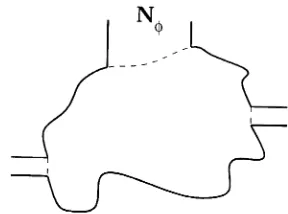
Apparently, the dierence between Eqs. (24) and (30) is due to the lack of phase coherence in the semi-classical minimal correlation approach. To strengthen this explanation, we incorporate into the quantum mechanical theory a dephasing mechanism via an additional Fctitious lead attached to the cavity (see Fig. 2). Following Refs. [20,21] we assume that this lead has a (Muctuating) distribution function which is determined from the condition that no current Mows into the reservoir at every energy and every instant of time. An electron absorbed by this lead is imme-diately reinjected back at the same energy, without any memory of the phase. Thus, this Fctitious lead
Fig. 2. Chaotic cavity with a Fctitious lead (supportingN( prop-agating modes) that models strong uniform dephasing.
introduces dephasing but not inelastic scattering. For homogeneous and complete dephasing, we take the
number of scattering channels N( in the dephasing
lead to be very large,N(NL; NR.
Our starting point is the expression for the
cur-rent operator in the lead (= L;R; () in terms of
creation=annihilation operators [8,2],
ˆ
I(t) =eh )
mn
dE
dEexpi(E−E)t
˜
×aˆ†
)m(E)Amn)(; E; E) ˆan(E): (31)
The sum over ) and is over the leads L, R, and
(, the sum over m, nis over the mode indices. The
current matrixAis expressed in terms of the scattering
matricess,
Amn
)(; E; E) =mn)−s)†mn(E)snm(E) (32)
and the creation and annihilation operators obey the fermion anticommutation relation
ˆ
a†m(E) ˆa-n(E) + ˆa-n(E) ˆa†m(E)
=-mn(E−E): (33)
The expectation value
a†
m(E) ˆa-n(E)=-mn(E−E)f(E) (34)
is given by the average distribution functionf(E) in
reservoir. From the condition that the average
(en-ergy resolved) currentI((E)through the dephasing
lead vanishes at every energy, one Fnds the average distribution function
f((E) =NLfNL+NRfR
L+NR ; (35)
The distribution function of the dephasing lead Muc-tuates in time. These Muctuations, which can also be found from the condition that the current through this lead vanishes, modify the Muctuations of the current
at the leadsLandR[21],
S ˆIL(t) =IˆL(t) +N NL L+NR
ˆ
I((t);
S ˆIR(t) =IˆR(t) +N NR L+NR
ˆ
I((t); (36)
where the intrinsic MuctuationsIˆ(t) = ˆI(t)−Iˆ(t)
are described by Eq. (31).
We now calculate the fourth cumulant of the charge transmitted through the left lead,
Q4= t 0 dt
S ˆI
L(t) 4
: (37)
Explicitly, we have
Q4=.
LLLL+N4NL L+NR.LLL(
+ 6NL2
(NL+NR)2.LL((+
4N3
L
(NL+NR)3.L(((
+ NL4
(NL+NR)4.((((; (38)
where we have deFned the cumulant
.1234=
4
i=1
dtiIˆi(ti)
(39)
in terms of the current operators (31). It remains to
calculate the cumulant of eight creation=annihilation
operators, by taking into account all possible
pair-ings between the operators ˆa†
)imiand ˆaini (i= 1;2;3;4)
which coupleallthe four current operators together.
ForN(NL; NR1 the leading contribution to the
cu-mulant comes from the terms with)i=i=(.
Sum-ming all possible pairings, we obtain
.1234= e4t
h Tr[A(((1)· · ·A(((4)]
dE
×f((1−f()[f(2 −4f((1−f()
+(1−f()2]; (40)
where the trace is taken over the mode indices. In the same leading order, we neglect all traces of the type Tr[s†(· · ·s (] ( : : : =L; R), unless all indices : : :
are the same. In this case
Tr[s†L(sL(]4=NL; Tr[s†R(sR(]4=NR: (41)
Summing all contributions in Eq. (37), we recover the result (24) of the semiclassical theory.
7. Conclusions
To summarize, we have studied the charge count-ing statistics in chaotic cavities uscount-ing three dierent approaches: (i) a fully coherent quantum mechanical theory; (ii) a dephasing-lead model that is also quan-tum mechanical but phenomenologically introduces uniform and strong dephasing inside the cavity; and (iii) the semiclassical minimal correlation approach. All three approaches give the same results if the two openings in the cavity have the same (large) number of scattering channels. The cumulants for this sym-metric case are given by Eq. (21). In the asymsym-metric case of two dierent openings, the Frst three cumu-lants are also the same in the three approaches, but the fourth cumulant is not: For approach (i) it is given by Eq. (30), for approaches (ii) and (iii) by Eq. (24).
We conclude that the counting statistics of a chaotic cavity is sensitive to dephasing even in the limit of a large number of scattering channels. This is an unex-pected conclusion since the shot noise is not aected by dephasing. What is lacking is an understanding in physical terms as to why the high-order cumulants of the transmitted charge respond dierently to dephas-ing than the low-order cumulants.
Acknowledgements
We thank the Max-Planck-Institut fTur Physik Kom-plexer Systeme in Dresden for hospitality and support. We acknowledge support by the Swiss National Sci-ence Foundation via the NanosciSci-ence program, by the
Dutch Science Foundation NWO=FOM, and by the
TMR program of the European Commission.
References
[1] M.J.M. de Jong, C.W.J. Beenakker, in: L.L. Sohn, L.P. Kouwenhoven, G. SchTon (Eds.), Mesoscopic Electron Transport, NATO ASI Series E345, Kluwer, Dordrecht, 1997, p. 225.
[4] B.L. Altshuler, L.S. Levitov, A.Yu. Yakovets, Pis’ma Zh. Eksp. Teor. Fiz. 59 (1994) 821 (JETP Lett. 59 (1994) 857). [5] Yu.V. Nazarov, Phys. Rev. Lett. 73 (1994) 134.
[6] Yu.V. Nazarov, in: H.A. Cerdeira, B. Kramer, G. SchTon (Eds.), Quantum Dynamics of Submicron Structures, NATO ASI Series E291, Kluwer, Dordrecht, 1995, p. 687. [7] K.E. Nagaev, Phys. Lett. A 169 (1992) 103. [8] M. BTuttiker, Physica B 175 (1991) 199.
[9] L.Y. Chen, C.S. Ting, Phys. Rev. B 43 (1991) 4534. [10] J.H. Davies, P. Hyldgaard, S. HershFeld, J.W. Wilkins, Phys.
Rev. B 46 (1992) 9620.
[11] M.J.M. de Jong, Phys. Rev. B 54 (1996) 8144.
[12] L.S. Levitov, G.B. Lesovik, Pis’ma Zh. WEksp. Teor. Fiz. 58 (1993) 225 (JETP Lett. 58 (1993) 230).
[13] D.A. Ivanov, L.S. Levitov, Pis’ma Zh. WEksp. Teor. Fiz. 58 (1993) 450 (JETP Lett. 58 (1993) 461).
[14] B.A. Muzykantskii, D.E. Khmelnitskii, Phys. Rev. B 50 (1994) 3982.
[15] H. Lee, L.S. Levitov, A.Yu. Yakovets, Phys. Rev. B 51 (1995) 4079.
[16] L.S. Levitov, H. Lee, G.B. Lesovik, J. Math. Phys. 37 (1996) 4845.
[17] Ya.M. Blanter, E.V. Sukhorukov, Phys. Rev. Lett. 84 (2000) 1280.
[18] M. BTuttiker, Phys. Rev. B 33 (1986) 3020. [19] M. BTuttiker, IBM J. Res. Dev. 32 (1988) 63.
[20] M.J.M. de Jong, C.W.J. Beenakker, Physica A 230 (1996) 219.
[21] S.A. van Langen, M. BTuttiker, Phys. Rev. B 56 (1997) R1680.
[22] R.A. Jalabert, J.-L. Pichard, C.W.J. Beenakker, Europhys. Lett. 27 (1994) 255.
[23] C.W.J. Beenakker, Rev. Mod. Phys. 69 (1997) 731. [24] H.U. Baranger, P. Mello, Phys. Rev. Lett. 73 (1994)