Environmental, morphological and physiological factors
analyzes for optimization of potato (Solanum tuberosum L.)
microtuber in vitro germination
Abraham Dieme, Mame Ourèye Sy*
Laboratoire Campus de Biotechnologies Végétales, Département de Biologie Végétale, Faculté des Sciences & Techniques, Uni- versité Cheikh Anta Diop, B.P. 5005, Dakar-Fann, Sénégal
Email: *[email protected], [email protected]
Received 18 August 2013; revised 18 September 2013; accepted 18 October 2013
Copyright © 2013 Abraham Dieme, Mame Ourèye Sy. This is an open access article distributed under the Creative Commons Attri- bution License, which permits unrestricted use, distribution, and reproduction in any medium, provided the original work is properly cited.
ABSTRACT
The microtuber is considered one of the most effec- tive means of spreading basic materials, as well as transporting and preserving potato germplasm varie- ties. To define the optimal conditions for the potato microtuber in vitro germination of Aida, Atlas and Odessa varieties, the effects of temperature, physio- logical age and grade (size) were evaluated. The study conducted at three different temperature levels has demonstrated that the most favorable temperature for microtuber germination at a higher and faster germination rate was 25˚C, regardless of the variety. In addition, microtubers of large caliber, greater than 4 mm, germinate more quickly, with a higher germi- nation rate, than smaller size ones (less than 4 mm) for all genotypes. For Atlas, Aida and Odessa varie- ties, a germination rate equal to 86.66%, 70% and 70% respectively, was obtained for microtubers with a caliber superior to 4 mm. Physiological age influ- ences microtuber germination. The mean length of sprouts, reached after a 7 week incubation period, was more marked at “multiple sprout” and “branched sprout” stages than at a “monosprout” stage. The average length was 2.35 cm, 2.48 cm and 1.5 cm, re-spectively. Thus, it is necessary to plant microtubers at a “multiple sprout” stage to optimize their yield in plants and minitubers.
Keywords:Solanum tuberosum; Microtubers; In Vitro
Germination; Temperature; Size; Physiological Age
1. INTRODUCTION
Potato is a crop grown in developing countries particu-
larly in Senegal (West Africa). Demand for that crop as well as comestible tubers, and plant for seeding purposes is steadily increasing in West African countries. Given its economic importance in the agri-food sector, potato has focused a significant amount of research, especially with varieties developed in the North that have proved well adapted to Senegalese agro-climatic conditions. In agricultural practice, the potato production cycle is mainly vegetative, tuber products constituting both an organ of asexual reproduction (seed tubers) and an edible part of the plant. The agronomic performances of seed tubers are highly dependent on dormancy but also on physiological age referred to the physiological state of the tuber at a given point in its growth. However, the use of seed tu- bers often exposes plants to infections, especially viral. The use of microtubers offers many advantages. With the same morphology, it is difficult to determine the physio- logical age of a classic tuber, especially at precocious early stages. In comparison, the reproducibility and syn- chronous nature of the initiation and in vitro tuberization allow a precise definition of the tuber growth stage [1]. Produced in an aseptic environment, microtubers repre- sent a possible alternative for the production of potato
seeds to overcome phytosanitary problems. They also
have the advantages of being easily handled and requir- ing little space for storage. Microtubers can be planted directly in the field for the production of a very large amount of minitubers that constitute another alternative
to conventional in vitro propagation of microcuttings.
Indeed, over the past two decades, many research efforts
have been made to determine the best conditions for in
vitro microtubers production [2] and greenhouse minitu- ber production to clarify the potential massive spread of
potatoes. Potato microtubers (Solanum tuberosum L.)
produced in vitro are also used in many areas of agricul-
ture as material for research [3], conservation of genetic resources and international distribution of cultivated genotypes [4], as well as certification systems [5]. In practice, large microtubers are preferred because they produce vigorous plants [6]. They are also less prone to drying out in storage, and have a short dormancy period and a high rate of survival in direct transfer into soil [7].
To define the optimal conditions for the in vitro ger- mination of microtubers collected from Aïda, Atlas and Odessa varieties, this study was undertaken to assess the impact of temperature, size and physiological age.
2. MATERIAL AND METHODS
2.1. Plant Material
The plant material represents the microtubers of three potato varieties (Aida, Atlas and Odessa), aseptically harvested from different tuberization media [8]. Micro- tubers were classified in two grades: those with a caliber under 4 mm and those with a caliber over or equal to 4 mm. They were kept thereafter in Petri dishes hermeti- cally sealed with parafilm or in jars and stored in the dark in a cold room at 4˚C ± 1˚C for at least 3 months.
2.2. Methods
2.2.1.Cultivation of Microtubers
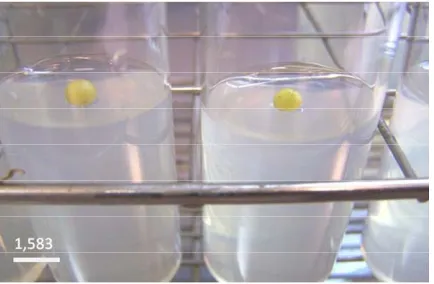
Germination tests of microtubers initiated after the pe- riod of cold storage, were made at three different tem- peratures (25˚C, 27˚C and 30˚C ± 1˚C) to identify the optimal temperature which would induce the best ger- mination rate. Four batches of five microtubers with dif- ferent calibers (over and under 4 mm grade) were used. For each environmental factor studied, three repetitions were performed. The microtubers were aseptically seeded in culture tubes filled with an 8% agarified MS (0) medium at pH 5.9 [9] and then incubated in the dark at different temperatures (Plate 1). The culture media were
prepared and conditioned as previously described [10]. A
Plate 1. Appearance of microtubers introduced on MS me- dium (0) and incubated in the dark at 25˚C. 1.583 cm re- presents a distance of 1 cm.
weekly count of the number of microtubers sprouted was made over an 8 week period.
The impact of the microtuber size on in vitro germina- tion was evaluated using six batches of 5 microtubers for each grade (over and under 4 mm caliber) and each vari- ety. Microtubers were inoculated aseptically into test tubes filled with MS medium (0) and then incubated in the dark at 25˚C ± 1˚C. A weekly count of the number of microtubers sprouted is performed over an 8 week pe- riod.
The influence of physiological age on in vitro germi- nation is highlighted by assessing the length parameter of the sprouts obtained. Thus, 5 microtubers, for each age class were incubated in the dark at 25˚C. The sprout length of each microtuber over 4 mm caliber, at different stages “monosprout”, “multiple sprouts” and “branched sprouts”, was measured weekly over a 7 week period. The average length of sprouts is then calculated for each stage.
2.2.2. Statistical Analysis
Statistical analysis focused on the comparison of differ- ent treatments using Analysis of Variance (ANOVA), followed by a comparison of means (Student Newman- Keuls’ test) at a 5% threshold when the interaction be- tween factors (variety*temperature; variety*caliber; va-riety*physiological age) is significant.
3. RESULTS
3.1. Effect of Temperature on Microtubers Germination
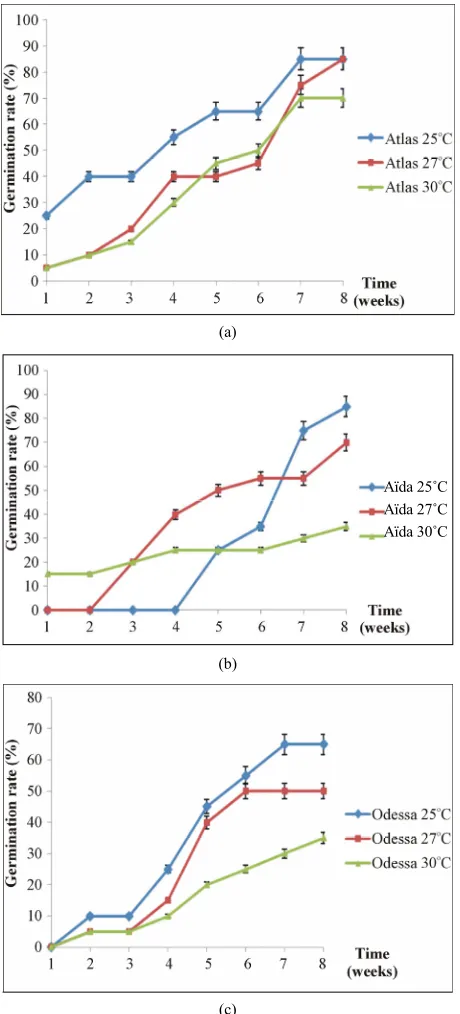
[image:2.595.65.282.558.700.2]The experiments showed that the highest germination rates were obtained at 25˚C for all varieties. However for the Atlas range, temperatures at 25˚C and 2˚C gave the same 85% germination rate. For Aida and Odessa varie- ties, optimal germination rates of 85% and 65% were ob- tained at 25˚C, respectively. High temperature of 30˚C drastically reduced the germination rate of all varieties (Table 1, Figure 1).
Table 1. Effect of different temperatures on microtuber in vitro germination of three potato varieties (Atlas, Aïda and Odessa) after 8 weeks in darkness.
Germination rate of microtubers(%)
Temperature (˚C) Atlas Aïda Odessa
25 85 a 85 a 65 bc
27 85 a 70 bc 50 cd
30 70 bc 35 d 45 cd
(a)
Aïda 25˚C Aïda 27˚C Aïda 30˚C
(b)
[image:3.595.58.288.83.590.2](c)
Figure 1. Kinetics of microtuber in vitro germination incubated at different temperatures for the 3 potato varieties (Atlas, Aïda and Odessa).
Germination kinetics showed that the Atlas variety seed quickly after incubation regardless of the tempera- ture (Figure 1(a)). The Aida variety had a long latency
period of 4 weeks for microtubers incubated at 25˚C and 2 weeks for those at 27˚C (Figure 1(b)). However, once
this period is exceeded, the germination rate rapidly reached 85% at 25˚C and 70% at 27˚C after 8 weeks of incubation. For the Odessa variety, the latency period is
short and only lasts a week, regardless of the temperature (Figure 1(c)).
3.2. Effects of Microtuber Size on in Vitro Germination
For all varieties, microtubers greater than 4 mm in size gave a higher germination rate than microtubers of cali- ber under 4 mm. Thus, the Atlas, Aida and Odessa varie- ties had a germination rate equal to 86.66%, 70% and 70% respectively for the range superior to 4 mm. As for microtubers under 4 mm in size, germination rates were 73.33%, 56.66% and 40%, respectively. However, for Atlas and Aida varieties, germination rates obtained for microtubers over 4 mm, were not significantly different from those of microtubers with a caliber under 4 mm. The difference noted between the two sizes was signifi- cant for Odessa variety. The Atlas variety microtubers yieldied better (86.66% and 73.33%) regardless of the size; followed by microtubers of Aïda and Odessa varie- ties, respectively (Figure 2).
Germination kinetics revealed that the Atlas variety microtubers germinated faster than microtubers of the other varieties whatever the caliber. After 5 weeks of incubation, the germination rate fluctuated around 50% - 58% for the two calibers against 30% - 50% and 30% - 48% for Aïda and Odessa varieties, respectively. The microtubers of Aida variety, after weak germination rates in the first four weeks, revealed germination rates that increased rapidly from 50% to 70% for those which size were superior to 4 mm. Microtubers of Odessa variety
had a lag time of one week (Figure 3). Then, those of
caliber superior to 4 mm started to germinate rapidly and reached a 70% germination rate at 8 weeks. In contrast, microtubers of size less than 4 mm germinated slowly and reached a final germination rate of 40% after the same incubation time (Figure 3).
3.3. Effect of Physiological Age on Microtuber in
Vitro Germination
The influence of microtubers physiological age on in
Aïda
[image:3.595.312.538.578.709.2](a)
Aïda c < 4 mm Aïda c ≥ 4 mm
(b)
[image:4.595.58.288.83.566.2](c)
Figure 3. Kinetics of microtubers germination of different sizes of the three varieties (Atlas, Aïda and Odessa) at 25˚C.
vitro germination was highlighted by assessing the length parameter of the sprouts obtained. Thus, the “multiple sprout” and “branched sprout” stages were most likely to germinate because they had an average length greater than that of the “monosprout” stage for all varieties. However, sprouts of “branched sprout” stage were less vigorous than those of “monosprout” stage, for all varie- ties. A Student Newman-Keuls t-Test indicated a non- significant difference in the sprout lengthening at the “multiple sprout” and “branched sprout” stages, while a significant variation was noted between these two stages
and the “monosprout” stage, regardless the variety (Ta- ble 2).
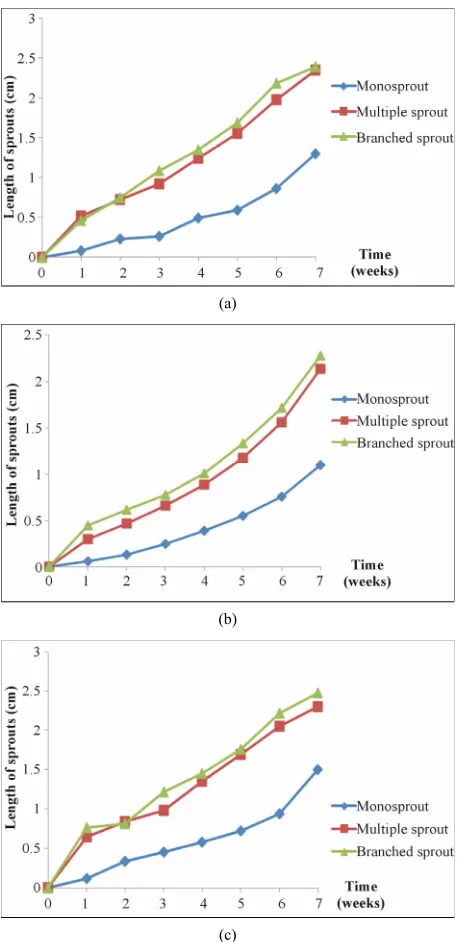
The growth of potato sprouts, according to incubation time, was studied over a 7 week period. Thus, there was a rapid growth of sprouts at “multiple sprout” and “branched sprout” stages while at “monosprout” stage,
growth was slow along the 7 weeks (Figure 4). During
the first 3 weeks after germination, the growth rate of sprouts was weak and did not reach 1.5 cm for all varie- ties. Then, it increased progressively. For the Odessa variety, the average maximum length measured after 7 weeks of incubation for “multiple sprout” “branched sprout” and “monosprout” stages was respectively 2.35 cm, 2.48 cm and 1.5 cm. For the two other varieties, sprouts of the “branched sprout” stage were longer at 2.39 and 2.82 cm, respectively.
4. DISCUSSION
At harvest, the potato tuber is in a dormant phase in which no germination can occur even under favorable environmental conditions. The same status occurs for microtubers obtained from tissue culture. This dormancy is similar to that of dry seeds which is an innate seed property that defines the environmental conditions under which the seed is able to germinate. It is determined by genetics with a substantial environmental influence. The process is mediated, at least in part, by the plant hor- mones abscissic acid and gibberellins. The dormancy status is not only influenced by the seed maturation en- vironment, but also changes continuously over time after shedding, and it also determined by ambient environ- mental conditions [11]. Seed dormancy is a block to the completion of germination in an intact viable seed under favorable conditions [12,13]. A useful definition of dor- mancy has been proposed by [14]: a dormant seed does not have the capacity to germinate in a specified period of time under any combination of normal physical envi- ronmental factors that are otherwise favorable for its germination, i.e. after the seed becomes non-dormant.
[image:4.595.308.540.645.716.2]Germination and growth of seedlings are controlled by gibberellins and abscisic acid contents, mainly accompa- nied by an increase in respiratory activity and water loss, as well as a significant degradation of starch and simple
Table 2. Influence of physiological age on the microtuber in
vitro germination of the three varieties at 25˚C.
Mean length of sprouts (cm)
Physiological age Atlas Aïda Odessa
Monosprout 1.3 c 1.1 c 1.5 c
Multiple sprout 2.35 a 2.14 b 2.298 ab
Branched sprout 2.39 a 2.282 b 2.478 a
(a)
(b)
[image:5.595.58.288.81.552.2](c)
Figure 4. Growth kinetics of the microtuber sprouts at 25˚C at different physiological stages of the three varieties Atlas (a), Aida (b) and Odessa (c).
sugars [15]. Temperature is the element that contributes most to maintaining the quality of stored seeds and po- tato microtubers as well. It affects respiration, germina- tion, water loss, relative humidity, chemical composition of tubers and the occurrence of diseases during the stor- age period. Reference [16] Désiré et al. (1995) showed that exposure to a period of cold can shorten the dor- mancy of microtubers and that storage at 4˚C before transfer to 19˚C, is also favorable for the germination of microtubers and this regardless of tuberization time.
These results are consistent with our findings. At the
temperatures studied (25˚C, 27˚C and 30˚C) during the incubation time, the lower the germination rate, the slower the germination speed. Average temperatures be- low 30˚C were more favorable for microtuber germina- tion as excess heat produced also developed sprouts, while cold temperatures result in deformed tuber. Indeed, for all varieties, the most favorable temperature for mi- crotuber germination was 25˚C, followed by 27˚C. With these results, it can be concluded that average incubation temperatures are more favorable for microtuber germina- tion than higher temperatures. These results confirm those of [17] who argued that the proper temperature for tuber germination is between 18˚C and 25˚C.
Germination is a series of morphological, physiologi- cal and biochemical processes that result in the transfor- mation of the seedling during the development of the future plant’s organs [18]. Organ development—leaves, stems and roots—occurs as a result of cell division and growth in the embryo. It is based on a series of chemical and physical transformations at a higher level of organi- zation and integration [19]. The germination process is genetically programmed and modulated by the environ- ment. Thus, when the tuber is placed in favorable envi- ronmental conditions, the higher the number of sprouts, the greater tuber size and weight [20]. Reference [21] Désiré et al. (1995) assumed that the germination vigor of microtubers depends on their size. Indeed, when the size increases, the pool of reserves, particularly carbohy- drates, is important and could thus be conducive to plant development. These results are consistent with our find- ings as the study of microtuber calibers on germination revealed that microtubers greater than 4 mm germinate faster and at a a higher rate than microtubers sized less than 4 mm, for all genotypes. Similarly, the sprouts of small-size microtubers take longer to reach a given length than those of microtubers of greater grades.
zero when sprouts start forming new tubers again. Ref- erences [27,28] also demonstrated that as potato tubers get physiologically older, germination occurs propor- tionally faster. When physiologically young, microtubers are either dormant or in a phase of insignificant germina- tion. Then, as they get older, their germination vigor in- creases and germination is therefore accelerated. In the same manner, reference [26] confirmed that during the dormant phase, the inability to grow is not necessarily a specific characteristic of buds, but may result in a tem- porary inability of the tuber to provide some metabolites necessary for growth. These results are consistent with our findings because with the Odessa variety, a latency period occured during a week. This can be explained by the fact that microtubers were still dormant when put to germinate. At the end of dormancy, metabolites are re- leased, making it possible for sprouts to grow from the tuber. This release is gradual and as, the tuber gets phy- siologically older, allows a more rapid growth of an in- creasing number of sprouts.
Microtubers, at “multiple and branched sprout” stages are more likely to germinate than sprouts of the “mono- sprout” stage, with an average maximum sprout length of 2.35 cm, 2.48 cm and 1.5 cm, respectively. These results confirm those of [29] and [24] explaining that the phy- siological state of a tuber, at a given time, determines vegetative growth. The “monosprout” stage is character- ized by an apical dominance, the “multiple sprout” stage by multiple germinations and rapid growth of sprouts and the “branched sprouts” stage by stunted sprouts [30].
Experiments on the influence of temperature, size and physiological age on the in vitro germination of micro- tubers have enable us to conclude that the average tem- perature of 25˚C is the most favorable for the germina- tion of microtubers at a better and faster rate, irrespective of the variety. Microtubers with a grade greater than 4 mm, germinated more quickly, and at a higher rate, than those of a smaller caliber for all genotypes. Physiological age influenced microtuber germination. In fact, the mean length of sprouts was greater at “multiple sprout” and “branched sprout” stages than at a “monosprout” stage. Thus, it is necessary to plant microtubers at the “multiple sprout” stage to optimize their performance for the vege- tative growth of plants and minituber production.
5. ACKNOWLEDGEMENTS
Authors are grateful to Mrs. Aminata Sow for correcting the English version of the manuscript.
REFERENCES
[1] Charles, G., Rossignol, L. and Rossignol, M. (1995) Mise au point d’un modèle de développement et de tubérisation contrôlés et synchrones chez lapomme de terre cultivée in
vitro. Acta Botanica Gallica, 142, 289-300. http://dx.doi.org/10.1080/12538078.1995.10515245 [2] Désiré, S., Couillerot, J.P. and Vasseur J. (1995) Germi-
nation en serre des microtubercules de pomme de terre (Solanum tuberosum L.) produit in vitro: Influence du diamètre, de la densité de la plantation et de l’âge des microtubercules sur le rendement. Acta Botanica Gallica, 142, 379-387.
http://dx.doi.org/10.1080/12538078.1995.10515258 [3] Coleman, W.K., Donnelly, D.J. and Coleman, S.E. (2001)
Potato microtubers as research tools: A review. American Journal of Potato Research, 78, 47-55.
http://dx.doi.org/10.1007/BF02874824
[4] Estrada, R., Tovar, P. and Dodds, J.H. (1986) Induction of in vitro tubers in a broad range of potato genotypes. Plant Cell Tissue and Organ Culture, 3, 3-10.
http://dx.doi.org/10.1007/BF00043915
[5] Slimmon, T., Machado, V.S. and Coffin, R. (1989) The effect of light on in vitro microtuberization of potato cul- tivars. American Potato Journal,66, 843-848.
http://dx.doi.org/10.1007/BF02853965
[6] Wiersema, S.G., Cabello, R., Tovar, P. and Dodds, J.H. (1987) Rapid seed multiplication by planting into beds microtubers and in vitro plants. Potato Research, 30, 200- 214. http://dx.doi.org/10.1007/BF02357690
[7] Leclerc, Y., Donnelly, D.J. and Seabrook, J.E.A. (1994) Microtuberization of layered shoots and cuttings of potato: The influence of growth regulators and incubation peri- ods. Plant Cell Tissue and Organ Culture, 37, 113-120. http://dx.doi.org/10.1007/BF00043604
[8] Dieme, A., Sagna, M. and Sy, M.O. (2011)Influence of hormonal treatments and of sucrose on the microtuberiza- tion of three potato varieties (Solanum tuberosum L.) adapted to agroclimatic conditions in Senegal). Interna- tional Journal of Plant, Animal and Environmental Sci- ences, 1, 69-77.
[9] Murashige, T. and Skoog, F. (1962) A revised medium for rapid growth and bioassays with tobacco tissue cul- ture. Physiologa Plantarum, 15, 473-497.
http://dx.doi.org/10.1111/j.1399-3054.1962.tb08052.x [10] Diémé, A., Sambe, M.A.N., Agbangba, E.C. and Sy, M.O.
(2013) Residual effects of sucrose and hormonal treat- ments of the tuberization medium on in vitro germination of potato (Solanum tuberosum L.) microtubers. American Journal of Plant Sciences, 4, 1872-1878.
http://dx.doi.org/10.4236/ajps.2013.49230
[11] Finch-Savage, W.E. and Leubner-Metzger, G. (2006) Seed dormancy and the control of germination. New Phy- tologist, 171, 501-523.
http://dx.doi.org/10.1111/j.1469-8137.2006.01787.x [12] Bewley, J.D. (1997) Seed germination and dormancy.
Plant Cell,9, 1055-1066.
http://dx.doi.org/10.1105/tpc.9.7.1055
[13] Li, B.L. and Foley, M.E. (1997)Genetic and molecular control of seed dormancy. Trends in Plant Science, 2, 384-389.
system for seed dormancy. Seed Science Research, 14, 1-16. http://dx.doi.org/10.1079/SSR2003150
[15] Burton, W.G. (1989) The potato. Longman Scientific & Technical, Harlow, England, 365-522.
[16] Désiré, S., Couillerot, J.P., Hilbert, J.L. and Vasseur J. (1995) Dormance et germination des microtubercules de pomme de terre (Solanum tuberosum L.) produit in vitro: Effets de la concentration en saccharose du milieu de tubérisation, de la durée de conservation à 4˚C et d’un traitement avec de l’acide gibbérellique. Acta Botanica Gallica, 142, 371-378.
http://dx.doi.org/10.1080/12538078.1995.10515257 [17] Bryan, J.E. (1990)Rupture de la dormance des tubercules
de pomme de terre. Guide de recherche du C.I.P. 16, Cambridge University Press, Cambridge, 41-45.
[18] Côme, D. and Corbineau, F. (1992) Les semences et le froid.Les végétaux et le froid, Hermann, Paris, 401-461. [19] Camelia, F.T., Morar, G., Teodora, F. and Moldovan, C.
(2011) Research regarding the influence of the caliber and the seeds treatment on the seeds germination in in- teraction with the genotype. Scientific Papers, UASVM Bucharest, Series A, Vol. LIV, 2011.
[20] Mikou, K., El Yamani, J. and Jarrar, O. (2003) Étude comparative des performances en production de quelques générations de Solanum tuberosum consommées au Maroc. Actes de l’Institut Agronomique et Vétérinaire, 23, 143- 151.
[21] Désiré, S., Couillerot, J.P., Hilbert, J.L. and Vasseur, J. (1995) Protein changes in Solanum tuberosum during in vitro tuberization of nodal cuttings. Plant Physiology and Biochemistry, 33, 303-310.
[22] Kumar, G.N.M. and Knowles, N.R. (1996) Oxidative stress results in increased sinks for metabolic energy dur- ing aging and sprouting of potato seed-tubers. Plant Phy-
siology, 112, 1301-1313.
[23] Kumar, G.N.M., Houtz, R.L. and Knowles, N.R. (1999) Age-induced protein modifications and increased prote-olysis in potato seed-tubers. Plant Physiology, 119, 89- 100. http://dx.doi.org/10.1104/pp.119.1.89
[24] Coleman, W.K. (2000) Physiological ageing of potato tubers: A review. Annals of Applied Biology, 137, 189- 199.
http://dx.doi.org/10.1111/j.1744-7348.2000.tb00050.x [25] Zabrouskov, V., Kumar, G.N.M., Spychalla, J.P. and
Knowles N.R. (2002) Oxidative metabolism and the phy- siological age of seed potatoes are affected by increased
α-linolenate content. Physiologia Plantarum, 116, 172- 185.
http://dx.doi.org/10.1034/j.1399-3054.2002.1160206.x [26] Perennec, P. and Madec, P. (1980) Age physiologique du
plant de pomme de terre. Incidence sur la germination et répercussions sur le comportement des plantes. Potato Research, 23, 183-199.
http://dx.doi.org/10.1007/BF02356268
[27] Vakis, N. J. (1986) Influence of physiological ageing of seed potatoes on yield and earliness. Potato Research, 29, 417-425. http://dx.doi.org/10.1007/BF02359973
[28] Désiré, S., Couillerot, J.P., Hilbert, J.L. and Vasseur, J., (1995) Protein changes in Solanum tuberosum L. during storage and dormancy breaking of in vitro microtubers. Plant Physiology and Biochemistry, 33, 479-487. [29] Reust, W. (1986) EAPR working group physiological age
of the potato. Potato Research,29, 268-271.
[30] Johnson, S.B. (1997) Selecting, cutting and handling po- tato seed. University of Maine.