An Analytical Study of Variable Preamble Length-Based
Broadcasting Scheme for WSNs
Arun Kumar1, Kai-Juan Wong2
1
School of Computer Engineering, Nanyang Technological University, Singapore 2
Singapore Institute of Technology, Singapore
Email: [email protected], [email protected]
Received May 2013
ABSTRACT
In this paper, we present a detailed analytical study of previously proposed variable preamble length-based broadcasting scheme for wireless sensor networks (WSNs). Analytical results show that in dense wireless sensor networks, broad-casting a packet with a small size preamble can significantly improve the energy conservation on already limited battery powered sensor nodes. For fairer comparison with variable preamble length-based broadcasting scheme, a comprehen-sive analytical study for an existing probability-based broadcasting scheme is also presented. Analytically calculated results show that variable preamble length-based broadcasting scheme is more energy-efficient than the probability- based broadcasting scheme.
Keywords: Broadcast; Flooding; Analytical Model; Wireless Sensor Network
1. Introduction
A large-scale wireless sensor network (WSN) can consist of thousands of sensor nodes and are helpful in many situations [1], such as disaster relief missions and battle-field communication facilities, infrastructure protection and scientific exploration [1-3]. Wireless data transmis-sion consumes more energy than data processing in a sensor node. The situation becomes worse in dense wire-less networks where broadcasting of data is necessary. In such cases, transmission of a single bit may consume the same amount of energy as that needed for processing thousand operations in a typical sensor node.
Wireless sensor networks have broadcast as one of its most fundamental service. Broadcast provides maximum message propagation across the whole network and serves high-level operations, making it critical to the overall network design. Although broadcasting in wireless sen-sor networks have many advantages, it can cause serious problems like “broadcaststormproblem” [4], which could cause a lot of contention, redundant retransmission, col-lision and most importantly, waste immense amount of energy. A possible solution is that the sensor nodes al-ternate between active and dormant states, which help them to conserve energy and extend the network lifetime. Simple broadcasting in this environment, where a node goes to active and dormant state periodically in asyn-chronous manner can be very challenging if there are not enough nodes in the active state when a source wants to
send data.
As wireless communication is the major cause of ener-gy consumption on sensor nodes, efforts have focused on how to conserve energy especially at the medium access control (MAC) layer. While a long preamble is used be-fore the data packet in BMAC [5], we believe that a small preamble is enough to achieve sufficient reachabil-ity and throughput in dense wireless area networks. On the other hand, it can dramatically save the energy re-quired to broadcast a packet.
In this paper, we present an analytical study for varia-ble preamvaria-ble length-based broadcasting scheme [6]. An Analytical study for an existing probability-based broad-casting scheme is also presented and the scheme is im-plemented to compare with the variable preamble length- based scheme.
The rest of the paper is organized as follows. Section 2 introduces the motivation behind variable preamble length- based broadcasting scheme. In Section 3, an analytical study for variable preamble length-based and probabili-ty-based broadcasting schemes is given. The parameters used during the simulations and results are given in Sec-tion 4. SecSec-tion 5 concludes the paper and gives some suggestions for future work.
2. Motivation and Variable Preamble
Length-Based Broadcasting
many sensor nodes alternate between active and dormant states, helping them to conserve energy and extend net-work lifetime. In dense area netnet-works, there is a greater chance of a node being in an active state to listen to the channel at a particular time, when compared to a sparse area network. Simple flooding in dense area networks, where more nodes are active at a time near the relay node will only cause energy consumption rather than covering additional areas in the network, resulting in unnecessary retransmission of packets and collisions.
Energy efficient MAC protocols are used to conserve energy of sensor nodes in wireless sensor networks. BMAC [5] is an energy-saving, distributed, asynchronous and random-access MAC protocol best suited for wireless sensor networks. BMAC employs the idea of “preamble listening” to conserve energy, whereby nodes would du-ty-cycle the radio receivers by periodically sampling the channel for activity. In order to transmit a packet, a node would transmit a long preamble to inform its neighbors of impending data. This allows B-MAC to support asyn-chronous and random-access transmission of data pack-ets. However, a long preamble contains no useful data and in dense wireless networks it is the major cause of energy wastage. Preamble length TPreamble in BMAC must
be such that
Preamble Interval T >T
where TPreamble is the duration of preamble length and
TInterval is the wakeup interval of the nodes.
Variable preamble length-based broadcast uses a small preamble before the data packet in dense wireless sensor networks [6]. Figure 1 shows the difference between (a) broadcast using the long preamble before the data packet and (b) broadcast using variable preamble length in asyn-chronous duty cycled wireless sensor network. The small preamble can clearly affect the overall performance of the broadcasting scheme in dense networks. In case of small preamble being sent before the data packet, this preamble will only be listened by a subset of nodes present in the radio range of a relay node or sender node. The subset of sensor nodes that receives the data packet then rebroadcasts the packet using the same preamble length. This practice of sending a small preamble before the data packet reduces the number of rebroadcasts as well as the overall energy consumption in the network, as only a subset of nodes will listen to the preamble and receive the data packet. Sensor nodes will rebroadcast the packet only after a random delay.
(a)
(b)
519
In dense area networks, even small preambles used in variable preamble length-based broadcast [6] can give sufficient data dissemination and dramatically save the energy of the node. In sparse area network, a compara-tively large preamble will be required due to the fact that there are lesser chances that a node is active in the neigh-borhood of the relaying node or the sender node. These small preambles will save most of the rebroadcasts and conserve maximum energy in dense area networks. In case of small preamble being used the preamble length
TPreamble must be such that
Preamble Interval
T ≤T
where TPreamble is the duration of the preamble and TInterval
is the wakeup interval of the nodes.
3. Analytical Models
[image:3.595.53.541.455.737.2]Most of the energy consumption on a node is because of the node’s radio power consumption. Therefore, analyti-cal models focus on the radio power consumption of nodes. Some equations in this section are due to [7].
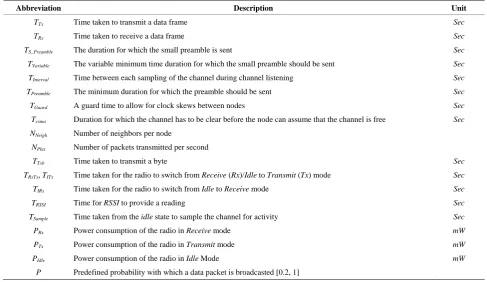
Table 1 lists the abbreviations and units used in the equations for the calculation of the energy consumption.
Furthermore, to simplify the comparisons, the analyti-cal study is based on the following conditions:
• All equations are normalized to one second.
• All the scenarios have same number of nodes and transmission conditions.
• Both the broadcasting algorithms use preambles be-fore the data packet but the size of the preamble dif-fers substantially. The following equations are used to calculate the duration of TPreamble and TS_Preamble for the
probability-based and variable preamble length-based broadcasting schemes respectively:
Preamble Interval Sample Guard
T =T +T +T (1)
_
S Preamble Variable Sample Guard
T =T +T +T (2) • To perform channel sampling from an idle state, a
node has to turn its radio on and then sample the channel. Thus, the time taken to perform channel sam-pling is calculated to be:
Sample IRx RSSI
T =T +T (3) • A node will turn on its receiver and wait for the Radio Strength Signal Information (RSSI) value to stabilize before transmitting a packet. Then the node will check whether the channel is free for the entire duration of
Tcsma. For simplifying the comparison between the
different protocols, the channel is always assumed to be clear, and therefore no back-offs were considered during channel contention. At the MAC layer, for both the broadcasting protocols, the total time, TCSMA,
in which the radio receiver is turned on to perform CSMA is calculated as follows:
(
)
CSMA IRx RSSI csma Pkts
T = T +T +T ∗N (4)
Table 1. Notations in the analytical model.
Abbreviation Description Unit
TTx Time taken to transmit a data frame Sec
TRx Time taken to receive a data frame Sec
TS_Preamble The duration for which the small preamble is sent Sec
TVariable The variable minimum time duration for which the small preamble should be sent Sec
TInterval Time between each sampling of the channel during channel listening Sec
TPreamble The minimum duration for which the preamble should be sent Sec
TGuard A guard time to allow for clock skews between nodes Sec
Tcsma Duration for which the channel has to be clear before the node can assume that the channel is free Sec
NNeigh Number of neighbors per node
NPkts Number of packets transmitted per second
TTxb Time taken to transmit a byte Sec
TRxTx, TITx Time taken for the radio to switch from Receive (Rx)/Idle to Transmit (Tx) mode Sec
TIRx Time taken for the radio to switch from Idle to Receive mode Sec
TRSSI Time for RSSI to provide a reading Sec
TSample Time taken from the idle state to sample the channel for activity Sec
PRx Power consumption of the radio in Receive mode mW
PTx Power consumption of the radio in Transmit mode mW
PIdle Power consumption of the radio in Idle Mode mW
• As in probability-based schemes nodes do not require global topological information of the network to make rebroadcast decisions. Every node is allowed to re-broadcast a packet based on a predetermined
forward-ingprobabilityP. A random number between 0 and 1
is generated and if this random number is below or equal to a predefined probabilityP then the packet is rebroadcasted.
Random Number≤P (5) • It is assumed that the transmitted signals will always be received correctly. So the channel noise is not mod-elled in the equations.
• In this analysis, for a fairer comparison of both the broadcasting schemes, the equations and results are based on “average case” scenarios for probability based broadcasting scheme and on the “average or worst case” scenarios for variable preamble length-based broadcasting scheme.
3.1. Probability-Based Broadcasting Scheme
The total power consumption of the radio in the case of probability-based broadcasting scheme, EProbBroadcast, is
cal-culated from the durations for which the radio receiver or transmitter is turned on to perform the following opera-tions: CSMA (4), transmission of the data packet (7), reception of a data packet (8), channel listening (9) and idling (10).
_ _
_ _
ProbBroadcast CSMA ProbBroadcast Tx ProbBroadcast Rx ProbBroadcast Listen ProbBroadcast Idle
E E E E
E E
= + +
+ + (6)
where, (ECSMA = TCSMA*PRx), (EProbBroadcast_Tx = T ProbBroad-cast_Tx*PTx), (EProbBroadcast_Rx = TProbBroadcast_Rx*PRx), (E Prob-Broadcast_Listen = TProbBroadcast_Listen*PRx) and (EProbBroadcast_Idle
= TProbBroadcast_Idle*PIdle).
Before transmitting a data packet, a node always sends a long preamble followed by the data packet. Therefore, the time, TProbBroadcast_Tx, for which the transmitter will be
turned on can be represented by following equation;
(
)
_
ProbBroadcast Tx RxTx Preamble Tx Pkts
T = T +T +T ∗N ∗P (7)
To receive a data packet, nodes turn their receiver on if any channel activity is detected during the periodic lis-tening. These nodes will keep their receiver turned on until a packet is received and the total time, T ProbBroad-cast_Rx, for which the node receiver is turned on for the
reception of a data packet is represented by following equation:
(
)
(
)
_
0.5 * * *
ProbBroadcast Rx
Preamble Rx Pkts Neigh T
T T N N P
= + ∗ (8)
For the remainder of the time, when a node is neither receiving nor transmitting data, the node performs
peri-odic channel listening. The duration, TProbBroadcast_Listen, for
which the receiver is turned on for channel listening is calculated as follows:
(
)
(
)
(
)
(
1 _ _ _)
ProbBroadcast Listen
ProbBroadcast Tx ProbBroadcast Rx CSMA Interval Sample
T
T T T T
T = − − − ∗ (9) Finally, the total time TProbBroadcast_Idle, for which a
node’s radio remains in an idle state, is calculated to be:
(
)
(
)
(
_ _ _)
_ 1 ProbBroadcast IdleProbBroadcast Tx ProbBroadcast Rx CSMA ProbBroadcast Listen
T
T T T
T
= − − −
−
(10)
The above equations will be true only if the following condition is satisfied:
TProbBroadcast_Listen≥ 0
This is explained by the fact that a negative value for
TProbBroadcast_Listen implies that the bandwidth of the
chan-nel has been exceeded.
3.2. Variable Preamble Length-Based Broadcasting Scheme
The total power consumption of a node in the case of variable preamble length-based broadcasting scheme can be calculated from the durations for which the node’s radio receiver or transmitter is turned on to perform the following functions: CSMA (4), transmission of the data packet (12), reception of a data packet (13) or (14), chan-nel listening (15) and idling (16).
_ _
_ _
PreaBroadcast CSMA PreaBroadcast Tx PreaBroadcast Rx PreaBroadcast Listen PreaBroadcast Idle
E E E E
E E
= + +
+ + (11)
where, (ECSMA = TCSMA*PRx), (EPreaBroadcast_Tx = T PreaBroad-cast_Tx*PTx), (EPreaBroadcast_Rx = TPreaBroadcast_Rx*PRx), (E Prea-Broadcast_Listen = TPreaBroadcast_Listen*PRx) and (EPreaBroadcast_Idle
= TPreaBroadcast_Idle*PIdle).
Before transmitting a data packet, a node will transmit a small preamble of fixed size followed by a data packet. This small preamble will always be less than the regular preamble sent in probability based broadcasting scheme as shown in Figure 1. The time which a node takes to transmit a packet can be represented by following equa-tion;
(
)
_ _ *
PreaBroadcast Tx RxTx S Preamble Tx Pkts
T = T +T +T N (12)
PreaBroad-521
cast_Rx, for which the node receiver is turned on for the
reception of a data packet is represented by following equation:
(
)
(
)
_ 0.5* _ * *
PreaBroadcast Rx S Preamble Rx Pkts Neigh
T = T +T N N
(13)
In the worst case (when the receiver checks the chan-nel just when the transmitting node starts sending the preamble) the total time, TPreaBroadcast_Rx, for which the
node receiver is turned on for the reception of a data packet is represented by following equation:
(
)
(
)
_ _ * *
PreaBroadcast Rx S Preamble Rx Pkts Neigh
T = T +T N N (14)
For the remainder of the time, when a node is neither receiving nor transmitting data, it performs periodic chan-nel listening. The duration, TPreaBroadcast_Listen, for which
the receiver is turned on for channel listening is calcu-lated as follows:
(
)
(
)
(
)
(
1 _ _ _)
*
PreaBroadcast Listen
PreaBroadcast Tx PreaBroadcast Rx CSMA Interval Sample
T
T T T T
T
= − − −
(15) Finally, the total time, TPreaBroadcast_Idle, for which a
node’s radio remains in the idle state, is calculated to be:
(
)
(
)
(
_ _ _)
_
1
PreaBroadcast Idle
PreaBroadcast Tx PreaBroadcast Rx CSMA PreaBroadcast Listen
T
T T T
T
= − − −
−
(16)
As worst case assumptions are being used, the above equations will be true only if the following conditions are satisfied:
TInterval≥ TS_Preamble + TIRx
TPreaBroadcast_Listen≥ 0
The above mentioned conditions can be explained by the fact that a negative value for TPreaBroadcast_Listen implies
that the bandwidth of the channel has been exceeded.
4. Simulation Parameters Used and Results
[image:5.595.308.540.243.679.2]As the previously proposed variable preamble length- based broadcasting scheme [6] has been experimentally evaluated, we now present the preliminary results of the broadcasting schemes based on analytical study.
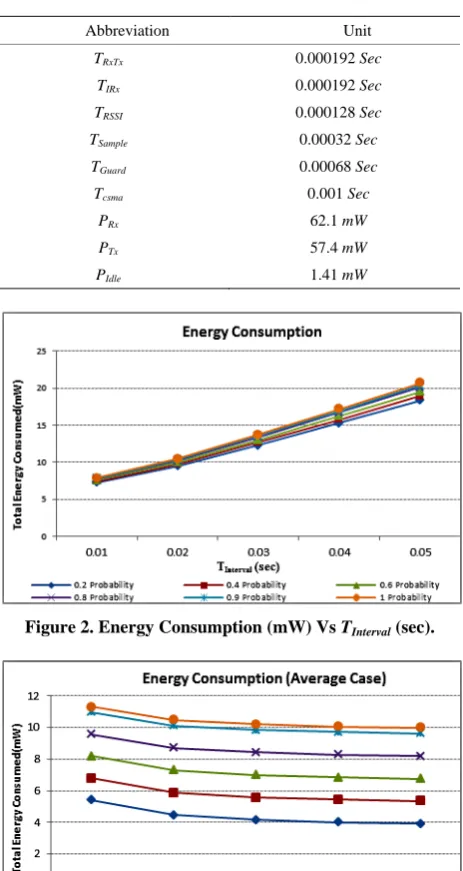
Table 2 shows the parameters used for the calculation of the energy consumption for the broadcasting schemes. These parameters are determined based on the CC2420 transceiver [8].
Packet broadcasting rate is 1 packet/sec. A data packet is of 32 bytes, time to transmit a byte is 0.000032 sec and
the data rate is 250 kbps. For the evaluation of probabili-ty-based broadcast the values of TPreamble are recalculated
according to the TInterval (0.01 - 0.05 sec) based on
for-mula (1).
Based on the parameters, the equations are solved to determine the energy consumption of the broadcasting nodes under different broadcasting conditions.
4.1. Scenario 1
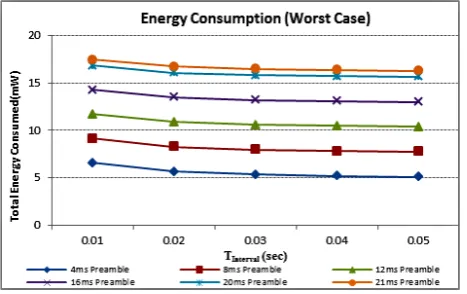
Figures 2-4 show the energy consumption by the node’s radios to communicate a packet between the nodes, while
Table 2. Parameters Used To Emulate CC2420.
Abbreviation Unit
TRxTx 0.000192 Sec
TIRx 0.000192 Sec
TRSSI 0.000128 Sec
TSample 0.00032 Sec
TGuard 0.00068 Sec
Tcsma 0.001 Sec
PRx 62.1 mW
PTx 57.4 mW
[image:5.595.307.540.249.557.2]PIdle 1.41 mW
Figure 2. Energy Consumption (mW) Vs TInterval (sec).
Figure 4. Energy Consumption (mW) Vs TInterval (sec).
[image:6.595.310.540.86.234.2]the broadcasting node considers 10 nodes in the neigh-bourhood. The power consumptions by the radios is cal-culated for different sets of TInterval (0.01 - 0.05 sec).
Figure 2 shows the energy consumption (mW) versus
TInterval (sec). It is observed that as the value of TInterval
increases, the energy consumption increases linearly. This increase in the energy consumption is due to the long preamble used for increased TInterval. Broadcasting a packet
with a low probability shows less energy consumption as compared to broadcasting a packet with high probability. The difference in energy consumption of different prob-abilities of broadcasting is clearly visible at higher values of TInterval.
Figures 3 and 4show the energy consumption (mW) versus TInterval (sec) for average and worst cases
respec-tively. The value of TInterval varies and the packets are
broadcasted with different preamble length (4 ms to 21 ms). It is observed that as the value of TInterval increases
the energy consumption decreases. Broadcasting a packet with a small preamble shows less power consumption compared to broadcasting a packet with a long preamble. A long preamble always results in high transmission and reception power consumption. The energy consumption of the radios in both cases decreases linearly as the T Inter-val increases. This energy saving in case of high TInterval is
because of the small preambles used for broadcasting packets.
4.2. Scenario 2
Figures 5-7 show the energy consumption by the node’s radios to communicate a packet between the nodes, while
TInterval is considered as 0.02 sec. The power
consump-tions by the radios is calculated for a range of neighbor-ing nodes (1 - 10 nodes).
Figure 5 shows the energy consumption (mW) versus number of neighbors. It is observed that as the number of neighbours of a broadcasting node increases, the energy consumption increases linearly. Broadcasting a packet with a low probability shows less energy consumption as
Figure 5. Energy Consumption (mW) Vs Number of Neigh-bors.
Figure 6. Energy Consumption (mW) Vs Number of Neigh-bors.
Figure 7. Energy Consumption (mW) Vs Number of Neigh-bors.
[image:6.595.310.539.272.412.2]Broad-523
casting a packet with a small preamble shows less power consumption compared to broadcasting a packet with a long preamble. A long preamble always results in high transmission and reception power consumption. The energy consumption of the radios in both cases increases as the neighboring nodes increases. But a higher energy con-sumption in worst case is due to the long preamble lis-tening.
5. Conclusion and Future Work
In this paper, we have presented a comprehensive analyt-ical model of the variable preamble length-based broad-casting scheme for wireless sensor networks. An analyt-ical model for an existing probability-based broadcasting scheme is also presented. Analytical models do not con-sider the circuit and CPU power consumption in the pre-sented equations. Our analytical study emphasizes the fact that a small preamble during broadcast can mitigate the need for higher energy consumption. Analytical re-sults show that variable preamble length-based broad-casting scheme provides higher energy conservation in dense area networks, when compared to the probability- based scheme.
In future, we plan to collect these power consumption results by implementing these broadcasting algorithms on a physical test bed. Results obtained from analytical studies, simulations and physical test bed will be used to compare the broadcasting algorithms.
REFERENCES
[1] T. He, S. Krishnamurthy, L. Luo, T. Yan, L. Gu, R. Sto-leru, G. Zhou, Q. Cao, P. Vicaire, J. A. Stankovic, T. F. Abdelzaher, J. Hui and B. Krogh, “VigilNet: An Inte-
grated Sensor Network System for Energy-Efficient Sur-veillance,” ACM Transaction on Sensor Network, Vol. 2 2006, pp. 1-38.
[2] L. Selavo, A. Wood, Q. Cao, T. Sookoor, H. Liu, A. Sri-nivasan, Y. Wu, W. Kang, J. Stankovic, D. Young and J. Porter, “LUSTER: Wireless Sensor Network for Envi-ronmental Research,” Proceedings of the 5th Internation-al Conference on Embedded Networked Sensor Systems, Sydney, 2007, pp. 103-116.
[3] N.Xu, S.Rangwala, K. K. Chintalapudi, D. Ganesan, A. Broad, R. Govindan and D. Estrin, “A Wireless Sensor Network for Structural Monitoring,” Proceedings of the
2nd International Conference on Embedded Networked Sensor Systems, Baltimore, 2004, pp. 13-24.
[4] Y.-C. Tseng, S.-Y. Ni, Y.-S. Chen and J.-P. Sheu, “The Broadcast Storm Problem in a Mobile Ad-hoc Network,”
Wireless Network, Vol. 8, 2002, pp. 153-167.
[5] J. Polastre, J. Hill and D. Culler, “Versatile Low Power Media Access for Wireless Sensor Networks,” Proceed-ings of the 2nd International Conference on Embedded Networked Sensor Systems, Baltimore, November 2004.
[6] A. Kumar and K. J. Wong, “A Variable Preamble Length-Based Broadcasting Scheme for Wireless Sensor Networks,” 7th International Conference on Wireless Communications, Networking and Mobile Computing, Wuhan, 23-25 September 2011, pp. 1-4.
[7] K. J. Wong and D. K. Arvind, “SpeckMAC: Low-Power Decentralised MAC Protocols for Low Data rate Trans- missions in Specknets,” Proceedings of the 2nd Interna- tional Workshop on Multi-Hop Ad Hoc Networks: From Theory to Reality, Florence, 2006, pp. 71-78.
[8] Texas Instrument, 2.4 GHz IEEE 802.15.4/ZigBee-ready RF Transceiver.