Munich Personal RePEc Archive
Impact of Alternative Innovative
Education Programmes: A Study of
Bridge Course Centres in Bardhaman
District
Hati, Koushik Kumar and Majumder, Rajarshi
Department of Economics, The University of Burdwan
May 2009
Online at
https://mpra.ub.uni-muenchen.de/45845/
IMPACT OF ALTERNATIVE & INNOVATIVE EDUCATION PROGRAMMES:
A STUDY OF BRIDGE COURSE CENTRES IN BARDHAMAN DISTRICT
Koushik Kumar Hati*
Project Fellow Department of Economics
University of Burdwan
&
Rajarshi Majumder
Reader
Department of Economics University of Burdwan
________________________________________________________________________
IMPACT OF ALTERNATIVE & INNOVATIVE EDUCATION
PROGRAMMES: A STUDY OF BRIDGE COURSE CENTRES IN
BARDHAMAN DISTRICT
Abstract
Education is the basic requirement and the ‘Fundamental Right’ of the citizens of a nation. Elementary Education system also serves as the base over which the super-structure of the whole knowledge system is built up. This calls for bringing all children under coverage of Elementary Education, which sadly has not been possible yet in India. Policy makers have responded through various programs – two latest examples of which are the Sarva Shikhsa Mission and the Right to Education Bill. The former have been hailed as a successful instrument to remove all ills plaguing the elementary education system in India through some of its alternative, innovative, and flexible programs. In this paper we examine the performance of one of the Flagship programme under SSA – the Bridge Course Centres – in selected areas of West Bengal to evaluate its performance, identify the shortcomings, and suggest some steps for improving them. This is extremely important as the SSA is now being extended to Madhyamik Shikhsa Mission and mistakes of the former should not be repeated in the latter.
Key Words: Education; Elementary Education; Innovative Program; Out of School Children; India.
JEL Classification: H43, I20, I21, I28, N35. ___________________________________
I. INTRODUCTION
One of the key ingredients of Human Development as envisaged by social scientists, reiterated by UNDP, and accepted by national, state, and regional governments is education. More specifically, greater access to knowledge in its various dimensions is critical to building of human capabilities, enhancement of freedom, and empowerment of people. The Millennium Development Goals (MDG) adopted and ratified by India also speaks of universalisation of primary education and promoting gender equality in education. The Jomtien Conference of 1990 established the goal of achieving basic
Education for All (EFA) by the year 2000 and provided a vision to include early childhood care and education, programs for out-of-school children, literacy programs for adults, equity in providing access to all children, and ensuring acceptable learning levels within the policy frame for education. Education is also perceived to be the primary means to overcome social discrimination (Omvedt, 1993), and the present market based global village puts up a barrier in front of those who ‘cannot read or write or count, and cannot follow written instructions’ (Sen, 1998).
and nearly one-third of men in India are illiterate. There are wide disparities in educational attainments across states and between genders. While the often-discussed state of Kerala has reached almost universal literacy, several pockets of Bihar, Rajasthan, and Uttar Pradesh have female literacy rates below 20 per cent (Census of India, 2001). About 20 per cent of all children were out of school in 2001, posing a serious challenge to the process of social and economic development (DISE, 2008, 2009). According to the same reports, while the Gross Enrolment Ratio (GER) in the country has crossed 90 per cent, the Net Enrolment Ratio (NER) is below 75 per cent. The NER for girls is reported to be about 60 per cent, over 25 percentage points lower than that of boys. 42 million children of the age group of 5–14 years in the country were out of school in 2004-05 (SRI-IMRB, 2005). An average of nearly a quarter of the children enrolled across the primary grades repeat classes. At the national level, only 56 per cent of the children enrolled in Class-I survive to Class-V (DISE, 2009). India is thus grappling with serious problems of inadequate access, poor quality and inefficiency in the schooling system.
Under such circumstances, the Sarva Shiksha Abhiyan (SSA) launched in India in 2001 aimed to extend useful and quality elementary education to all children in the age group of 5–14 years before the end of 2010. The SSM programme includes specific schemes for the development of pre-primary education, education of female children, and education of children belonging to SC/ST community, education of mentally and physically challenged children, education of school dropouts and displaced children. These schemes are implemented through Bridge Courses Centres,
Remedial Courses and Back to School Camps.
In this paper we seek to examine the effectiveness of Bridge Course Centres in universalisation of education, the problems faced by these centres, and some possible suggestions. The study was conducted in Bardhaman district of West Bengal during 2008-09 as a part of evaluation of SSA schemes in the district.
1. Background of the Scheme
While there has been some success in enrolment of children in schools, Dropout Rates
to adjust to domestic demands of work, sibling care and household chores. For such children, a facility has been provided under SSA through the Bridge Course Centres under the alternative and innovative educational programs (AIE) – schooling facilities that are more contextual, location specific and flexible. The objective of this scheme is to provide a short refresher course to children of older age; especially those never enrolled (NE) and dropouts (DO) and thereafter mainstream them back to formal schools. The course aims to wean children away from work, enabling the family to relocate work done by children amongst the adults. Duration of the course was 6 months initially, but has been extended to 9 months from 2007-08. At the end of the course, the children are evaluated, and admitted to formal schools in appropriate classes. Two levels of bridge courses are being run in the district under the SSA – Primary Centres for placing children in Classes I-IV, and Upper Primary Centres for placing children in Class-V. The scheme is run with active involvement of the Village Education and Health Committee (VEHC) and the local community. The VEHC and the local community have freedom to determine timing, duration, venue, and holiday pattern for the BCC as per learners’ convenience, aiming at transacting four hours of learning per day on an average. The centres are supported by Block Resource Centres and District Level Resource Organizations appointed by District office of SSA. Priority is given to small and remote habitations with at least twenty Out-Of-School
children in the relevant age group.
The teachers use the teaching-learning materials (TLM) provided by SSA, as well as develop their own TLM from locally available materials. These include pictures for story-telling, cards for letter recognition & counting, etc. The method of teaching differs from centre to centre, depending on the educational status of children.
II. METHODOLOGY
The methodology followed in this paper is in accordance with the standard requirements for socio-economic surveys – monitoring 10 percent of the Bridge Course Centres as samples. Out of the total 605 BCCs presently functioning in a district, the survey has been conducted in 75 BCCs with representation from almost all the blocks of the district (Table 1a & b).
Upper Primary BCCs. In all the surveyed BCCs, at least 10 per cent of the enrolled children were interviewed. In total, 530 learners were interviewed which is about 4 per cent of the total number of learners enrolled at that time.
Table 1a
Survey Coverage of Bridge Course Centres in Bardhaman District – Primary Indicators Existing Surveyed
No of CD Blocks (Rural)
Aggregate 14 14
East 4 4
Central 5 5
West 5 5
No of Bridge Course Centres
Aggregate 105 25
East 32 7
Central 38 9
West 35 9
No of Learners
Aggregate 2056 205
East 660 66
Central 684 68
West 712 71
Source: Office of the DPO, SSA-Bardhaman, and Field Survey, 2008-09
Table 1b
Survey Coverage of Bridge Course Centres in Bardhaman District – Upper Primary Indicators Existing Surveyed
No of CD Blocks (Rural)
Aggregate 29 29
East 9 9
Central 11 11
West 9 9
No of Bridge Course Centres
Aggregate 500 50
East 151 15
Central 210 21
West 139 14
No of Learners
Aggregate 11812 325 East 3627 100 Central 4519 125 West 3666 100
Source: Office of the DPO, SSA-Bardhaman, and Field Survey, 2008-09
As per norms spelt out by SSA (in its website www.ssa.nic.in/ssaalt.asp), the functioning of the BCC should be evaluated on the following lines:
A. Quantitative Indicators a) Children’s enrolment; b) Regularity of Attendance;
c) Numbers admitted to formal schools. B. Qualitative Indicators
a) Class Room Environment;
b) Teachers’ Competence and relationship with children;
in the three sub-regions – East (CD Blocks – Kalna-I, Kalna-II, Katwa-I, Katwa-II, Ketugram-I, Ketugram-II, Mongalkote, Monteswar, Purbasthali-I, Purbasthali-II), Central (CD Blocks – Ausgram-I, Ausgram-II, Bhatar, Burdwan-I, Burdwan-II, Galsi-II, Jamalpur, Khandoghosh, Memari-I, Memari-Galsi-II, Raina-I, Raina-II) and West (CD Blocks – Andal, Barabani, Durgapur-Faridpur, Galsi-I, Jamuria, Kanksa, Pandabeswar, Raniganj, Salanpur). Wherever possible, we have tried to bring out the relative situation in these three sub regions so that policies may be streamlined according to local conditions. It must be noted here that the Eastern and Central sub-regions are predominantly agricultural in nature, while the Western sub-region is dominated by Mining, Quarrying, and Manufacturing activities with sparse agriculture. Keeping these economic characteristics in mind will help us understand the results better.
III. SURVEY RESULTS AND ANALYSIS
1. Outreach & Coverage
One of the major objectives of SSA is to ensure that all children of 6-14 Years age are enrolled either in formal schools or in EGS and AIE Centres. Reasons for the children to be out of school are:
a) Household work & Sibling Care b) Engaged in work due to poverty c) Migration
d) Unwillingness of Parents
e) Gender related reasons (problems related to early marriage and absence of separate toilet facilities in school), and
f) School too far or School not attractive
To counter those factors, 605 BCCs were started in the district, focussing on areas and cluster of villages where a primary Child Census had revealed high incidence of Out of School Children (OOSC). During 2008-09, approximately 14,000 learners were enrolled in the BCCs across the district. The coverage of the BCCs is quite extensive and is dispersed across most of the blocks in the district. We have surveyed 75 BCCs, giving adequate representation to spatial spread.
2. Enrolment
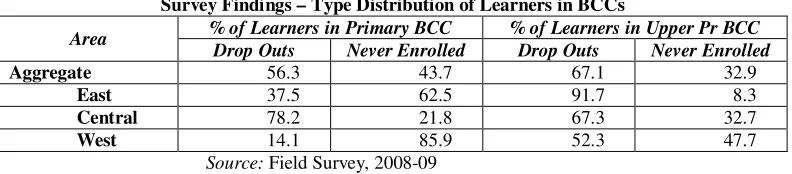
[image:8.612.109.505.315.402.2]The enrolment in the 75 surveyed BCCs is 1732, i.e. about 24 learners on an average in each BCC. Of these, 606 are in primary level BCCs and 1126 are in Upper Primary level BCCs. While majority of these learners are Drop Out from schools, a substantial number, especially in the primary level BCCs, has never been to schools (Table 2). There is regional variation, and whereas the central region follows the overall trend, in the eastern and western region incidence of never enrolled students is substantially higher. The situation is grave in the western region where about 85 percent of the learners in the primary level BCCs have never been to school. This indicates that the basic enrolment drive in this region has not been up to the mark. For the upper primary level BCCs too, almost 50 per cent of the current learners were never enrolled in school in this region.
Table 2
Survey Findings – Type Distribution of Learners in BCCs
Area % of Learners in Primary BCC % of Learners in Upper Pr BCC
Drop Outs Never Enrolled Drop Outs Never Enrolled
Aggregate 56.3 43.7 67.1 32.9
East 37.5 62.5 91.7 8.3
Central 78.2 21.8 67.3 32.7
West 14.1 85.9 52.3 47.7
Source: Field Survey, 2008-09
The age, gender and spatial spread of the interviewed learners are given in Table 3. It is observed that there are more girls than boys in the centres, especially in the upper age groups. This is reflective of the fact that incidence of non-enrolment and dropout is more among girls than boys, especially in the upper primary stage.
Table 3
Survey Findings – Age and Gender Distribution of Interviewed Learners
Indicators Boys Girls Total
Number of Learners Interviewed – Total 254 276 530 Numbers in 5-8 Age Group 68 36 104 Numbers in 9-10 Age Group 76 72 148 Numbers in 11-12 Age Group 59 84 143 Numbers in 13-14 Age Group 44 58 102 Numbers in 14+ Age Group 7 26 33
Source: Field Survey, 2008-09.
3. Regularity of Attendance
[image:8.612.156.457.493.591.2]It is observed that in the primary level BCCs, only about 30 percent of the students are regular in their attendance (Table 4). Attendance is higher among girls than boys, and in the western region compared to the other two. In the central region however, boys are more regular than the girls.
Table 4
Survey Findings – Enrolment & Attendance in Surveyed Primary BCCs
Region Number of Learners Enrolled Learners Attending Regularly (%)
Boys Girls Total Boys Girls Total
Aggregate 307 299 606 34.5 39.3 36.8 East 87 93 180 27.0 50.0 33.3 Central 116 105 221 38.9 30.3 34.8 West 101 104 205 28.6 52.4 40.5
Source: Field Survey, 2008-09.
[image:9.612.117.483.357.447.2]In the upper primary level BCCs, about 56 percent of the students are regular in their attendance (Table 5). Here, attendance is higher among boys than girls, and in the western and eastern regions compared to the central. In the eastern region, girls are more regular than the boys. Thus, attendance is more regular in the upper primary section, reasons for which are discussed latter.
Table 5
Survey Findings – Enrolment & Attendance in Surveyed Upper Primary BCCs
Region Number of Learners Enrolled Learners Attending Regularly (%)
Boys Girls Total Boys Girls Total
Aggregate 544 582 1126 63.8 50.0 56.6 East 186 159 345 60.0 66.7 62.8 Central 134 192 326 42.9 29.6 34.1 West 224 231 455 84.2 63.2 73.7
Source: Field Survey, 2008-09.
4. Mainstreaming
The most important aspect, the raison d’tre, of the BCCs is that of mainstreaming. The sole proclaimed objective of the centres is to wean back the out-of-school children to formal schools. The situation is not very comfortable in the district in this regard (Table 6). Of the total 1732 learners in the 75 centres, about 680 children were mainstreamed in the academic year 2008-09 of which 375 were from Primary BCCs and 305 from the Upper Primary BCCs.
Table 6
Survey Findings – Performance of the Learners in Surveyed BCCs
Percentage of Learners Primary BCC Upper Pr BCC All Total
Good Performers –
(mainstreamed in current session) 61.9 27.1 39.2 Average Performers -
(may be mainstreamed by next session) 17.4 35.1 29.7 Poor Performers -
(can not be mainstreamed) 20.7 37.8 31.1
[image:9.612.128.485.594.687.2]Thus only about 40 per cent of the enrolled students could be mainstreamed by the BCCs in 2008-09. This leaves about 900 learners still not capable to return to the formal schools in the surveyed BCCs alone – 233 in the primary level and 821 in the upper primary level. In proportionate term, this implies that about 40 percent of the learners in primary BCCs and 72 percent of the learners in the upper primary BCCs will not be mainstreamed even after completion of the scheme. In contrast, BCCs in Andhra Pradesh and Karnataka have been able to mainstream about 70-74 per cent of enrolled students, while the success in Assam and Tamil Nadu are about 57 and 47 per cent respectively.1 Among the larger states, only Madhya Pradesh has a lower figure of about 30 per cent of enrolled children being mainstreamed. Thus the figure of 40 per cent mainstreaming in running year and about 30 per cent possible mainstreaming in the next academic year is only moderate success for the district. The effort still leaves about 10000 out of school children in the whole district! This story is slightly better in the western region and poorest in the eastern region. The factors responsible for such ordinary performance are explained latter.
5. Residential Bridge Course Centres
put in formal schools. It can therefore be inferred that the performance of the RBCCs are much better than the non-residential BCCs.
Other than the educational aspects, RBCCs are also instrumental in taking care of the nutritional level of the children by providing them food. This has close linkage with the health standards and is a clear example of convergence of outreach programmes. Students in RBCCs were also engaged in different extracurricular activities like dancing, singing, recitation, etc. To motivate the students the centres organise cultural events performed by their own students. In addition to formal learning, students are also provided training for manufacturing various handicrafts, embroidery, sewing, pottery, etc. This may help those students who do not continue formal schooling to become self-employed in near future. The experiment of RBCCs is thus a remarkable success in the district.
IV. FACTORS AFFECTING PERFORMANCE
[image:11.612.129.467.378.554.2]To understand the performance of the BCCs in the district in terms of mainstreaming, several factors were examined. Let us discuss them briefly.
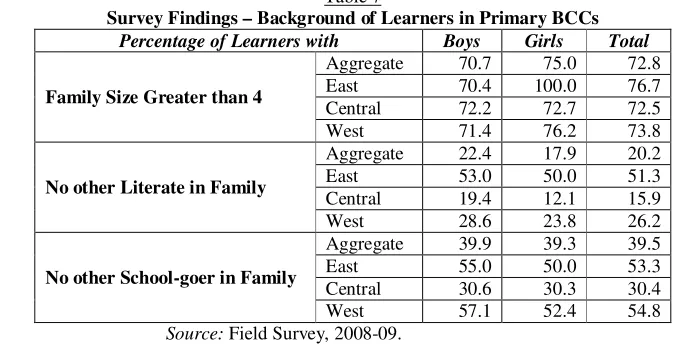
Table 7
Survey Findings – Background of Learners in Primary BCCs
Percentage of Learners with Boys Girls Total
Family Size Greater than 4
Aggregate 70.7 75.0 72.8 East 70.4 100.0 76.7 Central 72.2 72.7 72.5 West 71.4 76.2 73.8
No other Literate in Family
Aggregate 22.4 17.9 20.2 East 53.0 50.0 51.3 Central 19.4 12.1 15.9 West 28.6 23.8 26.2
No other School-goer in Family
Aggregate 39.9 39.3 39.5 East 55.0 50.0 53.3 Central 30.6 30.3 30.4 West 57.1 52.4 54.8
Source: Field Survey, 2008-09.
1. Background of the Learners
become irregular in BCCs, and even if mainstreamed, they would find it difficult to continue. This phenomenon is more evident in the eastern region, and among girls compared to boys.
[image:12.612.143.467.308.477.2]If we look at the educational background of the parents, we find that of the total number of learners interviewed by us, more than 20 per cent of primary level learners and 18 per cent of Upper Primary level learners have no other literate in the family. Thus, being first generation learners, they find it very difficult in convincing their parents about the necessity of continuing formal education. In addition to the lack of family support and encouragement, they don’t have the privilege of being tutored by their parents. Thus they are at the mercy of the teachers in school unless they can arrange for private tuitions. This again involves substantial cost, which acts as a disincentive towards formal schooling.
Table 8
Survey Findings – Background of Learners in Upper Primary BCCs
Percentage of Learners with Boys Girls Total
Family Size Greater than 4
Aggregate 70.7 68.8 69.7 East 68.0 72.2 69.8 Central 57.1 63.0 61.0 West 84.2 73.7 78.9
No other Literate in Family
Aggregate 25.9 12.5 18.9 East 28.0 16.7 23.3 Central 28.6 14.8 19.5 West 21.1 5.3 13.2
No other School-goer in Family
Aggregate 48.3 31.3 39.3 East 56.0 38.9 48.8 Central 50.0 25.9 34.1 West 36.8 31.6 34.2
Source: Field Survey, 2008-09.
The incidence of parents’ illiteracy and first generation learning is substantially high in the Eastern Region – more than 50 percent for the Primary level learners and 23 percent for the upper primary level learners. This explains the lack of success of the scheme in this region as illiterate parents are reluctant to send the children to formal schools and the family environment is also not conducive for learning, leading to poor performance of these children.
Table 9
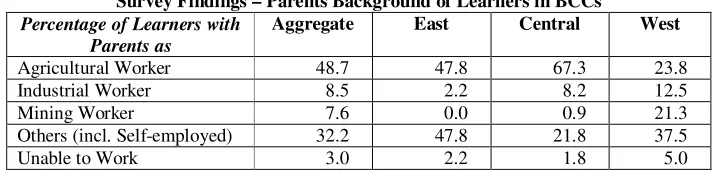
Survey Findings – Parents Background of Learners in BCCs
Percentage of Learners with Parents as
Aggregate East Central West
Agricultural Worker 48.7 47.8 67.3 23.8 Industrial Worker 8.5 2.2 8.2 12.5 Mining Worker 7.6 0.0 0.9 21.3 Others (incl. Self-employed) 32.2 47.8 21.8 37.5 Unable to Work 3.0 2.2 1.8 5.0
[image:12.612.126.489.613.699.2]Apart from the earlier generation, the factor of sibling education is also very important in the success of these innovative schemes. It is sadly observed that about 40 percent of learners of both Primary and Upper Primary levels do not have any other school going children in their family though they have siblings in 6-18 age group. This also reduces their scope for continuing education. This factor is also more worrisome in the eastern region compared to the other two. The parents are mostly working as agricultural and casual labourers (Table 9). Only in the western region, there are substantial numbers of industrial/mining workers. The income level of the families involved is also quite low – average per capita income being Rs. 600 per month only (Table 10). Only 25 percent of the families are getting more than Rs. 4000 per month. Thus the economic condition of the learners is quite adverse and is one of the main reasons behind discontinuity of schooling by these children. The situation is poorer in the eastern region compared to the other two.
Table 10
Survey Findings – Percentage of Learners in BCCs across Family Income
Monthly Family Income Aggregate East Central West
Less than Rs. 1000 pm 5.1 0.0 4.5 8.8 Rs. 1000 – Rs. 2000 pm 14.8 23.9 15.5 8.8 Rs. 2000 – Rs. 4000 pm 55.1 43.5 56.4 60.0 More than Rs. 4000 pm 25.0 32.6 23.6 22.5
Source: Field Survey, 2008-09.
The learners were also asked to rate the performance of their instructors and the environment of the BCC. It was observed that almost all of them have high esteem for the instructors. Interactions with the VEHC members also reveal that the instructors are doing their job sincerely and adequately. Thus, it is evident that the success of the BCC scheme is mixed – while there are evidences of quite a good job being done by the instructors in the BCCs, the socio-economic background of the learners makes it difficult for mainstreaming them.
Table 11a
Survey Findings – Reasons for being Out of Formal School – Boys
Percentage of Learners Left due to Aggregate East Central West
Financial Problem 12.1 3.8 18.0 10.0 Household Work 18.1 34.6 8.0 20.0 Working to Earn 26.7 23.1 24.0 32.5 Poor Performance 3.4 7.7 4.0 0.0 Lack of Interest / Incentive 15.5 11.5 20 12.5 Parents not Interested 6.0 3.8 10 2.5 Poor School environment / Ill treatment by Teachers 18.1 15.4 16.0 22.5
[image:13.612.116.500.555.668.2]2. Reasons for being Out of Formal School
The situation would become clearer if we look at the problems cited by the interviewed learners regarding their non-attendance in formal schools (Tables 11a & b). While 37 percent of the surveyed learners were never enrolled, the remaining 63 percent were once enrolled but has left thereafter. Of those who have dropped out, the reasons for doing so are mixed. While 27 percent have dropped out due to financial problems, 19 percent have done so due to remunerative work, and only about 3 percent cite poor performance in the formal schools as their main problem. The problems are diverse in the three regions. While finance is the main problem in the central region, in the western region working status of the children is the main problem. It should be noted that financial problem and working to earn are two different aspects. In the former, the parents are unable to bear the cost of education of children while in the latter the children have to work to supplement family income. These can however be viewed as two stages of poverty, the latter more acute than the former. Thus, about 46 per cent of school drop out is because of one form of poverty or other.
The reasons are also different for the boys compared to girls. For the boys, having to work to earn is the main reason in aggregate, while for the girls, financial problem is the main reason. This indicates that with the first hint of poor income situation, girls are withdrawn from schools, and only if the situation worsens, boys are withdrawn and then sent to work. Sacrificing the education of the girl child is therefore much more prevalent. This has serious implications for the overall socio-economic situation – not only for the present but for future generations as well. This phenomenon is more evident if we look at the factor of Parents not Interested. While 13 per cent of girls reveal that their parents are not interested in sending them to formal schools, only 6 per cent of boys say so.
Table 11b
Survey Findings – Reasons for being Out of Formal School – Girls
Percentage of Learners Left due to Aggregate East Central West
Financial Problem 40.8 20.0 60.0 22.5 Household Work including Sibling Care 10.0 15.0 8.3 10.0 Working to Earn 10.8 25.0 6.7 10.0 Poor Performance 3.3 5.0 5.0 0.0 Lack of Interest / Incentive 10.0 15.0 6.7 12.5 Parents not Interested 13.3 10.0 8.3 22.5 Poor School environment /Ill treatment by Teachers 11.7 10.0 5.0 22.5
Table -12
Linkage between Parents’ Profession & Reasons for Drop out
Gender Reasons for being
Out of School
Parents’ Profession Agricultural Worker Industrial Worker Mining Workers Casual & SE Not Working All Total All Children
Financial Problem 33.3 33.7 45.2 27.8 9.6 26.6
Household Work 33.3 10.9 23.8 5.6 18.0 14.5
Working to Earn 16.7 15.4 14.3 38.9 20.4 18.5
Poor Performance 0.0 0.0 0.1 0.0 0.1 0.0
Lack of interest 0.0 12.7 2.4 5.6 18.0 12.6
Parents not interested 0.0 8.2 7.1 5.6 16.2 10.2
Poor School Environment 16.7 15.7 2.4 16.7 13.2 14.0
Boys
Financial Problem 0.0 10.3 37.5 21.1 5.3 10.7
Household Work 50.0 12.7 43.8 0.0 26.6 19.5
Working to Earn 50.0 21.4 18.8 47.4 27.7 26.1
Poor Performance 0.0 3.2 0.0 0.0 5.3 3.5
Lack of interest 0.0 19.8 0.0 10.5 14.9 15.7
Parents not interested 0.0 9.5 0.0 0.0 5.3 6.5
Poor School Environment 0.0 23.0 0.0 21.1 14.9 18.0
Girls
Financial Problem 50.0 54.6 50.0 35.3 15.1 42.0
Household Work 25.0 9.2 11.5 11.8 6.9 9.7
Working to Earn 0.0 9.9 11.5 29.4 11.0 11.2
Poor Performance 0.0 3.6 7.7 0.0 4.1 3.7
Lack of interest 0.0 6.4 3.9 0.0 21.9 9.7
Parents not interested 0.0 7.1 11.5 11.8 30.1 13.8
Poor School Environment 25.0 9.2 3.9 11.8 11.0 10.0
Source: Field Survey, 2008-09.
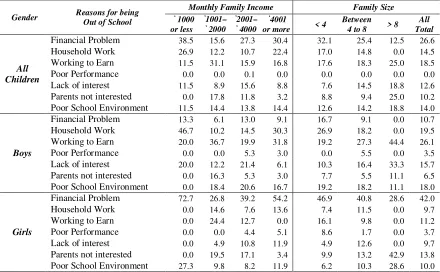
Table 13
Family Income, Family Size & Reasons for Drop out
Gender Reasons for being
Out of School
Monthly Family Income Family Size
` 1000 or less
`1001–
` 2000
`2001–
` 4000
`4001
or more < 4
Between 4 to 8 > 8
All Total
All Children
Financial Problem 38.5 15.6 27.3 30.4 32.1 25.4 12.5 26.6
Household Work 26.9 12.2 10.7 22.4 17.0 14.8 0.0 14.5
Working to Earn 11.5 31.1 15.9 16.8 17.6 18.3 25.0 18.5
Poor Performance 0.0 0.0 0.1 0.0 0.0 0.0 0.0 0.0
Lack of interest 11.5 8.9 15.6 8.8 7.6 14.5 18.8 12.6
Parents not interested 0.0 17.8 11.8 3.2 8.8 9.4 25.0 10.2
Poor School Environment 11.5 14.4 13.8 14.4 12.6 14.2 18.8 14.0
Boys
Financial Problem 13.3 6.1 13.0 9.1 16.7 9.1 0.0 10.7
Household Work 46.7 10.2 14.5 30.3 26.9 18.2 0.0 19.5
Working to Earn 20.0 36.7 19.9 31.8 19.2 27.3 44.4 26.1
Poor Performance 0.0 0.0 5.3 3.0 0.0 5.5 0.0 3.5
Lack of interest 20.0 12.2 21.4 6.1 10.3 16.4 33.3 15.7
Parents not interested 0.0 16.3 5.3 3.0 7.7 5.5 11.1 6.5
Poor School Environment 0.0 18.4 20.6 16.7 19.2 18.2 11.1 18.0
Girls
Financial Problem 72.7 26.8 39.2 54.2 46.9 40.8 28.6 42.0
Household Work 0.0 14.6 7.6 13.6 7.4 11.5 0.0 9.7
Working to Earn 0.0 24.4 12.7 0.0 16.1 9.8 0.0 11.2
Poor Performance 0.0 0.0 4.4 5.1 8.6 1.7 0.0 3.7
Lack of interest 0.0 4.9 10.8 11.9 4.9 12.6 0.0 9.7
Parents not interested 0.0 19.5 17.1 3.4 9.9 13.2 42.9 13.8
Poor School Environment 27.3 9.8 8.2 11.9 6.2 10.3 28.6 10.0
[image:15.612.106.546.406.678.2]3. Interlinkage between Reasons for Drop Out
Let us now try to explore whether there is any interlinkage between the various reasons for drop out identified by us. Whereas financial problem was observed to be the most important reason for being out of formal school, for the Casual & self employed workers and the unemployeds, children are out of school mostly because they are themselves working (Table 12). For the agricultural and mining workers, household work is an important factor affecting children’s schooling. Poor school environment is affecting schooling of the boys from mining families and girls from agricultural labourer households.
As for family income, in the lower income families, as expected, financial problem emerges to be the main culprit, especially for the girls (Table 13). Factors like disinterest of the parents and poor school environment emerge as crucial for the higher income groups.
[image:16.612.105.512.421.687.2]Lack of interest among parents is a major factor for large families, especially for the girls, while for the smaller families financial problem is the main reason behind drop out from formal schools (Table 13). For the boys, working to earn is more predominant in large families.
Table 14
Family Educational Status & Reasons for Drop out
Gender Reasons for being Out of School
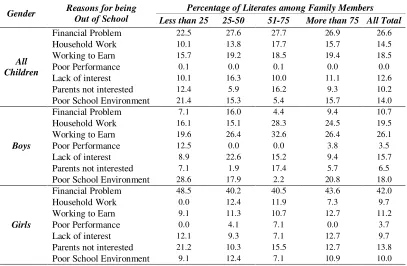
Percentage of Literates among Family Members Less than 25 25-50 51-75 More than 75 All Total
All Children
Financial Problem 22.5 27.6 27.7 26.9 26.6
Household Work 10.1 13.8 17.7 15.7 14.5
Working to Earn 15.7 19.2 18.5 19.4 18.5
Poor Performance 0.1 0.0 0.1 0.0 0.0
Lack of interest 10.1 16.3 10.0 11.1 12.6
Parents not interested 12.4 5.9 16.2 9.3 10.2
Poor School Environment 21.4 15.3 5.4 15.7 14.0
Boys
Financial Problem 7.1 16.0 4.4 9.4 10.7
Household Work 16.1 15.1 28.3 24.5 19.5
Working to Earn 19.6 26.4 32.6 26.4 26.1
Poor Performance 12.5 0.0 0.0 3.8 3.5
Lack of interest 8.9 22.6 15.2 9.4 15.7
Parents not interested 7.1 1.9 17.4 5.7 6.5
Poor School Environment 28.6 17.9 2.2 20.8 18.0
Girls
Financial Problem 48.5 40.2 40.5 43.6 42.0
Household Work 0.0 12.4 11.9 7.3 9.7
Working to Earn 9.1 11.3 10.7 12.7 11.2
Poor Performance 0.0 4.1 7.1 0.0 3.7
Lack of interest 12.1 9.3 7.1 12.7 9.7
Parents not interested 21.2 10.3 15.5 12.7 13.8
Poor School Environment 9.1 12.4 7.1 10.9 10.0
If we consider the educational status of the families in terms of the proportion of the family members being literate, we find that for families with low literacy score lack of interest among parents and poor school environment are major problems (Table 14). On the other hand, for high literacy score families, household and remunerative work are the main reasons.
It is thus obvious that the reasons for drop out are quite diverse and depends on family background. Therefore, intervention programmes must also be diversified and properly targeted to prevent school drop out and plug the flow of students into BCCs at the source.
4. Problems Faced by BCCs
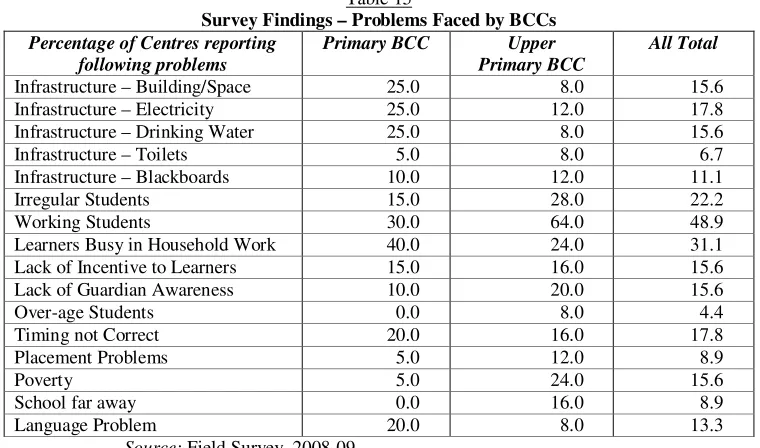
The centres are also facing certain problems that are hindering their teaching-learning process. The problems can be divided into infrastructural problems, student level problems, and other problems (Table 15).
a) Infrastructural Problems
[image:17.612.116.496.468.692.2]It is observed that for the primary BCCs the most important problem is lack of building/space. This is followed by non-availability of drinking water and electricity. On the other hand, the main problem of the upper primary BCCs is lack of electricity followed by non-availability of blackboards and buildings. The infrastructural requirement needs to be catered to by the administration through coordination between SSA, VEHC, and Local Self Government organizations.
Table 15
Survey Findings – Problems Faced by BCCs
Percentage of Centres reporting following problems
Primary BCC Upper
Primary BCC
All Total
Infrastructure – Building/Space 25.0 8.0 15.6 Infrastructure – Electricity 25.0 12.0 17.8 Infrastructure – Drinking Water 25.0 8.0 15.6 Infrastructure – Toilets 5.0 8.0 6.7 Infrastructure – Blackboards 10.0 12.0 11.1 Irregular Students 15.0 28.0 22.2 Working Students 30.0 64.0 48.9 Learners Busy in Household Work 40.0 24.0 31.1 Lack of Incentive to Learners 15.0 16.0 15.6 Lack of Guardian Awareness 10.0 20.0 15.6
Over-age Students 0.0 8.0 4.4
Timing not Correct 20.0 16.0 17.8 Placement Problems 5.0 12.0 8.9
Poverty 5.0 24.0 15.6
School far away 0.0 16.0 8.9
Language Problem 20.0 8.0 13.3
b) Student Level Problems
A significant number of instructors from these centres argue that there are serious problems at the level of the students that prevent smooth functioning and good performance of the BCCs. At the primary level, many children are busy attending domestic duties or engaged in some remunerative work. This hampers their regularity at the BCC. For the upper primary level, 64 percent students are working at some level or other. This keeps them busy and they do not find time to study at home. As a result, though these children have registered themselves at the BCCs, their performance is not satisfactory and it is unlikely that these children can ever be mainstreamed. Moreover, in the BCCs, they are supposed to encapsulate within 9 months all that are taught in formal schools for a year. Added to this is the fact that the learners in the BCCs are the weakest of the lot (since they are school drop outs/never attended). So just the 4 hours of learning in BCCs without any study time at home is not enough for them to be mainstreamed. This raises questions about the timing and the teaching method of BCCs, which needs to be addressed at the policy level.
c) Other Problems
V. CONCLUSION
1. Performance
To summarize our study, the performance of the BCCs in Burdwan district is mixed. This innovative scheme has been able to bring back about half of the out of school children to the formal schools. These BCCs are also observed to provide quite good learning opportunities to the marginal children so that even those who are not mainstreamed are learning some basic textual reading, comprehension, and maths. The flexibility in timings are allowing many of them to continue with their ‘works’ – be it household chores, domestic duties, or working as agricultural labourer, and yet coming to school at fixed timings. This inculcation of routine and discipline is indeed another success of the scheme.
Most significant success of the scheme is that most of the learners are now attracted towards education – they want to continue their studies. Creation of such eagerness and enthusiasm is very important in not only mainstreaming these out of school children but also for their retention in formal schools. This has happened because of close personal linkage and association between the instructors and the learners.
However, this success is not uniform across grades or region. The performance is substantially better in primary level compared to upper primary, and in the central region compared to the others. This difference is due to specific problems faced by the upper primary level BCCs and the Eastern Region.
2. Problems
need to travel more than 8 kilometres to attend Hindi medium high school in Raniganj block. It is no surprise that dropout is quite high in this region.
The problem of guardian’s lack of interest in sending their children to the centre regularly or to formal schools after completion of the bridge course is also a critical aspect. Under economic duress they look at their sons as earning members and to their daughters as replacements for their working mothers. Consequently the continuity of education of learners is quite questionable. They are sending children to BCCs because it is flexible, allows them to complete family chores, and is short term. Unless the parents are enthusiasts, the learners in BCCs will not move to formal schools, more so for the girls.
Another problem that we have identified is the lack of coordination between the upper primary centres and the high schools where these learners shall be placed. Formal high schools are refusing admission to learners from BCCs on ground of over-age, lack of proper certificate or simply on grounds of poor quality of these students. While there is no escaping the fact that most of the students from the BCCs are not at par with those studying in formal schools for four years continuously, we must keep in mind that schools have a moral responsibility to accommodate these marginal students also. These issues have to be sorted out at the administrative level.
3. Suggestions
We would like to put forward few suggestions for improving the effectiveness of the scheme.
First, as we have mentioned earlier, the timing of the course should be such that it ends by April-May so as to place the students in formal schools at the beginning of academic session. The decision to start BCCs in January was purely administrative and emanated from the program implementation calendar of the local SSA authorities. However, the authorities are now aware of the problem and are thinking of shifting the schedule appropriately.
Second, better coordination between formal schools and the BCCs is extremely important. The VEHC and the local PRIs have to play a more pro-active role in this regard. The performance of the Shiksha-Bandhu has to be closely monitored and expanded to make her the coordinator of such administrative issues.
nutritional level and also act as an incentive. It was often found during field visits that many children are enrolled in local primary school, visit it during the mid-day lunch hour only, but come to the BCC for actual learning. Some researchers have argued that under such situation mid-day meal should be provided to all children irrespective of their attending educational institution or not as in practice it is already delinked. However, such formal delinking will severe the thread that at least binds the children to the local school and teaches them to value school enrolment and attendance, at least for the food if not for the learning. Extending the midday meal program to the BCCs will create an added incentive for the out of school children to comeback under the umbrella of educational system. Some scholarship may also be offered to the learners at the BCCs so that they attend classes regularly and not go off to work to supplement family income. At present the state government provides ` 500 per month as scholarship to meritorious but poor students of class V-X in formal schools. If even half of that rate is allowed for the learners in BCCs (and other EGS/AIE centres), a sum of about ` 30 million per year will cover the budget for scholarship of all the Out-of-school-children in the district.
Fourth, supply of all TLM, books, and blackboards should be done within 15 days of commencement of classes. Without these, the quality of teaching and the performance of the learners would suffer, as observed by us in many cases. In addition, at least for the hamlets where most of the out of school children are Hindi speaking, the teachers and the TLM should be in Hindi or English.
Fifth, in the summer and monsoon days, lack of proper building is acting as a major problem. All primary school buildings and ICDS centres, even local Panchayat Buildings, may be used for the BCCs, and this have to be ensured by the administration. The locations of the centres should also be conducive to learning of young children and have to have adequate drinking water and sanitation facilities. Sixth, an experiment like residential BCCs was observed to be highly successful during field visit. These may be replicated – with at least one such centre in each block initially. NGOs and multilateral agencies like DFID, UNDP, and UNICEF may be approached for this purpose. These may also be linked with National Social Service (NSS) schemes of local colleges or schools so as to ensure regular availability of teaching personnel.
so that they can enter ITIs after completing Class-8 from formal schools. In addition, the learners who are unable to be mainstreamed would also imbibe some life-sustaining skills after completion of the course from BCC.
Eighth, as was mentioned in the section on methodology, we have tried to bring out regional and social variations in the problem of school drop out and the conditions of learners in the BCCs. Since the programme has substantial flexibility in the implementation part, authorities must take local factors under consideration while planning and executing the scheme. This is to be done by the district level resource organisations and the local VEHCs in consultation with the district SSA research section. It is heartening to note that during our field survey signs of such modulations and fine-tuning at the local level were already evident. This needs to be pursued further and formalised at the institutional level.
At a more long run prospective one may think of running these throughout the year where children will come at their suitable times and learn at their suitable pace. At the end they will sit for public examinations conducted by appropriate authorities (DPSC for primary level and WBBSE for higher levels) and on successful completion obtain certificates in that regard. In other words, open schooling system and BCCs may be merged and brought at par with formal schools. After all, we are to test whether a student has the adequate knowledge or not, not wherefrom she has acquired it. Gradual spreading out of such a system will not only expand our education network but also make learning enjoyable and fruitful, in addition to catering to the needs of the marginal children.
__________________
[This is part of a broader study on Impact Evaluation of Various Implemented Schemes of SSA in Bardhaman undertaken by the second author. The authors acknowledge financial and logistical support provided by SSA-Bardhaman for conducting the survey.]
Note
1
Data on performance of BCCs in selected states are obtained from: Andhra Pradesh - http://ssa.ap.nic.in/Alternative%20schooling.pdf; Assam - http://www.ssaassam.gov.in /Sanjyogi %20Siksha%20Kendra.htm; Karnataka - http://www.schooleducation.kar.nic.in /ssa/pdfdocs/ EGS&AIEProgress05.pdf and http://www.schooleducation.kar.nic.in/ssa/pdfdocs/npegel.pdf;
Madhya Pradesh - http://www.educationportal.mp.gov.in/Oosc/Public/ssrs/oosc_Report_Viewer .aspx ?RName=Ver_oosc_Summary_Report and http://ssa.nic.in/misdoc/mis-08-09/Madhya %20Pradesh%20-%20TISS%20Mumbai%20_Final_.pdf; and Tamil Nadu - http://www.ssa.tn.nic.in /Docu /Interventions.pdf and http://www.ssa.tn.nic.in/Schemes-E.htm;
References
DISE (2008) – DISE State Report Cards-2007-08, http://www.dise.in/Downloads/ Publications/Publications%202007-08/src0708/SRC%202007-08.pdf, accessed on 15-01-2010]
DISE (2009) – DISE Flash Statistics-2008-09, [available from http://www.dise.in/Downloads /Publications/Publications%202008-09/Flash%20Statistics%202008-09.pdf, accessed on 15-01-2010]
GOI (2008) – Annual Report 2006-07, Ministry of Human Resource Development, Government of India.
Omvedt, G. (1993) – Dalits and the Democratic Revolution: Dr. Ambedkar and the Dalit Movement in Colonial India, New Delhi: Sage Publications.
Sen, Amartya (1996) – “Radical Needs and Moderate Reforms”, in Jean Dreze and Amartya Sen (ed.)
Indian Development: Selected Regional Perspectives, New Delhi: Oxford University Press.