The Constrained Mean-Semivariance Portfolio
Optimization Problem with the Support of a Novel
Multiobjective Evolutionary Algorithm
K. Liagkouras, K. Metaxiotis
DSS Lab., Department of Informatics, University of Piraeus, Piraeus, Greece. Email: [email protected], [email protected]
Received May, 2013
ABSTRACT
The paper addresses the constrained mean-semivariance portfolio optimization problem with the support of a novel multi-objective evolutionary algorithm (n-MOEA). The use of semivariance as the risk quantification measure and the real world constraints imposed to the model make the problem difficult to be solved with exact methods. Thanks to the exploratory mechanism, n-MOEA concentrates the search effort where is needed more and provides a well formed effi-cient frontier with the solutions spread across the whole frontier. We also provide evidence for the robustness of the produced non-dominated solutions by carrying out, out-of-sample testing during both bull and bear market conditions on FTSE-100.
Keywords: Multiobjective Optimization; Evolutionary Algorithms; Portfolio Optimization
1. Introduction
Portfolio optimization is the process of choosing the as-sets and their proportions, so that it is attained the maxi-mum profitability for the risk undertaken. MOEAs tech-niques applied to the portfolio selection problem have become increasingly popular relatively recently. Not only because they provide a fast and reliable way of calculat-ing computationally demandcalculat-ing financial models but also why revolutionized the financial modeling research field itself by developing innovative algorithmic approaches for solving difficult financial problems that in many cas-es cannot be solved with exact methods. Over the past years researchers developed several approaches for the solution of the portfolio optimization problem with the use of MOEAs. Most of the early work on MOEAs adopts the unconstrained Markowitz Mean – Variance (MV) model [2,4]. Obviously, the practical usefulness of such a model is limited to academic purposes and cannot address the complexity and multiple real world con-straints faced by portfolio managers. More recent studies, incorporate a number of constraints into the optimization model, but do not examine how these constraints affect the evolutionary search process and the efficient frontier formulation. Additionally, still the majority of the studies use variance [3] for the quantification of portfolio risk although it’s well known undesirable mathematical properties [1].
Our paper proposes a bi-objective return semivariance portfolio optimization model that incorporates a number of real world constraints such as cardinality constraints, floor and ceiling constraints, non-negativity constraint and budget constraint and analyzes their effects on the efficient frontier formulation. Finally, we provide em-pirical evidence for the robustness of the proposed methodology by performing, out-of-sample experiments during both bull and bear market conditions on FTSE- 100.
The paper is organized as follows. Section 2 provides a formal introduction of the proposed multi-objective portfolio optimization model and the various constraints applied. Section 3 provides an analytical description of the proposed MOEA model, focusing especially on the applied techniques for the efficient exploration of the search space. Finally, section 4 evaluates the robustness of the proposed algorithm by carrying out a number of out-of-sample tests during both bull and bear market conditions.
2. Problem Definition
opti-The Constrained Mean-Semivariance Portfolio Optimization Problem with the Support of a Novel Multiobjective Evolutionary Algorithm
23
mize all objectives simultaneously. Thus, in reality we are trying to find good compromises or “trade-offs” be-tween the different objectives. This “trade-off” bebe-tween the different objectives was expressed for first time by Francis Edgeworth and generalized by Vilfredo Pareto. Nowadays, is known as Pareto optimality. Let be the
search space. Consider 2 objective functions f f1, 2 where fi: and .
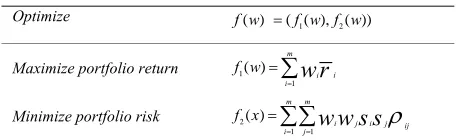
Table 1. The Portfolio Optimization Problem
Optimize
1 2
( ) ( ( ), ( ))
f w f w f w
Maximize portfolio return 1 1 ( ) m i i i
f w
w r
Minimize portfolio risk 2
1 1
( )
m m
i j i j ij i j
f x
w w s s
where:
Decision variables w(w1,..,wm) subject to w and m = 100 equalto the number of stocks in FTSE-100.
Rate of return of assets r r1, ..,2 rm. ij
is the correlation between asset i and j and
1 ij 1
s s,
.
j
i represent the semi-standard deviation of stocks returns i and j respectively. The formula is
2 1
( )
t R
n
i i t R
r T
S SV r T
n
,where svi represents the semivariance of security i. TR represents the target return, equal to zero in this occasion and t R the difference between realized return and target return.
r T
2.1. Constraints to the Problem
Budget constraint or summation constraint 1
1 m
i i
w
requires all portfolios to have non-negative weights
( i ) that sum to 1. The non-negativity
constraint indirectly implies that short selling is not al-lowed.
1
0w i1,..,m
1
C
Floor and ceiling constraints .
Where ai = the minimum weighting that can be held of asset i (i = 1, …, n ), bi = the maximum weighting that can be held of asset i(i = 1, …, n ) and
, 1, 2,..., i i i
a w b n
0 ai bi
1, 2,...,n
Cardinality constraint min max, where:
1 m i i C
q
Cmin = the minimum number of assets that a portfolio can hold
Cmax = the maximum number of assets that a portfolio can hold
1, 0
0, 0
i i
i i
q for w
q for w
2.2. Pareto Optimality Definitions
We make use of Pareto optimality framework in order to determine the solutions in this multi-objective optimiza-tion problem. In particular we use the following defini-tions:
Definition 1 (Pareto dominance)
Consider a maximization problem. Let x, y be two
de-cision vectors (solutions) from Ω. Solution x dominate y (also written as x > y) if and only if the following
condi-tions are fulfilled:(i) The solution x is no worse than y in
all objectives i i (ii) The
solu-tion x is strictly better than y in at least one objective n
y f x
f( ) ( ),1,2,...,
}:f xj( ) f yj( ) {1, 2,...,
j n
.If any of the above
con-ditions is violated the solution x does not dominate the solution y.
Definition 2 (Global Pareto-Optimal set)
The non-dominated set of the entire feasible search space Ω is the global Pareto-optimal set.
Definition 3 (Local Pareto-Optimal set)
Let S be a subset of the search space. All solu-tions which are not dominated by any vector of S are called non-dominated with respect to S. Solutions that are non-dominated with respect to S, are called
local Pareto solutions or local Pareto regions. S
Definition 4 (Strong dominance)
A solution x strongly dominates a solution y, x > y, if
solution x is strictly better than solution y in all m objec-tives.
Definition 5 (Weak dominance)
A solution x weakly dominates y, if f x f yi( ) i( ),1,2,...,n
and there is no x such that f xi( )f y ii( ), 1,2,...,n
Definition 6 (Non dominated solutions)
[image:2.595.58.286.211.281.2]A solution x is called non-dominated if x is either a strong non-dominated or a weak non-dominated.
Figure 1 we provide a schematic illustration of the dominance in a bi-objective optimization (portfolio re-turn and risk), where a higher value is better for f1(w) = “Return objective function” and a lower value is better for f2(w) = “Risk objective function”
In this example solution A1 strongly dominates solu-tion A2, A3 and B since the f1(w) and f2(w) of solution A1 are strictly better than the f1(w) and f2(w) of solution A2 , A3 and B respectively. Solution A and C are weakly dominated by solution A1 where the value of one of the objectives functions of the dominated solution is equal to the corresponding value of solution A1.
This section is dedicated to the presentation of the pro-posed MOEA. The n-MOEA is summarized in the fol-lowing steps.
[image:3.595.66.273.132.325.2]Algorithm_n-MOEA()
Figure 1. Pareto optimization in mean-risk portfolio opti-mization problem.
1) INITIALIZATION of the population
2) WHILE termination criterion not fulfilled
3) EVALUATE each portfolio of the population using Pareto Optimality
4) ARCHIVE add the Local non-dominated portfolios into the archive
5) EVALUATE_ARCHIVE according to Pareto Op-timality conditions
5a. DOMINATED_SOLUTIONS removed from ARCHIVE
5b. NON_DOMINATED remain into the ARCHIVE as
Global Non-dominated solutions
6) REPRODUCTION_FITNESS assign reproduction fitness to the Global non-dominated portfolios according to the Euclidian distance between them.
7) CREATE_NEW_POPULATION new population is created probabilistically from the Global non-domi- nated solutions in the ARCHIVE according to the fitness assigned to each portfolio.
8) MUTUTION operation applied to the new popula-tion to variate the portfolios
9) CROSSOVER operation applied to the new popu-lation to preserve popupopu-lation diversity.
10) GO TO step 2
Below we provide analytical description of the key elements of the proposed algorithm.
3.1. Reproduction Fitness Assignment
As soon as, we identify the Global non-dominated
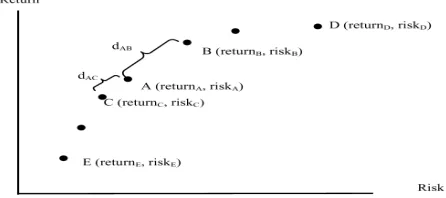
solu-tions, we arrange them into the Cartesian system. Thus, for any solution into the system we know the two neigh-bor solutions (portfolios). Please, note that the most left-ward and rightleft-ward points (E and D in this occasion) have one neighbor solution. Next, we calculate the Eu-clidian distance for each Global non-dominated solution (portfolio) in the Archive (see Figure 2).
where: dAB (returnBreturnA)2(riskBriskA)2
2 2
( A C) ( A )
AC return return risk risk
d C
Generally, the distance between two points x = (x1,…, xn) and y = (y1,…, yn) in Euclidean n-space is given by:
2 2
1 1 2 2 2
1
( , )
(
) (
)
...(
(
)
n n n
i i i
d x y
x y
x y
x y
)
2x y
We assign reproduction fitness to each Global non- dominated solution. The reproduction fitness points sum up to 1% or 100%. The reproduction fitness is assigned according to the Euclidian distance of the solution from its neighbor solutions. Thus, the higher the Euclidean distance of the solution, the higher gets the assigned re-production fitness. The rere-production fitness assigned to the Global non-dominated Archive solutions will guide the exploratory process.
3.2. Generation of New Population
Then, probabilistically are selected the solutions (portfo-lios) that will be included in the new population. Obvi-ously, the higher fitness solutions have more chances to be picked up. Depending on the size of population and the number of Global non-dominated solutions in the Archive, many copies of Solution A may be reproduced in the new population. For example if the population size is 50 and the non-dominated solutions in the Archive are 10, and assuming that solution A had much higher fitness (see Figure 3) than any other solution in the Archive, then we would expect solution A to be reproduced more
[image:3.595.311.534.596.695.2]The Constrained Mean-Semivariance Portfolio Optimization Problem with the Support of a Novel Multiobjective Evolutionary Algorithm
[image:4.595.64.279.91.233.2]25
Figure 3. Global non-dominated solution A is assigned a higher reproduction fitness, due to its higher Euclidian dis-tance from the rest non-dominated solutions.
than 5 times (average reproduction) in the new popula-tion due to the higher reproducpopula-tion fitness.
3.3. The Mutation Mechanism
The number of mutants is determined by the portfolio size and the mutation rate. For determining which stocks will exist the portfolio is calculated the Inverse Fitness. The Inverse Fitness is calculated as follows:
Inverse Fitness = Maximum Stock Fitness – Stock Fitness
where: Maximum Stock Fitness: The stock with the
high-est fitness among the stocks on FTSE-100 and Stock
Fit-ness: The fitness of each individual stock that is included
in the portfolio.
That means that the highest fitness stock of FTSE-100 has an Inverse Fitness of zero. As soon as we calculate the portfolio’s Inverse Fitness, we probabilistically select the stocks to exit the portfolio. Obviously, the highest fitness stock will not exit the portfolio as has an Inverse Fitness of zero. Stocks with higher inverse fitness and thus lower fitness are more probable to be removed from the portfolio. This is an elitism mechanism that gives probabilistic advantage to the higher fitness stocks to remain into the portfolio.
Having decided which stocks will exit the portfolio, and then we have to determine which stocks will enter the portfolio as mutants. In this case all the stocks of the index are taken into account, according to their fitness. Again, cardinality constraints and lower and upper bounds are taken into account during this process. Taking stocks’ fitness into account means that stocks with higher fitness are more probable to enter the portfolio as mutants.
3.4. The Crossover Mechanism
At this stage, the population already has been variated through the mutation process. In order to maintain
diver-sity in the population and avoid convergence to a single solution we make use of the crossover mechanism. The crossover between the various solutions (portfolios) is random, but within the maximum and minimum cross-over rates that we have specified at an earlier stage. For example if we specify maximum crossover rate = 90% and minimum = 70%, that means that randomly will be selected a crossover rate within these limits let’s say 80%. A crossover rate 80% simply means that 80% of portfolio A will be crossover with 20% of portfolio B and 20% of portfolio A will be crossover with 80% of portfolio B. Please note that the pairs to be crossover are selected randomly.
3.5. Efficient Frontier Formulation
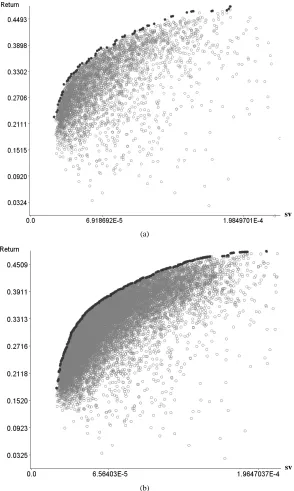
Next, we present the process of efficient frontier formu-lation by quoting experimental results based on historical data of FTSE-100. For the first experiment, as a training set we use 63 daily historical observations of FTSE-100 from 30-Nov-2011 till 29-Feb-2012. The configuration of the n-MOEA for this experiment is: population size 70, maximum number of generations 200, floor constraint 5%, ceiling constraint 31%, Cardinality constraint 20 stocks, crossover rate between 70% and 90% and muta-tion rate 20%. Below, we provide two figures with the Efficient Frontier formulation at different stages of the algorithm execution.
Figure 4 displays the exploratory process of n-MOEA. It is evident even from Figure 4(a) at generation 50 that the algorithm pusses the exploratory process towards the left and upward corner of the figure where the most effi-cient solutions reside i.e. solutions that command higher return and lower risk. At generation 200 as it is evident from Figure 4(b) the region surrounding the efficient frontier has been turned solid grey, meaning that given the constraints imposed has been exhausted the possibil-ity to move the efficient frontier further towards the left and upward corner of the figure.
4. Robustness of n-MOEA
sv
(a)
sv
[image:5.595.153.447.83.574.2](b)
Figure 4. Exploratory process of n-MOEA. n-MOEA for this experiment is: population size 70,
maximum number of generations 200, floor constraint 5%, ceiling constraint 31%, Cardinality constraint 20 stocks, crossover rate between 70% and 90% and muta-tion rate 20%. The objective of this experiment is to test whether the non-dominated solutions emerged during the in-sample testing remain robust in out-of-sample testing. It is well known that portfolio managers of large funds in order to succeed satisfactory diversification and achieve better returns, keep in their portfolios stocks from every component of FTSE-100 index. However, this strategy
can be followed only by big players and is associated with high administrative costs.
The Constrained Mean-Semivariance Portfolio Optimization Problem with the Support of a Novel Multiobjective Evolutionary Algorithm
27
[image:6.595.94.496.364.737.2]testing period of six months (March to August 2012) we do not rebalance our efficient portfolio. Table 2 presents the Efficient portfolio and the corresponding stocks and weights as these emerged during the optimization process. For carrying out the test we separate the out-of-sample period of six months into twelve intervals. For the calcu-lation of return and risk have been taken into account 30 observations, with ending observation the one that appear on the title of each graph of Figure 5. Thus, for example in Figure 5(e) for the calculation of return and risk of both Efficient portfolio and FTSE-100 index alike, are
Table 2. The Efficient Portfolio and the corresponding stocks and weights
Efficient Portfolio
stock weight ABF.L 29.81%
BNZL.L 30.64%
GFS.L 8.92%
SN.L 11.27% DGE.L 19.36%
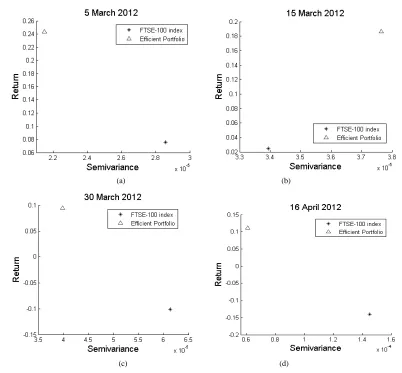
taken into account 30 observations, with last observation the 27-April-2012 (same as the title of the graph) and first observation if we count 30 trading days backwards the 15-March-2012. From the Figure 5 it is evident that
Efficient portfolio strongly dominates FTSE-100 index return and risk combinations in 9 out of 12 cases. Even six months after its formulation, the efficient portfolio, strongly dominates FTSE- 100 index return and risk as it appears clearly in Figure 5(k). In only, 3 situations (Figures 5(b), (i) and (l)) efficient portfolio and FTSE-100 index are non-dominated which means that
efficient solution is not strictly or weakly better than FTSE-100 index. It is worth mentioning that in none situation FTSE-100 index performance dominates
effi-cient portfolio performance during this six months out-of-sample testing period. This is a strong indication of the robustness of the solution produced by the n-MOEA. Finally, we should highlight that the six months out-of-sample testing period includes both bull and bear market periods and as it is evident from Figure 5, the n-MOEA Efficient portfolio proved robust in both upward and downward market conditions.
(a) (b)
(e) (f)
(g) (h)
(i) (j)
[image:7.595.103.491.89.727.2]
(k) (l)
The Constrained Mean-Semivariance Portfolio Optimization Problem with the Support of a Novel Multiobjective Evolutionary Algorithm
29
5. Conclusions
In this paper, we have proposed a novel MOEA for the solution of the constrained mean-semivariance portfolio optimization problem. The algorithm can handle suc-cessfully downside risk measures like semivariance and real world constraints and formulate well spread frontiers thanks to an elitism mechanism applied in the mutation process that give a reproduction advantage to the higher fitness stocks, and an exploratory mechanism that uses the notion that good solutions are more probable to be found near other non-dominated solutions. At the same time another mechanism calculates the Euclidian dis-tance between the various non-dominated solutions in order to assign reproduction fitness. That way, we safe-guard that the exploratory effort is concentrated where is needed more and the solutions are spread across the en-tire frontier. Also, the crossover process enhances the population diversity, by combining randomly two non-dominated solutions to produce two new off-springs. The robustness of the proposed algorithm is verified for short and mid-term by carrying out a number of
out-of-sample tests during both bull and bear market conditions on FTSE-100.
REFERENCES
[1] P. Artzner, F. Delbaen, J. Eber and D. Heath, “Coherent measures of risk. Mathematical Finance,”Mathematical
Finance, Vol. 9, No.3, pp.203–228.
doi:10.1111/1467-9965.00068
[2] H. M. Markowitz, “Foundations of Portfolio Theory,”
Journal of Finance, Vol.46, No. 2, 1991, pp.469-477.
doi:10.1111/j.1540-6261.1991.tb02669.x
[3] K. Metaxiotis and K. Liagkouras, “Multiobjective Evolu-tionary Algorithms for Portfolio Management: A com-prehensive Literature Review,” Expert Systems with
Ap-plications 39, Vol.39, No. 14, 2012, pp.11685–11698.
doi:10.1016/j.eswa.2012.04.053
[4] F. Pasiouras, S. Tanna and C. Zopounidis, “The Impact of Banking Regulations on Bank’s Cost and Profit Effi-ciency: Cross country Evidence,” International Review of
Financial Analysis, Vol. 18, No. 5, 2009, 294 - 302.