Munich Personal RePEc Archive
On the spatial diffusion of knowledge by
universities located in small and medium
sized towns
Rego, Conceição and Caleiro, António
Departamento de Economia CEFAGE-UE, Universidade de Évora,
Portugal
13 July 2009
On the spatial diffusion of knowledge by universities located in small and
medium sized towns
1Conceição Rego António Caleiro
([email protected]) ([email protected])
Departamento de Economia & CEFAGE-UE Departamento de Economia & CEFAGE-UE
Universidade de Évora Universidade de Évora
Portugal Portugal
Abstract
Many studies, provided by diverse authors and institutions, demonstrate that, at a territorial level, development is directly related to the level of education and R&D. Territories with higher development levels are, generally, those that have a higher level of education and R&D. The relationship between the acquisition of knowledge and institutional education is therefore decisive. In this area, the role of universities is fundamental. The retention of university graduates is one of the main ways that the cities and the regions can adopt to retain those endowed with higher propensity to innovation, enterprise spirit and management capacity. Given that higher education institutions, in general, and universities, in particular, are obviously crucial in the process of knowledge increase, it becomes important to analyse how can these institutions act as ways of spatial diffusion of knowledge given that their graduates may migrate to other regions of the country (or for another country). The alleged increased probability of this migration to occur when the university is located in a small or medium sized town makes that analysis also interesting from the viewpoint of the development role that this kind of cities can perform, not only in the adjacent rural areas, but also across all the urban areas of the territory. The focus of our work consists in this analysis, which complements a theoretical approach with an empirical part based upon the results that can be observed for the influence of one university located in a small/medium sized town (the University of Évora) in the spatial diffusion of knowledge through its graduates
Keywords: Human capital, Small towns, Spatial diffusion of knowledge, Universities.
JEL codes: I23, J24, O15, R11.
1
A previous version of this paper was presented at the conference “Knowledge in Small and Medium
1. Introduction
Many studies, provided by diverse authors and institutions, demonstrate that territory
development is directly related to the level of education and R&D characterising those
territories. Indeed, territories with higher development levels are, generally, those
whose area is characterised by a higher level of education and R&D. As a consequence,
any insufficiency in these territories on those matters constitutes an obstacle to
development.
As is well-known education plays an inter-generational role. Education is a legacy of
one generation to the following one; this being its main social function (Thomas,
1995). It is a medium-term investment, made by the society in general and by
households in particular, to the extent that expectations of higher contributions in the
future mean forgoing the productive contribution of the young in the present (Lopes,
2001). Parents want their children to receive a high-quality education because they
understand that in this way they are better preparing them for the labour market.
In the European Union framework, the debate on the role of higher education
institutions (henceforth, HEIs) within the knowledge economy is deeply important. The
creation of a Europe of knowledge has been defined as main goal for the European
Union since the Lisbon Council (March 2000). The Lisboa agenda include many players,
in which the universities are certainly to be included. In terms of growth, the
knowledge society depends upon the production of new knowledge, its transmission
through education and training, and its dissemination through information and
communication technologies. In this context, universities traditionally play their role in
the fields such as those of research and development of their results, due to industrial
cooperation and spin-off, education and training, in particular training of researchers,
As a matter of fact, according to the Communication from European Commission [COM
(2003): 58 final]2, universities play a key role to the knowledge economy and society. For example, universities employ 34% of the total number of researchers in Europe
and are responsible for 80% of the fundamental research pursued in Europe. In
addition, universities train an increasing number of students with increasingly higher
qualifications, which contribute to strengthening the competitiveness of the European
economy. Universities also contribute to the objectives of the Lisbon strategy,
particularly employment and social cohesion, and to the improvement of the general
level of education in Europe: in the total population aged 25-64, the rate of
employment of persons holding higher education qualifications stood at 84% in 2001.
On the other hand, the rate of unemployment amongst those which have higher
education qualifications remains at 3,9%, about one third of total of persons with a low
qualifications level.
The analysis of local and regional role of HEIs is related to local economic, social and
cultural environment. In this sense, HEIs are important instruments of regional
development and of strengthening European cohesion. The development of
technology centres and science centres, the proliferation of regional cooperation
structures between the business sector and the universities, the expansion of
university regional development strategies, the regional networking of universities are
some dimensions of university activity. In addition, universities can play an important
role as a source of expertise and a catalyst for multiple partnerships between
economic and social players with multiple networks at the regional and local levels
[COM (2003): 58 final].
The contributions of HEIs to regional economies have been made through different
ways. Drucker & Goldstein (2007: 22) identify eight different functions, or outputs, of
modern research universities that may potentially lead to economic development
impacts:
2 Communication from the Commission,
1. Creation of knowledge,
2. Human-capital creation,
3. Transfer of exiting know-how,
4. Technological innovation,
5. Capital investment,
6. Regional leadership,
7. Knowledge infrastructure production,
8. Influence on regional milieu.
Obviously, each of the previous outputs may cause a distinct pattern of effects on the
regional economy, ranging from the direct and indirect effects of university spending
to productivity gains in private enterprises, from the creation of new firms to increases
in regional creativity and the capacity to sustain long-term development and growth
(Drucker & Goldstein, 2007: 22). According these authors, traditional approaches to
assessing the impacts of universities have focused largely on the impacts arising from
direct spending and regional investment activities. On the other hand, extensions of
these spending-impact studies have branched into considering the effects of
human-capital creation and induced regional migration patterns. In this sense, the recent
approaches have focused on the basic knowledge creation, knowledge-infra-structure
provision, technological innovation, and technology-transfer activities of universities
and HEIs, in general (Drucker & Goldstein, 2007: 23).
The focus of our work consists in the analysis sketched up, which complements a
theoretical approach with an empirical part based upon the results that can be
observed for the influence of one university located in a small/medium town (the
University of Évora) in the spatial diffusion of knowledge trough its graduates.
The rest of the paper is structured as follows. From a theoretical point of view, the
importance of HEIs in the accumulation and diffusion of human capital through their
Section 3 the case of the University of Évora, which is located in small/medium size
town, as a source of spatial diffusion of knowledge. Section 4 concludes.
2. The importance of higher education institutions in the accumulation and diffusion of knowledge
The human capital accumulation is a fundamental issue when the goal is to understand
the economic and territorial development process. In this sense, the HEIs role is
crucial. The HEIs, in general, and universities, in particular, are promotional agents for
the development of the regions where they are located, being also sure that some
spatial spillover effects are generally observable. Hence, universities are fundamental
entities within the development process, capable of generating positive externalities in
improving the performance of human capital through the exercise of the functions of
education, R&D and community service.
According to Drucker & Goldstein (2007: 34), analyses of knowledge production have
demonstrated that knowledge, as an output, has qualities that make it unique:
knowledge-producing organizations must be considered differently than other large
organization with substantial output and employment. External benefits of knowledge
production in the form of spatial spillovers lead to increased innovation among other
regional firms. In this discussion, the fundamental issue is understand how knowledge
generated through a university’s activities adds value to the local economy, and how
relation between universities in their teaching and research activities and other
agencies in the local economy contribute to the knowledge creation (Battu et al.,
1998).
Undoubtedly, “Human capital is a fundamental variable in the economic development
process: the education of the citizens, more than any material wealth, is the force that
mobilizes the cultural spread of a country, gives it influence between nations and
attributes to it aptitude to cooperate in the development of a world that is becoming,
This sentence suggests that we can approach the relations between education and
economic development in two ways: firstly, education is responsible for increases in
private incomes by enhancing the capacity for obtaining jobs and higher wages;
secondly, it generates collective externalities and it stimulates the competitiveness of
companies and territories.
Capturing the economic impact of higher education in human capital in a region
requires determination of the effect of a specific institution’s education on future
activity levels as well as the comparison of that effect of what would have occurred
had the students been educated elsewhere (Blackwell et al. 2002: 89). According to
Blackwell et al. (2002: 89) this type of impacts must include a measure of the discount
value of the differences in flows of future economic activity – differences that arise
from firms and institutions that are located in the area due to the presence of the
university.
The accumulation of capital, physical and human, is a basic condition for sustainable
economic growth in the long run, and for the reduction of the divergences of income
between countries. Economic success, the first condition for the improvement of the
standard of living of the population, translates into the capacity of regions or
organizations to mobilize different institutions (companies, organizations,
infrastructures of information, systems of incentives, etc.) to support learning. The
relation between the acquisition of knowledge and institutional education is decisive.
In this area, the HEIs role is fundamental. According to Goodard (1998), is in the level
of education and the employment of graduates in the regional labour market, as well
as the level of programmes of professional improvement, that the effects of these
institutions will be more significant.
The effect of universities on regional economies can be analysed through the skills
long-run course of a region’s economy (Nagowsky, 2006). The HEIs, through teaching
and research, produce skilled workers and increases in technology, both of which can
directly increase the wages in the region. Higher wages rates can benefit a region’s
economy through increased tax revenue, increased consumption and higher rates of
saving and investment (Nagowsky, 2006: 3).
The studies in this area was developed, for example, by Bluestone (1993) and Berger
and Black (1993) as well as by Beeson and Montgomery (1993) or Brown and Heaney
(1997). According to Nagowsky (2006) the research done by Bluestone (1993) and
Berger and Black (1993) use estimatives of the potential future income stream of
graduates who stay to work in the region as the measure of the long-run economic
impact of HEIs. Other studies – developed by the Institute for Higher Education Policy,
2005 - in this area looked beyond the immediate effect on wages to consider the less
tangible effects that universities have on their communities (Nagowsky, 2006). In this
sense, researchers have established that the graduates are more likely to volunteer in
their communities, vote and be aware of political events, require less health care, not
smoke, experience lower rates and durations of unemployment, participate in the
labour force and not require public assistance at some point in their lives.
Beeson and Montgomery (1993) developed some research about the several ways in
which HEIs can influence the local labour markets. On the one hand, HEIs increase job
prospects and the chances of earning higher wages for their graduates; on the other
hand, by increasing the average level of knowledge, HEIs can promote an increase in
local productivity and in capacity to develop and to implement new technologies,
depending on the average level of human capital in the economy. One relevant area in
the debate between higher education and labour market gives respect to the kind of
skills, i.e., the critical issue in this debate is whether or not the training at first-degree
level should be professionalized to impart skills or should provide general education to
Battu et al. (1998) quoted Felsenstein which identified three tips of ‘forward linkage’,
in the form of changes to the local level of human capital, to the pool of knowledge,
and to the attractiveness of the local area to households and firms:
1. Universities raise the level of human capital in their local economy but only to
the extent that graduates stay in the local area after completing their studies;
2. Universities add to the knowledge base of the area through a whole series of
university-business links, including consultancy and contract research;
3. Universities may also add to the attractiveness of an area through the creation
of positive ‘quality of life’ externalities.
Very close with this proposal, Varga (1998) suggests a model to analyse the effect of
agglomeration on local university knowledge spillovers, knowledge transfer
mechanisms based into three categories:
1. Information transmission via local personal networks of university and industry
professionals (local labour market graduates, faculty consulting, university
seminars, conferences, student internships, local professional associations,
continuing education of employees).
2. Technology transfers through formal business relations (university spin-off
companies, technology licensing).
3. Spillovers promoted by university physical facilities (libraries, science
laboratories, computer facilities) (Varga, 1998: 3).
In this sense, knowledge is an asset in constant formation and accumulation at the
university level and can be expected to filter into the local economy in due course,
through teaching, consultancy and research; also, a university’s international
connections can also be important in arresting any inertia that might otherwise
contribute to the loss of competitiveness of the local economy (Battu et al., 1998).
meaningful university technology transfers (Varga, 1998). For example, the absence of
a ‘critical mass’ of the enterprises ‘side’, the lack of producer services, venture capital
and entrepreneurial culture may explain the dissonance in local spillover effect, i.e.,
HEIs and local companies and other institutions should have the same ‘language’ and
understand their complementarities in order to promote the rising of territorial
knowledge effects.
One of the fundamental factors in the economic success of a region is the extent it can
attract or retain graduates, in that these citizens generally become more productive. A
great part of the economic effect of the HEIs depends in the decisions of its graduates
not to migrate (Brown & Heaney, 1997). It must be admitted that higher education
increases the probability of migration, in so far as graduates are better equipped to
compete in the national and international labour markets and thus leave the region
where they have studied. Migration decisions are based on job chances: if a given
region does not have a tradition of growth of jobs in specific sectors, but has graduates
in these areas, then these will be potential emigrants. At the same time, the increase
in the knowledge of the HEI cannot influence the development of economies if there is
a lack of adequate and available jobs for graduates.
So, the retention of graduates is one of the main means that the cities and the regions
can adopt to hold in to those endowed with sensitivity to innovation, enterprise spirit
and management capacity. Retention rates show, however, a relationship of many
factors: the capacity of the HEIs to offer studies and training that take into account the
needs of the local and regional economy; stability, diversity and importance of the
economic regional base, the context of the national or regional economy, the origin of
the students, the type of educational establishment and the economic and social
context of the students.
Given that HEIs, in general, and universities, in particular, are obviously in the process
as means of spatial diffusion of knowledge given that they graduates may migrate for
other regions of the country (or for another country). The alleged increased probability
of this migration to occur when the university is located in a small or medium sized
town makes that analysis also interesting from the viewpoint of the development role
that this kind of towns can perform, not only in the adjacent rural areas, but also
across all the urban areas of the territory.
3. The case of the University of Évora
The University of Évora is located in a small/medium size town, i.e. in Évora, which has
a population of about 55 000 inhabitants. Évora is the main urban agglomeration of
the ‘Alentejo Central’ (NUT III) as well as of the province of Alentejo, which is the least
densely populated region of Portugal and one of the poorest in the European Union.
The evidently distinct behaviour of Évora, in economic and demographic terms, from
the rest of the Alentejo (Central) is due to some factors, in which the importance of
the University of Évora can undoubtedly be included.
Being the main institution of higher education and of research and development (R&D)
located in the Alentejo, the University of Évora has increased responsibilities in the
areas of higher learning, research and community service. With reference to education
and research, the areas prioritised for development are Natural Sciences, Social and
Human Sciences, Economics and Management as well as Agrarian and Veterinarians
Sciences.
In the area of the activities of community service, the University of Évora offers
services at the level of training and consultancy, or by promoting the insertion of
graduates in the regional labour market. It also participates in many regional entities,
at the level of the respective administrations, seeks regional partners for the
institution through participation in activities of education or research, and maintains a
accomplishment or promotion of cultural and similar activities has been one of the
most systematic ways used for involving the city.
As a matter of fact, after the re-establishment of the University in 1979, the presence
of this HEI has contributed decisively to the modification of the dynamic of the city
through the increasingly significant presence of students, many of them coming from
regions other than the Alentejo (see Rego & Caleiro, 2004). Particularly in the 1980s
and 1990s the University of Évora has contributed to fulfil the needs of the job market
in Évora and throughout all the Alentejo through its graduates. This migration of
human capital, therefore of knowledge, towards Évora (and Alentejo) can therefore be
viewed as complementary to the economic-base relevance of the University of Évora
(see Brown & Heaney, 1997, for an argument of how the skill-base approach, which is
considered here, does not disregard the traditional economic-base approach, but,
indeed, adds to it).3
Having said that, it is our point that the diffusion of knowledge that is due to the
University of Évora can be proxified by a positive proportion of the number of
graduates that enter the job market in which they exert a profession requiring the
knowledge and competencies earned at the University. In doing so we distinguish four
territories of diffusion: Évora, (rest of) Alentejo Central, (rest of) Alentejo and the (rest
of) Portugal.
In accordance to our main goal, it is illuminating to present a figure showing those four
territories of diffusion, not only in terms of their location in the country but also in
terms of their areas, as both aspects are clearly important in the understanding of the
real importance of the spatial process of diffusion of knowledge by the graduates of
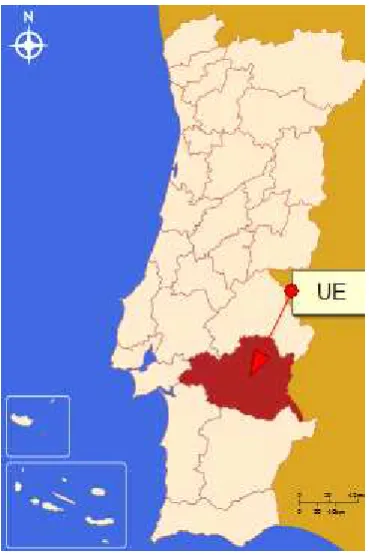
the University of Évora. Figure 1 thus shows all Portugal, the NUT III Alentejo Central
(in red), the location of the UE, and the location of the Alentejo (which is composed by
3 From a different, but complementary, perspective, Sorensen & Fleming (2004) analyse the importance
the Alentejo Central and the 4 NUTs III (out of the 5) surrounding the Alentejo Central
[image:13.595.206.391.149.427.2]with largest areas.
Figure 1: The four territories of diffusion
As pointed out by some authors, one fruitful source of knowledge diffusion is the
mobility in the job market (see Franco & Filson, 2006). In order to consider this issue,
we take the results of a recent enquire to the graduates of the University of Évora as
representative. In what concerns the job market, the responses to the question:
“Where did you get your first job” vs. “Where are you working nowadays?” can be
consulted in Table 1.
Table 1: The dynamics between jobs
Évora Alentejo Central Alentejo Portugal
Évora 201 12 23 66
Alentejo Central 21 74 16 30
Alentejo 14 11 169 53
Portugal 33 12 22 581
Current job
Fir
st
jo
[image:13.595.124.474.656.747.2]From Table 1 it can easily be inferred the importance of Évora as an attraction pole,
despite being also evident that many graduates do indeed take their knowledge with
them to other parts of the country.
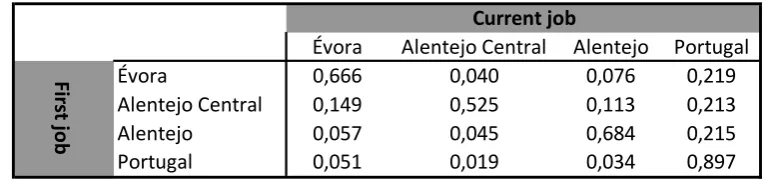
As some authors recognise, the diffusion of knowledge can be measured by the
analysis of the migration between jobs, which, being a dynamic process, can be
[image:14.595.104.491.329.420.2]analysed from a Markov chain point of view.4 Following this approach, the transition matrix corresponding to the data is given in Table 2.5
Table 2: The transition matrix
Évora Alentejo Central Alentejo Portugal
Évora 0,666 0,040 0,076 0,219
Alentejo Central 0,149 0,525 0,113 0,213
Alentejo 0,057 0,045 0,684 0,215
Portugal 0,051 0,019 0,034 0,897
Current job
Fir
st
jo
b
Under the usual hypothesis, the stationary distribution of the dynamic process is given
by {Évora = 15%; Alentejo Central = 5%; Alentejo = 13%; Portugal = 67%}.6 Plainly, these figures have to be made proportional to the area of the four territories of
diffusion, in order to accurately point out the importance of the diffusion of knowledge
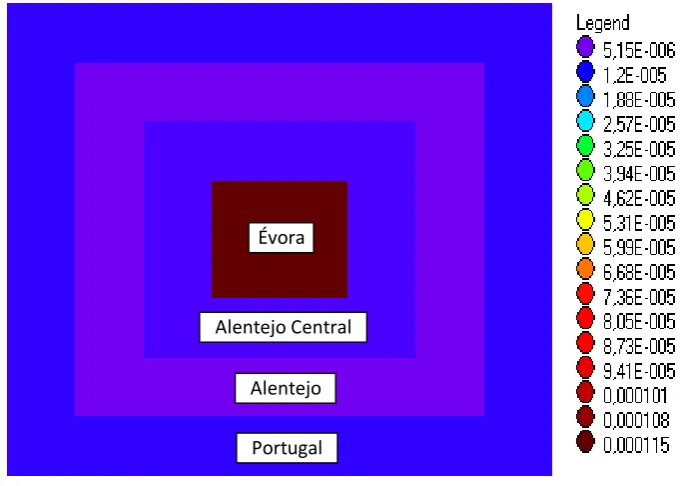
due to the University of Évora via its graduates. The values obtained after dividing
those values by the areas (measured in Km2) of their corresponding territories are represented in Figure 2, this being constructed in order to include the territory with
less area in the one with the area immediately above, i.e. obviously, Évora in the
Alentejo Central, the Alentejo Central in the Alentejo and the Alentejo in Portugal.
4 Weingart et al. (1999) also use a Markov chain approach in order to analyse the role of knowledge in
the sequential processes of negotiation. 5
As the values in the transition matrix are obtained dividing each of values in Table 1 by the sum of each row, each row in Table 1 adds to one.
6 This stationary distribution corresponds to the percentages that in the long-run, each of the (four
Évora Évora
Alentejo Central
Alentejo
[image:15.595.129.471.119.362.2]Portugal
Figure 2: The spatial diffusion of knowledge by the University of Évora
Being understood as a rainbow (cold/hot) plot, Figure 2 clearly point out the
importance of the diffusion of knowledge particularly in Évora and in the rest of
Portugal, that can be associated to the graduates of the University of Évora, being also
observable that the (rest of the) Alentejo is the territory where that importance is less
evident.
4. Conclusion
The HEIs can contribute to improving and to consolidating the regional knowledge
capacity, through mechanisms in the area of education and research. The coherence of
regional knowledge creation and diffusion system will become more robust through a
rigorous selection of courses and curricula adapted to regional technological needs,
and by supporting the development of a culture using local techniques (accumulation
characteristics. From this point of view, the dynamics of local enterprises are crucial,
particularly through the employment promotion and retaining the graduates.
Also, the processes of creation, acquisition, adaptation and diffusion of new
knowledge developed in the universities, can consolidate the relationship capacity of
the region where they are inserted, developing projects that involve the sharing of
co-operation between companies. This can contribute to diminishing the distance
between science, technology and the society, between pure and applied research and
between the discovery of new technologies and the development of products and
viable processes of production (facilitating the accumulation of tacit knowledge).
In empirical terms, the main conclusion is the University of Évora is an important
sources of knowledge diffusion in terms of the small/medium sized town where it is
located (i.e. Évora), despite not being ignorable the importance in terms of the rest of
the country. From this point of view, the importance of the University of Évora, in
terms of spatial diffusion of knowledge, is to be added to the economic impact of this
university as measured in Rego (2003).7 As a matter of fact, when adding up also the diffusion of knowledge that is certainly due to the scientific activity of the academic
staff of the University of Évora, the importance of this HEI is obviously closer to its real
figure.
As directions for further research we would like to study an issue that despite being
apparently/intuitively important could not be studied due to lack of information in the
enquiry (which may require the application of another enquiry). As a matter of fact, in
order to better understand the regional effects of the University (of Évora), it seems
crucial to know if graduates, during their study period, had some contact with
enterprises operating in the region of Évora and/or in the region of actual residence,
thus favouring the admission of students to business jobs after their graduation
degrees.
References
BATTU, H.; FINCH, J.; NEWLANDS, D. (1998), “Integrating knowledge effects into
university impact studies: a case study of Aberdeen University”, Report prepared for
the Principal for Aberdeen University, Department of Economics, University of
Aberdeen.
BEESON, P.; MONTGOMERY, E. (1993), “The effects of colleges and universities on local
labor markets”, Review of Economics and Statistics, vol. 75, nº 4, pp. 753-761.
BERGER, M. C.; BLACK, D.A. (1993), “The long run economic impact of Kentucky Public
Institutions of Higher Education”, Lexington, KY: University of Kentucky Center for
Business and Economic Research.
BLACKWELL, M; COBB, S.; WEINBERG, D. (2002), “The Economic Impact of Educational
Institutions: Issues and Methodology”; Economic Development Quarterly, 16; 88-95.
BLUESTONE, B. (1993), “UMASS Boston: An Economic Impact Analysis”, Boston: John
W. McCormack Institute of Public Affairs, The University of Massachusetts.
BROWN R. H.; HEANEY, M.T. (1997), “A note on measuring the economic impact of
institutions of higher education”, Research in Higher Education, vol. 38, nº 2, pp.
229-240.
CALEIRO, A.; REGO, C. (2005), “Os Efeitos Económicos das Universidades nas Regiões:
Porque se deve usar a análise input-output na sua medição?”, Paper given at the XI
CONGRESSO DA ASSOCIAÇÃO PORTUGUESA PARA O DESENVOLVIMENTO REGIONAL,
CRESPO, V. (1993), Uma Universidade para os anos 2000, o Ensino Superior numa
perspective de futuro, Lisbon: Editorial Inquérito.
DRUCKER, J.; GODSTEIN, H. (2007), “Assessing the regional economic development
impacts of universities: a review of current approaches”, International Regional
Science Review, 30, 1: 20-46 (January 2007).
FRANCO, A.M.; FILSON, D. (2006), “Spin-outs: Knowledge diffusion through employee
mobility”, RAND Journal of Economics, Vol. 37, N.º 4, pp. 841-860.
GODDARD, J. (1998), “Contribuition au développement national et regional”, UNESCO,
Conférence mondiale sur l’enseignement supérieur, Paris.
KALE, D.; WIELD, D.; CHATAWAY, J. (2006), “Diffusion of knowledge through migration
of scientific labour in India”, mimeo, Paper given at the SPRU 40th Anniversary
Conference, The Future of Science, Technology and Innovation Policy.
LOPES, R. (2001), Competitividade, Inovação e Territórios, Lisboa, Celta Editora.
MAYANJA, M.K. et al (2001), “A comparative study of Makerere University graduates of
the faculties of arts and sciences”, AAU Research Paper Series, Study program on
Higher Education Management in Africa,
(available at http://www.aau.org/studyprogram/pdfiles/mayanja3.pdf).
NAGOWSKY, M.P. (2006), “Assessing the economic impact of higher education
institutions in New England”, Memorandum, New England Public Policy Center,
Federal Reserve Bank of Boston, Boston
THOMAS, D. (1995), “Education and the role of the university in economically
developing regions”, Higher Education Policy, 8 (2), 51-62.
REGO, C. (2003), Impactes da Universidade de Évora: Estudo de alguns efeitos no
território envolvente, Tese de Doutoramento, Universidade de Évora.
REGO, C. (2006), “Universities in peripherals countries: researching ‘in the regions’ or ‘for the regions’? – Some evidence based on the University of Évora experience”,
paper presented at The UNESCO Forum for Higher Education, Research and
knowledge: “Universities as Centres of Research and Knowledge Creation: An
Endangered Species?, UNESCO, December 2006.
REGO, C.; CALEIRO, A. (2004), “Universities and Economically Depressed Regions: How
‘attractive’ is the University of Évora?”, Conference Paper 23, European Regional
Science Association (available at http://www.ersa.org/ersaconfs/ersa04/PDF/23.pdf).
SORENSON, O.; FLEMING, L. (2004), “Science and the diffusion of knowledge”,
Research Policy, 33, pp. 1615-1634.
VARGA, A. (1998), “Local academic knowledge spillovers and the concentration of
economic activity”, Conference Paper 493, 38th
Congress of the European Regional
Science Association, Vienna, Austria
(available at http://www.ersa.org/ersaconfs/ersa98/papers/493.pdf).
WEINGART, L.R.; PRIETULA, M.J.; HYDER, E.B.; GENOVESE, C.R. (1999), “Knowledge and
the Sequential Processes of Negotiation: A Markov Chain Analysis of