Munich Personal RePEc Archive
Efficient coalition formation and stable
coalition structures in a supply chain
environment
Popp, Alexandru W. A.
APOC Services
27 October 2009
Online at
https://mpra.ub.uni-muenchen.de/18277/
Efficient coalition formation and stable coalition structures in a supply
chain environment
1Alexandru W. A. Popp2
Abstract
We study a real supply chain environment from which specific information and knowledge can be extrapolated for other similar environments. We focus our research on the analysis of the interactions between members forming different teams (and between the teams themselves), and on the leader’s management of the supply chain.
We note that there are many elements that contribute to the profitability of the network, which is dependent on the actions of the actors involved. We analyze certain characteristics that the actors have, such as their behavior, adaptation and learning levels, effort and willingness. Based on these components, we examine the performance of our actors and of the teams that the actors form.
We provide specific calculations that take into account most of the components determining the added value to the system. One of the advantages of our main formula is that it can be used to monitor the progress of the actors, as well as it can help in the identification of problematic aspects impeding in the creation of value for the system.
Our formula is very flexible and a modeler is able to adapt it to similar environments, providing him with great insight in the structures that he investigates.
We study certain theoretical games from which we uncover certain information and characteristics of similar environments and settings. Moreover, we provide a real life example in order to truly understand the mechanism of the network, and validate our theoretical assessments.
Moreover, we provide certain recommendations for a leader that is responsible for the supervision of actors (which have specific responsibilities) and the administration of a supply chain environment.
1
This paper was presented in 2008 in the Cooperation and Bargaining section, at the Workshop on Dynamic Games in Management Science, organized by GERAD – Montreal.
2
Part 1
1.1. Introduction
3There are many theories that treat and describe (theoretically) coalitions and coalition formation (i.e., behavior theories, group dynamics, social psychology, psychological studies, evolutionary studies, etc). For the purpose of this paper, we are interested in the reality of coalition maintenance. Thus, we study a real environment from which specific information and knowledge can be extrapolated for other similar environments and situations.
Teamwork is critical for the success of any firm. Well-established companies focus on the training and education of their employees, and on the understanding of how their virtual enterprise works. In today’s dynamic, multi-level segregated information and interactions, and, simply put, complex economic-society, successful companies focus on the tangible aspects of their operations, on the virtual inter-intra-connectiveness, as well as on the operations of the teams forming within the company. It is through this global performance that the overall success of the company is measured.
Any corporation must focus not only on the productivity (or revenues), but also on its employees, their development and on the interactions between the employees. In general, corporate companies focus on three aspects for the betterment of their employees:
1. Key aspects of team behaviors that are critical for the team success; 2. Diagnosing team behaviors (basically, identifying problematic behaviors); 3. Suggesting courses of action corrections, if need be.
In order to provide an adequate answer to these key components characterizing any team, we focus our research on individual agent actions, patterns of agents’ interaction, and three distinct (yet correlated) models: individual, multiple, and global team model.
We analyze practical economic situations in which one cannot assume complete information for in real life situations there is no event where there is global complete information. Thus, the ability of agents to adapt to a changing environment (an environment where information is introduced sporadically and where information can change part of the setup of the environment) is essential. There are many examples where companies invest considerable time, resources and effort in order for their employees to be prepared for a change that is introduced.
The environment that we study has many aspects relating to supply chain (SC) environments. In general, SC analysis is characterized by transfers of inventory between the different networks present in the chain. Our paper focuses on the obligations of actors, how actors fulfill these obligations, the behavior of actors, either taken individually or collectively as a team, and their added value to the company.
The paper is set up in the following manner. In Part 1, we will have an overview of the literature and we will provide the basis for coalitions, as well as for supply chain environments. In Part 2, we will establish the characteristics of our game and the
3
responsibilities of the leader (that has certain control over the environment). Moreover, Part 2 will describe the payoff structure, provide the composition of the coalitions, and describe the different types our players’ behavior. The actions of our actors and our understanding of the former are also portrayed in Part 2.
In Part 3, we will analyze the statistical data that we gathered, we will provide a further understanding regarding the payoffs to the actors, and we will describe in greater detail the core concept of a game. Moreover, we will analyze different games representing different situations that can arise in our environment. A detailed analysis of all the games that we study will also be provided in Part 3.
We end our paper with general remarks and certain recommendations regarding similar environments studied.
1.2. Overview
In human constructed environments, laws regulate social interactions and behavior (either individual or collective). Laws impose certain influence and constrains on the manner people behave in their social interactions, interactions where conflict is present between individual (or collective) interests and where the common good is at risk. As a result, laws are a mechanism of aligning individual and collective interests through operative behaviors.4
We observe that companies have well-established rules and regulations. Thus, we believe it is important to define and describe these vast terms. Anglo-Saxon jurisprudence tradition (Raz, 1980) refers to laws as ‘obligations backed by incentives’. Laws reflect certain rules of conduct, the obligations that are enforced by different means of penalties, and the rewards which refer to the incentives that an individual has. Obligations are people’s responsibilities under the specific law, what people are asked to do (or not to do). Incentives represent the positive or negative consequences people face if they follow or do not follow the specific obligations. The implications of and how the latter influence individual behavior has been analyzed in different contributions of psychology and economics.5
The corner stone of a rule is the influence it has on individual behavior. Analysis has proven that legal rules (laws) can influence to a certain extent individual behavior through different material payoffs – incentives.6 However, this view is limited in understanding why, for example, political parties obey legal rules if by disobeying the laws, the certain party (or actor, in our case) can relatively improve its payoff.7
We take special noticeof certain findings that Galbiati and Vertova (2008, p 155) arrive at regarding the obligations that affect the levels of average contributions to a public good. They also explore different situations where an unexpected increase in the minimum contribution triggers a temporary re-start in the cooperation (that previously deteriorated) between the members, while an unexpected reduction in the minimum
4
Galbiati and Vertova 2008, p 147.
5
See Fehr and Falk, 2002.
6
See Cooter and Ulen, 2003; Polinsky and Shavell, 2000.
7
contribution does not alter the descending trend of cooperation.8 Another very interesting conclusion that Galbiati and Vertova (2008, p 159) have is that obligations have certain limits on individual behavior in social dilemmas.
It has been proven that there is an expressive function in laws. Thus, rules and laws provide a coordination device that helps in the understanding and comprehension of individual’s beliefs about other’s behaviors.9 Moreover, regulations have a strong impact on psychological individual preferences. If the actors see the rules as fair (meaning that the same rules apply to all in the same manner), then the actors are ‘forced’ to revise their values and, subsequently, their conduct.10,11
We point out that sanctions for non-cooperation could be understood through incomplete and very subtle contracts. Yet, this method is preferred with the intention to encourage a second chance for cooperation of the deviator (or the ‘lawless’) in order for the latter to have the opportunity to remedy himself.12 However, this strategy creates certain precedence, and it impacts the subtleness of (other) contracts that are opened to interpretation. If the specific laws and contracts are not applied correctly, the leader13 can be perceived as loosinghis power (or authority) of influence because the latter creates the perception that he is inefficient. We also note that the lack of leader effectiveness or the illusion of it are almost equal in importance in a short time span.
Mainstream economic and psychology literature has shown that both intentions and incentives play a key role in the manner that sanctions unfold.14 We also note that incentives refer to impersonal rules of law15, while intentions revolve around human beliefs and purposes. The lack of proper incentives is the main cause why threats of sanctions fail to induce cooperative behavior. In the same time, it has been proven by many researchers16 that intentions are deterministic elements. Furthermore, researchers pointed out that the former also has an important role in shaping decisions.17
One of the theories that explains certain aspects referring to the individuals’ actions and restrictions is cognitive dissonance theory. The latter theory (Festinger, 1957), including self-serving biases (Babcock and Loewenstein, 1997), upholds the idea that people long to have consistent beliefs (resulting in consistent behavior)18. Consistent
8
Galbiati and Vertova 2008, p 159.
9
See Bohnet and Cooter, 2005; McAdams and Nadler, 2005; Cooter, 1998.
10
See Cooter, 1998; Kahan, 1997.
11
Galbiati and Vertova 2008, p 147.
12
The following lesson is taken from psychology: if an actor has the ‘initiative’ of an action, the results will be longer lasting (and the actor will believe harder in it), than if the action is imposed on him from an outside actor or the environment. Moreover, if the lawless has the initiative (not imposed by the leader), than this enterprise will help the individual build his self-esteem faster.
13
The leader is responsible for all activity of his direct reports.
14
Fehr and Schmidt, 2007; Fehr and List, 2004; Andreoni et al., 2003; Camerer, 2003; Fehr and Rockenbach, 2003; Fehr and Falk, 2002; Sefton et al., 2007; Dickinson, 2001; Fehr and Gächter, 2000a; Gneezy and Rustichini, 2000a, 2000b; Bewley, 1999; Falk et al., 1999; Ostrom et al., 1992; Yamagishi, 1986, 1988.
15
Houser et al. (2008), p 510.
16
Falk et al., 2008, 2003; Charness, 2004; Charness and Levine, 2004; McCabe et al., 2003; Charness and Haruvy, 2002; Fehr et al., 1993.
17
Falk et al., 2008, 2003; Fehr et al., 2007; Charness, 2004; Charness and Levine, 2004; Falk and Kosefeld, 2004; McCabe et al., 2003; Charness and Haruvy, 2002; Nelson, 2002; Offerman, 2002; Brandts and Solà, 2001; Fehr and Gächter, 2000b; Blount, 1995; Gordon and Bowlby, 1989; Greenberg and Frisch, 1972.
18
behavior, consistent beliefs, self-serving biases (and other concepts of cognitive dissonance theory) can explain partly why intentions have a strong influence on the actions of individuals in economic environments.19,20
We see a real need for analyzing individual behavior and the elements that influence cognition because they play an important role in today’s regular interactions. Moreover, cognitive psychology literature has shown that actors have a tendency to find similarities (varying from outside environment(s) to internal cognition processes) even though there are no assurances of their existence.21
Alloy and Tabachnik (1984) suggest that having such consistencies helps researchers understand past behavior and predict future ones.22 Moreover, the same authors proved that certain types of obligations influence the rate of decline of cooperation over time, an aspect that is essential in our research.
1.3. General remarks on coalition
We know that politics, economics (and economy)23 are present in a corporation. Thus, in order to ‘survive’ in such an environment, one must be a member of an alliance (a coalition).
In our research, we refer to teams as coalitions of different members that have a similar interest. We differentiate between business coalitions (strategic level), where business interests are at stake (over which the leader has full authority) and personal coalitions (social level), which denote similar personal interests of the actors (over which the leader has no authority and no control over them).
In general terms, a coalition (besides being a multi-agent system) is an alliance among individuals or teams that engage in a common action for the accomplishment of a common purpose. We note that certain cooperative literature stipulates that coalition participants’ self-interests must be present for there must be a valid reason for the formation of the specific coalition. In our game, there are certain personal self-interests that are tangential to the interests of the coalition.24 However, personal interests have no relation with the formation of the work coalition. It is the leader that forms the business coalition. In our research, we focus on the latter type of the coalition, and we make the parallel between self-interests/personal interests (which may be represented in the literature as private goods) and business interests (which may reflect the public goods rational).
We refer to a private good as a benefit that is only useful for a specific individual. A public good is a reward that is applied to the entire community (and to all members of
19
Charness, 2004; Charness and Levine, 2004; Falk and Kosefeld, 2004; Falk et al., 2003; Charness and Haruvy, 2002.
20
Extensive research has already been done on this topic. For some examples, see Konow, 2000; Rabin, 1994; Akerlof and Dickens, 1982; Festinger, 1957.
21
For examples and detailed analysis, see Arkes and Harness, 1983; Allan and Jenkins, 1980.
22
Sonsino and Sirota (2003), p 390.
23
We make the distinction between economy and economics as in Popp, 2006b.
24
that community). In the same time, we do not disregard the presence of core(s) in our analysis.
Game theory (GT) does not provide specific formulas that agents can employ to form coalitions. The former focuses on asserting, verifying, and validating stability and fairness by Kernel concepts, and on calculating the corresponding (side-) payments to (and between) agents. We point out that throughout our analysis, we circumvent certain aspects and problems that mainstream coalition literature has. In our example, even if we use GT, we resolve one such difficulty of coalition formation by a mechanism through which the leader appoints the members to a specific coalition. Thus, we do not allow agents to form the teams that they desire (besides a deviation coalition – situation that we will analyze in section 2.3. and 2.4.). The coalitions are imposed. Having this approach, we simplify the coalition formation processes.
We note that there are three stages within the life of a coalition:
a) Members convey together and form a coalition;
b) Coalition maintenance, i.e. maintaining the coalition (excluding members; replacing excluded members);
c) Coalition termination: end of the coalition.
As stated before, we simplify steps a) and c) by providing the leader with control over these aspects. Our research focuses on the second step, coalition maintenance.
1.4. On supply chain environments
Game theory can help in expending the supply chain analysis (and literature), an environment where multiple agents are present and where diverging interests, objectives and directives exist.
Supply chain management (SCM) analyses mainly the integration of information and resources in the flow of a network. Yet, in this analysis, one must pay particular attention to important elements of the network, such as location, transportation and logistics, inventory and forecasting, incentives, reverse logistics, strategic alliances, and (the quality of) services. One of the goals of SCM is to provide the best distribution of resources (whatever those may be).
Even though GT is useful regarding some SCM aspects, in the same time, we acknowledge certain procedural limits when analyzing SCM using GT. One such difficulty is the fact that managers have problems in the implementation of mixed strategies, or determining what mechanisms must be utilized when determining mixed strategies. Another difficulty is the actual implementation of the specific mixed strategies.
We focus our research on the analysis of the interactions, operationalization and management of a supply chain.
We make certain distinctions between a network, a chain and a network chain. A
formed by a series of nodes that are connected, forming a whole, where one node is connected to at least two other nodes (excluding the first and last nodes). A network chain (supply chain or supply network)25 is a network of actors who coordinate the flow of information and resources, and cooperate in the process of converting the materials into products (or services) that are to be delivered to a client.
We note that any action that influences, may that be positively or negatively, the end result is part of the network chain (NC).Also, the end-result of any supply chain is the creation of value to either the service or the product of which the chain specializes in. Moreover, the structure of the NC plays an important role in the manner success is achieved throughout the specific network.
In order to better comprehend the characteristics of a supply network and how it applies to our game-environment, we will analyze: 1) the process, which identifies the mission and the procedures of the network; 2) the performance, which takes in consideration the variations in productivity/production and its reasons; and 3) the
institution(al) perspective that refers to the network’s configuration and structure. Moreover, we point out that there must be a strategy for the implementation and realization of the imposed mission.
One of the potential problems that a network-chain can exhibit is that some companies function in silos. A silo-company does not possess a powerful supply chain management. There is an unsynchronized decision-making process and lack of communication between silos that does not aid the company to properly face the challenges of the 21st century’s complex economy. The former brings unnecessary high cost activities to the specific business, thus loosing the company’s competitive advantage(s).
Another difficulty, which is challenging to grasp, is that companies must deliver to its clients a quality product, in a short time-span, at a good price. In order to accomplish this, pertinent information (accurate and adequate) must be available for those involved in the planning and execution of the different stages of the network. Yet, this information may not be accessible and/or user-friendly.
Throughout our paper, we will analyze some of the problems that corporations are facing regarding SCM, and we will try to provide certain recommendations to these difficulties.
Part 2
2.1. Characteristics of the game
As stated before, we analyze a real life situation in order to better understand the mechanics of stable coalition structures. The environment (E) of the game is representative of a particular set of supply chain procedures that form a semi-opened loop. The end-result of our NC is a set of service(s) provided to different clients.
25
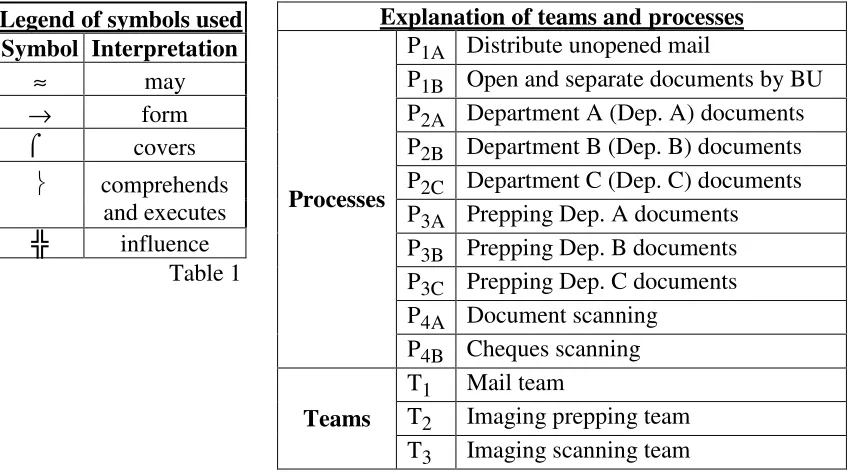
The game is characterized by three different teams, which together may form the total core (Level 0, L0)26. We also examine the grand coalition specific to each team, formed by its members (Level 1, L1). Thus, L1 illustrates the interactions of the individuals of the teams. The NC is established in four processes (Pni), which are executed by three different teams (Tn). Thus, we have27:
a) Tn = {(T1, T2, T3) Tn≈→ L0)},
where tni→ Tni and tni’∈ Tni’;28
b) Pn = {(P1, P2, P3, P4) (P1A, P1B) ∈ P1; (P2A, P2B, P2C) ∈ P2;
(P3A, P3B, P3C) ∈ P3; (P4A, P4B) ∈ P4},
where all process sets and sub-sets are specialized29;
c) T1 = {(t1a, t1b) T1 (P1, P2),
where (t1a, t1b) (P1, P2)};
d) T2 = {t2a, t2b, t2c, t2d, t2e, t2f} T2 P3,
where (t2a, t2b, t2c, t2d) (P3A), (t2e) (P3B),
(t2f) (P3C)};
e) T3 = {(t3a, t3b) T3 P4 ,
where (t3a) (P4A), (t3b) (P4B)}.
We have represented in Table 2 the description of the sets (and subsets) of the teams and processes, and we have provided in Figure 1 the workflow of our NC.
In such a structure, we have two major coordination perspectives: 1. vertical (between teams); and 2. horizontal (between the members of a specific team). For this reason, dynamic interactions between the members of the teams and between the teams themselves are encouraged. Moreover, we specify that the members of a team (or
26
We have mentioned that we are interested in business coalitions (public goods). Analysis of a public goods context regarding the non-emptiness of the core in coalition games has been provided by Demange (1994), Greenberg & Weber (1986), Guesnerie & Oddou (1981). Meanwhile, Greenberg & Weber (1993) analyze the same situation from a political economy point of view.
27
Refer to Table 1 of the Appendix for the legend of the symbols.
28
Members of a specific team form the specific team, and the members of the specific team belong to that specific team.
29
team) have symmetric roles. However, teams do not have a symmetric role due to our NC setup.
There is a predetermined production schedule where complete information regarding the amount of the demand of the service(s) is not provided by too much time in advance. Yet, members and teams are responsible and accountable for meeting specific expectations. Even if the overall process (procedural supply chain) is imposed by the leader, members have control over sub-processes, thus creating a semi-decentralized decision making process. We observe that the dynamics of the system increase having this approach. The overall success is dependent on the decisions and actions of the members of the teams. Moreover, the leader has a supervisory role where he verifies the end result.
We note that the Service Demand Harmonization (SDH) is of two (2) hours, which means that the members of the teams have two hours to complete P1 to P4. The quantity of the services rendered would suffer if the SDHs were not met30. In the same time, all teams’ members must pay particular attention to the quality of their work, which is indicated in the overall quality of the services rendered by our Administrative Services Unit (ASU).
Moreover, our game is played daily because there is a one-day business cycle (no work is left for the following day).31
2.2. Leader
The leader (referred also as protocol manager) plays a central role within our game set-up. He has two key responsibilities: 1. customer service (being a liaison between the members of a team, between the teams, between teams and members, and between his direct reports and the other Business Units/departments (BUs)); 2. to oversee the good operation of his teams. The last attribute is broken in different subcategories: a) provide assistance to his direct reports and to his teams; b) he is responsible for the performance of all the functions within his department.
Moreover, planning and forecasting undergone by the leader are essential in the network. The accuracy of these two elements impacts the performance and processes of the network. We note that leader effectiveness can be measured by the procedures implemented and by the level(s) at which actors follow them.
The leader must be flexible and must be able to implement customized tasks imposed by the outside system, i.e. properly respond to the demand(s) of the environment. He must adapt fast and bring the team(s) to accept and follow the specific change. Thus, the protocol manager is also responsible for the distribution and redistribution of the tasks among the members of the coalition.
30
This is transferred to the team through negative payoffs.
31
In order for the teams (as well as the individuals) to perform at their best capacities (and capabilities), the leader must be capable to provide adequate social engineering and instill a specific social identity in the network. The cohesion of the members of the teams as well as between the teams themselves are an important task that the leader must take in consideration and to which he must allocate the necessary time and resources.
Moreover, beliefs learning and environmental adaptation play a central role in the daily behavior of actors. It is the leader that must provide the tools that are needed for the development of both staff as well as the latter’s sets of beliefs (effective and appropriate). Specific decisions must be accurate and taken in a timely manner by the leader. Thus, because dynamics are involved, there are continuous-time processes which are important in the normal flow of operations. Dynamic optimization of interactions is essential. Therefore, the leader must create an environment that is prone to communication between the members of all teams as well as between the teams themselves.
The leader is also responsible for the payment of the payoffs (positive or negative) to the actors and to the teams for he is accountable for the overall performance (individual as well as collective). The latter can be measured through the accuracy of procedural benchmarks and follow-ups.
There are certain restrictions and conditions that the leader imposes. For this reason, the leader may be seen by the actors as dictatorial. One such example is the manner in which he assigns the members of the teams. Members of the team are pre-assigned (by the leader), i.e. actors cannot choose their own team. When creating the teams and when introducing a new member in the team, the leader must take in consideration the following aspects and characteristics of an actor (yet, not restricted only to them): the competences that he possesses, his ability (and willingness) to learn new tasks, his ability to adapt to a changing environment, the impact on the other team members, and his capability to adapt to the team that he will be a member of (and to function efficiently and effectively within that team). It is on this basis that we consider the leader as the architect of the teams. We address the basis on which the leader assigns an actor to a team in section 2.4.
The leader must always address individual challenges and must work together with the actors in order for them to surpass expectations personal as well as the ones imposed by the team. The same rational applies also to the needs of a team.
In order to understand clearly the dynamics of the interactions, we must comprehend the system from the leader’s perspective32, as well as from the perspective of the teams’ members33.
32
Thus, understanding the game where the leader establishes the variable(s) that influences the state of the system.
33
2.3 Payoffs
All payoffs depend on the type of coalition structure that is developed. The former rely on the efficiency of the entire team, consequently, on the effectiveness of the members and on the dynamic structural configuration that is formed. Payoffs are dependent on the feedback received by the different BUs (provided to the teams by the leader), thus creating externalities to our game set-up. Members belonging to the same team receive the same team payoff because their duties are similar. Positives and negative payoffs depend on the actions of the previous day(s) as well as on those of the current day, and they are paid by the leader as he sees appropriate.34 Therefore, the payoff provided by the leader to the team has the following form:
Tϕλ = Σf(λϕdx), (2.3.1)
where we have payoff ϕ, leader λ, the function f(λϕdx) denoting the payment rational, and d working days with d ∈ D = {d1, d2, d3, d4, d5}35.
The same process for payment of the payoffs applies to the actors also. Thus, the payoff received by an individual that belongs to Tn is:
ϕi = [ni/(ni – 1)]Tϕλ + ϕλ + δϕi + + c1Σ
tni ∈ Tnx (ϕtni) + c2Σtni ∉ Tnx (ϕtni), (2.3.2)
where i is a specific actor, tni is a member of Tn receiving the specific payoff, ni representing the number of members in the team that tni belongs to, c1 and c2 are the coefficients representing the weight of the payoff36 received by a member from other members of the same team and from members of a different team, respectively. We note that the term [ni/(ni – 1)]Tϕλ is formed by the team’s payoff and a coefficient c > 1 relative to how many members are in a specific team. Σ
tni ∈ Tnx (ϕtni) and Σtni ∉ Tnx (ϕtni)
represent the sum of all the payoffs that an actor receives from members of their team and members of diffferent teams, respectively.
Therefore, we note that the leader provides a payment to an individual, and that actor also receives other types (different sources) of payments.
We specify that payments may be granted more than once a day, depending on the outcomes of the actions of the actors/teams37, and the payoffs are caped. In the same
34
Operational mistakes may not be necessarily identified immediately. They can be revealed on a latter date. After a five (5) working day period, all mistakes (if any) have been signaled and responded to.
35
d is a refinement of our system. We will not use it in our analysis for simplicity reasons. Moreover, the term Σλϕ(d) captures all payoffs provided by the leader to the team.
36
The weight of the payoff is assigned by the actor and represents the importance that the latter attributes to the source of that specific payoff.
37
time, once a payment is granted, that payment cannot be retracted. Also, there are no recursive payments for the same action.
Members of teams can provide other members with side payments. However, we point out that there are non-transferable positive (or negative) payoffs allowed between the players for the formation of a coalition(s). The latter statement contradicts the basis of cooperative literature.38 We answered in section 2.2. (and we will analyze this aspect in greater detail in section 2.4.) to a very important question: how are the teams formed if there are no payments allowed between tns (in order to form Tni)? The leader appoints actors to a specific team.
We note however that side payments between Tns are permitted in order for the possibility to form the total core L0 (providing greater possibilities for the core. See section 3.2.2. and 3.2.3.for a detailed description).
We consider a member of a coalition myopic if he is only concerned with his immediate payoffs. Individualistic behavior is penalized from different sides, in such a way that actors engaged in myopic strategies (aiming also at deviation), as well as nonmembers, receive negative payoffs.39,40 These payoffs are assigned by the independent team actors (acting individually and independently of the team), by the team, as well as by the leader. This is a control that brings the coalition deviator in an ‘outcast’ position, situation that creates and influences the degree of his cognitive pessimism. At this stage, cognitive dissonance is present for the deviator, and the latter must engage in different mental processes in order to reduce the dissonance between the normal cognitions and the environmental ones.
In order to avoid myopism, deviation and the presence of acute cognitive pessimism, behavioral change mechanisms must be put in place such that actors are encouraged to be proactive members of the team(s) and must uphold their respective coalition(s) (notwithstanding different positive payoffs that represent positive reinforcement). Therefore, the leader is responsible for creating and maintaining the team spirit, the willingness of an actor to be part of the team.
Worst payoff is to be fired, meaning that the leader not only terminates the actor’s membership to a team, but that actor is fully taken out of play. This is the greatest sanction that a leader may inflict to an individual. As Leon Petrosian (HEC 2008)41 stated very clearly, this payoff is characterized as ‘sudden death’ for the actor in the game. This sanction is used as a last resort.
The deviation payoff function to a member of a team is the following:
work done. The sooner the individuals receive their payoff, the better it is for the entire system, and especially for the individuals. Payment of rewards (or penalties) should occur as soon as possible.
38
In most cooperative literature, side payments between members of a team not only that are permitted, but are essential for it is through the payment mechanism that members form coalitions.
39
They do not have a 0 (zero) payment for this would mean there is a status quo situation. Having a negative payoff properly illustrates the impediments that the nonmember imposes on the team.
40
These payoffs are given to the individual regardless of the team he is in. The direct payoff of the team (value of the coalition in GT format) is not affected. Yet, the congruentpayoff (Coalition Factor Estimation (CFE) analyzed in section 3.2.2.) of the team is affected for the latter is composed by all individualistic payoffs of each member.
41Workshop on Dynamic Games in Management Science
δϕi = λϕδ + c1Σ
tni ∈ Tnx (ϕδtni) + c2Σtni ∉ Tnx (ϕδtni), (2.3.3)
where δ is the deviation weight (and δ is negative).
The leader must ensure that appropriate sanctions mechanisms are in place; if they are not present, the leader must create them. We note that sanctions must be applied as a correction method to the individual (or to the team) that is not following procedures. Moreover, the former must be proportionate to the error in question. However, we note a grey zone (in which extensive research has already been made) in which individuals must be able to acknowledge the difference between credible and non-credible threats imposed by the leader.42 The deviation coefficient is representative of the sanctions mechanisms that either the leader creates or that the team (or individuals of a team) may impose on a deviator.
We note that there is no individual best reply strategy(ies) for deviators. Any individual player knows that if he deviates, it will be enough to precipitate a decrease in productivity of the remaining coalition. Moreover, it is common knowledge that a decrease in productivity or quality will be panelized.
The reason why the payoffs are caped is that neither teams’ members, teams, not even the leader, can provide a payment that is not lawful within the system (the company).43 Thus, the payoffs’ minimum and maximum values (especially the maximum ones) are following strict rules, regulations and policies imposed by the corporation and the department. The leader does not have great flexibility in increasing the range of the payoffs (increasing the maximum payoff enforced by the system). However, we note that different systems may have different scales. Moreover, for our game set-up, all variables described in Table 3 belong to N. If one requires the values to belong to R, we see no inconvenience.
We remark that ϕλ (from (2.3.2)) and λϕδ (from (2.3.3)) are mutually exclusive. A player cannot receive a positive payoff from the leader for a job well done and in the same time receive a negative payoff because the player is deviating. The terms c1, c2 are positive for a player cannot assign a negative value to a payoff that he received from other members of his team or other teams.
2.4. Coalition
Individuals are brought into the specific environment based on certain competence matrixes, on their previous experiences, on their willingness and capacity to learn new tasks. Moreover, the actor’s ability to adapt to the team to which he will be allocated, as well as the willingness of the team to ‘incorporate’ the new member to the team, play a central role in the leader’s decision to hire the candidate. The leader must analyze all the information available to him.
42Non-credible-threats
is a tool that is used more often by teams vs. teams or teams vs. individual. The leader can use this method also, however we advise not to employ it often. If the actors realize that the leader uses non credible threats, the leader might be challenged, loose power of influence, etc.
43
Once the actors are appointed to the specific team, there are two aspects to be considered: 1) old team members must accept the new addition to the team; 2) the new member of the team must understand how the team works and adapt to the new environment. Only once these two elements are accomplished, the leader can address the team as an entity by itself. The leader works closely with the team and with the new member in order to have an easy transition/integration.
The leader sets the roles, duties and responsibilities of all the actors (information that is common knowledge to all actors). Once the team is formed, the leader must be aware of how the specific coalition structure functions for he is responsible for the overall operations. Yet, he is not required to monitor all the team’s interactions. The latter has a life of its own.44 The reason why the leader must know the dynamics of the coalition structure is that if he is required to intervene (on an individual basis, or at the team level), he would have the necessary knowledge of the dynamics as well all the necessary information before he addresses the situation. No additional research or preparation is required for the leader. The latter can intervene very quickly to remedy the situation, if need be.
The behavior, actions and involvement of one member of the network influence (and has a direct impact on) the production and performance of all other members (or teams) in the specific network, thus he has a direct influence on the profitability of the network. Moreover, the overall value of the coalition depends upon the actions of actors in the coalition, thus on the members themselves. In the same time, the coalition strength is determined by what it can achieve on its own [uT* = f(m)]; nonmembers are not taking in consideration.
The leader must implement programs that result in an efficient and effective coalition structure. These programs must induce the coalitions to be farsighted and the actors must have an attitude free of deviation (procedures). The overall success of the coalition (which is based on the final payoffs) is the principal target of coalitions.
In order to ensure a high performance level of the chain, open information exchanges are required. The information must be available to all actors as soon as it is available. Moreover, the negative implications of poor coordination can have very drastic consequences, which can bring the destruction of the individual teams, or even that of the entire network. We note that information flows both ways: top-down (leader informs the actors); and, bottom-up (actors inform the leader).
We have the subsequent definition for a coalition:
Definition 1: In order for a coalition to be possible, we need the following elements:
-there is a finite set T of players ti, where ti≥ 2; -uT* is the value of the coalition, where u(∅) = 0.45
We specify that the value of the coalition is constant (and it is based on a typical day)46. uT* would increase iff. the members of the teams are faced with difficult (out of
44
If the leader becomes a fully active member of the team, he will loose his leader authority. His role is to lead the specific team.
45
the normal) situations and they address the latter in an adequate manner. We note that the leader would increase the payment to both the members and the teams only in out-of-the-ordinary situations47. Once the environment regains its equilibrium (normal state of affairs), uT* would come back to the original constant value.
Members of teams can deviate from their teams (from the collective unit rational; a member can isolate himself; he is not supporting the team, the members of his team, and the other members/teams, etc.). The deviation can go up to the point where the individual fully excludes himself from the team. In the case that there are two players that are deviating in the same time, they can try to form a deviator coalition (it is a psychological effect that the deviator(s) (in our case, the individual) have. They do not want to be singled out – forming singletons – thus, they look for an allegiance with another member(s)). In the situation where there is a deviator coalition, the leader would address the deviators individually, not the deviator coalition. It is easier to persuade the individual than the coalition.48
We had the opportunity to test the previous theoretical assessment in real live situations. Throughout our research, there were four occasions of multiple simultaneous deviations (more than one member deviated in the same time period and where the deviators formed a coalition). On three occasions, the issues were addressed on an individualistic basis; this approach resulted in the issues been resolved. Only on one occasion the leader addressed the entire deviator coalition, process that did not bring any positive results. The former then addressed the issues on an individual basis. All the problems that the actors had were fixed, and the actors re-integrated their specific teams (stopped being deviators and stopped pursuing deviation). Even though our statistical data pool was not large, we are convinced that the best course of action for the leader is to address similar situations on an individualistic basis.
We illustrate in the following manner the deviator and the remaining members of team in (2.4.1), and ∆T as the deviator coalition (2.4.2):
tniδ∈ {tni} tni→ Tni∴ Tni = {(tniδ), [(tni) – (tniδ)]}; (2.4.1)
tniδ∈∆T iff. i > 1 tn∀
iδ∈∆T . (2.4.2)
46
A typical day in ASU is characterized by the following events: 1) mail – a. an average of 520 envelopes either to be dispatched or opened for the imaging team; b. 3 address changes; c. an average of outgoing mail for Canada Post of 1250 pieces, 120 pieces for UPS, and 2 pieces for QA courier; d. a weekly average of 3 changes; 2) imaging – a. an average of 1200 documents prepped and scanned (including checks); b. answering queues; c. a weekly average of 4 changes. In both mail and imaging sub-departments there are 2 to 4 difficult situations. We note that not all the issues can be addressed by the players. If this is the case, then the leader is responsible for the proper handling of the specific issues.
47
Out-of-the-ordinary situations refer to: complicated demands; complicated documents; players absent; spike in volumes; late receipt of mail.
48
If a deviator coalition ∆T exists, then an additional negative payoff is paid by the leader to ∆T. Moreover, uT* would decrease if one of the following conditions is present: a) if ∆Tti ≥ 1; b) if the members are not following procedures, thus incurring mistakes.
We recall that if ∆Tti = 1, creating thus a singleton, the deviator has a certain degree of pessimism regarding the structure that he is a member of, or regarding the environment in which he is placed. These are the aspects that the leader must identify and address with the deviator.
We also take note that there is a possibility where the team might exclude a member in order to receive a bigger payoff49. However, all present members must participate to the work done, information that is common knowledge. In this situation, the leader will penalize the team (not taken in consideration the member that was excluded). The rational for the team’s penalty is due to the fact that the team surpassed their role, farsighted strategies were not used, the team did not act as a collective unit, and the team did not inform the leader of the need/want/willingness to exclude a member (the team’s desire). It is the leader’s responsibility to exclude (thus terminate) a member of a team.
We require a coalition configuration (specific to each team) that is stable and optimal in terms of utility maximization. A core partition is stable in the sense that there is no reason for a deviation to take place.50 However, we point out that certain problems related to incentives of cyclical coalitional deviations might be present. It is optimal in the sense that not only the members of a team work in concert in order to accomplish a specific goal, but also the actors try to maximize the dynamic function of the payoff.
We also note that one person might deviate unwillingly. This is a situation where the not-work-related environment has a strong influence on an actor. Due to human nature, one cannot fully dissociate personal-life and work-life. Because we are analyzing work situations, we have to acknowledge the fact that actors’ work (and behavior) is influenced (positively or negatively) by events in their personal life. If the latter’s influence is significant, then the actor would not be able to focus on his work, or he will be absent minded; the result will be an unwilling deviation (besides the procedural mistakes that the actor makes).
Any coalition requires a protocol (of specific duties), as well as strategies (that can be employed in order to achieve a specific goal). Moreover, we point out that a coalition may only be as strong as its weakest member. In the same time, uT* for one coalition is not dependent on uT* of another coalition. Each team has its own coalition value.
2.5. Types of behavior
There is a slight difference in the analysis undergone by cooperative GT and by non-cooperative GT. Cooperative GT analyses a game from the perspective of the value created through the cooperation of the players. Thus, it focuses on the outcome of the
49
Let us say that one member is doing procedural mistakes; this is translated in a low uT*. If the team excludes that member (tx∉ Tx), the work load is divided between the members of Tx, then uT* would increase.
50
game. Non-cooperation GT aims at understanding the specific actions of players. In order to have a clear understanding of the situation, one must utilize both cooperation and non-cooperation analysis. Thus, a powerful method that a modeler might see useful is to change a cooperation game in a non-cooperation game and/or vice versa.
Once a player is assigned to a team, he can have only three different types of behavior (regarding the team that he is a member of, as well as towards other teams):
i. Cooperative behavior (Cb) – where he supports the team;
ii. Non-cooperative behavior (NCb) – where he is either aiming at deviation or already a deviator (non-member of the team);51
iii. Non-adaptive behavior (NAb) – having the same behavior as before he joined the coalition.52
As stated before, there are strategic and dynamic interactions between members and teams. Cb is strongly encouraged by the leader and by the other members of the team. Meanwhile, the actors know that individual prolonged NCb (and NAb)53 will have the worst outcome: the person would be terminated and taken out of the game.
In order to transform NCb into Cb (or NAb in Cb), the actors are forced to use farsighted strategies where all actors must act as a collective unit. One of the reasons for farsightedness is that the members of the teams want to keep their membership to the team in which they belong, thus maintain their employment. We note that the individual as well as the collective payoffs are important in the type of behavior that is adopted, and players change their behavior due to incentives (either positive or negative) – i.e., the payoffs. Moreover, research has shown that obligations (supported by low incentives) cannot sustain cooperation in repeated interactions.54
The environmental behavior β55 of a player i has the following form:
βi = q’Cbi + q”NCbi + q’”NAbi (2.5.1)
{≡ [1–(q”+q’”)] Cbi + [1–(q’+q’”)] NCbi + [1–(q’+q”)] NAbi},
where βi is the behavior of a player, and q’, q” and q’” are percentages that reflect the probability of the actor choosing either Cbi, NCbi or NAbi, such that 1 = q’ + q” + q’”.
After the integration of an actor in our system, NAbi = 0, and the term q’”NAbi {[1–(q’+q”)] NAbi} is taken out of the equation.56
51
Deviation refers to his lack of support to the network (lack of support regarding Tn – thus, regarding tni) – or lack of support impeding for Tn≈→ L0.
52
This type of behavior can occur after the introduction of a new player in the network.
53
We note that prolonged NAb is transformed in NCb.
54
Galbiati and Vertova (2008), p 160.
55
This refers to the behavior of an actor regarding his environment: towards the team that he is a member of, towards members of the team, towards other teams, towards other members, etc.
56
Moreover, we note that there are different forms of behavior available to the actors in each set of behaviors. Their choice is influenced by many elements (or conclusions).57
2.6. Actions
We note that actions and processes are not similar. Being engaged in the accomplishment of a process requires an (process-) action. However, in (2.5.1), we are referring to behavioral-actions, not to process-actions. Moreover, the beliefs of an actor shape the way the actor sees his environment. We also point out that the environment influences the formation, shaping and annihilation of beliefs of actors.58
We denote ait as action i of player t, where ai ∈ A, A being the set of feasible actions (permitted or not by the system and leader). We point out that A is comprised of many types of actions (team related, work related, individual related, process related, etc.). Moreover, an action permutation is the vector of actions a = (a1, …, ai) that has the following form ai:ti. When all players engage in the same action, we have a uniform action combination that is translated to the progress of the team in the same direction.
We acknowledge that the action-function is also dynamic and it is dependent on the individual, his beliefs, his perceptions, his actions. Player ti’s value of action(s) (and consequently their work beliefs) should be consistent with the following linear rule:
ai:ti = (adati⋅ lti)(ap.k) + GLOQ
+ βti + βTni + βti(Tni)⋅ adati + OBR
+ ϕσ
ti⋅ (eff.ti + wti)
ϕσ
ti - MOT
- s ⋅ (adati+ lti)/(adati⋅ lti), TAL
(2.6.1)
where we have the player’s adaptation coefficient adati, player’s learning coefficient lti,
βti is the player’s behavior, the player’s team behavior βTni, player’s behavior demanded by his team denoted by βti(Tni), player’s payoff stimulation ϕσ
ti, player’s effort
coefficient eff.ti, player’s willingness coefficient wti, and time index s with s > 1.
We note that one player cannot have more than one ai:ti permutation simultaneously (or during the same time period). Moreover, the cumulative actions of the players determine the Coalition Factor Estimation (CFE) (û). Thus,
57
See Popp (2006a) for details of conceptual conglomerates (ConCs).
58
Σai:ti∈
T = ûTti .
59
(2.6.2)
We point out that ûT refers to the added value of the specific team to the environment, to the department, and consequently to the entire company.
We remark that there is a finite set of possibilities that a player can create. Thus, there is a set X of states and the state space X is finite. Moreover, the actions undertaken by the individuals, and thus their outcomes (the value of the actions), are related to the payoffs received by the players.
We point out that a modeler can construct different (types of) vectors for the illustration of the relationship between actions and payoffs.
GLOQ
The GLOQ term [(adati ⋅ lti)(ap.k)] refers to the global quality of the work done.60 We note that higher coefficients for adatiand lti will signify a higher adaptation level and a more rapid learning, respectively. The product (adati ⋅ lti)(ap.k) represents the applied knowledge that a player has and is engaged in for the work (process-action) that he has to perform. Moreover, adati refers to the overall adaptation of the player to his environment: to the team(s), to the work necessities, to change, to demands, etc. lti represents the player’s learning capabilities that take in consideration the different methods of learning, the time required for the player to learn a topic (or a process), different approaches to the treatment of information61.
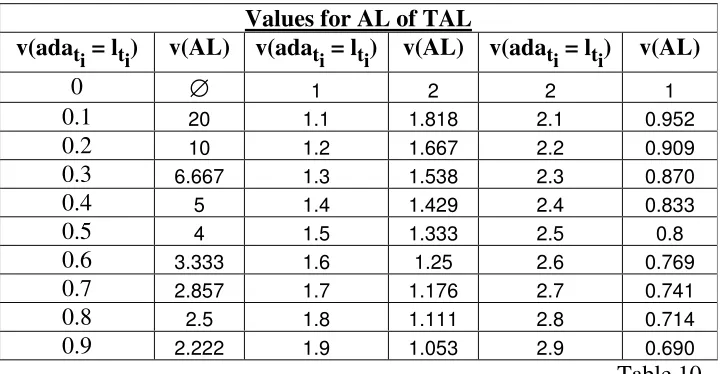
We acknowledge that adati and lti are directly correlated, and the relationship between adati and lti that the leader is looking for in an actor prior to the actor’s introduction to our game environment is:
lti≥ ;adati; g(adat,lt)
2 ≥ lti – adati. (2.6.3)
Table 4 illustrates the values associated to each level of learning for an individual in our game setup.62
OBR
The overall behavior requisites term (OBR) [βti + βTni + βti(Tni) ⋅ adati] is composed by all the behavior demands made on the player. OBR takes into account the
59
We note that uT* is not the same as ûT*
60
We use the assumption (Assumption 4) that a high level of adaptation and learning (which refer to the specific applied knowledge to the process in question) will result in a good quality work. See Proof 1 of the Appendix.
61
See Popp (2009) for learning process and what elements influence the learning process.
62
behavior of the player, the behavior of the team, and a measurement formed by the behavior demanded by the team on the behavior of the player and the player’s adaptation capacity to this demand. Most of the time the team’s behavior and the behavior that the team demands from the player are the same [βTni≡βti(Tni)] Thus, we can write OBR in the following way:
βti + βTni + βti(Tni)⋅ adati = βti + βTni + βTni⋅ adati. (2.6.4)
The leader will always impose a cooperation behavior to the team (and within the team), thus cooperation from all the members of the team.63 Therefore, we rewrite (2.6.4) as:
βti + βTni + βTni⋅ adati = βti + Cbi + Cbi⋅ adati
= βti + Cbi⋅ (1 + adati). (2.6.5)
As stated before, we are aware that there are coefficient levels that determine (and characterize) how engaged the actors are in the specific type of behavior. We describe in Table 5 the different values associated to cooperation and non-cooperation behaviors.
We note that a value of zero (0) for βti signifies that the actor is neither engaged in cooperation nor non-cooperation. However, if this is the case, then we assign the actor a value of weak non-cooperation for he is not ‘helping’ his environment. This is translated to an apathetic player.
Considering (2.6.5) and replacing βti from (2.5.1), we have:
q’Cbi + q”NCbi + q’”NAbi + Cbi⋅ (1 + adati). (2.6.6)
Cbi and NCbi are of interest to us. NAbi is taken in consideration only when new players are brought in the system. Let us assume for now q’”NAbi = 0. Thus, we have from (2.6.6):
q’Cbi + q”NCbi + Cbi⋅ (1 + adati). (2.6.7)
Moreover, cooperative and non-cooperative behaviors are mutually exclusive when an actor is engaged in a specific action. A player cannot be cooperative and non-cooperative in the same time regarding the same issue. However, we note that during the course of one day, an actor can have both cooperative behaviors and non-cooperative behaviors.
Thus, if an actor is engaged in cooperative behavior, we have from (2.6.7):
63
q’Cbi + Cbi⋅ (1 + adati), (2.6.8)
and if the actor is engaged in non-cooperative behavior, we have:
q”NCbi. (2.6.9)
We note that in (2.6.9), adati is not present. This illustrates correctly reality for in a situation where an individual upholds a non-cooperative behavior, he is not supporting his team, he is not adapting to the environment; thus, there is no need for that actor to adapt to anything.
Moreover, we note that in (2.5.1), the probabilities that an actor may cooperate or not cooperate are present. However, in (2.6.8) and (2.6.9), even though q’ and q” are present, we can make both of them equal to 1. As stated before, cooperation and non-cooperation are mutually exclusive. Thus, we have
Cbi + Cbi⋅ (1 + adati) = Cbi⋅ (2 + adati); (2.6.10) OBR
NCbi. (2.6.11)
MOT
The motivation term (MOT) [ϕσ
ti⋅ (eff.ti + wti)
ϕσ
ti] is composed by the player’s
payoff stimulation ϕσ
ti, the player’s effort coefficient eff.ti, and the player’s willingness
coefficient wti. We note that the payoff stimulation ϕσ
ti has the following form:
ϕσ
ti = ϕcti – ϕr(s-1)ti, (2.6.12)
where ϕ
cti represents the payoff considered by ti, the time index s with s > 1, and ϕr(s-1)ti
represents the payoff received by ti in (s-1) (referring to the last payoff received). There are three possibilities for ϕσ
ti:
ϕ
cti > ϕr(s-1)ti∴ϕσti > 0;
ϕ
cti = ϕr(s-1)ti∴ϕσti = 0;
ϕ
cti < ϕr(s-1)ti∴ϕσti< 0.
We note that ϕ
r(s-1)ti is a fact for ti received the payment ϕti. However, ϕcti is
If ϕσ
ti > 0, then MOT is positive, and this signifies that the actor is motivated. If
ϕσ
ti = 0, then the player is apathetic. If ϕσti < 0, then MOT is negative, and it indicates
the disincentive/discouragement (de-motivation) of the actor. We point out that MOT is dependent on ϕ
cti and ϕr(s-1)ti, the payment that an
actor received and the one that he is considering receiving depending on the effort and willingness that he is keen to be engaged in. We note that if ϕσ
ti = 0, then there is no
reason for an actor to increase his effort or willingness for these coefficients will not change his motivation coefficient. However, we realize that if an actor increases eff.ti and wti, he will expect ϕσ
ti > 0. If the player increased eff.ti and wti, but ϕσti < 1, then the
actor not only that would be de-motivated, but also his demotivation would be proportionate to the effort and willingness that he had.
Moreover, we specify that there are different levels of players’ effort and willingness. We also note that an actor’s levels may not necessarily be equivalent with those of another actor (ex. t2a may consider an effort/willingness of 2, while t2b would consider an effort/willingness of 3 for the performance of the same task). For simplicity reasons, we will consider the effort and willingness levels being applicable to all players in the same manner. Table 6 provides the values and the levels breakdown of our coefficients.
Individual as well as team moral are essential. If moral is low, then the players would have a tendency to be de-motivated, and MOT would be negative.
For all these reasons, we believe that our formula (and thus, our understanding) for MOT is correct and adequate in representing reality.
TAL
The time-adaptation-learning term (TAL) [s ⋅ (adati+ lti)/(adati⋅ lti)] represents an indicator composed by the ability to adapt, the capacity to learn, and time. Having a time component, the term illustrates accurately reality: all individuals need time to adapt and to learn. Moreover, the term is negative because time influences negatively the actions of a player.64 A simpler version of the term is:
s ⋅ (adati+ lti)/(adati⋅ lti) = (s ⋅ adati)/(adati⋅ lti) + (s ⋅ lti)/(adati⋅ lti)
= s / lti + s / adati. (2.6.13)
As lti (adati) increases, the term s / lti (s / adati) decreases. We also note that if the learning and adaptation coefficients increase, then the TAL’s65 value will decrease66. Thus, for higher values of the two coefficients, time does not play an important role; it is
64
The time component refers to how many time units a player needs to adapt or to learn. One can set the time units to any time period, depending on the game situations and the environment of the game.
65
Note that process-action quality is present by itself, as GLOQ.
66
minimal. However, for small values of lti (adati), this term increases (not only in value, but also in importance).
We can conclude from (2.6.13) that adaptation, as well as learning, are inverse proportionate to time. Our conclusion illustrates nature adequately for one can observe that high adaptation (or learning) skills require modicum time for the person to adapt (or to learn).
Having [s/(adati ⋅ lti)] (time / process-action quality) is counterintuitive due to the fact that we usually calculate the employee’s ‘productivity’ by how many processes he can perform in a unit time (# processes / unit time). However, (adati ⋅ lti) (which is equivalent to (adati ⋅ lti)(ap.k)) represents the adaptation and learning levels regarding the work applied knowledge of the employee.
We must take in consideration the fact that players’ past experiences influence their behavior, and the former can increase adati and lti. Moreover, if an actor is familiar (in any way) with the protocols to be learnt, adati and lti will increase furthermore. This aspect is part of the intrinsic characteristics of humans (actors in our case): to draw necessary connections (and conclusions) regarding similarities between situations. However, more research needs to be made regarding past experiences with similar situations and their degree of influence on the actors’ behavior.
Part 3
3.1. Statistical data
Table 7 describes different situations where the leader is present (or not present) in the direct supervision of the actors. We have the following labels: setting λ1 – the leader is present; setting λ2 – the leader is absent; event α1 – SDH met; event α2 – SDH not met (by more than 5 minutes); event α3 – time to spare; event α4 – usage of time to spare; event α5 – work related communication; event α6 – no-work related communication.
Our data was collected over a 100 non-consecutive day span where the leader was present and supervised directly the players and their work (50 non-consecutive days), and where the leader was not present (50 non-consecutive days) while the players were engaged in their roles and duties.
The manner in which the leader gathered the data was: 1) present – close contact with his direct reports67; 2) not present – the leader observed from a distance.
The SDH are applicable only to the imaging team. Moreover, we point out that each BU (documents for that specific BU) has its own SDH. Therefore, the SDH does not apply to the overall volumes, but to the specialized processes in Imaging. There were two (2) SDH shifts (shift 1: 8.30-10.30; shift 2: 10.30-12.30), for a total of 4 hours duration.
67
![δ [-3, 0] Table 3 Table 4](https://thumb-us.123doks.com/thumbv2/123dok_us/7957106.752784/46.612.93.522.82.733/d-table-table.webp)