Integrated Concept for the Selection of Process-improving
and Competence-increasing Methods for the Shopfloor
Bellmann Vivian K.
*, Schmidt Matthias
Institute of Production Systems and Logistics, Germany
Copyright©2016 by authors, all rights reserved. Authors agree that this article remains permanently open access under the terms of the Creative Commons Attribution License 4.0 International License
Abstract
Drivers like globalization, digitalization and the demographic change force companies to constantly adapt to changing environmental requirements. In order to cope with this changes companies use process-improving and competence-increasing methods. To select the most suitable methods, a concept is needed which supports companies by identifying suitable methods. This paper describes which factors have to be considered for an efficient selection of process-improving and competence-increasing methods and how companies can identify their need to improvement with regard to key performance indicators and employee competences.Keywords
Competence-increasing Methods, Increase in Productivity, Process-improving Methods, Identification of Need for Improvement, Profiles for Methods1. Introduction
Due to the advancing globalization, digitalization and an increasing demographic change companies are forced to constantly adapt to changing environmental requirements in order to maintain their competitiveness [1]. Facing these challenges companies try to improve their production as a source of the company's profitability. Moreover, companies need to include their employees into the improvement process. Because the employees are the ones who are carrying out improvement processes an increase of the employees’ competences is often necessary. [1-3]. To achieve an overall performance improvement, companies apply process-improving and competence-increasing methods on the shopfloor. Process-improving methods like 5S, Poka Yoke or Kanban aim to improve key performance indicators such as delivery times, quality rate or work in progress [4-6]. Furthermore, companies apply competence-increasing methods like job rotation, job
enrichment or job enlargement. The increased competences are necessary to enable the employees in order to respond more appropriate to new challenges [7, 8]. With these methods, process-improving as well as competence-increasing methods, companies can increase their productivity and, moreover, influence their competitiveness in a positive way [9].
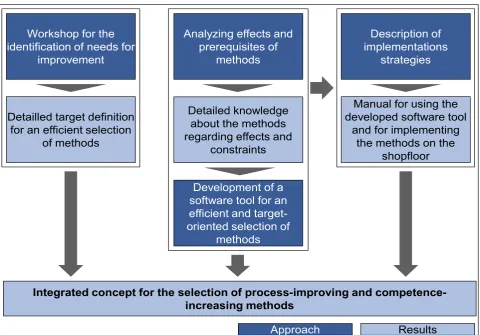
Since there is a huge amount of applicable methods, companies face the challenge of selecting and applying the right method. There is a lack of knowledge about the effects of the methods on the overall performance. Also, the requirements which are needed to implement a method successfully are often not known. In practice, the selection of methods is therefore often based on intuition or experiences [10]. As it is very complex to gather all the relevant information and compare different methods which each other, a tool was developed that supports the companies by selecting the methods. In order to select the necessary methods with the tool support, the company has to know about its specific need for improvement and about which targets should be aimed for by implementing the methods on the shopfloor. Therefore the tool is integrated into a concept which supports companies throughout the whole method selection process.
2. Development of the Integrated
Concept
Figure 1. Elements of the integrated Concept
Within the second element of the integrated concept an approach was developed which enables a target-oriented selection of methods. The approach is based on the awareness of the methods, their effects on productivity as well as the implementation prerequisites. Therefore, selected methods were analyzed in order to identify their effects on key performance indicators as well as on employee competences [11]. Another focus is on the prerequisites that might exist in a company and that might complicate a successful implementation or even make it impossible [12]. All information about the methods’ effects and the prerequisites are collected in a database. To process these data a system was developed which compares the identified company’s targets with the effects of each method.
To complete the integrated concept a third element, a manual, was developed. The manual includes descriptions of how to design and execute the interview-based workshop (element 1) in a company. It also contains so-called method profiles. These method profiles include all information about the effects of the methods on the performance, their constraints as well as detailed descriptions on how to implement the methods [12]. The manual is an additional support for the companies using the developed software tool.
3. Development of Method Profiles
For an efficient selection of methods it is necessary to know what effects occur while applying the methods on the shopfloor. In general process-improving and competence-increasing methods have effects on different key performance indicators as well as on employee competences. Before selecting and applying a method, companies have to know what effects a method has on specific key performance indicators and employee competences. In addition, a successful and sustainable implementation of methods depends on several aspects. On the one hand the employees need to be capable of applying the methods. For a successful and a sustainable implementation each method requires certain employee competences. On the other hand the company’s characteristics play an important role. These characteristics include for example the different forms of production systems. An exemplary differentiation can be made between single-piece productions and serial productions. There are methods that perfectly fit to one context, but are not applicable in another. Considering these aspects, the methods for process and competence improvement were analyzed from different points of view. A detailed analyzation of implementation steps and applying strategies is the basis for deriving method profiles.
Development of a
software tool for an
efficient and
target-oriented selection of
methods
Description of
implementations
strategies
Manual for using the
developed software tool
and for implementing
the methods on the
shopfloor
Analyzing effects and
prerequisites of
methods
Detailed knowledge
about the methods
regarding effects and
constraints
Detailled target definition
for an efficient selection
of methods
Workshop for the
identification of needs for
improvement
Results
Approach
Figure 2. Effects of methods on key performance indicators and employee competences [12]
For the development of the integrated concept more than 60 shopfloor-relevant methods were collected and analyzed. All gathered information was transferred into method profiles for methods. The profiles include details about the effects on key performance indicators and employee competences causes by an implementation of the method. Apparently, there are methods which cause effects on key performance indicators as well as on employee competences, e.g. semi-autonomous work groups or worker self-inspection [13]. These methods are particularly interesting because companies can improve several critical success factors by only implementing one method. The differentiation of the effect of the methods on employee competences and key performance indicators is based on a three-stage scale from zero to two. Figure 2 shows an excerpt of the database for the effect of methods.
Additional to the effects of the methods on key performance indicators and employee competences, the developed profiles support companies by only choosing methods which fit into their context. The method profile includes specific company characteristics as well as employee competences which are critical for a successful implementation of the method. Furthermore, the profiles include a detailed description of the different steps that are necessary for implementation. Also a best-case practice example is given to facilitate the process of implementing the methods on the shopfloor.
Although the profiles contain all relevant information for the selection of methods, it is still very time-consuming to compare the different methods and to identify those which cause the highest effect on the company-relevant key performance indicators and employee competences. Therefore an approach was developed which connects all the collected information and evaluates the methods based on an integrated decision-making algorithm. The approach is the
basis for a software tool which supports the process of selecting the best fitting methods. Nevertheless, the first element of the integrated concept, the workshop, is still very important for the efficient selection of methods. Companies need to analyze relevant critical environmental factors as well as their strengths and weaknesses. Without a detailed awareness of their need for improvement, it is not possible to choose methods which really lead to a sustainable competitive advantage.
4. Determining Relevant Future Key
Performance Indicators and
Employee Competences
The integrated concept requires an approach which helps companies to specify its need for improvement as precise as possible. To support the process of identifying the specific need for improvement an interview-based workshop was developed. The workshop is divided into two parts and six to ten people can participate.. In order to allow all relevant decision-makers and internal experts of the company to take part in the workshop an external facilitator is needed.
In the first part of the workshop the participants focus on analyzing the internal strengths and weaknesses of the company, e.g. insufficient delivery time or unqualified employees and external opportunities and threads with respect to competitors. For the analysis the facilitator interviews all workshop participants using prepared interview sheets (Figure 3). These interview sheets contain the relevant key performance indicators and employee competences that were identified within our research project. For every single key performance indicator and employee competence the workshop participants evaluate whether it is a strength or a weakness. Furthermore they evaluate the Method
Employee Competences Key Performance Indicators Ability for team
work awarenessQuality Throughput time Reject rate
Impact Impact Impact Impact
5S 0 0 2 2
Kanban 1 0 2 1
Semi-autonomous
working-group 2 2 0 2
Worker
self-inspection 0 2 0 2
Impact:
performance of the company in comparison to competitors. The assessment is based on a five-tier scale. The range of the scale is from poor to excellent. In addition to the analysis, the workshop participants evaluate which key performance indicators and employee competences play an important role for the future of the company. A five-tier scale is used again and the key performance indicators can be classified from unimportant to crucial. The complete analysis as well as the assessment of the role and impact of key performance indicators and employee-competences is interview-based.
The second part of the workshop focusses on identifying
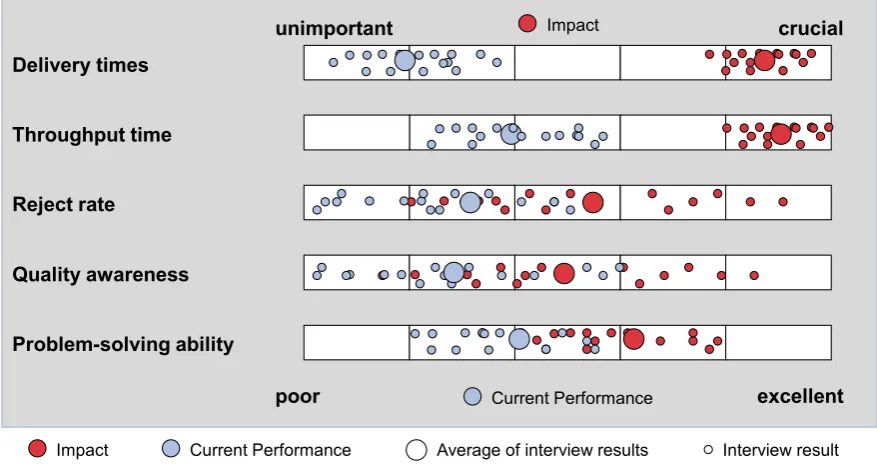
[image:4.595.87.525.220.488.2] [image:4.595.85.524.506.738.2]the needs for improvement and on setting targets for the next planning period. The facilitator anonymizes all interviews and aggregates the results of the interviews from part one (Figure 4). In order to support the process of identifying the need for improvement, the facilitator uses a chart. This chart displays the current performance in comparison to the future role assigned by the workshop participants for every single key performance indicator and employee competence. In most cases there is a gap between the current company’s performance and the assigned role and impact.
Figure 3. Extract of Interview Sheets for determining relevant key performance indicators and employee competences
Figure 4. Exemplary Presentation of interview results
Strength and Weaknesses:How do you evaluate the current performance of single key performance indicators and employe competences?
poor excellent
Delivery times
Opportunities and Threats: How do you evaluate your performance in comparison to competitors / benchmarks?
poor excellent
Delivery times
Role and Impact:How do you evaluate the role and impact of single key performance indicators and employee competences? (corporate strategy, customer requirements etc.)
unimportant crucial
Problem-solving ability Quality awareness Capacity for teamwork Reject rate
Throughput time Delivery times
crucial unimportant
Delivery times
Throughput time
Reject rate
Quality awareness
Problem-solving ability
poor excellent
Impact Current Performance Average of interview results Interview result
Together with the external facilitator, the company’s internal experts discuss the results with respect to the identified threats and opportunities. The main objective of the discussion is to define field of actions that are critical for the company’s success, e.g. improving delivery times or improving the problem-solving ability of the employees. It is not mandatory to choose those key performance indicators and employee competences with the largest gap between the current performance and the assigned role and impact. This is especially important, if the competitor’s performance in one category is much better than the one of the company’s and if this category is also connected to a crucial role and impact. In this case it might be very decisive for the competitiveness of the company to improve this key performance indicator or employee competence.
After discussing the results the workshop participants are now able to prioritize the key performance indicators and employee competence with respect to their corporate strategy and their ability to respond to competition. These targets can now be transferred into the software tool. In addition, the software tool requires information about the current performance of the single key performance indicators and employee competences as well as the individual company characteristics.
In order to select those methods which best contributes to the company’s targets, the software tool compares the given information of the company with the effects and requirements of the methods. First the software tool excludes those methods which do not fit to the company’s characteristics. For example the method “semi-autonomous working-group” should not be implemented if the company employs only unskilled workers [12]. As the semi-autonomous working group requires workers which are able to perform different tasks like planning, executing and controlling, an unskilled worker would not be able to perform these tasks. After excluding those methods which do not fit to the company’s characteristics, the software tool selects those which have the highest effect on the prioritized key performance indicators and employee competences. Supported through the developed manual, the company is now able to implement the selected methods successfully.
5. Outlook
Although the method profiles and the manual already contain much information about the methods and their implementation strategies, it is not possible to integrate all relevant aspects for guaranteeing a successful implementation. For example, the software tool does not capture the fact that each company has a different corporate business culture. The fact that the results of the selection are strongly connected to the quality of the information given by the company should not be neglected. The manual tries to capture all these constraints, but these aspects need to be kept in mind when using the software tool. Therefore the main goal of the tool is to support decision-makers in selecting
methods by showing possible solutions for their given context.
Acknowledgments and Legal
Responsibility
The IGF-project 18226 N of the Forschungsvereinigung Gesellschaft für Verkehrsbetriebswirtschaft und Logistik e.V. – GVB, Wiesenweg 2, 93352 Rohr was funded through the AIF under the program to promote joint industrial research (IGF) of the Federal Ministry of Economics and Technology (BMWi) following a decision of the German Federal Parliament.
REFERENCES
[1] Spath, D.; Ganschar, O.; Gerlach, S.; Hämmerle, M.; Krause, T.; Schlund, S.: Studie Produktionsarbeit der Zukunft – Industrie 4.0. Stuttgart 2013
[2] Heinen, T.: Planung der soziotechnischen Wandlungsfähigkeit in Fabriken. PZH Verlag, Garbsen 2011 [3] North, K.; Reinhardt, K.: Kompetenzmanagement in der
Praxis. Mitarbeiterkompetenzen systematisch identifizieren, nutzen und entwickeln. Wiesbaden 2005
[4] Kamiske, G. F.: Handbuch QM-Methoden. Die richtige Methode auswählen und erfolgreich umsetzen. 2. Auflage München 2013
[5] Sekine, K.; Arai, K.: TPM for the Lean Factory. Innovative Methods and Worksheets for Equipment Management. Portland, Oregon 1998
[6] Lunau, S.; Meran, R.; Schmitz, A.; John, A.; Roenpage, O.; Staudter, C.: Six Sigma+Lean Toolset. Mindset for Successful Implementation of Improvement Projects. New York 2013
[7] Ryschka, J.; Tietze, K.-O.: Beratungs- und betreuungsorientierte Personalentwicklungsansätze. In: Ryschka, J.; Solga, M.; Mattenklott, A. (Hrsg.): Praxishandbuch Personalentwicklung. Instrumente, Konzepte, Beispiele. Wiesbaden 2011
[8] Richter, F.; Pohlandt, A.: Arbeitsintegrierte Ansätze der Personalentwicklung. In: Ryschka, J.; Solga, M.; Mattenklott, A. (Hrsg.): Praxishandbuch Personalentwicklung. Instrumente, Konzepte, Beispiele. Wiesbaden 2011
[9] Sehorsch, S.; Vössing, J.; Gebhardt, M.: Früher qualifizieren, schneller profitieren. Personalwirtschaft (2013) No. 5, pp. 59‐61
[10] Zoléko, J.-F. : Reifegradbasierte Planung eines organisatorischen Regelwerkes in einer Produktion. Dissertation. Leibniz Universität Hannover: PZH GmbH 2011
[12] Bellmann, V.K.: Systematik zur effizienten Methodenauswahl. In: Industrie Management 32 (2016) No. 3, pp. 43.46
![Figure 2. Effects of methods on key performance indicators and employee competences [12]](https://thumb-us.123doks.com/thumbv2/123dok_us/8782178.904832/3.595.65.532.75.288/figure-effects-methods-key-performance-indicators-employee-competences.webp)