Journal of Chemical and Pharmaceutical Research
__________________________________________________
ISSN No: 0975-7384 CODEN(USA): JCPRC5
J. Chem. Pharm. Res., 2010, 2(5):562-571
Formulation and development of anti-blemish preparation
using microsponge technology
1
*Vyas L. K., 2Tapar K. K., 1Laddha B. H., 1Lahoti A. O. and 3Nema R. K.
1
Vidyabharati Mahavidyalaya, Camp, Amravati, India
2
Vidyabharati College of Pharmacy, Camp, Amravati, India
3
Rishiraj College of Pharmacy, Indore(M.P.), India
______________________________________________________________________________
ABSTRACT
Microsponges are highly porous micro-sized particles with a unique ability for entrapping actives. They are biologically safe, yet are Simple to produce making them attractive in the field of Cosmetics. They are consisting of 10-25 microns in diameter Loaded with active agent. Microsponge technology offers entrapment of ingredients & is believed to contribute towards increased elegance enhanced formulation flexibility & improved Stability. Microsponge technology is non-irritating, non-toxic, & Non-allergenic. Microsponge technology has been explored for applications like Anti-blemish Preparation.
Keywords: SepiwhiteTM MSH, Anti-blemish preparation, Microsponge technology.
______________________________________________________________________________
INTRODUCTION
Delivery system comprised of a polymeric bead having network of pores with an active ingredient held within was developed to provide controlled release of active ingredients whose final target is skin itself1. The size of the microsponge can be varied usually from 5 to 300µm in diameter depending upon the degree of smoothness or after feel required for the end formula2. Microsponge systems are stable over range of pH1 to 11, temperature up to 300C compatible with most vehicles & ingredients.
MATERIALS AND METHODS
Preparation3
Drug Loaded in Microsponges can take place in two ways one step process or by two step process, based on physio-chemical properties of drug to be loaded. If drug is typically an inert non-polar material, will create the porous structure it is called porogen. Porogen drug which neither hinders the polymerization nor become activated by it & stable to free radical is entrapped with one step process. There are two methods to prepare microsponge:
1) Liquid-Liquid Suspension Polymerization3
Microsponges are conveniently prepared by liquid-liquid suspension polymerization. Polymerization of styrene or methyl methacrylate is carried out in round bottom flask. A solution of non-polar drug is made in the monomer, to which aqueous phase usually containing Surfactant & dispersant to promote suspension is added. Polymerization is effected, once suspension with the discrete droplets of the desired size is established by activating the monomers either by catalysis or increased temperature. When the drug is sensitive to the polymerization conditions, two steps process is used.
2) Quasi-emulsion Solvent diffusion3
Microsponge can also be prepared by quasi-emulsion Solvent diffusion method using different polymer amounts. The procedure is as follows:
To prepare the inner phase, polymer was dissolved in solvent. Then drug can be then added to the solution & dissolved under ultrasonification at 350C. The inner phase was poured into PVA Solution in water (outer phase). Following 60 min of stirring, the mixture is filtered to separate the microsponge. The microsponges are dried in air heated oven at 400C for 12 hour and weighed to determine production yield.
Application of Microsponge2
Microsponge technology has been successfully applied to a large number of topical products including cosmetics, cosmoceuticals over the counter drugs & prescription drugs. Useful active materials for personal care are easy to load onto the Polymer because they simply require the addition of an active solutions or liquid to the polymer under controlled conditions. This technology is used for treatment of:
1) Treatment of acne vulgaris. 2) Treatment of actinic keratoses.
3) Treatment of post inflammatory hyperpigmentation & melasma.
_____________________________________________________________________________
Advantages of Microsponge4
* Advanced Oil control absorb up to 6 times its weight without drying. * Extended release continuous action upto 12 hours.
* Reduced irritation.
* Improved product aesthetics-give product an elegant feel. * Improves stability thermal, physical & chemical.
* Allows for novel product forms.
Components: Actives & formulation aids
Actives: Examples of Microsponge based delivery Systems includes incorporation of active such
as Sepiwhite TM MSH.
Formulation Aids: Ethylcellulose, Dichloromethane, Carbomer 940, Triethanolamine, Mineral
oil, Cetyl alcohol, Stearic acid, Glyceryl monostearate, Lanolin, Isopropylmyristate, Petrolatum, Propylene glycol, Glycerine, Sesame oil, Span 80, Emulsifying wax, Poly vinyl alcohol, Cocoa Butter, Almond oil, Propyl paraben, Methyl Paraben.
Methods:
1) Preparation of Microsponges (Unloaded)
2) Preparation of microsponges (loaded with SepiwhiteTM MSH)
Flow chart for preparation of Microsponges containing sepiwhite TM MSH.
Formulation of Various Cosmetics
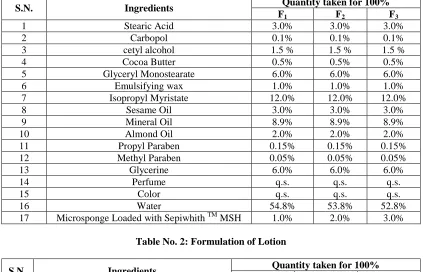
Cream: The ingredients of oil & aqueous phase were heated separately in beaker to 75-800C. As soon as temperature was reached the oil phase was added to the aqueous phase & mixed well with stirrer. The perfume was added when product was cooled to 400C. The selected formula for cream containing microsponge loaded with sepiwhite TM MSH is given in Table 1.
Lotion: The lotion was prepared by the conventional method. The oil & aqueous phase were
_____________________________________________________________________________
products in the concentration of 1%, 2% & 3%. The selected formula for lotion containing microsponge loaded with sepiwhiteTM MSH is given in Table 2.
Evaluation of MicroSponges:
Microsponge was evaluated by using different methods such as determination of particle size, photomicrographic valuation, and assay for maximum drug loading of microsponges.
Evaluation of cream and Lotion:
[image:5.595.95.518.265.537.2]Cream and lotion was evaluated by using different methods such as accelerated stability studies, determination of pH, total fatty substances content, determination of water content, determination of viscosity & determination of thermal stability.5
Table 1: Formulation of O/W Cream
S.N. Ingredients Quantity taken for 100% F1 F2 F3
1 Stearic Acid 3.0% 3.0% 3.0%
2 Carbopol 0.1% 0.1% 0.1%
3 cetyl alcohol 1.5 % 1.5 % 1.5 %
4 Cocoa Butter 0.5% 0.5% 0.5%
5 Glyceryl Monostearate 6.0% 6.0% 6.0%
6 Emulsifying wax 1.0% 1.0% 1.0%
7 Isopropyl Myristate 12.0% 12.0% 12.0%
8 Sesame Oil 3.0% 3.0% 3.0%
9 Mineral Oil 8.9% 8.9% 8.9%
10 Almond Oil 2.0% 2.0% 2.0%
11 Propyl Paraben 0.15% 0.15% 0.15%
12 Methyl Paraben 0.05% 0.05% 0.05%
13 Glycerine 6.0% 6.0% 6.0%
14 Perfume q.s. q.s. q.s.
15 Color q.s. q.s. q.s.
16 Water 54.8% 53.8% 52.8%
17 Microsponge Loaded with Sepiwhith TM MSH 1.0% 2.0% 3.0%
Table No. 2: Formulation of Lotion
S.N. Ingredients Quantity taken for 100%
F1 F2 F3
1 Stearic Acid 2.0% 2.0% 2.0%
2 Cetyl alcohol 1.5% 1.5% 1.5%
3 Petrolatum 4.0% 4.0% 4.0%
4 Lanolin 5.0% 5.0% 5.0%
5 Glycerine 2.0% 2.0% 2.0%
6 Span80 2.0% 2.0% 2.0%
7 Propylene glycol 5.0% 5.0% 5.0%
8 Polyethylene glycol-4000 3.0% 3.0% 3.0%
9 Triethanolamine 1.0% 1.0% 1.0%
10 Propyl Paraben 0.15% 0.15% 0.15%
11 Methyl paraben 0.05% 0.05% 0.05%
12 Perfume q.s. q.s. q.s.
13 Color q.s. q.s. q.s.
14 Water 73.3% 71.3% 70.3%
[image:5.595.96.516.514.728.2]RESULTS AND DISCUSSION
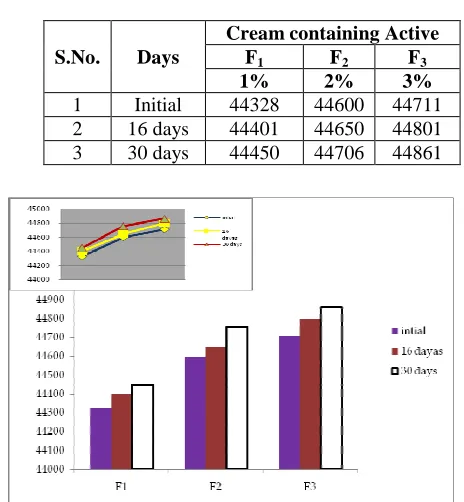
Two different cosmetic products of different characteristics were chosen as a base or career. They include cream & lotion which is the bases for preparation of various sepiwhiteTM MSH inoculated products & all variable parameters in the formulation procedure were optimized in each care. Therefore they were elevated as per respected ISO Accelerated stability studies. These carriers are having more advantage when studied various parameters.
[image:6.595.168.443.230.515.2]Accelerated Stability Studies:
Table No.3: Effect of pH on Cream at Room Temperature
S.No. Days Cream containing Active F1 F2 F3
1% 2% 3%
1 0 days 7.3 7.3 7.2
2 8 days 7.2 7.2 7.2
3 16 days 7.3 7.3 7.3
4 24 days 7.3 7.3 7.3
5 30 days 7.4 7.4 7.4
Table No.4: Effect of Viscosity on Cream:
S.No. Days
Cream containing Active F1 F2 F3
1% 2% 3%
[image:6.595.180.412.540.791.2]_____________________________________________________________________________
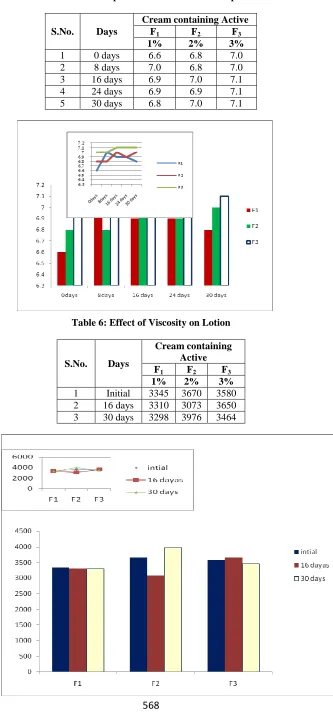
Table 5 : Effect of pH on Lotion at Room Temperature
S.No. Days
Cream containing Active F1 F2 F3
1% 2% 3%
1 0 days 6.6 6.8 7.0
2 8 days 7.0 6.8 7.0
3 16 days 6.9 7.0 7.1
4 24 days 6.9 6.9 7.1
[image:7.595.173.418.94.400.2]5 30 days 6.8 7.0 7.1
Table 6: Effect of Viscosity on Lotion
S.No. Days
Cream containing Active F1 F2 F3
1% 2% 3%
Stability Study of Microsponge:
The present stability is carried out according to guidelines given by International Council of Harmonization (ICH giddiness). In view of the potential Utility of coated & uncoated & ethylcellulose microsponge formulation stability Studies were carried out. The formulation was tested for stability at 5+20 C, 25+20 C, 40+20 C temperature. Formulations were stored in glassed bottles/Vials & them they were evaluated after 15, 30, 45 days for change.
Formulation and Evaluation:
Three different batches of Cream & Lotion with different ingredients were formulated & Formulation 3 (F3) as given in Table 1 and 2 respectively was selected on the basis of
optimization.
In-vivo studies:
For Cream and Lotion:
Patch test/ Photographic Evaluation: i) Material: Product Containing active
ii)Preparation of Sample : Sample of Product Containing active was prepared with known concentration.
iii)Selection of volunteers: The healthy Subjects were selected. iv) Mode of Execution.
Different blemish areas are marked on skin & labelled as controlled product. Sample is applied daily twice and observations are noted. Photographs were taken after interval of weeks.
_____________________________________________________________________________
CONCLUSION
The microsponge delivery system originally developed for topical delivery of drugs provides a wide range of formulating advantages. The formulation F3 of Cream and Lotion after
incorporation of Microsponge were satisfied all desired characteristics and acts as a novel cosmetic product. The microsponge delivery System increases the safety of irritating and sensitizing drug and programmed released can control the amount of drug release to the targeted site.
REFERENCES
[1] David W. Osborne. Anton H. Amann, Topical drug delivery formulations, Page No. 301, 302, 304, 306
[2] Meyer R. Rosen, Delivery system handbook for personal care & Cosmetic product, Page No. 338, 339, 340, 341.
[3] www.pharmainfo.net.
[4] Indian standard: Guideline hygienic manufacture of cosmetic specification for skin cream &
Lotion, 6608, 1978.
[5] Shlomo Magdassi, Elka Touitou, Cosmetic Science & Technology Series, Volume 19 Page No. 1-5.
[6] Kydonieus A.F. and Berner B. Transdermal Delivery of Drugs. CRC Press, Boca Raton,
1987.
[7] Journal of Microencapsulation, 1996, 13(5), 575-588.
[8] Stacy Smith, Vera Morhenn, Guy Webster, Journal of Drug in Dermatology, Nov-Dec.2006. [9] Indian Pharmacopea, 1996, Vol. II, A-161.
[10]P. P. Sharma, Cosmetic formulation, Manufacturing & Quality Control 4th Edition, Pg. No. 749, 822.
[11]Chowdary K.P.R. & Rao. Y. S., Biol.Pharm. Bull, 2004, 27(11) 1717-1724. [12]www.yashambioscience.com