Aspirations and Expectations: Comparing Scientist and
Teacher Views as a Source of Ideas for
Teaching Evolution
Matthias Weiss
1,2, Daniel C. Dreesmann
1,*1AG Didactics of Biology, Institute of Zoology, Johannes Gutenberg-University, D-55099 Mainz, Germany 2Rabanus-Maurus-Gymnasium, 117er Ehrenhof 2, D-55118 Mainz, Germany
*Corresponding Author: [email protected]
Copyright © 2014 Horizon Research Publishing All rights reserved.
Abstract
Biological evolution still lacks representation in school, especially below high school level. In order to find new implications that could help achieve significant improvement in teaching evolution, twelve expert interviews with both renowned researchers and experienced science teachers were conducted. Results of the comparison between the mindsets of scientists and teachers yield the five recommendations that could significantly improve the teaching practices of biological evolution: (1) Evolution should be taught as early as possible and should be exposed as the central concept of biology. (2) Despite the large theoretical framing of biological evolution, many occasions occur for hands-on, creative, and even experimental class-room-activities. (3) Biological evolution allows discussing controversial scientific concepts, illustrating the scientific way to gain knowledge. Thereby, misconceptions held by students could be changed towards a scientific perspective. (4) Biological evolution topics are well suited to practice reflection and evaluation skills, equipping students with the keys to answer questions humans have. (5) Since effective teaching can only succeed with capable teachers, new teaching and training materials for biological evolution issues should be developed.Keywords
Evolution, Education, Nature of Science, Experimental Evolution, Competencies, Controversial topics, Expert Interview1. Introduction
1.1. Intention of the Survey
Evolution is constantly in action, but its effects can hardly be witnessed within a human lifetime. Similarly, research in education took action in adapting teaching evolution to modern requirements, but very little of these advances can be
perceived in schools. Since the majority of studies about teaching evolution focus on high school and college students or teachers and their knowledge and attitudes towards evolution, the perspective of researchers on evolution is usually missing.
Here, the present study attempts to draw a connection: By comparing researchers’ and teachers’ mindsets on evolution, coinciding and complementary viewpoints are used as a source of ideas for teaching evolution.
1.2. Literature Review
When trying to find reasons for the observation, that “the most important concept in biology” [1] – evolution – is still underrepresented in biology classes, the research literature reveals a number of obstacles blocking successful attempts to teach the issue. In 1984 Brumby[2] discovered grave misconceptions about the theory of evolution held even by scientifically educated medical biology students. Bishop & Anderson[3] note that teaching evolution produces more difficulties among students than they expected. Namely, they described several misconceptions regarding natural selection, which complicate students’ understanding of evolution as a whole.
In order to achieve improvement in teaching evolution, students’ pre-scientific conceptions should be used as an origin of teaching approaches helping to promote conceptual change towards a scientific understanding [3]. But conceptual change seems to be difficult to accomplish in the classroom [4], and a long time span is required “to construct a meaningful understanding of evolution” [5].
Wandersee[6] refer to the benchmarks for science literacy [7] as a good source for designing and advancing evolution education. They cover science standards, which should be achieved at the end of US-grades 2, 5, 8, and 12, including many aspects of biological evolution.
evolution. The following represents an incomplete but characteristic selection:
Alles[8] uses “evolution as the framework for teaching biology,” including the nature of science as it is proposed by National Academy of Science[9]. Smith[10] explains how to teach the “principles of evolution in a 50-minute lecture.” Alters & Nelson[11] and Nelson[12] accentuate the importance of “active learning” and “interactive engagement methods” to “directly address misconceptions and students resistance” and to “focus on scientific and general critical thinking” by applying scientific discourse on experimental methods or on the interpretation of collected data. Wagler[13] proposes “biological evolution content standards” for 4th grade students, and votes for teaching biological evolution at elementary school [14]. McVaugh et al.[15] “propose a different way of thinking about and teaching evolution” and also recommend that the “introduction into evolutionary biology should … begin … at the elementary and middle [level]” in order to avoid the lingering of certain misconceptions. Furthermore, they name suitable contexts, the implementation of historical perspectives (e.g., the Lamarckian theory of speciation), “contrasting preconceptions with tested scientific explanations,” and “learning progressions … involving students in a variety of practice” as promising components of successful teaching approaches. Evans et al. [16] describe a developmental learning progression providing a framework to promote young students’ understanding of two core ideas of biological evolution, such as common descent and natural selection. Heitz et al. [17] report improvements regarding learning evolution by using online modules. Wiles & Alters[18] describe an educational instruction method “designed to address an inclusive inventory of factors identified as potentially affecting student acceptance of evolution,” including “the nature of science; the history of evolutionary theory; … methods used in determining the chronology of cosmological, geological, and biological history; evidence of evolution …; evolutionary mechanisms; … the origin of the first organisms; … applications of evolutionary science … in … medicine and agriculture” and report positive results. Abraham et al. [19] “interviewed undergraduates to explore their alternate conceptions about macroevolutionary patterns and designed a 2-h lesson plan to present evidence that life has evolved,” but came to rather disappointing conclusions: “Even with the best instructional design intentions, you may encounter students coming away from instruction with unanticipated or unresolved alternate conceptions” [19].
Many grievances described at the end of the last millennium are still confirmed by recent studies. Besides numerous publications regarding students’ conceptions and misconceptions (for an overview see [20]), it is criticized that evolution lacks representation at high school level [21] and is poorly understood by students, despite valid standards [22]. Students accept “evolutionary theory at a lower rate than other theories” [23], and even science teachers sometimes lack qualifications regarding biological evolution [24-28].
“Evolution Challenges” by Rosengren et al. [29], a 450-page-volume, covers the large variety of topics discussed “in order to promote better methods for getting students of all ages to understand and accept evolution” [29]. After all, it still applies, that “biological evolution is one of the most challenging topics of science education. … Hardly any subject area has to be explored as urgently [as evolution education], in order to support teachers, editors of school curricula, and others working on reformation of science education” [6].
The main obstacles of teaching evolution may be summarized as follows: Besides the widespread misconceptions held by students, and a lack of qualification of many teachers, biological evolution is not anchored in the curricula, as is necessary.
A brief look into the German school curricula confirms this impression [30-32]. Besides the fact that evolution is mentioned only marginally as one topic among many to be taught, it is notable that it is generally the last theme taught at the end of a school year: at a rather unfavorable period of time, or the first theme to be shortened when time is running out. At best, evolution is reduced to deliver a suitable context to repeat previously discussed topics, such as genetics or ecology. In any case, it is certainly impossible to use evolution as a unifying element in biology teaching, as many experts recommend it.
1.3 Research Questions
In order to find expedient ideas to improve the representation of biological evolution in the classroom, renowned researchers were asked to express their aspirations and expectations on teaching evolution, based on their own experiences in school as well as on their research perspective.
In addition, experienced teachers, who could be regarded as outstanding experts in their field of work, were asked on their attitudes towards evolution education.
The interviews were conducted based on the following research questions:
I. What is the importance of biological evolution in science, society, and at school?
II. Which concepts, competencies, and methods of instruction define the content?
III. What aspects of biological evolution should be taught in which grades?
By analyzing the expert interviews, the viewpoints of scientists and teachers are compared in order to deduce how evolution can be installed properly into biology classes.
Deliberately, instead of a questionnaire study, a qualitative approach was chosen which allows a profound immersion in the matter.
2. Methods
2.1. Introducing Our Interview Partners
Twelve highly qualified experts participated in this study: six researchers, specialized in different biological disciplines with a close relationship to biological evolution, and six biology teachers, all entrusted with distinguished responsibilities in the area of science education. (It should be noted that German high school teachers are trained to a Master degree level.) Among the interviewees, genders were equally distributed; ages ranged from 39 to 65, thus, different stages of professional experience (ranging from four to more than 25 years) are represented.
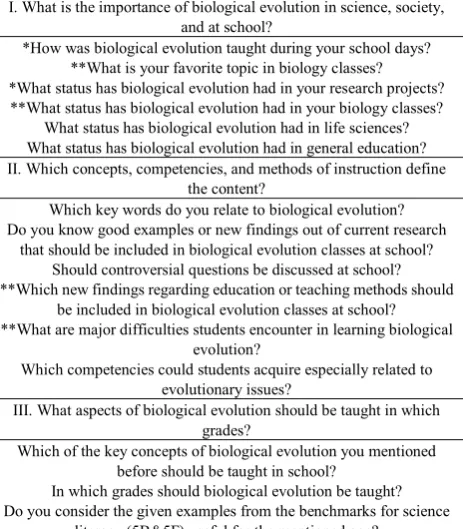
Table 1. Research questions (I, II, III) and central questions of the
interviews; only asked of scientist experts*; only asked of teacher experts** I. What is the importance of biological evolution in science, society,
and at school?
*How was biological evolution taught during your school days? **What is your favorite topic in biology classes? *What status has biological evolution had in your research projects?
**What status has biological evolution had in your biology classes? What status has biological evolution had in life sciences? What status has biological evolution had in general education? II. Which concepts, competencies, and methods of instruction define
the content?
Which key words do you relate to biological evolution? Do you know good examples or new findings out of current research
that should be included in biological evolution classes at school? Should controversial questions be discussed at school? **Which new findings regarding education or teaching methods should
be included in biological evolution classes at school? **What are major difficulties students encounter in learning biological
evolution?
Which competencies could students acquire especially related to evolutionary issues?
III. What aspects of biological evolution should be taught in which grades?
Which of the key concepts of biological evolution you mentioned before should be taught in school?
In which grades should biological evolution be taught? Do you consider the given examples from the benchmarks for science
literacy (5B&5F) useful for the mentioned age?
2.2. Conducting the Interviews
From July 2011 to May 2012, twelve qualitative, semi-structured, open face-to-face interviews were conducted. Therefore, cards containing all central questions were prepared and read by the researcher during the interview. Moreover, additional cards holding further information (e.g. curricular terms belonging to biological evolution, examples from the benchmarks for science literacy) [7] were used to provide particular stimuli during certain phases of the conversation.
Interview questions (see Table 1) were based on a questionnaire used by van Dijk [25] including further aspects of common misconceptions regarding biological evolution [6, 20, 33, 34], curriculum content, and competencies. Several questions were asked solely of the scientists and of
the teachers, because of the special knowledge expected from this particular group of experts.
2.3. Analyzing the Interviews
The interviews lasted approximately 25 – 50 minutes, were recorded, and subsequently transcribed following specified transcription rules. Raw texts were analyzed using qualitative content analysis methods [35,36]. Each interview was read several times to identify propositions, which were rephrased, and, if necessary, supplemented by using further information from the same interview. Category definitions were deduced from the analyzed texts, which were used to summarize and generalize the propositions. The obtained categories of each interview were combined, resulting in an overview of scientist experts’ propositions contrasting those from the teacher experts. This synopsis was analyzed in order to find agreeing and disagreeing opinions about biological evolution and its educational implementation. Thus, leading to frame recommendations regarding how biological evolution could be successfully taught in schools.
3. Results
In the following paragraphs, the interviewed researchers are referred to as “scientist experts” and are indicated as S1, S2, S3, S4, S5, and S6, whereas participating biology teachers are called “teacher experts,” and are denoted as T1, T2, T3, T4, T5, and T6. The expression “experts” include both groups of interviewees. Translated quotations from the original interviews are written in italics.
3.1. Research Question I: What is the Importance of Biological Evolution in Science, Society, and at School?
For biological science, evolution is “a hyper-conception, which … contains and penetrates the whole issue” (S3), a “unitary theory … to explain everything” (S6). According to this, all scientist experts stressed that evolution is essential to explain their own findings, whether by providing a phylogenetic context, or a suitable background for adaptation of organisms. Hence, all experts agree that biological evolution has an outstanding position in science, and it should be an important element of a good educational background, providing answers to questions about human existence and being “a very important component of our world view” (S1). It helps evaluate topical questions about ecological sustainability, medical advancement, and gene technology, which are covered by the media as well.
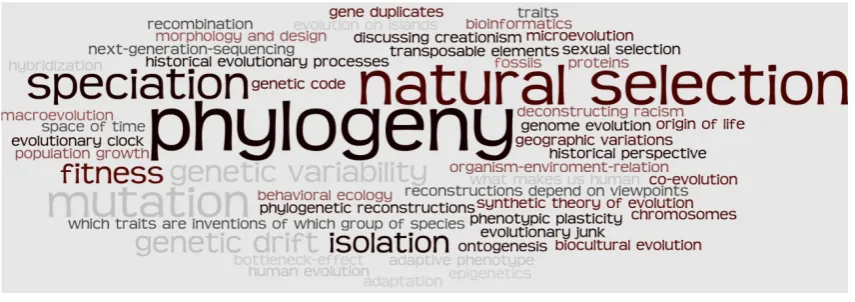
[image:3.595.64.296.280.545.2]Figure 1. All key concepts of biological evolution, spontaneously mentioned by scientist experts; size reflects frequency (range: 5 to 1); created by wordleTM
Figure 2. All key concepts of biological evolution, spontaneously mentioned by teacher experts; size reflects frequency (range: 4 to 1); created
by wordleTM
This might have changed in the last years. Though none of the teacher experts account biological evolution as his or her favorite topic, four consider evolution to be the guiding theme of their biology classes, whereas two other teacher experts implement biological evolution solely as “an independent topic in biology classes” (T6).
If biological evolution lacks representation in the teacher experts’ teaching practices, it appears to be due to scientific or educational deficiencies: “I think if I saw options, I would use it [as a guiding theme]” (T1). “I should have much more knowledge [about evolution]” (T3). This corresponds to the observation, that trainee teachers avoid teaching biological evolution in demonstration lessons because this topic requires profound and extensive scientific knowledge; knowledge they do not feel certain about during the early stages of their professional development (T6).
3.2. Research Question II: Which Concepts,
Competencies, and Methods of Instruction Define the Content?
Key Concepts
Each expert was asked to identify approximately ten key concepts of biological evolution that she or he felt are the most important. In total, 70 different terms were mentioned during all twelve interviews. The scientist experts proposed 50 (See Figure 1), emphasizing phylogeny, natural selection, speciation, and mutation. The teacher experts focused on 30 items, mostly corresponding to the curricular content with a focus on natural selection, mutation, adaptation, and Darwin (See Figure 2).
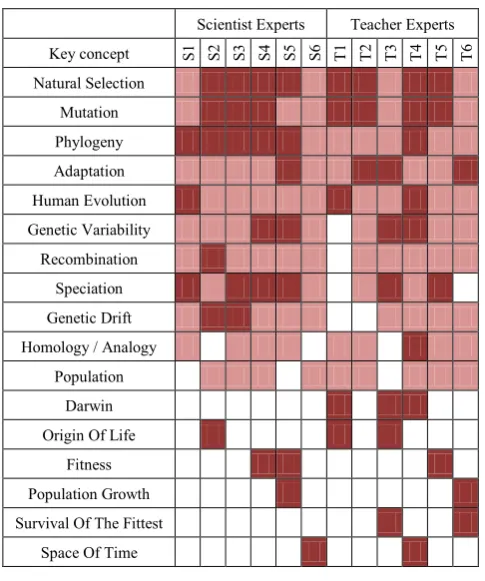
Afterwards, the interviewees were shown eleven key
concepts taken from the curricula (Table 2). Experts were asked to classify the terms according to their significance. Overall, the curriculum concepts were considered the most important by teacher experts as well as by scientist experts (See Table 2).
Examples
Considerable discrepancies between scientist and teacher experts arise from the examples proposed for biological evolution classes. On the one hand, teacher experts recommend well-tried topics like fossils or series of progression (“from wolf to dog,” T2; “from monads to multicellular organisms,” T4) for teaching evolution. On the other hand they also provide innovative ideas, like aspects of sexuality (“why are men and women different?” T2) or the nature of science (“criticism on Darwin … [and] … how he gained his findings,” T3) as appropriate examples for teaching evolution.
Scientist experts suggested many unexpected examples for biological evolution classes, referring to co-evolution (“herbivory,” S5), behavioral ecology (S4), molecular genetics (“genome evolution,” S1), and experimental evolution (Lenski’s long-time experiment with E. coli, S2). These suggestions are all connected to experimentally described evolution in progress, showing ongoing evolutionary processes.
[image:4.595.93.521.75.226.2](S6), which makes human evolution a sensitive topic. Overall, all examples given by respondents were outlined on only a very general level, thus, no deeper details may be set forth here.
Table 2. Key concepts of biological evolution mentioned by at least two
experts; spontaneously mentioned, considered important after displaying the concept by card, concept not mentioned; concepts displayed by cards during the interviews are written in italics
Scientist Experts Teacher Experts
Key concept S1 S2 S3 S4 S5 S6 T1 T2 T3 T4 T5 T6
Natural Selection Mutation Phylogeny Adaptation Human Evolution Genetic Variability Recombination
Speciation Genetic Drift Homology / Analogy
Population Darwin Origin Of Life
Fitness Population Growth Survival Of The Fittest
Space Of Time
Competencies
Both scientist and teacher experts provided a significant amount of competencies that could be acquired in biological evolution classes. They agree that biological evolution offers many opportunities to exercise evaluating and reflecting competencies [37], like “critically discussing the status of a scientific theory” (T1) or appreciating the value of biodiversity (S6). Some scientist experts also depict “the ability to synthesize intellectually … single observations … to a … decisive deduction” (S5), as well as “analytical abilities” (S5) or “the entanglement of biology … with other sciences” (S1) to be major competencies exercised by biological evolution education.
In this context, controversial issues, such as epigenetics and its significance to evolution should be included in biological instructions, even if a scientific consensus regarding these topics does not exist. Discussing these topics in class would be motivating and exciting both for students and for teachers and be “a good occasion … to talk about … the nature of science” (S4). But it would be important that students “have the opportunity to understand conflicting viewpoints thoroughly” (S4) and have the chance “to take part in discussions” (T3). Admittedly, this would only be wise in higher grades as case studies.
Though two teacher experts indicated that biological evolution qualifies to train “all [spheres of competencies] in equal measure” (T2), the other teacher experts did not see many opportunities to train experimental skills in biological evolution classes. Scientist experts disagree in this respect, identifying several occasions in which experimental competencies can be integrated into biological evolution classes:
“What samples do I need? What effect size? How do I approach a [experimental] design? Do I need a control group? … I think, in biological evolution … opportunities occur to conduct relatively simple experiments.” (S4) Misconceptions
Most of the teacher experts are acquainted with students’ misconceptions about biological evolution. Though not asked about misconceptions, two scientist experts, drawing from their university teaching, also mention them as familiar problems. Table 3 indicates, that misconceptions about the nature of science, evolutionary spaces of time, and teleology of evolutionary processes are widespread. Creationistic misconceptions appear to be only single observations. At the time this study was conducted, creationism was not a current issue either in educational discussions or in the media.
Table 3. Misconceptions held by students, known by the interview
partners from their own teaching experience (experts S1 – S5 were not asked about that explicitly)
Scientist
Experts Teacher Experts
Misconception S2 S3 S6 T1 T2 T3 T4 T5 T6
Evolutionary changes
…
happen out of needs are teleological lead to progress
are part of divine plans
happen by chance happen on the individual level Wrong
conception of …
the status of the nature of science
evolutionary spaces of time
Problems with …
clutter of terms and definitions randomness of genetic changes Methods of Instruction
[image:5.595.312.552.400.634.2]Using evolution as the guiding theme of biology could be a common thread in biology classes of all grades. Especially combined with an increased use of hands-on activities like creative writing or illustrations of time spans, new examples (see above), experiments, or excursions, biological evolution could strengthen students’ interest in learning biology.
3.3. Research Question III: What Aspects of Biological Evolution Should be Taught in Which Grades? Almost all experts agree that biological evolution “can be understood by young students … even in elementary school” (S3). It should be included in biological classes “as soon as you start to teach biology” (S4). Otherwise it appears to be difficult to highlight evolution as a central concept and perpetuate it as guiding theme of biology. Topics taken from geological history, like fossils or the extinction of dinosaurs, could meet the interests of younger students and allow for the early teaching of the “general principles of evolutionary change, without details regarding mechanisms of evolution” (S5). Adaptation of plants and animals, as well as biodiversity and its change have been proposed as appropriate contexts for younger biological classes.
An example from the benchmarks for science literacy [7] illustrate how natural selection could be taught in different grades at different levels, and has been classified as “well elaborated” (S3) and “wise” (T4).
Experts disagree on the importance of genetics for understanding biological evolution: While some teacher experts consider genetic knowledge essential for learning evolution, others believe that genetics is not required in early education of biological evolution (“Darwin himself studied evolution without genetics” S6).
4. Discussion
Although the number of expert interviews was limited to a number of twelve, they yield significant implications. The results presented here show substantial differences in the experts’ views of biological evolution and its implementation in schools. However, they agree on one important point: Evolution is the fundamental, unifying element for all life sciences, and it is exceptionally important for general education. Great socio-political issues, such as ecological sustainability, environmental protection and nature conservation, and genetic engineering and its medical application, can only be perceived properly against the background of evolutionary processes that are associated with these matters. Therefore, biological evolution appears doubly important for schools: first to help build a solid foundation for biological knowledge, and second for the general educational mission of the school. In the following sections, recommendations on how this could be achieved are derived from the experts’ ideas.
4.1. Spinning the Common Thread
Biological evolution should be taught not later than Grade 5, if possible even in the grades below [15,40,41]. This is the basic requirement for exposing biological evolution as the basic principle of biology, and for picking it up again in other biological topics.
Some experts polled in this study think that biological evolution could only be understood if certain content requirements are available, such as basic knowledge of genetics. Blancke et al.[42] conclude that the cognitive development of children changes considerably at the age of 10, so that “educational efforts towards understanding evolution may be better targeted at children over 10 years old”[42]. Nonetheless, many researchers describe successful teaching attempts for children at this age [14,16] and the benchmarks of science literacy [7] clearly show how certain aspects of the theory of evolution can successfully be taught at the elementary school level. Likewise, evolutionary aspects for grades 5 and 6 are included in almost all German curricula. The newly developed science curriculum in Rhineland-Palatinate provides topics like adaptation of organisms to their environment and animal breeding to create a first conceptual understanding of evolution [30]. These concepts should not remain on a purely descriptive level, but should also include the essential mechanisms of evolution as variation, overproduction and selection. This approach can certainly work with a naive, intuitive understanding of heredity, as is suggested by the Benchmarks [7], without a deeper knowledge of genetics. It is more important to implement biological evolution in the classroom as early as possible, rather than waiting until all necessary foundations have been treated in their technical depth; a robust foundation for understanding biology cannot be laid otherwise. Evolutionary aspects can be taken up again in higher grades, allowing students to expand their knowledge of the mechanisms of biological evolution as well as their understanding of the connections between various biological issues taught at school. Without a sound foundation, all attempts to use evolution as a common thread in teaching biology will fail.
4.2. Seeing Beyond Our Own Nose
The query of key concepts of biological evolution during the expert interviews provides interesting links to pick-up that common thread. By looking on the key terms taken from the curricula, a high degree of consensus can be recognized (see Table 2). Even if several experts did not name some of these curricular terms spontaneously, most interviewees consider them to be among the most important concepts. Because of this agreement on the key concepts, there is no question about what aspects of biological evolution should be taught in school. The terms that were independently and spontaneously mentioned by at least two experts are broadly consistent with the results found by van Dijk[25]. However, she detected a focus on micro evolutionary processes, which cannot be confirmed by the present study.
professors at German universities should define basic biological knowledge relevant to general public, two thirds of the stated terms were single nominations, mostly belonging to the interviewee’s own area of research. This also corresponds to the findings of the present study, because 53 of overall 70 key concepts mentioned by participants were named only once.
Looking at the resulting spectrum of these single nominations, differences between teacher experts and scientist experts occur regarding richness and emphasis. Teacher experts focus on the most common concepts that are already included in the curricula, emphasizing adaptation and the major evolutionary mechanisms (see Figure 2). Scientist experts call upon many terms in their own field of research and connect them with biological evolution, accentuating the importance of phylogeny (see Figure 1).
These results are a treasure trove: If teachers see beyond their own noses, using these scientist viewpoints on evolution, they are able to significantly expand the curriculum framing and find appropriate topics to take up evolution in biology classes again. For example, many findings of human evolution have been obtained using methods of modern molecular genetics, like next generation sequencing, or genomics. This results in a sound setting for this challenging, under-represented topic of human evolution, satisfying both the curriculum and the interests of students.
4.3. Finding Good Examples for Grades 6 - 8
Measured by the central status of biological evolution, it should be easy to find suitable examples for each grade level. According to this, one teacher expert reports that many suitable topics were sketched during a training seminar she held for teachers (T3). In addition, online-resources like MERLOT[44] or Understanding Evolution[45] provide many interesting peer-reviewed materials for teaching evolution at different grades. As Table 4 shows, most of the teaching materials were created for high school and college. For lower grades, only a few entries can be found. This is also true for German online-resources 4 teachers.de[46] and Lehrer-online[47]. Since the curricula do not demand this, it is not surprising that appropriate teaching materials are missing for these grades.
Currently, these curricula will be revised in Rhine-land-Palatinate, and it is expected that evolution will be awarded a greater importance in the new versions, especially in younger classes. Thus, the task is to find appropriate examples.
Although most of the examples provided by the experts are recommended for high school level, some innovative ideas for junior grades occurred throughout the interviews. Topics such as sexual selection, mating, and the evolution of sex could be very interesting for pubescent teenagers. More stimulating contexts arise from the key concepts of evolution provided by the experts (see above, Figure 1 – 2, Table 2): fossils, co-evolution, behavioral ecology, and bioinformatics are examples for exciting issues that might encounter interest
by middle school students.
Better references to everyday life could be achieved by connecting “Medicine and Evolution” [48]. By including medical issues into biological classes all the important aspects of biological evolution can be illustrated. Since most students are very interested in medical topics, it should be easy to teach lively lessons in this context. Further suggestions can be found in Meikle & Scott[49], Beardsley et al. [50], Dreesmann et al.[51], and Ryan[52].
Table 4. Number of teaching materials for biological evolution in
online-databases “MERLOT”, “Understanding Evolution”, “lehrer-online”, and “4teachers.de”, divided by grade levels (elem.: grades <6 in USA, grades <7 in GER, mid.: grades 6-8 in USA, grades 7-8 in GER, high: grades 9-12 in USA, grades 9-13 in GER, coll.: College, Graduate School in USA); obtained by internet research, 29 January 2014
Database Search attributes elem mid. high Coll.
MERLOT (USA)
Keyword: evolution, community: biology, category:
education
3 9 21 18
Under-standing Evolution
(USA)
(no search
attributes) 28 32 176 177
Lehrer- online (GER)
Unterrichtsmaterial Sek I und Sek II >
Biologie > Unterrichts-einheiten > Genetik&Evolution
3 3 5 -
4teachers.de (GER)
Suche: evolution, in: Materialien
Fach: Biologie 1 12 33 -
4.4. Including Experiments in Teaching Evolution One of the most common misconceptions associated with biological evolution is a false understanding of the nature of science, often consolidated by “describing scientific understanding as a pre-determined, stepwise process [and leaving] students with a distorted understanding of how science is actually conducted” [15]. In order to produce relief, they propose “learning progressions, including ‘gathering data through observation or experiment, representing data, reasoning – with oneself and others – about what data mean, and applying key ideas to new situations’” [15] (see also Understanding Science[53]).
The experts taking part in the present survey develop similar ideas. Experimental evolution (see above: Results, Examples), which, regrettably, is still missing in most textbooks, could provide fascinating examples of current research that could be transformed into interesting classroom activities, attending to, at least theoretically, teach the nature of science.
examples, such as illustrating overproduction and phenotypic plasticity (by germination of the potential progeny of a single plant and its comparison) or co-evolution (herbivory and plant defense, using Euphorbia and caterpillars of Minoa murinata and Pieris rapae) have been proposed by another scientist expert (S5) and could be easily incorporated into the classroom.
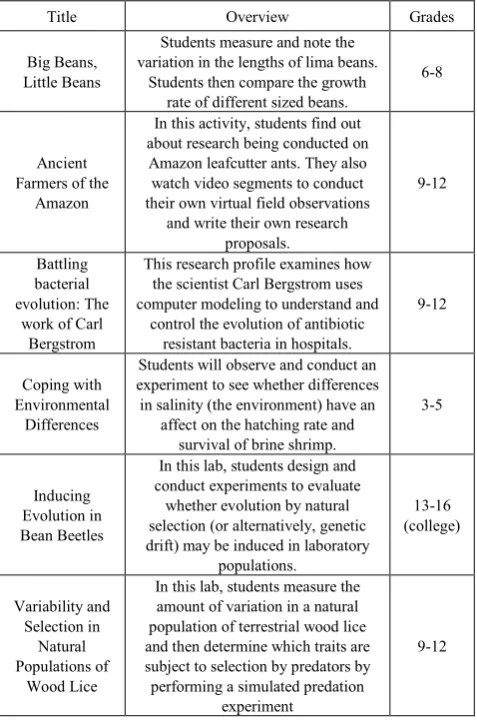
For both proposals – conducting experiments in the classroom and discussing examples of experimental evolution theoretically – there are examples in the aforementioned online database Understanding Evolution[45] (see Table 5). Though suggested by the interview partners themselves, teaching materials for such examples can hardly be found in Germany. Therefore, it appears to be a special challenge to adapt those examples to the needs of German schools.
Table 5. Examples on experimental approaches to teaching biological
evolution, obtained from internet research on
http://evolution.berkeley.edu/evolibrary/search/search_lessons_start.php, search attributes: all grades, any topic, keyword: experiment, any type; 29 January 2014
Title Overview Grades
Big Beans, Little Beans
Students measure and note the variation in the lengths of lima beans.
Students then compare the growth rate of different sized beans.
6-8
Ancient Farmers of the
Amazon
In this activity, students find out about research being conducted on Amazon leafcutter ants. They also watch video segments to conduct their own virtual field observations
and write their own research proposals.
9-12
Battling bacterial evolution: The
work of Carl Bergstrom
This research profile examines how the scientist Carl Bergstrom uses computer modeling to understand and
control the evolution of antibiotic resistant bacteria in hospitals.
9-12
Coping with Environmental
Differences
Students will observe and conduct an experiment to see whether differences
in salinity (the environment) have an affect on the hatching rate and
survival of brine shrimp.
3-5
Inducing Evolution in Bean Beetles
In this lab, students design and conduct experiments to evaluate
whether evolution by natural selection (or alternatively, genetic drift) may be induced in laboratory
populations.
13-16 (college)
Variability and Selection in
Natural Populations of
Wood Lice
In this lab, students measure the amount of variation in a natural population of terrestrial wood lice and then determine which traits are subject to selection by predators by performing a simulated predation
experiment
9-12
4.5. Providing Controversial Issues against Misconceptions
Many biologists consider the theory of evolution easy to comprehend and are surprised by the problems learners
encounter with this topic [3,34]. This agrees with the results of the present study: Two teacher experts (T2, T5) were initially surprised that evolution is supposed to represent a difficult topic in biology classes. But then they admit to being familiar with most of the misconceptions mentioned during the interviews. In particular, through their own teaching experience, they were well aware of the difficulty of conceptual change.
As mentioned earlier (see Introduction), many promising approaches have been published on how these misconceptions should be confronted. Most of them relate to the conceptual change theory [15] and are well known to the experts polled in this survey (see Results, Methods of instruction). However, as Demastes et al.[5] and Duit & Treagust[4] have shown in their studies, existing misconceptions are very persistent, and it takes a long time until they can be changed towards a scientific point of view. Therefore, in order to facilitate conceptual change, it is even more important to teach evolution early and repeatedly in biology classes.
In this context, teaching controversial topics could help to face a widespread misconception regarding the nature of science. Under the given conditions (see Results, Competencies), controversial discussions could illustrate the process of scientific discovery and theory construction – related to current matters that may be of interest to students and teachers alike. Different viewpoints could be discussed; conflicting arguments could be balanced. This might lead to a demanding training of students’ evaluation skills that are required by national educational standards [37]. Nelson[12] includes similar thoughts in his strategies of teaching evolution (“focus on scientific and critical thinking”).
In the interviews, two controversial issues have been suggested by the experts: First, epigenetics, an intensively studied active field of research, offers an interesting opportunity to engage discussions in biological evolution lessons, namely, whether Lamarckian evolution is possible or not. Although this topic is only marginally included in most textbooks, extensive teaching materials can be found [55, 56].
[image:8.595.59.298.323.687.2]4.6. Improving Teachers’ Skills
The implementation of current, controversial teaching content requires well-trained teachers. Although some researchers complain about the lack of teachers’ knowledge regarding the theory of evolution (see Introduction), the high scientific standards of teacher education in Germany should ensure highly qualified biology teachers. However, there are legitimate doubts that this applies to the knowledge of evolution. Two of the teacher experts taking part in this study do not feel as competent in the subject matter of biological evolution as they wish, and van Dijk [25] identified “a common pre-scientific conception,” an informal use of the term “theory”, among her interviewees regarding the nature of science. Furthermore, the present survey indicates that biological evolution is only a subordinate issue at the institutions of teacher training (see Results, Research Question I). It therefore appears to be reasonable to give biological evolution greater attention during teacher education; a suggestion also supported by Rutledge & Mitchell [28] and Blancke et al [42]. The fact that all scientist experts attach a high value to biological evolution leads to the prospect that solid knowledge of evolution is taught at universities nowadays. For teachers, whose education was insufficient in this respect, training seminars should be developed that could help them integrate biological evolution in their teaching practice.
5. Conclusions
The aim of this study was to identify aspirations and expectations of teaching evolution by means of an expert survey, involving both scientists and teachers. The benefit of this approach becomes visible in the conclusions that can be drawn from this comparison: Even if single observations may occur as well known, the overall picture displays new insights. Therefore, it would be interesting to conduct similar studies in other countries with different educational systems.
Requirements of good education regarding biological evolution can be summarized as follows:
(1) Evolution should be taught as early as possible and should be exposed as the central concept of biology. For this purpose, motivating and stimulating contexts should be found for all grades.
(2) Despite of the large theoretical framing of biological evolution, many occasions occur to include hands-on, creative, and even experimental classroom-activities. Especially for the latter, there are very few teaching materials available at this time.
(3) Biological evolution allows discussing
controversial scientific concepts, illustrating the scientific way to gain knowledge. Thereby, including these types of topic in the classroom may help change the misconceptions students
have towards the scientific perspective. (4) Biological evolution topics are well suited to
practice reflecting and evaluating skills, equipping students with the keys to answer questions humans have.
(5) Since effective teaching can only succeed with capable teachers, new teaching and training materials for biological evolution issues should be developed.
The results of the expert interviews presented here point to many useful ways to achieve these requirements, helping to remove the barriers to successfully teaching biological evolution.
Acknowledgements
We cordially thank our interview partners: Andrea Becker, Josef Billmeier, Susanne Foitzik, Thomas Hankeln, Joachim W. Kadereit, Anja Koestler, Carolin Kosiol, Juergen Markl, Gabriele Merk, Friedemann Schrenk, Waltraud Suwelack, Volker Tschiedel. We are grateful to an anonymous reviewer for his valuable comments that helped to improve the manuscript.
REFERENCES
[1] Mayr E. What Evolution is. New York, Oxford: Basic Books; 2001.
[2] Brumby MN. Misconceptions about the concept of natural selection by medical biology students. Sci Educ. 1984; 68(4): 493–503.
[3] Bishop BA, Anderson CW. Student conceptions of natural selection and its role in evolution. J Res Sci Teach. 1990; 27(5): 415–27.
[4] Duit R, Treagust DF. Conceptual change: A powerful framework for improving science teaching and learning. Int J Sci Educ. 2003; 25(6): 671–88.
[5] Demastes SS, Good RG, Peebles P. Patterns of conceptual change in evolution. J Res Sci Teach. 1996; 33(4): 407–31. [6] Wandersee JH, Good RG, and Demastes SS. Forschung zum
Unterricht über Evolution: Eine Bestandsaufnahme. ZfDN. 1995; 1: 43–54.
[7] American Association for the Advancement of Science (AAAS). Benchmarks for science literacy. New York: Oxford University Press; 1993.
http://www.project2061.org/publications/bsl/online/index.ph p. Accessed 29 January 2014.
[8] Alles DL. Using Evolution as the Framework for Teaching Biology. Am Biol Teach. 2001; 63(1): 20–3.
http://www.nap.edu/openbook.php?record_id=5787. Accessed 29 January 2014.
[10] Smith CM. A Three-Step Method for Teaching the Principles of Evolution to Non-Biology Major Undergraduates. Evo Edu Outreach. 2011; 4(2): 293–7.
[11] Alters BJ Nelson CE. Perspective: Teaching Evolution in Higher Education. Evolution 2002; 56(10):1891–901. [12] Nelson CE. Teaching evolution (and all of biology) more
effectively: Strategies for engagement, critical reasoning, and confronting misconceptions. Integr and Comp Biol. 2008; 48(2): 213–25.
[13] Wagler R. A Missing Link: K-4 Biological Evolution Content Standards. Evo Edu Outreach. 2010; 3(3): 443–50.
[14] Wagler R. Assessing “The Framework” for Kindergarten Through Fifth Grade Biological Evolution. Evo Edu Outreach. 2012; 5(2): 274–8.
[15] McVaugh NK, Birchfield J, Lucero MM, Petrosino AJ. Evolution Education: Seeing the Forest for the Trees and Focusing Our Efforts on the Teaching of Evolution. Evo Edu Outreach. 2011; 4(2): 286–92.
[16] Evans EM, Rosengren KS, Lane JD, Price KLS. Encountering Counterintuitive Ideas: Constructing a Developmental Learning Progression for Evolution Understanding. In: Rosengren KS, Brem SK, Evans EM, Sinatra GM, editors. Evolution challenges: Integrating research and practice in teaching and learning about evolution. Oxford; New York: Oxford University Press; 2012. p. 174–99.
[17] Heitz JG, Cheetham JA, Capes EM, Jeanne RL. Interactive Evolution Modules Promote Conceptual Change. Evo Edu Outreach. 2010; 3(3): 436–42.
[18] Wiles JR, Alters B. Effects of an Educational Experience Incorporating an Inventory of Factors Potentially Influencing Student Acceptance of Biological Evolution. Int J Sci Educ. 2011; 33(18): 2559–85.
[19] Abraham JK, Perez KE, Downey N, Herron JC, Meir E. Short Lesson Plan Associated with Increased Acceptance of Evolutionary Theory and Potential Change in Three Alternate Conceptions of Macroevolution in Undergraduate Students. CBE. 2012; 11(2): 152–64.
[20] Gregory TR. Understanding Natural Selection: Essential Concepts and Common Misconceptions. Evo Edu Outreach. 2009; 2(2): 156–75.
[21] Mead LS, Branch G. Overcoming Obstacles to Evolution Education: Why Bother Teaching Evolution in High School? Evo Edu Outreach. 2011; 4(1): 114–6.
[22] Beardsley PM. Middle School Student Learning in Evolution: Are Current Standards Achievable? Am Biol Teach. 2004; 66(9): 604–12.
[23] Rutledge ML, Sadler KC. University Students' Acceptance of Biological Theories - Is Evolution Really Different? JCST. 2011; 41(2):38–43.
[24] Prinou L, Halkia L, Skordoulis C. The Inability of Primary School to Introduce Children to the Theory of Biological Evolution. Evo Edu Outreach. 2011; 4(2): 275–85.
[25] van Dijk EM. Teachers' views on understanding evolutionary theory: A PCK-study in the framework of the ERTE-model. Teaching and Teacher Education. 2009; 25(2): 259–67. [26] Asghar A., Wiles JR, Alters B. Canadian Pre-Service
Elementary Teachers' Conceptions of Biological Evolution and Evolution Education. McGill J Educ. 2007; 42: 189–209. [27] Nehm RH, Schonfeld IS. Does Increasing Biology Teacher Knowledge of Evolution and the Nature of Science Lead to Greater Preference for the Teaching of Evolution in Schools? J Sci Teacher Educ. 2007; 18(5): 699-723.
[28] Rutledge ML, Mitchell MA. High School Biology Teachers' Knowledge Structure, Acceptance & Teaching of Evolution. Am Biol Teach. 2002; 64(1): 21–8.
[29] Rosengren KS, Brem SK, Evans EM, Sinatra GM. Evolution challenges: Integrating research and practice in teaching and learning about evolution. Oxford; New York: Oxford University Press; 2012.
[30] MBWWK (Ministerium für Bildung Wissenschaft, Weiterbildung und Kultur). Rahmenlehrplan Naturwissen-schaften fuer die weiterfuehrenden Schulen in Rhein-land-Pfalz. Bernkastel- Kues: Johnson-Druck; 2010.
[31] MBWWK (Ministerium für Bildung, Wissenschaft, Weiterbildung und Kultur). Lehrplanentwürfe. Lernbereich Naturwissenschaften, Biologie, Physik, Chemie. Grünstadt: Sommerverlag; 1997.
[32] MBWWK (Ministerium für Bildung, Wissenschaft, Weiterbildung und Kultur). Lehrplan Biologie. Grund- und Leistungsfach Jahrgangsstufen 11 bis 13 der gymnasialen Oberstufe (Mainzer Studienstufe). Worms: Heinrich Fischer Rheinische Druckerei GmbH; 1998.
[33] van Dijk EM, Reydon TAC. A Conceptual Analysis of Evolutionary Theory for Teacher Education. Sci & Educ. 2010; 19(6-8): 655–77.
[34] Graf D, Hamdorf E. Evolution: Verbreitete Fehlvorstellungen zu einem zentralen Thema. In: Dreesmann DC, Graf D, Witte K. Evolutionsbiologie: Moderne Themen für den Unterricht. Heidelberg: Spektrum Akademischer Verlag; 2011. p. 25–42. [35] Mayring P. Qualitative Inhaltsanalyse: Grundlagen und
Techniken. Weinheim, Basel: Beltz Verlag; 2010.
[36] Patton MC. Qualitative Research & Evaluation Methods. 3rd
edition. Thousand Oaks: Sage Publications; 2002.
[37] KMK (Sekretariat der St. Konferenz der Kultusminister der Laender der Bundesrepublik Deutschland). Beschluesse der Kultusministerkonferenz: Bildungsstandards im Fach Bio-logie für den Mittleren Schulabschluss. Muenchen, Neuwied: Luchterhand; 2005.
[38] Zabel J. Stories and Meaning: What Students’ Narratives Reveal about their Understanding of the Theory of Evolution. 2007. http://naserv.did.gu.se/ESERA2007/pdf/504.pdf. Accessed 30 Jul 2012.
[39] Griffhorn B, Langlet J. Einführung in die Selektionstheorie. So früh wie möglich! PdN-Biologie. 2006; 55(6): 6–15. [40] Kattmann U. Konzeption eines naturgeschichtlichen
[41] Marquardt-Mau B, Rojek R. Kinder auf den Spuren Charles Darwins: Evolutionsbiologie im Sachunterricht. In: Dreesmann DC, Graf D, Witte K. Evolutionsbiologie: Moderne Themen für den Unterricht. Heidelberg: Spektrum Akademischer Verlag; 2011. p. 43-63.
[42] Blancke S, Boudry M, Braeckman J, Smedt J de, Cruz H de. Dealing with creationist challenges. What European biology teachers might expect in the classroom. J Biol Educ. 2011; 45(4): 176–82.
[43] Dreesmann DC. 35 Experten – 350 Antworten Biologisches Basiswissen aus der Sicht von Hochschullehrern. Ber Inst Didaktik Biologie. 2005; 14: 63–80.
[44] MERLOT (Multimedia Educational Resource for Learning and Online Teaching). http://www.merlot.org/merlot/index.h tm. 29. January 2014.
[45] Understanding
Evolution.http://evolution.berkeley.edu/evolibrary/home.php. Accessed 29. January 2014.
[46] http://www.4teachers.de. Accessed 29. January 2014 [47] http://www.lehrer-online.de. Accessed 29. January 2014 [48] Jenkins KP, Antolin MF. Evolution and Medicine. Evo Edu
Outreach. 2011; 4: 556-558.
[49] Meikle WE, Scott EC. Evolutionary Medicine: A Key to Introducing Evolution. Evo Edu Outreach. 2011; 4(4): 644–7. [50] Beardsley PM, Stuhlsatz MAM, Kruse RA, Eckstrand IA, Gordon SD, Odenwald WF. Evolution and Medicine: An Inquiry-Based High School Curriculum Supplement. Evo Edu Outreach. 2011; 4(4): 603–12.
[51] Dreesmann DC, Graf D, Witte K. Evolutionsbiologie: Moderne Themen für den Unterricht. Heidelberg: Spektrum Akademischer Verlag; 2011.
[52] Ryan F. Virolution. London: HarperCollins Publishers Ltd.; 2009.
[53] Understanding Science. http://undsci.berkeley.edu/index.php. Accessed 29. January 2014.
[54] A.N.T.S. (Ameisenforschung als neues Thema an Schulen). http://www.bio.uni-mainz.de/zoo/didaktik/365.php.
Accessed 29 January 2014.
[55] Epigenetik – Vererbung ist mehr als die Summe der Gene. Biomax. Neugierig auf Wissenschaft. Max-Planck-Gesell-schaft. 2008; 23.
http://www.max-wissen.de/Fachwissen/show/5540.html. Accessed 29 January 2014.
[56] Von Koeniginnen und dicken Maeusen. Beispiele zur Epigenetik.
http://www.sciencebridge.net/uploads/docs/11_Epigenetik_b .pdf. Accessed 29. January 2014.
[57] Graf D. Evolutionstheorie: Akzeptanz und Vermittlung im europäischen Vergleich. Berlin, Heidelberg: Springer-Verlag; 2011.
[58] Hermann R. Cognitive Apartheid: On the Manner in Which High School Students Understand Evolution without Believing in Evolution. Evo Edu Outreach. 2012;
doi:10.1007/s12052-012-0446-6