Journal of Chemical and Pharmaceutical Research, 2012, 4(6):3134-3138
Research Article
CODEN(USA) : JCPRC5
ISSN : 0975-7384
Studies on Carica Papaya Starch as a Pharmaceutical Excipient
P. Rajeev Kumar
1*, Rekha Rajeevkumar
2and S. Anbazhagan
21
Department of Pharmaceutics, Karuna College of Pharmacy, Iringutoor,
Thirumittacode,Palakkad-679533(Kerala) India
2
Department of Pharmaceutical Analysis, Karuna College of Pharmacy, Iringutoor, Thirumittacode,
Palakkad-679533(Kerala) India
_____________________________________________________________________________________________
ABSTRACT
A study has been carried out to investigate the physicochemical, binding and disintegrating properties of starch isolated from grains of Carica papaya (Family: Caricaceae). The studies indicated that this starch is qualitatively and quantitatively comparable to Corn starch as also the rheological and swelling characteristics. Paracetamol (500mg) tablets prepared using Corn and Carica papaya starch met the requirements of uniformity of weight, assay, friability and hardness. These tablets also conformed to the disintegration and dissolution specifications of Indian Pharmacopoeia. Carica papaya starch showed adequate binding and disintegrating characteristics.
Key Words: Carica papaya Starch, papaya Starch, Corn Starch, Paracetamol, Physicochemical properties,
Dissolution, Binding and Disintegrating properties.
_____________________________________________________________________________________________
INTRODUCTION
Carica papaya is also known as Indian papaya, ‘Omykka, Kaplainga’ in Malayalam and ‘Papali’ in Tamil. The
chief producing states in India are Kerala, Tamilnadu, Karnataka and Andhra Pradesh. The pulp contains starch as chief carbohydrate. The pulp contains carbohydrate. The grains are edible and contain 43.28% starch1,2. Starches are used as multifunctional excipient in the field of pharmaceutical sciences.
The present work deals with isolation of starch from Carica papaya powder and comparison of its physicochemical, binding and disintegrating properties with Corn starch which is being abundantly used.
EXPERIMENTAL SECTION
Materials:
Paracetamol (Wallace Pharmaceutical Pvt.Ltd, Goa), Carica papaya powder (Procured from local market), Corn starch (Durga chemical laboratories). All other chemicals were of analytical grade were obtained from Qualigens fine chemicals, Mumbai.
Method of Extraction:
i) Fresh papaya (Carica papaya, family: Caricaceae) fruits were collected and washed it thoroughly with water.
ii) The outer layer was removed using a sharp knife and then washed again. The fruits were cut into very thin and small pieces and dried in an oven at 800C for 36 hrs.
iii)Then dried papaya pieces were ground thoroughly in a mixer grinder at medium speed. iv)The dried powder was then passed through sieve number 40 and stored in an airtight container.
Physicochemical properties:
Extracted starch and Corn starch were studied for microscopic characteristics3, Loss on drying4, Acidity5, pH6, Ash value7, Bulk Density8, Angle of respose8, and compressibility index9.
Rheological studies of Starch mucilage:
Starch mucilage (5% and 10%) of Carica papaya and Corn were prepared. The rheological characteristics of mucilages were evaluated by using Brookfield viscometer.
Swelling characteristics:
Swelling characteristics of the starches were studied at different temperatures by microscopic method. The extend of swelling was calculated by finding the ratio between grain size at the maximum temperature and at 35°C.
Formulation of Tablets:
Six formulations of Paracetamol (500mg) tablets containing 2.5%, 5.0% and 10% of Carica papaya starch and Corn starch as a disintegrant were prepared. Paracetamol granules were prepared using 10% w/w paste of Corn starch as well as Carica papaya starch by wet granulation method was found that good charecteristeristic(compactness and binding properties). Lubricated granules were compressed by using single punch tablet machine (Cadmach, Ahmedabad).
EVALUATION OF GRANULES Bulk density (Db):
It is ratio of total mass of powder to the bulk volume of powder. 10 gm of drug excipient mixture were taken and transferred into a 50 ml measuring cylinder and the volume was noted. The bulk density of the powder were expressed in gm/ml was determined as follows.
Db = M/Vo
Where,
M is the mass of the powder
Vo is the bulk volume of the powder.
Angle of repose:
The frictional forces in a loose powder can be measured by the angle of repose, θ. This is the maximum angle possible between the surface of a pile of powder and the horizontal plane and it is given as,
tan θ = h / r,
θ = tan-1[h /r]
Where
θ is the angle of repose h is the height in cm r is the radius.
The powder mixture was allowed to flow through the funnel fixed to a stand at definite height. The angle of repose was then calculated by measuring the height and radius of the heap of powder formed.
Test for friability and flow properties of granules:
% Friability = (1-W1/W2) x 100
Where,
W1 = weight of granules after test.
W2 = weight of granules before test.
Flow properties of granules were tested by determining angle of repose7.
EVALUATION OF TABLETS Hardness and friability tablets10:
Hardness and Friabilator testing were carried out by using Monsanto hardness tester and Roche friabilator respectively.
Uniformity of weight11:
The weight variation test of the tablets was performed as per I.P. Twenty tablets of each type were weighed and average weights were calculated.
Thickness of tablets:
The thickness of six tablets was measured using Vernier calipers. The extent to which the thickness of each tablet deviated from ± 5% of the standard value was determined. Six tablets from each batch were selected and evaluated, and the average value with standard deviation was recorded.
Disintegration Test:
All the six formulations were tested for disintegration time as per method prescribed in I.P. for uncoated tablets11.
Assay
Assays were carried out by using the method prescribed in I.P.11.
Dissolution studies
Dissolution studies were performed as per procedure given in I.P11. The sampling time specified in I.P. The sampling time specified in I.P. was modified instead of withdrawing a single sample after 30 minutes; serial sampling was done at 5, 10,15,20,25 and 30 minutes.
RESULTS AND DISCUSSION
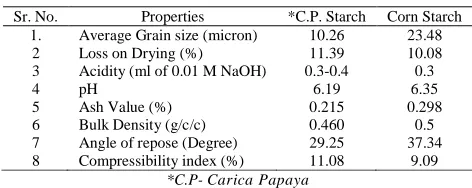
[image:3.595.179.415.566.660.2]Starch extracted from Carica papaya had a light yellowish tinge hence bleaching was carried out with water. On dry basis 27.5% starch was obtained. Grains of Carica papaya starch were found to be smaller in size than of Corn starch. They were round, granular in shape. Not much difference was observed in loss on drying, acidity, ash value, pH values of Carica papaya starch and Corn Starch. The loss on drying and acidity values was well within official limit Table 1. The bulk density, angle of repose and compressibility index of both starches was comparable Table 1.
Table 1. Properties of Starches
Sr. No. Properties *C.P. Starch Corn Starch 1. Average Grain size (micron) 10.26 23.48 2 Loss on Drying (%) 11.39 10.08 3 Acidity (ml of 0.01 M NaOH) 0.3-0.4 0.3
4 pH 6.19 6.35
5 Ash Value (%) 0.215 0.298 6 Bulk Density (g/c/c) 0.460 0.5 7 Angle of repose (Degree) 29.25 37.34 8 Compressibility index (%) 11.08 9.09
*C.P- Carica Papaya
Table 2. Swelling characteristics starches
Temperature (°C)
Average size of starch grain (Micron) C.P. Starch Corn Starch 35 10.26 23.48 40 10.34 23.73 50 10.56 24.02 60 10.83 25.92 70 12.16 39.70 80 24.34 47.85 Swelling ratio 2.147 2.037
The friability testing of granules showed that the Corn starch had slightly high binding strength than that of Carica
papaya starch Table 3. In all the cases the values of angle of response were ≤30°, which indicate that both the starches were free flowing. Hardness and % friability of the tablets were found to be well within acceptable limits Table 3.
Table 3. Hardness and friability of paracetamol tablets
Product Friability (%) Hardness (Kg/sq.cm) Paracetamol Tablets
C.P C
0.865 ±0.036 0.615± 0.078
6.40±0.52 7.10±0.63
Where, C.P – Containing Carica papaya starch as binder and disintegrant C- Containing Corn Starch as binder and disintegrant
The tablets prepared with both starches met the pharmacopoeial requirements of uniformity of weight Table 4. Values of maximum percent deviation were well within pharmacopoeial limit. All the tablets conformed to the requirement of assay as per I.P.
Table 4.In vitro evaluation of paracetamol tablets
Paracetamol Tablets Uniformity of weight
Average weight (mg) Maximum % deviation Assay (Percent of labeled amount)
C.P 620 +2.6 -3.6 97.89%
C 615 +3.4
-2.4 100.15%
Where, C.P – Containing Carica papaya starch as binder and disintegrant C – Containing Corn Starch as binder and disintegrant
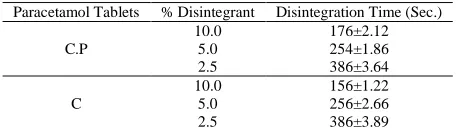
[image:4.595.184.413.574.639.2]The study of disintegrating property of all the formulations showed that the disintegration time for the tablets prepared with Carica papaya starch was less than that of Corn starch Table 5 reflecting its good disintegrating characteristic. One point dissolution data of all the tablets prepared with both the starches conform to dissolution specifications of I.P.
Table 5. Disintegration time of paracetamol (tablets (n=6)
Paracetamol Tablets % Disintegrant Disintegration Time (Sec.)
C.P
10.0 5.0 2.5
176±2.12 254±1.86 386±3.64
C
10.0 5.0 2.5
156±1.22 256±2.66 386±3.89
Where, C.P – Containing Carica papaya starch as binder and disintegrant C – Containing Corn Starch as binder and disintegrant
CONCLUSION
Acknowledgement
The authors wish to thank Department of Pharmaceutics, Karuna College of Pharmacy, Thirumittacode, Palakkad, Kerala for providing necessary facilities and to carry over the work. The authors wish to express their gratitude to Wallace Pharmaceutical Pvt.Ltd, Goa for providing the authentic sample (Lincomycin Hydrochloride).
REFERENCES
[1].www.Botanical.com.
[2].O.I. Oloyede, Pakistan Journal of Nutrition, 2005,4(6); 379-381.
[3].Kokate C.K., Practical Pharmacognosy, 4th Edition, Vallabh Prakashan, New Delhi, 1994.
[4].Indian Pharmacopoeia, 4th Edition, Government of India, Ministry of Health and Family Welfare, New Delhi,
1996, 711.
[5].The United State Pharmacopoeia, USP XXI, NF XVI, Mack Publishing Co, Easton, 1985, 1610.
[6].Indian Pharmacopoeia, 2nd Edition, Government of India, Ministry of Health and Family Welfare, New Delhi,
1996,692.
[7].Martin A, Physical Pharmacy, 4th Edition, B.I. Waverly, New Delhi ,1993,444.
[8].Lachman L, Lieberman H.A, Kanig J.L, The theory and practice of Industrial Pharmacy, 3rd Edition, Varghese Publishing House, Bombay, 1987,67, 317.
[9].Lachman, L, Lieberman, H.A, King J.L, The theory and practice of Industrial Pharmacy, 3rd Edition, Varghese Publishing House, Bombay, 1987, 297, 299.
[10].Indian Pharmacopoeia,3rd Edition, Government of India ,Ministry of Health and Family Welfare , New Delhi,
1985,480, 501, A-122.
[11].Indian Pharmacopoeia,4th Edition, Government of India, Ministry of Health and Family Welfare, New Delhi,1966,556.
[12].Nakhat P.D., Yeole P.G., International Journal of Pharmaceutical Excipients, 2004 ,21-24. [13]Perez E., Lares M., Plant Foods Hum Nutr. 2005,60(3), 113-116.