D. S. BROWN * W. H. GRIGGS B . T. IWAKIRI
Observations of the test trees in this study indicate that (presumably because of in- continuity of chilling) a varying portion of apple and pear buds may fail to open, even after a winter such as 1964-65 which provided 1,560 hours of chilling tempera- tures. Good chilling during both Decem- ber and January is especially critical. Since winter-chilling is insufficient, or poorly distributed in the important pear- producing districts of the state more often than in the apple districts, the results em- phasize the importance of heading back vigorous upright branches on young pear trees to insure near-to-normal foliation and branching. Except after the mildest winters, or with varieties having a high chilling requirement like Rome Beauty, such a pruning practice is seldom bene- ficial on apple trees, however.
~~~
INTER COLD is needed to condition
W
deciduous fruit trees so that their buds open and grow normally in the spring. Each winter can be characterized by the chilling temperatures experienced, and classified as either a good chilling or a poor chilling winter according to the behavior of the buds of deciduous fruit trees the following spring. Records at Davis show that over the past 36 years, an average of 1405 hours of temperaturesat or below 45'F were recorded between September 1 and March 1. Among those years were 20 with good chilling winters, averaging 1544 hours at or below 45'. The other 16 were years with poor chill- ing winters, averaging 1231 hours at 45' or lower (see graph).
During 17 years the chilling was be- tween 1218 hours (the lowest value among the years of sufficient cold), and 1476 hours (the highest among those of insufficient chilling). Ten of the 17 years were classified as poor chilling winters, even though 5 years had more than 1300 hours below 45'. Seven were classified as good chilling winters, with 3 of them hav- ing fewer than 1300 hours below 45'F. Clearly, the total number of chilling hours from September to March for these 17 years did not determine the fruit tree response, suggesting that it is the quality (timing and distribution) of chilling that is the critical factor.
The good chilling winters provided many more hours under 45'F during December and January than did the poor chilling winters, indicating that these months are the most critical for adequate chilling (see graph)
.
Variations from average in the chilling experienced be- fore or after December-January seem tohave had less influence on bud behavior than such variations during these critical months, and may account in part for the overlap in the range of chilling hours
Photo 2. Bartlett pear trees with quince rootstocks, April 2 1, 1965, following different chilling treatments the preceding winter (table. 1).
Photo 3. Jonathan apple trees, April 21, 1965, following different chilling treatments the preceding winter (table 1).
Photo 1. New vegetative shoats developing May 10, 1965 from lateral secondary bud primordia near the bases of dead terminal flower buds on Bartlett pear spur (left) and shoots (center and right). The flower buds died as a result of inadequate chilling during the previous winter.
among good and poor chilling winters. Apple and pear trees, following winters that fail to provide sufficient chiIIing, may show delayed and prolonged bloom periods, flower buds that are dead, a re- duced number of flowers, delayed folia- tion, and reduced vigor. Well-developed buds of most pear and apple varieties normally open after an exposure of 1200 to 1500 hours to winter cold at or below 45'F. The influence of amount, timing, and distribution of chilling, and of spe- cies and rootstock was demonstrated in tests at Davis with Bartlett pear and Jona- than apple trees during the 196465 dor- mant season and with Bartlett pear only during the 1965-66 season.
In September 1964, 60 pear and 20 apple trees growing in soil in three- and five-gallon containers were selected for testing. Some of the pear trees were Bart- lett grafted on an Old Home intermediate stock, on Angers quince roots; others were Bartlett grafted on Pyrlls calleryam seedling roots. The apple trees were Jona- than on Malling
IX
dwarfing rootstocks. The trees, grafted in 1960 and 1961, were planted in the containers in February 1962. In 1965, trees grown in the nursery in 1963 and planted in containers in 1964 were used-10 of Bartlett grafted onP.
calleryana and 10 of Bartlett propagated on their own roots by cuttings.
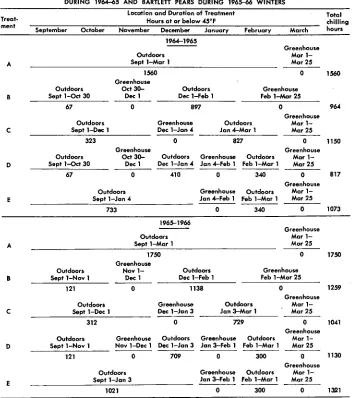
Several types of winters were simu- lated by exposing the trees to different periods of outdoor fall and winter tem- peratures, alternating with periods in the greenhouse where the temperature was maintained above 60'F. In the 1964-65 winter, eight Bartlett trees on quince root, four on
P .
calleryana, and four Jon- athan apple trees were subjected to each treatment (table 1 ) . In addition to the chilling treatments, each time trees were moved into the greenhouse, half of them were sprayed with 3,000 ppm of an ex- perimental growth-retarding compound, N-dimethyl amino succinamic acid(Alar
or B-9), which is not yet registered, nor recommended by the University of Cali- fornia for use on deciduous fruit trees. Thus, trees moved into the greenhouse only once, as under treatment
A,
received only one application of Alar, while those moved into the greenhouse two different times (treatmentsB,
C,
andE)
or three times (treatmentD )
received two and three applications, respectively. All of the trees were in the greenhouse from March 1 until March 25, 1965, and then moved outdoors. Data were gathered re- garding the number of flower buds on each tree that either opened (and devel- oped a flower cluster and a vegetative shoot) or were killed, the date and dura- tion of the bloom period, foliation, and the amount of shoot growth made during the 1965 growing season (table 2 ) . The shoot lengths tabulated are averages ofthe 10 longest shoots per tree.
In the 1965-66 winter, two trees of Bartlett pear propagated on their own roots from cuttings and two trees of Bart- lett grafted on
P .
calleryana were sub- jected to each treatment (table 1 ) .No
Alar (B-9) sprays were applied to these
Photo 4. Bartlett pear trees with quince root- stocks, March 16, 1965, near full bloom. Trees received adequate, well-distributed chilling the previous winter (treatment A). Tree at left was sprayed March 1, 1965 with 3000 ppm Alar.
Photo 5. Bartlett pear trees with quince root- stocks, March 11, 1965, near the end of the bloom period. Trees were held in the warm greenhouse during November 1964 and Feb- ruary 1965, but received good chilling during December 1964 and January 1965 (treatment
B). Tree at the left was sprayed October 30,
1964 and February 1, 1965, with 3000 ppm Alar.
Photo 6. Jonathan apple trees with Malling IX
rootstocks, March 16, 1965, during early part
of bloom period. Trees received adequate, well-distributed chilling the previous winter (treatment A). Tree at left was sprayed March 1, 1965 with 3000 ppm Alar.
Photo 7. Jonathan apple trees with Malling IX
rootstocks, March 11, 1965, early in the bloom period. Trees were held in the warm green- house during November 1964 and February 1965, but received good chilling during De- cember 1964 and January 1965 (treatment B). Tree at the left was sprayed October 30, 1964 and February 1, 1965 with 3000 ppm Alar.
Photo 8. Bartlett pear trees with Pyrus caller-
yana rootstocks, March 11, 1965. Trees were
held in the warm greenhouse during November 1964 and February 1965, but received good chilling during December 1964 and January 1965 (treatment B). Tree at the left was sprayed October 30, 1964 and February 1,
1965 with 3000 ppm Alar.
trees. Data similar to those collected in 1964-65 were gathered to characterize the growth response of the trees (table
3 ) . The flower buds formed by these trees were too few to give an indication of treatment effects and are not tabulated. In 1 9 6 6 5 , treatment
D
(mild Novem- ber and January) provided a total of 817 hours of temperatures at or below 45'F,the least chilling of all the treatments. Most of the flower buds on the pear trees died and did not open. Frequently, new, but often weak, vegetative shoots devel- oped from lateral secondary bud primor- dia near the bases of dead terminal buds of this and other treatments (photo 1).
The periods of bloom and foliation of both the apple and the pear trees under
Photo 9. Bartlett own-rooted pear trees, April
7, 1966, following different chilling treatments the preceding winter (table 1).
Photo 10. Bartlett pear trees with Pyrus caller-
yana rootstocks, April 7, 1966, following dif- ferent chilling treatments the preceding winter (table 1).
TABLE 1 . CHILLING TREATMENT SCHEDULE FOR BARTLETT PEAR AND JONATHAN APPLE TREES DURING 1964-65 AND BARTLETT PEARS DURING 1965-66 WINTERS
Location and Duration of Treatment
Hours at or below 45°F Tot01 chilling September October November December January February March hours Treot-
ment
1964-1965
Greenhouse
Outdoors Mar 1-
A Sept 1-Mar 1 Mar 25
1560 Greenhouse
0 1560
Outdoors Oct 30- Outdoors Greenhouse
B Sept 1-0d 30 Dec 1 Dee 1-Feb 1 Feb 1-Mar 25
67 0 897 0 964
Greenhouse
Outdoors Greenhouse Outdoors Mar 1-
C Sept 1-Dec 1 Dec l J a n 4 Jan 4-Mar 1 Mar 25
323 0 827 0 1150
Greenhouse Greenhouse
Outdoors Oct 30- Outdoors Greenhouse Outdoms Mar 1.- D Sept 1-Oa 30 Dec 1 Dec 1-Jan 4 Jan 4-Feb 1 Feb 1-Mar 1 Mar 25
67 0 41 0 0 340 0 817
Outdoors
Greenhouse Greenhouse Outdoors Mar 1-
E Sept 1-Jan 4 Jan CFeb 1 Fab I-Mar 1 Mar 25
733 0 340 0 1073
1965-1966
Greenhouse
Outdoors Mar 1-
A Sept 1-Mar 1 Mor 25
1750 0 1750
Greenhouse
Outdoors NOV 1- Outdoors Greenhouse
Dee 1 Dee 1-Feb 1 Feb 1-Mar 25
B Sept l-Nov 1
121 0 1138 0 1259
Greenhouse
Outdoors Greenhousa Outdoors Mar 1-
C Sept 1-Dec 1 Dee 1-Jan 3 Jan 3-Mar 1 ' Mor25
312 0 729 0 1041
Greenhouse Outdoors Greenhouse Outdoors Greenhouse Outdoors Mar 1- D Sept 1-Nov 1 Nov 1-Dec 1 Dec 1-Jan 3 Jan 3-Feb 1 Feb 1-Mar 1 Mar 25
121 0 709 0 300 0 1130
Greenhouse Outdoors Greenhouse Outdoors Mor 1- Sept 1-Jan 3 Jan 3-Feb 1 Feb 1-Mar 1 Mar 25
E
1021 0 300 0 13Q1
treatment
D
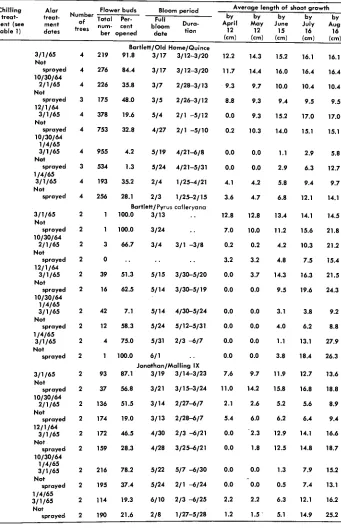
were greatly delayed and prolonged, and no shoot growth was made until June (table 2, photos 2 and3 ) . Buds of the Jonathan apple appeared to require less chilling than those of the Bartlett pear since a few flower buds on the apple trees opened in February and by August 16 the trees had made rela- tively good growth in spite of a late start. Slightly higher amounts of chilling, 964
hours under treatment
B
(mild November and February), 1073 hours under treat- mentE
(mild January) and 1150 hours under treatment C (mild December) were also insufficient as compared to the1560 hours experienced under treatment A, but were generally more effective than the 817 hours under treatment
D.
Under these treatments, from one-half to nearly three-quarters of the flower buds on the pear trees on quince roots failed to open and foliation and shoot growth were de- layed and generally reduced. The im- portance of good chilling during both De- cember and January, despite low total chilling, was indicated by the generally better response of the pear trees under treatmentB
in comparison with those which experienced either a mild Decem- ber (treatment C) or January (treat- mentsD
andE ) .
With a mild February following good December and January chilling, the apple and pear trees under treatmentB
actually started blooming and foliating before those of treatment A, but had higher percentages of the flower buds that failed to open, had more pro- longed bloom and foliation periods, and made less shoot growth (table 2, photos4, 5, 6, and 7 ) . Bud development and growth are advanced by mild periods in late winter, but if the prior chilling is only marginally adequate and the mild periods are long, the development of many buds may be impaired.
A mild December (treatment C ) also resulted in more delay in bloom and foli- ation than occurred with a mild Novem- ber and February (treatment
B ) .
How- ever, the November and February chill- ing of treatment C apparently somewhat offset the lack of December chilling under this treatment, so that although shoot growth was delayed, the average length of shoot was finally greater than that under treatmentB.
.
Prior to the mild January, the trees under treatment
E
were exposed to 733 hours of chilling which was enough to allow some of the buds to open in the greenhouse during late January. The bloom period was long and foliation and shoot growth were delayed. The average length of shoot growth, however, was [image:3.612.41.398.340.738.2]finally greater than under treatment
B,
indicating that the November and Febru- ary chilling of treatment
E somewhat off-
set the lack of January chilling.The proportion of flower buds opening after a mild December (treatment
C )
was similar to that after a mild January (treatmentE)
.
However, the trees ex- posed to the mild January in general showed more growth by mid-April than those exposed to a mild December, but both lots continued to show symptoms of delayed foliation. By mid-August, how- ever, the average shoot lengths under the two treatments were nearly the same. Fewer shoots developed than on the trees exposed to the full amount of winter chill- ing (treatment A ) , but by mid-August the average shoot lengths on the apple trees and the pear trees onP.
calleryanaroots under treatments
C
andE
were equal to or greater than on the trees of treatmentA.
Shoot growth on the pear trees on quince root, however, was shorter under treatmentE
than under either treatmentA
orC .
Except under treatment
E,
more flower buds opened on the Jonathan apple trees sprayed with 3,000 ppm of Alar than on those which were not sprayed (table 2,photos 6 and 7 ) , indicating that the sprays at least partly offset the deleterious effect of insufficient chilling, and stimu- lated bud development. Under treatment
E,
the January 4 spray may have been too early to stimulate the buds while that applied on March 1 was ineffective be- cause most of the buds that failed to open were dead before the spray was applied. Shoot growth on some of the sprayed ap- ple trees was delayed or reduced, but the effect was not clearly related to any par- ticular type of chilling regime or time of spraying.Alar
spraysThe Alar sprays had little or no effect on flower bud behavior or shoot growth of the pear trees on quince roots (table 2,
photos 4 and
5).
For the pear trees onP.
calleryana there was some indication of a delay in foliation and/or reduction in shoot growth on some of the sprayed trees, but it was not clearly related to any chilling regime or time of spraying (photo 8).
Shoot growth of the pear trees onP.
calleryana in general was more de- layed than that of the pear trees on quince roots. In most instances, however, the average shoot length of the trees onP.
cderyana was greater by mid-August than that of trees on quince root. Unfor- tunately, the flower buds of the Bartlett onP.
calleryana trees were too few toTABLE 2. EFFECT OF ROOTSTOCK, CHILLING TREATMENT, AND ALAR (8-9) SPRAYS O N BARTLETT PEAR AND JONATHAN APPLE FLOWER-BUD OPENING AND SHOOT GROWTH I N 1965
Average length of shoot growth Chilling Alar Flower buds Bloom period
ment (see ment trees num- cent bloom Dura-
F
Full April Mcly June July Aug. 12 12 15 16 16 (cm) (cm) (cm) (cm) (Em) treat- Number
treot- of Total Per-
table 1) dates ber opened dote
A A 8 8 C C D D E E A A 8 8 C C D D E E A A 8 8 C C D D E E 3/1/65 Not 10/30/64 2/ 1/65 Not 12/1/64 31 1/65 Not sprayed sprayed sprayed 10/30/64 1/4/65 3/1/65 Not 1/4/65 31 1/65 Not sprayed sprayed 3/1/65 Not 10/30/64 2/1/65 Not 12/1/64 Not 10/30/64 1/4/65 3/ 1/65 sprayed sprayed 31 1/65 sprayed Not 1/4/65 3/1/65 Not sprayed sprayed 311 165 Not 10/30/64 21 1/65 Not 12/1/64 Not 10/30/64 1/4/65 31 1/65 sprayed sprayed 3/1/65 sprayed Not 1/4/65 3/1/65 Not sprayed soraved 4 4 4 3 4 4 4 3 4 4 2 2 2 2 2 2 2 2 2 2 2 2 2 2 2 2 2 2 2 2
Bartlett/Old HomeIQuince 219 91.8 3/17 3112-3/20
276 84.4 3/17 3112-3/20
226 35.8 317 2/28-3113
175 48.0 315 2/2&3/12 378 19.6 514 211 4 / 1 2
753 32.8 4/27 211 4 / 1 0
955 4.2 5/19 4 / 2 1 4 / 8
534 1.3 5/24 4121-5/31
193 35.2 214 1/25-4/21
256 28.1 213 1/25-2115 Bartlett/Pyrus calleryana 1 100.0 3/13 ..
1 100.0 3/24
3 66.7 314 311 -318
0
..
..
..
39 51.3 5/15 3130-5/20
16 62.5 5/14 3130-5/19
42 12 4 1 93 37 136 174 172 159
7.1 5/14 4130-5/24
58.3 5/24 5112-5/31
75.0 5/31 213 -617
100.0 611 . . Jonathan/Malling I X 87.1 3/19 3/14-3123
56.8 3/21 3 / 1 M / 2 4
51.5 3/14 2127-617
19.0 3/13 2128-617
46.5 4/30 213 -6121
28.3 4/28 3/25-5121
216 78.2 5/22 517 6 / 3 0
195 37.4 5/24 211 6 / 2 4
114 19.3 6/10 213 -6125
190 21.6 218 1/27-5/28 12.2 11.7 9.3 8.8 0.0 0.2 0.0 0.0 4.1 3.6 12.8 7.0 0.2 3.2 0.0 0.0 0.0 0.0 0.0 0.0 7.6 11.0 2.1 5.4 0.0 0.0 0.0 0.0 2.2 1.2 14.3 14.4 9.7 9.3 9.3 10.3 0.0 0.0 4.2 4.7 12.8 10.0 0.2 3.2 3.7 0.0 0.0 0.0 0.0 0.0 9.7 14.2 2.6 6.0 2.3 1.8 0.0 0.0 2.2 1.5 15.2 16.0 10.0 9.4 15.2 14.0 1.1 2.9 5.8 6.8 13.4 11.2 4.2 4.8 14.3 9.5 3.1 4.0 1.1 3.8 11.9 15.8 5.2 6.2 12.9 12.5 1.3 0.5 6.3 5.1 16.1 16.4 10.4 9.5 17.0 15.1 2.9 6.3 9.4 12.1 14.1 15.6 10.3 7.5 16.3 19.6 3.8 6.2 13.1 18.4 12.7 16.8 5.6 6.4 14.1 14.8 7.9 7.4 12.1 14.9 16.1 16.4 10.4 9.5 17.0 15.1 5.8 12.7 9.7 14.1 14.5 21.8 21.2 15.4 21.5 24.3 9.2 8.8 27.9 26.3 13.6 18.8 8.9 9.4 16.6 18.7 15.2 13.1 16.2 25.2
TABLE 3. EFFECT OF ROOTSTOCK AND CHILLING TREATMENT O N BARTLETT PEAR BUD OPENING AND SHOOT GROWTH IN 1966
Average length of shoot growth from: Terminal buds Lateral buds
treat- by by by by by by
May June July May June July (see ber of Total Per- Totol Per-
11 20 18 11 20 18 table 1) trees num- cent num- cent
ber opened 'her opened (cm) (cm) (cm) (cm) (cm) (cm)
A 2 31 100.0 182 33.5 21.8 22.2 22.2 10.0 11.6 11.8 8 2 34 64.8 176 18.7 13.8 14.2 15.5 20.0 20.3 21.5 C 2 24 91.8 179 60.4 7.7 7.7 7.7 10.2 13.8 13.9 D 2 23 21.7 170 27.0 19.1 40.8 40.8 14.2 14.8 17.2 E 2 34 64.7 116 15.5 19.6 20.8 20.8 24.1 26.8 26.8
17.3 17.4 17.6 7.4 8.8 10.5 A 2 58 91.5 125 28.0
8 2 46 58.8 127 14.9 14.8 14.8 15.7 15.0 15.0 15.0 1.7 6.4 7.8 C 2 32 72.0 139 40.3 5.7 5.7 5.7
D 2 34 41.2 114 28.1 5.2 5.2 5.2 16.1 17.5 27.5 E 2 37 35.2 85 14.3 12.4 14.9 14.9 8.6 10.9 11.0
Bud opening Chilling -m-uN
Bartlett, own-rooted
[image:4.612.228.569.54.585.2]permit bloom comparisons with those of Bartlett on quince roots.
The 1965-66 treatments, except for treatment
C,
provided more chilling than comparable treatments in 1964-65, be- cause of a marked difference in Decem- ber chilling. In December of the 1965-66season there were 709 hours at or below
45OF, an amount well above the 410
hours in 1964-65, and the long-time averages of 355 hours for the poor chill- ing and 463 hours for the good chilling years. Had the December chilling been nearly average, the two seasons would have been quite similar in the distribu- tion of chilling and the total amount re- ceived under the different treatments.
A mild December (treatment
C)
re- sulted in marked delayed foliation and reduced shoot growth (photos 9 and 10, table 3 ) . However, the percentage of buds on the trees of treatmentC
that ultimately opened and made some growth was sur- prisingly high, second only to the trees receiving full chilling (treatment A) for the terminal buds and highest among all treatments for the lateral buds.Delay in foliation
In contrast, the delay in foliation on the trees which experienced a mild Jan- uary (treatment
E)
was much less severe than on trees exposed to a mild Decem- ber, primarily because some of the buds began to grow in January when the trees were in the greenhouse. Most of the buds that did not start then, however, failed to open later, so that the percentages of buds opening were considerably below those of the trees exposed to a mild De- cember or those receiving full chilling. The average length of shoots that grew was also better following a mild January than after a mild December, nearly equal to or better than that on trees receiving full chilling, probably related to the fact that fewer shoots were involved, thus fa- voring greater growth per shoot.When a mild November was experi- enced prior to the mild January (treat- ment D)
,
the delay in foliation was more like that on the trees experiencing a mild December (treatmentC)
than on those with a mild January (treatmentE, photos
9 and 1 0 ) . The percentages of buds grow- ing under treatment
D,
however, were much less than on the trees with a mild December (treatmentC ) ,
but more than on those with a mild January (treatmentE )
except for the terminal buds of the Bartlett trees on their own roots. The trees under treatment D received a total of only 830 hours of chilling before being placed in the mild greenhouse in January. Con-AVERAGE WEEKLY TOTALS OF TEMPERATURES BELOW 45’F AT DAVIS FOR 16 YEARS WITH MILD WINTERS AND 20 YEARS WITH
ADEQUATE CHILLING
I
SEPT. OCT. NOV. DEC. JAN. FEB.
sequently the buds did not start to develop quite as soon as they did under treatment
E,
which received 1021 hours prior to January. About 1000 hours of chilling would seem to be enough to permit some but not all of the vegetative buds to open, the proportion opening depending at least in part upon the timing and continuity of chilling. Intermittent chilling as in treat- ment D would appear to be less favorable than longer intervals of continuous chill- ing as in treatmentB
or E. The generally better bud survival under treatmentC
suggests that uninterrupted late-season (January and February) chilling is some- what more important for vegetative bud survival and development than chilling in December or earlier.In general, higher percentages of both terminal and lateral vegetative buds opened and more shoot growth was made by the own-rooted Bartlett trees than by the Bartlett on
P .
ccclleryana, suggesting that the chilling requirements of the latter were somewhat higher, a result similar to that noted in 1964-65 between Bartlett on quince and Bartlett onP .
calleryana.Growth response
The growth response .of the trees in these tests is similar to that observed in commercial pear orchards in the state. The trees in many young Bartlett pear orchards show bare areas on the basal half or two-thirds of the previous season’s shoots, as well as a lack of well-placed side branches on this and older wood. The condition is most comon in so-called
“long pruned” orchards where very little heading back of branches is practiced. Such symptoms are typical of a delayed foliation response like that in test trees.
Similarly, the previous year’s shoots on young apple trees, especially, or the vigorous growth on older trees frequently show delayed foliation symptoms after all but the coldest winters. Rome Beauty trees are particularly prone to some de- layed foliation in most years. Vigorous Starking trees, or those of similar red Delicious varieties, also show some symp- toms after only moderately mild winters. Pear and apple trees usually do not produce spurs and side branches on cur- rent season’s growth, but do produce them from lateral buds formed on shoots the previous year. Following winters pro- viding excellent chilling conditions, a good portion of these one-year-old lateral buds will form either spurs or side branches even on long shoots that were not headed back at the time of dormant pruning. Following winters providing inadequate chilling, however, due either to a shortage of chilling hours or to warm periods which break chilling continuity, most of the lateral buds fail to open. A pruning cut usually stimulates the buds near the wound to open and develop side branches or spurs even after a poor chill- ing winter.
Dillon
S.
Brown and WilliamH .
Griggsare Professors and Pornlogists and Ben