Economic Dispatch with Valve Point Effect using
Iteration Particle Swarm Optimization
M.N. Abdullah A.H.A. Bakar N.A. Rahim J.J. Jamian M.M. Aman
Universiti Tun Hussein Onn Malaysia
University of Malaya, Malaysia [email protected]
UMPEDAC, University of Malaya, [email protected]
Universiti Teknologi Malaysia
University of Malaya, Malaysia [email protected]
Abstract- Economic dispatch (ED) is one of the optimization problems in power system operation and planning. The practical ED problems have non-smooth cost functions with equality and inequality constraints. It becomes more complicated problem when valve point effects of generator are considered and results multiple local minima. This makes the ED problems are difficult to find global optimum solution when using any mathematical approach due to non-convex cost function. The Classical particle swarm optimization (PSO) has ability to reach near global optimum solution by tuning some parameters but always stuck at local minima. In this paper, an iteration particle swarm optimization (IPSO) is proposed to solve ED problems with valve point effects. The proposed algorithm is introduced a new parameter in the original velocity equation of PSO in order to enrich searching behaviour, solution quality and avoid being trapped at local minima. The proposed IPSO algorithm has been implemented on two test power systems (consisting 3 and 13 generating units) to validate its effectiveness. The simulation results confirmed that IPSO algorithm has better convergence characteristic and more robust compared to PSO and some published results.
Index Terms-- Economic dispatch, constraints handling, particle swarm optimization, valve point effect.
I. INTRODUCTION
The operation cost of power system has becomes an important issues due to increase power demand and fuel cost. One of the options is to operate the committed generator units efficiently and economically based on economic dispatch (ED) optimization. The main objective of ED problem is to allocate power demand among scheduled generator at minimum cost while satisfying all the generator and system constraints [1, 2].
Different methods have been developed to solve ED problem in past few decade. Traditional algorithm such as lambda iteration, gradient method, Newton method, linear programming [3] and quadratic programming [4] has been implemented to solve ED problems. However, most of these methods are not capable of solving ED problem with non-convex and highly nonlinear solution space [5]. The practical ED problem with valve point effect, prohibited operating zone, multifuel options and ramp rate limit represent non-smooth or non-convex optimization problem (with equality and inequality constraints). This makes the finding of global optimum difficult and cannot be solve by traditional methods.
Modern heuristic optimization methods are proposed by researcher based on artificial intelligence concepts such as
evolutionary programming [6], genetic algorithm [7], simulated annealing, ant colony optimization [8], tabu search [9], artificial immune system [10] and particle swarm optimization [1, 11]. These methods do not always guarantee to find global best solution but they often achieve a fast and near global optimum solution.
Among these methods, PSO is widely implemented in ED problem due to simple implementation, less storage requirement and able to find global optimum solution. PSO is also capable to solve nonlinear and complex problems because it is a free derivative algorithm. However, premature convergence always occurs in classical PSO and results to local solution.
In this paper, an iteration particle swarm optimization (IPSO) is proposed to solve economic dispatch problem considering valve point effects. A new parameter is introduced into velocity equation of IPSO algorithm that can enhance exploration capability, improve solution quality and avoid premature convergence. Two test power systems are employed (3 and 13 unit systems) to verify the performance of IPSO as compared to PSO. Furthermore, results obtained by IPSO and PSO are compared with other methods reported in literature. For the ED problem, simulation results show that the IPSO method has better convergence property with lowest generation cost and more robust compared to PSO method.
The paper organized as follows. Section II presents the mathematical model of economic dispatch problems. Section III briefly reviews the concept of PSO and IPSO methods. Section IV discusses the detailed implementation of IPSO method to solve ED problems. Section V shows the simulation results on two test system and compared with classical PSO and published results. Finally, the conclusions are drawn in section VI.
II. PROBLEM FORMULATION
The economic dispatch problem is about minimizing the total generation cost of thermal generator while satisfying equality and inequality constraints. The objective function corresponding to the fuel cost production can represent as follow:
Minimize
∑
=
=
Ngi i i t
F
P
F
1
)
Where,
Ft = total cost production Fi = fuel cost for generator i
The generation cost for generator is usually approximated by a second order quadratic function as:
∑
=+
+
=
Ng i i i i i i ii
P
a
P
b
P
c
F
1 2
)
(
(2)Where ai, bi and ci are cost function coefficients of i-th
generating unit, Ngis Number of committed generators and Pi
is the real power output of generator i.
In this paper, valve point effect is considered as practical operation constraint of generators. The valve point effect introduce ripple in the heat rate function and make the fuel cost function highly non-linear, discontinuous and having multiple local optimum [1]. A second order quadratic cost function is added with rectified sinusoidal equation for accurate modeling of generator cost function considering valve point effect as follows:
))
(
sin(
)
(
2 mini i f e i i i i i i
i
P
a
P
b
P
c
e
f
P
P
F
=
+
+
+
−
(3)Where, ei and fi are the coefficient of generator i with valve
point effects.
There are two types of constraint involve in ED problems that must be satisfied throughout the optimization process as follows:
i. Equality constraint:
In ED problem, equality constraint is the total generated power must be equal to load demand and system losses.
L D Ng
i
i
P
P
P
=
+
∑
=1
(4)
Where PD and PL are total load demand and total system
loss. Total system loss can be calculated by using B-coefficient as follow:
∑
∑∑
= = =+
+
=
Ng i i i j ij Ng i Ng j iL
P
B
P
B
P
B
P
1 00 0 1 1(5)
Where, Bij, B0i and B00 are transmission loss coefficients.
However, transmission loss is not considered in this paper (PL=0).
ii. Inequality constraints:
The real power output of each generating unit must vary between lower and upper limits as given by:
max min
i i i
P
P
P
≤
≤
(6) WhereP
imin andP
imax are minimum and maximum limit for power output of the i-th generating unit.III. REVIEW OF PSO AND IPSO
A. Particle swarm optimization (PSO)
In 1995, Kennedy and Eberhart developed a PSO algorithm based on the social behaviour of organisms such as fish schooling and bird flocking [12]. The PSO algorithm is based on the group of individual to find the optimum solution. An individual in swarm approaches to the optimum through the previous experience, present velocity and experience of its neighbours.
Let X and V are the particle or position and velocity in a d
dimension search space. Position represents the objective variable in optimization problem and velocity is the step size particle to move in the next iteration. The i particle is represented as Xi=( Xi1, Xi2,…, Xid) in the d dimensional
searching space. The best position of the i particle is stored and represented as pbesti=( pbesti1, pbesti2,…, pbestid). The
best particle among all particles in the group is recorded as
gbestd. The velocity of the i particle is updated using the
following formula:
)
(
)
(
2 2 1 1 1 j id j d j id j id j id j idX
gbest
r
c
X
pbest
r
c
wV
V
−
+
−
+
=
+ (7)And the position is updated as follows:
1
1 +
+
=
+
jid j id j
id
X
V
X
(8)Where,
1 +
j id
V
= the updated velocity of particle i in dimension dw
= inertia weight factorj id
V
= velocity of particle i at iteration j2 1
,
c
c
= acceleration coefficients2 1
,
r
r
= random number [0,1]1 +
j id
X
= update position of particle i in dimension dj id
X
= position of particle i at iteration jThe inertia weight factor (w) is used to increase the rate of convergence speed of the PSO algorithm based on descending linear function. The best range for is between 0.9 and 0.4 implemented using following equation [13]:
iter
iter
w
w
w
w
⎟⎟
×
⎠
⎞
⎜⎜
⎝
⎛
−
−
=
max min maxWhere wmax and wmin are maximum and minimum value of
weighting factor respectively, iter is the current iteration and
itermax is the maximum number of iteration. B. Iteration particle swarm optimization (IPSO)
In order to improve the solution quality of PSO, a new index named ‘iteration best’ is incorporated in (7) and employed in this paper. The updated velocity of proposed IPSO method is computed as follows:
)
(
)
(
)
(
, 3 3 2
2
1 2 1
j id j
d best j
id j d
j id j id j
id j
id
X
I
r
c
X
gbest
r
c
X
pbest
r
c
wV
V
−
+
−
+
−
+
=
+
(10)
Where Ibest,d is the best value of fitness function that has been
obtained by any particle in iteration j and c3 is represents the
weighting of the stochastic acceleration term to pull each particle towards Ibest [14] as follow:
))
exp(
1
(
11
3
c
c
iter
c
=
×
−
−
×
(11)To evaluate performance of IPSO comparing with PSO, a mathematical test function has been performed. The main purposed of this analysis is to minimize the function (12) with multiple local points. Where the global minimum value is f(x,y)=-18.55 reported in [15].
10
,
0
)
2
sin(
1
.
1
)
4
sin(
)
,
(
x
y
=
x
x
+
y
y
≤
x
y
≤
f
(12)To make a fair comparison, the number of population is set at 20, value c1 and c2 are set to 0.4 and maximum iteration is
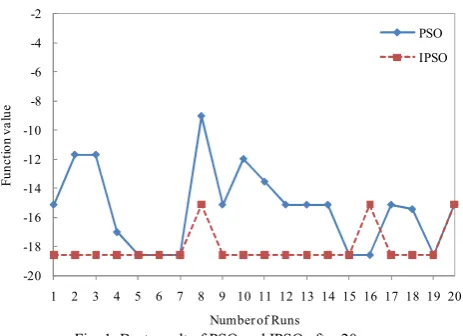
[image:3.595.312.544.56.224.2]set to 500 for both methods. After completing 20 runs for each method, the results are presented in Table 1. From the result, IPSO have lowest standard deviation and highest percentage of hits to the global solution compared to conventional PSO. In term of average function value, the IPSO method has lowest value which is near to global value compared to PSO. Fig. 1 shows the best result can be achieved by IPSO and PSO after 20 runs. It can be shown that, the IPSO has ability to give consistent result after different runs compared to the PSO. So it can be concluded that IPSO is more ability to find global optima and less stuck at local minima as compared to PSO.
TABLE 1
PERFORMANCE OF PSO AND IPSOAFTER 20RUNS
Function Value Method
PSO IPSO
Minimum -18.5547 -18.5547
Maximum -9.03554 -15.1079
Average -15.3696 -18.0377
Standard Deviation 2.773748 1.262725 Percentage of hits global (%) 30 85
-20 -18 -16 -14 -12 -10 -8 -6 -4 -2
1 2 3 4 5 6 7 8 9 10 11 12 13 14 15 16 17 18 19 20
Fu
nc
tion v
al
ue
Number of Runs
PSO
IPSO
Fig. 1. Best result of PSO and IPSO after 20 runs
IV. IMPLEMENTATION OF IPSO FOR EDPROBLEM WITH VALVE POINT EFFECTS
The implementation steps of the IPSO algorithm for solving ED problem with valve point effect are as follows:
Step 1: Initialization
In ED problem, the number of generating units is the dimension (or variable) in IPSO. The velocity is set to zero initially. The value of c1 and c2 are 0.4 respectively. The ith particle for d generating units (or dimension) is represented as [16]:
)
,...,
,
(
i1 i2 idi
P
P
P
P
=
(13)The particles of each dimension are randomly generated within the maximum and minimum limits of the generator in (6) as given below:
min min
max
)
(
d d did
r
P
P
P
P
=
×
−
+
(14)Step 2: Evaluation function
The fitness of each individual is evaluated by the evaluation function. The popular penalty factor method is employed to reduce the fitness function of the particle that proportional to the equality constraints violation in (4). The penalty parameter must be choosing carefully to distinguish between feasible and infeasible solution. The evaluation function is defined as follows [17].
∑
∑
= =
−
−
+
=
Ngi
L Ng
i
D i i
i
i
F
P
k
P
P
P
P
f
1 1
)
(
)
(
(15)Where k is the penalty parameter for the total generated power not satisfying load demand and system loss.
Step 3: Initialization of pbest and gbest
The initial particles obtained in Step 1 are set as initial pbest
[image:3.595.49.286.598.694.2]Step 4: Update the velocity
The velocity is updated using (10). The velocities of the ith particle in d dimensional space are limited by -Vmax and Vmax.
In this paper, the maximum velocity was set between 15% and 20% of the dynamic range of each variable (dimension) [1].
Step 5: Update the swarm
The new position of each particle in d dimensional search space is computed using (8). If the evaluation function of ith particle is better than the previous pbest, the current value is set to be pbest. If current gbest is better than previous gbest, the value is set to be gbest.
Step 6: Stopping criteria
In this paper, IPSO algorithm will be terminated if the maximum number of iteration is reached (itermax=500). Then,
choose global best as an optimal solution. Otherwise, go to step 2.
V. SIMULATION RESULTS
The proposed IPSO for solving ED problem with valve point effect has been tested on two case studies with different sizes (3 and 13 generating unit). The simulation has been done in MATLAB 7.6 on core 2 quad processor 2.66GHz with 3GB RAM. For each test system, 20 independent runs were performed to investigate the solution quality and robustness of proposed method. The performance of IPSO is compared with classical PSO and other methods from the literatures.
A. Case study 1: 3 unit system
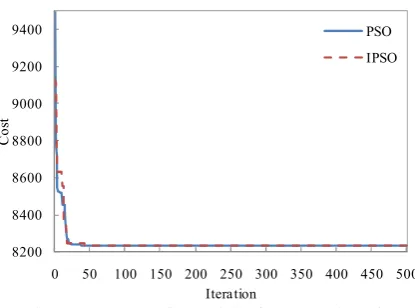
This case study consists of 3 generators with the valve point effects. The total load demand of the system is 850 MW. The fuel cost coefficients of the generator are taken from [18] and transmission losses are neglected. The population size for this case study is set to 30. Table 2 show best results obtained by PSO and IPSO after 20 runs with different initial population. We can see that both algorithms can find the global solution at 8234.07 $/h. However, IPSO has lower average cost compared to PSO. Fig. 2 shows the convergence characteristic of the best result obtained by both algorithms in finding the minimum cost for this system.
TABLE 2
BEST RESULTS OF PSO AND IPSO AFTER 20RUNS
Generating Units PSO IPSO
P1 (MW) 300.2669 300.2655
P2 (MW) 400 400
P3 (MW) 149.7331 149.7345
Total Power Output (MW) 850 850 Total generation cost ($/h) 8234.07 8234.07
Average cost 8425.45 8346.51
8200 8400 8600 8800 9000 9200 9400
0 50 100 150 200 250 300 350 400 450 500
Co
st
Iteration
[image:4.595.323.531.57.211.2]PSO IPSO
Fig. 2. Convergence characteristics for 3 generating units
The results obtained from the proposed IPSO method has been compared with GA [18], EP [19], and MPSO [20] in Table 3. It can be seen IPSO can achieved the global optimum solution same as others method except better than GA method.
The performance of heuristic methods such as PSO cannot be evaluate by single trial due to the random number involve during optimization process. In order to investigate the robustness the IPSO, 20 independent runs are tested for the both IPSO and PSO methods that illustrated in Fig. 3. It clearly shows that, IPSO can give the lowest cost in the most number of runs result compared to PSO. For this case, IPSO method is more robust compares to PSO in finding the global solution.
TABLE 3
COMPARISON OF BEST RESULTS FOR 3UNIT SYSTEM
Method Minimum cost ($/h)
GA [19] 8234.60
EP [20] 8234.07
MPSO [21] 8234.07
PSO 8234.07 IPSO 8234.07
7600 7800 8000 8200 8400 8600 8800
1 2 3 4 5 6 7 8 9 10 11 12 13 14 15 16 17 18 19 20
Co
st
Number of runs
PSO IPSO
Fig. 3. Best result of PSO and IPSO for 20 runs
B. Case study 2: 13 unit system
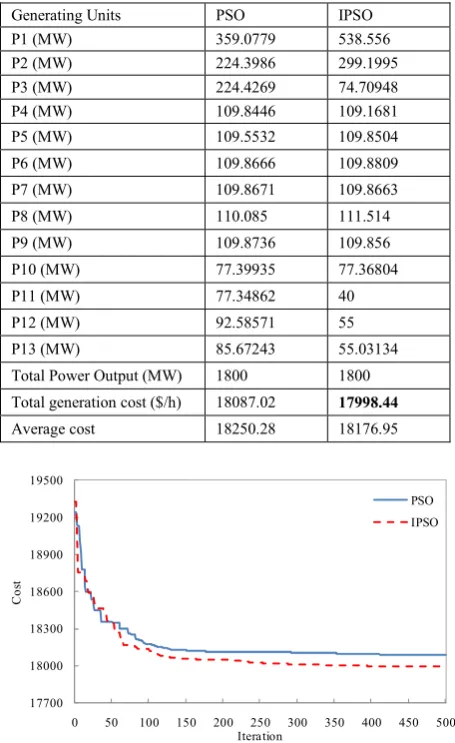
methods are set to 200 due to high dimension or complex problem compared to 3 unit system. The fuel cost coefficient of the generator has been taken from [21] and transmission losses are neglected. Table 4 shows the best result obtained by proposed IPSO and PSO method after 20 runs. As seen in Table 4, the IPSO method can obtain a good solution compared to PSO. Its can reach to near optimum solution faster than PSO as illustrated in Fig. 4. The new parameter in the IPSO method can enhance searching capability of proposed method that result to near global solution. However, the classical PSO stuck at local solution after certain iteration.
TABLE 4
BEST RESULTS OF PSO AND IPSOAFTER 20RUNS
Generating Units PSO IPSO
P1 (MW) 359.0779 538.556
P2 (MW) 224.3986 299.1995
P3 (MW) 224.4269 74.70948
P4 (MW) 109.8446 109.1681
P5 (MW) 109.5532 109.8504
P6 (MW) 109.8666 109.8809
P7 (MW) 109.8671 109.8663
P8 (MW) 110.085 111.514
P9 (MW) 109.8736 109.856
P10 (MW) 77.39935 77.36804
P11 (MW) 77.34862 40
P12 (MW) 92.58571 55
P13 (MW) 85.67243 55.03134
Total Power Output (MW) 1800 1800 Total generation cost ($/h) 18087.02 17998.44
Average cost 18250.28 18176.95
17700 18000 18300 18600 18900 19200 19500
0 50 100 150 200 250 300 350 400 450 500
Cos
t
Iteration
PSO IPSO
Fig. 4. Convergence characteristics for 13 generating units
The results obtained by the IPSO method has been compared with the published results: GA [22], IGA [23], PSO [21], SAPSO [21], CPSO [21] and NPSO [21] given in Table 5. It is clearly shows that the proposed IPSO has less generation cost compared to other methods.
In order to investigate the robustness the IPSO, similar approach as case study 1 is carried out for both IPSO and PSO methods. From Fig. 5, it clearly shows that the IPSO method can give the lowest generation cost in the most number of runs compared to PSO. Furthermore, the average
cost of IPSO is better than PSO given in Table 2. For this case, IPSO method is more robust compared to PSO in finding the global solution because it can provide the consistent result with minimum cost as compared to original PSO. It can be concluded that, IPSO approach can improve the performance of classical PSO for solving ED problem with valve point effect.
TABLE 5
COMPARISON OF BEST RESULT FOR 13UNIT SYSTEM
Method Minimum cost ($/h) Method Minimum cost ($/h)
GA [23] 18671 NPSO [22] 18124
PSO [22] 18105 IGA [24] 18063.58
SAPSO [22] 18076 PSO 18087.02
CPSO [22] 18090 IPSO 17998.44
17400 17600 17800 18000 18200 18400 18600
1 2 3 4 5 6 7 8 9 10 11 12 13 14 15 16 17 18 19 20
Co
st
Number of runs
PSO
IPSO
Fig. 5. Best result of PSO and IPSO for 20 runs
VI. CONCLUSION
In this paper, an iteration particle swarm optimization (IPSO) method has been successfully applied to solve the ED problem taking into account the valve point effects. A new iteration best parameter is employed to update the velocity in order to enhance searching behaviour and find the global optimum solution. Simulation results show that the proposed algorithm can achieves the global optimum solution for 3 units system. For 13 units system, the proposed algorithm give better cost compared to other methods from the literature. From the two case studies, it can be concluded that IPSO has ability to reach near to global optimum solution and more robust in comparison with PSO and other published results.
ACKNOWLEDGEMENTS
The Authors would like to sincerely acknowledge the Universiti Tun Hussein Onn Malaysia (UTHM) for funding this research work.
REFERENCES
[1] K. T. Chaturvedi, M. Pandit, and L. Srivastava, "Particle swarm optimization with time varying acceleration coefficients for non-convex economic power dispatch," International Journal of Electrical Power &
[image:5.595.54.282.212.584.2][2] I. Jacob Raglend, S. Veeravalli, K. Sailaja, B. Sudheera, and D. P. Kothari, "Comparison of AI techniques to solve combined economic emission dispatch problem with line flow constraints," International
Journal of Electrical Power & Energy Systems, vol. 32, pp. 592-598,
2010.
[3] N. Nabona and L. L. Freris, "Optimisation of economic dispatch through quadratic and linear programming," Proceedings of the Institution of Electrical Engineers, vol. 120, pp. 574-580, 1973. [4] G. F. Reid and L. Hasdorff, "Economic Dispatch Using Quadratic
Programming," IEEE Transactions on Power Apparatus and Systems,
vol. PAS-92, pp. 2015-2023, 1973.
[5] A. Farag, S. Al-Baiyat, and T. C. Cheng, "Economic load dispatch multiobjective optimization procedures using linear programming techniques," IEEE Transactions on Power Systems, vol. 10, pp. 731-738, 1995.
[6] N. Sinha, R. Chakrabarti, and P. K. Chattopadhyay, "Evolutionary programming techniques for economic load dispatch," IEEE
Transactions onEvolutionary Computation, vol. 7, pp. 83-94, 2003.
[7] N. Amjady and H. Nasiri-Rad, "Economic dispatch using an efficient real-coded genetic algorithm," IET Generation, Transmission & Distribution, vol. 3, pp. 266-278, 2009.
[8] T. Sum-im and W. Ongsakul, "Ant colony search algorithm for unit commitment," IEEE International Conference on Industrial
Technology, 2003, pp. 72-77 Vol.1.
[9] W. M. Lin, F. S. Cheng, and M. T. Tsay, "An Improved Tabu Search for Economic Dispatch with Multiple Minima," Power Engineering
Review, IEEE, vol. 22, pp. 70-70, 2002.
[10] B. Vanaja, S. Hemamalini, and S. P. Simon, "Artificial Immune based Economic Load Dispatch with valve-point effect," 2008 IEEE Region
10 Conference inTENCON 2008 -, 2008, pp. 1-5.
[11] G. Zwe-Lee, "Particle swarm optimization to solving the economic dispatch considering the generator constraints," IEEE Transactions on
Power Systems, vol. 18, pp. 1187-1195, 2003.
[12] J. Kennedy and R. Eberhart, "Particle swarm optimization," IEEE
International Conference on Neural Networks, 1995, pp. 1942-1948
vol.4.
[13] D. N. Jeyakumar, T. Jayabarathi, and T. Raghunathan, "Particle swarm optimization for various types of economic dispatch problems,"
International Journal of Electrical Power & Energy Systems, vol. 28,
pp. 36-42, 2006.
[14] T.-Y. Lee and C.-L. Chen, "Unit commitment with probabilistic reserve: An IPSO approach," Energy Conversion and Management, vol. 48, pp. 486-493, 2007.
[15] R. L. Haupt and S. E. Haupt, Practical Genetic Algorithms. New Jersey: John Wiley & Sons, 2004.
[16] K. T. Chaturvedi, M. Pandit, and L. Srivastava, "Self-Organizing Hierarchical Particle Swarm Optimization for Nonconvex Economic Dispatch," IEEE Transactions on Power Systems, vol. 23, pp. 1079-1087, 2008.
[17] A. I. Selvakumar and K. Thanushkodi, "A New Particle Swarm Optimization Solution to Nonconvex Economic Dispatch Problems,"
IEEE Transactions on Power Systems, vol. 22, pp. 42-51, 2007.
[18] D. C. Walters and G. B. Sheble, "Genetic algorithm solution of economic dispatch with valve point loading," IEEE Transactions on
Power Systems, vol. 8, pp. 1325-1332, 1993.
[19] Y. Hong-Tzer, Y. Pai-Chuan, and H. Ching-Lien, "Evolutionary programming based economic dispatch for units with non-smooth fuel cost functions," IEEE Transactions on Power Systems, vol. 11, pp. 112-118, 1996.
[20] P. Jong-Bae, L. Ki-Song, S. Joong-Rin, and K. Y. Lee, "A particle swarm optimization for economic dispatch with nonsmooth cost functions," IEEE Transactions on Power Systems, vol. 20, pp. 34-42, 2005.
[21] K. S. Kumar, R.Rajaram, V.Tamilselvan, V. Shanmugasundaram, S.Naveen, and I. G. M. Nowfal, "Economic Dispatch with Valve POints Effect Using Various PSO Techniques," International Journal of Recent Trends in Engineering, vol. 2, p. 6, 2009.
[22] B. Vanaja, S. Hemamalini, and S. P. Simon, "Genetic Algorithm Based Economic Load Dispatch with Valve-Points Effects,"AISTED International Conference on Power and Energy Systems, 2008.
[23] S. H. Ling, H. K. Lam, F. H. F. Leung, and Y. S. Lee, "Improved genetic algorithm for economic load dispatch with valve-point loadings," Industrial Electronics Society, 2003. IECON '03. The 29th