Journal of Chemical and Pharmaceutical Research
__________________________________________________
ISSN No: 0975-7384 CODEN(USA): JCPRC5
J. Chem. Pharm. Res., 2010, 2(3):559-566
559
Preparations, properties and theoretical studies of a few polyimines
containing ester linkages
Vasishta D. Bhatt*, Smita Srivastava and Ketul Patel
Department of Chemical Sciences, N V Patel College of Pure & Applied Sciences, Vallabh Vidyanagar, Gujarat, India
______________________________________________________________________________
ABSTRACT
Synthesis and characterization of some polyimines containing ester linkages are reported here. The electrical conductivity of these polymers is measured and the results are explained using quantum mechanical (AM1) as well as molecular mechanical (MM2) calculations. The polymers are then doped with Ag and a few mineral acids. The electrical conductivity of most of the doped polymers is found to register significant increase. Attempts are made to explain this increase in electrical conductivity.
Keywords: Polyimines; ester linkages; Synthesis; Electrical conductivity.
______________________________________________________________________________
INTRODUCTION
Electrical conductivity of organic polymers has drawn attention of many researchers [1-8]. In earlier communications [7, 8], we made attempts to explain the conductivity of organic polymers employing Pariser-Parr-Pople (PPP) molecular orbital (M.O.) theory. The present investigation was carried out in continuation of our work [7, 8] on the synthesis and electrical conductivity polyesters containing azomethine linkage, where use was made of frontier electron density type index to explain conductivity.
_____________________________________________________________________________
560
EXPERIMENTAL SECTION
Materials
All the reagents used were of AR grade. The solvents used were purified by standard methods [9].
Preparation of Monomers and Polyimines Dialdehyde Monomers
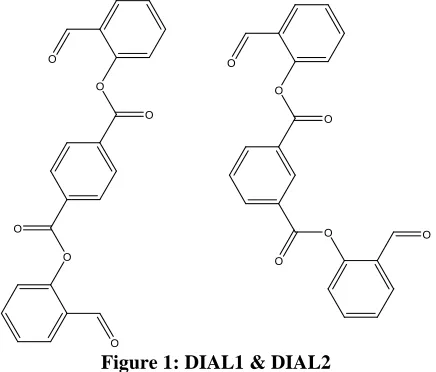
A solution of 0.01 moles of Ter / Isophthaloyl Chloride in 50 ml of absolute alcohol was added slowly to a solution of 0.01 mole of salicylaldehyde dissolved in 50 ml of absolute alcohol through a dropping funnel with constant stirring. The contents were stirred on a magnetic stirrer for about two hours. Precipitates thus obtained were washed thoroughly with aqueous sodium bicarbonate solution to remove any acid formed. These resultant dialdehydes containing ester linkages were then dried under vacuum. Products DIAL1 and DIAL2 are depicted in Figure 1.
O
O
O O
O O
O
O
O
[image:2.595.198.416.280.466.2]O O O
Figure 1: DIAL1 & DIAL2
Polyimines
0.01 moles of o-/m-/p-phenylenediamine was dissolved in about 50 ml of dimethylformamide (anhydrous). Equimolar solution containing dialdehydes with ester linkages in 50 ml of anhydrous dimethylformamide was introduced slowly with stirring. The stirring was continued for 2 hours at 50 oC in a water bath. The reaction was catalyzed with a few drops of acetic acid. The polymers thus formed were precipitated and were separated by filtration. Precipitates ob-tained were washed with hot R-spirit several times to remove the unreacted material. These polymeric powders were then dried under vacuum for 48 hours. The structures of the products PI1 to PI6 are shown in figure 2.
O
O
O
O NH2
N NH2
561
O
O O
O
H2N
N
H2N N
O
O O
O
H2N N NH2
N
O
O O
O
NH2
N
H2N
N
O
O O
O
H2N N H2N
N
O
O O
O
H2N N NH2
N
_____________________________________________________________________________
562
Doping
Doping is used here in the broadest sense of the word and it is the process of generation and incorporation of atomic species of silver into the polymer matrix. 1:1 molar solution of silver nitrate and formaldehyde in DMF was added to the polymer kept in DMF [10]. The mixture was kept in dark for 12 hours. The polymer was then filtered through a fluted filter paper, washed several times with cold double distilled water. The silver doped was estimated by decomposing known amount of the doped polymer with cone. Sulphuric acid-Nitric acid mixture. The silver was precipitated as silver chloride and weighed.
Doping with mineral acids was done by keeping the polymers in 2M aceticacid / hydrochloric acid / sulphuric acid under the influence of ultrasound for 2 hours. The mixture was then allowed to stand for 24 hours and then filtered. Here the terminal amine groups and probably some of the imine groups of the polymer forms adduct with the mineral acids. The polymer was then filtered through a fluted filter paper, washed several times with cold double distilled water.
Measurements
The IR Spectra (KBr pellets) were recorded on Perkin Elmer-983 and FT-IR impact 400D spectrophotometer. Shimadzu UV visible recording spectrophotometer model UV-160 A was employed for recording UV spectra. Conductivity of compressed pellets was measured on Solatron Impedance Analyzer Model 260, Kelvin Bridge and Phillips digital multimeter. The carbon, hydrogen and nitrogen were analyzed with Heraeus C H N—O Rapid Analyzer.
RESULTS AND DISCUSSION
Characterization of Monomers and Polymers Elemental Analysis
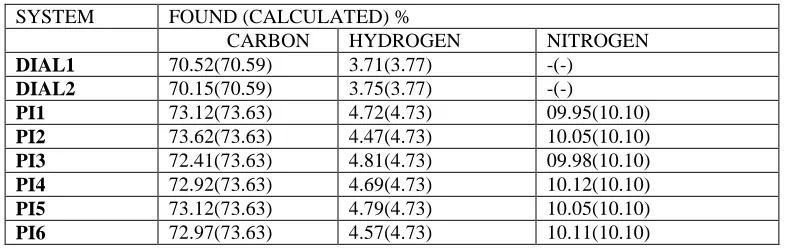
[image:4.595.110.503.507.632.2]The elemental analysis (Table 1) of monomers and polymers indicated that in each polymer the monomers are practically in equimolar proportions. Also, the theoretically calculated values of composition are in close agreement with that of the practical ones.
Table 1 : Elemental analysis of monomers and polymers
SYSTEM FOUND (CALCULATED) %
CARBON HYDROGEN NITROGEN
DIAL1 70.52(70.59) 3.71(3.77) -(-)
DIAL2 70.15(70.59) 3.75(3.77) -(-)
PI1 73.12(73.63) 4.72(4.73) 09.95(10.10)
PI2 73.62(73.63) 4.47(4.73) 10.05(10.10)
PI3 72.41(73.63) 4.81(4.73) 09.98(10.10)
PI4 72.92(73.63) 4.69(4.73) 10.12(10.10)
PI5 73.12(73.63) 4.79(4.73) 10.05(10.10)
PI6 72.97(73.63) 4.57(4.73) 10.11(10.10)
Infrared Spectroscopy
563
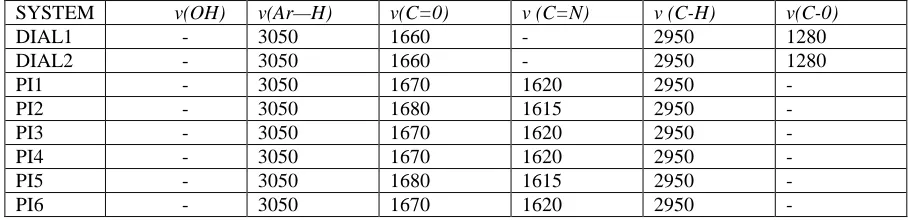
to C = N stretching [12, 14]. All the compounds have bands in the region 1500-1600 cm-1 which may be assigned to aromatic C = C vibrations [11, 14]. The C—O stretching frequency of the C—O(H) moiety in each of the monomers is found around 1280 cm-1 [13,14]. This band disappears in case of the polymers.
Table 2 : Bands Observed in Infrared Spectra of Monomers and Polymers
SYSTEM v(OH) v(Ar—H) v(C=0) v (C=N) v (C-H) v(C-0)
DIAL1 - 3050 1660 - 2950 1280
DIAL2 - 3050 1660 - 2950 1280
PI1 - 3050 1670 1620 2950 -
PI2 - 3050 1680 1615 2950 -
PI3 - 3050 1670 1620 2950 -
PI4 - 3050 1670 1620 2950 -
PI5 - 3050 1680 1615 2950 -
PI6 - 3050 1670 1620 2950 -
UV Transitions
[image:5.595.92.550.164.274.2]All the monomers and their polymers show the characteristic Π —> Π* (Table 3) transition around 255 nm. These bands are attributed to the presence aldehyde groups in monomers and imine groups in the polymers [14, 15]. The UV spectra of the Ag doped polymers do not register any significant change over the respective polymers. This is not unexpected as Ag is not involved in formation of any chemical bond with the polymer, but simply acts as a source of electron donor. The spectra of mineral acid doped polymers also did not register any remarkable change.
Table 3: UV Transitions (nm) Observed in Spectra of Monomers and Polymers
SYTEM A1 A2 A3 A4
DIAL1 257 301 348 -
DIAL2 257 301 342 -
PI1 251 300 343 511
PI2 - 301 342 515
PI3 259 293 342 521
PI4 256 301 346 515
PI5 251 - 342 510
PI6 256 304 345 515
The above discussion supports the structures proposed for these polymers as shown in Figure 2. It is interesting to note that the intensity of corresponding peaks in the polymers is more than those in monomers, since in polymers more number of similar functional groups is present.
Computational Methods Method of Calculation
In our earlier communications [3, 4, 7], Pariser-Parr-Pople method without configuration interaction was employed to study the polymers, as it is thought that the extent of delocalization of the IT electrons will be the major contributor to the conductivity of these polymers.
_____________________________________________________________________________
564
proposed by Dewar are used. Here, unpaired electron is treated as a pair of ½ electrons with opposite spin.
Since the study involves relatively larger sized molecules, molecular mechanical method (MM2) is also used to understand the electrical conductivity of these polymers [18]. This molecular mechanical method based on laws of classical physics calculates the steric energy of the molecules. It was thought appropriate to calculate the steric energy of one and two repeating units of the polymers for correlating the extent of polymerization with the observed conductivity in the polymers under investigation.
DISCUSSION
The mechanism of electrical conduction in polymer may not be a simple one. One of the possible routes may be that electron(s) from HOMO (Highest Occupied Molecular Orbital) of the repeating unit is (are) transferred to the LUMO (Lowest Unoccupied Molecular Orbital) and possibly to the next higher orbital where electron density at certain appropriated place(s) become high, which helps in conduction. Moreover, the extent of polymerization which also depends on the steric factors is expected to show direct proportionality with the electrical conductivity.
Monomers and Polymers
It will be worth examining the role of ∆E, the difference in energy of the HOMO and LUMO in
[image:6.595.69.546.411.535.2]the electrical conduction.
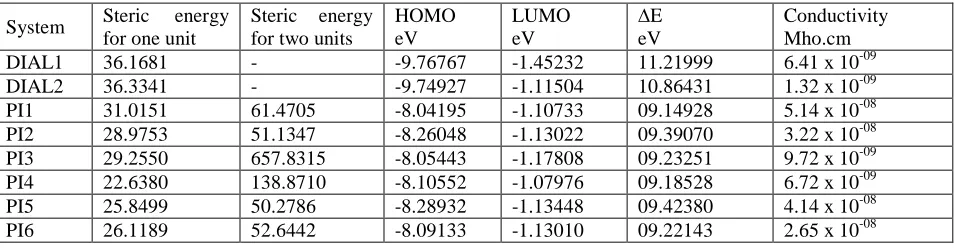
Table 4 Results of AM1, MM2 and conductivity studies of monomers and polymers
System Steric energy
for one unit
Steric energy for two units
HOMO eV
LUMO eV
∆E eV
Conductivity Mho.cm
DIAL1 36.1681 - -9.76767 -1.45232 11.21999 6.41 x 10-09
DIAL2 36.3341 - -9.74927 -1.11504 10.86431 1.32 x 10-09
PI1 31.0151 61.4705 -8.04195 -1.10733 09.14928 5.14 x 10-08
PI2 28.9753 51.1347 -8.26048 -1.13022 09.39070 3.22 x 10-08
PI3 29.2550 657.8315 -8.05443 -1.17808 09.23251 9.72 x 10-09
PI4 22.6380 138.8710 -8.10552 -1.07976 09.18528 6.72 x 10-09
PI5 25.8499 50.2786 -8.28932 -1.13448 09.42380 4.14 x 10-08
PI6 26.1189 52.6442 -8.09133 -1.13010 09.22143 2.65 x 10-08
From the Table 4, it is apparent that the electronic conductivity of the molecules increases proportionately with decreasing ∆E values. Thus, a simple correlation is observed between
electrical conductivity and ∆E in the present investigation.
565
monomers. We propose that the low conductivity in the said moieties is due to very low degree of polymerization.
Doped Polymers
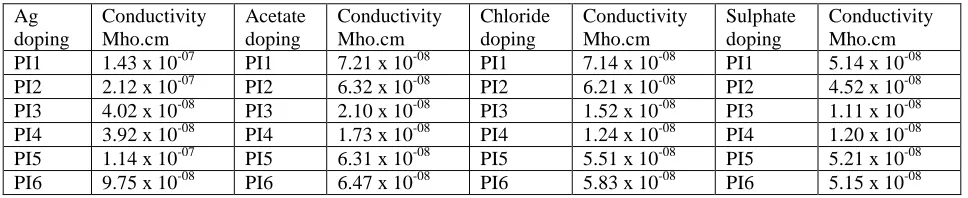
[image:7.595.65.549.259.358.2]The conductivity values of the doped polymers are shown in Table 5. Doping of the polymers with silver increases the conductivity by around ten folds. Consequently, it becomes necessary to invoke a mechanism to explain such an increase. As has already been discussed, the conductivity is dependent on the electron density in the unoccupied orbitals. Since Ag atom can freely share its electron(s), it maybe that the said electron(s) from Ag is accommodated in different unoccupied orbitals of the concerned polymer. Here the conductivity of all the Ag doped polymers show significant improvement.
Table 5 Electrical conductivities of doped polymers
Ag doping
Conductivity Mho.cm
Acetate doping
Conductivity Mho.cm
Chloride doping
Conductivity Mho.cm
Sulphate doping
Conductivity Mho.cm
PI1 1.43 x 10-07 PI1 7.21 x 10-08 PI1 7.14 x 10-08 PI1 5.14 x 10-08
PI2 2.12 x 10-07 PI2 6.32 x 10-08 PI2 6.21 x 10-08 PI2 4.52 x 10-08
PI3 4.02 x 10-08 PI3 2.10 x 10-08 PI3 1.52 x 10-08 PI3 1.11 x 10-08
PI4 3.92 x 10-08 PI4 1.73 x 10-08 PI4 1.24 x 10-08 PI4 1.20 x 10-08
PI5 1.14 x 10-07 PI5 6.31 x 10-08 PI5 5.51 x 10-08 PI5 5.21 x 10-08
PI6 9.75 x 10-08 PI6 6.47 x 10-08 PI6 5.83 x 10-08 PI6 5.15 x 10-08
Doping of the polymers by mineral acids has shown an extremely small yet consistent improvement in the electrical conductivity. Here, it is thought that some of the mineral acid molecules might have formed adduct with the terminal –NH2 groups of the polymer chain. However, no comprehendible mechanism for explaining this increase in conductivity could be thought.
CONCLUSION
In comparison to the respective monomers bases, the ∆E values (the difference in energy
between HOMO and LUMO) for the corresponding polymers showed a small decrease. This might be one of the reasons why the conductivity of the polymers did not register substantial increase. However, a reasonably good correlation could be obtained between the conductivity of the polymers and the steric energy for two repeating units.
On doping with Ag, the conductivity of the polymers increased around tenfold. Mineral acids could not effect a large improvement in the electrical conductivity of the polyimines. Attempts have been made to explain the conductivity of the doped polymers employing both quantum mechanical and molecular mechanical methods.
Acknowledgements
Authors are thankful to University Grants Commission, Pune for providing financial assistance for the present study. Authors also thank SICART, V V Nagar for providing analytical services.
REFERENCES
[1] J. E.Eaton, Organic Semiconducting Polymers, 1970, Marcel Dekker Inc., New York. [2] A. F.Garito, and A. J. Heeger, Acc. Chem. Res., 1974, 7, 232.
_____________________________________________________________________________
566
[4] A. O.Patil, A. J. Heeger and F.Windl, Chem. Rev., 1988, 88, 183. [5] A.Ray, and K. K.Makhija, Ind. J. of Chemistry, 1990, 29(A), 321.
[6] J. S.Anand, Palaniappan and D. N.Sathyanarayana, Synth. Met., 1994, 63, 43. [7] V. D.Bhatt, and A.Ray, Synth. Met., 1998, 92, 115.
[8] V. D. Bhatt and A.Ray, Intern. J. Polymeric Mater., 2001,49, 355.
[9] D. D.Perrin, , W. L. F.Armarego, and D. R.Perrin, Purification of Laboratory Chemicals,
1986, 2nd edition, Pergamon Press, Toronto.
[10] R. Liepins, , B.Jorgensen, A. Nyitray, S. E.Wentworth, D. M.Sutherlin, S. E.Tunney, and J. K. Stelle, Synth. Met., 1986, 15, 249.
[11] D. H.Williams, and I. Flaming, Spectroscopic Methods in Organic Chemistry, 1987 Tata Mc Graw-Hill Publishing Company, New Delhi.
[12] J. E. Kovacic, Spectrochim. Acta, 1967, 23(A),183.
[13] K. K.Ramaswamy, C. I. Jose, and D. N. Sen, Ind. J. of Chem.,1967, 5, 156.
[14] John R. Dyer, Applications of Absorption Spectroscopy of Organic Compounds, 2007, Prentice-Hall of India Private Limited, New Delhi, 4 - 57.
[15] William Kemp, Organic Spectroscopy, 2008, Palgrave, 3rd edition, p 243
[16] Asha Sharma, U. Lourderaj, Deepak, N. Sathyamurthy and Monica Katiyar, Computational
Materials Science,2005, 33(1), 206-211.
[17] Li Zhang, Qiuyu Zhang, Hua Ren, Hongling Yan, Junping Zhang, Hepeng Zhang and Junwei Gu, Solar Energy Materials and Solar Cells, 2008, 5, 92, 581-587.
[18] Tamaki Nakano, Kazuyuki Takewaki, Tohru Yade, and Yoshio Okamoto J. Am. Chem.