www.jocpr.com
Available online
Journal of Chemical and Pharmaceutical Research, 2015, 7(12):913-919
Research Article
CODEN(USA) : JCPRC5
ISSN : 0975-7384
Effect of biocompatible polymers on the physicochemical properties of
fenofibrate in nanoparticle system
Hasanzadeh Ghobad
1*and Soltani Cheraghali
21Department of Plant Science, PNU University Teachers and Teacher Education, Iran
2Department of Geology, Teachers Education, Iran
_____________________________________________________________________________________________
ABSTRACT
This paper aims to investigate the effects of biocompatible polymers on the physicochemical and dissolution properties of poorly water-soluble drugs in nanoparticle systems. Four types of nanoparticles containing poorly water soluble fenofibrate were prepared using solvent evaporation technique with different biocompatible polymers such as polyvinylpyrrolidone (PVP), hydroxypropylmethyl cellulose(HPMC), carbopol and ethylcellulose. Their physicochemical properties were investigated using scanning electron microscopy, differential scanning calorimetry, and powder X-ray diffraction. The solubility and dissolution of nanoparticle-entrapped fenofibrate were compared with those of free drug powder. Biocompatible polymers affected themorphology and sizes of fenofibrate nanoparticles. PVP or carbopol-based nanoparticles showed spherical appearance, whereas HPMC or ethylcellulose-based nanoparticles formed aggregates with irregular shape. The particle sizes increased in the order of the nanoparticle prepared with carbopol B PVP\HPMC\ethylcellulose. The size of PVP-based nanoparticles did not significantly differ from that of carbopol-based nanoparticles, showing the mean sizes of ca. 10 lm. As compared to free drug powder, the solubility and dissolution of the drug in nanoparticles increased in the order of PVP[HPMC[carbopol[ethylcellulose. The enhanced solubility and dissolution of poorly water-soluble fenofibrate via nanoparticle system did not depend on particle size but on crystallinity. In conclusion, in nanoparticle development of poorly water-soluble drugs such as fenofibrate, the nature of biocompatible polymers plays an important role in the physicochemical and dissolution of poorly water-soluble drugs in the nanoparticles.
Keywords: Nanoparticle preparation method, Fenofibrate, Biocompatible polymers, Dissolution, Solubility. _____________________________________________________________________________________________
INTRODUCTION
Nanoparticle systems have been widely studied to increase the solubility of poorly water-soluble drugs (Park et al.2009; Tran et al. 2013; Yan et al. 2012). Drugs in nanoparticle system exist as an amorphous form in polymer matrix. Moreover, this system can improve the solubility and dissolution of drug as compared with drug in crystalline state, since the drugs dispersed in polymer matrix may produce the highest degree of particle size reduction and surface area increase (Lee et al. 2013; Yan et al. 2012).Until now, most studies on the development of nanoparticles containing poorly water-soluble drugs have focused on the preparation methods (Joe et al. 2010; Li et al. 2010;Marasini et al. 2013; Newa et al. 2007; Tran et al. 2013).However, there is still limited information on the role of biocompatible polymers as nanoparticle matrix in the physicochemical properties of encapsulated poorly water soluble drug.
Hasanzadeh Ghobadand Soltani Cheraghali J. Chem. Pharm. Res., 2015, 7(12):
_____________________________________________________________________________
and powder X-ray diffraction (PXRD). Furthermore, the solubility and dissolution of the drug in these nanoparticles were evaluated compared to drug powder.
EXPERIMENTAL SECTION
All chemicals were of reagent grade and used with out further purification.
Preparation of four fenofibrate-loaded nanoparticles
Fenofibrate was loaded into nanoparticles of different biocompatible polymers using solvent evaporation method. PVP, HPMC, carbopol and ethylcellulose were used as biocompatible polymers. Four types of fenofibrate-loaded nanoparticles were prepared by dissolving 5 g of fenofibrate and 5 g of biocompatible polymers in 200 ml ethanol. The mixtures were delivered to the nozzle (0.7 mm diameter) of a Bu¨chi 190 nozzle type mini spray dryer(Flawil, Switzerland) at a flow rate of 5 ml/min via a peristaltic pump and spray-dried at 100 _C inlet temperature and 75– 80°C outlet temperature. The pressure of the sprayed air was 4 kg/cm2 and the flow rate of the drying airwas kept at the aspirator setting of 10 (pressure of the aspirator filter vessel, -25 mbar).Shape and surface morphology. The shape and surface morphology of fenofibrate in free drug powder or nanoparticles were examined using a scanning electron microscope (S-4100, Hitachi, Japan). The samples were fixed on a brass specimen club using double-side adhesive tape and made electrically conductive by coating in a vacuum (6 Pa) with platinum (6 nm/min)using a Hitachi Iron Sputter (E-1030) for 300 s at 15 mA.
Thermal characteristics and crystallinity
The thermal characteristics of fenofibrate loaded in 4 types of nanoparticles were investigated using a differential scanning calorimeter (DSC-2010, TA Instruments, USA). Samples of about 2 mg were placed in sealed aluminium pans, before heating under a nitrogen flow (25 ml/min) at a heating rate of 10 _C/min from 30 to 215 _C. Furthermore, the crystallinity of the powder, carriers and nanoparticles were assessed by X-ray powder diffraction (D/MAX-2500, Rigacu, Japan) conducted at 25 _C using monochromatic
Cu Ka-radiation (k = 1.54178 A ° ) at 40 mA and 40 kV in the region of 2.5_ B 2h B 40_ with an angular increment of 0.02_ per second.
Particle size analysis
The particle size of the nanoparticles was determined using a Zetasizer Nano ZS (Malvern Instruments; Malvern, UK)dynamic light scattering particle size analyser (wavelength,635 nm; scattering angle, 90_; temperature, 25 _C). The values of z-average diameters derived from cumulated analysis by Auto measure software (Malvern Instruments, Malvern, UK) were used.
Aqueous solubility
Excessive amount of nanoparticles (about 20 mg) were added to 1 ml of water. They were shaken in a water bath for 3 days, centrifuged at 3,000g for 10 min (Eppendorf, USA) and filtered through a 0.45 lm membrane filter. The concentration of fenofibrate in the resulting solution was then checked at UV 300 nm (Zhang et al. 2012).
Dissolution
The hard capsule containing the nanoparticles equivalent to25 mg of fenofibrate were inserted into a sinker and placed in the dissolution tester (Shinseang Instrument Co., South Korea), respectively (Li et al. 2010). A dissolution test was performed at 37 ± 0.5 _C using the paddle method at100 rpm with 900 ml 0.2 % Tween 80 solution. At 5, 10,15, 20, 30 and 60 min, 3 ml of the medium was taken and filtered through a 0.45 lm membrane filter. Then, the concentration of fenofibrate in the supernatant was determined by UV spectrophotometer (Ultrospec 7000; GE Healthcare, Buckinghanshire, GK) at 300 nm.
RESULTS AND DISCUSSION
Four different fenofibrate-loaded nanoparticles were prepared with fenofibrate and biocompatible polymers such as PVP, HPMC, carbopol and ethylcellulose at the weight ratio of 1:1 using solvent-evaporation method. The mixture solution of fenofibrate and various biocompatible polymers in ethanol were spray-dried under the same conditions. Evaporation of ethanol by spray drying resulted in four different types of fenofibrate-loaded nanoparticles (Joeet al. 2010; Li et al. 2008).
Hasanzadeh Ghobadand Soltani Cheraghali J. Chem. Pharm. Res., 2015, 7(12):
_____________________________________________________________________________
evaporation method produced a spherical shape which was formed during spray-drying process of the drugs and polymers (Lee et al. 2013; Joe et al. 2010). However, unlike conventional nanoparticles, those with HPMC(Fig. 1c) or ethylcellulose (Fig. 1d) formed aggregates of irregular shape due to their relatively high viscosity.
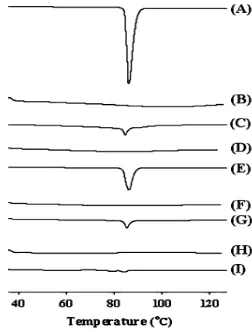
[image:3.595.124.494.209.682.2]Drug powder and nanoparticles showed different thermal properties from polymer carriers (Fig. 2). The DSC curve shows that free fenofibrate powder has an endothermic peak at about 80 _C, meaning its melting point and indicating its crystalline nature (Fig. 2a) (Park et al. 2009;Zhang et al. 2012). The polymers such as HPMC (Fig. 2b), PVP (Fig. 2d), carbopol (Fig. 2f) and ethylcellulose(Fig. 2h) had no intrinsic peaks (Kang et al. 2012; Leeet al. 2013). Unlike polymer carriers, a sharp peak of fenofibrate was shown in the nanoparticles prepared by the solvent-evaporation method. Our results suggest that the drug did not chemically interact with biocompatible polymers in these nanoparticle systems (Park et al. 2009).
Fig. 1 Scanning electron micrographs (X 2,000):a fenofibrate powder; b fenofibrate nanoparticle prepared with PVP; c fenofibrate nanoparticle prepared with HPMC; d fenofibrate nanoparticle prepared with carbopol; e fenofibrate nanoparticle prepared with
ethylcellulose. All nanoparticles were prepared with fenofibrate and biocompatible polymer at the weight ratio of 1:1
Hasanzadeh Ghobadand Soltani Cheraghali J. Chem. Pharm. Res., 2015, 7(12):913-919
______________________________________________________________________________
a typical crystalline pattern (Fig. 3A) (Lee et al.2013). These sharp peaks were hardly observed in the nanoparticle prepared with PVP (Fig. 3B), indicating that the crystalline drug was changed to an amorphous form in this nanoparticle (Kang et al. 2012; Oh et al. 2012).
However, the other nanoparticles prepared with HPMC(Fig. 3C), carbopol (Fig. 3D) and ethylcellulose (Fig. 3E)showed the intrinsic sharp peaks similar to drugs, even if they showed weak density compared to drug. These results suggested that these nanoparticles could partially alter to amorphous form. The z-average particle sizes of four nanoparticles are given in Table 1. Sizes of the fenofibrate-loaded nanoparticle Increased in the order of nanoparticles prepared with carbopol B PVP\HPMC\ethylcellulose. The size of PVP-based nanoparticles did not significantly differ from that of carbopol-based nanoparticles, showing average size of about 10 lm. The size of nanoparticle prepared with HPMC was about 20 lm. However, the sizes of ethylcellulose-based nanoparticles could not be detected because of huge aggregate formation. Regardless of polymer types, all nanoparticles increased the solubility of fenofibrate over that of the drug powder. The aqueous solubility of fenofibrate in these nanoparticles is described in Table 2. Fenofibrate had the aqueous solubility of about 0.3 lg/ml, indicating its poor water solubility(Zhang et al. 2012).
[image:4.595.243.369.324.490.2]Furthermore, the aqueous solubility of the drug was significantly improved in the order of the fenofibrate-loaded nanoparticle prepared with PVP[HPMC[carbopol[ethylcellulose. Noticeably, the solubility of fenobirate in HPMC-based nanoparticles was more than 30-fold higher than that in free powder form. Biocompatible polymer types of nanoparticles affected the dissolution of fenofibrate. To evaluate the dissolution ofthe drug from the nanoparticles, the dissolution test on four fenofibrate-loaded nanoparticles was performed (Fig. 4).
Fig. 2 Differential scanning calorimetric thermograms: (A) fenofibrate powder; (B) PVP; (C) fenofibrate nanoparticle prepared with PVP; (D) HPMC; (E) fenofibrate nanoparticle prepared with HPMC;(F) carbopol; (G) fenofibrate nanoparticle prepared with carbopol;
(H) ethylcellulose; (I) fenofibrate nanoparticle prepared with ethylcellulose. All nanoparticles were composed of fenofibrate and biocompatible polymer at the weight ratio of 1:1
Table 1 Sizes of fenofibrate-loaded nanoparticles
[image:4.595.205.411.566.652.2]Hasanzadeh Ghobadand Soltani Cheraghali J. Chem. Pharm. Res., 2015, 7(12):913-919
______________________________________________________________________________
[image:5.595.197.416.158.316.2]forms. Furthermore, four polymers have different properties in nature and charges, even though they were soluble in ethanol. PVP is cationic, hydrophilic and soluble in water (Oh et al. 2011). HPMC, a cellulose derivative, is neutral, hydrophilic and soluble in water (Lim et al. 2010; Park et al. 2009). Carbopol, a polyacrylic acid derivative polymerized without crosslinking agent, is anionic, hydrophilic and water-swellable(Kang et al. 2012; Yoshida et al. 2012). Ethylcellulose, a cellulose derivative, is neutral, hydrophobic and insoluble in water (Hernandez et al. 1994; Kim et al. 2011). The fenofibrate-loaded nanoparticles composed of fenofibrate and various polymers at the weight ratio of 1:1 were prepared with four different polymers.
Fig. 3 X-ray powder diffraction: (A) fenofibrate powder; (B) fenofibrate nanoparticle prepared with PVP; (C) fenofibrate nanoparticle prepared with HPMC; (D) fenofibrate nanoparticle prepared with carbopol; (E) fenofibrate nanoparticle prepared with ethylcellulose.
All nanoparticles were composed of fenofibrate and biocompatible polymer at the weight ratio of 1:1
Table 2 Aqueous solubility of fenofibrate in free powder and Nanoparticles
The solubility and dissolution of the drug was improved in the order of the fenofibrate-loaded nanoparticle prepared with PVP[HPMC[carbopol[ethylcellulose. The anionic and water soluble PVP might be covalently interacted with fenofibrate, anionic drug (Zhang et al. 2012). Therefore, through nanoparticle formulation, the crystalline drugs were entirely changed to amorphous forms, leading to most improved solubility and dissolution (Oh et al. 2011; Yan et al. 2012).The neutral and water-soluble HPMC, and cationic and water-swellable carbopol might be weakly bonded with drugby dipole–dipole interaction. Thus, the crystalline drugs were partially altered to amorphous forms (Cho and Choi 2013; Lim et al. 2010; Yoshida et al. 2012), resulting in secondly and thirdly improved solubility and dissolution, respectively.
[image:5.595.193.425.381.483.2]Hasanzadeh Ghobadand Soltani Cheraghali J. Chem. Pharm. Res., 2015, 7(12):913-919
______________________________________________________________________________
Fig4. Effect of biocompatible polymers on the dissolution of drug from fenofibrate-loaded nanoparticles in 2 % Tween aqueous solution.All nanoparticles were composed of fenofibrate and biocompatible polymer at the weight ratio of 1:1. Each value represents the
mean ± SD (n = 6)
CONCLUSION
In the development of a nanoparticle system using the solvent-evaporation technique, the nature of biocompatible polymers plays an important role in the physicochemical and dissolution of poorly water-soluble drugs in the nanoparticles. Given the enhanced solubility and dissolution profiles of entrapped fenofibrate, a cationic and water soluble PVP is suggested as the most suitable polymer for nanoparticle formulation of poorly water-soluble and anionic drug such as fenofibrate.
REFERENCES
[1] Cho KH, Choi HG (2013) Drug Dev Ind Pharm 39(6):901–908.
[2] Hernandez JI, Gharly ES, Malave A, Marti A (1994) Drug Dev Ind Pharm 20:1253–1265.
[3] Joe JH, Lee WM, Park YJ, Joe KH, Oh DH, Seo YG, Woo JS, YongCS, Choi HG (2010) Int J Pharm395:161– 166.
[4] Kang JH, Oh DH, Oh YK, Yong CS, Choi HG (2012) Eur J Pharm Biopharm 80(2):289–297.
[5] Kim YI, Kim KS, Suh KH, Shanmugam S, Woo JS, Yong CS, ChoiHG (2011) Int JPharm 415:129–139. [6] Lee SN, Poudel BK, Tran TH, Marasini N, Pradhan R, Lee YI, LeeDW, Woo JS, Choi HG, Yong CS, Kim JO (2013) Arch Pharm Res 36(1):79–85.
[7] Li DX, Oh YK, Lim SJ, Kim JO, Yang HJ, Sung JH, Yong CS, ChoiHG (2008) Int JPharm 355:277–284. [8] Li DX, Jang KY, Kang WK, Bae KJ, Lee MH, Oh YK, Jee JP, ParkYJ, Oh DH, Seo YG, Kim YR, Kim JO, Woo JS, Yong CS, ChoiHG (2010) Biol Pharm Bull 33:279–284.
[9] Lim HT, Balakrishnan P, Oh DH, Joe KH, Kim YR, Hwang DH, LeeYB, Yong CS, Choi HG (2010) Int J Pharm 397:225–230.
[10] Marasini N, Tran TH, Poudel BK, Cho HJ, Choi YK, Chi SC, ChoiHG, Yong CS, Kim JO (2013) Int J Pharm
441:424–432.
[11] Newa M, Bhandari KH, Li DX, Kwon TH, Kim JA, Yoo BK, Woo JS,Lyoo WS, Yong CS, Choi HG (2007) Int
J Pharm 343:228–237.
[12] Oh DH, Park YJ, Kang JH, Yong CS, Choi HG (2011) Drug Deliv 18(1):46–53.
[13] Oh DH, Kang JH, Kim DW, Lee BJ, Kim JO, Yong CS, Choi HG(2012) Int J Pharm 420(2):412–418.
[14] Park YJ, Ryu DS, Li DX, Quan QZ, Oh DH, Kim JO, Seo YG, LeeYI, Yong CS, Woo JS, Choi HG (2009)
Arch Pharm Res 32(6):893–898.
[15] Tran TH, Poudel BK, Marasini N, Chi SC, Choi HG, Yong CS, KimJO (2013) Int J Pharm 443:50–57.
Hasanzadeh Ghobadand Soltani Cheraghali J. Chem. Pharm. Res., 2015, 7(12):913-919
______________________________________________________________________________
[17] Yoshida T, Kurimoto I, Yoshihara K, Umejima H, Ito N, Watanabe S,Sako K, Kikuchi A (2012). Int J Pharm
428:18–24.
[18] Zhang M, Li H, Lang B, O’Donnell K, Zhang H, Wang Z, Dong Y,Wu C, Williams RO 3rd (2012) Formulation