
Journal of Chemical and Pharmaceutical Research, 2014, 6(7):2484-2490
Research Article
CODEN(USA) : JCPRC5
ISSN : 0975-7384
Effect of particle size on reduction behavior in iron ore-coal
composite pellets
Yi Man, Junxiao Feng, Qi Ge and Fujie Li
School of Mechanical Engineering, University of Science and Technology Beijing, Beijing, China
____________________________________________________________________________________________ABSTRACT
The reduction of iron ore-coal composite pellets was carried out in the temperature range of 500~1200°C by thermogravimetry. This study aims to investigate the effect of particle size of iron ore on reduction behavior. Three samples of different particle size were selected: 25~48µm, 75~106µm and 150~180µm. The reaction kinetic
parameters were estimated based on the thermogravimetric data. The characterization of the heated residues was identified by X-ray diffraction and Scanning electron microscope. The experimental results indicated that the selected iron ore with particle size 25~48µm was appropriate for the reduction of iron ore-coal composite pellets in the
experimental conditions, and particle size 75~106µm and 150~180µm were insufficient to complete the reduction.
With the increase of particle size, the activation energy increased from 53.04kJ/mol to 131.72kJ/mol. Particle size 25
~48µm had the faster reduction which may be ascribed to more developed surface.
Keywords: Kinetics analysis, Direction reduction, Reduction characteristics, Particle size, Iron ore-coal composite
pellets.
____________________________________________________________________________________________
INTRODUCTION
to FeO in the presence of syngas constituents was investigated based on the thermogravimetric data [19]. Luo et al. [20] presented a novel iron making technology using biomass and iron oxide. The effects of briquettes composition, reduction temperature, reaction time and reducing gas composition on the quality of metallic iron were discussed. Weiss et al. [21]investigated the reduction kinetics of iron ore fines under fluidised bed conditions with hydrogen-rich gas mixtures in the temperature range of 400~700°C, and the influence of both temperature and reducing gas composition on the reaction rate was considered. Halder et al. [9,22,23] examined the rates and shrinkage of Iron-Oxide-Carbon Composites. The fundamental reactions occurring during the heat treatment of cold bonded pellets (CBP) comprised of iron and steelmaking by-products have been studied [24]. However, the effect of particle size on reduction behavior has been studied little.
Due to the importance of iron making in the current and future technologies, the reduction of iron ore-coal composite pellets is probably one of the most studying topics. The objective of the present investigation is to study the reduction characteristics of iron ore-coal composite pellets. For this purpose the thermogravimetry methods are applied to estimate the reduction kinetics of iron ore with different particle sizes and the heated residues are identified by X-ray diffraction.
EXPERIMENTAL SECTION
2.1. Materials
The iron ore from Qian`an, Hebei used in the study contained 64.5%Fetotal, 10.57%FeO, 6.35%SiO2, 0.25%CaO, 1.02%Al2O3, 0.09%MgO and 0.03%S. The particle size distribution were 25~48µm, 75~106µm and 150~180µm, and the average size were 38µm, 90µm, 163µm, respectively. The reductant selected for this analysis was bituminous coal supplied from Datong. The main constituents of this bituminous coal were 13.01%ash, 12.51% volatile matter and 74.8% fixed carbon. The particle size of coal ranged from 74 to 147µm, and the average size was 109µm. The coal was devolatilized at 600°C for an hour in nitrogen before mixed. There was no any further weight loss when the material was treated at 900°C, which indicated that most of the volatile matter was removed.
2.2. Experimental
The sample was mixed to obtain mole ratio of fixed carbon CFix against oxygen OTFe in iron ore particles of 1.0, enabling a complete reduction reaction. The iron ore/carbon mixtures were homogenized by mixing in a laboratory size rotating bowl mixer for 10 minutes. Pellets were made of 1% bentonite binder and iron ore/carbon mixtures in a disc pelletizer(diameter 1000 mm, rim height 300 mm, angle of inclination 45° and rotating 24 rpm) and drying at 110°C for 2 hours to remove moisture before the reduction process. The diameter of pellets in 12~15mm were selected. The kinetics of reduction was investigated by means of the continuous thermogravimetry measurement technique. The thermogravimetric analyzer apparatus was made of a vertical furnace, a quartz glass tube reactor, an electronic balance and a temperature controller. The experiments were carried out in nitrogen atmosphere under the continuous flow of N2 at 0.5l/min. The furnace was heated to the desired temperature. Then the sample was placed in heating zone. All experiments were performed at a linear heating rate of 10°C /min and the experiments were completed when the temperature reached to 1200°C.
The samples dropped off oxygen and carbon along with the reduction. The mass loss of the samples was measured continuously and the mass loss value was then converted into conversion degree using the following formula [25,26]:
(
)
(
)
0 16
28
T
W W oxygen mass
α= − ×
× (1)
Where W0 is the initial mass of samples after removal of moisture, WT is the mass of samples at temperature T.
Fig.1. Reduction process conversion degree versus time in temperature range of 500~1200°C
The conversion degree α for all temperatures in the range of 500~1200°C is shown in Fig.1. As the temperature increased, the reduction conversion degree increased for all mixtures. The reduction of samples with particle size of 163µm occurred at approximately 830°C, while the reduction of samples with particle size of 38µm and 90µm began at 600°C and 680°C, respectively. It was found that the change of particle size caused the change of initial reaction temperature and reduction rate. The reduction rate of samples with the average particle size of 38µm was significantly higher than the others. It may be attributed to the differences in specific surface area.
RESULTS AND DISCUSSION
Fig.2. X-ray diffraction analysis of ore sample and the heated residues (a)iron ore at 20 , (b) iron ore(℃ 150~180µm) at 1200 , (c) iron ℃ ore(75~106µm) at 1200 , (d) iron ore(℃ 25~48µm) at 1200 .℃
reduction process has been improved. Evidently, the selected iron ore with particle size of 163µm was insufficient to complete the reduction. With further decrease of the iron ore particle size to 90µm, the X-ray diffractograms indicated that the intensities of the peak characteristics for metallic iron phases increased highly, whereas the intensities of the peak characteristics for wustite (FeO) was greatly decreased. Based on the principle of phase reduction, the presence of metal iron indicated a high reduction degree. When the iron ore particle size decreased to 38µm, almost the whole reduction of the iron ore achieved at 1200°C. The X-ray diffraction analysis of this mixture showed that metallic iron phase occupied an important position in the residue. This indicated that the iron ore particle size of 38µm was sufficient to complete the reduction.
3.2. Scanning electron microscope (SEM) analysis
In order to reveal morphology characteristics of reduction reaction, the heated residues were crushed and made into samples. Fig.3. shows the scanning electron microscope (SEM) images for both the fresh and the used samples. The microscopic structure of reduced samples obtained from the non-isothermal experiment conducted at 163µm did not reveal any significant alteration due to the slow rate of reduction. In the 90µm sample prepared at 1200°C, it was evident that ore particles were porous system and the structure became relatively loose. The ore particle size in 38µm sample exhibited a developed porous system and some bright area appeared which was confirmed to be metallic iron through the energy spectrum analysis.
(a) (b)
(c) (d)
Fig.3. Scanning electron microscope analysis of samples (a)iron ore at 20 , (b) iron ore(150~180µm) at 1200 , (c) iron ore(℃ 75~106µm) at 1200 , (d) iron ore(℃ 25~48µm) at 1200 .℃
3.3. Kinetic analysis
Knowledge of the kinetic behavior is essential to understand and predict the reduction processes. In order to estimate the reaction process, the activation energies and pre-exponential factors were tested based on the conversion degree. The common equation is usually expressed as a function of Arrhenius parameters with reaction model under non-isothermal conditions:
d E RT
( )
Ae f dT
α
β = − α (2)
Where T is the temperature, α is the fraction reacted till temperature T, β is the heating rate, A is the pre-exponential or frequency fact, E is the activation energy, R is the gas constant and f(α) is the reaction model function.
The patterns dα/dT versus T can be calculated by integration as follow:
( ) ( )
00
d
= Texp
T
A E
G dT
f RT
α α
α
α β
= −
Where T0 is the initial temperature of reduction reaction, the activation energy has been defined as the energy barrier, and the pre-exponential factor describes the frequency of occurrence of the reaction situation. The initial temperature of reduction reaction was considered low, and the reaction rate was negligible. Integration can be calculated between 0 ~ α and 0 ~ T, the equation is expressed as:
( ) ( )
0 0
d
=G A Texp E dT
f RT α α α α β = −
∫
∫
(4)The right-hand side of the equation has no exact integral. A simplified mathematical form of the reaction kinetics by Coats-Redfern can be described as:
ln G
( )
2 ln AR 1 2RT ET E E RT
α β = − −
(5)
At a fixed conversion degree, the temperature is moderate and the value of E is great, ln[AR/βE(1-2RT/E)] can be considered as constant. Plotting the left-hand side versus 1/T leads to a temperature-programmed Arrhenius plot, in which the slope is equal to -E/R and ln[AR/βE(1-2RT/E)] may be calculated from the intercept with vertical axis of the plot of ln[G(α)] against 1/T.
[image:5.595.79.536.611.728.2]The reduction of iron oxide is a gas-solid reaction, and the reduction process may be controlled by the following link: (1) carbon gasification reaction; (2) three-dimensional diffusion; (3) interfacial reaction. The models deduced from the sphere shrink model or the formation and growth of nuclei mode were listed in table 1.
Table 1. Models selection for gas–solid reaction
No. Kinetics process controlling Equation G(α)
1 First order formation and growth (carbon gasification) −ln 1
(
−α)
2 Three-dimensional diffusion
(
)
2 1 3
1 1 α
− −
3 Three-dimensional interfacial reaction 1− −
(
1 α)
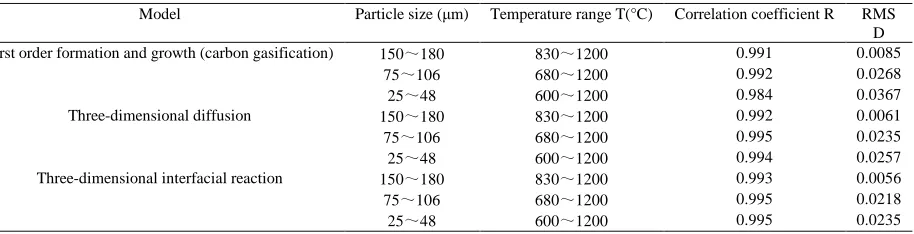
1 3Applying the regression method, the values of conversion α were calculated. The root mean square deviation (RMSD) was employed for comparison of the calculated results and experimental data. The following equation was applied [19]:
(
)
2 c exp 1 alc RMSD nα −α
=
−
∑
(6)
Where αcalc is the calculated result, αexp is the experimental data, and n is the number of experimental data points. The calculated results are detailed in table 2.
Table 2. the calculated results of reduction process
Model Particle size (µm) Temperature range T(°C) Correlation coefficient R RMS D First order formation and growth (carbon gasification) 150~180 830~1200 0.991 0.0085
75~106 680~1200 0.992 0.0268
25~48 600~1200 0.984 0.0367
Three-dimensional diffusion 150~180 830~1200 0.992 0.0061
well. The calculated activation energies and pre-exponential factors for the three particle size ranges of iron ore reduction are detailed in Table 3.
Fig.3. The relation between ln{[1-(1-α)1/3]/T2} and 1/T for reduction composed of different mixtures
Table 3. Kinetic parameters of detected particle size ranges of iron ore reduction
Particle size (µm) 150~180 75~106 25~48
Activation energy E(kJ/mol) 131.72 71.07 53.04 Frequency factor A(s-1) 13.57 7.79E-0
2
2.17 E-02
The reduction rate increased obviously as the temperature raised and the particle size decreased. The reaction activation energy increased from 53.04 kJ/mol to 131.72 kJ/mol when the particle size of iron ore increased from 38µm to 163µm. The increase of activation energy means the decrease of reacting moles which lead to the decrease of adsorption rate. Also increasing activation energy means that the mass diffusion and chemical reaction become more difficult.
The reduction of iron ore-coal composite pellets in the temperature range of 500~1200°C was studied using
thermogravimetry method. Three kinds of iron ore with different particle sizes (25~48µm, 75~106µm, and 150~ 180µm) were investigated. The following conclusions are drawn:
(1) X-ray diffraction analysis and thermogravimetric experiments show that, the particle size of 38µm is appropriate for the reduction of iron ore-coal composite pellets in the experimental conditions. When the coal was mixed with iron ore in the particle size of 163µm, it was reduced to predominantly wustite (FeO), with small amounts of metallic iron presenting in the residue. For iron ore with the particle size of 90µm, the residue was mainly composed of wustite (FeO) and metallic iron. As to the iron ore with the particle size of 38µm, the residue was predominantly composed of metallic iron.
(2) The three-dimensional interfacial reaction model enabled a satisfactory fit to the experimental data. The kinetics of the reduction of iron ore-coal composite pellets indicated that there were considerable variation of kinetics parameters E and A with the change of particle size. The reaction activation energy increased from 53.04kJ/mol to 131.72kJ/mol when the particle size of iron ore increased from 38µm to 163µm. The initial reaction temperature increased from 600°C to 830°C. The kinetic parameters reflected the faster reduction of iron ore with the particle size of 38µm compared to the other two, which may ascribe to more developed surface.
Acknowledgements
This work was sponsored by the Fundamental Research Funds for the Central Universities (NO.FRF-SD-12-007B)
REFERENCES
[1] V Strezov. Iron ore reduction using sawdust: Experimental analysis and kinetic modelling. Renewable Energy,
[image:6.595.190.423.318.359.2][2] P Kaushik; RJ Fruehan. Behavior of Direct Reduced Iron and Hot Briquetted Iron in the Upper Blast Furnace Shaft: Part I. Fundamentals of Kinetics and Mechanism of Oxidation. Metallurgical and Materials Transactions B, 2006, 37(5), 715-725.
[3] R Sah; SK Dutta. Kinetic Studies of Iron Ore–Coal Composite Pellet Reduction by TG–DTA. Transactions of the
Indian Institute of Metals, 2011, 64(6), 583-591.
[4] GS Liu; V Strezov; JA Lucas; LJ Wibberley. Thermal investigations of direct iron ore reduction with coal.
Thermochimica Acta, 2004, 410(1-2), 133-140.
[5] YL Ding; NA Warner. Reduction of Carbon-Chromite Composite Pellets with Silica Flux. Ironmaking and
steelmaking, 1997, 24(4), 283-287.
[6] HV Duong; RF Johnston. Kinetics of Solid State Silica Fluxed Reduction of Chromite with Coal. Ironmaking and
steelmaking, 2000, 27(3), 202-206.
[7] NS Srinivasan. Reduction of Iron Oxides by Carbon in a Circulating Fluidized Bed Reactor. Powder Technology,
2002, 124(1-2), 28-39.
[8] E Donskoi; RI Olivares; DLS McElwain; LJ Wibberley. Experimental Study of Coal based Direct Reduction in Iron Ore/Coal Composite Pellets in a One Layer Bed under Nonisothermal, Asymmetric Heating. Ironmaking and
Steelmaking, 2006, 33(1), 24-28.
[9] S Halder; RJ Fruehan. Reduction of Iron-Oxide-Carbon Composites: Part II. Rates of Reduction of Composite Pellets in a Rotary Hearth Furnace Simulator. Metallurgical and Materials Transactions B, 2008, 39(6), 796-808. [10] M Kawanari; A Matsumoto; R Ashida; K Miura. Enhancement of Reduction Rate of Iron Ore by Utilizing Iron Ore/Carbon Composite Consisting of Fine Iron Ore Particles and Highly Thermoplastic Carbon Material. ISIJ
International, 2011, 51(8), 1227-1233.
[11] DQ Zhu; V Mendes; TJ Chun; J Pan; QH Li; J Li; GZ Qiu. Direct Reduction Behaviors of Composite Binder Magnetite Pellets in Coal-based Grate-rotary Kiln Process. ISIJ International, 2011, 51(2), 214-219.
[12] YK Rao. The kinetics of reduction of hematite by carbon. Metallurgical and Materials Transactions, 1971, 2(5), 1439-1447.
[13] HY Lin; YW Chen; CP Li. The mechanism of reduction of iron oxide by hydrogen. Thermochimica Acta, 2003, 400(1-2), 61-67.
[14] YM Wang; ZF Yuan. Reductive kinetics of the reaction between a natural ilmenite and carbon. Interational
Journal Of Mineral Processing, 2006, 81(3), 133-140.
[15] A Pineau; N Kanari; I Gaballah. Kinetics of reduction of iron oxides by H2 Part I: Low temperature reduction of hematite. Thermochimica Acta, 2006, 447(1), 89-100.
[16] A Pineau; N Kanari; I Gaballah. Kinetics of reduction of iron oxides by H2 Part II. Low temperature reduction of magnetite. Thermochimica Acta, 2007, 456(2), 75-88.
[17] YG Ding; JS Wang; XF She; G Wang; QG Xue. Reduction Characteristics and Kinetics of Bayanobo Complex Iron Ore Carbon Bearing Pellets. Journal Of Iron And Steel Research, International, 2012, 20(5), 28-33.
[18] BR Reddy; BVR Murthy; YV Swamy; HS Ray. Correlation of nickel extraction with iron reduction in oxidic nickel ore by a thermogravimetric method. Thermochimica Acta, 1995, 264(15), 185-192.
[19] K Piotrowski; K Mondal; H Lorethova; L Stonawski; T Szyma´nski; T Wiltowski. Effect of gas composition on the kinetics of iron oxide reduction in a hydrogen production process. International Journal of Hydrogen Energy,
2005, 30(15), 1543-1554.
[20] SY Luo; CJ Yi; YM Zhou. Direct reduction of mixed biomass-Fe2O3 briquettes using biomass-generated syngas.
Renewable Energy, 2011, 30(15), 3332-3336.
[21] B Weiss; J Sturn; S Voglsam; F Winter; J Schenk. Industrial fluidized bed direct reduction kinetics of hematite ore fines in H2 rich gases at elevated pressure. Chemical Engineering Science, 2011, 66(4), 703-708.
[22] S Halder; RJ Fruehan. Reduction of Iron-Oxide-Carbon Composites: Part I. Estimation of the Rate Constants.
Metallurgical and Materials Transactions B, 2008, 39(6), 784-795.
[23] S Halder; RJ Fruehan. Reduction of Iron-Oxide-Carbon Composites: Part III. Shrinkage of Composite Pellets during Reduction. Metallurgical and Materials Transactions B, 2008, 39(6), 809-817.
[24] R Robinson. High temperature properties of by-product cold bonded pellets containing blast furnace flue dust.
Thermochimica Acta, 2005, 432(1), 112-123.
![Fig.3. The relation between ln{[1-(1- α)1/3]/T2} and 1/T for reduction composed of different mixtures](https://thumb-us.123doks.com/thumbv2/123dok_us/8766655.896779/6.595.190.423.318.359/fig-relation-ln-a-reduction-composed-different-mixtures.webp)
