International Journal of Emerging Technology and Advanced Engineering
Website: www.ijetae.com (ISSN 2250-2459,ISO 9001:2008 Certified Journal, Volume 3, Issue 7, July 2013)
521
Improved Near Field Communication Protocol (INFCP)
Abhishek Bhattacherjee
Assistant Professor, Desh Bhagat University, Mandi Gobindgarh, Punjab, India
Abstract - Near field Communication having a capability to secured money transaction thus it requires heavy security during card emulation mode comm. INFCP provides a user based security, Improved Near Field Communication Protocol makes a NFC device more advance and secure from any false user from the existing model. This security is very tactical because it’s totally depends upon user functionality his/her usage with the device. This protocol basically consists of four layers completely depending upon user behaviour. Thus it becomes a new benchmark for security in comm.
I. INTRODUCTION
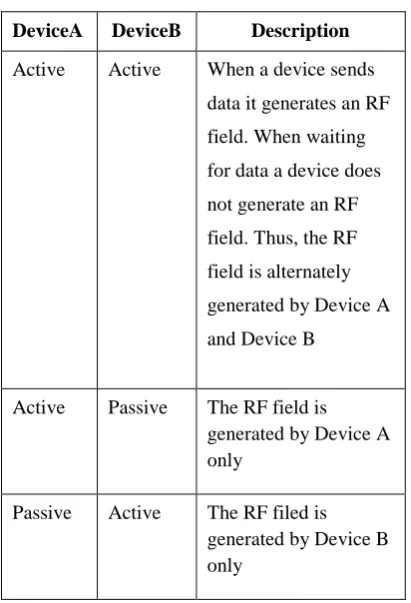
[image:1.595.62.268.421.723.2]NFC stands for Near Field Communication. The specification details of NFC can be found in ISO 18092 [4]. NFC is characterized as a very short range radio communication technology with a lot of potential, especially when applied to mobile handsets.
Table 1.1
Communication configurations
DeviceA DeviceB Description
Active Active When a device sends
data it generates an RF
field. When waiting
for data a device does
not generate an RF
field. Thus, the RF
field is alternately
generated by Device A
and Device B
Active Passive The RF field is generated by Device A only
Passive Active The RF filed is generated by Device B only
NFC standards cover communications protocols and data exchange formats, and are based on existing radio-frequency identification (RFID).
The standards include ISO/IEC 18092 [5] and those defined by the NFC Forum. It is a short-range radio technology that operates on the 13.56 MHz frequency, with data transfers of up to 424 kilobits per second. NFC communication is triggered when two NFC-compatible devices are brought within close proximity, around four centimeters. The interface can operate in several modes. The modes are distinguished whether a device creates its own RF field or whether a device retrieves the power from the RF field generated by another device. If the device generates its own field it is called an active device, otherwise it is called a passive device. Active devices usually have a power supply, passive devices usually don't (e.g. contactless Smart Card). When two devices communicate three different configurations are possible. These are described in Table 1:
II. APPLICATIONS
It is impossible to give a complete picture of NFC applications as NFC is just an interface. The following sub sections introduce three example applications. These shall be viewed as typical use cases and where chosen to motivate the list of possible threats given in the next section.
2.1 Contactless Token
International Journal of Emerging Technology and Advanced Engineering
Website: www.ijetae.com (ISSN 2250-2459,ISO 9001:2008 Certified Journal, Volume 3, Issue 7, July 2013)
522 2.2 Ticketing / Micro Payment
In this example application, the NFC interface is used to transfer some valuable information. The ticket or the micro payment data is stored in a secure device. This could be a contactless Smart Card, but could as well be a mobile phone. When the user wants to perform a payment or use the stored ticket, the user presents the device to a reader, which checks the received information and processes the payment or accepts/rejects the ticket. In this application example the user device must be able to perform a certain protocol with the reader. A simple read operation will not be sufficient in most cases. Also, the user device is likely to have a second interface which is used to load money or to buy tickets. This second interface can for example be linked to the mobile phone CPU. The ticket data could then be loaded into the mobile phone via the cellular network.
In this application sometimes the term ’Secure NFC’ is used. However, this does not at all mean that the NFC link is somehow secured. The name just denotes a configuration using an NFC hardware chip in combination with a Smart Card chip. It should be called ’Secure Smart Card and NFC’, but unfortunately the shorter name is used quite often.
2.3 Device Pairing
In this application the two devices communicating would belong to the same group of devices. An example could be a laptop and a digital camera. The user wants to establish a Bluetooth connection between the two devices to exchange image data. The Bluetooth link is established by bringing the two devices close together and running a given protocol over NFC between the two devices. This makes it obvious for the user which two devices get actually linked and takes away the burden of navigating through menus and selecting the right devices from lists of possible communication partners. It should be noted that the NFC connection itself in this example is only used to establish the Bluetooth link. Image data is not transferred over NFC because NFC’s bandwidth is simply too small for transferring big amounts of data
.
III. THREATS
With announcements from Mobile Phone Handset several manufacturers that Near Field Communication (NFC) enabled handsets will available soon, along with persistent rumors that the next version of the Apple iPhone will include the technology, there has been renewed interest in NFC in the last few months. This has built expectations that this year we will see its widespread deployment rather than just another trial. NFC technology combines the speed and ease of use of a contactless card, such as the Oyster Card [7], with the convenience and flexibility of a smart phone.
And, as with other new service technologies, along with NFC comes new opportunities for fraud. This work provides an insight into the technology and the services that are expected to be deployed through NFC and gives a high- level review of the information security risks associated with the NFC device, along with an introduction to the countermeasures expected to be embedded in the services.
3.1 Phishing
Phishing attacks could easily be performed by modifying or replacing tags. This is a simple and inexpensive way to mislead the user. Using signatures on tags and transporters would be suitable way to overcome this issue
3.2 Eavesdropping
Because NFC is a wireless communication interface it is obvious that eavesdropping is an important issue. When two devices communicate via NFC they use RF waves to talk to each other. An attacker can of course use an antenna to also receive the transmitted signals. Either by experimenting or by literature research the attacker can have the required knowledge on how to extract the transmitted data out of the received RF signal. Also the equipment required to receive the RF signal as well as the equipment to decode the RF signal must be assumed to be available to an attacker as there is no special equipment necessary.
The NFC communication is usually done between two devices in close proximity. This means they are not more than 10 cm (typically less) away from each other. The main question is how close an attacker needs to be to be able to retrieve a usable RF signal. Unfortunately, there is no correct answer to this question. The reason for that is the huge number of parameters which determine the answer. For example the distance depends on the following parameters, and there are many more.
•
RF filed characteristic of the given sender device (i.e. antenna geometry, shielding effect of the case, the PCB, the environment)•
Characteristic of the attacker’s antenna (i.e. antenna geometry, possibility to change the position in all 3 dimensions)•
Quality of the attacker’s receiver•
Quality of the attacker’s RF signal decoder•
Setup of the location where the attack is performed (e.g. barriers like walls or metal, noise floor level)•
Power sent out by the NFC device additionally, it isInternational Journal of Emerging Technology and Advanced Engineering
Website: www.ijetae.com (ISSN 2250-2459,ISO 9001:2008 Certified Journal, Volume 3, Issue 7, July 2013)
523
Both cases use a different way of transmitting the data and it is much harder to eavesdrop on devices sending data in passive mode. In order to not leave the reader without any idea on how big the eavesdropping distances are, we give the following numbers, which as stated above are not valid in general at all, but can only serve to give a rough idea about these distances. When a device is sending data in active mode, eavesdropping can be done up to a distance of about 10 m, whereas when the sending device is in passive mode, this distance is significantly reduced to about 1 m.
3.3 Data Corruption
Instead of just listening an attacker can also try to modify the data which is transmitted via the NFC interface. In the simplest case the attacker just wants to disturb the communication such that the receiver is not able to understand the data sent by the other device. Data corruption can be achieved by transmitting valid frequencies of the data spectrum at a correct time. The correct time can be calculated if the attacker has a good understanding of the used modulation scheme and coding. This attack is not too complicated, but it does not allow the attacker to manipulate the actual data. It is basically a Denial of Service attack.
3.4 Data Modification
In data modification the attacker wants the receiving device to actually receive some valid, but manipulated data. This is very different from just data corruption. The feasibility of this attack highly depends on the applied strength of the amplitude modulation. This form of attack is possible for some bits under different coding schemes. There are a number of ways to provide protection against this form of security attack. It is impossible for an attacker to modify all the data transmitted at the 106 Baud data rate in active mode. As a result, the 106 Baud data rate, active mode would be required for data transfer in both directions
.
3.5 Data Insertion
This means that the attacker inserts messages into the data exchange between two devices. But this is only possible, in case the answering device needs a very long time to answer. The attacker could then send his data earlier than the valid receiver. The insertion will be successful, only, if the inserted data can be transmitted, before the original device starts with the answer. If both data streams overlap, the data will be corrupted.
3.6 Man-in-the-Middle-Attack
In the classical Man-in-the-Middle Attack, two parties which want to talk to each other, called Alice and Bob, are tricked into a three party conversation by an attacker Eve. This is shown in Figure 1.
Alice and Bob must not be aware of the fact that they are not talking to each other, but that they are both sending and receiving data from Eve. Such a setup is the classical threat in unauthenticated key agreement protocols like Diffie-Hellmann protocol (DHP, 2009) Alice and Bob want to agree on a secret key, which they then use for a secure channel. However, as Eve is in the middle, it is possible for Eve to establish a key with Alice and another key with Bob. When Alice and Bob later use their key to secure data, Eve is able to eavesdrop on the communication and also to manipulate data being transferred.
IV. REVIEW OF LITERATURE
Reviewing academic literature in a research area is a necessary work for providing contributions, taxonomy, research frameworks and signifying open research areas, as well as future research directions. Such a work about NFC research area has not performed so far in a discipline and rigorous way. To provide a literature review on NFC research, primarily related review studies - Attacking NFC mobile phones[1] Fraunhofer-Institute for Secure Information Technology SIT (Division for Secure Mobile Systems) - are explained in detail.
International Journal of Emerging Technology and Advanced Engineering
Website: www.ijetae.com (ISSN 2250-2459,ISO 9001:2008 Certified Journal, Volume 3, Issue 7, July 2013)
524
Another related and a broader research area is electronic commerce (e-commerce) because of its novelty and increasing growth. One can find several review studies on electronic commerce indifferent times and from different perspectives.
Today, we see that e-commerce has a great coverage area due to growing interest on it. In accordance with some e-commerce reviews such Eric Schmidt (2011) "NFC has been around for a long time but everything has just started to come together," which supports the increasing number of tech news headlines that reference NFC (near field communication) or wireless payments. Google's even built NFC transmit and receive systems into its Nexus S Android phone in anticipation of the coming revolution, and included NFC tags in its Google Places promotion.
V. PRESENT WORK
Study of different mobile operating systems related to their immunity in security of NFC Technology Investigating their specification and performance during the communication with other paired device. A mobile operating system (Mobile OS) is the software operating system that operates on mobile devices such as mobile phones, smartphones, PDAs, and hand-held computers. Mobile OS is a mobile version of an operating system found on computers. Here is the list of most common operating systems (OS) found on smartphones and it’s manufacturers.
• Symbian OS – Nokia’s Cell Phone operating system
• Android OS – Google’s free, open source cellphone operating system
• iPhone OS (iOS ) – Apple’s mobile operating system
• BlackBerry OS – Proprietary mobile operating system, developed by Research In Motion for its BlackBerry
• Windows Phone 7 ( Windows Mobile ) – Mobile operating system developed by Microsoft
• Palm OS (Garnet OS)- mobile operating system initially developed by Palm
• Palm webOS – Mobile operating system from HP/Palm
• Bada - Mobile operating system developed by Samsung Electronics
• Maemo OS – from Nokia (open source, GPL) • MeeGo OS – from Nokia and Intel (open source,
GPL)
But NFC only support following operating systems
Symbian OS – Symbian^3,
Symbian Anna, Symbian belle
• Android OS – Android 2.3.3 onwards • BlackBerry OS – BlackBerry OS
7.0
• Bada – Bada 2.0
• MeeGo OS – MeeGo OS, v1.2 Harmattan
Present Scenario
In terms of Applications and utility softwares for communicating one NFC device to another Android mobile platform is achieving the highest credentials. The following chart shown bellow is a result of market analysis for NFC usage.
Chart 1.1 Market Analysis of NFC based applications
Applications like Google Wallet [3] having a major impact on other NFC based applications on any other mobile platforms. Google Wallet stores your encrypted payment card credentials on a computer chip on your phone called the Secure Element. Think of the Secure Element as a separate computer, capable of running programs and storing data. The Secure Element is separate from your Android phone's memory. The chip is designed to only allow trusted programs on the Secure Element itself to access the payment credentials stored therein. The secure encryption technology of MasterCard
PayPass protects your payment card credentials as they are transferred from the phone to the contactless reader.
0 1 2 3 4 5 6 7 8 9
2009
2010
International Journal of Emerging Technology and Advanced Engineering
Website: www.ijetae.com (ISSN 2250-2459,ISO 9001:2008 Certified Journal, Volume 3, Issue 7, July 2013)
525
VI. PROBLEM FORMULATION
As the popularity of NFC is increasing everyday there are large number of mobile platforms (Operating Systems) arrives in the market with their advanced security policies. But to get an optimum security user behavior identification is necessary for accessing a NFC device with the resource. This work basically aims towards the security issues in mobile platforms with an user unique capabilities and procedures for accessing NFC and protecting her/his potentials.
VII. OBJECTIVES
The major objective of this work is to provide a better security to a NFC user by their own procedures for accessing a device with the resource in an appropriate way so that the system will identify and verify the actual user compared with the false user. Some of the other objectives are
•
Finding the platform which will provide better user operate ability with NFC device having more secure.•
Verify the user procedures and identify the genuinely of the appropriate user for that particular resource.•
Increase the Quality Of Service (QOS) to the user in respect to Near Field Communication.VIII. METHODOLOGY
With the help of Improved Near Field Communication Protocol (INFCP). This makes a NFC device more advance and secure from any false user from the existing model. This security is very tactical because it’s totally depends upon user functionality his/her usage with the device. This protocol basically consists of four layers completely depending upon user behavior. Thus it becomes a new benchmark for security in communications.
8.1 Improved Near Field
Communication Protocol (INFCP)
Phase 1: Touch
At the first phase the protocol will verify the touch frequency speed of genuine user which may be differ from the unauthentic user.
Phase 2: Time
At the second phase similarly the protocol will verify the time consumed by the genuine user with the unauthentic user.
Phase 3: Distance & Angle
At the third phase the protocol will verify the appropriate distance and the angle of the genuine user which may differ from the unauthentic user.
Phase 4: Digital Signatures & Certificates
This is a very crucial stage in which a 3rd party will verify the OEM (Original Equipment Manufacturer) and its MAC address and the digital signatures [6] will verify the key encryption. Therefore if all the four stages are cleared properly then the user may access the resource.
According to INFC Protocol the user should have to remember his behavioral activity and usage for NFC device as he has done it at the first time of pairing. The above three activities are stored in the PN65 chip [8]. At the first stage this protocol will compare the actual touch sensitive response by the genuine user with the false user, if the differences varies too much then it will lock the system otherwise the second stage will starting identify time period for reacting with resource either aggressively or slowly, similarly if the differences is too much it will further lock the system otherwise the third stage will open and starting identifying the appropriate distance and angle of the NFC devices with the resource, similarly if the distance and the angle having a large tolerance value as compared with the genuine user it will lock the system, if the user clears all these three stages that’s mean he clears 50% of INFCP. Thus pending job will be identified at the last step of digital signature with hash codes crunched with the user private key to the device and the Certificates by the authorized 3rd party, where the OEM will verify genuinely of an user and his credentiality.
REFERENCES
[1] Attacking NFC mobile phone, http://www.mulliner.org/collin/acad emic/, 2011
[2] Diffie–Hellman Protocol, http://eprint.iacr.org/2009/174, 2009 [3] Google Wallet, http://www.google.com/wallet,2012
[4] "Information technology - Telecommunications and information exchange between systems — Near Field Communication — Interface and Protocol (NFCIP-1)", ISO/IEC 18092, First Edition, 2004-04-01.
International Journal of Emerging Technology and Advanced Engineering
Website: www.ijetae.com (ISSN 2250-2459,ISO 9001:2008 Certified Journal, Volume 3, Issue 7, July 2013)
526
[6] Jing Zheng, Zuhua Shao, Shoudao Huang, and TiaoHao Yu. Security of two signature schemes based on two hard problems. Communication Technology, 2008. ICCT 2008. 11th IEEE International Conference on, pages 745–748, Nov. 2008.
[7] Oyster Card , https://oyster.tfl.gov.uk/oyster/entry.do,2012 [8] PN65 Chip, http://www.nfc.cc/technology/nxpnfc-chips/,2012