Process models implementation in the
construction industry: a literature
synthesis
Tzortzopoulos, P, Sexton, MG and Cooper, R
http://dx.doi.org/10.1108/09699980510627162
Title Process models implementation in the construction industry: a literature synthesis
Authors Tzortzopoulos, P, Sexton, MG and Cooper, R
Type Article
URL This version is available at: http://usir.salford.ac.uk/678/ Published Date 2005
USIR is a digital collection of the research output of the University of Salford. Where copyright permits, full text material held in the repository is made freely available online and can be read, downloaded and copied for noncommercial private study or research purposes. Please check the manuscript for any further copyright restrictions.
PROCESS MODELS IMPLEMENTATION IN THE CONSTRUCTION
INDUSTRY: A LITERATURE SYNTHESIS
Patricia Tzortzopoulos, Martin Sexton, Rachel Cooper
Research Institute for the Build and Human Environment; University of Salford, Maxwell
Building, Salford, M5 4WT, UK
Corresponding author:
Name: Patricia Tzortzopoulos Address: SCRI/SCPM
University of Salford 4th floor Maxwell Building Salford
M5 4WT UK
Email: [email protected] Phone: +44 (0) 161 2954284
Fax: +44 (0) 161 2954587
PROCESS MODELS IMPLEMENTATION IN THE CONSTRUCTION
INDUSTRY: A LITERATURE SYNTHESIS
Category:
Literature review
Purpose
Different process models have been developed by academia and industry to enhance the
effectiveness and efficiency of the design and construction activity in response to the need for
improving performance. However, the effective and widespread adoption and use of process
models has been limited, and the benefits resulting from these endeavours have been
ambiguous at best and not existent at worst. This paper synthesises the key general and
construction specific literature related to process model implementation around a generic
model, providing a systematic picture on the current knowledge on implementation.
Design/methodology/approach
Secondary data sources were reviewed, criticised and synthesised. The books and academic
papers identified focused on the areas of process management in construction and
manufacturing, change management and knowledge/technology transfer.
Findings
The paper concludes that the body of literature related to process model implementation lacks
an integrated focus and cohesion, and the need to appropriately locate and operate the
implementation strategy within a visible organisational context is not adequately addressed.
Research limitations/implications
The paper review and synthesis is limited to relevant literature within the context of
Practical Implications
Gaps in the literature are identified and discussed, and a set of questions proposed to stipulate
future research.
Originality/value
The paper originality relates to providing a broad, systemic perspective on the complexity of
process models implementation, analysing it from different but interrelated conceptual lenses.
Key words: construction industry; process models; implementation; literature review
Introduction
The construction industry has been challenged to be able to deliver projects that are
predictable on cost, time and quality, through an understanding of customer requirements
(Egan, 1998; DTI, 2002). A key part of this broad agenda relates to the need for improving
the performance of the design and construction process. Numerous reports, for example Egan
(1998), DTI (2002) and Fairclough (2002) have examined the process management aspects of
design and construction, and constantly concluded the need for innovation and change in
process management practices. The complexity of design and construction has been
consistently noted as the primary reason for the difficulty in sustaining significant
improvements in this area (Aouad et al., 1994).
It has been proposed that the means to navigate through and reduce this complexity is the
development and implementation of generic process models, which would allow for a
consistent and integrated design and construction process (Kagioglou et al., 1998). Even
though relationships are complex and dynamic in a project environment, the underlying
generic processes remain broadly consistent (Mill and Ion, 1994; Kagioglou, et al., 1998).
However, the effective adoption and use of these models in practice is slow, and there have
been ambiguous signs of improvement resulting from these solutions (Austin et al., 2000).
Hammer and Champy (2001), for instance, identified that implementation of new or
redesigned processes fail in 50 to 70% of Business Process Reengineering (BPR) initiatives.
There are a number of reasons cited for these failure rates. Smith and Morrow (1999)
analysed product development process modelling efforts in manufacturing and concluded that
models failed on the criterion of applicability to projects. Finally, Lawson et al. (2003) depict
that model failure occurs because of lack of motivation, with process maps left unused on the
shelf regardless of the time, knowledge and effort invested in developing them.
The departing point for this paper is an assertion that there is a mismatch between the
espoused benefits of generic process models and the actual benefits realised in practice. The
aim of this paper is to understand this mismatch from the perspective that the espoused
benefits are not accomplished because of inadequate consideration of implementation of
generic process models.
This paper is organised around three main issues: (a) the main triggers and outcomes for
implementation, drawing from process research; (b) insights into the implementation process,
using the organisational change literature as conceptual lenses from which to understand
implementation steps; and (c) insights into the implementation process from a knowledge
transfer perspective. The last section of the paper set out a number of questions for future
Implementation concept model
Three areas of knowledge are investigated to provide new theoretical insights on
implementation, i.e. process management, change management and technology transfer. Such
literature domains have been structured around a generic model shown in Figure 1, which
aims to provide a holistic and systematic perspective on implementation.
FIGURE 1 HERE
This model argues that successful implementation outcomes (i.e. the effective adoption and
sustained use of a process model within a construction firm) can be achieved through suitable
implementation triggers (related to the improvement need), and will be determined by an
appropriate implementation process (i.e. the strategy and steps used, and the way the model
content is transferred to its users) as well as by the usefulness of the process model content.
Implementation triggers and outcomes
Implementation triggers relate to the reasons why a company decides to invest on process
models. Outcomes are benefits that accrue from it. One of the goals of modelling processes is
the creation of predictive models that improve managerial decision-making (Smith and
Morrow, 1999) and optimise process predictability. The same authors stress that developing
models is useful for both learning about the process and suggesting ways for improvement.
Prior to approaching process model implementation it is important to provide a brief review
of process modelling, presented as follows.
Processes have been the focus of studies in different areas such as New Product Development
(NPD), Business Process Reengineering and Operations Management for many years. Due to
this diversity, different definitions of processes can be found in the literature (Lindsay et al.,
2003). Therefore, there has been an evolving definitional debate emerging from a variety of
different perspectives.
The framework of scientific management describes processes as transformations of inputs into
outputs by approaching the idea of task, as described by Taylor (1913). According to this
perspective, processes can be broken up into smaller, more manageable parts, which are
smaller versions of the whole operations of which they form a part (Slack et al., 2001). This is
a potentially powerful idea, since the same set of managerial principles can be used at
different levels, which simplifies management (Koskela, 2000).
However, production processes need to be analysed not only as transformations but also as
flows and as value generation (Koskela, 2000). Transformations, flows and value exist as
different aspects of processes. For instance, each design task is in itself a transformation, and
it is a stage in the total flow of design. Also, internal and external client requirements direct
the transformation of input information into a design solution. Therefore, the three views
should be approached in an integrated fashion (Huovila et al., 1997; Koskela, 2000). Indeed,
the importance of analysing the flow of information as well as value generation aspects of
design has been well acknowledged in the literature (see, for instance, Cooper and Press,
1995; Anumba and Evbuomwan, 1997; Barrett and Stanley, 1999; Cooper, 2001).
Furthermore, there are shortcomings in analysing processes only as transformations. For
instance, considering that the total amount of work can be divided into parts and managed as
because each task has an impact on the timeliness and on the quality of output of the
subsequent tasks. Lindsay et al. (2003) supports this argument, stating that the traditional
approach to input-process-output lacks concepts to model coordination activities involving
actors, information exchanges and coordination structures, which have important influences
over the quality of the process. By conceptualising processes as transformations, flows and
value generation, such considerations become possible.
Finally, the aim of a process is to produce a product that fulfils clients’ needs. Process
activities are related to one another by a trigger relationship and are also triggered by external
events representing a process starting with a commitment to a client and ending with the
termination of that commitment (Linsay et al., 2003). It has been argued that in construction,
focus should be given to fulfilling clients’ needs in order to deliver better quality throughout
the industry (DTI, 2002). Conceptualising process as value generation is beneficial as it
makes the focus on clients needs more explicit.
Regarding process models, the literature describes two broad types of process maps: (a) true
maps of what happens (‘as-is’ models); and (b) potential maps of what ought to happen
(‘to-be’ models). ‘As-is’ models simply try to depict the process, some focusing on the process as
a whole (e.g. Prasad et al., 1998; Yazdani and Holmes, 1999), while others describe parts of it
(e.g. Mazijoglou and Scrivener, 1998). In turn, ‘to-be’ models attempt to provide protocols
and tools to support improved process management. Those models generally aim at
organising work and information flows (Prasad et al., 1998), and provide a set of tools, such
as templates containing checklists of the key steps in a project.
It is here argued that both types of models are needed, i.e. in order to ‘prescribe’ action
practice, which can be achieved through a descriptive, as-is model. Furthermore, modelling
will influence current and future practice regardless of whether a model is prescriptive or
descriptive and, therefore, process models will need to be implemented in some way.
Process maps can present different levels of detail of the process being modelled. Broadly
speaking, two levels are found in the literature: generic and detailed maps. Models which
describe the process to a detailed level are usually developed using structured modelling
approaches, e.g. IDEF0 (Sanvido, 1990), which focuses on defining information flows.
However, such approaches tend to be over-detailed for use by non-specialists and tend to
ignore the organisational context which structures the flows of information being mapped
(Kartam et al., 1997; Winch and Carr, 2001).
On the other hand, generic (or ‘high-level’) maps provide an overview of the whole process,
describing its main stages and activities (Kagioglou et al., 1998). They focus on flows of
information within an organisation and between different actors. Typically a two dimensional
map is designed, describing a dimension of sequence, or stages in one axis, and actors or
functions responsible for each sub-process on the other axis. Sub-processes describing
activities or tasks are usually defined through different levels of detail. Deliverables are
typically identified, and generally phase reviews are incorporated. Examples of such models
can be found both in the manufacturing (e.g. Pahl and Beitz, 1988; Pugh, 1991; Ulrich and
Eppinger, 2000; Cooper, 2001) and construction domains (RIBA, 1980; BPF, 1983; Cornick,
1991; Kagioglou et al., 1998; Gray and Hughes, 2001).
Even though the main aim of modelling is the effective use of the model in real life settings,
studies on processes tend to focus on the design of the process model, rather than on the
(2001) do not present any considerations on implementation. Some studies from the process
management domain superficially address implementation issues (e.g. Kagioglou et al., 1998),
but the implementation process is not comprehensively analysed nor described.
It is argued here that the superficiality of advice about implementation found within process
management literature has been leading to an excessive focus on the design and form of the
process models themselves, without appropriately considering their implementation. This
narrow focus is producing over elaborate models that cannot be effectively implemented. This
goal displacement gives partial insight into the cause of low success rates identified in the use
of process models in practice.
There is thus a significant gap in the literature with respect to the implementation, rather than
design of process models. In the area of strategic management, for example, Grant (1997: vii)
stresses that “a strategy that cannot be implemented is worthless: strategy must be formulated
with a view to its implementation”. In the same way, a process model should be designed with
a view to its implementation, and as this review shows, this consideration is often missing
within the literature.
Implementation triggers
For companies, the main triggers for designing and implementing generic models are to
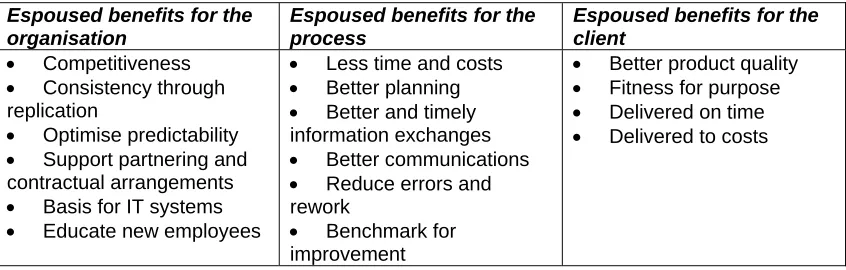
achieve some of the benefits that have been claimed by the use of processes. The espoused
benefits described in the literature are here classified under three generic themes: benefits for
the organisation; the process; and the client. These are summarised in Table 1.
Probably the most important organisational benefit relates to the possibility of achieving
consistency and integration through the replication of the managerial practices embedded in
the generic process to all company projects. The replication of the process and its activities,
deliverables and functions makes it possible to achieve more predictable outcomes
(Kagioglou et al., 1998; Ulrich and Eppinger, 2000; Cooper, 2001; Winch and Carr, 2001).
Furthermore, a process model can act as a means to educate new employees, since it describes
the company’s ‘way’ of working (Gray and Hughes, 2001; Cooper, 2001). Finally, it can
provide the basis for contractual arrangements between clients and suppliers.
Many benefits have been described at the project level. A process specifies the phases a
project will go through and checkpoints along the way (Cooper, 2001). Following the process
is one way of assuring the product quality (Pugh 1991; Ulrich and Eppinger, 2000) and
reducing cycle times and costs (Reinertsen, 1997; Kagioglou et al, 1998; Cooper, 2001).
Further, the roles of stakeholders can be clearly defined (Gray and Hughes, 2001). A process
model can also act as a benchmark for assessing the performance of ongoing projects
(Cooper, 2001).
For clients, the major benefit relates to the possibility of achieving better value for money
through a product free of defects, satisfying fitness for purpose, with reasonable running costs
and delivered on time (Reinertsen, 1997; Kagioglou et al., 1998; Ulrich and Eppinger, 2000).
Maylor (1996) describes that empirical studies in the NPD area normally describe benefits in
using models, but they do so regardless of complementary activities that might be taking place
within the firms. Consequently, it is difficult to determine weather the benefits claimed are
directly from the use of a process model or if they are a by-product of the use of various
which may influence outcomes, and also whether there exists significant adverse effects from
implementing processes. Finally, even though the organisational context is extremely
important in determining the relevance of a process model (Pettigrew, 1987; Bresnen and
Marshall, 2001), this issue seem to have been abstracted away from most research into
process model design.
Implementation outcomes
The outcomes of implementation efforts have not been consistently successful. Stickland
(1998), for example, suggests that 70% of BPR programs fail, and states that the reason for
this is related to poor management of the change process within companies. Kotter (1995)
states that companies suffer from problems in managing change as they look for short cuts by
expecting individuals to execute new working practices without training or awareness of need.
Cooper (2001) further supports this idea, stating that lack of training and education is
responsible for scepticism and lack of acceptance when processes are implemented.
A further factor that has contributed to unsuccessful implementation outcomes is that
producing clear evidence of performance effects (i.e. measuring benefits from a process
model use) is a difficult endeavour, especially in project environments like construction
(Bresnen and Marshall, 2001). In construction it is difficult to clearly compare results between
projects due to their uniqueness, and it is also hard to establish links between the performance
of a project and the use of a process model.
Discussion
In summary, in the process management domain, much effort has been put in developing
Different concepts and principles have been proposed and a number of benefits in adopting
processes have been described. Nonetheless, the understanding of process model
implementation is limited. As a consequence, there is little evidence that construction
companies have accomplished the espoused benefits of using process models.
There are three main causes for the superficiality of the advice on implementation found
within process literature. First, a process model design is a difficult, long-term exercise
involving different knowledge domains (Formoso et al., 2001). Due to this factor, studies tend
to put great focus on the model design, leaving implementation as an area for further research.
Second, most models found in the literature have not been developed considering empirical
evidence, nor have been empirically validated, which suggests that the research strategies
applied do not lead to the consideration of implementation. Finally, implementation issues are
multifaceted, complex, and tend to be context specific, and therefore it is difficult to
generalise results from empirical studies.
Process model implementation should be approached considering the specific context in
which it takes place, especially in construction where companies tend to design ‘in-house’
process models. Therefore, the model itself directly influences implementation success.
Furthermore, implementation success could be measured with basis on the accomplishment of
the expected benefits. From this thinking, two research questions are posed:
• What are the actual improvements to current practices brought about by process
models devised/implemented in construction firms?
• Are the espoused benefits of process models achieved in practice? And if not, why are
Implementation process
‘Implementation process’ here refer to the steps that a firm goes through to design and use a
process model. The literature on process management presents generic guidelines on the
implementation process. In addition, the organisational change domain presents models to
support change programmes. Both are discussed below.
In the Design and Construction Process Protocol (Kagioglou et al., 1998) generic
implementation guidelines are presented. The importance of a process representing a generic
set of principles that allow for a consistent application in a repeatable form has been
emphasised. It also stressed that process models should be interpreted, adopted and applied in
a flexible manner across projects, teams and client needs, with benefits being clearly
measured. Those are important guidelines, but more information is needed to support process
models adoption in practice.
The NPD literature provides information on implementation by presenting ‘processes’ to
implement processes. For instance, Cooper’s (2001) model has three stages: (1) defining
process requirements; (2) designing the process; and (3) implementing it through training,
internal marketing, and having a process ‘owner’. A similar model is presented by Smith and
Reinerstein (1995), stressing: (a) need for planning implementation; (b) implementing the
process from the beginning of a project; (c) getting the right leader and providing training; (d)
getting management to facilitate the process; (e) using past experiences to demonstrate how
behaviour can be changed; and (f) gradually roll-out implementation. It can be argued that if
there is a need for a process model to implement a process model, maybe there would be a
need for a further process prescribing advice on the process to implement a process model,
Guidance on implementation is also provided through several conceptual models and
methodologies found in the Business Process Reengineering literature (e.g. Selegna and
Fazel, 1996; Vakola et al., 2000; Tissari and Heikkila, 2001). Even though such
methodologies have been developed with different focuses, consensus has emerged and some
common themes can be identified, described as follows.
The first common theme is that such methodologies are one-off type models, i.e. they have a
defined start and end. Therefore, they concentrate on creating change rather than managing
change as a continuous event (Cooper, 1994; Stickland, 1998).
A second common theme is that they provide prescriptive sequential steps to implement
changes (Vakola et al., 2000), and most models in the literature present similar steps. They
start with the definition of strategic goals and targets. Then, there is the selection and analysis
of the processes to be reengineered, followed by process redesign. After that, models describe
the need for an implementation plan, pilot and rollout implementation. Most models
emphasise the need for creating a team, having a champion, and changing the organisational
structure and capabilities. Even though it appears that a consensus has emerged in the
literature on the prescriptive steps to be used, the results from the application of such steps
have not been generally successful (Hammer and Champy, 2001).
The potential oversimplification of such change models is a major problem described in the
literature (Beer et al., 1993; Cao et al., 2001). In many cases the simplified diagrammatic
formats appear to be just common sense (Cao et al., 2001), which can lead to the omission of
important steps and a lack of rigour in the application of such models (Beer et al., 1993). The
lack of change expertise on the part of managers, trainers and developers has been identified
Lindsay et al. (2003) states that BPR represents a ‘repackaging’ of traditional techniques
derived from scientific management, which are very mechanistic in nature. The authors also
point out that even though attempts have been made to soften such techniques (by adding, for
instance, team working) the models still represent positivistic approaches that should be used
to shape and structure human activities. In this way, the literature fails to address the
complexity and non-linear nature of much of the work carried out in organisations. It also
assumes that humans are rational decision makers co-operating together to achieve agreed and
clearly defined goals, and are concerned with past practice and promoting standardised best
practice (Lindsay et al. 2003). As demonstrated by Pettigrew and Whipp (1991), companies
are composed by individuals and groups which can have differing values, needs and goals,
which sometimes leads to conflicts, and these factors are generally not considered within the
BPR literature.
Implementation needs to be understood as an organisational change, which involves change at
individual, group and organisational levels (Stickland, 1998). Individuals need to be capable
and motivated to change their behaviour in some way to allow the adoption of a process
model. Social norms also play an important influence in determining perceptions, motivations
and behaviours (French and Bell, 1995), as different groups will have varying views on the
process and on its implementation, which can lead to potentially conflicting actions between
such groups.
The design and implementation of a process model can be understood through the well known
unfreeze, move and refreeze change process proposed by Lewin (1946). The design of a
process model can be the means to ‘unfreeze’ the way the process is currently developed,
into a specific project can be analysed as moving from the ‘old’ way of developing projects to
the ‘new’ one. The adoption of the generic model into different projects can be approached as
refreezing, or embedding new working practices in the company. These concepts informed
the theoretical framework for implementation, presented in Figure 2.
FIGURE 2 HERE
Examining the implementation of process models from the organisation to the project level
(i.e. from the generic to the specific process model), and among multiple projects of a firm is
a valid way to understand how these models can improve the management of the design and
construction process (Tissari and Heikkila, 2001). To validate this statement, a further
research question is proposed:
• How do construction project teams implement process models (how the
implementation process occurs within specific cases)?
Implementation content
‘Implementation content’ refers to the transfer of the knowledge embedded in a process model
from the model developers to its users, thus providing a complimentary perspective on
implementation. Knowledge (or technology) transfer literature provides insights that can
assist a better understanding of process models implementation in three ways.
First, implementation involves the transfer of the knowledge embedded in the generic model
to its users. To ‘move’ technology (i.e. a process model) within an organisation involves two
this way, the users will be able to apply the knowledge to manage the project in hand and, as a
result, identify potential benefits (as well as problems) from the process model’ use at
organisational, project and individual levels.
One potential problem related to knowledge transfer regards the nature of the knowledge
itself. It is argued that a generic process model, as a written document, presents explicit
knowledge. Such knowledge can be transferred with reasonable accuracy (Nelson and Winter,
1982). Nonetheless, there is a substantial amount of tacit knowledge involved in managing
design and construction (Kagioglou et al., 1998), and there is a large amount of tacit
knowledge generated during the process model design. The latter is generated due to the
learning that occurs throughout the analysis of the ‘as-is’ process and the proposition of
improvements in the ‘to-be’ model. Both explicit and tacit knowledge need to be transferred
to users to allow successful implementation. Tacit knowledge is especially hard to transfer
from the source that creates it to other parts of the organisation (Davenport and Prusak, 1998;
Szulanski, 1999) because it cannot be fully articulated through written and verbal
communication, and thus must be learned through experience (Nelson and Winter, 1982;
Nonaka and Takeuchi, 1995; Empson, 2001).
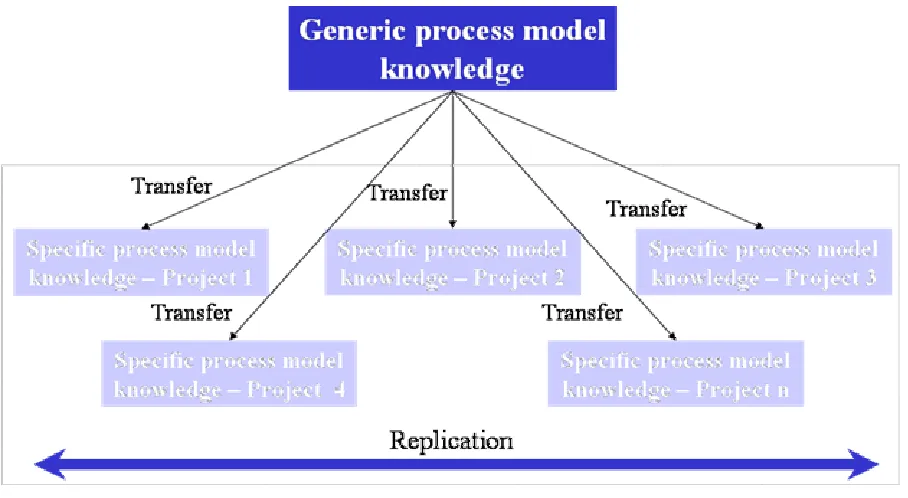
The second issue is the concept of replication of routines. Replication is a process by which
organisations re-utilise knowledge that is already in use (Nelson and Winter, 1982). In this
way, the re-utilisation of routines expressed in a model at different projects can be analysed as
a replication issue. This is important because the aim of a process model’s implementation is
the use of the model not only in one project, but in all different projects developed by the
company to allow consistency, as represented in Figure 3.
Finally, there are a variety of factors that affect the opportunity to transfer, which originate
from different sources and are likely to predict difficulties during transfer (Nonaka and
Takeuchi, 1995). Those factors are referred to as measures of ‘stickiness’ of knowledge
transfer (Szulanski, 1999). It is postulated that such measures present barriers that may
influence implementation success, providing a framework to better understand the difficulties
or stickiness during implementation. Measures of implementation stickiness are described as
follows.
The level of complexity of the process model content can generate implementation
difficulties. These relate to the ambiguity occuring due to the complexity or depth of the
practice to be implemented, referred to as causal ambiguity (Szulanski, 1999). Causal
ambiguity can create uncertainty in proceeding with implementation and it can occur due to:
(a) the model developers’ understanding and ability to explain the process model can be
incomplete; and (b) the model users’ ability to specify the environment in which the model
will be applied can also be incomplete (Nonaka and Takeuchi, 1995; Szulanski, 1999).
However, such uncertainty can be mitigated if there is evidence that the model has proven
robust in other environments.
Assessing model robustness involves considering issues such as the existence of solid proof
that the process model is helpful and contributes to the management of design and
construction. Such proof could be provided by performance measures or through the model
validation by successful implementations. Nonetheless, if there is a certain degree of
conjecture on the utility of the process model (Szulanski, 1999; Dixson, 2000), it is likely that
The ease of communications, collaboration and intimacy of the relationship between the
process model developer and its users also affects implementation. In cases where there is a
laborious and distant relationship (i.e. an arduous relationship),problems will arise in
implementation due to the difficulties in transferring tacit knowledge (Szulanski, 1999).
Empson (2001) further supports this idea, stating that barriers to transferring tacit knowledge
could reflect barriers to inter-personal communications.
Poor motivation can also provide difficulties. The motivation of the model developer may
vary with the incentive to compete or collaborate with the users and with the effort required to
support the transfer (Teece et al., 1997; Davenport and Prusak, 1998). The model users may
also lack motivation, as implementation disrupts operations not only with regards to the new
working practices, but also in terms of personnel being retrained, as well as infrastructure
being modified. Lack of motivation may result in foot dragging, passivity, hidden sabotage, or
outright rejection in implementation (Szulanski, 1999).
Forth, the degree to which the model user perceives the donor of the best practice as reliable
can potentially generate difficulties during implementation. In this context, the donor of the
best practice can be described not only as the developers of the process model themselves, but
also the sources of information used to build the process model. It has been argued that a
capable and trustworthy process model developer is more likely to influence the behaviour of
the model users (Szulanski, 1999).
Also, lack of absorptive capacity of the model users, i.e. their ability to exploit outside sources
of knowledge is another potential source of stickiness (Szulanski, 1999). Process model users
can have difficulties in their ability to identify, value and apply new knowledge, which is
Finally, the organisational context may affect the willingness and ability of organisational
units to complete implementation tasks. In a barren organisational context implementation
successes can be difficult (Empson, 2001). Influences can occur through norm and value
settings, through incentives and through counsel and support (Szulanski, 1999).
In summary, the stickiness of knowledge transfer can be used to identify measures of
implementation stickiness, which are: (a) causal ambiguity; (b) unproven knowledge; (c)
arduous relationship; (d) model developers lack motivation; (e) model users lack motivation;
(f) model developer is not perceived as reliable; (g) model user lacks absorptive capacity; and
(g) barren organisational context. The suitability of these measures to describe process models
implementation problems needs to be assessed through empirical data. In this way, a further
research question has been proposed:
• Which ‘stickiness’ factors affect the success of implementation efforts?
Discussion
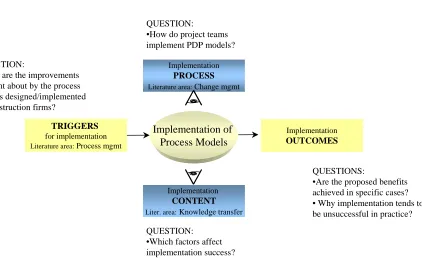
The literature on process models implementation has been structured around the model set out
in Figure 1, which described its triggers and outcomes, implementation strategy (steps), and
the transfer of the process model content. Process management research provides valuable
insights on the benefits and possible outcomes from applying process models in practice, but
focus is given to process model design, and implementation issues are inadequately described.
The implementation of a process model occurs through a set of steps or activities that need to
approaching change as a one-off activity, not consider that it should be managed as a
continuous event within organisations. Empirical results have suggested that the use of such
frameworks has led to outcomes which were not as successful as expected. Organisational
change literature offers the unfreeze, move and refreeze model, which provides a fruitful
platform to better understand and therefore enact implementation as a change process within
construction organisations. Nonetheless, the need to appropriately link the implementation
strategy to the organisational context and to soft people issues (such as consensus,
collaboration and motivation) has not been sufficiently addressed.
The importance of explicitly assessing the usefulness of the model content in the organisation
and project levels has also not been sufficiently emphasised. It appears that it has been
assumed that any change or innovation proposed in such models would be beneficial,
regardless of the type of organisation and project to which it is being applied. As a
consequence, the literature does not explicitly describe means to assess such usefulness.
The technology transfer literature offers a complementary perspective on the implementation
process by looking at the transfer of information within and across implementation steps. It
also provides a framework to identify potential problems that can occur in implementation
efforts. Such implementation stickiness, related to transferring the knowledge content of the
model throughout the organisation and between different projects is yet to be established.
Based on the findings of this literature synthesis it is possible to state that the knowledge on
process models implementation is characterised by a lack of clear direction. Several gaps in
the understanding of process models implementation in construction are identified, and such
gaps hinder our understanding of this multifaceted phenomenon. Such gaps are set out in
Whilst our understanding of implementation is not increased, it is envisaged that companies
will continue having difficulties in achieving the espoused benefits of designing and adopting
process models.
FIGURE 4 HERE
Conclusions
This paper has explored the literature on process model implementation, drawing from the
construction and manufacturing domains. The discussion was structured around the triggers,
outcomes, process and content of process models implementation. Gaps on the knowledge
have been discussed for each perspective analysed and the following research questions which
require further investigation are posed:
• What are the improvements to current practices brought about by process models
devised/implemented in construction firms?
• Are the espoused benefits of processes achieved in specific cases? If not, why do
process models implementation efforts tend to be unsuccessful in practice?
• How do project teams implement PDP models (how the implementation process occur
within specific cases)?
• Which factors affect the success of implementation efforts?
modelling is the use of the models in real life settings to improve process management. This
has been leading to practical implementation results which are not as successful as expected.
Examining implementation within company specific settings is a way to better understand
how process models can effectively improve process management. Also, a process model
could have different roles within a company, for instance it could be a learning instrument or
the basis for planning process activities. The exploration and analysis of its role(s) in context
specific settings can help in better determining the model effectiveness. It can also contribute
to focus further research in the area, as it generates different approaches to the practical aim of
process models as well as to implementation approaches.
The need for a better conceptualisation of implementation as a practically oriented
phenomenon is clear. The development of a more holistic and integrated theoretical body of
knowledge on processes implementation will offer appropriate guidance for companies
aiming to successfully implement process models.
References
Anumba, C. and Evoumwan, M. (1997). Concurrent Engineering in design-built projects.
Construction Management and Economics, 15, 271-281.
Aouad, C., Brandon, P., Brown, F., Cooper, G., Ford, S., Kirkham, J., Oxman, R., Sarshar, M.
and Young, B. (1994). Integration of Construction Information (ICON): Final Report –
Integrated databases for the design construction and management of construction, University
of Salford, UK.
Austin, S., Baldwin, A., Li, B. and Waskett, P. (2000). Analytical design planning technique
(ADePT): a dependency structure matrix tool to schedule the building design process.
Barrett, P. and Stanley, C. (1999). Better Construction Briefing. Blackwell Science. UK.
157p.
Beer, M., Einstat, R.A., and Spector, B. (1993). Why change programmes don't produce
change. Sage.
BPF - British Property Federation (1983). Manual of the BPF system: the British Property
Federation System for building design and construction, UK: The British Property Federation.
Cao, G., Clarke, S. and Lehaney, B. (2001). A critique of BPR from a holistic perspective.
Business Process Management Journal 7 (4), 332-339.
Cohen, W.M. and Levinthal, D.A. (1990). Absorptive capacity: A new perspective on
organisational learning. Administrative Science Quarterly 35, 128-152.
Cooper, Rachel & Press, Mike (1995). The design agenda: A guide to successful design
management. UK: John Wiley & Sons.
Cooper, R G. (1994). Third-Generation New Product Processes. Journal of Product
Innovation Management 11, 3-14.
Cooper, R.G. (2001). Winning at New Products: Accelerating the process from idea to
launch. Cambridge, Massachusetts: Perceus Publishing.
Cornick, T. (1991). Quality management for building design. UK, Butterworth-Heinemann.
Davenport, T.H. and Prusak, L. (1998). Working knowledge: how organizations manage what
they know. Boston, Massachusetts: Harvard Business School Press.
DTI (2002). Accelerating Change. Department of Trade and Industry, London.
Egan, J. (1998). Rethinking Construction. Department of the Environment, Transport and the
Regions, London.
Empson, L. (2001). Knowledge management in professional firms. Human Relations 54(7),
811-817.
Fairclough, J. (2002). Rethinking construction innovation and research: a review of
Formoso, C.T., Tzortzopoulos, P. and Liedtke, R. (2002). A model for managing the product
development process in house building. Engineering Construction and Architectural
Management 9(5-6), 419-432.
French, W.L., and Bell, C.H. (1995). Organization Development. (5th Edition) USA: Prentice
Hall:Englewood Cliffs.
Grant, R.M. (1997). Contemporary strategic analysis: concepts, techniques, applications.
Oxford, UK: Blackwell.
Gray, C., and Hughes, W. (2001). Building Design Management. University of Reading, UK:
Butterworth Heinemann.
Hammer, M., and Champy, J. (2001). Reengineering the corporation: a manifesto for
business revolution. UK, Nicholas Brealey Publishing.
Huovila, P.; Koskela, L.; Lautanala, M. (1997) Fast or Concurrent: The Art of Getting
Construction Improved. In: Lean Construction, Ed. by Alarcón, L. Balkema, Rotterdam, pp.
143-160.
Kagioglou, M., Cooper, R., Aouad, G., Sexton, M. and Sheath, D. (1998). A Generic Guide to
the Design and Construction Process Protocol. UK: The University of Salford.
Karlsson, C. and Ahltrom, P. (1996). The difficult path to Lean Product Development.
Journal of Product Innovation Management 13, 283-295.
Kartam, S., Ballard, G. and Ibbs, W.C. (1997). Introducing a new concept and approach to
modelling construction. Journal of Construction Eng. and Management 123(1), 89-97.
Koskela, L. (2000). An exploration towards a production theory and its application to
construction. Espoo, VTT, 2000. VTT Publications 408, 2000, 296 p.
Kotter, J.P. (1996). Leading change. Harvard Business School Press.
Lawson, B., Bassanino, M., Phiri, M. and Worthington, J. (2003). Intentions, practices and
aspirations: understanding learning in design. Design Studies.24, 327-339.
Mazijoglou, M. and Scrivener, S.A.R. (1998). The rich picture of design activity. Automation
in Construction 7, 157-175.
Lindsay, Ann, Downs, Denise & Lunn, Ken (2003). Business processes - attempt to find a
definition. Information and Software Technology, 45, 1015-1019.
Mill, H. and Ion, B. (1994). Implementing a New Design Process. World Class Design to
Manufacture, 1(5), 9-12.
Nelson, R.R. and Winter, S.G. (1982). An evolutionary theory of economic change.
Cambridge, MA, USA: Harvard University Press.
Nonaka, I. and Takeuchi, H. (1995). The knowledge creating company. Oxford University
Press.
Pahl, G. and Beitz, W. (1988). Engineering Design: A systematic approach. UK: The Design
Council.
Prasad, B., Wang, F. and Deng, J. (1998). A Concurrent Workflow Management Process for
Integrated Product Development. Journal of Engineering Design 9(2), 121-135.
Pugh, S. (1991). Total Design: Integrated methods for successful product engineering.
Addison-Wesley.
R.I.B.A. (1980). Handbook of Architectural Practice and Management. Royal Institute of
British Architects, London.
Sanvido, V. (1990). An integrated building process model. CIC technical report: Pennsylvania
State University
Sengala, G. and Fazel, F. (1996). An integrative approach for selecting a TQM/BPR
implementation plan. International Journal for Quality Science 1(3), 6-23.
Slack, Nigel, Chambers, Stuart, Harland, Christine, Harrson, Alan & Johnston, Robert (2001).
Operations management. London: Pitman Publishing.
Smith, P.G. and Reinertsen, D.G. (1995). Developing Products in Half the Time. New York:
Smith, R.P. and Morrow, J.A. (1999). Product development process modelling. Design
Studies 20, 237-261.
Stickland, F. (1998). The dynamics of change: insights into organisational transition from the
natural world. London, Routledge.
Szulanski, G. (1999). The process of Knowledge transfer: a diachronic analysis of stickiness.
USA: Warton School, University of Pennsylvania.
Taylor, F. W. (1913). The principles of scientific management. New York: Harpers and
Brothers.
Teece, D., Pisano, G. and Shuen, A. (1997). Dynamic capabilities and strategic management.
Strategic Management Journal 18 (7), 509-533.
Tissari, T. and Heikkila, J. (2001). Successful re-engineering: learning by doing, International
Journal of Logistics 4(3), 329-344.
Tunstall, G. (2000). Managing the building design process. UK: Butterworth Heinemann.
Ulrich, K.T. and Eppinger, S.D. (2000). Product Design and Development. USA:
McGraw-Hill.
Vakola, M., Rezgui, Y. and Wood-Harper, T. (2000). The Condor Business Process
Reengineering Model. Managerial Auditing Journal 15(1), 42-46.
Winch, G. and Carr, B. (2001). Processes, maps and protocols: understanding the shape of the
construction process. Construction Management and Economics 19, 519-531.
Yazdani, B. and Holmes, C. (1999). Four models of design definition: sequential, design
Bibliographical sketches
Dr Patricia Tzortzopoulos is an architect, MSc and PhD in design process management. She is
currently an academic fellow in the Salford Centre for Research and Innovation from the
University of Salford. Her research interests include design management; process
management and implementation, lean thinking, new product development, the link between
the build and human environment and healthcare, organisational change and technology
transfer. She has participated as a researcher in six research projects in Brazil and in the UK,
and has published over 20 articles in both journals and conferences, as well a number of
research reports.
Dr Martin Sexton is the Director of Organisational Development at the School of
Construction and Property Management, University of Salford, England. His research
interests include the management of innovation in project-based organisations, the
management of knowledge-intensive professional service firms, and knowledge transfer in
project-based industries. Dr Sexton has published over 70 papers based on his research.
Professor Rachel Cooper is a Professor of Design Management and Director of the Adelphi
Research Institute for Creative Arts and Sciences at the University of Salford. Her work
includes research in the areas of design and construction process, new product development,
design management and socially responsible design. Professor Cooper was Principal
Investigator of the Process Protocol Research project, is editor of The Design Journal, and
author of four books and over 200 papers based on her research. Professor Cooper is also
Acknowledgements
The authors would like to thank CNPq (Conselho Nacional de Desenvolvimento Científico e
Tecnológico), from Brazil, for the financial support, sponsoring the first author’s PhD
Figure 1: Generic model of the implementation process
Implementation
PROCESS
Literature area:Change mgmt
Implementation of
Process Models
Implementation
OUTCOMES TRIGGERS
for implementation
Literature area:Process mgmt
Implementation
CONTENT
Figure 2: Process models implementation framework Adapting
the model to context
Adopting
the process model Generic PDP model Generic PDP model Specific process model Specific process model ACT
Use the model to guide action
ACT
Use the model to guide action
Factors affecting ‘adaptation’ in implementation Factors affecting ‘adoption’ in implementation
Analysis and feedback Impl. strategy & process model
design Impl. strategy & process model
Figure 3: Knowledge transfer from the generic process model to the specific models used to
Figure 4: Research questions on process models implementation
Implementation
PROCESS Literature area:Change mgmt
Implementation of Process Models
Implementation
OUTCOMES TRIGGERS
for implementation Literature area:Process mgmt
Implementation
CONTENT Liter. area:Knowledge transfer QUESTION:
•What are the improvements brought about by the process models designed/implemented in construction firms?
QUESTIONS:
•Are the proposed benefits achieved in specific cases? • Why implementation tends to be unsuccessful in practice? QUESTION:
•How do project teams implement PDP models?
Table 1: Espoused benefits of adopting process models
Espoused benefits for the organisation
Espoused benefits for the process
Espoused benefits for the client
• Competitiveness
• Consistency through replication
• Optimise predictability
• Support partnering and contractual arrangements
• Basis for IT systems
• Educate new employees
• Less time and costs
• Better planning
• Better and timely information exchanges
• Better communications
• Reduce errors and rework
• Benchmark for improvement
• Better product quality
• Fitness for purpose
• Delivered on time