Dynamic Characteristics and Seismic Performance Evaluation of Low
Rise Existing RC Moment Resisting Frame using Microtremor
Technique and Standard Code of Practice
AHMAD FAHMY BIN KAMARUDIN
1MOHD. EFFENDI BIN DAUD
2KOH HENG BOON
31,2,3
Faculty of Civil and Environmental Engineering
Universiti Tun Hussein Onn Malaysia
86400 Pt. Raja, Bt. Pahat, Johor, MALAYSIA
1
[email protected]
2
[email protected]
3
[email protected]
ZAINAH BINTI IBRAHIM
Department of Civil Engineering, Faculty Engineering
University of Malaya
50603 Kuala Lumpur, MALAYSIA
[email protected]
AZMI BIN IBRAHIM
Faculty of Civil Engineering
Universiti Teknologi MARA
40450 Shah Alam, Selangor, MALAYSIA
Abstract: - Most of existing multi-storey reinforced concrete (RC) buildings in Malaysia was designed to BS 8110 without considering seismic load. Tremors generated from previous distant earthquakes occurred from Sumatran faults zone had shaken many low-rise to high-rise buildings in Peninsular Malaysia and emerged panic. Worst scenario when the conventional practice of unreinforced masonry like brick wall is weak in lateral resistance and ease to damage. Poor soil condition may also have a crucial modifying influence occasionally acted as a resonator and amplifies the seismic wave when reached to ground surface. A microtremor study was conducted in order to evaluate the dynamic characteristics of site-structure, resonance potential and seismic capacity of an existing 4-storey RC primary school building and its site in SK Sri Molek which located in Batu Pahat-Johor. From the findings, it was expected that the building is prone to resonate since both site and building have only a slight different between their natural frequencies. The predominant building frequencies were predicted at 4.20 Hz and 4.35 Hz in transverse and longitudinal directions whereas for site fundamental frequencies were between 2.69 to 3.20 Hz in North-South (NS) direction and 2.79 to 2.98 Hz in East-West (EW) direction. By using the site response spectra for Kuala Lumpur region based on the consideration of large magnitude of distant earthquake scenario at 9.3 and 530 km of the closest to site distance produced by previous researcher, the design response spectrum (RSA) has given 0.32 m/s
2
at natural period between 0.15 to 0.40 s. From this RSA value, an equivalent static analysis (ESA) for base shear force estimation was performed
according to EC 8 [2]. The analysis shows that, the design ultimate horizontal load described in BS 8110 [3] based on conventional load combination has been exceeded more than 1.5% as recommended by the code.
Key-Words: - Microtremor, dynamic characteristics, resonance, base shear force
1 Introduction
Less attention has been given to the earthquake hazard especially in low seismic region such as
medium seismic activity level, however the effect of tremors from Sumatra earthquakes have been reported several times [5]. According to Megawati et al. [6], it was predicted that an earthquake at moment magnitude greater than 7.8 from the Sumatra subduction zone has the capability to generate destructive ground motion in Singapore and Kuala Lumpur, even at a distance of 700 km. Even a longer distance may create destructive ground motion, it seems reasonable to postulate larger and closer earthquakes that might result in tremendous ground motion to Peninsular Malaysia especially [7].
Reinforced concrete framed structures had shown in large number of deterioration or become unsafe when subjected to changes in loading and configuration [8]. Worst, when no specific guideline was proposed in re-evaluating the dynamics performance of underlying site, and vulnerability of existing RC moment resisting frame (MRF) in Malaysia up to date. It is important to take serious action on seismic hazard in order to provide structural and occupant safety especially to the existing RC structure.
In a situation of distant earthquake, the seismic waves that reached to Peninsular Malaysia bedrock is rich in long period waves which significantly amplified due to resonance when they propagate upward, especially through the soft soil sites with a frequency close to the predominant frequency of the seismic waves [9]. The amplification waves may cause resonance to the buildings and inducing a large motions on the buildings which enough to be felt by the residence [9]. The reliability of these site-structure interactions effect due to resonance phenomenon had significantly proven in the destruction of selective buildings between five to fifteen storey which were constructed on the soft ground strata in 1985 Mexico City earthquake [10], even the epicenter distance was 320 km to 350 km away. Hence, it is important to consider the effect of soil-structure resonance either in seismic design or re-evaluation work on existing site or structure including to distant earthquake region due to a tendency of resonance disaster for safety reason.
In this study, microtremor technique was conducted in order to evaluate the resonance of site-structure frequencies of existing new low rise reinforced concrete building in SK Sri Molek. Microtremor is a non-destructive method, cheap but effective. It is suitable for a region which lacking of ground motions records but higher level of noise for dynamic characteristics investigation of a ground surface layer or structure. The equipment is also light and only small number of operators needed in
in-situ measurement [11], at the same time gives extra credit to additional advantages. Besides, the base shear force was also calculated using a developed response spectra by Looi et al. [1]. According to Gioncu and Mozzalani [12], ESA is a simplified dynamic analysis and available when there has a predominant mode of vibration (primary mode of vibration) compared to others, and the system is accurately modeled by a single degree of freedom. ESA is an approximation method but adequate for regular building type at the ground fundamental period having close to the first vibration of the structure.
2 Study Area and Fieldwork
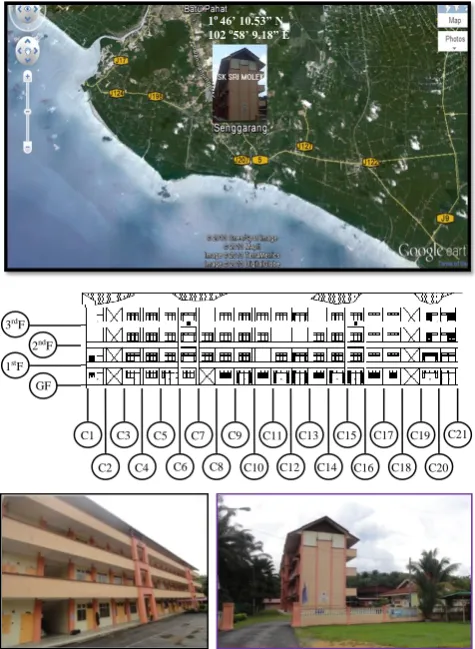
Fig. 1 shows the location and front elevations of SK Sri Molek building. This building is a 4-storey reinforced concrete structure which located in Senggarang, Batu Pahat-Johor. The school is designed by Public Works Department Malaysia (JKR) based on a standard RC design with typical building configuration of 3.6 m storey height, 3 m spacing between bays, 7.5 m building width and 2.1 m length of cantilever corridor balcony with 1.05 m of parapet wall height. The total length of the building is 60 m.
[image:2.595.308.546.427.752.2]
Fig. 1 Location and elevations of SK Seri Molek
1o 46’ 10.53” N
102 o58’ 9.18” E
C1 C3 C2
C5 C4
C7 C6
C9 C8
C11 C10
C13 C12
C15 C14
C17 C16
C19 C18 C20 GF
1st
F 2nd
F 3rdF
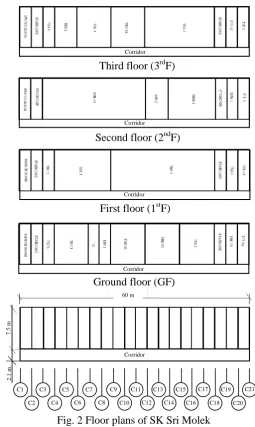
Each floor is divided into a few rooms as shown in Fig. 2. On the upper floor, four main rooms are used for prayer room (TBA 6), classroom (TBD 3A), lounge room (TBL 3) and counseling room (TBB 2). Meanwhile, on the second floor, it has been provided for a meeting room (TBM 3) and library (TBR10) followed by a headmaster office (TBP 9) and teachers’ room (TBT 5) on the first floor. Sport room (TSS 3), other two classrooms and health centre (TBE 3) are placed on the ground floor. The other room functions and imposed load used in the calculation is tabulated in Table 1.
Fig. 2 Floor plans of SK Sri Molek
A series of microtremor measurements were performed by using three units of Lennartz portable tri-axial seismometer sensors (S), with 1 Hz eigenfrequency, CityShark II data logger and 1 GB memory. Since the input vibration is based on ambient vibration in three major components of NS, EW and vertical (V) directions, the external noises disturbance such as extreme weather (strong wind,
lightning, heavy rain etc.), transient noises (traffic, pedestrian, etc.), monochromatic sources (machinery, pumps, generator etc.) and nearby structures (tress, pipes, sewer lids etc.) should be in minimum operation for the best result of natural frequency prediction as recommended by SESAME [13] guideline. The site-structure measurements were started from 8.00 am and finished at 5.30 pm for five days.
[image:3.595.33.289.225.653.2]
Table 1 Room types in SK Sri Molek building
Code Room Function Qk
(kN/m2)
TBA 6 Prayer room 3.0
TTU 1C Wuduk room 2.0
TSS 3 Sport room 2.5
TBL 3 Lounge room 2.5
TBB 2 Counseling room 2.5
TBT 5 Teacher’s room 4.0
TBD 3A Classroom 3.0
TBC 1 Access room 2.0
TBP 9 Headmaster office 4.0
TBM 3 Main meeting room 4.0
TBS 2 Invigilator room 2.5
TBR 10 Library 4.0
TBE 3 Health centre 2.5
TBY 1 Security room 2.0
T 1 Access 2.0
TBK 1A Book shop 4.0
TBW 1 Prefect Room 2.5
TTP 1 Toilet (Female) 2.0
TTL 1 Toilet (Male) 2.0
TSA 1 Store 2.0
TTS 1 A Toilet (Staff) 2.0
SWITCH ROOM Service room 2.0
Corridor Corridor 3.0
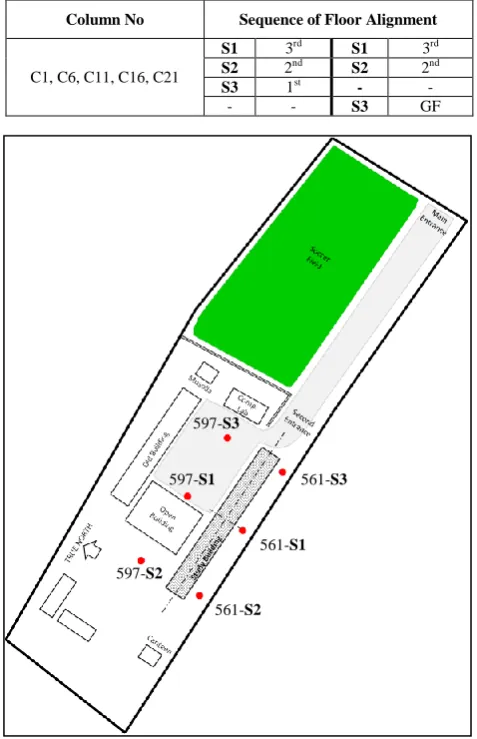
Similar equipment was applied in site and building measurements. All sensors were referred to the True North direction as the bench mark. This bench mark direction is also parallel to the transverse axis of the building (see Fig. 3). In building measurement, the sensors were arranged and positioned in horizontal and vertical sensor alignments which close to the main structural frame joint along the corridor. The arrangement of measurement points in both alignments were given in Table 2 and Table 3. A total of 14 measurements were carried out in horizontal alignment whereas 10 measurements in vertical alignment. Meanwhile, for site measurement, the sensors were placed on 25 m x 25 m grid as represented by six coloured red dots in Fig. 3. Only two measurements on site were considered in the analysis. The sampling rate of 100 Hz was used at optimum gain level in all recording. 15 minutes of recording length was taken in site as well as in building measurements. All frequencies below 1 Hz were not of interested [14], in both building and site measurements.
2.
1
m
Third floor (3rdF)
Second floor (2ndF)
Second floor (2ndF) First floor (1stF)
Ground floor (GF)
Corridor
Corridor
Corridor Corridor
C1 C3 C2
C5 C4
C7 C6
C9 C8
C11 C10
C13 C12
C15 C14
C17 C16
C19 C18 C20
C21 Corridor
60 m
7.
5
Table 2 Arrangement and position of sensor on every floor in horizontal measurements
Floor No Sensor 1 (S1) Sensor 2 (S2) Sensor 3 (S3)
3rd, 2nd and 1st Floor
C11 C21 C1
C11 C3 C19
C11 C6 C16
C11 C9 C13
Ground Floor C11 C21 C1
C11 C16 C6
Table 3 Arrangement and position of sensor at selected columns in vertical measurements
Column No Sequence of Floor Alignment
C1, C6, C11, C16, C21
S1 3rd S1 3rd
S2 2nd S2 2nd
S3 1st
- -
- - S3 GF
Fig. 3 Layout plan of SK Seri Molek and positions of sensors on site
3 Data Processing and Analysis
Horizontal to Vertical Spectral Ratio (HVSR) technique is an attractive method especially in estimating the dynamic characteristics of a structure or site in low or none seismicity regions [5]. It is widely used nowadays due to much faster, cheaper and non-destructive compared to conventional methods. Besides, it also proven that the amplification of strong motion at the predominant frequency of ground may approximately estimate
through this technique but in a case of larger amplitude of vertical component dominating (when influenced by Rayleigh wave), it may affect to the prediction of amplification characteristic [6]. HVSR is also not recommended in determination of building frequencies if the soil amplification is significant strong which may contaminate to the building response [7]. Therefore, careful analysis and evaluation must be carried out. In this study, respective dynamic characteristics estimation for site and building was applied via HVSR technique and a standard method of Fourier amplitude spectra (FAS). In order to check the reliability of a building natural frequency, there should has a good correspondence frequency at each measured floor with the peaks predominant frequency will increase with increase of height [7].
Geopsy software was used in the analysis as a processing tool for HVSR and FAS curves analyses, based on the following variable parameters; 15 sec of automatic window length was selected with anti-triggering algorithm and a cosine taper of 5%. The Fourier spectra were computed for each window length and smoothed by Konno Ohmachi smoothing constant of 40. Directional energy method was chosen in HVSR analysis when the ambient vibration signals in both NS and EW are calculated accordingly to respective direction. Reliability and clarity of the significant peaks of mean HVSR curves were checked based on the recommended criteria by the SESAME [13] guideline. The dynamic characteristics in terms of predominant frequency of building, Fo, and fundamental
frequencies of ground surface, fo, in conjunction
with site-structure amplifications, Ao, were
determined. Illustration of dominant vertical mode shape based on predominant frequencies given in both longitudinal and transverse directions were produced. Besides, the horizontal mode shape was also prepared in order to study the lateral deflection mode.
Estimation of the base shear force was computed using equivalent static analysis according to EC 8 [2]. The intensity of dead load (Gk) and imposed
load (Qk) used were based on typical standard
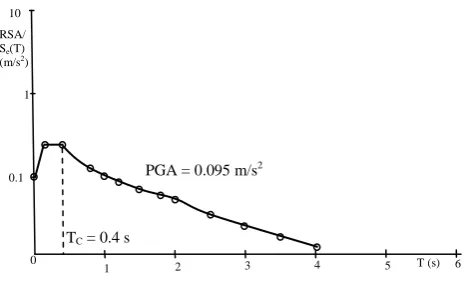
construction design characteristics as proposed by JKR and BS 6399-1 [18]. Since none of a site specific response spectrum has been developed in this study region up to this moment, the design response spectrum produced by Looi et al. [1] as in Fig. 4 was adopted. The used RSA was modeled
based on the consideration of large magnitude distant earthquake scenario at 9.3 from neighboring region of Sumatra with 530 km of the closest to site distance. Comparison was made to the estimated
597-S1
597-S3
597-S2
561-S3
561-S1
[image:4.595.48.287.213.583.2]S1 3.20 5.71 R C Passed
S2 2.69 7.78 R C Passed
S3 3.42 9.99 NR C Failed
S1 2.98 8.32 NR C Failed
S2 2.88 6.78 R C Passed
S3 2.98 7.46 R C Passed
S1 2.88 7.55 R C Passed
S2 2.79 11.68 NR C Failed
S3 3.20 9.95 NR C Failed
S1 2.79 6.37 R C Passed
S2 2.79 9.82 NR C Failed
S3 2.88 7.37 R C Passed
597-EW
Reliable (R) or No Reliable (NR)
Clear (C) or No Clear
(NC)
Criteria: Passed, Failed or Recommended to be
Repeated Natural
Frequencies , fo
(Hz)
Amplification Factor,
Ao
File No. Sensor No.
561-NS
561-EW
597-NS
applicable notional design ultimate horizontal force that can be resisted by the building. As stated in BS8110 [3], conventional design load combination of 1.4 Gk + 1.6 Qk should be capable to resist a
notional design ultimate horizontal load applied at each floor or roof level simultaneously equal to 1.5 % of the characteristic dead weight of the structure between mid-height of the storey below and either mid-height of the storey above or the roof surface.
Fig. 4 Redrawn RSA for Kuala Lumpur region [1]
4 Results and Discussions
4.1
Dynamic
Characteristics
of
Site-Structure and Resonance Effect
Table 4 indicates the passing files of site fundamental frequencies (no shaded row) carried out based on recommendations criteria by SESAME [13] which must fulfilled 3/3 of reliability criteria, and at least 5/6 for clarity criteria of HVSR curve. The predicted fo were obtained between 2.69 to 3.20
Hz with maximum Ao of 7.8 in NS direction. While,
in EW, it shows between 2.79 to 2.98 Hz for maximum Ao reached was 7.46. Rough evaluation
of soil depth in conjunction with the natural period below < 0.5 s shows that, this site may be classified in shallow stiff soil stratification with 6 to 30 m soil depth based on B&R-M system [19].
The theory and interpretation of ambient vibration for buildings are not so structure and straightforward as for the free-field case (site) [20]. The main difficulties is to detect and eliminate the effects of fundamental frequencies of the nearby free-field and other buildings in the vicinity [20]. Besides, strong site amplification may also able to contaminate the building response and false prediction to the building natural frequencies. Due to these reasons, comparison between FAS (only considered on the upper floor for building) and HVSR (on the ground surface for site) curves in NS and EW was produced for predominant building
frequency assessment. Interesting results were shown when the peak FAS curves in NS direction was slightly shifted to 4.20 Hz (see Fig. 5a) but vice versa in EW direction (see Fig. 6a), whereby the sites amplifications were highly dominated between 2.69 to 3.20 Hz (see Fig. 5e) and 2.79 to 2.98 Hz (see Fig. 6e). It was expected that, the first mode of building frequency in EW was predicted to occur at the second peaks frequency of 4.35 Hz which can be clearly seen from the FAS curves. This circumstance could be due to high amplifications factor of site that largely contaminate to the building response in both directions even though on the upper floor and become stronger when lowering to the ground level. Besides, it was clearly shown in Fig. 5b-d and Fig. 6b-d when the peak frequency of FAS curves tend to approach to site’s HVSR peak as given in Fig. 5e and Fig. 6e, especially when reaching to bottom level.
Table 4 Reliability and clarity checking of HVSR curve
Small difference between site and building natural frequencies observed may trigger into the potential of resonance effect. According to Gosar [20], the indication of soil-structure probable can be applied by taking the ratio between building frequency that is closer to the site frequency. When the difference is within +15%, the danger of soil-structure resonance is high, if it is within +15 to 25% it is medium, while if it is higher than +25%, then it is low [20]. Thus, Table 4 indicates the computed result of site- structure resonance level. From the ratio of 4.20 Hz of Fo and 3.42 Hz by the
fo taken into consideration, it shows to medium level
of resonance potential.
Table 5: Indication to site-structure potential level
Fo(Hz) fo (Hz) Danger to Soil-Structure
Resonance Potential
NS 4.20 2.6 – 3.20
Medium
EW 4.35 2.98
TC = 0.4 s
PGA = 0.095 m/s2
0 0.1
1 10
1 2 3 4 5 T (s) 6 RSA/
Se(T)
(m/s2
[image:5.595.53.286.195.336.2]Fig. 5 FAS and HVSR curves for building and site in NS/ transverse direction
4.2 Mode Shapes
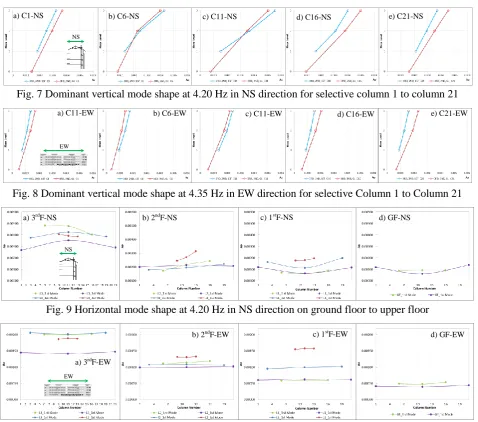
Vertical and horizontal mode shapes were drawn according to the predominant frequencies of building obtained at 4.20 Hz and 4.35 Hz in respective directions. From Fig. 7 and Fig. 8, the displacement pattern of the building has shown a similar trend when the upper storey remained the
Fig. 6 FAS and HVSR curves for building and site in EW/ longitudinal direction
highest amplitude value and it decreasing when lowering to the ground level. Consistent result was also given by the horizontal mode shapes as in Fig. 9 and Fig. 10. Even the school has almost geometrically symmetry, however the deformations between bays were slightly different due to several expected reasons as highlighted in following discussions.
Po
te
n
ti
a
l
to
Re
so
n
a
n
ce
Z
o
n
e
2.79 Hz 2.98 Hz
a) Fo-3rdF-EW
b) Fo-2ndF-EW
c) Fo-1stF-EW
d) Fo-GF-EW
e) fo-Site-EW
4.35 Hz
a) Fo-3
rd
F-NS 4.20 Hz
2.69 Hz
3.20 Hz
b) Fo-2ndF-NS
c) Fo-1stF-NS
d) Fo-GF-NS
e) fo-Site-NS
Po
te
n
ti
a
l
to
Re
so
n
a
n
ce
Z
o
n
[image:6.595.53.282.58.620.2] [image:6.595.311.542.60.618.2]By referring to Fig. 7c and Fig. 8c, the center column of C11 has indicated to the highest top displacement in NS and EW directions, compared to the adjacent column of C6 and C16 on the same floor. This situation may be due to higher mass concentration developed at the mid-span in addition to farther distance of the staircases which located in bay two (between C2 to C3) and bay eighteen (between 18 to 19) which less contribute to lateral resistance. Besides, larger imposed loads induced by a classroom (on the 3rd floor) and library (on the 2nd floor) located at the mid-span of the building may also explained the sources of the mass. However, the displacement amplitudes were reducing when reaching to the both ends as illustrated in Fig 7a-b and 7d-e, as well as Fig. 8a-b and Fig. 8d-e.
Meanwhile, from the view of horizontal mode shapes which involved the translational deformation in NS and EW directions for every floor have shown to similar pattern when the upper floor indicates to the highest displacement amplitude and it's getting
lesser when lowering down to the ground level. Interesting finding was found when inconsistent shape of the bending curves given by the first three floors from top (see Fig. 8a-c) in NS direction, but a steady mode shape given in EW direction (see Fig. 9). On the upper floor (see Fig. 9a), the maximum displacement amplitude was given at C11 and it started to reduce when reaching to both ends. However, C11 shows the least displacement amplitudes on the first floor (see Fig. 9c), but it’s getting bigger when approaching to the ends. Similar pattern also found on the ground level mode shape as in Fig. 9d. This scenario may be affected by the ground amplification intrusion to lower levels of building since higher Ao were observed on S3 and
S2 positions (closer to both ends of the building) compared to S1 (closer to C11) from the site measurement findings.
Finally, in Fig. 10a-d, almost a straight deflection lines were illustrated in all diagrams. However, a significant difference was obtained on the first floor
NS
a) C1-NS b) C6-NS c) C11-NS d) C16-NS e) C21-NS
Fig. 7 Dominant vertical mode shape at 4.20 Hz in NS direction for selective column 1 to column 21
NS
a) 3rdF-NS b) 2ndF-NS c) 1stF-NS
d) GF-NS
Fig. 9 Horizontal mode shape at 4.20 Hz in NS direction on ground floor to upper floor
Fig. 10 Horizontal mode shape at 4.35 Hz in EW direction on ground floor to upper floor
EW
a) 3rdF-EW
b) 2ndF-EW c) 1stF-EW
[image:7.595.54.533.53.475.2]d) GF-EW
Fig. 8 Dominant vertical mode shape at 4.35 Hz in EW direction for selective Column 1 to Column 21
EW
(see Fig. 10c) when two measurements at C3-C11-C19 and C9-C11-C13 have moved farther than others. The reason was expected due to the external noise disturbance of human activities and car transients a few times on ground level during the measurement since it significantly influencing to the amplitude of floor displacement.
4.3 Simplified Estimation of Natural Period
and Building Base Shear
Several estimations of natural period have been made by using three standard codes and previous research in order to compare the fundamental period of the building obtained from the microtremor measurement. Table 6 shows the prediction equations (Eq.) of natural period (T) where H is the building height above the base in meter for moment resistant concrete frames which taken from Masi and Vona [21]. The computed results of natural frequency are in between 1.87 to 5.03 Hz and the closest prediction has been given by equation (4).
Table 6 Result comparison between simplified equations and ambient vibration measurement
Code/ Author [21] Eq. T (s) Fo =1/T
(Hz)
Ambient Vibration Findings, Fo
(Hz)
NEHRP-2003:
T = 0.0466H0.9 (1) 0.40 2.50 Hz
ATC3-06 and EC8-CEN2003): T = 0.075H0.75
(2) 0.45 2.22 Hz
4.20 Hz to 4.35 Hz at 10.8 m height NZSEE-2006:
T = 0.09H0.75 (3) 0.54 1.85 Hz
Hong and Hwang (2000): T = 0.0294.H0.804
(4) 0.20 5.00 Hz
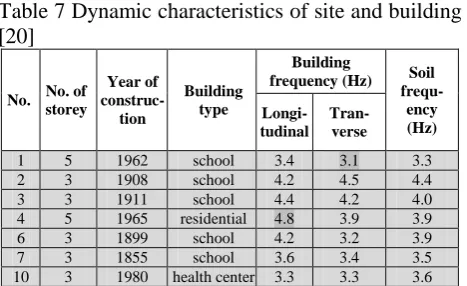
Meanwhile, Table 7 shows a study conducted by Gosar [20] on seven buildings between 3 to 5-storey. Based on these results, the building frequencies are found between 3.1 to 4.8 Hz within similar range as obtained from this study.
Table 7 Dynamic characteristics of site and building [20]
No. No. of storey
Year of construc-
tion
Building type
Building
frequency (Hz) Soil
frequ-ency (Hz)
Longi-tudinal Tran-verse
1 5 1962 school 3.4 3.1 3.3
2 3 1908 school 4.2 4.5 4.4
3 3 1911 school 4.4 4.2 4.0
4 5 1965 residential 4.8 3.9 3.9
6 3 1899 school 4.2 3.2 3.9
7 3 1855 school 3.6 3.4 3.5
10 3 1980 health center 3.3 3.3 3.6
4.4 Approximate calculation of base shear
using ESA
A few assumptions have been applied including some extracted data from standard school constructions drawing obtained from Public Works Department of Malaysia (JKR). Besides, other considerations were also made according to standard design practice of British Standard since most of existing conventional structures in Malaysia were designed to this standard. Table 8 shows the design data applied in terms of building configurations, material properties other assumptions used in the calculation.
Table 8 Design data applied
Dimensions and sizes
Total bay 20
Storey height 3.60 m
Bay spacing 3.00 m
Building width 7.50 m
Corridor slab width 2.10 m Parapet wall height 1.05 m
Slab
Thickness 150 mm
Concrete density 24 kN/m3
Finishing 1.0 kN/m2
Brickwall
Thickness 150 mm
Plastering 20 mm/side
Clay brick density 26 kN/m3
Mortar density 21 kN/m3
Qk Imposed load Refer Table 1.
Since none of a national seismic code yet introduced in this country, a seismic design code of EC8 [2] has been referred for estimation of existing building base shear force. The following calculations are totally based on the expressions as provided from this code and other related supplementary Eurocode standards.
As a beginning, a total mass (in tonne) was calculated based on equation (5) which taken from clause 3.2.4 EC8 [2]. It was then computed to every floor from the ground level until roof by taking the combination coefficient for variable action, ΨE.i,
equal to 0.24 (where ΨE.i = ϕ ⋅Ψ2i with ϕ = 0.8 and
Ψ2i = 0.3). The summary of seismic masses
calculated for each level is given in Table 9.
[image:8.595.305.550.258.400.2]Gk + ΨE.i.Qk (in kN) (5)
Table 9: Seismic mass calculation
Then, by taking 4.2 to 4.35 Hz (or 0.23 to 0.24 s of natural period, TM) obtained from microtremor
Level Gk (kN) Qk (kN) Gk + ΨE.i Qk
(kN) Mass (tonne)
Roof 230.4 576.0 368.6 37.6
3 5,020.4 1,626.8 5,410.8 551.6 2 4,820.6 1,986.8 5,297.4 540.0 1 4,820.6 1,998.0 5,300.1 540.3 GF 4,970.7 1,615.5 5,358.4 546.2
[image:8.595.52.286.627.770.2]measurement, the site may be categorized in TB < T
< TC as explained in clause 3.2.2.2 in EC8 [2] when
the elastic response spectrum, Se(TM), can be
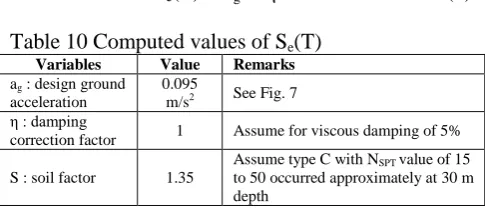
calculated by using equation (6) with all variables taken as given in Table 10. The calculated Se(TM)
shows 0.32 m/s2 which similar to the peak acceleration value given by the design response spectrum curve as in Fig. 4, for TM between 0.23 to
0.24 s.
[image:9.595.46.289.196.301.2]Se(T) = ag⋅S⋅η⋅2.5 (6)
Table 10 Computed values of Se(T)
Variables Value Remarks
ag : design ground
acceleration
0.095
m/s2 See Fig. 7
η : damping
correction factor 1 Assume for viscous damping of 5%
S : soil factor 1.35
Assume type C with NSPT value of 15
to 50 occurred approximately at 30 m depth
As stated in expression 4.5 from EC8 [2], the base shear force can be determined as expressed in equation (7), when λ is assumed 0.85 due to TM is
lesser than 2TC. From Fig. 4 again, TC is identified
close to 0.4 s.
F = Se(TM)⋅m⋅λ (7)
In the end of this calculation, it shows that the estimated base shear force may achieve up to 602. 8 kN which bigger than 1.5 % provision of notional horizontal load as stated in clause 3.1.4.2 from BS 8110 [3].
5 Conclusions
Integration of geophysical method and standard design code of practice may give to a bigger perspective in re-evaluation of dynamic characteristics and seismic performance of existing non-seismically design RC structure. This methodology can also benefit for a structure or site which lack of specific design database due to poor managing record system or the structure is too old. However, verification via reasonable methods should be carried out in order to produce a significant and reliable finding.
In this study, the dynamic characteristics and seismic performance of a new school RC building in SK Sri Molek has shown to a successful prediction by using integration methods of mictrotremor technique and two standard codes of practices. The predominant frequencies of building are determined between 4.20 to 4.35 Hz in transverse and longitudinal directions, whereby the highest top displacement occurs on the upper floor and reducing when lowering to the ground level. The influence of
bigger imposed load that mostly concentrated in the mid-span and farther from staircases (may react as bracing member) has increased the translation displacement amplitude in transverse direction for C11, but the amplitudes are reducing when approaching to C1 and C21.
Meanwhile, the fundamental frequencies of site have indicated between 2.69 to 3.20 Hz with maximum Ao of 7.8 in NS direction and 2.79 to 2.98
Hz at 7.46 of Ao in EW direction. Reliability and
clarity checking are also performed as recommended by SESAME [13] guideline. In terms of resonance potential of site-structure, it is expected to be classified in moderate level that could be occurred under equal oscillation between building and ground surface frequencies, possibly by strong ground shaking which also lead to structural damages.
Finally, from estimation of the total base shear force to EC8 [2] made has indicated that, the notional design ultimate horizontal load for conventional load combination design applied in BS 8110 [3] on existing structure has been exceeded. The design response spectrum is adopted from the extreme earthquake experience ever recorded at 9.3 earthquake magnitude and 530 km of epicenter distance in Kuala Lumpur by Looi et al. [1]. Even, most expectation has been made that a low-rise structure may survive and experiencing to less potential to structural damage compared to high-rise building, however lower natural period from this kind of building that mostly reflected to the highest peak of ground acceleration design response spectra either on hard or soft ground stratification, may influence to seismic damage potential especially for building without seismic design provision.
Acknowledgement
The authors would like express a great appreciation to Ministry of Education Malaysia (Higher Education) grants of ERGS 011 for their financial support to this research, and also to Universiti Tun Hussein Onn Malaysia for their sponsorship to this publication. Besides, a lot of thanks to JKR, District Education Office of Batu Pahat and SK Sri Molek administration for their priceless co-operation and permission along the period of this research being conducted.
References:
Jurutera: Civil and Structural Engineering, Vol 2013 No.4. ISSN 0126-9909, pp. 6-20.
[2] Eurocode 8 (2003). Design of Structures for Earthquake Resistance; General Rules, Seismic Actions and Rules for Buildings. Brussels, European: EC 8: Part 1.
[3] British Standards Institution. (1997). Structural Use of Concrete, Code of Practice for Design and Construction. London: BS 8110: Part 1. [4] Koong, N.K and Won, L.K. (2005). Earthquake
Hazard and Basic Concepts of Seismic Resistant Design of Structure. Master Builders, 4th Quarter, pp. 90-95.
[5] Adnan, A., Marto, A., and Hendriyawan (2004). Lesson learned from the effect of recent far field Sumatra earthquakes to Peninsular Malaysia. 13th World Conference on Earthquake Engineering, B.C., Paper No. 416. Canada: Vancouver.
[6] Megawati, K., Pan, T.C. & Koketsu, K. (2005). Response spectral attenuation relationship for Sumatran-subduction earthquake and the seismic hazard implications to Singapore and Kuala Lumpur. Soil Dynamics and Earthquake Engineering, 25, pp.11-25.
[7] Pan, T.C. (1998). Estimation of peak ground acceleration of the Malay Peninsula due to distant Sumatran. GeoForschungs Zentrrum Potsdam. Germany: Scientific Technical Report STR98/14, pp. 340 – 359.
[8] Mukherjee, A. and Joshi, M. (2005). FRPC reinforced concrete beam-column joints under cylic excitation. Composite Structures, 70, pp. 185-199.
[9] Balendra, T. and Li, Z. (2008). Seismic Hazard of Singapore and Malaysia. EJSE Special Issue: Earthquake Engineering in the low and moderate seismic regions of Southeast Asia and Australia (2008), pp. 57-63.
[10] Flores, J., Novaro, O., and Seligman, T.H. (1987). Possible resonance effect in the distribution of earthquake damage in Mexico City. Nature, 326. pp. 783-785.
[11] Ivanovic, S.S., Trifunac, M.D., Novikova, E.I. , Gladkov, A.A. and Todorovska, M.I. (2000). Ambient vibration tests of a seven-story reinforced concrete building in Van Nuys, California, damaged by the 1994 Northridge earthquake. Soil Dynamics and Earthquake Engineering 19, pp. 391 – 411.
[12] Gioncu, V. and Mazzolani, F. (2011).
Earthquake engineering for structural design.
New York: Spon Press, pp. 1-527.
[13] SESAME. (2004). Guidelines for the implementation of the H/V spectral ratio
technique on ambient vibrations:
measurements, processing and interpretation.
European Commission – Research General Directorate Project No. EVG1-CT-2000-00026. [14] Gosar, A. (2009). Microtremor soil-structure
resonance in the Bovec Basin (NW Slovenia) related to 1998 and 2004 damaging earthquake, In Mucciarelli, M., Herak, M. and Cassidy, J.,
Increasing Seismic Safety by Combining Engineering Technologies and Seismological Data, Netherlands: Springer, pp. 241-279. [15] Nakamura, Y. (2000). Clear identification of
fundamental idea of Nakamura’s techniques and its applications. Twelfth World Conference on Earthquake Engineering, New Zealand, pp. 1–8.
[16] Sato, T, Nakamura, Y. and Saita, J. (2004). Evaluation of the amplification characteristics of subsurface using microtremor and strong motion – the studies at Mexico City. 13th World Conference on Earthquake Engineering, Paper No. 862, Canada: Vancouver.
[17] Dwa Desa Warnana, Triwulan, Sungkono, Widya Utama. (2011). Assessment to the soil-structure resonance using microtremor analysis on Pare - East Java, Indonesia. Asian Transactions on Engineering (ATE ISSN: 2221-4267) Volume 01, Issue 04, pp. 6-12.
[18] British Standards Institution. (1996). Loading for buildings-Code of practice for dead and imposed loads. London: BS 6399: Part 1. [19] Marek, A.R., Bray, J.D., Abrahamson, N.A.
(2009). An empirical geotechnical seismic site response procedure. In Mucciarelli, M., Herak, M. and Cassidy, J., Increasing Seismic Safety by Combining Engineering Technologies and Seismological Data, Netherlands: Springer, pp. 353-380.
[20] Gosar, A. (2010). Site effects ad soil-structure resonance study in the Kobarid basin (NW Slovenia) using microtremors. Nat. Hazards Earth Syst. Sci. 10, pp. 761-772.
[21] Masi, A and Vona, M. (2009). Estimation of the period vibration of existing RC building types Based on experimental data and numerical result. In Mucciarelli, M., Herak, M. and Cassidy, J., Increasing Seismic Safety by Combining Engineering Technologies and Seismological Data, Netherlands: Springer, pp. 207-225.